Daily reading
Semidouble · November 5 · Sanctoral
November 5: Fifth Day within the Octave of All Saints
From Dom Guéranger’s The Liturgical Year.
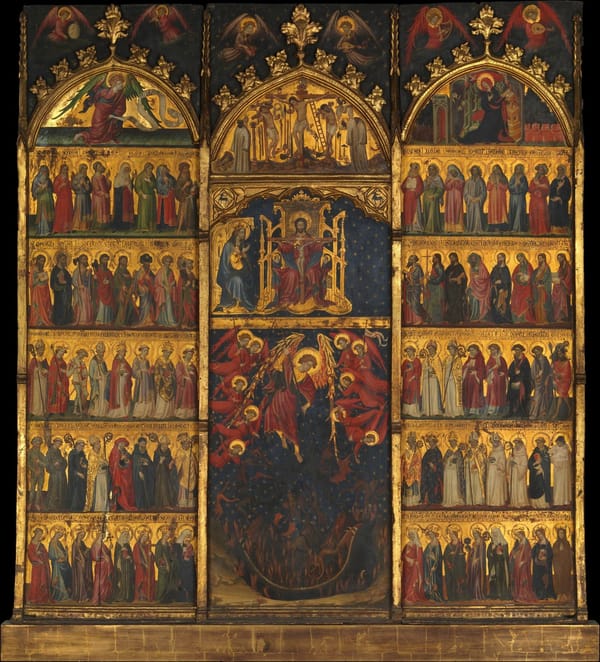
And the Spirit and the Bride say: Come And he that heareth, let him say: Come! — Surely I come quickly: Amen. Come, Lord Jesus.*
While we honour the Church triumphant with our chants, and succour the Church suffering with our prayers, let us also turn our thoughts to the Church militant, during these days when the closing cycle presents her to us as about to complete her work on earth. Now the Church is our model; but especially at the close of our pilgrimage ought we to make her attitude our own. The above-cited dialogue, which will terminate the world's history, shows clearly the sentiments wherewith the Holy Spirit inspires her in preparation for the final hour.
As the sufferings of the dying man break the last ties that bound him to the life of the senses; so the last social convulsions, however violently they may shake the Church, will eventually disengage her from the trammels of a world, which she will no longer be able to save from ruin. Free, therefore, to give herself up to her desires, which had been pent up for ages and kept under control by so many labours, she will have but one word to utter: Come! And in the universal destruction, when the sun shall be darkened and the moon shall hide her light, and the powers of heaven shall be moved, she will rejoice, knowing that in the midst of that awful night the cry will be heard: Behold the Bridegroom cometh!
Let him that heareth, let everyone of us say also: Come! If we love our Lord, if we would be recognized as members of his dear Church, let us be worthy of that beautiful title; let us see all things with the Church's eyes; let us appreciate all things, and especially death, according to her heart; let us look upon the last passage, both for our dear ones and for ourselves, as the entrance into the eternal nuptial feast. We know well that if anyone sincerely desires our Lord, our Lord will not be wanting to him. Even if, after this life, we have yet some debts to pay, if some adornment be wanting to our wedding garment ere we can take our place at the heavenly banquet; the blessed passage, nevertheless, places all the just, at once and entirely, in a state of impeccability, and in the secure possession of eternal love. Such, as we shall have occasion to see, were the sentiments of our forefathers.
Many churches in France, Switzerland, and England, used formerly to sing the following Sequence in honour of the Saints.
Sequence
Nostra canunt melodiam agmina,
Laudes omnibus dantia
Sanctis per haec sacrata festalis.
Per quam nobis vitae sunt data praemis.
Regina, quae es mater et casta,
Solve nostra per Filium tuum peccata.
Et Archangelorum turba inclyta
Nostra diluant jam peccata,
Parando supera coeli gaudia.
Atque plus quam propheta,
In lucida nos pone via,
Mundans nostra corpora.
Juncta caterva, jam corrobora
Vera in doctrina
Plebis pectora.
Sanctorumque Martyrum turma valida,
Fortia date corda, corpora aeque firma,
Sacra ut hostem vincant rite spicula.
Et praesulum omnis caterva,
Suscipe nunc pia modo
nostra clemens precata.
tu Mater es incorrupta,
Virgo et gravida; sacrata Domino est castitas:
Nostras serva animas mundaque corpora.
Omniumque Sanctorum contubernia per precata assidua
Nostra gubernent tempora, nosque ducant ad superna
Polorum vera gaudia.
Amen redempta.
our white-robed choirs sing melody,
giving praise to all the Saints
on this their sacred festival.
through whom was given to us the gift of life
O Queen, who art both Mother and Virgin,
through thy Son cancel our sins.
and the glorious multitude of Archangels,
cleanse away our sins,
and prepare us for the supernal delights of heaven.
and herald, and lamp,
yea and more than a prophet,
make us all pure and set us in the path of light.
together with all thy colleagues,
strengthen the hearts of thy people
in true doctrine.
mighty army of holy martyrs;
give us brave hearts and strong bodies,
that the darts of our holy faith may duly vanquish the enemy.
and all the band of holy Pontiffs,
kindly receive this day
our filial prayers.
thou art a Mother and yet spotless,
a Maiden and yet fruitful; chastity is sacred to our Lord;
preserve our souls and bodies pure.
and may the assembly of all the Saints by their prayers,
rule our times, and lead us
to the true and supernatural joys of heaven.
add a fervent Amen.
The hymn for the Vespers of the Dead in the Mozarabic Office is taken from the tenth song in the Cathemerinon of Prudentius.
Hymn
Duo qui socias elementa:
Vivum simul, ac moribundum,
Hominem, Pater effigiasti.
Tibi copula jungitur horum;
Tibi, dum vegetata cohaerent
Spiritus simul et caro servit.
Solvunt hominem, perimuntque;
Humus excipit arida corpus,
Animae rapit aura liquorem.
Labefacta senescere tandem,
Compactaque dissociari,
Et dissona texta retexi.
Impenditur: hinc resolutos
Honor ultimus accipit artus,
Et funeris ambitus ornat.
Pietas studet, utpote credens
Fore protinus omnia viva,
Quae nunc gelidus sopor urget.
Miserans tegit aggere terrae:
Opus exhibet ille benignum
Christo pius omnipotenti.
Gemitum dare sorte sub una,
Cognataque funera nobis
Aliena in morte dolere.
Quibus atra e morte triumphans,
Tua per vestigia mandas
Socium crucis ire latronem.
Via lucida jam paradisi;
Licet et nemus illud adire
Homini, quod ademerat anguis.
Famulam tibi praecipe mentem
Genitali in sede sacrari,
Quam liquerat exsul, et errans.
Quarum memores sumus ipsi,
Deus, sorde rogamus, piatas,
Erebi rogis fac alienas.
Laus, gloria, summa potestas
Patri, Genito, sive Domino
Orbis Regi; qui Deus unus.
who, uniting two elements in one,
the mortal and the immortal,
didst fashion man, O our Father.
their union is linked to thee;
and while they live and cleave together,
both spirit and flesh serve thee.
dissolution and death come upon man;
the dry earth receives his body,
while the swift spirit flees to heaven.
to fail and grow old at last,
for compound beings to be dissolved,
for the union of dissimilar elements to be unknit.
therefore are the last honours
paid to these lifeless limbs,
and the funeral pomp does them homage.
exercised by Christ's disciples,
believing that all which now lies wrapt in icy slumber,
shall suddenly spring to life again.
shall cover with earth the corpses that lie unburied,
does in his piety a kindly deed
to Christ himself the Omnipotent.
that all groan under the same fate,
it behoves us to mourn, in a stranger's death,
the loss of one of our kin.
O Redeemer, when, triumphing over dismal death,
thou didst bid the thief, thy fellow-crucified,
to tread in thy footprints.
that leads to the broad land of Eden, lies open to thy faithful;
and man may again enter that beautiful garden,
of which the serpent had despoiled him.
bid the soul thy handmaid
be made holy in the place of her creation,
which she had quitted as an exile and a wanderer.
whose memory we cherish;
let them, we beseech thee, be cleansed from all stain,
and escape the fires of hell.
Praise, glory, sovereign power,
to the Father, to the Son, to the Lord
who rules the world, one only God.
The following Preface, which is well inspired and has a ring of the ancient formulae, is still used in some places in Masses for the Dead.
Preface
* Apoc. xxii. 17, 20. ↩︎
| Previous November 4 (the Same Day): Sts. Vitalis and Agricola, Martyrs | Next November 6: Sixth Day within the Octave of All Saints |