Daily reading
After Pentecost
Semidouble · Movable from Easter · Temporal
November 17, 2019
From Dom Guéranger’s The Liturgical Year.

|
The Twenty-Third Sunday after Pentecost
When the number of the Sundays after Pentecost is only twenty-three, the Mass for to-day is taken from the twenty-fourth and last Sunday; and the Mass appointed for the twenty-third is said on the previous Saturday, or on the nearest day of the preceding week which is not impeded by a double or semi-double feast.
But, under all circumstances, the antiphonary ends to-day. The Introits, Graduals, Communions, and Postcommunions, which are given below, are to be repeated on each of the Sundays till Advent, which vary in number each year. Our readers will remember that, in the time of St. Gregory, Advent was longer than we now have it;1 and that, in those days, its weeks commenced in that part of the cycle which is now occupied by the last Sundays after Pentecost. This is one of the reasons for the lack of liturgical riches in the composition of the dominical Masses which follow the twenty-third.
Even on this one, the Church, without losing sight of the last day, used to lend a thought to the new season which was fast approaching, the season, that is, of preparation for the great feast of Christmas. There was read, as Epistle, the following passage from Jeremias, which was afterwards, in several Churches, inserted in the Mass of the first Sunday of Advent: 'Behold! the days come, saith the Lord, and I will raise up to David a just branch: and a King shall reign, and shall be wise: and shall execute judgment and justice in the earth. In those days, shall Juda be saved, and Israel shall dwell confidently: and this is the name that they shall call Him: The Lord our Just One. Therefore, behold the days come, saith the Lord, and they shall say no more: The Lord liveth, who brought up the children of Israel out of the land of Egypt! But: The Lord liveth, who hath brought out, and brought hither, the seed of the house of Israel, from the land of the north, and out of all the lands, to which I had cast them forth! And they shall dwell in their own land.’2
As is evident, this passage is equally applicable to the conversion of the Jews and the restoration of Israel, which are to take place at the end of the world. This was the view taken by the chief liturgists of the middle ages, in order to explain thoroughly the Mass of the twenty-third Sunday after Pentecost. Bearing in mind that, originally, the Gospel of this Sunday was that of the multiplication of the five loaves, let us listen to the profound and learned Abbot Rupert, who, better than anyone, will teach us the mysteries of this day, which brings to a close the grand and varied Gregorian melodies.
'Holy Church,’ he says,’is so intent on paying her debt of supplication, and prayer, and thanksgiving, for all men, as the apostle demands,3 that we find her giving thanks also for the salvation of the children of Israel, who, she knows, are one day to be united with her. And, as their remnants are to be saved at the end of the world,4 so, on this last Sunday of the year, she delights in them, as though they were already her members. In the Introit, calling to mind the prophecies concerning them, she thus sings every year: My thoughts are thoughts of peace, and not of affliction. Verily, His thoughts are those of peace, for He promises to admit to the banquet of His grace the Jews, who are His brethren according to the flesh; thus realizing what had been prefigured in the history of the patriarch Joseph. The brethren of Joseph, having sold him, came to him when they were tormented by hunger; for then he ruled over the whole land of Egypt. He recognized them; he received them; and made, together with them, a great feast. So, too, our Lord, who is now reigning over the whole earth, and is giving the bread of life, in abundance, to the Egyptians (that is, to the Gentiles), will see coming to Him the remnants of the children of Israel. He, whom they had denied and put to death, will admit them to His favour, will give them a place at His table, and the true Joseph will feast delightedly with His brethren.
‘The benefit of this divine Table is signified, in the Office of this Sunday, by the Gospel, which tells us of our Lord’s feeding the multitude with five loaves. For it will be then that Jesus will open to the Jews the five Books of Moses, which are now being carried whole, and not yet broken; yea, carried by a child, that is to say, this people itself, who, up to that time, will have been cramped up in the narrowness of a childish spirit.
‘Then will be fulfilled the prophecy of Jeremias, which is so aptly placed before this Gospel: “They shall say no more: The Lord liveth, who brought up the children of Israel out of the land of Egypt! But, the Lord liveth, who hath brought out the seed of Israel from the land of the north, and from all the lands into which they had been cast."
‘Thus delivered from the spiritual bondage which still holds them, they will sing with all their heart the words of thanksgiving as we have them in the Gradual: “Thou hast saved us, O Lord, from them that afflict us!"
‘The words we use in the Offertory: “From the depths I have cried to thee, O Lord," clearly allude to the same events; for, on that day, His brethren will say to the great and true Joseph: “We beseech thee to forget the wickedness of thy brethren!”5 The Communion: “Amen, I say to you, all things whatsoever ye ask, when ye pray," etc., is the answer made by that same Joseph, as it was by the first:6 “Fear not! Ye thought evil against me : but God turned it into good, that He might exalt me, as at present ye see, and might save many people. Fear not, therefore, I will feed you, and your children.”’7
Mass
The Introit, which we have just had explained to us by Rupert, is taken from the Prophet Jeremias,8 as was the ancient Epistle.
Introit
Prayer for pardon is continually on the lips of the Christian people, because the weakness of human nature is ever making itself felt, here below, even by the just man.9 God knows our frailty, and He is always ready to pardon us; but it is on the condition that we humbly acknowledge our faults, and have confidence in His mercy. These are the sentiments which suggest to the Church the words of the Collect.
Collect
The other Collects, as on page 120.
Epistle
Cap. iii. et iv.Fratres, Imitatores mei estote, et observate eos, qui ita ambulant, sicut habetis formam nostram. Multi enim ambulant, quos sæpe dicebam vobis (nunc autem et flens dico) inimicos crucis Christi : quorum finis interitus : quorum deus venter est : et gloria in confusione ipsorum, qui terrena sapiunt. Nostra autem conversatio in cœlis est: unde etiam Salvatorem exspectamus Dominum nostrum Jesum Christum, qui reformabit corpus humilitatis nostræ, configuratum corpori claritatis suæ, secundum operationem, qua etiam possit subjicere sibi omnia. Itaque, fratres mei charissimi et desideratissimi, gaudium meum et corona mea : sic state in Domino, charissimi. Evodiam rogo, et Syntichen deprecor idipsum sapere in Domino. Etiam rogo et te, germane compar, adjuva illas, quæ mecum laboraverunt in Evangelio, cum Clemente, et ceteris adjutoribus meis, quorum nomina sunt in libro vitæ.
Chapters iii. and iv.
Brethren: Be followers of me, and observe them who walk so as you have our model. For many walk, of whom I have told you often (and now tell you weeping) that they are enemies of the cross of Christ; whose end is destruction, whose god is their belly, and whose glory is in their shame: who mind earthly things. But our conversation is in heaven; from whence also we look for the Saviour, our Lord Jesus Christ, who will reform the body of our lowness, made like to the body of his glory, according to the operation whereby also he is able to subdue all things unto himself. Therefore, my dearly beloved brethren, and most desired, my joy, and my crown: so stand fast in the Lord, my dearly beloved. I beg of Evodia, and I beseech Syntyche, to be of one mind in the Lord. And I entreat thee also, my sincere companion, help those women that have laboured with me in the Gospel, with Clement and the rest of my fellow labourers, whose names are in the book of life.
The Clement here mentioned by the apostle was St. Peter’s second successor. Very frequently, the twenty-third Sunday after Pentecost comes close upon the feast of this great Pope and Martyr of the first century. Disciple of Paul, and, later on, in close intimacy with Peter, and named by the Vicar of Christ as the fittest to succeed him in the apostolic chair, Clement, as we shall see on November 23, was one of the saints most venerated by the faithful in those early times. The mention made of him in the Office of the time, just before his appearance on the cycle of holy Church, excited the Christian people to joy, and roused their fervour; it reminded them, that one of their best and dearest protectors would soon be visiting them.
At the time when St. Paul was writing to the Philippians, Clement, who was long to survive the apostles, was prominently one of those men spoken of in our Epistle, those illustrious models, who were called to perpetuate in the flock confided to their care10 the pattern of holy living; and that, not so much by their zealous teaching, as by the force of example. The Church, the one true bride of the divine Word, was known by the incommunicable privilege of possessing within her the truth; not only its dead letter, but its ever-living self. The Holy Ghost has not kept the Books of sacred Scripture from passing into the hands of the sects separated from the centre of unity; but He has reserved to the Church the treasure of tradition, which transmits, surely and fully, from one generation to another, the word which is life and light.11 This tradition is kept up by the truth and the holiness of the Man-God, ever existing in His members, ever tangible and visible in the Church.12 Holiness, which is inherent in the Church, is tradition in its purest and strongest form; because it is the truth, not only preached, but reduced to action and work,13 as it was in Christ Jesus, and as it is in God.14 It is the deposit,15 which the disciples of the apostles had the mission to hand faithfully down to their successors, just as the apostles themselves had received it from the Word, who had come upon the earth.
Hence, St. Paul did not content himself with entrusting dogmatic teaching to his disciple Timothy;16 he said to him : 'Be thou an example to the faithful, in word, and in living.,17 He said much the same to Titus: ‘Show thyself an example of good works, in doctrine and in integrity of life.’18 He repeated to all: 'Be ye followers of me, as I also am of Christ.'19 He sent Timothy to the Corinthians, that he might remind them, or, where it was necessary, might teach them, not only the dogmas of his Gospel, but likewise his ways in Christ Jesus, that is, his manner of life. For this manner of life of the apostle was, in a certain measure, his teaching everywhere in all the Churches;20 and he lauded the faithful of Corinth for being mindful to imitate him in all things, which was a keeping to the tradition of Christ.21 As for the Thessalonians, they had so thoroughly entered into this teaching, taken from their apostle’s life, that, as St. Paul says of them, they had become a pattern to all believers; this silent teaching of Christian revelation, which they showed forth in their conduct, made it superfluous for the messengers of the Gospel to say much.22
The Church is a magnificent temple, which is built up, to the glory of God, of the living stones, which let themselves be set into its walls.23 The constructing of those sacred walls on the plan laid down by Christ is a work in which all are permitted to share. What one does by word,24 another does by good example;25 but both of them build, both of them edify the holy city; and, as it was in the apostolic age, so always; example is more powerful than word, unless that word be supported by the authority of holiness in him who speaks it, unless, that is, he lead a life according to the perfection taught by the Gospel.
But, as the giving of edification to those around him is an obligation incumbent on the Christian—an obligation imposed both by the charity he owes to his neighbour, and by the zeal he should have for the house of God—so likewise, under pain of presumption, he should seek his own edification in the conduct of others. The reading of good books, the study of the lives of the saints, the observing, as our Epistle says, those holy people with whom he lives, all this will be an incalculable aid to him, in the work of his own personal sanctification and in the fulfilment of God’s purposes in this regard. This devout intercourse with the elect of earth and of heaven will keep us away from men who are enemies of the cross of Christ and mind earthly things, and put their happiness in carnal pleasures. It will make our conversation be in heaven. Preparing for the day which cannot now be far off, the day of the coming of our Lord, we shall stand fast in Him, in spite of the falling off of so many amongst us, who, by the current of the world’s fashion, are hurried into perdition. The troubles and sufferings of the last times will but intensify our hope in God; for they will make us long all the more ardently for the happy day when our Redeemer will appear and complete the work of the salvation of His servants by imparting to their very flesh the brightness of His own divine Body. Let us, as our apostle says, be of one mind in the Lord; and then, as he bids his dear Philippians, let us rejoice in the Lord always, for the Lord is nigh.26
Gradual
Gospel
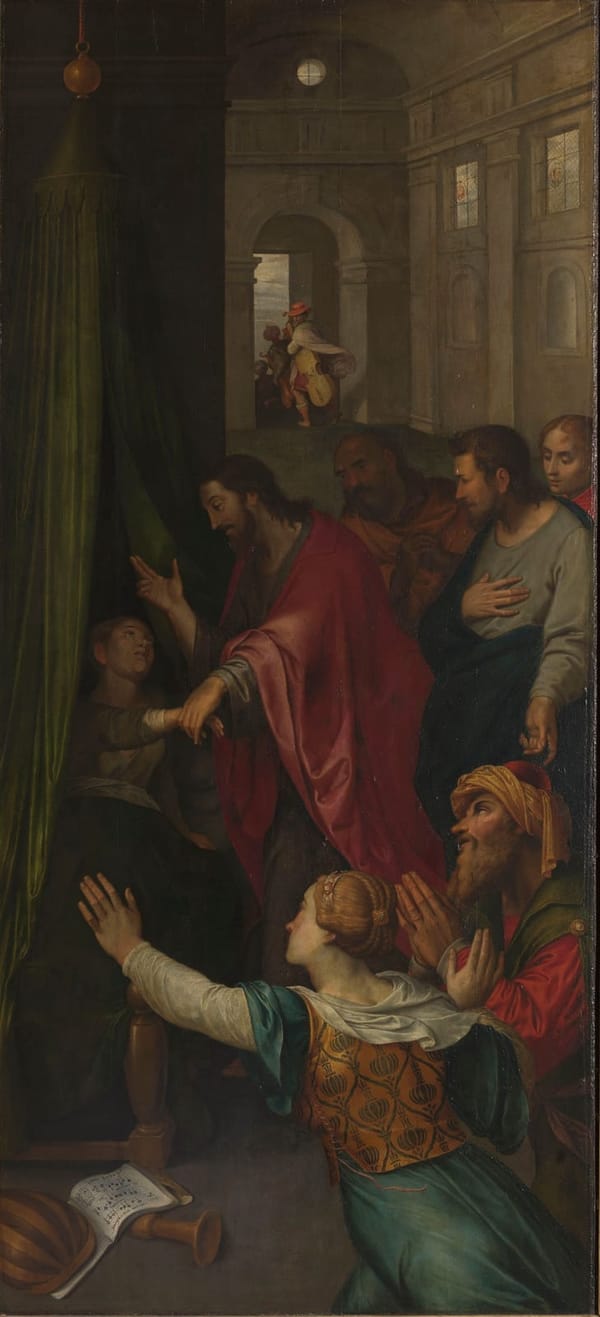
Cap. ix.In illo tempore : Loquente Jesu ad turbas, ecce princeps unus accessit, et adorabat eum, dicens: Domine, filia mea modo defuncta est: sed veni, impone manum tuam super eam, et vivet. Et surgens Jesus sequebatur eum, et discipuli ejus. Et ecce mulier, quæ sanguinis fluxum patiebatur duodecim annis, accessit retro, et tetigit fimbriam vestimenti ejus. Dicebat enim intra se : Si tetigero tantum vestimentum ejus, salva ero. At Jesus conversus, et videns eam, dixit : Confide, filia, fides tua te salvam fecit. Et salva facta est mulier ex illa hora. Et cum venisset Jesus in domum principis, et vidisset tibicines, et turbam tumultuantem, dicebat : Recedite, non est enim mortua puella, sed dormii. Et deridebant eum. Et cum ejecta esset turba, intravit, et tenuit manum ejus. Et surrexit puella. Et exiit fama hæc in universam terram illam.
Ch. ix.At that time : As Jesus was speaking to the multitude: Behold a certain ruler came up and adored him, saying : Lord, my daughter is even now dead; but come lay thy hand upon her, and she shall live. And Jesus rising up followed him, with his disciples. And behold a woman who was troubled with an issue of blood twelve years, came behind him, and touched the hem of his garment. For she said within herself: If I shall touch only his garment I shall be healed. But Jesus turning and seeing her, said : Be of good heart, daughter, thy faith hath made thee whole. And the woman was made whole from that hour. And when Jesus was come into the house of the ruler, and saw the minstrels and the multitude making a rout, he said : Give place: for the girl is not dead, but sleepeth. And they laughed him to scorn. And when the multitude was put forth, he went in and took her by the hand. And the maid arose. And the fame hereof went abroad into all that country.
Although the choice of this Gospel for the twenty-third Sunday is not of great antiquity, yet is it in most perfect keeping with the post-pentecostal liturgy, and confirms what we have stated relative to the character of this portion of the Church’s year. St. Jerome tells us, in the homily selected for the day, that the hemorrhoissa, healed by our Lord, is a type of the Gentile world; whilst the Jewish people is represented by the daughter of the ruler of the Synagogue.27 This latter is not to be restored to life until the former has been cured; and this is precisely the mystery we are so continually commemorating during these closing weeks of the liturgical year, viz., the fullness of the Gentiles recognizing and welcoming the divine Physician, and the blindness of Israel at last giving way to the light.28
The liturgy at this close of the year continually alludes to the end of the world. The earth seems to be sinking away, down into some deep abyss; but it is only that it may shake off the wicked from its surface, and then it will come up again blooming in light and love. After the divine realities of this year of grace, we ought to be capable of feeling a thrill of admiration at the mysterious, yet, at the same time, the strong and sweet ways of eternal Wisdom.29 At the beginning, when man was first created, sin soon followed, breaking up the harmony of God’s beautiful world, and throwing man off the divine path where his Creator had placed him. Wickedness went on increasing, until God’s mercy fell upon one family. The light which beamed on that privileged favourite only showed more plainly the thick darkness in which the rest of mankind were enveloped. The Gentiles, abandoned to their misery, all the more terrible because they had caused it and loved it, saw God’s favours all bestowed on Israel, whilst they themselves were disregarded, and wished to be so. Even when the time came for original sin to be remedied, it seemed to be the very time for the final reprobation of the Gentiles; for the salvation that came down from heaven in the person of the Man-God was seen to be exclusively directed towards the Jews and the lost sheep of the house of Israel.30
But the people that had been treated with so much predilection, and whose fathers and first rulers had so ardently prayed for the coming of the Messias, was no longer in the position to which it had been raised by the holy patriarchs and prophets. Its beautiful religion, founded on desire and hope, was then nothing but a sterile expectancy, which kept it motionless and unable to advance a single step towards its Redeemer. As to its Law, Israel then minded nothing but the letter, and, at last, turned it into a mummy of sectarian formalism. Now, whilst in spite of all this sinful apathy it was mad with jealousy, pretending that no one else had any right to heaven’s favours, the Gentile, whose ever-increasing misery urged him to go in search of some deliverer, found one, and recognized him in Jesus the Saviour of the world. He was confident that this Jesus could cure him; so he took the bold initiative, went up to Him, and had the merit of being the first to be healed. True, our Lord had treated him with an apparent disdain; but that had only had the effect of intensifying his humility, and humility has a power of making way anywhere, even into heaven itself.31
Israel, therefore, was now made to wait. One of the Psalms he sang ran thus: ‘Ethiopia shall be the first to stretch out her hands to God.’32 It is now the turn for Israel to recover, by the pangs of a long abandonment, the humility which had won the divine promises for his fathers, the humility which alone could merit his seeing those promises fulfilled.
By this time, however, the word of salvation has made itself heard throughout all the nations, healing and saving all who desired the blessing. Jesus, who has been delayed on the road, comes at last to the house towards which He first purposed to direct His sacred steps; He reaches, at last, the house of Juda, where the daughter of Sion is in a deep sleep. His almighty compassion drives away from the poor abandoned one the crowd of false teachers and lying prophets, who had sent her into that mortal sleep, by all the noise of their vain babbling: He casts forth for ever from her house those insulters of Himself, who are quite resolved to keep the dead one dead. Taking the poor daughter by the hand, He restores her to life, and to all the charm of her first youth; proving thus, that her apparent death had been but a sleep, and that the long delay of dreary ages could never belie the word of God, which He had given to Abraham, His servant.33
Now therefore, let this world hold itself in readiness for its final transformation; for the tidings of the restoration of the daughter of Sion puts the last seal to the accomplishment of the prophecies. It remains now but for the graves to give back their dead.34 The valley of Josaphat is preparing for the great meeting of the nations;35 Mount Olivet is once more to have Jesus standing upon it,36 but this time as Lord and Judge!37
Offertory
The service we pay to God is, of itself, far beneath what His sovereign Majesty deserves; but the Sacrifice, which every day constitutes part of our service, ennobles it even to an infinite worth, and supplies all our own deficiencies of merit. This is what we are told in this Sunday’s Secret.
Secret
The other Secrets, as on page 130.
Communion
Having, by these sacred mysteries, entered into a participation of divine life, let us beseech our Lord, that we may no longer be subject to the dangers of this world. Let us say with the Church:
Postcommunion
The other Postcommunions, as on page 131.
Vespers
The psalms, capitulum, hymn, and versicle, as above, pages 71-81.
Antiphon of the Magnificat
- See our ‘Advent,’ chap. i., page 23 et seq. ↩︎
- Jer. xxiii. 5-8. ↩︎
- 1 Tim. ii. 1. ↩︎
- Rom. ix. 27. ↩︎
- Gen. l. 17. ↩︎
- Ibid. 19-21. ↩︎
- Rup., De Div. Off., xii. 28. ↩︎
- Jer. xxix. ↩︎
- Prov. xxiv. 16. ↩︎
- 1 St. Pet. v. 3. ↩︎
- St. John i. 4. ↩︎
- 1 St. John i. 1. ↩︎
- 1 Thess. ii. 13. ↩︎
- St. John v. 17. ↩︎
- 1 Tim. vi. 20. ↩︎
- 2 Tim. ii. 2. ↩︎
- 1 Tim. iv. 12. ↩︎
- Tit. ii. 7. ↩︎
- 1 Cor. iv. 16. ↩︎
- Ibid, 17. ↩︎
- Ibid. xi. 1-2. ↩︎
- 1 Thess. i. 5-8. ↩︎
- Eph. ii. 20-22. ↩︎
- 1 Cor. xiv. 3. ↩︎
- Rom. xiv. 19. ↩︎
- Phil. iv. 4, 5. ↩︎
- S. Hieron., in Matt., cap. ix. ↩︎
- Rom. xi. 25. ↩︎
- Wisd. viii. 1. ↩︎
- St. Matt. xv. 24. ↩︎
- Ecclus. xxxv. 21. ↩︎
- Ps. lxvii. 32. ↩︎
- St. Luke i. 54, 55. ↩︎
- Dan. xii. 1, 2. ↩︎
- Joel iii. 2. ↩︎
- Acts i. 11. ↩︎
- Zach. xiv. 4. ↩︎
November 17: St. Gregory Thaumaturgus, Bishop and Confessor
MOSES instructed in all the wisdom of the Egyptians, mighty in his words and in his deeds,1 retired into the desert: Gregory, adorned with the best gifts of birth and nature, brilliant in rhetoric, rich in every science, hid himself from men in the flower of his youth, and hastened to offer to God in solitude the holocaust best pleasing to the Lord. Each was the hope of his race; yet each turned away to lose himself in the contemplation of heavenly mysteries. Meanwhile, the yoke of Pharaoh lay heavy upon Israel; meanwhile, souls were perishing, whom one of Gregory's burning words might have snatched from the empire of idolatry: was not such flight, then, desertion?
Is it for man to proclaim himself a saviour, when Jesus did not arrogate that title to himself? And when evil was rife all around, did the Carpenter of Nazareth do wrong to remain in the shade for thirty years previous to his short period of ministry? O ye teachers of our excited, fevered times, who dream of a new hierarchy among the virtues, and understand divine charity far otherwise than did our fathers: not those are of the race of Israel's saviours whose ideas concerning social good differ from those of the world's Redeemer.
Gregory, like Moses, was of that blessed race. His friends and enemies agreed in saying that he resembled the Hebrew legislator in the excellence of his virtue, and in the splendour of the prodigies wrought by his word.2 Both were actuated by the desire of knowing God, and manifesting him to the men they were called to lead: the fulness of doctrine is the gift most necessary to the guides of the people, and their want of it the greatest penury. I am who am was the answer to Moses' enquiry; and this sublime formula, confided to him from the midst of the burning bush, authenticated the mission which called him forth from the desert. When Gregory was commanded by God to go out into the world, the blessed Virgin, of whom the burning bush was a figure, appeared before his dazzled eyes in the dark night when he was praying for light. And St. John, following the Mother of God, let fall from his lips this other formula completing the former for the disciples of the Law of love:
One only God, Father of the living Word, of that substantial and mighty Wisdom who is the eternal expression of himself; the perfect principle of the only and perfect Son begotten by him. One only Lord, sole-begotten of the Only one; God of God, efficacious Word, Wisdom embracing and containing the world, creative power of all creation, true Son of a true Father. One only Holy Spirit, holding of God his divine existence, revealed to men by the Son of whom he is the perfect likeness, life and life-giving, holy and imparting holiness. The perfect Trinity, immutable, inseparable in glory, in eternity, in dominion.3
This was the message our Saint was to communicate to his country, the creed that was to bear his name in the Church. By his faith in the most holy Trinity he was to remove mountains, and set limits to the waves, to drive out Satan, and eradicate infidelity from Pontus. When, towards the year 240, Gregory, then bishop, was on his way to Neocaesarea, he saw on all sides the temples of idols, and stopped for the night at a famous sanctuary. In the morning all the gods had taken to flight and refused to come back; but the Saint gave to the priest of the oracle a note thus worded: Gregory to Satan: return. A more bitter defeat awaited the demons; forced to stay their precipitate retreat, they were compelled to witness the ruin of their empire over the souls they had abused. The priest was the first to give himself up to the Bishop, and became his deacon ; and soon upon the ruins of the temples everywhere overthrown arose the Church of Christ, the only God.
Happy was that Church, so firmly founded that heresy was powerless against it in the following century, when so many others bowed before the storm of Arianism. On the testimony of St. Basil, the successors of St. Gregory, themselves eminent men, were as an adornment of precious stones, a crown of stars, to the Church of Neocaesarea. Now all these illustrious Pontiffs, says he, considered it an honour to keep up the memory of their great predecessor; they would never suffer that any act, word, or movement other than his, in performing the sacred rites, should prevail over the traditions he had left.4
When Clement XII., as we have seen, established in the entire Church the feast of St. Gertrude the Great, he at first decreed that it should be kept on this day, on which it is still celebrated by the Order of St. Benedict. But as the 17th November had been for long centuries assigned to St. Gregory Thaumaturgus, it seemed unfitting, said Benedict XIV. that he who moved mountains should himself be moved from his place by the holy virgin. Accordingly in 1739, the year following its institution, the feast of St. Gertrude was fixed on the fifteenth of this month.5
Let us read the brief account of the great Thaumaturgus given in the holy Liturty.
O holy Pontiff, thy faith, removing mountains and commanding the waves, was a justification of our Lord's promise. Teach us in our turn to do honour to the Gospel, by never doubting of our Lord's word and of the help he promises us against Satan, whom the Church points out to us today as the proud mountain that is to be cast into the sea;6 and also against the overflowing tide of our passions, and the enticements of the world, of which thy writings teach us the vanity.7 After the victory let us not forget that the succour came to us from heaven; preserve us from ingratitude, which thou didst so detest. We still possess the touching eulogy dictated by thy gratitude towards the illustrious master, to whose teachings, under God, thou didst owe the glorious strength and splendour of thy faith. Here is a precious and practical lesson for all: while praising divine Providence in the man who was his predestined instrument in thy regard, thou didst not forget the homage due to the Angel of God, who had preserved thee from falling into the abyss, during the darkness of infidelity in which thy first years were spent; that heavenly Guardian who, ever watchful in his active, enlightened, persevering devotedness, supplies for our insufficiencies, nourishes and instructs us, leads us by the hand, and secretly arranges for our souls those blessed circumstances and occasions, which transform our life and secure eternal happiness.8
How can wo sinful creatures sufficiently thank the Author of all good, the infinite Being who gives to man both the holy Angels and the visible intermediaries of divine grace on earth? But let us take courage, for we have as our Head his own Son, his Word who saved our souls, and who rules the universe. He alone, and that without effort, can render to his Father unceasing, eternal thanksgiving, for himself and for us all, without risk of not knowing or of forgetting the least subject of gratitude, without fear of any imperfection in the manner or the magnitude of his praise. To him, then, to the divine Word, we commit as thou didst, O Gregory, the care of perfecting the expression of our gratitude for the unspeakable kindness of our heavenly Father; for the Word is to us, as to thee, the only channel of piety, gratitude, and love.9 May he give us in these days pastors who will imitate thy works; and may he raise up again the ancient churches of the East, which once received such light from thee!
- Acts vii. 22. ↩︎
- Basil. De Spiritu Sancto. xxix. ↩︎
- Greg. Nyss. Vita Greg. Thaumaturg. ↩︎
- Basil. De Spiritu Sancto xxix. ↩︎
- Benedict xiv. De canonizat. Ss. Lib. i. cap. xli. 40, 41. ↩︎
- Homil. Ad Matut. Ex Beda in Marc. ↩︎
- Greg. Thaumat. Metaphrastis in Ecclesiasten Salomonis. ↩︎
- In Origeuem oration panegyrica. ↩︎
- Ibid. ↩︎
| Previous November 16 [November 15]: St. Gertrude, Virgin | Next November 17: St. Gregory Thaumaturgus, Bishop and Confessor |