Daily reading
After Pentecost
Double · November 25 · Sanctoral
November 25: St. Catherine, Virgin and Martyr
From Dom Guéranger’s The Liturgical Year.
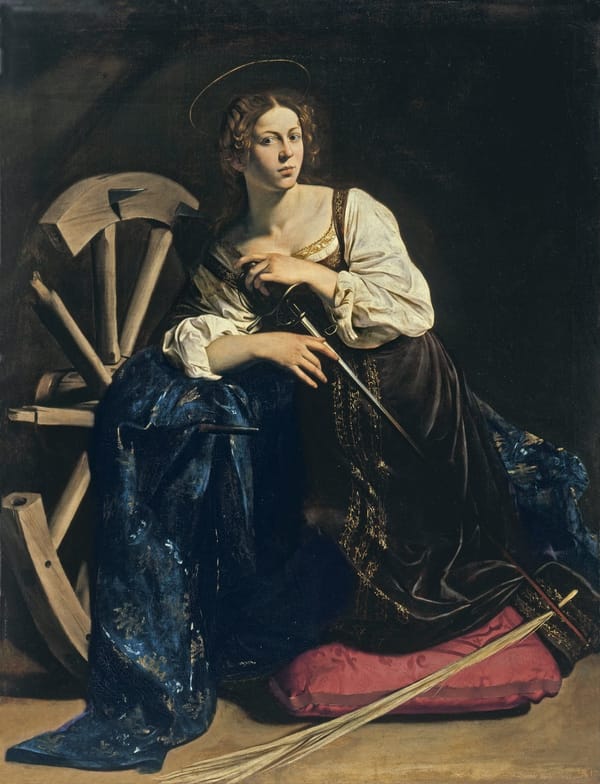 |
GERTRUDE the Great, from her very infance, felt a special attraction towards the glorious virgin Catharine. As she was desirous of knowing how great were her merits, our Lord showed her St. Catharine seated on a throne so lofty and so magnificent, that it seemed her glory was sufficient to have filled the courts of heaven had she been its sole queen; while from her crown a marvellous brightness was reflected on her devout clients.1 It is well known how the Maid of Orleans, entrusted by St. Michael to the guidance of St. Catharine and St. Margaret, received aid and counsel from them during seven years; and how it was at Sainte-Catherine-de-Fierbois that she received her sword.
In the twelfth and thirteenth centuries the Crusaders of the West experienced the powerful assistance of the Alexandrian martyr; and on their return from the East they introduced her cultus, which soon became extremely popular. An Order of knighthood was founded to protect the pilgrims visiting her holy body on Mount Sinai. Her feast was raised to the rank of first class, and as observed was a holiday of obligation by many churches. She was honoured as patroness by Christian philosophers, scholars, orators, and attorneys. The senior advocate was called bastonier, because it was his privilege to carry her banner; while confraternities of young girls were formed under the invocation of St. Catharine, whose members vied with one another in their zeal for adorning her venerated image. She was classed among the helping saints, as being a wise counsellor; and was claimed patroness by various associations merely on account of their experience of her powerful intercession with our Lord. Her betrothal with the divine Child, and other scenes from her legend, furnished Christian rt with many beautiful inspirations.
The holy and learned Baronius regretted that even in his day the Acts of the great Oriental martyr were open to discussion on certain points, which were eagerly seized upon by the extreme critics of the succeeding centuries in order to lessen popular devotion towards her.2 There remains, however, this grlory to Christian honoured by pupils and masters and became the guiding spirit in the development of human though during the centuries illustrated by such brilliant suns of lerning as Albert the Great, Thomas of Aquin, and Bonaventure. “Blessed are the clean of heart, for they shall see God.”3 Methodius, a bishop and martyr of the third century, thus speaks in his “Banquet of Virgins”: “The virgin must have a very great love of sound doctrine; and she ought to hold an honourable place among the wise.”4
Let us now read the abridged Legend of St. Catharine in the book of holy Church.
Today’s feast has inspired many liturgical compositions in the West. We will limit our selections to a sequence from the Gradual of St. Victor’s, and a beautiful and touching responsory still used by the Friars Preachers.
Sequence
Nostro sonet Conditori,
Qui disponit omnia,
Per quem dimicat imbellis,
Per quem datur et puellis
De viris victoria;
Feminae non feminina
Stupuit ingenis,
Quum beat Catharina
Doctos vinceret doctrina,
Ferrum patientia.
Pulchrum dedit ornamentum
Morum privilegia,
Clara per progrenitores,
Claruit per sacros mores
Ampliori gratia.
Lectionis et laboris
Attrivere studia:
Nam perlegit disciplinas
Saeculares et divinas
In adolescentia.
Reputavit sicut lutum
Bona transitoria,
Et reduxit in contemptum
Patris opes et parentum
Larga patrimonia.
Virgo sapiens et prudens
Sponso pergit obvia,
Ut, adventus ejus hora,
Praeparata, sine mora
Intret ad convivia.
Cupiens pro Christo mori;
Cujus in praesentia
Quinquaginta sapientes
Mutos reddit et silentes
Virginis facundia.
Et rotarum triste plaustrum,
Famem et jejunia,
Et quaecumque flunt ei,
Sustinet amore Dei,
Eadem ad omnis.
Superat imperatorem
Feminae constantia:
Cruciatur imperator,
Quia cedit cruciator,
Nec valent supplicia.
Et, dum morte mors finitur,
Vitae subit gaudia.
Angelis mox fuit curae
Dare corpus sepulturae
Terra procul alia.
Quod informos multos sanat
Evidenti gratia.
Bonum nobis dat unguentum,
Si per suum interventum
Nosra sanet vitia.
De se praesens gaudia,
Et futura praebeat,
Quae dedit praesentis,
Et hic hobis gaudest,
Illi nos in gloria,
resound in praise of our Creator,
who disposes all things;
by whom they fight
who are unskilled in war,
by whose power maidens triumph over men.
stand amazed to see
in blessed Catharine
qualities that seem above her sex,
when she vanquishes learned men by her science
and the sword by her courage.
she adds the precious ornaments
of incomparable virtue;
and noble by birth,
she becomes more noble still
by grace and holy living.
yet she spares it
neither labour nor study;
and in early youth
she masters earthly science
and that which is of God.
she considers transitory
goods as mire,
contemning her
father's wealth
and her ample patrimony.
as a wise and prudent virgin,
she goes to meet the Spouse;
that, ready at the hour of his coming,
she may enter without delay
to the feast.
she is led before the emperor;
and in his presence,
by her eloquence,
puts fifty philosophers
to silence.
the horrors of the prison,
the cruel wheel,
hunger and want,
and all her other sufferings;
she remains unchanged through all.
a woman's constancy
triumphs over the emperor;
yea, the emperor himself is tormented,
seeing both executioner
and torments unavailing.
and by death ending death,
enters into the joys of life,
while Angels with all care
bury her body
in a far-off land.
by a visible grace
heals the sick;
good indeed is the unction she gives us,
if she heals our vices
by her prayers.
to see the joy she causes us;
may she who gives us present joys
give likewise those to come;
and may she now rejoice with us,
and we with her in glory.
Responsory
Gloria Patri, et Filio, et Spiritui Sancto.* Fragrat.
Glory be to the Father, and to the Son, and to the Holy Ghost.* A sweet frangrance.
O blessed Catharine, accept us as thy disciples. In thy person, philosophy, true to its beautiful name, leads us to Eternal Wisdom, truth leads to goodness, and science to Christ who is the way, the truth, and the life. “O curious inquirers, who delight in idle, fruitless speculation,” exclaims the most eloquent of thy panegyrists, “know that the brilliant light of science which enchants you, is not intended merely to please your eyes, but to guide your steps and rule your conduct. Vain minds, that make such pompous display of your learning in order to win men's praise, learn that this glorious talent has not been entrusted to you for your self-advancement, but for the triumph of the truth. And you, cowardly, sordid souls, who use science as a means of gaining earthly goods, consider seriously that so " divine a treasure is not meant to be traded within so unworthy a manner ; and that the only commerce it is concerned with, is of a higher and sublimer kind, viz: the redemption of souls.”5
Thus, O Catharine, thou didst employ thy science solely for the truth. Thou madest “the majesty of Jesus Christ so visible, that his presence dissipated all the errors of philosophy, and the truths it had usurped acknowledged him for their Master, or rather were gathered up in him as in their centre. Let us learn from this holy example to bear witness to the truth and to make it triumph over the world, employing all our light of knowledge in the fulfilment of this duty. O holy truth I owe thee the testimony of my words, of my life, of my blood: for the truth is God himself.”6
This, O magnanimous virgin, is the thought of holy Church, when she thus formulates her prayer for today: O God, who didst give the law to Moses on the summit of Mount Sinai, and didst wonderfully deposit in the same place the body of the blessed Virgin and Martyr Catharine by means of thy holy Angels; grant, we beseech thee, that by her merits and intercession, we may be enabled to arrive at the mountain, which is Christ, who liveth and reigneth with thee for ever and ever.7
| Previous November 24 (the Same Day): St. Chrysogonus, Martyr | Next November 26: St. Sylvester, Abbot |