Daily reading
December 2 · Sanctoral
December 2, 2019
From Dom Guéranger’s The Liturgical Year.
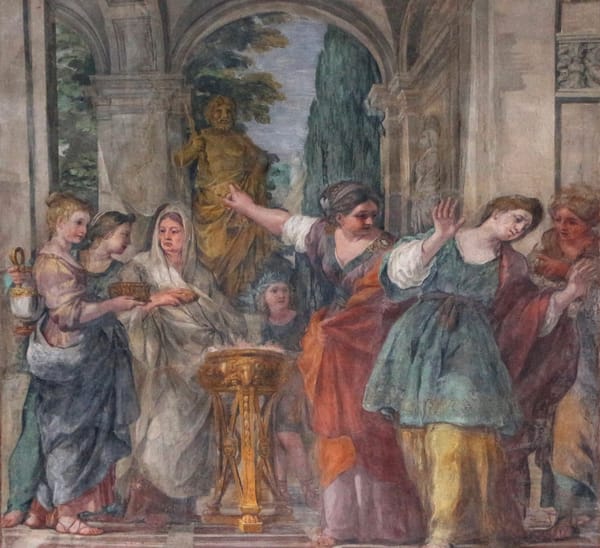
December 2: Saint Bibiana, Virgin and Martyr
Of the saints whose feasts are kept during Advent, five are virgins. The first, St. Bibiana, whom we honour to-day, is a daughter of Rome; the second, St. Barbara, is the glory of the eastern Churches; the third, St. Eulalia of Merida, is one of Spain’s richest treasures; the fourth, St. Lucy, belongs to beautiful Sicily; the fifth, St. Odilia, is claimed by France. These five wise virgins lighted their lamps and watched, waiting for the coming of the Spouse. Such was their constancy and fidelity, that four of them shed their blood for the love of Him, after whom they longed. Let us take courage by this noble example; and since we have not, as the apostle expresses it, as yet resisted unto blood, let us not think it hard if we suffer fatigue and trouble in the holy exercises of this penitential season of Advent: He, for whom we do them all, will soon be with us and repay us. To-day, it is the chaste and courageous Bibiana, who instructs us by her glorious example.
Holy Bibiana, most wise virgin! thou hast gone through the long unbroken watch of this life; and when, suddenly, the Spouse came, thy lamp was bright and richly fed with oil. Now thou art dwelling in the abode of the eternal marriage-feast, where the Beloved feeds among the lilies. Remember us who are still living in the expectation of that same divine Spouse, whose eternal embrace is secured to thee for ever. We are awaiting the birth of the Saviour of the world, which is to be the end of sin and the beginning of justice; we are awaiting the coming of this Saviour into our souls, that He may give them life and union with Himself by love; we are awaiting our Judge, the Judge of the living and the dead. Most wise virgin! intercede for us, by thy fervent prayers, with this our Saviour, our Spouse, and our Judge; pray that each of these three visits may work and perfect in us that divine union, for which we have all been created. Pray also, O faithful virgin, for the Church on earth, which gave thee to the Church in heaven, and which so devoutly watches over thy precious remains. Obtain for her that strict fidelity, which will ever render her worthy of Him, who is her Spouse as He is thine. Though He has enriched her with the most magnificent gifts, and given her confidence by His promises which cannot fail, yet does He wish her to ask, and us to ask for her, the graces which will lead her to the glorious destiny which awaits her.
We will to-day consider the state of nature at this season of the year. The earth is stripped of her wonted verdure, the flowers are gone, the fruits are fallen, the leaves are torn from the trees and scattered by the wind, and every living thing stiffens with the cold. It seems as though the hand of death had touched creation. We see the sun rise after the long night of his absence; and scarcely have we felt his warmth at noon, than he sets again, and leaves us in the chilly darkness. Each day he shortens his visit. Is the world to become sunless, and are men to live out the rest of life in gloom? The old pagans, who witnessed this struggle between light and darkness, and feared the sun was going to leave them, dedicated the twenty-fifth day of December, the winter solstice, to the worship of the sun. After this day their hopes revived on seeing the glorious luminary again mounting up in the sky, and gradually regaining his triumphant position.
We Christians can have no such feelings as these; our light is the true faith, which tells us that there is a Sun to be sought for which never sets, and is never eclipsed. Having Him, we care little for the absence of any other brightness; nay, all other light, without Him, can only lead us astray. O Jesus! Thou true light, that enlightenest every man coming into this world! Thou didst choose, for Thy birth among us, a time of the year which forces us to reflect upon the miserable state of the world when Thou didst come to save it. ‘The evening was coming on, and the day was far spent,’ says St. Bernard: ‘the Sun of justice had all but set, so that exceeding scanty was His light or warmth on earth: for the light of divine knowledge was very faint, and, sin abounding, the heat of charity had grown cold. There was neither angel to visit men, nor prophet to speak to them; both seemed in despair, for the hardness and obstinacy of man had made every effort useless: then I said —they are the words of our Redeemer—then I said, lo! I come!’* O Jesus! O Sun of justice! give us a clear knowledge of what the world is without Thee; what our understanding is without Thy light; and what our heart, without Thy divine heat. Open Thou the eyes of our faith; that whilst seeing with the eyes of the body the gradual decrease of the material light, we may think of that other darkness, which is in the soul that has not Thee. Then, indeed, will the cry which comes from the depths of our misery make its way to Thee, and Thou wilt come on the day Thou hast fixed, dispelling every shadow of darkness by Thy irresistible brightness.
Prayer for the Time of Advent
(The Mozarabic breviary, Wednesday of the second week of Advent, Capitula)
* First Sermon of Advent. ↩︎
Monday of the First Week of Advent
Cap. i.Lavamini, mundi estote, auferte malum cogitationum vestrarum ab oculis meis: quiescite agere perverse, discite benefacere: quaerite judicium, subvenite oppresso, judicate pupillo, detendite viduam. Et venite, et arguite me, dicit Dominus. Si fuerint peccata vestra ut coccinum, quasi nix dealbabuntur: et si fuerint rubra quasi vermiculus, velut lana alba erunt.
Ch. i.Wash yourselves, be clean, take away the evil of your devices from my eyes: cease to do perversely, learn to do well; seek judgement, relieve the oppressed, judge for the fatherless, defend the widow. And then come, and accuse me, saith the Lord. If your sins be as scarlet, they shall be made as white as snow; and if they be red as crimson, they shall be white as wool.
The Saviour, who is so soon to be with us and to save us, warns us not only to prepare ourselves to appear before Him, but also to purify our souls. ‘It is most just,’ says St. Bernard, ‘that the soul, which was the first to fall, should be the first to rise. Let us therefore defer caring for the body, until the day when Jesus Christ will come and reform it by the Resurrection; for, in the first coming, the Precursor says to us: “Behold the Lamb of God, who taketh away the sins of the world.” Observe, he says not the maladies of the body, nor the miseries of the flesh; he says sins, which are the malady of the soul, and the corruption of the spirit. Take heed, then, thou my body, and wait for thy turn and time. Thou canst hinder the salvation of the soul, and thine own safety is not within thy reach. Let the soul labour for herself, and strive thou too to help her, for if thou sharest in her sufferings thou wilt share in her glory. Retard her perfection, and thou retardest thine own. Thou wilt not be regenerated until God sees His own image restored in the soul.’* Let us, then, purify our souls. Let us do the works of the spirit, not the deeds of the flesh. Our Saviour’s promise is most clear; He will turn the deep dye of our iniquities into the purest whiteness. He asks but one thing of us: that we sin no more. He says to us: ‘Cease to do perversely, and then come and accuse Me, come and complain against Me, if I do not cleanse you.’ O Jesus! we will not defer a single day of this holy season; we accept, from this moment, the conditions Thou offerest us. We sincerely desire to make our peace with Thee; to bring the flesh into subjection to our spirit, to make good all the injustice we have committed against our neighbour, and to hush, by the sighs of our heart-felt compunction, that voice of our sins which has so long cried to Thee for vengeance.
Prose for the Time of Advent
(Composed in the eleventh century, and taken from the ancient Roman-French missals)
Condolens humana perire sæcla per tentantis numina.
Ferens mundo gaudia.
Tu animas et corpora nostra, Christe, expia,
Ut possideas lucida nosmet habitacula.
Adventu primo justifica.
In secundo nosque libera;
Ut cum facta luce magna, judicabis omnia,
Moved with compassion to see the human race perish by its idolatry offered to its very tempter.
Then, by thy own gratuitous love, assuming our human nature,
Giving joy to this world.
Come, O Christ, purify our souls and bodies.
And make them thy own pure abode.
Justify us by thy first coming.
And in thy second, deliver us;
That so, when thou judgest all things, on the day of the great light,
Prayer from the Ambrosian Breviary
(Second Sunday of Advent)
* Sixth Sermon of Advent. ↩︎
| Previous December 1 | Next Monday of the First Week of Advent |