Daily reading
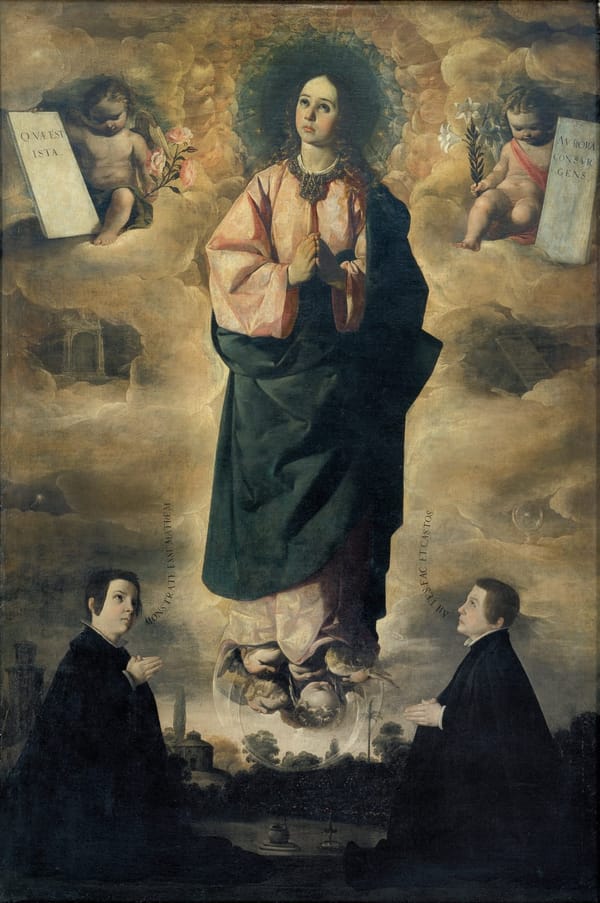
December 9: The Second Day within the Octave of the Immaculate Conception
Let us consider how the immaculate Mary came into this world nine months after her conception, and how each day of her life gave man fresh reason to hope for the great promises made him by God. Let us admire the fulness of grace which God has given to her, and contemplate the respect and the love wherewith the holy angels look upon her as the future Mother of Him who is to be their Head and King, as well as ours. Let us follow this august Queen to the temple of Jerusalem, where she is presented by her parents, St. Joachim and St. Anne. When but three years of age, she was initiated into all the secrets of divine love. 'I always rose at midnight (thus she spoke of herself, in a revelation to St. Elizabeth of Hungary), and went before the altar of the temple, where I besought of God that I might observe all the commandments of His Law, and be enriched with those graces which would render me pleasing to His Majesty. I most earnestly prayed Him, that I might live to see that most holy virgin who was to bring forth into this world His own divine Son. I asked Him to grant me to enjoy the use of my eyes that I might see her, of my tongue that I might praise her, of my hands that I might serve her, of my feet that I might go her errands, and of my knees that I might adore the Son of God resting in her arms.’
Thou, O Mary, thou thyself wast this Virgin, who was worthy of the praises of men and angels! But God had not yet revealed it to thee, and thy heavenly humility forbade thy thinking that the immense dignity, which thou didst so deeply venerate, could ever be thine. Nay, thou wast the first and the only one of the daughters of Israel that had renounced all hope of ever being the Mother of the Messias. To be Mother of the Messias was, indeed, an ineffable honour; but it seemed as though it could only be received on the condition of having another spouse besides God, and this thou wouldst not suffer; thou wouldst be united to God alone, and thy vow of virginity which made thee so, was dearer to thee than the possibility of any privilege, which would rob thee of even a tittle of that. Thy marriage with St. Joseph, therefore, was a fresh lustre added to thy incomparable purity, whilst, in the designs of God, it provided thee with the protection which thy coming honours would soon require. We follow thee, O bride of Joseph, into thy house at Nazareth, where is to be spent thy humble life. There we behold thee diligent in all thy duties, the valiant woman of the Scriptures,1 the object of the admiration of God and of His angels. Suffer us, O Mary! to unite our Advent devotions with the prayers which thou didst offer up for the coming of the Messias; with the veneration wherewith thou didst think upon her that was to be His Mother; and with the inflamed desires wherewith thou didst long for the divine Saviour. We salute thee as the Virgin2 foretold by Isaias; it is thyself, O blessed Mother, that deservest the praise and love of the holy people and city, the redeemed of the Lord.3
Sequence (Taken from the Cluny Missal of 1523)
Genitricem gratiæ,
Salutis dulcedinem,
Fontem Sapientiæ.
Regina prudentiæ,
Virgo plena gratia,
Aurora laetitiae.
Castitatis lilium;
Jaspide splendidior,
Mœroris solatium.
Fidei principium.
Mater admirabilis,
Vas virtutis pretium.
Mater honestissima,
Odor nardi pretiosi,
Rosa suavissima.
Stella fulgentissima,
Generosa Mater, gaude,
Virginum sanctissima.
Regina consilii,
Peperisti florem florum,
Christum fontem gaudii.
Donatrix auxilii,
Memor esto miserorum,
In die judicii.
Charitatis regula,
Victoris stipendium,
Aromatum cellula.
Virgo sine macula,
Honor et imperium,
Per aeterna saecula.
the Mother of grace,
the sweetness of salvation,
the fount of Wisdom.
the Queen of prudence,
the Virgin full of grace,
the aurora of joy.
the lily of chastity;
she is brighter than the jasper,
our solace in sorrow.
source whence came the author of our faith,
Mother most admirable,
precious vessel of virtue.
Mother of the beautiful King;
thou art the perfume of precious ointment;
thou art the sweetest rose.
O brightest of stars,
O noblest of mothers,
O Virgin most holy!
and Queen of counsel,
didst bring forth the flower of flowers,
Jesus the source of our joy.
help of the needy,
be mindful of us sinners
on the day of judgement.
the model of charity,
the encouragement to victory,
the treasury of every fragrance.
immaculate Virgin,
be queenly honour
for ever.
Prayer from the Gregorian Sacramentary
(In the daily Prayers for Advent)
Monday of the Second Week of Advent
Cap. xiii.Onus Babylonis, quod vidit Isaias filius Amos. Super montem caliginosum levate signum, exaltate vocem, levate manum, et ingrediantur portas duces. Ego mandavi sanctificatis meis, et vocavi fortes meos in ira mea, exsultantes in gloria mea. Vox multitudinis in montibus, quasi populorum frequentium: vox sonitus regum, gentium congregatarum. Dominus exercituum præcepit militiæ belli, venientibus de terra procul, a summitate cœli; Dominus, et vasa furoris ejus, ut disperdat omnem terram. Ululate, quia prope est dies Domini, quasi vastitas a Domino veniet. Propter hoc omnes manus dissolventur, et omne cor hominis contabescet, et conteretur. Torsiones et dolores tenebunt, quasi parturiens dolebunt: unusquisque ad proximum suum stupebit, facies combustæ vultus eorum. Ecco dies Domini veniet crudelis et indignationis plenus, et iræ, furorisque ad ponendam terram in solitudinem, et peccatores ejus conterendos de ea. Quoniam stellæ cœli, et splendor earum non expandent lumen suum: obtenebratus est sol in ortu suo, et luna non splendebit in lumine suo. Et visitabo super orbis mala, et contra impios iniquitatem eorum: et quiescere faciam superbiam infidelium, et arrogantiam fortium humiliabo.
Ch. xiii.The burden of Babylon, which Isaias the son of Amos saw. Upon the dark mountain lift ye up a banner, exalt the voice, lift up the hand and let the rulers go into the gates. I have commanded my sanctified ones, and have called my strong ones in my wrath, them that rejoice in my glory. The noise of a multitude in the mountains, as it were of many people: the noise of the sound of kings, of nations gathered together. The Lord of hosts hath given charge to the troops of war, to them that come from a country afar off, from the end of heaven: the Lord and the instruments of his wrath, to destroy the whole land. Howl ye, for the day of the Lord is near, it shall come as a destruction from the Lord. Therefore shall all hands be faint, and every heart of man shall melt, and shall be broken. Gripings and pains shall take hold of them, they shall be in pain as a woman in labour: every one shall be amazed at his neighbour, their countenances shall be as faces burnt. Behold, the day of the Lord shall come, a cruel day, and full of indignation, and of wrath, and fury, to lay the land desolate, and to destroy the sinners thereof out of it. For the stars of heaven, and their brightness shall not display their light: the sun shall be darkened in his rising, and the moon shall not shine with her light. And I will visit the evils of the world, and against the wicked for their iniquity: and I will make the pride of infidels to cease, and will bring down the arrogance of the mighty.
The Church puts before us again, in the Office of to-day, the terrible spectacle of the last coming of Jesus Christ. The sinful Babylon, of which Isaias speaks, is the world grown old in its crimes; the cruel day, full of indignation and wrath, is that on which the Messias will return to judge the world, with His sign glittering in the clouds. The words used by the prophet to describe the terror of the inhabitants of Babylon are so expressive, that it is difficult to meditate upon them seriously and not tremble. You, then, who, in this second week of preparation for the birth of our Saviour, are still wavering and undecided as to what you intend to do for the day of His coming, reflect upon the connection that there is between the two comings. If you receive your Saviour in the first, you need be in no fear for the second; but if you despise the first, the second will be to your destruction, nor will the cries of your despair save you. The Judge will come on a sudden, at midnight, at the very time when you persuade yourself that He is far off from you.
Say not that the end of the world is not yet come, and that the destinies of the human race are not filled up: it is not the world that is here in question, it is you individually. True the day of the Lord will be terrible, when this world shall be broken up as a vessel of clay, and the remnants of creation shall be a prey to devouring flames; but, long before that day of universal terror, your own day of judgement will come. The inexorable Judge will come to you, you will stand before His face, you will have none to defend you, and the sentence He will pass will be eternal; and though the nature of that sentence, whether for or against you, will not be known to the rest of the world until the last and general judgement, still is this His coming to you, at your own judgement, terrible above measure. Remember, therefore, that what will make the terror of the last day so great is, that then will be solemnly and publicly confirmed what was judged irrevocably, though secretly, between your own soul and her Judge; just as the favourable sentence, which the good receive at the happy moment of their death, will be repeated before the immense assembly of men and angels on the last day. Is it wise, then, Christians, to put off your conversion, on the plea of the day of the Lord not having to come for ages, when it might be this night that your soul were required of you?* The Lord is coming: lose no time; prepare to meet Him; a humble and contrite and converted heart is sure to find acceptance.
Canticle of the Last Judgment
(It is an interpolation of appropriate sentences into the Responsory Libera: it was occasionally so sung in the fifteenth and sixteenth centuries)
Nescio vos, cultores criminis: Vos decepit gloria sæculi; Descendite ad ima barathri, Cum Zabulon et suis ministris. O proh dolor! quanta tristitia! Quantus luctus! quanta suspiria!* Dum veneris judicare sæculum per ignem.℣. Jam festinat Rex ad judicium, Dies instat horrenda nimium; Et quis erit nobis refugium, Nisi Mater Virgo, spes omnium, Quæ pro nobis exoret Filium? O Jesu Rex, exaudi poscimus
Preces nostras, et salvi erimus;* Quando cœli movendi sunt et terra.℣. Creator omnium rerum Deus qui me de limo terræ formasti, et mirabiliter proprio sanguine redemisti, corpusque meum, licet modo putrescat, de sepulchro facies in die judicii resuscitari; exaudi, exaudi me, ut animam meam in sinu Abrahæ patriarchæ tui jubeas collocari;* Dum veneris judicaro saeculum per ignem.
Prayer from the Ambrosian Liturgy
(In the third week of Advent)
* St. Luke xii. 20. ↩︎
| Previous The Second Sunday of Advent | Next Monday of the Second Week of Advent |