Daily reading
December 12 · Sanctoral
December 12, 2019
From Dom Guéranger’s The Liturgical Year.
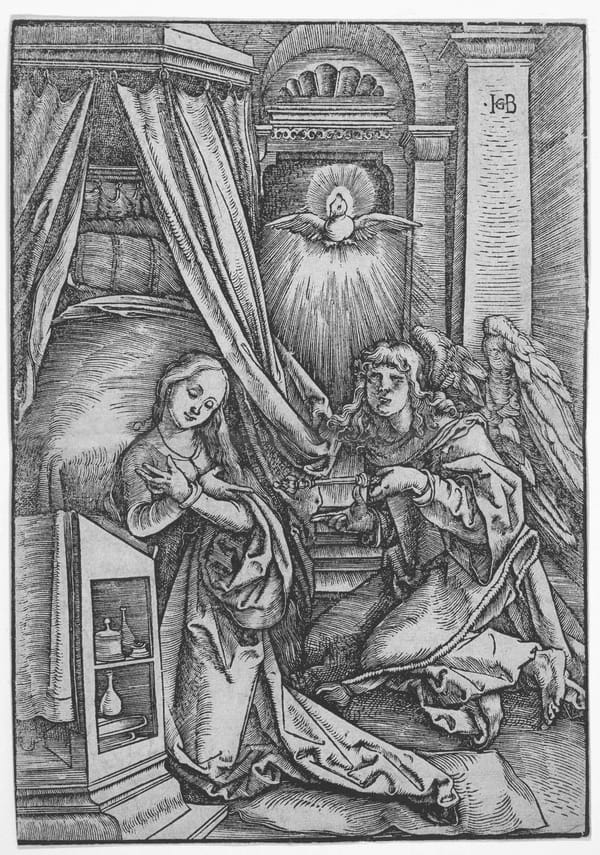
December 12: The Fifth Day within the Octave of the Immaculate Conception
Let us contemplate the sentiments of profound respect and maternal tenderness, which fill the soul of our blessed Lady, now that she has conceived Jesus in her chaste womb: He is her God, and yet He is her Son. Let us think upon this wonderful dignity bestowed upon a creature; and let us honour the Mother of our God. It is by this mystery that the prophecy of Isaias was fulfilled: ‘Behold, a Virgin shall conceive and bear a Son;’1 and that of Jeremias: ‘The Lord hath created a new thing upon the earth; a woman shall compass a Man.’2 The Gentiles themselves had received the tradition of these prophecies. Thus in the old pagan Carnutum (Chartres), there was an altar dedicated ‘To the Virgin that was to bring forth a Son and that of Jeremias: 'The Lord hath created a new thing upon the earth; a woman shall compass a Man.' 11 The Gentiles them- selves had received the tradition of these prophecies. Thus in the old pagan Oarnutum (Chartres), there was an altar dedicated ' To the Virgin that was to bring forth a Son and that of Jeremias: 'The Lord hath created a new thing upon the earth; a woman shall compass a Man.' 11 The Gentiles them- selves had received the tradition of these prophecies. Thus in the old pagan Oarnutum (Chartres), there was an altar dedicated ' To the Virgin that was to bring forth a Son (Virgini Parituræ)’; and whilst modern rationalism, with its ignorant scepticism, was affecting to throw a doubt on this fact of history, the researches of science were discovering that Carnutum was far from being the only city of the west which had such an altar.
But what human language could express the dignity of our Lady, who carries within her chaste womb Him that is the world’s salvation! If Moses, after a mere colloquy with God, returned to the Israelites with the rays of the majesty of Jehovah encircling his head, what an aureola of glory is due to Mary, who has within her, as in a living heaven, that very God Himself! The divine Wisdom tempers the effulgence of her glory that it be not visible to men; and this in order that the state of humility, which the Son of God has chosen as the one in which He would manifest Himself to the world, should not be removed at the very outset by the dazzling glory which would, otherwise, have been seen gleaming from His Mother.
The sentiments which filled the heart of Mary during these months of her ineffable union with the divine Word, may be thus expressed in the words of the bride in the sacred Canticle: ‘I sat under the shadow of Him whom I desired; and His fruit was sweet to my palate. I sleep, but my heart watches. My soul melted when He spoke. I to my Beloved and my Beloved to me, who feedeth among the lilies, till the day break, and the shadows retire.’3 And if there ever were a human heart, that was forced, by the overpowering vehemence of its love of God, to use these other words of the same Canticle, it was Mary’s: ‘O daughters of Jerusalem! stay me up with flowers, compass me about with fragrant fruits; for I languish with love.’4 ‘These sweet words,’ says the venerable Peter of Celles, ‘are those of the bride that dwelleth in the gardens, and is now near the time of her delivery. What so lovely in creation as this Virgin, who loves the Lord with such matchless love and is so exceedingly loved by this her Lord? It is she of whom the Scripture speaks, when it calls the bride the dearest hind. What, too, so lovely as that well-beloved Son of God, born of His beloved Father from all eternity, and now, at the end of time, as the apostle speaks, formed in the womb of His dearest Mother, and become to her, in the words of the same divine proverb, the sweetest fawn? Let us, therefore, cull our flowers, and offer them to both Child and Mother. But let me briefly tell you what are the flowers you must offer to our Lady. Christ says, speaking of His Humanity, “I am the flower of the field, and the lily of the valleys.” By Him, therefore, let us purify our souls and bodies, and so be able to approach our God in chastity. Next, preserve this flower of purity from all that would injure it; for flowers are tender things, and soon droop and fade. Let us wash our hands among the innocent, and, with a pure heart, and pure body, and cleansed lips, and chaste soul, let us gather in the paradise of our heavenly Father our fresh flowers for the new Nativity of our new King. With these flowers let us stay up this most saintly Mother, this Virgin of virgins, this Queen of queens, this Lady of ladies; that so we may deserve to receive the blessing of the Mother and of the divine Babe.’5
Virgo Mater gloriosa,
Mater Regis gloriæ.
Ave, fulgens margarita
Per quam venit mundi vita,
Christus sol justitiæ.
O oliva fructifera,
Tu pietatis viscera
Nulli claudis hominum.
Nos exsules laetificas,
Ut vitis, dum fructificas
Salvatorem Dominum.
Ave, Virgo Mater Dei,
Tu superni sol diei,
Et mundi noctis luna.
Succurre nobis miseris,
Mortalium spes unica.
Ave, decus virginale,
Templum Dei speciale! Per te fiat veniale
Omne quod committimus.
Tu nobis es singularis;
Tu nos ducas, stella maris;
Tu nos semper tuearis:
En ad te confugimus.
Ad te, pia, suspiramus,
Si non ducis, deviamus;
Ergo doce quid agamus;
Post hunc finem ut vivamus
Cum sanctis perenniter.
Jesu Christe, Fili Dei,
Tota salus nostræ spei;
Tuæ matris interventu,
Angelorum nos conventu
Fac gaudere jugiter.
glorious Virgin-Mother
of the King of glory!
Hail, fair pearl!
by whom came the life of the world,
Christ the Sun of justice.
O fruitful olive!
thou excludest no mortal
from thy tender compassion.
Thou givest gladness to us exiles,
for, like a fruitful vine,
thou yieldest thy fruit, Jesus our Lord.
Hail, Virgin Mother of God!
thou art the sun of the heavenly day!
thou art the moon of the world’s night!
Tenderest of Mothers!
help us poor mortals,
for God wills us to hope in thee above all creatures.
Hail, O purest Virgin!
God’s special temple! pray for us to him,
that he would forgive us all our sins.
Thou art unto us what no other creature is.
Guide us, O star of the sea!
Defend us always and in all places.
We fly to thee in our necessities.
Tender Mother! we pray thee guide us,
or we go astray.
Tell us what would thy Jesus have us do?
that so, after this life is ended,
we may live for ever with the saints.
O Jesus! Son of God,
our only Saviour, in whom rests all our hope!
grant by the intercession of thy Mother,
that we may be united
to the angels in eternal joy.
A Prayer for the Time of Advent
(The Mozarabic breviary, first Sunday of Advent)
Thursday of the Second Week of Advent
Cap. xix.Onus Ægypti. Ecce Dominus ascendet super nubem levem: et ingredietur Ægyptum: et commovebuntur simulacra Ægypti a facie ejus, et cor Ægypti tabescet in medio ejus: et concurrere faciam Ægyptios adversus Ægyptios, et pugnabit vir contra fratrem suum, et vir contra amicum suum, civitas adversus civitatem, regnum adversus regnum.
Ch. xix.The burden of Egypt. Behold the Lord will ascend upon a light cloud: and will enter into Egypt: and the idols of Egypt shall be moved at his presence, and the heart of Egypt shall melt in the midst thereof: and I will set the Egyptians to fight against the Egyptians, and they shall fight brother against brother, and friend against friend, city against city, kingdom against kingdom.
The Egypt which the Lord is here represented as visiting, and whose idols and empire He will overthrow, is the city of satan, which is to be destroyed, and to give place to the city of God. But how peaceful is the divine Conqueror’s entrance into His conquest! it is on a cloud, a light cloud, that He comes, as on His triumphal chariot. How many mysteries in these few words! ‘There are three clouds,’ says Peter of Blois; 'the first the obscurity of the prophets; the second, the depth of the divine decrees; the third, the prodigy of a Virgin Mother.’1 First, as to the obscurity of the prophets, it is essential to every prophecy that it be thus veiled, to the end that man’s free will may not be interfered with; but under this cloud the Lord comes at last, and when the day comes for the prophecy to be accomplished, all things are clear enough. Thus was it with the first coming; so will it be with the second. Then, as to the decrees of God; as they are ordinarily made manifest by second, that is by created, causes only, it almost always happens that the extreme simplicity of the means employed by the divine Wisdom takes men by surprise. Never was this so observable as in the grand event of the Incarnation. Men would naturally expect that, in restoring a fallen world, a power equal, at least, to that which first created it would be displayed; and all they are told about the portent is: ‘You will find the Child wrapped in swaddling clothes, and laid in a manger’! O almighty power of God, how dazzling is Thy light through this cloud! how strong art Thou in this apparent weakness!
But there is the third cloud; it is the Virgin Mary; a light cloud, ‘for,’ says St. Jerome, ‘neither concupiscence, nor the burden of earthly marriage, weighs upon her a cloud, too, laden with a refreshing Dew, since it holds the Just One, who is to be rained down upon us, that our seething passions may be quenched, and the soil of our spiritual life made fertile. How sweet is the majesty of our divine King, when seen thus through this beautiful cloud! O incomparable Virgin! the whole Church of God recognizes thee in that mysterious cloud which the prophet Elias,2 from the summit of Mount Carmel, saw rising up from the sea, little, at first, like a man’s foot, but sending at last such a plentiful rain that all Israel was refreshed by its abundance. Delay not, we pray thee; give us that heavenly and divine Dew which thou possessest within thee. Our sins have made the heavens as brass, and we are parched; thou alone of creatures art just and pure! Beseech our Lord, who has set up His throne of mercy in thee, to come speedily and destroy our enemies and bring us peace.
Hymn for Advent
(The Mozarabic breviary, first Sunday of Advent)
Mundum salvare veniens,
Formam assumpsit corporis
Nostræ similitudinis.
Virginis intrat uterum,
Nasciturus in corpore,
Mortis vincla disrumpere.
Videbunt lumen fulgoris,
Cum Salvator advenerit
Redimere quos condidit.
Cecinerunt oracula,
Nunc veniet in gloria,
Nostra ut curet vulnera.
Simul in Dei Filio,
Parati eum suscipere
Adventus sui gloria.
coming to save the world,
assumed to himself a body
like unto ours.
enters the Virgin’s womb,
that he may be born in the flesh,
and break the bonds of death.
but they shall see the brightest light,
when the Saviout shall come
to redeem his creatures.
oracles of the prophets anciently sang,
shall now come in glory
to cure our wounds.
and in the Son of God,
and be ready to receive him
in his glorious coming.
Prayer from the Ambrosian Breviary
(Sixth Sunday of Advent, Preface)
| Previous Wednesday of the Second Week of Advent | Next Thursday of the Second Week of Advent |