Daily reading
December 13 · Sanctoral
December 13, 2019
From Dom Guéranger’s The Liturgical Year.
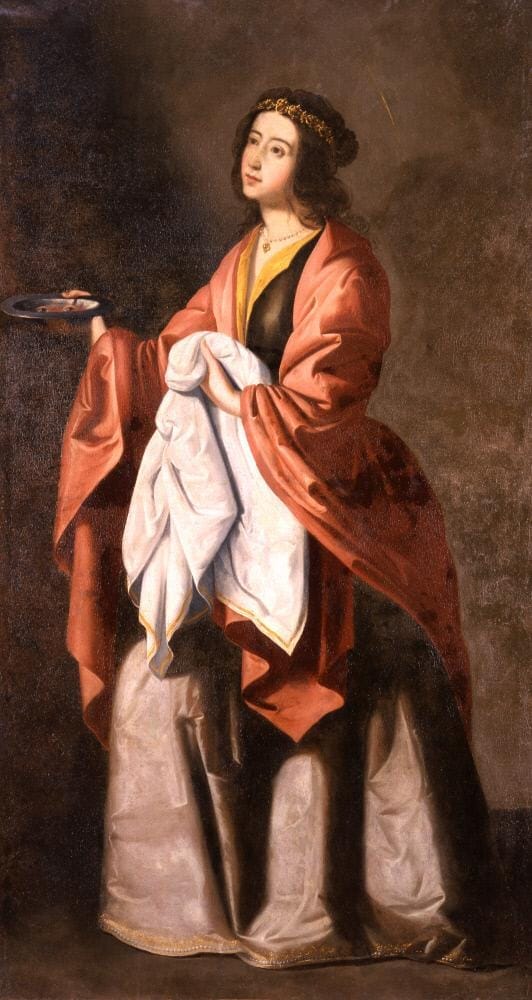
December 13: St. Lucy, Virgin and Martyr
We here give some of the antiphons which occur in the Office of the saint: they form a lyric poem of great beauty.
O virgin Lucy! why askest thou of me, what thyself canst straightway grant unto thy mother?
Because of thee, O virgin Lucy! the city of Syracuse shall be honoured by the Lord Jesus Christ.
Words of Lucy: I bless thee, the Father of my Lord Jesus Christ, because by thy Son the fire around me was quenched.
In thy patience thou didst possess thy soul, O Lucy, bride of Christ! thou didst hate the things that are in the world, and thou shinest among the angels. Thou didst conquer the enemy by thine own blood.
We present ourselves before thee, O virgin martyr, beseeching thee to obtain for us that we may recognize in His lowliness that same Jesus whom thou now seest in His glory. Take us under thy powerful patronage. Thy name signifies light; guide us through the dark night of this life. O fair light of virginity! enlighten us; evil concupiscence has wounded our eyes: pray for us, O thou bright light of virginity! that our blindness be healed, and that rising above created things, we may be able to see that true light, which shineth in darkness, but which darkness cannot comprehend. Pray for us, that our eye may be purified, and may see, in the Child who is to be born at Bethlehem, the new Man, the second Adam, the model on which the life of our regeneration must be formed. Pray too, O holy virgin, for the Church of Rome and for all those which adopt her form of the holy Sacrifice; for they daily pronounce at the altar of God thy sweet name; and the Lamb, who is present, loves to hear it. Heap thy choicest blessings on the fair Isle, which was thy native land, and where grew the palm of thy martyrdom. May thy intercession secure to her inhabitants firmness of faith, purity of morals, and temporal prosperity, and deliver them from the disorders which threaten her with destruction.
December 13 (the Same Day): St. Odilia, Virgin and Abbess
On this same day, we have also the fifth of the wise virgins, whose bright lamps light us, during Advent, to the crib of Jesus their Spouse. Odilia did not shed her blood for Him, as did Bibiana, Barbara, Eulalia, and Lucy; her offering was her tears and her love. Her wreath of lilies blends sweetly with the roses, which form the crowns of her four companions. Her name is held in special veneration in the east of France, and beyond the Rhine. The holy hill whereon her tomb has rested now these thousand years, is still visited by numerous and devout pilgrims. Several kings of the Capetian race, and several emperors of the house of Hapsburg, were descendants of the father of our saint, Adalric or Atticus, Duke of Alsace.
Odilia was born blind. Her father insisted on her being removed from the house, for her presence would have been a continual humiliation to him. It seems as though this affliction was permitted by Providence, in order that the action and power of divine grace might be the more clearly manifested in her regard. The little exile was taken from her mother, and placed in a monastery. God, who designed to show the virtue of the holy Sacrament of regeneration, permitted that her Baptism should be deferred until she had reached her thirteenth year. The time at length came for Odilia to be made a child of God. No sooner was she taken from the baptismal font, than she received her eyesight, which was but a feeble figure of the light which faith had lit up in her soul. This prodigy restored Odilia to her father and to the world; and from that time forward, she had to defend, against unceasing attacks, the virginity which she had vowed to God. Her personal beauty, and her father’s wealth and power, attracted to her many rich suitors. She refused them all; and her father himself built a monastery on the rocks of Hohenburg, wherein she served her divine Lord, governed a large community, and gave relief to every sort of suffering.
After a long life spent in prayer, penance, and works of mercy, the day came which was to reward her for it all. It was this very day, the thirteenth of December, the feast of the holy virgin Lucy. The sisters of Hohenburg, desirous of treasuring up her last words, assembled round their saintly abbess. She was in an ecstasy, and already dead to the things of this life. Fearing lest she should die before she had received that holy Viaticum, which leads the soul to Him who is her last end, the sisters thought it their duty to rouse her from the mystic sleep, which, so it seemed to them, rendered her forgetful of the duties which she had to perform. Being thus brought to herself, she turned to the community, and said to them: ‘Dear sisters, why have you disturbed me? Why would you again oblige me to feel the weight of this corruptible body, when I had once left it? By the favour of His divine Majesty, I was in the company of the virgin Lucy, and the delights I was enjoying were so great that no tongue could tell them, nor ear hear them, nor human eye see them.’ No time was lost in giving her the Bread of life and the Chalice of salvation, which having received, she immediately rejoined her heavenly companion, and the thirteenth day of December thus united into one the feasts of the abbess of Hohenburg and of the martyr of Syracuse.
The Church of Strasburg, which honours Odilia as one of its greatest glories, has the following lessons for this feast. By giving them a place here, we do not adopt the statement they contain with regard to the rule which was followed in the monastery of Hohenburg. Mabillon, who proves that St. Odilia followed the rule of St. Benedict, shows that the Canonical Rule, as it was called, did not exist at that time.
The ways of God in thy regard, O holy virgin, were admirable indeed, and He manifested in thee the riches and power of His grace. He deprived thee of sight, that so thy soul might the more eagerly cling to His own infinite beauty; and when afterwards He bestowed on thee thy bodily vision, thou hadst already made choice of the better part. The harshness of thy father deprived thee of the innocent pleasures of home; but it prepared thee to become the spiritual mother of so many noble virgins, who, following thy example, trampled on all the vanities of the world. Thou didst choose a life of humility, because thy heavenly Spouse Jesus had humbled Himself for our sake. Thou didst imitate Him also in His being our divine Deliverer, and taking upon Himself all our miseries, for thou hadst the tenderest compassion on the poor and the sick. Thou didst take on thyself the care of a poor leper, that had been abandoned by all else; with a mother’s courage thou didst feed him, and affectionately dress his loathsome sores. And is it not this that our Jesus is coming down from heaven to do for us; to heal our wounds by embracing our human nature, and to nourish us with that food, which He is preparing to give us at Bethlehem? Whilst the leper was receiving thy loving care, the frightful disease which excluded him from the society of his fellow-creatures suddenly disappeared; a delicious odour came from his whole person, whereas before, none but a saint like thyself could have borne to approach him. Is it not this which Jesus is coming down to do for us? The leprosy of sin was upon us; His grace heals us, and man regenerated sheds around him the good odour of Christ.1
In the midst of the joys which thou art now sharing with Lucy, remember us, O thou that wast ever so compassionate to the needy! We cannot forget the tears thou didst shed, and the prayers thou didst offer up for the soul of thy father after his death, whereby thou didst deliver him from purgatory, and open the gates of heaven to him that had banished thee from his house. Thou art no longer in the land of tears; thine eyes are opened to the light of heaven, and contemplate God in His glory: pray therefore for us, for thy prayers are now more powerful than heretofore. Think of us who are poor and infirm; obtain the cure of our maladies. The Emmanuel, who is coming to us, tells us that He is the Physician of our souls, for He has said: 'They that are in health need not the Physician, but they that are ill.’2 Ask Him to cure us of the leprosy of sin, and make us become even like unto Himself. Pray for France, thy country, and help her to maintain the purity of the Catholic faith. Watch over the ruins of the holy empire. Heresy has disunited the members of that great body; but it will once more flourish, if our Lord, propitiated by such prayers as thine, vouchsafe to bring Germany back again to the true faith and to submission to the Church. Yes, pray that these glorious things be brought about for the honour and glory of thy divine Spouse, and that nations, now weary of their errors and disunion, may unite together in propagating the kingdom of God upon earth.
Let us consider the ever blessed Mother of God leaving her humble dwelling at Nazareth, in order to visit her cousin, St. Elizabeth. The Church honours this mystery of the Visitation on the Friday in Ember Week of Advent, as we have mentioned above, in the Proper of the Time. We will let St. Bonaventure relate this sublime incident of Mary’s life, convinced that our readers will be pleased to hear the seraphic Doctor revealing to them, with his wonderful unction, these preludes to the birth of Jesus.
‘After, this, our Lady, pondering the words spoken unto her by the angel concerning her cousin Elizabeth, resolved to visit her, that she might congratulate with her and render her service. She, therefore, together with Joseph her spouse, set out from Nazareth for the house of Elizabeth, which might perhaps be fourteen or fifteen miles distant from Jerusalem. Neither the roughness nor the length of the journey discouraged her; but she walked with haste, forasmuch as she wished to be little seen in public. She was not like other mothers, burthened by her Child, nor was it to be thought that the Lord Jesus would be a burthen to His Mother. See, therefore, how the Queen of heaven and earth takes this journey alone, with none but her spouse Joseph; not riding, but walking; neither is she escorted by troops of soldiers and barons, nor attended by handmaids and fine ladies. Her train is poverty, humility, modesty, and the beauty of all virtues. The Lord Himself, too, is with her; and He verily hath a numerous and honourable suite, but it is not that of the world, vain and pompous.
‘Now, when she had entered the house of Elizabeth, she greeted her saying: “ Hail! my sister Elizabeth!” But she, exulting, and all full of joy, and inflamed by the holy Spirit, rises and most tenderly embraces Mary, exclaiming for joy: “Blessed art thou among women, and blessed is the fruit of thy womb! And whence is this to me, that there should come unto me the Mother of my Lord?” For as soon as the Virgin had greeted Elizabeth, John, in his mother’s womb, was filled with the Holy Ghost, as was likewise the mother. Nor was it that the mother was filled and then her child, but contrariwise the child was filled first, and he communicated the Spirit unto the mother. The babe effected nought in Elizabeth’s soul, but he merited that the Holy Ghost should do a work in her soul, because the grace of the divine Spirit had descended into him with greater abundance, and he was the first to receive the grace. And as Elizabeth had perceived the coming of Mary, so did John perceive the coming of Jesus. Therefore was it that he leaped for joy, and she prophesied. See the virtue of our Lady’s words, when by their utterance the Holy Ghost is conferred; for so replenished was Mary with Him, that, by her merits, He filled others also with Himself. Upon this, Mary made answer unto Elizabeth, saying: “My soul doth magnify the Lord, and my spirit hath rejoiced in God my Saviour.”
Sequence in Honor of the Mother of God
(Taken from the ancient Roman-French missals)
Celebris in Matris Dei
Agitur memoria.
Decantemus in hac die
Semper Virginis Mariæ
Landes et præconia.
Omnis homo, omni hora,
Ipsam ora et implora
Ejus patrocinia.
Psalle, psalle, nisu toto,
Cordis, oris, voce, voto:
Ave plena gratia!
Ave, Domina cœlorum,
Inexperta viri torum,
Parens paris nescia.
Fœcundata sine viro,
Genuisti more miro
Genitorem filia.
Florens hortus Austro flante,
Porta clausa post et ante,
Via viris invia.
Fusa cœli rore tellus,
Fusum Gedeonis vellus,
Deitatis pluvia.
Salve, splendor firmamenti:
Tu caliginosae menti
Desuper irradia.
Placa mare, maris stella,
Ne involvat nos procella
Et tempestas obvia.
Amen.
for on it we make commemoration of Mary,
the Mother of God.
Lot us sing to-day
the praises and the dignity of the ever blessed
Virgin Mary.
Whoe’er thou art,
and where’er thou art,
pray to her, beseech her to help thee.
Sing, sing, with all thy heart
and voice’s power;
Hail Mary! full of grace.
Hail, Queen of heaven,
purest of Virgins,
yet incomparable Mother!
Made fruitful by God,
thou, his creature, didst give birth,
O prodigy of prodigies! to thy Creator.
Here was the prophecy fulfilled;
that a garden should flower under the breath of the south wind;
that all its gates were closed, and no man could enter.
Mary is the earth spoken of as enriched with the dew of heaven;
she is as Gedeon’s fleece prefigured her,
filled with the dew of the Godhead.
Hail, Mary, thou brightness of heaven!
bring to our darkness
the light that is from above.
O star of the sea,
calm its storms,
and suffer not that they overwhelm us.
Amen.
Introit of Advent
(Ambrosian missal, sixth Sunday, Ingressa)
Friday of the Second Week of Advent
Cap. xxiv.Ecce Dominus dissipabit terram, et nudabit eam; et affliget faciem ejus et disperget habitatores ejus. Et erit sicut populus, sic sacerdos; et sicut servus, sic dominus ejus; sicut ancilla, sic domina ejus; sicut emens, sic ille qui vendit; sicut fœnerator, sic is qui mutuum accipit; sicut qui repetit, sic qui debet. Dissipatione dissipabitur terra, et direptione prædabitur: Dominus enim locutus est verbum hoc. Luxit et defluxit terra, et infirmata est: defluxit orbis, infirmata est altitudo populi terræ. Et terra infecta est ab habitatoribus suis: quia transgressi sunt leges, mutaverunt jus, dissipaverunt fœdus sempiternum. Propter hoc maledictio vorabit terram, et peccabunt habitatores ejus, ideoque insanient cultores ejus; et relinquentur homines pauci. Luxit vindemia, infirmata est vitis, ingemuerunt omnes qui laetabantur corde. Cessavit gaudium tympanorum, quievit sonitas lætantium, conticuit dulcedo citharæ. Cum cantico non bibent vinum: amara erit potio bibentibus illam. Attrita est civitas vanitatis: clausa est omnis domus, nullo introeunte. Clamor erit super vino in plateis: deserta est omnis laetitia, translatum est gaudium terræ. Relicta est in urbe solitudo, et calamitas opprimet portas. Quia hæc erunt in medio terræ, in medio populorum; quomodo si paucae olivae quae remanserunt, excutiantur ex olea: et racemi, cum fuerit finita vindemia. Hi levabunt vocem suam, atque laudabunt; cum glorificatus fuerit Dominus, hinnient de mari. Propter hoc in doctrinis glorificate Dominum, in insulis maris nomen Domini Dei Israel. A finibus terræ laudes audivimus, gloriam justi.
Ch. xxiv.Behold the Lord shall lay waste the earth, and shall strip it: and shall afflict the face thereof, and scatter abroad the inhabitants thereof. And it shall be as with the people, so with the priest; and as with the servant, so with his master; as with the handmaid, so with her mistress; as with the buyer, so with the seller; as with the lender, so with the borrower; as with him that calleth for his money, so with him that oweth. With desolation shall the earth be laid waste, and it shall be utterly spoiled: for the Lord hath spoken this word. The earth mourned and faded away, and is weakened: the world faded away, the height of the people of the earth is weakened. And the earth is infected by the inhabitants thereof: because they have transgressed the laws, they have changed the ordinance, they have broken the everlasting covenant. Therefore shall a curse devour the earth, and the inhabitants thereof shall sin; and therefore they that dwell therein shall be mad, and few men shall be left. The vintage hath mourned, the vine hath languished away, all the merry-hearted have sighed. The mirth of timbrels hath ceased, the noise of them that rejoice is ended, the melody of the harp is silent. They shall not drink wine with a song; the drink shall be bitter to them that drink it. The city of vanity is broken down, every house is shut up, no man cometh in. There shall be a crying for wine in the streets: all mirth is forsaken, the joy of the earth is gone away. Desolation is left in the city, and calamity shall oppress the gates. For it shall be thus in the midst of the earth, in the midst of the people, as if a few olives that remain should be shaken out of the olive tree: or grapes, when the vintage is ended. These shall lift up their voice, and shall give praise, when the Lord shall be glorified, they shall make a joyful noise from the sea. Therefore glorify ye the Lord in instruction: the name of the Lord God of Israel in the islands of the sea. From the ends of the earth we have heard praises, the glory of the just one.
Thus was the earth in desolation when the Messias came to deliver and save it. So diminished, so decayed, were truths among the children of men, that the human race was bordering on its ruin. The knowledge of the true God was becoming rarer as the world grew older; idolatry had made everything in creation an object of its adulterous worship; the practical result of a religion which was but gross materialism, was frightful immorality; man was for ever at war with man; and the only safeguards of what social order still existed in the world, were the execrable laws of slavery and extermination. Among the countless inhabitants of the globe, a mere handful could be found who were seeking God! they were as rare as the olives that remain on the tree after a careful plucking, or as grape-bunches after the vintage is ended. Of this happy few were, among the Jewish people, those true Israelites whom our Saviour chose for His disciples; and, among the Gentiles, the Magi that came from the east, asking for the new-born King; and later on, Cornelius the centurion, whom the angel of the Lord directed to St. Peter. But with what faith and joy did they acknowledge the incarnate God! and what their hymns of glad gratitude, when they found that they had been privileged, above others, to see with their own eyes the promised Saviour!
Now, all this will again happen when the time draws near of the second coming of the Messias. The earth will once more be filled with desolation, and mankind will be again a slave of its self-degradation. The ways of men will again grow corrupt; and, this time, the malice of their evil will be the greater, because they will have received Him who is the Light of the world, the Word of life. A profound sadness will sit heavy on all nations, and every effort for their well-being will seem paralyzed; they, and the earth they live on, will be conscious of decrepitude; and yet it will never once strike them that the world is drawing to an end. There will be great scandals; there shall fall stars from heaven, that is, many of those who had been masters in Israel shall apostatize, and their light shall be changed into darkness. There shall be days of temptation, and faith shall grow slack; so that when the Son of Man shall appear, faith shall scarce be found on the earth. Let it not be, O Lord, that we live to see those days of temptation; or, if it be Thy will that they overtake us, make our hearts firm in their allegiance to Thy holy Church, which will be the only beacon left to Thy faithful children in that fiorce storm. Grant, O Lord, that we may be of the number of those chosen olives, of those elect bunches of grapes, wherewith Thou wilt complete the rich harvest which Thou wilt garner for ever into Thy house. Preserve intact within us the deposit of faith which Thou hast entrusted to us; let our eye be fixed on that Orient of which the Church speaks to us, and where Thou art suddenly to appear in Thy majesty. When that day of Thine comes, and we behold Thy triumph, we will shout our glad delight, and then, like eagles which cluster round the body, we shall be taken up to meet Thee in the air, as Thy apostle speaks, and thus shall we for ever be with Thee.* Then we shall hear the praises and glory of the Just One, from the ends of this earth, which it is Thy good will to preserve until the decrees of Thy mercy and justice shall have been fully executed. O Jesus! we are the work of Thy hands; save us, and be merciful to us on that great day.
Hymn of Advent
(Mozarabic breviary, in the second week of Advent)
Ad nos venis per Virginem,
Baptismi rore consecrans,
Cunctos fide regenerans.
Excepit formam hominis,
Victor a morte rediens,
Gaudia vitae largiens.
Illabere propitius,
Clarum que nostris cordibus
Lumen præbe deificum.
Ejusque soli Filio
Cum Spiritu Paraclito,
In sempiterna sæcula.
thou comest to us by the Virgin,
consecrating us all by the dew of Baptism,
and by faith regenerating us.
has taken on himself the form of man,
returning after conquering death,
and giving us the joys of a now life.
descend upon us in thy mercy,
and give to our hearts
the brightness of the divine light.
and to his only Son,
and to the holy Paraclete,
be glory for ever and ever.
Prayer from the Gallican Missal
(In Adventu Domini, Collecta)
* 1 Thess. iv. 16. ↩︎
| Previous Thursday of the Second Week of Advent | Next December 13 (the Same Day): St. Odilia, Virgin and Abbess |