Daily reading
Christmas
Double · December 29 · Sanctoral
December 29, 2019
From Dom Guéranger’s The Liturgical Year.
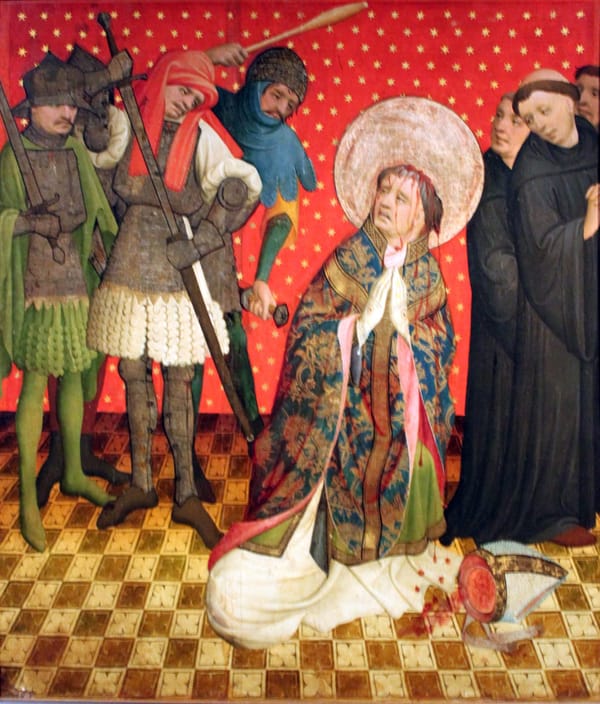 |
December 29: St. Thomas, Archbishop of Canterbury and Martyr
ANOTHER Martyr comes to-day to take his place round the Crib of our Jesus. He does not belong to the first ages of the Church: his name is not written in the Books of the New Testament, like those of Stephen, John and the Innocents of Bethlehem. Yet does he stand most prominent in the ranks of that Martyr Host which has been receiving fresh recruits in every age, and is one of those visible abiding proofs of the vitality of the Church, and of the undecaying energy infused into her by her divine Founder. This glorious Martyr did not shed his blood for the faith; he was not dragged before the tribunals of pagans or heretics, there to confess the truths revealed by Christ and taught by the Church. He was slain by Christian hands; it was a Catholic King that condemned him to death; it was by the majority of his own brethren, and they his countrymen, that he was abandoned and blamed. How, then, could he be a Martyr? How did he gain a Palm like Stephen's? He was the Martyr for the liberty of the Church.
Every Christian is obliged to lay down his life rather than deny any of the articles of our holy Faith: it was the debt we contracted with Jesus Christ when he adopted us in Baptism as his Brethren. All are not called to the honour of Martyrdom, that is, all are not required to bear that testimony to the Truth which consists in shedding one's blood for it: but all must so love their Faith as to be ready to die rather than deny it, under pain of incurring the eternal death from which the grace of our Redeemer has already delivered us. The same obligation lies still more heavily on the Pastors of the Church. It is the pledge of the truth of their teachings. Hence we find in almost every page of the History of the Church the glorious names of saintly Bishops, who laid down their lives for the Faith they had delivered to their people. It was the last and dearest pledge they could give of their devotedness to the Vineyard entrusted to them, in which they had spent years of care and toil. The blood of their Martyrdom was more than a fertilizing element—it was a guarantee, the highest that man can give, that the seed they had sown in the hearts of men was in very truth the revealed Word of God.
But beyond the debt which every Christian has, of shedding his blood rather than denying his Faith, that is, of allowing no threats or dangers to make him disown the sacred ties which unite him to the Church, and through her to Jesus Christ; beyond this, Pastors have another debt to pay, which is that of defending the liberty of the Church. To Kings and Rulers, and, in general to all diplomatists and politicians, there are few expressions so unwelcome as this of the liberty of the Church; with them it means a sort of conspiracy. The world talks of it as being an unfortunate scandal, originating in priestly ambition. Timid temporizing Catholics regret that it can elicit anyone’s zeal, and will endeavour to persuade us that we have no need to fear anything, so long as our Faith is not attacked. Notwithstanding all this, the Church has put upon her altars the glorious St Thomas of Canterbury, who was slain in his Cathedral in the twelfth century because he resisted a King's infringements on the extrinsic rights of the Church. She sanctions the noble maxim of St Anselm, one of St Thomas’s predecessors in the See of Canterbury: Nothing does God love so much in this world as the liberty of his Church; and the Apostolic See declares by the mouth of Pius VIII, in the nineteenth century, the very same doctrine she would have taught by St Gregory VII, in the eleventh century: The Church, the spotless Spouse of Jesus Christ the immaculate Lamb, is by God’s appointment Free, and subject to no earthly power.1
But in what does this sacred liberty consist? It consists in the Church’s absolute independence of every secular power in the ministry of the Word of God, which she is bound to preach in season and out of season, as St Paul says, to all mankind, without distinction of nation or race or age or sex: in the administration of the Sacraments, to which she must invite all men without exception, in order to the world’s salvation: in the practice, free from all human control, of the Counsels, as well as of the Precepts, of the Gospel: in the unobstructed intercommunication of the several degrees of her sacred hierarchy: in the publication and application of her decrees and ordinances in matters of discipline: in the maintenance and development of the Institutions she has founded: in holding and governing her temporal patrimony: and lastly in the defence of those privileges which have been adjudged to her by the civil authority itself, in order that her ministry of peace and charity might be unembarrassed and respected.
Such is the Liberty of the Church. It is the bulwark of the Sanctuary. Every breach there imperils the Hierarchy, and even the very Faith. A Bishop may not flee, as the hireling, nor hold his peace, like those dumb dogs of which the Prophet Isaias speaks, and which are not able to bark.2 He is the Watchman of Israel: he is a traitor if he first lets the enemy enter the citadel, and then, but only then, gives the alarm and risks his person and his life. The obligation of laying down his life for his flock begins to be in force at the enemy’s first attack upon the very outposts of the City, which is only safe when they are strongly guarded.
The consequence of the Pastor’s resistance may be of the most serious nature; in which event we must remember a truth which has been admirably expressed by Bossuet in his magnificent panegyric on St Thomas of Canterbury, which we regret not being able to give from beginning to end. 'It is an established law,' he says, 'that every success the Church acquires costs her the life of some of her children, and that in order to secure her rights she must shed her own blood. Her Divine Spouse redeemed her by the Blood he shed for her; and he wishes that she should purchase on the same terms the graces he bestows upon her. It was by the blood of the Martyrs that she extended her conquests far beyond the limits of the Roman Empire. It was her blood that procured her both the peace she enjoyed under the Christian, and the victory she gained over the Pagan Emperors. So that as she had to shed her blood for the propagation of her teaching, she had also to bleed in order to make her authority accepted. The discipline, therefore, as well as the faith of the Church, was to have its Martyrs.’
Hence it was that St Thomas, and the rest of the martyrs for ecclesiastical liberty, never once stopped to consider how it was possible, with such weak means as were at their disposal, to oppose the invaders of the rights of the Church. One great element of Martyrdom is simplicity united with courage; and this explains how there have been martyrs amongst the lowest classes of the faithful, and that young girls, and even children, can show their rich palm-branch. God has put into the heart of a Christian a capability of humble and inflexible resistance which makes every opposition give way. What, then, must that fidelity be, which the Holy Ghost has put into the souls of Bishops, whom he has constituted the Spouses of his Church, and the defenders of his beloved Jerusalem? 'St Thomas,' says Bossuet, ‘yields not to injustice, under the pretext that it is armed with the sword, and that it is a King who commits it; on the contrary, seeing that its source is high up, he feels his obligation of resisting it to be the greater, just as men throw the embankments higher when the torrent swells.'
But the Pastor may lose his life in the contest! Yes, it may be so: he may possibly have this glorious privilege. Our Lord came into this world to fight against it and conquer it; but he shed his blood in the contest, he died on a Cross. So likewise were the martyrs put to death. Can the Church, then, which was founded by the Precious Blood of her Divine Master, and was established by the blood of the martyrs—can she ever do without the saving laver of blood, which reanimates her with vigour, and vests her with the rich crimson of her royalty? St Thomas understood this: and when we remember how he laboured to mortify his flesh by a life of penance, and how every sort of privation and adversity had taught him to crucify to this world every affection of his heart, we cannot be surprised at his possessing, within his soul, the qualities which fit a man for martyrdom—calmness of courage, and a patience proof against every trial. In other words, he had received from God the Spirit of Fortitude, and he faithfully corresponded to it.
'In the language of the Church,' continues Bossuet, 'fortitude has not the meaning it has in the language of the world. Fortitude, as the world understands it, is undertaking great things; according to the Church, it goes not beyond suffering every sort of trial, and there it stops. Listen to the words of St Paul: Ye have not yet resisted unto blood; as though he would say: “You have not yet gone the whole length of your duty, because you have not resisted your enemies unto blood.” He does not say, “You have not attacked your enemies and shed their blood;” but, “Your resistance to your enemies has not yet cost you your blood.”
'These are the high principles of St Thomas; but see how he makes use of them. He arms himself with this sword of the Apostle's teaching, not to make a parade of courage, and gain a name for heroism, but simply because the Church is threatened, and he must hold over her the shield of his resistance. The strength of the holy Archbishop lies not in any way either in the interference of sympathizers, or in a plot ably conducted. He has but to publish the sufferings he has so patiently borne, and odium will fall upon his persecutor: certain secret springs need only to be touched by such a man as this, and the people would be roused to indignation against the King! But the Saint scorns both plans. All he has on his side is the prayer of the poor, and the sighs of the widow and the orphan: these, as St Ambrose would say, these are the Bishop's defenders, these his guard, these his army! He is powerful, because he has a soul that knows not either how to fear or how to murmur. He can in all truth say to Henry, King of England, what Tertullian said in the name of the whole Church to a magistrate of the Roman Empire, who was a cruel persecutor of the Church: We neither frighten thee nor fear thee:3 we Christians are neither dangerous men, nor cowards; not dangerous, because we cannot cabal, and not cowards, because we fear not the sword.'
Our panegyrist proceeds to describe the victory won for the Church by her intrepid martyr of Canterbury. We can scarcely be surprised when we are told that during the very year in which he preached this eloquent Sermon, Bossuet was raised to the episcopal dignity. We need offer no apology for giving the following fine passage.
'Christians! give me your attention. If there ever were a martyrdom, which bore a resemblance to a sacrifice, it was the one I have to describe to you. First of all there is the preparation: the Bishop is in the Church with his ministers, and all are robed in the sacred vestments. And the victim? The victim is near at hand—the Bishop is the victim chosen by God, and he is ready. So that all is prepared for the sacrifice, and they that are to strike the blow enter the Church. The holy man walks before them, as Jesus did before his enemies. He forbids his clergy to make the slightest resistance, and all he asks of his enemies is that they injure none of them that are present: it is the close imitation of his Divine Master, who said to them that apprehended him: If it be I whom you seek, suffer these to go their way. And when all this had been done, and the moment for the sacrifice was come, St Thomas begins the ceremony. He is both victim and priest: he bows down his head, and offers the prayer. Listen to the solemn prayer, and the mystical words of the sacrifice: And I am ready to die for God, and for the claims of justice, and for the liberty of the Church, if only she may gain peace and liberty by this shedding of my blood!4 He prostrates himself before God: and as in the Holy Sacrifice there is the invocation of the Saints our intercessors, Thomas omits not so important a ceremony; he beseeches the holy Martyrs and the Blessed Mary ever a Virgin to deliver the Church from oppression. He can pray for nothing but the Church; his heart beats but for the Church; his lips can speak nothing but the Church; and when the blow has been struck, his cold and lifeless tongue seems still to be saying: The Church!'
Thus did our glorious Martyr, the type of a Bishop of the Church, consummate his sacrifice, thus did he gain his victory; and his victory will produce the total abolition of the sinful laws which would have made the Church the creature of the State, and an object of contempt to the people. The tomb of the Saint will become an altar; and at the foot of that altar, there will one day kneel a penitent King, humbly praying for pardon and blessing. What has wrought this change? Has the death of Thomas of Canterbury stirred up the people to revolt? Has his martyrdom found its avengers? No. It is the blood of one who died for Christ producing its fruit. The world is hard to teach, else it would have long since learned this truth, that a Christian people can never see with indifference a pastor put to death for fidelity to his charge; and that a government that dares to make a martyr will pay dearly for the crime. Modem diplomacy has learned the secret; experience has given it the instinctive craft of waging war against the liberty of the Church with less violence and more intrigue—the intrigue of enslaving her by political administration. It was this crafty diplomacy which forged the chains wherewith so many churches are now shackled, and which, be they ever so gilded, are insupportable. There is but one way to unlink such fetters—to break them. He that breaks them will be great in the Church of heaven and earth, for he must be a martyr: he will not have to fight with the sword, or be a political agitator, but simply to resist the plotters against the liberty of the Spouse of Christ, and suffer patiently whatever may be said or done against him.
Let us give ear once more to the sublime panegyrist of our St Thomas: he is alluding to this patient resistance which made the Archbishop triumph over tyranny.
'My brethren, see what manner of men the Church finds rising up to defend her in her weakness, and how truly she may say with the Apostle: When I am weak, then am I powerful.5 It is this blessed weakness which provides her with invincible power, and enlists in her cause the bravest soldiers and the mightiest conquerors this world has ever seen—the Martyrs. He that infringes on the authority of the Church, let him dread that precious blood of the martyrs which consecrates and protects it.’
Now all this fortitude, and the whole of this victory, came from the Crib of the Infant Jesus: therefore it is that we find St Thomas standing near it, in company with the Protomartyr Stephen. Any example of humility, and of what the world calls poverty and weakness, which had been less eloquent than this of the mystery of God made a little Child, would have been insufficient to teach man what real power is. Up to that time, man had no other idea of power than that which the sword can give, or of greatness than that which comes of riches, or of joy than such as triumph brings: but when God came into this world, and showed himself weak and poor and persecuted, everything was changed. Men were found who loved the lowly Crib of Jesus, with all its humiliations, better than the whole world besides: and from this mystery of the weakness of an Infant God they imbibed a greatness of soul which even the world could not help admiring.
It is most just, therefore, that the two laurelwreaths of St Thomas and St Stephen should intertwine round the Crib of the Babe of Bethlehem, for they are the two trophies of his two dear martyrs. As regards St Thomas, divine Providence marked out most clearly the place he was to occupy in the cycle of the Christian year, by permitting his martyrdom to happen on the day following the Feast of the Holy Innocents; so that the Church could have no hesitation in assigning December 29 as the day for celebrating the memory of the saintly Archbishop of Canterbury. As long as the world lasts, this day will be a feast of dearest interest to the whole Church of God; and the name of Thomas of Canterbury will be, to the day of judgement, terrible to the enemies of the liberty of the Church, and music breathing hope and consolation to hearts that love that liberty, which Jesus bought at the price of his Precious Blood.
We will now listen to this dear Mother of ours, the Church, who gives us, in her Divine Office, a short history of the life and sufferings of St Thomas.
Mass
The solemn Introit of to-day’s Mass shows the transport of joy wherewith the Church celebrates the Feast of our holy Martyr. The words, and the chant which accompanies them, are only used about four times in the year. Both words and music bespeak enthusiasm and joy: and the Church on earth is elated at the thought that she and the Angels are making one choir to the praise of the victory of Thomas of Canterbury.
Introit
Ps. Rejoice in the Lord, O ye just, praise becometh the upright. ℣. Glory, etc.
In the Collect, Holy Church emphasizes the merit of the glorious Martyr by saying that it was for the very Spouse of the Son of God that he shed his blood. After this, she expresses the special confidence she has in his intercession.
Collect
Commemoration of the Octave of Christmas, p. 203.
Epistle
Cap. V.Fratres: Omnis pontifex ex hominibus assumptus, pro hominibus constituitur in iis quæ sunt ad Deum, ut offerat dona et sacrificia pro peccatis: qui condolere possit iis qui ignorant et errant: quoniam et ipse circumdatus est infirmitate: et propterea debet, quemadmodum pro populo, ita etiam et pro semetipso offerre pro peccatis. Nec quisquam sumat sibi honorem, sed qui vocatur a Deo, tamquam Aaron. Sic et Christus non semetipsum clarificavit ut Pontifex fieret: sed qui locutus est ad eum: Filius meus es tu, ego hodie genui te. Quemadmodum et in alio loco dicit: Tu es Sacerdos in æternum, secundum ordinem Melchisedech.
Ch. ℣. Brethren: Every High Priest taken from among men is ordained for men in the things that appertain to God, that he may offer up gifts and sacrifices for sins: who can have compassion on them that are ignorant and that err: because he himself also is compassed with infirmity: and therefore he ought, as for the people, so also for himself, to offer for sins. Neither doth any man take the honour to himself, but he that is called by God, as Aaron was. So also Christ did not glorify himself that he might be made a High Priest: but he that said to him: Thou art my Son, this day have I begotten thee. As he saith also in another place: Thou art a Priest for ever, according to the order of Melchisedech.
When we meet in the annals of the Church with the names of those great Bishops who have been the glory of the Christian Pontificate, we are at once sure that these men, the true images of the great High Priest Jesus our Lord, did not intrude themselves uncalled into the dread honours of the Sanctuary. The history of their lives shows us that they were called by God himself, asAaron was; and when we come to examine how it was that they were so great, we soon find that the source of their greatness was their humility, which led them to refuse the honourable burden that others would put upon them. God assisted them in the day of trouble and trial, because their exaltation to the episcopacy had been his own work.
Thus was it with St Thomas, who sat on his episcopal throne of Canterbury, the dignified and courageous Primate. He began by declining the high honour that was offered him. He boldly tells the King, as St Gregory VII, before ascending the Papal Throne, told the Emperor who fain would see him Pope, that if forced to accept the proffered dignity, he is determined to oppose abuses. He thought by this to frighten men from putting him into the honours and responsibilities of the pastoral charge, and hoped that they would no longer wish him to be a Bishop, when they suspected that he would be a true one: but the decree of God had gone forth, and Thomas, called by God, was obliged to bow down his head and receive the holy anointing. And what a Bishop he, that begins by humility, and the determination to sacrifice his very life in the discharge of his duty! He is worthy to follow, and that to Calvary, the God-Man, who being called by his Father to Priesthood and to Sacrifice, enters this world saying: Behold! I come to do thy will, O God!6
The Gradual, in its first Versicle, applies to St Thomas the encomium given by the Sacred Scripture to Abraham. These words, which speak the praises of one who surpassed all others in merit, are singularly applicable to our illustrious Martyr, whose glory exceeds that of most other holy Bishops whose memory is celebrated by the Church.
The Alleluia-Verse repeats the words of our Saviour, in which he declares himself to be the Good Shepherd. Why does the Church use them on this feast? She would thereby tell us that St Thomas was a faithful representation of him whom St Peter calls the Prince of Pastors.7
Gradual
Gospel
Cap. X.In illo tempore: Dixit Jesus Pharisæis: Ego sum Pastor bonus. Bonus pastor animem suam dat pro ovibus suis. Mercenarius autem, et qui non est pastor, cujus non sunt oves propriæ, videt lupum venientem, et dimittit oves, et fugit; et lupus rapit et dispergit oves: mercenarius autem fugit, quia mercenarius est, et non pertinet ad eum de ovibus. Ego sum Pastor bonus: et cognosco oves meas, et cognoscunt me meæ. Sicut novit me Pater, et ego agnosco Patrem: et animam meam pono pro ovibus meis. Et alias oves habeo, quæ non sunt ex hoc ovili: et illas oportet me adducere, et vocem meam audient, et fiet unum ovile et unus Pastor.
Ch. X.At that time: Jesus said to the Pharisees: I am the Good Shepherd. The good shepherd giveth his life for the sheep. But the hireling, and he that is not the shepherd, whose own the sheep are not, seeth the wolf coming, and leaveth the sheep, and flieth: and the wolf catcheth and scattereth the sheep; and the hireling flieth, because he is a hireling, and he hath no care for the sheep. I am the Good Shepherd: and I know mine, and mine know me. As the Father knoweth me, and I know the Father; and I lay down my life for my sheep. And other sheep I have, that are not of this fold: them also I must bring, and they shall hear my voice, and there shall be one fold and one Shepherd.
All the strength of the Pontiffs and Pastors of the Church consists in their imitation of Jesus. It is not enough that they have in them the character of his Priesthood; they must also be ready, like him, to lay down their lives for their sheep. The Shepherd who thinks more of his own life than of the salvation of his flock, is a hireling, not a shepherd: he loves himself, and not his sheep. His flock has a claim upon his shedding his blood for them; and if he will not, he is no longer an image of the Good Shepherd, Jesus. See how calmly St Thomas lays down his life! He bows down his head to receive the blows of his executioners, as though he were simply acquitting himself of a duty, or paying a debt. After the example of Jesus, he gives his blood for the deliverance of his people; and no sooner has the sword done its work, than the Church, over which God had placed him, is set free: his blood has brought peace.8 He withstood the wolf that threatened destruction to his flock; he vanquished him; the wolf himself was turned into a lamb, for the king visited the tomb of his victim, and sought in prostrate supplication the Martyr’s blessing.
Thomas knew his sheep, that is, he loved them; it was a happiness to him, therefore, to die for them. He was made Pastor on the condition that he would die for them; just as our Emmanuel was made High Priest in order that he might offer Sacrifice, in which, too, he was both Priest and Victim. Jesus’ sheep know their divine Shepherd: they know that he came in order to save them; therefore is it that his Birth at Bethlehem is so dear to them. The Shepherd of Canterbury, too, is also known by his sheep; and, therefore the feast of his triumphant martyrdom is very dear to them, not only in the century when it happened, but even now, and so will it ever be, even to the end of time. In return for this love and devotion paid him by the Church on earth, Thomas blesses her from heaven. We cannot doubt it—the wonderful return to the ancient Faith which we are now witnessing in our dear England, is due in no little measure to the powerful intercession of St Thomas of Canterbury; and this intercession is the return made by our glorious Martyr for that fervent and filial devotion which is shown him, and which the faithful will ever show to him who was so heroically what only the true Church can produce: a true Pastor.
In the Offertory, holy Church sings of the crown of glory wherewith Emmanuel encircled the brow of his Martyr. The Pastor gave his blood to purchase that crown; and his death gave him life.
Offertory
The Secret shows us that the merits of the Martyr are united with those of the Divine Victim. Whilst offering the Blood of the Lamb to the Eternal Father, we remind him of that shed by his Martyr.
Secret
In the Communion Verse, we have our Divine Pastor Jesus speaking to us, the same that has just been giving himself to his sheep as their food. It is by this Holy Sacrament that the Sheep more intimately know their Shepherd, and that the Shepherd, who has just been born in the House of Bread, Bethlehem, receives a proof of their love to him.
Communion
In the Postcommunion, the Church once more pronounces the name of our great Martyr. She prays that she may obtain through his intercession the grace of receiving more fully than ever the effects of the divine Mystery which cleanses our souls, and is the remedy of their infirmities.
Postcommunion
Vespers
The Antiphons and Psalms of Christmas Day, as given on pages 210-216, having been sung, the rest of the Office is as follows:
Capitulum (Jas. i)
Hymn
Deus tuorum militum, p. 234.
At the Magnificat
O God, in defence of whose Church the glorious bishop Thomas fell by the swords of wicked men: grant, we beseech thee, that all who implore his assistance may find comfort in the grant of their petitions. Through, etc.
Commemoration of the Sunday
(This is said only if the Office of the Sunday in the Octave is said on the following day.)
℣. Verbum caro factum est, alleluia.
℣. The Word was made flesh, alleluia.
Commemoration of Christmas Day
℣. Notum fecit Dominus, alleluia.
℣. The Lord hath made known, alleluia.
As we might expect, the Liturgy of our English Church honours her beloved Martyr with an affectionate and enthusiastic homage. We copy from the ancient Salisbury Breviary several passages, and we begin with some of the Antiphons of Matins and Lauds. The whole Office is rhymed, according to the custom observed in the thirteenth century, the time when this Office of St Thomas was composed.
Cultor agri Domini tribuios evellit, et vulpes a vineis arcet et expellit.
Nec in agnos sustinet lupos desævire, nec in hortum olerum tineam transire.
Exulantis prædia præda sunt malignis, sed in igne positum non exurit ignis.
Satanæ satellites irrumpentes templum, inauditum perpetrant sceleris exemplum.
Strictis Thoma ensibus obviam procedit, non minis, non gladiis, sed nec morti cedit.
Felix locus, felix ecclesia in qua Thomæ vivit memoria: Felix terra quæ dedit præsulem, felix illa quæ fovit exulem. Granum cadit, copiam germinat frumenti: alabastrum frangitur, fragrat vis unguenti.
Totus orbis Martyris certat in amorem, cujus signa singulos agunt in stuporem.
A monk, wearing the hairshirt secretly under his cleric's dress, he subdues the rebellion of his flesh, for he was not a slave to the flesh.
Husbandman of the Lord’s vineyard, he roots up the brambles, and drives the foxes from the vines.
He neither suffers wolves to prowl among the lambs, nor slugs to crawl in the garden.
He is sent into exile, and his possessions made over to wicked men; but the fire of tribulation burns him not.
The satellites of Satan rush into the Temple, and perpetrate the unheard-of crime.
Thomas advances to meet the unsheathed swords: nor threats nor swords nor very death can make him yield.
Happy Canterbury! Happy Church that cherishes the memory of her Thomas! Happy land that gave such a Bishop, and happy too the country that harboured such an exile!The grain of wheat falls, and bringeth forth much fruit: the precious vase is broken, and perfumes all the earth!
The whole earth seeks how most to love our Martyr, and men look in wonder at each other as they hear or see the miracles that are wrought.
Our next selection is of passages equally interesting as showing the affection and confidence of the faithful in our glorious Martyr.
Ant. Salve, Thoma, virga justitiæ, mundi jubar, robur Ecclesiæ, plebis amor, deri deliciæ. Salve, gregis tutor egregie, salva tuæ gaudentes gloriæ.
Ant. Hail, O Thomas I sceptre of justice, light of the earth, strong champion of the Church, beloved of the people, favourite of the clergy! Hail, admirable keeper of the Flock! keep in safety all us who rejoice in thy glory.
We cannot resist adding the following Responsory from the same Salisbury Breviary. It is remarkable for containing an entire prose, inserted as a verse, with the repetition of the Cælum domo at the end. We need scarcely draw the attention of our readers to the freshness and beauty of this liturgical gem.
Clangat pastor in tuba cornea,
Ut libera sit Christi vinea, Quam assumpsit, sub carnis trabea, Liberavit cruce purpurea.
Adversatrix ovis erronea,
Fit pastoris cæde sanguinea.
Pavimenta Christi marmorea
Sacro madent cruore rubea.
Martyr, vitæ donatus laurea,
Velut granum purgatum palea,
In divina transfertur horrea.* Coelum domo commutans lútea.
Let the Pastor, trumpet-tongued, cry out to men
That Christ’s vineyard must be free:
The vineyard that he took unto himself, when he clothed himself with our flesh,
And made free by the blood he shed upon the Cross.
A lost sheep, become an enemy,
Is blood-stained by the murder of his Shepherd.
The marble pavement of Christ's sanctuary
Is purpled with the stream of holy blood.
The Martyr, decked with the laurel-crown of life,
Is, like wheat well winnowed from its chaff.
Carried into the garner-house of heaven.* Changing his house of clay for heaven.
The Church of France also testified by its Liturgy its admiration for our illustrious Martyr. Adam of Samt Victor composed as many as three Sequences, which are given below, in honour of his triumph over the enemies of God. They breathe the warmest sympathy for the saintly Archbishop of Canterbury, and prove how dear was the liberty of the Church to the faithful of those days, and how the cause for which St Thomas was the Martyr, was then looked upon as the cause of the whole of Christendom.
First Sequence
Voce, voto jocundare
Solemni lætitia.
Pro te, Christe, immolatur
Salutaris hostia.
Nullo tamen est elatus
Honoris fastigio.
Pro tutela sui gregis
Damnatur exilio.
Ense cinctus spiritali,
Triumphare meruit.
Et pro suo mori grege,
Decertare studuit.
Et pastore viduatam,
Se plangebat Cantua.
Exsultavit tanto viro
Senonensis Gallia.
Infirmata conculcatur
Libertas Ecclesiæ.
Nec a vero recessisti
Tramite justitiae.
Primus eras, et regali
Militans palatio.
Et, ut mos est, temporali
Plaudebas præconio.
Præsulatu sublimatus,
Novus homo reparatus
Felici commercio.
Et te murum objecisti,
Caput tuum obtulisti
Christi sacrificio.
Triumphalis es athleta;
Palma tibi datur læta,
Quod testantur insueta
Plurima miracula.
Motus carnis nostræ doma
Precum efficacia.
Radicati, vera vitæ
Capiamus præmia.
in voice and heart make holiday
on this joyous solemnity.
for thee is he immolated
as a saving host.
yet is he humble
amidst all these great honours.
he is sentenced to exile
for having defended his flock.
he is girt with the sword of the spirit;
he deserved his victory.
for the law of his God,
and for the flock entrusted to him.
to see herself left lonely without her guide,
and widowed of her Shepherd.
it was Sens in France,
exulting in her possession of so great a man.
the liberty of the Church was weakened,
and being weakened was trampled on.
nor ever didst thou turn
from the right path of justice.
first Lord of the Court, serving as a faithful minister
in the palace of a King.
—short-lived things,
as they ever are.
thy whole heart is changed.
It was a happy barter of office,
for it made thee a new man.
as a wall against iniquity:
thou didst offer thy head
as a sacrifice to Christ.
was a small thing in thy eyes,
brave champion and conqueror!
Thou didst receive a splendid palm,
as thy extraordinary and numerous miracles testify.
thou pearl of priests, tame the rebellion of our flesh
by thy powerful prayers.
we may receive the solid rewards
of eternal life.
Second Sequence
Quod patravit major Britannia
Factum detestabile;
Pietate movetur Francia;
Fugit cœlum, tellus et maria,
Scelus execrabile!
Grande scelus et horrendum
Perpetravit Anglia.
Patrem suum prædamnavit,
Et in sede trucidavit
Restitutum propria.
Flos vernans, et Ecclesiæ
Specialis gloria,
In templo Cantuariæ
Pro legibus justitiæ
Fit sacerdos et hostia.
Templi super liminare
Concutitur, non frangitur;
Sed gladiis conscinditur
Velum templi medium.
Zacharias trucidatur,
Pax tradita dissolvitur
Et organum convertitur
In lamentum flentium.
Innocenter ad tormentum
Pertrahitur, concutitur,
Et cerebrum effunditur
Cuspide mucionis.
Templi rubet pavimentum,
Quod sanguine respergitur,
Dum Sacerdos induitur
Veste passionis.
Sanguis justus condemnatur,
Ense caput dissecatur
In conspectu Domini;
Immolator immolatur,
Ut virtutis relinquatur
Hoc exemplum homini.
Jam per orbem propalatum.
In odorem Deo gratum
Est pontifex oblatus;
Duplex stola præparatur,
Ubi sedes restauratur
Archiepiscopatus.
Insultant idolatræ, quod Christianismus
Fœdus violaverit,
Nec patri pepercerit Christianitatis.
Quem in matris utero vidit trucidari;
Super cujus obitum
Dant in fletu gemitum
Mentes pietatis.
Quem supernus artifex
In cœlorum culmine Magnum stabilivit,
Postquam pertransivit
Gladios Anglorum.
Sed cervicem præbuit
In suo sanguine;
Ut abhinc exivit,
Semel introivit
In Sancta sanctorum.
Testantur miracula:
Christe, nobis suffragetur
Per æterna sæcula.
over Britannia’s hateful deed.
France is moved to compassion,
and Heaven, earth and sea
turn away from
the execrable crime.
a heinous, horrid crime.
She gave sentence
against her own Father,
and having restored him
to his See, she slew him.
fair flower, the Church's
special glory,
is made Priest and Victim,
for the laws of justice,
in Canterbury’s Church.
on the threshold of God's House,
he is struck, but is not vanquished;
it is the rending of the veil of the temple
by the edge of the sword.
'tis Zacharias slain.
The kiss of peace just given is broken,
and the voice of the organ
is changed into lamentation and weeping.
when this innocent victim was dragged
to execution and struck down,
and his brains picked out
with a sword's point.
is enriched with rubies:
it is sprinkled with blood,
as its Priest puts on
the vestment of the Passion.
the blood of the just man is condemned,
and his head is split with a sword,
in the very presence of our Lord.
is himself made sacred;
the sacrificer is made the sacrifice,
leaving the world this example of courage.
a holocaust full of marrow:
the whole world is filled with its fame,
and its fragrance is most sweet unto God.
whereon was marked the tonsure-crown,
he receives a twofold robe
when the Archiepiscopal See is restored.
and Idolaters reproach
a Christian people that broke the sacred vow
and murdered a Bishop of the Christian Church.
for she saw him murdered whilst in her sacred lap;
and every feeling heart
sheds o’er this glorious death
the tears of its sad grief.
after he had passed
the English swords,
was magnified in high heaven
by the supreme Creator.
and shed his blood,
he left this world,
and entered once
and for ever
into the Holy of Holies.
how precious was this death;
may it, O Jesus!
draw down thy grace
upon us for eternity.
Sequence
Novi salis nova dulcedine,
Ollam plenam lethali gramme
Novi farris sanat pinguedine
Elisæus;
Et pro matre proles occiditur;
In obscuris sol novus oritur
In quo serus annus promittitur
Jubileus.
Novum Jacob Seir sævitia,
Novum Joseph fratrum invidia,
Intercepit fraude nefaria,
His diebus.
Non materno parcentes uberi;
Thomas præsul dum datur funeri,
Novum chaos videtur ingeri
Mundi rebus.
Jacob servat Mesopotamia,
Joseph regnat in aula regia,
Thomas noster in cœli curia
Coronatur.
Bethel novus fit Dorovernia,
Fit piscina propitiaria,
In qua fugis et multifaria
Salus datur.
Fit Naaman alter et tertius,
Derivatur Siloe longius,
Coelum pluit manna profusius
Quam solebat.
Magnus Annæ donatur filius.
Novum vatem Herodis gladius
Trucidavit inverecundius
Quam decebat.
Sancto namque, pro sanctimonia,
Pro sinceræ mentis constantia,
Vita, salus, et lux ætherea
Condonatur.
Lepram curat, fugat dæmonia;
Cæcis visum, claudis vestigia.
Verba mutis, ægris remedia
Imprecatur.
Quas in Sanctum arsit injurias;
Visu dempto, tristes exsequias,
Maturando nefandas furias
Terminavit.
Zelo pravo sustractus lumini,
Sed mox datus visus acumini,
Laudes lætus divino nomini
Decantavit.
Pii Patris prece benefica,
Crebro pollent virtute cœlica;
Far fit humi, quod paralytica
Membra sanat.
Accenduntur coelesti lumine;
Declaratur in vasis fragmine
Locum sanctum fraudes molimine
Qui profanat.
Pœnitendo calcem absciderat;
Mox, ut opem Sancti petierat,
Bipedalem gressum meruerat,
Res stupenda!
Nostra, Thoma, laudes et cantica
Summo Regi prece gratifica
Et eidem prece magnifica
Nos commenda.
by putting into them a new vase of salt;
and by the seasoning of fresh meal,
removed the bitterness from the pot
of poisonous herbs;
or as a child that is sacrificed that the mother may be spared.
He rises as a new Sun in a night-covered world,
promising a long year
of Jubilee.
a new Abel has been sacrificed by a wicked Cain,
a new Jacob by a cruel Esau,
and a new Joseph by
envious brethren.
harrowing the bosom of their Mother.
A new chaos seems to have enveloped all things on earth;
how else could the Pontiff Thomas have
met with death?
Jacob is safe in Mesopotamia,
Joseph rules in the court of the king,
and our Martyr, Thomas, wears a crown in the
palace of heaven.
and Canterbury becomes a new Bethel,
and a land where
is a pool of ever and many-healing
waters.
and who could tell how many Naamans there receive their cure?
The spring of Siloe has sent her stream to Albion,
and heaven's manna falls where
once it was not known.
The barren Anna is blessed with a noble Son.
But, oh! shame above that of old!
a Herod’s sword has slain
the new Prophet.
Life, salvation and celestial light
are bestowed on him for his holy deeds,
and for the courage of his upright
mind.
He heals leprosy, he puts devils to flight,
he gives sight to the blind, he makes the lame walk,
he gives speech to the dumb, he obtains a cure for
every sickness.
poured out blasphemies against the Saint,
was struck blind; and whereas he desisted not
from his mad fury, he met with a wretched
death.
had, through a false zeal, lost his sight;
he recovered it immediately on praying to the Saint,
and went his way singing joyfully his praises
to God.
are often known to have a heavenly power,
by the powerful prayer of the loving Pastor.
The dust from round his sepulchre is known
to heal paralysis.
they were lit by a light from heaven.
A man who had attempted to profane the holy spot,
was found out by the breaking
of a vase.
and repenting of his deed, had maimed himself.
No sooner has he begged the prayers of the Saint,
than, wonderful miracle! he recovers the use of both
his feet.
let thy prayers give worth to our praises and hymns,
that they be pleasing to the King our God;
and by thy powerful intercession, commend us
to the same!
Prose
Sicut suo Petro Roma,
Gaude Cantuaria!
Pia laudum solvens vota,
Militans Ecclesia.
Legem Dei, promeretur
Iram regis Angliæ.
Et transcurso mari, credit
Sese regi Franciæ.
Tam devote quam benigne,
Sicut patrem visitat.
Thomas, in fervore miro,
Regi regum militat.
Pace dolis palliata,
Regressus ad propria.
Inde sævit et protervit,
Hostis arte varia.
Nunc ut tygris virulenta,
Tentat omnes aditus.
Ille nihil emollitur,
Idem manens penitus.
Virum assertorem veri,
Nec frangi propositum;
Cohortatur ad cruorem
Cohortem satellitum.
Tam in fraude quam in fide,
Libertatis ut Patronum
Tollant et usurpent thronum,
Ruunt in Ecclesia.
Palam prodit, hoste spreto;
Nec turbatur quies mentis
Turbæ metu sævientis,
Sed procedit obviam.
Exoptatum mille votis
Suæ matris gremio,
Ferrum bibit, cruor manat,
Et ibidem cæcos sanat
In tumultu medio.
Per se satis eloquuntur,
Ubique miracula?
Dæmon cedit, mors obedit,
Desperatis salus redit,
Fugit lepræ macula.
Motus nostræ carnis doma
Precum efficacia.
Radicati, vere vitæ
Capiamus præmia.
with thy late Martyr, Thomas,
as Rome is with her Peter.
be devout to thy Saint,
and pay him the holy tribute of her praise.
the anger of England's king,
because he defends the law of God.
and crossing the sea,
seeks protection from the King of France.
and visits the Pontiff devoutly and affectionately,
as he would a father.
serves the King of kings
with wonderful fervour.
though it was but the crafty show of peace,
he returns to his country.
wherefore the king, his artful enemy, grows mad with rage
and wantons in his wrath.
and now like a savage tigress,
he tries each door, each scheme:
but Thomas is nothing moved,
unflinching as at first.
was not to be moved,
and that his resolve was inflexible:
against the Pastor
and whispers murder to a minion troop.
crafty and faithless, they enter the church,
that they may make away with
the champion of liberty,
and usurp his throne.
he comes forth, heeding not the enemy.
The serenity of his soul is ruffled not
with fear of the raging troop;
he goes to meet them.
which had been fondly caressed on a mother's breast,
Now feels the edge of deadly steel;
the blood gushes forth;
and there, in the midst of all the disorder,
gives sight to a blind man.
proclaimed throughout the world?
Devils are put to flight, death yields up her victims,
health is restored to them that had lost all hope,
and lepers are cleansed.
O glorious Pontiff Thomas! thy prayers are ne'er refused
—oh! calm the rebellion of our flesh.
the true Vine,
we may receive the solid rewards of eternal life.
O glorious Martyr Thomas! courageous defender of the Church of thy divine Master! we come on this day of thy feast to do honour to the wonderful graces bestowed upon thee by God. As children of the Church, we look with delighted admiration on him who so loved her, and to whom the honour of this Spouse of Christ was so dear that he gladly sacrificed his life in order to secure her independence and liberty. Because thou didst so love the Church as to sacrifice thy peace, thy temporal happiness, and thy very life for her; because, too, thy sacrifice was for nothing of thine own, but for God alone; therefore have the tongues of sinners and cowards spoken ill of thee, and heaped calumnies upon thee. O Martyr truly worthy of the name! for the testimony thou didst render was against thine own interests. O Pastor! who, after the example of Jesus the Good Shepherd, didst shed thy blood for the deliverance of thy flock! we venerate thee because the enemies of the Church insulted thee; we love thee because they hated thee; and we humbly ask thee to pardon them that have been ashamed of thee, and have wished that thy Martyrdom had never been written in the history of the Church, because they could not understand it!
How great is thy glory, O faithful Pontiff! in being chosen, together with Stephen, John and the Innocents, to attend on the Infant Jesus in the stable of Bethlehem! Thou didst enter on the battle-field at the eleventh hour; and far from being on that account deprived of the reward granted to the earliest of thy brother-combatants, thou art great even amongst the Martyrs. How dear must thou not be to the Divine Babe whose Birthday we are keeping, and who came into the world that he might be the King of Martyrs! What will he refuse to his grand Martyr of Canterbury? Then pray for us, and gain us admission into Bethlehem. Our ambition is to love the Church as thou didst—that dear Church for love of which Jesus has come down upon the earth; that sweet Church our Mother, who is now unfolding to us such heavenly consolations by the celebration of the great Mysteries of Christmas, with which thy name is now inseparably associated. Obtain for us by thy prayers the grace of Fortitude, that so we may courageously go through any suffering, and make any sacrifice, rather than dishonour our proud title of Catholic.
Speak for us to the Infant Jesus—to him that is to bear the Cross upon his shoulders, as the insignia of his government9—and tell him that we are resolved, by the assistance of his grace, never to be ashamed of his cause or its defenders; that, full of simple filial love for the Holy Church, which he has given us to be our Mother, we will ever put her interests above all others; for she alone has the words of eternal life, she alone has the power and the authority to lead men to that better world which is our last end, and passes not away as do the things of this world; for everything in this world is but vanity, illusion, and more frequently than not, obstacles to the only real happiness of mankind.
But in order that this Holy Church of God may fulfil her mission, and avoid the snares which are being laid for her along the whole road of her earthly pilgrimage, she has need, above all things else, of Pastors like thee, O Holy Martyr of Christ! Pray, therefore, the Lord of the vineyard that he send her labourers who will not only plant and water what they plant, but will also defend her from those enemies that are at all times seeking to enter in and lay waste, and whose character is marked by the sacred Scripture, where she calls them the wild boar10 and the fox.11 May the voice of thy blood cry out more suppliantly than ever to God, for in these days of anarchy the Church of Christ is treated in many lands as the creature and slave of the State.
Pray for thine own dear England, which, three hundred years ago, made shipwreck of the faith through the apostacy of so many Prelates who submitted to those usurpations which thou didst resist even unto blood. Now that the Faith is reviving in her midst, stretch out thy helping hand to her, and thus avenge the outrages offered to thy venerable name by thy country, when she, the once fair Island of Saints, was sinking into the abyss of heresy. Pray also for the Church of France, for she harboured thee in thy exile, and in times past was fervent in her devotion to thee. Obtain for her Bishops the spirit that animated thee; arm them with episcopal courage, and like thee they will save the liberty of the Church. Wheresoever and in what way soever this sacred Liberty is trampled on or threatened, do thou be its deliverer and guardian, and by thy prayers and thine example win victory for the Spouse of our Lord Jesus Christ.
Our new-born King is five days old to-day! Let us contemplate him seated on his Throne. The Holy Scriptures tell us12 that our God sitteth upon the Cherubim in heaven: and that, under the old and figurative Law, he chose for his throne on earth the Ark of the Covenant.13 Blessed be his name, for thus revealing to us the mystery of his Throne! But beyond this, the Psalmist told us of another place where God rested. Adore, said he, the footstool of his feet.14 The adoration here commanded to be paid, not to God himself, but to the resting-place of his Divine Majesty, seems to contrast with so many other passages of the Sacred Volume, wherein God commands us to adore only himself. But, as the Holy Fathers observe, the mystery is now explained. The Second Person of the Blessed Trinity, the Word, the Son of God, has assumed our human nature; he has united it in unity of Person to his Divine Nature; and he commands us to adore this his Humanity, this Body and Soul which are like our own, this Throne of his Majesty, in a word, this ineffable holy Footstool of his Feet.
But this Humanity itself has its Throne. The Blessed Mother, Mary, raises the Divine Infant from the Crib; she presses him to her heart; she places him on her knees; it is our God, Emmanuel, throned, but with such love and majesty! on the Ark of the New Covenant. How far is the glory of Mary above that of the other living Throne formed for the Eternal Word by the trembling wings of Cherubim! And the Ark of Moses, made of corruptible wood, covered with plates of gold, holding within it the Manna and the Rod of Aaron and the very Tables of the Law—is it not a figure that pales in the presence of the holiness and the dignity of the Mother of God?
How adorable art thou on this Throne, O Jesus! and how lovable and easy of approach! Those tiny hands stretched out to sinners, and the smile of Mary, the Living Throne: both bid us go near. Oh! the happiness of being subjects of a King so great and yet so endearing! Mary is the Seat of Wisdom because thou, O Wisdom of the Father! art reposing on her. Reign there for ever, sweet Jesus! be thou our King and Lord, and rule us in thy comeliness and beauty and meekness!15 We are thy subjects, and we offer thee our adoring loyalty and love; and to Mary, the Queen thou hast given us, we promise the homage of our best devotion!
We will celebrate the Birth of our Divine King to-day, in the words used by the Greek Church in her Office of Christmas Day.
EVENING OFFICE
Magna tua misericordia; Domine, gloria tibi.
And now a Hymn to our Lady, the Seat of Wisdom! Let us offer her this beautiful one, taken from the Cluny Missal of 1523.
Sequence
Ave mitis, ave pia,
Ave, plena gratia.
Quæ per rubum designaris
Non passum incendia.
Ave, Jesse virgula,
Cujus fructus
Nostri luctus
Relaxavit vincula.
Contra mundi fœdera,
Ediderunt filium.
Mundo diu flebili
Reparasti gaudium.
Per quam fulsit lux superna
His quos unda tenuit.
Et de cujus lacte pasci
Rex cœlorum voluit.
Ave, sancti Spiritus sacrarium.
O quam mirabilis,
Et quam laudabilis
Hæc est virginitas.
Facta Paraclitum
Fulsit fœcunditas!
Quam serena!
Quam benigna!
Esse virgo creditur!
Quam amœna.
Porta cœli aperitur,
Et libertas redditur.
Tuum precare filium,
Qui salus est humilium,
In flebili judicio,
Subjiciat supplicio.
Mundans a peccati fæce,
Collocet in lucis domo.
Amen dicat omnis homo.
Hail, gentle Queen!
Hail, loving Mother! Hail, full of grace!
imaged in the Bush that burned,
yet was not burnt.
Hail, Jesse’s Rod!
whose Fruit
broke the chains
of our misery.
for whom God set aside all nature’s laws,
and made thy virginal womb bring forth his Son.
’twas thou didst make
the long sad world rejoice.
pouring out thy celestial light
on them whom tempests toss.
and suck the food
whereon he deigned to live.
Hail, Temple of the Holy Ghost!
Oh! how wonderful
and how venerable
is this Virginity!
a fruitfulness produced
by the Holy Paraclete.
how peaceful
I how kind!
how lovely
must we deem her!
the gate of heaven was opened,
and liberty brought back again.
pray for us to thy Son,
the Saviour of the humble.
he may not sentence us
to torments for our sins;
may he cleanse us from the dross of sin;
And admit us into mansions of eternal light.
Amen! let every Christian say, Amen!
- Litter a Apostolica ad Episcopos Provinciæ Rhenanæ. 30 Junii 1830 ↩︎
- Isa. lvi 10. ↩︎
- Non te terremus, qui nec timemus. ↩︎
- Et ego pro Deo mori paratus sum, et pro assertione justitiæ, et pro Ecclesiæ libertate; dummodo effusione sanguinis mei pacem et libertatem consequatur! ↩︎
- 2 Cor. xii 10. ↩︎
- Heb. x 9. ↩︎
- 1 St Pet. v 4. ↩︎
- Col. i 20. ↩︎
- Isa. ix 6. ↩︎
- Ps. lxxix 14. ↩︎
- Cant. ii 15. ↩︎
- Isa. xxxvii 16, and frequently elsewhere. ↩︎
- Exod. xxv 22. ↩︎
- Ps. xcviii 5. ↩︎
- Ps. xliv 5. ↩︎
Sunday within the Octave of Christmas or the Sixth Day within the Octave of Christmas
(If December 30 falls on a Saturday, it is called the Sixth Day within the Octave, and the third Mass of Christmas Day, page 202, is repeated, except for the Epistle and Gospel, which are taken from the second Mass, pages 191, 192, the extra prayers are given on page 415, and in this case the Office of the Sunday in the Octave is said on December 31, with a commemoration of St Silvester. But if December 30 falls on any other day of the week, the Office is of the Sunday within the Octave of Christmas.)
THIS is the only day within the Christmas Octave which is not a Saint’s Feast. During the Octaves of the Epiphany, Easter and Pentecost, the Church is so absorbed in the respective mysteries that she puts off everything that could share her attention; whereas during this of Christmas, there is only one day which does not celebrate the memory of some glorious Saint, and our Infant Jesus is surrounded by a choir of heroes who loved and served him. Thus the Church, or, more correctly, God—for God is the first author of the cycle of the year—shows us how the Incarnate Word, who came to save mankind, desires to give mankind confidence by this his adorable familiarity.
We have already shown that the Birth of our Lord took place on a Sunday, the Day on which, in the beginning of the world, God created Light. We shall find, later on, that his Resurrection also was on a Sunday. This the first day of creation, and the first of the week, was consecrated by the old Pagans to the Sun: with us Christians, it is most sacred and holy, on account of the two risings of our divine Sun of Justice—his Birth and his Resurrection. Whilst the solemnity of Easter is always kept on a Sunday, that of Christmas falls by turns on each of the days of the week—we have already had this difference explained to us by the Holy Fathers: but the mystery of Jesus’ Birth is more aptly and strongly expressed, when its anniversary falls on a Sunday. Other years, when the coincidence does not happen, the Faithful will at least be led by their Christian instincts, to give especial honour to the day within the Octave which falls on the Sunday. The Church has honoured it with a proper Mass and Office, and we of course insert them.
Mass
It was at midnight that the Lord delivered his people from bondage, by the Passage of his destroying Angel over the land of the Egyptians: so also was it in the still hour of midnight that Jesus, the Angel of Great Counsel, came down from his royal throne, bringing mercy to our earth. It is just, that whilst commemorating this second Passage, the Church should sing the praises of her Emmanuel, who comes, clad in his strength and beauty, to take possession of his Kingdom.
Introit
In the Collect the Church prays to be directed by that divine rule which was taught us by our Saviour, the Sun of Justice, who shone upon us in order to enlighten and guide our steps in the path of good works.
Collect
The Commemoration of the Octave of Christmas is given on page 228.
Epistle
Cap. IV.Fratres, quanto tempore hæres parvulus est, nihil differt a servo, cum sit dominus omnium: sed sub tutoribus et actoribus est usque ad præfinitum tempus a patre: ita et nos, cum essemus parvuli, sub elementis mundi eramus servientes. At ubi venit plenitudo temporis, misit Deus Filium suum factum ex muliere, factum sub lege, ut eos, qui sub lege erant, redimeret, ut adoptionem filiorum reciperemus. Quoniam autem estis filii, misit Deus Spiritum Filii sui in corda vestra, clamantem: Abba, Pater. Itaque jam non est servus, sed filius. Quod si filius: et hæres per Deum,
Ch. IV.Brethren: As long as the heir is a child, he differeth nothing from a servant, though he be lord of all: but is under tutors and governors, until the time appointed by the father: so we also, when we were children, were serving under the elements of the world. But when the fulness of the time was come, God sent his Son, made of a woman, made under the law, that he might redeem them who were under the law, that we might receive the adoption of sons. And because you are sons, God hath sent the Spirit of his Son into your hearts, crying: Abba, Father. Therefore now he is not a servant, but a son. And if a son, an heir also, through God.
The Child that is born of Mary and is couched in the Crib at Bethlehem, raises his feeble voice to the Eternal Father, and calls him, My Father! He turns towards us and calls us My Brethren! We, consequently, when we speak to his Father, may call him Our Father! This is the mystery of adoption, revealed to us by the great event we are solemnizing. All things are changed, both in heaven and on earth: God has not only one Son, he has many sons; henceforth we stand before this our God, not merely creatures drawn out of nothing by his power, but children that he fondly loves. Heaven is now not only the throne of his sovereign Majesty; it is become our inheritance, in which we are joint-heirs with our Brother Jesus, the Son of Mary, Son of Eve, Son of Adam, according to his Human Nature, and (in the unity of Person) Son of God according to his Divine Nature. Let us turn our wondering and loving thoughts first to this sweet Babe, that has brought us all these blessings, and then to the blessings themselves, to the dear inheritance made ours by him. Let our mind be seized with astonishment at creatures having such a destiny! and then let our heart pour out its thanks for the incomprehensible gift!
Gradual
Gospel
Cap. II.In illo tempore: Erat Joseph, et Maria mater Jesu, mirantes super his quæ dicebantur de illo. Et benedixit illis Simeon, et dixit ad Mariam matrem ejus: Ecce positus est hic in ruinam et in resurrectionem multorum in Israel: et in signum cui contradicetur: et tuam ipsius animam pertransibit gladius, ut revelentur ex multis cordibus cogitationes. Et erat Anna Prophetissa, filia Phanuel, de tribu Aser. Hæc processerat in diebus multis, et vixerat eum viro suo annis septem a virginitate sua. Et hæc vidua usque ad annos octoginta quatuor: quæ non discedebat de templo, jejuniis et obsecrationibus serviens nocte ac die. Et hæc, ipsa hora superveniens, confitebatur Domino, et loquebatur de illo omnibus, qui exspectabant redemptionem Israel. Et ut perfecerunt omnia secundum legem Domini, reversi sunt in Galilæam, in civitatem suam Nazareth. Puer autem crescebat, et confortabatur, pienus sapientia: et gratia Dei erat in illo.
Ch. II.At that time: Joseph, and Mary the Mother of Jesus, were wondering at those things which were spoken concerning him. And Simeon blessed them, and said to Mary his Mother: Behold, this Child is set for the fall and for the resurrection of many in Israel: and for a sign which shall be contradicted: and thine own soul a sword shall pierce, that out of many hearts thoughts may be revealed. And there was one Anna, a prophetess, the daughter of Phanuel, of the tribe of Aser: she was far advanced in years, and had lived with her husband seven years from her virginity. And she was a widow until fourscore and four years: who departed not from the temple, by fastings and prayers serving day and night. Now she at the same hour, coming in, confessed to the Lord, and spoke of him to all that looked for the redemption of Israel. And after they had performed all things according to the law of the Lord, they returned into Galilee, to their city Nazareth. And the Child grew and waxed strong, full of wisdom: and the grace of God was in him.
The passage of the Gospel selected for this Mass, though bearing on the Divine Infancy, yet gives us, we may almost say prematurely, the terrible prophecy of Simeon regarding the dear Babe of Bethlehem. The heart of Mary, that was overflowing with joy at the miraculous Birth of her Child, is here made to feel the sword spoken of by the venerable Priest of the temple. Her Son, then, is to be but a sign that shall he contradicted! The mystery of man's adoption by God is to cost this Child of hers his life! We that are the Re deemed in his Blood, we may not yet dwell on the fatigues and the Passion and the Death of our Emmanuel; the time will come for that; at present we are forbidden to think of him other than as the sweet Child that is born to us, the source of all our happiness by his having come among us. Let us catch up the words of Anna, who calls him the Redemption of Israel. Let our eye delight in the sight of the earth regenerated by the birth of its Saviour. Let us admire and study well this Jesus newly born among us, and adore in humble love the wisdom and grace that are in him.
During the Offertory, the Church celebrates the wonderful renovation wrought in the world, a renovation which saved it from destruction. She sings the praises of the great God who came down into the poor Stable of Bethlehem, yet left not his eternal throne.
Offertory
Secret
The Commemoration of the Octave is given above, p. 232.
The words chanted by the Church at the Communion are those spoken by the Angel to St Joseph. She has given this Divine Infant to her faithful children in Holy Communion, in order that they may carry him in their hearts, and bids them guard him against the snares laid for him by his and their enemies. Let the
Christian, therefore, take heed lest Jesus should be taken from him. Let him, by strict watchfulness and by good works, crush the tyrant sin that seeks the life of the Divine Guest of his soul. It is for this reason that, in the Postcommunion, the Church prays that our vices may be destroyed, and our desires for a virtuous life be blessed.
Communion
Postcommunion
The Commemoration of the Octave is given above, p. 233.
Vespers
If December 30 be kept as the Sunday in the Octave of Christmas, Vespers are as follows:
The Antiphons and Psalms are those of Christmas Day, p. 210.
Capitulum (Gal. iv)
Hymn, Jesu Redemptor omnium, p. 217.
Antiphon to the Magnificat
Commemoration of St Sylvester, Pope
Then Commemoration of Christmas Day, p.321.
But if the Sunday in the Octave be kept on December 31, Vespers are as above, except that the Antiphon to the Magnificat is Dum medium silentium, as on p.321; and commemorations are made of St Sylvester, as above, and of the Octave of Christmas, as on p. 321.
On this the sixth day since the Birth of our Emmanuel, let us consider how the Divine Infant lies in the Crib of a Stable, and is warmed by the breath of the Ox and the Ass, as Isaias had foretold: The ox knoweth his owner, and the ass his master's crib; but Israel hath not known me.1 Thus does the great God enter that world which his own hands have created! The dwellings of men are refused him, for man has a hard heart for his God, and an indifference which is a real contempt. The only shelter he can find to be born in is a Stable; and that necessitates his coming into the world in the company of poor dumb brutes.
At all events, these animals are his own work. When he created the irrational world of living things, he subjected it, as the inferior part of creation, to man; and man was to ennoble it, by referring it to the Creator. When Adam sinned, this subjection, this harmony, was broken. The apostle teaches us that the brute creation is not insensible to the degradation thus forced upon it by sinful man.2 It obeys him with reluctance; it not infrequently rebels against and deservedly punishes him; and on the day of judgement it will take the side of its Creator, and avenge itself of that wickedness of which man has made it the unwilling instrument.3
In the mystery of his Birth, the Son of God visits this part of his creation; men refused to receive him, and he accepts the hospitality of the dwelling of brutes. It is from their dwelling that he begins the divine career of the three and thirty years. The first human beings he invites into the company of his blessed Mother and his dear St Joseph, the first he admits into the Stable to see and adore himself, are shepherds, who were busy watching their flocks, and whose simple hearts have not been corrupted by the atmosphere of cities.
The Ox—which, as we learn from Ezechiel4 and St John,5 is one of the symbolic creatures standing round God’s throne—is the figure of the sacrifices of the Old Law. The blood of oxen has flowed in torrents upon the altar of the Temple: it was the imperfect and material offering prescribed to be made to God, until he should send the true Victim. The Infant Jesus, who lies in the Crib, is that Victim, and St Paul tells us what he says to his Eternal Father: Sacrifices and Oblations and Holocausts for sin thou wouldst not have, neither are they pleasing to thee; behold, I come!6
The Prophet Zachary,7 foretelling the peaceful triumph of the Meek King, says that he will make his entry into Sion riding upon an Ass. We shall assist, further on in the year, at the accomplishment of this prophecy. Now that we are at Bethlehem, in our Christmas mystery, let us observe how the heavenly Father places his Divine Son between the instrument of his peaceful triumph and the symbol of his Sacrifice on Calvary.
Ah! dear Jesus! Creator of heaven and earth! how strange is this thy entrance into thine own world! The whole universe should have given thee a welcome of love and adoration: and yet what motionless indifference! Not one house to take thee in! Men buried in sleep! And when Mary had placed thee in the Crib, thy first sight was that of two poor animals, the slaves of him who proudly rejected thee! Yet this sight did not displease thee, for thou dost not despise the work of thy hands. What afflicts thy loving Heart is the presence of sin in our souls, the sight of that enemy of thine which has so often caused thee to suffer. Oh! hateful sin! we renounce it, and wish, dear Jesus, to acknowledge thee for our Lord and Master, at did the Ox and the Ass. We will unite in that hymn of praise which creation is ever sending up to thee, by henceforth adding to it the homage of our adoration and gratitude; nay, we will lend speech to nature, and give it soul, and sanctify it, by referring all creatures to thy service.
The following Prose is the composition of Adam of St Victor, and is one of the most mystical of the Sequences in the Missals of the Middle Ages. It will serve us as a further tribute of praise to the Divine Infant.
Sequence
Se conformans homini,
Tandem lætus,
Novum promat canticum;
Et captivus,
Prodeat in publicum.
Vitae fructum
Virgo gaudens edidit.
Propter illum
Castitatis perdidit.
Atque soli sit objecta,
Scintillat igniculum:
Nec in partu solvitur
Pudoris signaculum.
Stupet usus et natura,
Deficitque ratio.
Tam pia, tam humilis
Christi generatio.
Virga profert, et pudica
Virgo Dei Filium.
Vellus rorem,
Creatura creatorem,
Creaturæ pretium.
Nucis, roris;
Pietati Salvatoris
Congruunt mysteria.
Protegendo;
Flos, dulcore;
Nux, pascendo:
Ros, cœlesti gratia.
Est Judæis scandalum,
Cum virga produxerit
Sicca sic amygdalum?
Nam prolata nux in lucem
Lucis est mysterium.
Tria confert, unctionem,
Lumen et edulium.
Circa carnem pæna crucis,
Testa, corpus osseum.
Et Christi suavitas
Signatur per nucleum.
Christus ægris, et fomentum
Piis animalibus.
Fœnum carnis in frumentum
Convertit fidelibus.
Jesu, pascis in præsenti,
Tuo vultu satia.
Nos hinc transfer ad paternæ
Claritatis gaudia.
taking to himself the likeness and nature of man,
is at length made glad,
and may sing a new canticle;
and captive
may now come before the world.
Mary, the glad Virgin,
brought forth the Fruit of Life.
thereby lose
the treasure of virginity.
up to the sun;
the spark glitters through,
so in the Birth of Jesus,
it injured naught of the Mother's purity.
at that divine Birth,
and reason was confounded.
is an ineffable mystery
—so full of love, and so humble!
yields leaf and flower and almond:
so does the chaste Virgin her Child, the Son of God.
bears the dew from heaven;
the creature bears the creature's ransom
—the Creator.
the almond and the dew,
are mystic emblems
of our Saviour’s love.
that shades us;
the sweet flower that regales us;
the almond-nut that feeds us;
the dew that waters us with heavenly grace.
should be a stumbling-block to the Jews?
Have they forgotten the dry branch of Aaron,
how it bore the almonds?
for, viewed in its true light,
it is the mystic emblem of him that is the Light.
and all three it gives to man:
unction, light and food.
he endured in the Flesh:
the shell is his Body—his Flesh and Bones.
which are sheathed within the Flesh,
are figured by the kernel.
and unction to the sick,
and soothing to holy souls.
He changes his Flesh, that lies as hay in the manger,
into the Wheat of the elect.
to be satiated
with the sight of thy holy Face in heaven.
take us hence to the joys
of thy Father's glory.
We borrow from the Syrian Church the following stanzas of one of its hymns, written by her sublime poet, St Ephrem the Deacon of Edessa.
Hymn
| Previous December 28: The Holy Innocents | Next Sunday within the Octave of Christmas or the Sixth Day within the Octave of Christmas |