Daily reading
Temporal
January 12, 2020
From Dom Guéranger’s The Liturgical Year.
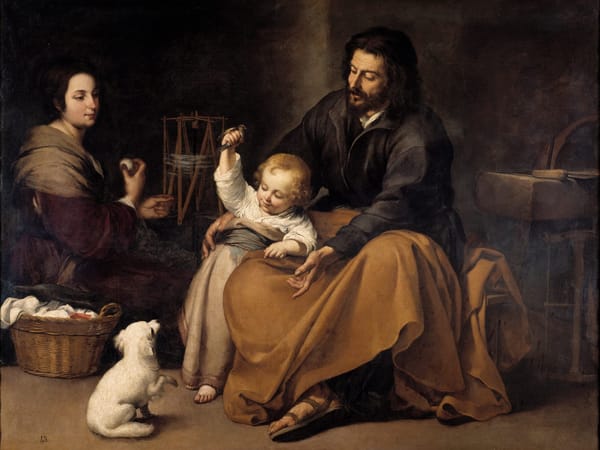
Sunday within the Octave of the Epiphany (or, the Feast of the Holy Family)
THIS Sunday has been chosen by the Church for the celebration of the Feast of the Holy Family; the liturgy of the day, as expressed in the Gospel, harmonizes well with the mystery of the new Feast, for it already carries us forward to the childhood of our Emmanuel and gives us those wonderful words which, after the example of his Blessed Mother, we must ever ponder within our hearts: ‘And he went down with them and came to Nazareth and was subject to them.’
The Feast of the Holy Family is of recent origin. In 1663 Barbara d'Hillehoust founded at Montreal the Association of the Holy Family; this devotion soon spread and in 1893 Leo XIII expressed his approval of a feast under this title and himself composed part of the Office. The Feast was welcomed by succeeding Pontiffs as an efficacious means for bringing home to the Christian people the example of the Holy Family at Nazareth, and by the restoration of the true spirit of family life, stemming, in some measure, the evils of present-day society. These motives led Benedict XV to insert the Feast in the universal Calendar, and from 1921 it has been fixed for this present Sunday.
Mass
The Introit recalls the joy that must have filled the cave of Bethlehem on that Christmas night; let us again rejoice with Mary and Joseph and sing the praises of the resting-place of the Lord of Hosts.
Introit
The Church prays in the Collect that the home life of every Christian family may be sanctified and perfected by the example of that of the Holy Family; this is her unceasing wish for her children.
Collect
Commemoration is made of the Sunday within the Octave:
Then of the Epiphany:
Epistle
Cap. III.Fratres, induite vos, sicut electi Dei, sancti, et dilecti, viscera misericordiæ, benignitatem, humilitatem, modestiam, patientiam, supportantes invicem, et donantes vobismetipsis, si quis adversus aliquem habet querelam: sicut et Dominus donavit vobis, ita et vos. Super omnia autem hæc, caritatem habete, quod est vinculum perfectionis: et pax Christi exsultet in cordibus vestris, in qua et vocati estis in uno corpore; et grati estote. Verbum Christi habitet in vobis abundanter, in omni sapientia, docentes, et commonentes vosmetipsos, psalmis, hymnis, et canticis spiritualibus, in gratia cantantes in cordibus vestris Deo. Omne quodcumque facitis, in verbo aut in opere, omnia in nomine Domini nostri Jesu Christi, gratias agentes Deo et Patri per Jesum Christum Dominum nostrum.
Ch. III.Brethren, put ye on therefore as the elect of God. holy, and beloved, the bowels of mercy, benignity, humility, modesty, patience; bearing with one another, and forgiving one another, if any have a complaint against another; even as the Lord hath forgiven you, so you also. But above all these things have charity, which is the bond of perfection; and let the peace of Christ rejoice in your hearts, wherein also you are called in one body; and be ye thankful. Let the word of Christ dwell in you abundantly in all wisdom, teaching and admonishing one another in psalms, hymns, and spiritual canticles, singing in grace in your hearts to God. All whatsoever you do in word, or in work, all things do ye in the name of the Lord Jesus Christ, giving thanks to God and the Father, through Jesus Christ our Lord.
If we would attain to charity, the bond of perfection which unites all Christians together in the one great family of God, we must pay heed to those virtues which the Epistle puts before us. We must be full of mercy, benignity, humility, modesty and patience; we must bear with one another and forgive one another, after the example of the Incarnate Word. Then the peace of Christ will dwell not only in our hearts, but in those around us, and our homes will truly become like that of Nazareth, where Mary and Joseph were ever singing in grace to the Lord God.
In the Gradual Holy Church again celebrates the praises of the House of the Lord; she proclaims the blessedness of those that obtain lasting fellowship in the heavenly home above; yet in the Alleluia verse she recalls the lowliness of the earthly home of our Emmanuel which made him truly a hidden King.
Gradual (Ps. xxiii)
Alleluia, alleluia. ℣. Isa. 45. Vere tu es Rex absconditus. Deus Isræl Salvator. Alleluia.
Alleluia, alleluia. ℣. Isa. 45. Verily thou art a hidden King, the God of Israel, the Saviour. Alleluia.
Gospel
Cap. II.Cum factus esset Jesus annorum duodecim, ascendentibus illis Jerosolymam secundum consuetudinem diei festi, consummatisque diebus, cum redirent, remansit puer Jesus in Jerusalem, et non cognoveruntparentes ejus. Existimantes autem ilium esse in comitatu, venerunt iter diei, et requirebant eum inter cognatos et notos. Et non invenientes, regressi sunt in Jerusalem, requirentes eum. Et factum est, post triduum invenerunt illum in tempio sedentem in medio doctorum, audientem illos, et interrogantem eos. Stupebant autem omnes, qui eum audiebant, super prudentia et responsis ejus. Et videntes admirati sunt. Et dixit mater ejus ad ilium: Fili, quid fecisti nobis sic? ecce pater tuus et ego dolentes quærebamus te. Et ait ad illos: Quid est quod me quærebatis? Nesciebatis quia in his quæ Patris mei sunt, oportet me esse? Et ipsi non intellexerunt verbum, quod locutus est ad eos. Et descendit cum eis, et venit Nazareth: et erat subditus illis. Et mater ejus conservabat omnia verba hæc in corde suo. Et Jesus proficiebat sapientià, et ætate, et gratia apud Deum et homines.
Ch. II.When Jesus was twelve years old, they went up to Jerusalem, according to the custom of the feast; and having fulfilled the days, when they returned, the Child Jesus remained in Jerusalem, and his parents knew it not. And thinking that he was in the company, they came a day’s journey, and sought him among their kinsfolk and acquaintance. And not finding him, they returned into Jerusalem, seeking him. And it came to pass, that after three days they found him in the temple, sitting in the midst of the doctors, hearing them, and asking them questions. And all that heard him were astonished at his wisdom and his answers. And seeing him, they wondered. And his Mother said to him: Son, why hast thou done so to us? Behold thy father and I have sought thee sorrowing. And he said to them: How is it that you sought me? Did you not know that I must be about my Father’s business? And they understood not the word that he spoke unto them. And he went down with them, and came to Nazareth, and was subject to them. And his Mother kept all these words in her heart. And Jesus advanced in wisdom, and age, and grace with God and men.
Thus, O Jesus! didst thou come down from heaven to teach us. The tender age of Childhood, which thou didst take upon thyself, is no hindrance to the ardour of thy desire that we should know the one only God, who made all things, and thee, his Son, whom he sent to us. When laid in the Crib, thou didst instruct the Shepherds by a mere look; when swathed in thy humble swaddling-clothes, and subjected to the voluntary silence thou hadst imposed on thyself, thou didst reveal to the Magi the light they sought in following the star. When twelve years old, thou explainest to the Doctors of Israel the Scriptures which bear testimony to thee. Thou gradually dispellest the shadows of the Law by thy presence and thy words. In order to fulfil the commands of thy heavenly Father, thou dost not hesitate to occasion sorrow to the heart of thy Mother, by thus going in quest of souls that need enlightening. Thy love of man will pierce that tender Heart of Mary with a still sharper sword, when she shall behold thee hanging on the Cross, and expiring in the midst of crudest pain. Blessed be thou, sweet Jesus, in these first Mysteries of thine Infancy, wherein thou already showest thyself devoted to us, and leavest the company of thy Blessed Mother for that of sinful men, who will one day conspire thy Death.
The Offertory takes us in thought to the Feast of the Purification; let us again offer ourselves to the Lord.
Offertory (Luke ii)
In the Secret the Church again prays that she may be strengthened in peace and grace; these gifts have been purchased for us by our Lord himself; it is through the Holy Mass that we can be more strongly established in them.
Secret
Commemoration of the Sunday
Commemoration of the Epiphany
The Preface is as on the Epiphany, p. 126.
The Communion recalls the subject of to-day's Gospel; let us never cease to meditate on the divine humility shown us in these words.
Communion (Luke ii)
If we have kept before our eyes the example of the holy Family, we may humbly trust that at the hour of our death we shall be helped and consoled and be found worthy to have fellowship with Christ in the eternal dwellings. Such is the last prayer of the Church, and may it be one we love to repeat and dwell on.
Postcommunion
Commemoration of the Sunday
Commemoration of the Epiphany
Vespers
Antiphons
The Psalms are from the Common of the Blessed Virgin Mary, and will be found on the Feast of the Purification, p. 488.
Little Chapter
(Luke ii)
Hymn
Et summa spes mortalium, Jesu,
O cui domestica
Arrisit orto caritas.
O sola quæ casto potes
Fovere Jesum pectore,
Cum lacte donans oscula.
Delecte custos Virginis,
Dulci patris quem nomine
Divina proies invocat.
Nati in salutem gentium,
Audite nos qui supplices
Vestras ad aras sistimus.
Rebus nitorem detrahit,
Nos hic manentes intimo
Ex corde vota fundimus.
Virtutis omnis gratia,
Hanc detur in domesticis
Referre posse moribus.
Qui natus es de Virgine,
Cum Patre, et almo Spiritu,
In sempiterna sæcula.
Sole hope of them that dwell on earth,
The purest love that ever graced
A home, did smile upon thy birth.
Was ever yet so rich in grace?
Didst nourish Christ upon thy knee
And fold him in a sweet embrace?
The Virgin with thy gentle might,
The Infant Jesus smiled on thee
And called thee father as by right.
Were born of David’s noble line,
O hear the humble prayers of all
To-day, who gather round your shrine.
And earth is veiled in shadows gray;
Yet hearts a-fire with joy and love
Still bid us linger on to pray.
Which held the earthly Trinity,
Be shed abroad upon the world
And bless the Christian family.
Immortal glory be to thee;
Praise to the Father infinite
And Holy Ghost eternally.
At the Magnificat
Collect as at Mass, p. 139.
Commemoration of the Epiphany
or—
The Collect as on p. 139.
Commemoration of the Sunday
The Collect as on p. 139.
MASS OF THE SUNDAY WITHIN THE OCTAVE OF THE EPIPHANY
(In some Churches, the Feast of the Holy Family is not observed on this day; the Mass will then be of the Sunday.)
It is the Kingship of the divine Infant that the Church again proclaims in the opening Canticle of the Mass for the Sunday within the Octave of the Epiphany. She sings the praises of her Emmanuel's Throne, and takes her part with the Angels who hymn the glory of Jesus' eternal Empire. Let us do the same, and adore the King of Ages, in his Epiphany.
Introit
The Collect is given on p. 139.
Epistle
Cap. XII.Fratres, obsecro vos per misericordiam Dei, ut exhibeatis corpora vestra hostiamviventem, sanctam, Deo placentem, rationabile obsequium vestrum. Et nolite conformari huic sæculo, sed reformamini in novitate sensus vestii: ut probetis quse sit voluntas Dei bona, et beneplacens, et perfecta. Dico enim per gratiam quæ data est mihi, omnibus qui sunt inter vos: Non plus sapere quam oportet sapere, sed sapere ad sobrietatem: et unicuique sicut Deus divisit mensuram fidei. Sicut enim in uno corpore multa membra habemus, omnia autem membra non eumdem actum habent: ita multi unum corpus sumus in Christo, singuli autem alter alterius membra: in Christo Jesu Domino nostro.
Ch. XII.Brethren, I beseech you, by the mercy of God, that you present your bodies a living sacrifice, holy, pleasing unto God, your reasonable service. And be not conformed to this world, but be reformed in the newness of your mind: that you may prove what is the good, and the acceptable, and the perfect will of God. For I say, by the grace that is given me, to all that are among you, not to be more wise than it behoveth to be wise, but to be wise unto sobriety, and according as God hath divided unto every one the measure of faith. For as in one body we have many members, but all the members have not the same office: so we, being many, are one body in Christ, and every one members of one another, in Jesus Christ our Lord.
The Apostle invites us to make our offering to the new-born King, after the example of the Magi; but the offering which this Lord of all things asks of us is not anything material or lifeless. He that is Life gives his whole self to us; let us, in return, present him our hearts, that is, a living sacrifice, holy, pleasing unto God; whose service may be reasonable, that is, whose obedience to the divine will may be accompanied by a formal intention of offering itself to its Creator. Here again, let us imitate the Magi, who went back another way into their own country—let us not adopt the ideas of this world, for the world is the covert enemy of our beloved King. Let us reform our worldly prudence according to the divine wisdom of Him, who may well be our guide, seeing he is the Eternal Wisdom of the Father. Let us understand, that no man can be wise without Faith, which reveals to us that we must all be united by love, so as to form one body in Christ, partaking of his life, his wisdom, his light, and his kingly character.
In the chant which follows the Epistle, the Church returns to her praise of the ineffable wonders of a God with us: Justice and righteousness have come down from heaven, to take up their abode on our mountains and hills.
Gradual
Alleluia, alleluia. ℣. Jubilate Deo omnis terra: servite Domino in lætitia. Alleluia.
Alleluia, alleluia. ℣. Sing joyfully to the Lord, ail the earth: serve ye the Lord with gladness. Alleluia.
The Gospel is the one for the Feast of the Holy Family, p. 141.
During the Offertory, the Church resumes her canticles of joy; the presence of the Divine Infant fills her with joy.
Offertory
The Secret is given on p. 143.
Whilst distributing the Bread of Life come down from heaven, the Church repeats the words addressed by Mary to her Son: Why hast thou done so to us? I and thy father have sought thee. The Good Shepherd, who feeds his Sheep with his own Flesh, replies, that he must needs do the will of his Father who is in heaven. He is come to be our Life, our light, and our food: he, therefore, leaves everything in order to give himself to us. But, whilst the Doctors in the Temple only saw and heard him, we, in this Living Bread, possess him and are united with him in sweetest union.
Communion
The Postcommunion is given on p. 144.
January 12: The Seventh Day within the Octave of the Epiphany
HAVING laid their offerings at the feet of Jesus, as the sign of the alliance they had, in the name of all mankind, contracted with him, and laden with his graces and blessings, the Magi take their leave of the Divine Babe; for such was his will. They take their departure from Bethlehem, and the rest of the world seems a wilderness to them. Oh, if they might be permitted to fix their abode near the new-born King and his incomparable Mother! But no; God's plan for the salvation of the world requires that everything savouring of human pomp and glory should be far from him who had come to take upon himself all our miseries.
Besides, they are to be the first messengers of the Gospel; they must go and tell to the Gentiles that the Mystery of Salvation has begun, that the earth is in possession of its Saviour, and that their salvation is nigh at hand. The star does not return to them; they needed it to find Jesus; but now they have him in their hearts, and will never lose him. These three men are sent back into the midst of the Gentile world, as the leaven of the Gospel which, notwithstanding its being so little, is to leaven the whole paste.* For their sakes, God will bless the nations of the earth; from this day forward infidelity will lose ground, and faith will progress; and when, the Blood of the Lamb having been shed, Baptism shall be promulgated, the Magi shall be, not merely men of desire, but perfect Christians, initiated into all the Mysteries of the Church.
The ancient tradition, which is quoted by the author of The Imperfect Work on St Matthew, which is put in all the editions of St John Chrysostom, and was probably written about the close of the 6th century, tells us that the three Magi were baptized by St Thomas the Apostle, and devoted themselves to the preaching of the Gospel. But we scarcely need a tradition on such a point as this. The vocation of these three Princes could never be limited to the mere privilege of being the first among the Gentiles to visit the eternal King who had come down from heaven to be born on this earth and show himself to his creatures; a second vocation was the consequence of the first, the vocation of preaching Jesus to men.
There are many details relating to the life and actions of the Magi, after they had become Christians, which have been handed down to us; but we refrain from mentioning them, as not being sufficiently ancient or important traditions to have induced the Church to give them place in her Liturgy. We would make the same observation with regard to the names assigned to them of Melchior, Gaspar, and Balthassar; the custom of thus naming them is too modern to deserve credit; and though it might be indiscreet to deny that these were their true names, it seems very difficult to give proofs of their correctness.
The Relics of these holy Kings were translated from Persia to Constantinople, under the first Christian Emperors, and, for a long time, were kept in the Church of Saint Sophia. At a later period, they were translated to Milan, when Eustorgius was Bishop of that city. There they remained till the 12th century, when, through the influence of the Emperor Frederic Barbarossa, they were translated to the Cathedral Church of Cologne by Reynold, Archbishop of that metropolitan see. The Relics are in a magnificent Shrine, perhaps the finest specimen now extant of medieval metallic art, and the superb Cathedral where it is religiously kept is, by its size and architectural beauty, one of the grandest Churches of the Christian world.
Thus have we followed you, O Blessed Magi! Fathers of the Gentile world! from your first setting out from the East for Bethlehem to your return to your own country, and even to your sacred resting-place; which the goodness of God has made to be in this cold West of ours. It was the love of children for their parents that made us thus cling to you. Besides, were we not ourselves in search of that dear King whom you so longed for and found? Blessed be those ardent desires of yours, blessed be your obedience to the guidance of the star, blessed be your devotion at the Crib of Jesus, blessed be the gifts you made him, which, while they were acceptable to God, were full of instruction to us! We revere you as Prophets, for you foretold the characters of the Messias by the selection of your three gifts. We honour you as Apostles, for you preached, even to Jerusalem herself, the Birth of the humble Jesus of Bethlehem, of that Jesus whom his Disciples preached not till after the triumph of his Resurrection. We hail you as the Spring Flowers of the Gentile world, but Flowers which produced abundant and rich fruits, for you brought over entire nations and countless people to the service of our divine King. Watch over us, and protect the Church. Be mindful of those Eastern countries, whence rises to the earth the light of day, the beautiful image of your own journey towards Bethlehem. Bless this Western world of ours, which was buried in darkness when you first saw the star, and is now the favoured portion of God's earth, and on which the Divine Sun of Justice pours forth his brightest and warmest rays. Faith has grown weak among us; reenkindle it. Obtain of the divine mercy that the West may ever send forth her messengers of salvation to the South and North, and even to that infidel East, where are laid the tents of Sem, and where the light that you gave her has been long extinguished by her apostasy. Pray for the Church of Cologne, that illustrious sister of our holiest Churches in the West; may she preserve the faith, may she defend her sacred rights and liberty; may she be the bulwark of Catholic Germany, and be ever blessed by the protection of her Three Kings, and the patronage of the glorious Ursula and her virginal army. Lastly, we beseech you, O venerable Magi! to introduce us to the Infant Jesus, and his Blessed Mother; and grant us to go through these forty days, which the Church consecrates to the Mystery of Christmas, with hearts burning with love for the Divine Child, and may that same love abide with us during the pilgrimage of our life on this earth.
To-day, also, we will make use of the formulas employed by the several ancient Churches in honour of the Mystery of the Epiphany. Our first selection is a hymn written by the great Fulbert of Chartres.
Hymn
Natus est Christus, Dominator orbis,
In Bethlehem Judæ; sic enim Propheta
Dixerat ante.
Hunc canit lætus chorus Angelorum,
Stella declarat, veniunt Eoi
Principes, dignum celebrare cultum,
Mystica dona.
Thus Deo, myrrham tribuunt sepulchro,
Auream Regi speciem decenti,
Dum colunt unum, meminere Trino
Tres dare terna.
Gloriam trinæ monadi canamus,
Cum Deo divæ Genitore Proli,
Flamini necnon ab utroque fuso
Corde fideli.
Christ, the Ruler of the earth,
is born in Bethlehem of Juda:
for thus was it foretold by the Prophet.’
the same is announced by the Star,
and the Eastern Kings come to offer to Jesus
the worthy homage of their mystic gifts.
the Myrrh honours his sepulchre; the Gold is the token of his Kingly character.
Whilst thus worshipping One,
the three offerers give three gifts to the Blessed Three,
glory to the Father, and to his divine Son,
and to the Holy Spirit, who is sent into the hearts of the faithful
by the Father and the Son.
Prayer
Prayer
We take the following Sequence from the ancient Missals of the Churches of Germany.
Sequence
Celebremus cum honore
Diem natalitium.
Nobis datus, nobis natus,
Et nobiscum conversatus,
Lux et salus gentium.
Eva prius interemit;
Sed Salvator nos redemit
Carnis suæ merito.
Prima parens nobis luctum,
Sed Maria vitæ fructum
Protulit cum gaudio.
Negligentes non neglexit,
Sed ex alto nos prospexit
Pater mittens Filium.
Præsens mundo, sed abs consus,
De secreto tamquam sponsu:
Prodiit in publicum.
Gigas velox, gigas fortis,
Gigas nostræ victor mortis,
Accinctus potentia.
Ad currendam venit viam,
Complens in se prophetiam
Et Legis mysteria.
Jesu, nostra salutaris
Medicina, singularis
Nostra pax et gloria;
Quia servis redimendis
Tam decenter condescendis,
Te collaudant omnia.
Amen.
Let us solemnly celebrate
his Birthday.
and with us has he lived,
he the light and salvation of the Gentiles.
but Jesus, by the merits of the human nature he assumed,
has redeemed us.
but Mary joyfully brought forth
for us the fruit of life.
he looked down upon us from heaven,
and sent us his only Son.
but, at length he came forth as a Bridegroom from the nuptial chamber,
and made himself known.
and vanquishing our death,
for he was girt with power.
and so verify the prophecy,
and the mysteries of the Law.
saving medicine,
our only Peace and glory!
for that thou didst so mercifully condescend
to redeem us thy servants!
This beautiful canticle in honour of the Infant Jesus is from the pen of St Ephrem, the sublime bard of the Syrian Church.
Hymn
The Menæa of the Greek Church furnish us with these beautiful stanzas in honour of the holy Mother of God.
Die XVI Januarii
* St Matt. xiii 33. ↩︎
January 12 (the Same Day): St. Benet Biscop, Bishop
ST BENET BISCOP is one of the great Benedictine saints to whom England owes so much. His devotion and loyalty to the Holy See, his love of learning, his zeal for the beauty of the house of God, for the monastic observance and for the Church's chant, show him to be a true monk, though his influence extended far wider than the narrow limits of his monastery, and affected the social condition of the people and the whole life of the Church in England. His feast is kept in several dioceses in England, but as there is no uniformity with regard to the date, we have inserted it in our calendar on the day of his death.
St Benet stands out among the great travellers in the cause of religion. He visited Rome no fewer than seven times, not only to satisfy his own devotion, but to obtain from the mother of all the churches the purest traditions, the most correct books for use in the divine liturgy, and objects of piety wherewith to inspire the devotion of the faithful. These treasures were all destined to be used for the benefit of his own countrymen, who were unable to seek them for themselves at the fountain-head. He inspired all those with whom he came in contact with a more exalted idea of the dignity of the worship of God. With regard to the Divine Service, his ruling principle was that nothing but the best was worthy of use, whether it were in the carrying out of liturgical functions or the actual fabric of the church. In his day Britain was far behind the continental nations in industry and art, and stone buildings were hardly known. St Benet, therefore, journeyed into Gaul to procure stonemasons, who came to the monastery at Wearmouth in Northumbria, and, with the help of the monks whom they instructed, built a stone church for the Community. The making and use of glass was also unknown in these islands at the time, and again St Benet sent messengers to Gaul who brought back workers in glass to glaze the windows of his church.
The record of St Benet's life has come down to us as written by the Venerable Bede, who was a monk of the abbey founded by the saint at Jarrow. Bede was admitted into this monastery when a child, during the lifetime of St Benet Biscop, and thus in his Life speaks from personal experience. He records several charming incidents which are not included in the Breviary lessons, one of which is given here as being illustrative of the saint's zeal for the Divine Office.
The Venerable Bede records that once during a visitation of the pestilence the monks at Jarrow were all stricken with the sickness with such severity that there remained but two persons in the house who were able to go to the church to sing the Divine Office, the Abbot Benet and Bede, who was still a child. These two performed the duties of the whole choir with unflagging zeal until the monks gradually regained sufficient strength to resume their share of the work of God. One can well imagine the joy of the angels at the sight of the venerable Abbot and the innocent child, each intent upon performing his share of the psalmody with exactitude so that it might never be said that the praise of God had ceased to resound through the Abbey church.
The following is the life of the saint as given in the Breviary lessons.
| Previous January 11 (the Same Day): St. Hyginus, Pope and Martyr | Next January 12: The Seventh Day within the Octave of the Epiphany |