Daily reading
Epiphanytide
Double · Temporal
January 26, 2020
From Dom Guéranger’s The Liturgical Year.

|
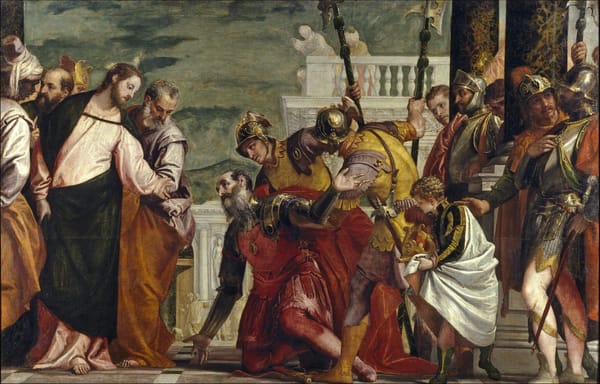
The Third Sunday after Epiphany
THE variation of Easter Sunday necessitates almost every year a different arrangement of the Sundays after the Epiphany from that in which they stand in the Missal. Septuagesima often comes in January and the Feast of the Purification is occasionally later than Quinquagesima Sunday; hence the office of these four last Sundays may have to be transferred to another season of the liturgical cycle. We were obliged then to provide for these changes and simplify them for the Faithful by adopting our present plan. We have inserted here the third and fourth Sundays as usually falling in Christmastide, while the office of the fifth and sixth Sundays will be found in the volumes of Septuagesima and the second after Pentecost, this latter season being the one in which they are most frequently kept.
Mass
The Introit represents the Angels of God adoring him on his entrance into this world, as St Paul* explains this passage of the Psalms. The Church celebrates with David the gladness of Sion, and the joy of the daughters of Juda.
Introit
Collect
Commemoration of the Blessed Virgin Mary
The third Prayer is one of the following:
Against the persecutors of the Church
For the Pope
Epistle
Cap. XII.Fratres, nolite esse prudentes apud vosmetipsos: nulli malum pro malo reddentes: providentes bona non tantum coram Deo, sed etiam coram omnibus hominibus; si fieri potest, quod ex vobis est, cum omnibus hominibus pacem habentes: non vosmetipsos defendentes, carissimi, sed date locum iræ; scriptum est enim; Mihi vindicta, ego retribuam, dicit Dominus. Sed si esurierit inimicus tuus, ciba ilium; si sitit, potum da illi: hoc enim faciens, carbones ignis congeres super caput ejus. Noli vinci a malo, sed vince in bono malum.
Ch. XII.Brethren, be not wise in your own conceits. To no man rendering evil for evil. Providing good things not only in the sight of God, but also in the sight of all men. If it be possible, as much as in you, having peace with all men. Not revenging yourselves, my dearly beloved, but give place unto wrath. For it is written: 'Revenge to me, I will repay,' saith the Lord. But 'if thy enemy be hungry, give him to eat: if he thirst, give him to drink: for doing this, thou shalt heap coals of fire upon his head.’ Be not overcome by evil, but overcome evil by good.
This love of our neighbour, recommended to us by the Apostle, is a consequence of that universal brotherhood which our Saviour, by his Birth, brought us from heaven. He came to establish peace between heaven and earth; men, therefore, ought to be at peace one with another. Our Lord bids us not to be overcome by evil, but to overcome evil by good:—and did not he first practise this by coming among us, who were children of wrath, that he might make us children of adoption by his humiliations and his sufferings?
In the Gradual, the holy Church again celebrates the coming of Emmanuel, and invites all nations, and all the kings of the earth, to come and praise his holy name.
Gradual
Gospel
Cap. VIII.In illo tempore, Cum descendisset Jesus de monte, secutæ sunt eum turbæ multæ; et ecce leprosus veniens, adorabat eum dicens: Domine, si vis, potes me mundare. Et extendens Jesus manum, tetigit eum dicens: Volo, mundare. Et confestim mundata est lepra ejus. Et ait illi Jesus: Vide, nemini dixeris; sed vade, ostende te sacerdoti et offer munus, quod præcepit Moyses, in testimonium illis. Cum autem introisset Capharnaum, accessit ad eum centurio, rogans eum et dicens; Domine, puer meus jacet in domo paralyticus, et male torquetur. Et ait illi Jesus: Ego veniam et curabo eum. Et respondens centurio, ait: Domine, non sum dignus ut intres sub tectum meum; sed tantum dic verbo, et sanabitur puer meus. Nam et ego homo sum sub potestate constitutus, habens sub me milites, et dico huic: vade, et vadit; et alii: veni, et venit; et servo meo: fac hoc, et facit. Audiens autem Jesus, miratus est, et sequentibus se dixit: Amen dico vobis, non inveni tantam fidem in Isræl. Dico autem vobis, quod multi ab oriente et occidente venient, et recumbent cum Abraham et Isaac et Jacob in regno cœlorum; filii autem regni ejicientur in tenebras exteriores: ibi erit fletus et stridor dentium. Et dixit Jesus centurioni: Vade, et sicut credidisti, fiat tibi. Et sanatus est puer in illa hora.
Ch. VIII.At that time, when Jesus was come down from the mountain, great multitudes followed him; and behold a leper came and adored him, saying: Lord, if thou wilt, thou canst make me clean. And Jesus stretching forth his hand, touched him, saying: I will, be thou made clean. And forthwith his leprosy was cleansed. And Jesus saith to him: See thou tell no man, but go, show thyself to the priest, and offer the gift which Moses commanded for a testimony unto them. And when he had entered unto Capharnaum, there came to him a centurion, beseeching him, and saying: Lord, my servant lieth at home sick of the palsy, and is grievously tormented. And Jesus saith to him: I will come and heal him. And the centurion making answer, said: Lord, I am not worthy that thou shouldst enter under my roof; but only say the word, and my servant shall be healed. For I also am a man under authority, having under me soldiers; and I say to this, Go, and he goeth, and to another, Come, and he cometh, and to my servant, Do this, and he doeth it. And when Jesus heard this, he marvelled, and said to them that followed him: Amen, I say to you, I have not found so great faith in Israel. And I say unto you, that many shall come from the east and the west, and shall sit down with Abraham, and Isaac, and Jacob, in the kingdom of heaven; but the children of the kingdom shall be cast out into the exterior darkness: there shall be weeping and gnashing of teeth. And Jesus said to the centurion: Go, and as thou hast believed, so be it done to thee. And the servant was healed at the same hour.
The human race was infected with the leprosy of sin: the Son of God touches it by the mystery of the Incarnation, and restores it to health. But he requires that the sick man, now that he is healed, shall go and show himself to the priest, and comply with the ceremonies prescribed by the law; and this, to show that he allows a human priesthood to co-operate in the work of our salvation. The vocation of the Gentiles, of which the Magi were the first-fruits, is again brought before us in the faith of the centurion. A Roman soldier, and millions like him, shall be reputed as true children of Abraham, Isaac and Jacob; while they who are the sons of this Patriarch according to the flesh, shall be cast out from the feast-chamber into the gloom of blindness; and their punishment shall be given as a spectacle to the whole earth.
Let man, then, saved as he has been by the coming of Emmanuel, sing a hymn of praise to the power of God, who has wrought our salvation by the strength of his almighty arm. Man had been sentenced to death; but now that he has God for a Brother, he shall not die: he will live: and could he spend his life better than in praising the works of this God that has saved him?
Offertory
Secret
Commemoration of the Blessed Virgin Mary
Against the persecutors of the Church
For the Pope
Preface
℣. Dominus vobiscum. ℟. Et cum spiritu tuo.
℣. Sursum corda. ℟. Habemus ad Dominum.
℣. Gratias agamus Dominum Deo nostro. ℟. Dignum et justum est.
℣. The Lord be with you. ℟. And with thy spirit.
℣. Lift up your hearts. ℟. We have them fixed on God.
℣. Let us give thanks to the Lord our God. ℟. It is meet and just.
After having distributed the Bread of Life, the Church reminds us how the people were in admiration at the words of Jesus. The children of the Church, initiated into all his Mysteries, are at this moment enjoying the effects of that ineffable Word, by means of which the Redeemer has changed the bread into his Body, and the wine into his Blood.
Communion
Postcommunion
Commemoration of the Blessed Virgin Mary
Against the persecutors of the Church
For the Pope
Vespers
The Psalms, Antiphons, Capitulum, Hymn, and Versicle are given on pages 89-96.
Antiphon of the Magnificat
* Heb. i 6. ↩︎
January 26: St. Polycarp, Bishop and Martyr
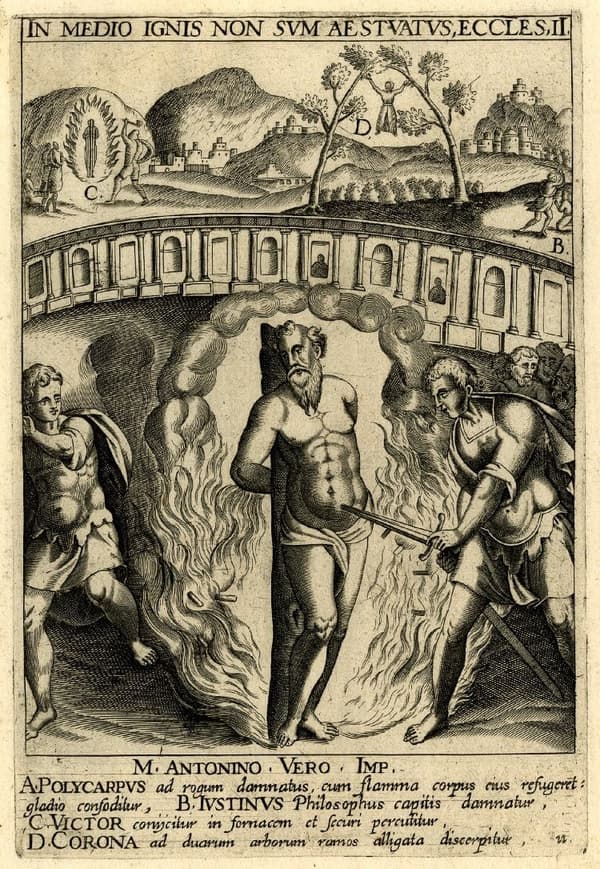 |
AMIDST the sweetness he is enjoying from the contemplation of the Word made Flesh, John, the Beloved Disciple, beholds coming towards him his dear Polycarp, the Angel of the Church of Smyrna,1 all resplendent with the glory of martyrdom. This venerable Saint has in his soul the fervent love that made him say in the amphitheatre, when asked by the Proconsul to curse his Divine Master: "Six-and-eighty years have I served Him, and he has never done me any wrong; nay, he has laden me with kindness. How could I blaspheme my King, who has saved me?" After having suffered fire and the sword, he was admitted into the presence of this King his Saviour, in reward for the eighty-six years of his faithful service, for the labours he had gone through in order to maintain faith and charity among his flock, and for the cruel death he endured.
He was a disciple of St John the Evangelist, whom he imitated by zealously opposing the heretics, who were then striving to corrupt the faith. In obedience to the command of his holy Master,2 he refused to hold intercourse with Marcion, the heresiarch, whom he called the first-born of Satan. This energetic adversary of the proud sect that denied the mystery of the Incarnation, wrote an admirable Epistle to the Philippians, in which we find these words: Whosoever confesses not that Jesus Christ came in the flesh, is an Antichrist. Polycarp, then, had a right to the honour of standing near the Crib, in which the Son of God shows himself to us in all his loveliness, and clothed in flesh like unto our own. Let us honour this disciple of John, this friend of Ignatius, this Bishop of the Apostolic Age, whose praise was pronounced by Jesus Christ himself in the Revelations of Patmos. Our Saviour said to him by the mouth of Saint John: Be thou faithful unto death, and I will give thee the crown of life.3 Polycarp was faithful even unto death, and has received his crown; and whilst we are celebrating the coming of his King among us, he is one of the Saints who assist us to profit by the holy season.
The Church gives us a passage from St Jerome's book, On Ecclesiastical Writers, in which there is contained the following short notice of our holy Martyr.
The Greek Church sings the praises of St Polycarp in her Menæa, from which we extract the following passages.
Die XXIII Februarii
Supra crucem visus, et hierarchico ornamento digne indutus, Pater, in templum Dei introisti proprio sanguine.
That thou, O holy Pontiff! mightest be presented to Christ, the Prince of Pastors, as the victim elect marked out by him, thou becamest the imitator of his passion, and art now a partaker of his glory, and the coheir of his kingdom.
How well didst thou bear out the full meaning of thy name, O Polycarp! for thou didst produce many fruits for thy Saviour, during thy six-and-eighty years spent in his service. The numerous souls won over to Christ, the virtues which adorned thy life, and thy life itself, which thou didst present to thy Lord in its full maturity—these were thy fruits. And what happiness was thine to have received instruction from the Disciple that leaned upon Jesus' Breast! After being separated from him for more than sixty years, thou art united with him on this the day of thy martyrdom, and thy venerable master receives thee in a transport of joy. Thou adorest, with him, that Divine Babe, whose simplicity thou hadst imitated during life, and who was the single object of thy love. Ask of him for us, that we too may be Faithful unto death.
By thy prayers, now that thou art throned in heaven, make fruitful the vineyard of the Church, which when on earth thou didst cultivate by thy labours, and water with the blood of thy glorious martyrdom. Re-establish faith and unity in the Churches of Asia, which were founded by thy venerable hand. Hasten, by thy prayers, the destruction of that degrading slavery of Mohammedanism which has kept the East in bondage so long, because her once faithful children severed themselves from Rome by the great schism of Byzantium. Pray for the Church of Lyons, which regards thee as its founder, through the ministry of thy disciple Pothinus, and takes itself so glorious a share in the apostolate of the Gentiles, by the Work of the Propagation of the Faith.
Watch over the purity of our holy Faith, and preserve us from being deceived by false teachers. The error which thou didst combat, and which teaches that all the mysteries of the Incarnation are but empty symbols, has risen up again in these our days. There are Marcions, even now, who would reduce all religion to myths; and they find some few followers; may thy powerful prayers rid the world of this remnant of so impious a doctrine. Thou didst pay homage to the Apostolic Chair, for thou, too, wouldst see Peter, and didst journey to Rome, in order to consult its Pontiff on questions regarding the interests of thy Church of Smyrna. Defend the rights of this august See, whence alone are derived both the jurisdiction of our Pastors, and the authoritative teachings of Faith. Pray for us, that we may spend the remaining days of this holy Season in the contemplation and the love of our new-born King. May this love, accompanied with purity of heart, draw down upon us the merciful blessings of God, and at length, after our course is run, obtain for us the Crown of Life.
| Previous January 25: The Conversion of St. Paul | Next January 26: St. Polycarp, Bishop and Martyr |