Daily reading
Epiphanytide
Double · February 8 · Sanctoral
February 8, 2020
From Dom Guéranger’s The Liturgical Year.
A Double leads the weekday.Rubric
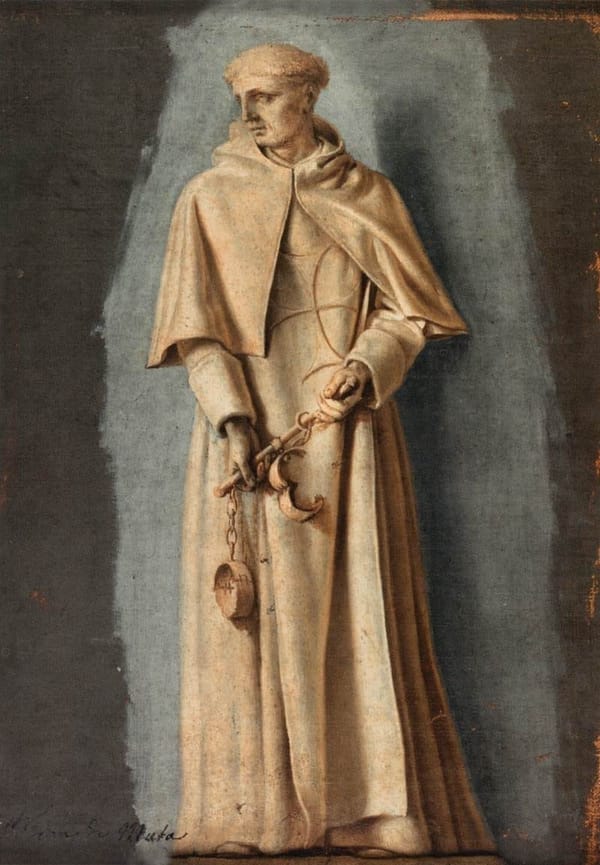 |
February 8: St. John of Matha, Confessor
We were celebrating, not many days ago, the memory of Peter Nolasco, who was inspired, by the holy Mother of God, to found an Order for the ransoming of Christian captives from the infidels: to-day, we have to honour the generous saint, to whom this sublime work was first revealed. He established, under the name of the most holy Trinity, a body of religious men, who bound themselves by vow to devote their energies, their privations, their liberty, nay, their very life, to the service of the poor slaves who were groaning under the Saracen yoke. The Order of the Trinitarians, and the Order of Mercy, though distinct, have the same end in view, and the result of their labours, during the six hundred years of their existence, has been the restoration to liberty and preservation from apostasy of upwards of a million slaves. John of Matha, assisted by his faithful co-operator, Felix of Valois (whose feast we shall keep at the close of the year), established the centre of his grand work at Meaux, in France. We are preparing for Lent, when one of our great duties will have to be that of charity towards our suffering brethren: what finer model could we have than John of Matha, and his whole Order, which was called into existence for no other object than that of delivering from the horrors of slavery brethren who were utter strangers to their deliverers, but were in suffering and in bondage. Can we imagine any almsgiving, let it be ever so generous, which can bear comparison with this devotedness of men, who bind themselves by their rule, not only to traverse every Christian land begging alms for the ransom of slaves, but to change places with the poor captives, if their liberty cannot be otherwise obtained? Is it not, as far as human weakness permits, following to the very letter the example of the Son of God Himself, who came down from heaven that He might be our ransom and our Redeemer? We repeat it: with such models as these before us, we shall feel ourselves urged to follow the injunction we are shortly to receive from the Church, of exercising works of mercy towards our fellow-creatures, as being one of the essential elements of our lenten penance.
But it is time we should listen to the account given us by the liturgy of the virtues of this apostolic man, who has endeared himself, both to the Church and to mankind, by his heroism of charity.
And now, generous-hearted saint, enjoy the fruits of thy devoted charity. Our blessed Redeemer recognizes thee as one of His most faithful imitators, and the whole court of heaven is witness of the recompense wherewith He loves to honour thy likeness to Himself. We must imitate thee; we must walk in thy footsteps; for we too hope to reach the same eternal resting-place. Fraternal charity will lead us to heaven, for the works it inspires us to do have the power of freeing the soul from sin, as our Lord assures us.1 Thy charity was formed on the model of that which is in the heart of God, who loves our soul yet disdains not to provide for the wants of our body. Seeing so many souls in danger of apostasy, thou didst run to their aid, and men were taught to love a religion which can produce heroes of charity like thee. Thy heart bled at hearing of the bodily sufferings of these captives, and thy hand broke the chains of their galling slavery. Teach us the secret of ardent charity. Is it possible that we can see a soul in danger of being lost, and remain indifferent? Have we forgotten the divine promise, told us by the apostle: ‘He that causeth a sinner to be converted from the error of his way, shall save his soul from death, and shall cover a multitude of his own sins’?2 Obtain for us, also, a tender compassion for such as are in bodily suffering and poverty, that so we may be generous in comforting them under these trials, which are but too often an occasion of their blaspheming Providence. Dear friend and liberator of slaves! pray, during this holy season, for those who groan under the captivity of sin and Satan; for those, especially, who, taken with the frenzy of earthly pleasures, feel not the weight of their chains, but sleep on peacefully through their slavery. Ransom them by thy prayers, convert them to the Lord their God, lead them back to the land of freedom. Pray for France which was thy country, and save her from infidelity. Protect the venerable remnants of thy Order, that so it may labour for the present wants of the Christian world, since the object for which thou didst institute it has ceased to require its devotedness.
Saturday before Septuagesima Sunday
Suspension of the Alleluia
The calendar of the liturgical year will soon bring us to the commemoration of the Passion and Resurrection of our Redeemer; we are but nine weeks from these great solemnities. It is time for the Christian to be preparing his soul for a fresh visit from his Saviour; a visit even more sacred and more important than that He so mercifully paid us at His Birth.
Our holy mother the Church knows how necessary it is for her to rouse our hearts from their lethargy, and give them an active tendency towards the things of God. On this day, the eve of Septuagesima, she uses a powerful means for infusing her own spirit into the minds of her children. She takes the song of heaven away from us: she forbids our further uttering that Alleluia, which is so dear to us, as giving us a fellowship with the choirs of angels, who are for ever repeating it. How is it that we poor mortals, sinners, and exiles on earth, have dared to become so familiar with this hymn of a better land? It is true, our Emmanuel, who established peace between God and men, brought it us from heaven on the glad night of His Birth; and we have had the courage to repeat it after the angels, and shall chant it with renewed enthusiasm when we reach our Easter. But to sing the Alleluia worthily, we must have our hearts set on the country whence it came. It is not a mere word, nor a profane unmeaning melody; it is the song that recalls the land we are banished from, it is the sweet sigh of the soul longing to be at home.
The word Alleluia signifies praise God: but it says much more than this, and says it as no other word or words could. The Church is not going to interrupt her giving praise to God during these nine weeks. She will replace this heaven-lent word by a formula also expressive of praise: Laus tibi, Domine, Rex æternæ gloriæ! Praise be to Thee, O Lord, King of eternal glory! But this is the language of earth; whereas Alleluia was sent us from heaven. ‘Alleluia,’ says the devout Abbot Rupert, ‘is like a stranger amidst our other words. Its mysterious beauty is as though a drop of heaven’s overflowing joy had fallen down on our earth. The patriarchs and prophets relished it, and then the Holy Ghost put it on the lips of the apostles, from whom it flowed even to us. It signifies the eternal feast of the angels and saints, which consists in their endless praise of God, and in ceaselessly singing their ever new admiration of the beauty of the God on whose Face they are to gaze for everlasting ages. This mortal life of ours can in no wise attain such bliss as this. But, to know where it is to be found, and to have a foretaste of it by the happiness of hope, and to hunger and thirst for what we thus taste, this is the perfection of saints here below. For this reason, the word Alleluia has not been translated; it has been left in its original Hebrew, as a stranger to tell us that there is a joy in his native land, which could not dwell in ours: he has come among us to signify, rather than to express that joy.'*
During this season of Septuagesima, we have to gain a clear knowledge of the miseries of our banishment, under pain of being left for ever in this tyrant Babylon. It was, therefore, necessary that we should be put on our guard against the allurements of our place of exile. It is with this view that the Church, taking pity on our blindness and our dangers, gives us this solemn warning. By taking from us our Alleluia, she virtually tells us that our lips must first be cleansed, before they again be permitted to utter this word of angels and saints; and that our hearts, defiled as they are by sin and attachment to earthly things, must be purified by repentance. She is going to put before our eyes the sad spectacle of the fall of our first parents, that dire event whence came all our woes, and our need of Redemption. This tender mother weeps over us, and would have us weep with her.
Let us, then, comply with the law she thus imposes upon us. If spiritual joy is thus taken away from us, what are we to think of the frivolous amusements of the world? And if vanities and follies are insults to the spirit of Septuagesima, would not sin be an intolerable outrage on that same spirit? We have been too long the slaves of this tyrant. Our Saviour is soon to appear, bearing His cross; and His sacrifice is to restore fallen man to all his rights. Surely, we can never allow that precious Blood to fall uselessly on our souls, as the morning dew that rains on the parched sands of a desert! Let us with humble hearts confess that we are sinners, and, like the publican of the Gospel, who dared not so much as to raise up his eyes, let us acknowledge that it is only right that we should be forbidden, at least for a few weeks, those divine songs of joy, with which our guilty lips had become too familiar; and that we should interrupt those sentiments of presumptuous confidence which prevented our hearts from having the holy fear of God.
That indifference for the liturgy of the Church, which is the strongest indication of a weak faith, and which now reigns so universally in the world, is the reason why so many, even practical Catholics, can witness this yearly suspension of the Alleluia, without profiting by the lesson it conveys. A passing remark, or a chance thought, is the most they give to it, for they care for no other devotions but such as are private; the spirit of the Church, in her various seasons, is quite beneath their notice. If these lines should meet their eye, we would beg of them to reflect for a moment that the Church is their mother; that her authority is the highest on earth; that her wisdom enables her to know what is best for her children. Why, then, keep aloof from her spirit, as though there were some other to be found, that could better lead them to their God? Why be indifferent in this present instance? Why deem of no interest to piety this suspension of the Alleluia, which she, the Church, considers as one of the principal and most solemn incidents in her liturgical year? Perhaps we shall be doing them a service, by showing them how keenly this interruption of the word of heavenly joy was felt by the Christians of those ages, when faith was the grand ruling principle, not only with society at large, but with each individual.
The farewell to Alleluia, in the Middle Ages, varied in the different Churches. Here, it was an affectionate enthusiasm, speaking the beauty of the celestial word; there, it was a heart-felt regret at the departure of the much-loved companion of all their prayers.
We begin with two antiphons, which would seem to be of Roman origin. We find them in the Antiphonarium of Saint Cornelius of Compiègne, published by Dom Denys de Sainte Marthe. They are a farewell to Alleluia made by our Catholic forefathers in the ninth century; they express, too, the hope of its coming back, as soon as the Resurrection of Jesus shall have brightened up the firmament of the Church.
Ant. Alleluia, mane apud nos hodie, et crastina proficisceris, Alleluia; et dum ortus fuerit dies, ambulabis vias tuas, Alleluia, Alleluia, Alleluia.
Ant. Alleluia, abide with us to-day, and to-morrow thou shalt set forth, Alleluia; and when the day shall have risen, thou shalt proceed on thy way, Alleluia, Alleluia, Alleluia.
The Gothic Church of Spain thus saluted the Alleluia, on the eve of its interruption. We merely make a selection from what is almost a complete Office.
Hymn
Cives ætherei, psallite unanimiter
Alleluia perenne.
Ad summum resonate hymniferis choris
Alleluia perenne.
Quæ lætis resonans cantibus, excitat
Alleluia perenne.
Victores capite, quo canere possitis
Alleluia perenne.
Jocundum reboat carmine perpetim
Alleluia perenne.
Oblectans reduces, haustibus affluens
Alleluia perenne.
Rerum carminibus, laudeque pangimus
Alleluia perenne.
Nostris, omnipotens, ac tibi dicimus
Alleluia perenne: Alleluia perenne.
Reddentes Domino gloriticum melos,
Alleluia perenne.
give forth Alleluia in your holy canticles;
sing with one voice your eternal Alleluia.
as ye sing to the great God, in your hymning choirs,
the eternal Alleluia,
the city which echoes with songs of joy,
and awakens the eternal Alleluia.
wherein ye may chant
the eternal Alleluia.
with sweetest voices singing ever their joyous,
their eternal Alleluia.
to exiles reaching home; and this is their cup of overflowing nectar:
the eternal Alleluia.
in sweetest hymns we praise thee, singing
our eternal Alleluia.
to thee we say:
Eternal Alleluia! Eternal Alleluia!
and return to your Lord with your melody of glory,
the eternal Alleluia.
Capitulum
Anthem
Benediction
The Churches of Germany, in the Middle Ages, expressed their farewell to the Alleluia in the following fine sequence, which is to be found in all their missals up to the fifteenth century.
Sequence
In laudibus æterni regis, hæc plebs resultet Alleluia.
Hoc denique cœlestos chori cantent in altum Alleluia.
Hoc beatorum per prata Paradisiaca psallat concentus Alleluia.
Quin et astrorum micantia luminaria jubilent altum Alleluia.
Nubium cursus, ventorum volatus, fulgurum coruscatio et tonitruum sonitus, dulce consonent simul Alleluia.
Hinc variæ volucres Creatorem laudibus concinite cum Alleluia.
Ast illic respondeant voces altæ diversarum bestiarum Alleluia.
Istinc montium celsi vertices sonent Alleluia.
Hinc vallium profunditates saltent Alleluia.
Tu quoque maris jubilans abysse, dic Alleluia.
Necnon terrarum molis immensitates: Alleluia.
Nunc omne genus humanum laudans exsultet Alleluia.
Et Creatori grates frequentans consonet Alleluia.
Hoc deniqua nomen audire jugiter delecfcatur Alleluia.
Hoc etiam carmen cœleste comprobat ipse Christus Alleluia.
Nunc vos socii cantate lætantes: Alleluia.
Et vos pueruli respóndete semper: Alleluia.
Nunc omnes canite simul, Alleluia Domino, Alleluia Christo, Pneumatique Alleluia.
In praise of the eternal King, let this assembly give forth Alleluia.
And let the heavenly choirs loudly chant Alleluia.
Let the choir of the blessed sing in the land of paradise, Alleluia.
Nay, let the bright stars hymn one loud Alleluia.
Fleet clouds, swift winds, flashing lightning, and pealing thunder, let all unite in a sweet Alleluia.
And ye countless birds, sing the praises of your Maker with an Alleluia.
To which let the loud-voiced beasts respond another Alleluia.
Let the high mountain-tops ring with Alleluia.
And the deep valleys echo Alleluia.
Thou, too, deep jubilant sea, say Alleluia;
And thou, boundless earth, Alleluia!
Now let the whole race of men say its praiseful Alleluia,
And oft to its Creator give this canticle of thanks, Alleluia!
He loves to hear this word eternally repeated, Alleluia;
And Jesus too applauds the song, the heavenly Alleluia.
Do you, then, brethren, be glad, and sing: Alleluia!
And you, little children, never fail to respond: Alleluia!
Let all, then, sing together: Alleluia to the Lord; Alleluia to Christ; and to the Holy Ghost, Alleluia!
The Churches of France, in the thirteenth century, and long even after that, used to sing at Vespers of the Saturday before Septuagesima the following beautiful hymn:
Hymn
Alleluia laus suavis Est choris cœlestibus,
Quam canunt Dei manentes In domo per sæcula.
Alleluia vox tuorum Civium gaudentium:
Exsules nos flere cogunt Babylonis flumina.
Alleluia vox reatus Cogit intermittere;
Tempus instat quo peracta Lugeamus crimina.
Ut tuum nobis videre Pascha des in æthere,
Quo tibi læti canamus Alleluia perpetim.
is the melody of heaven’s choir,
chanted by them that dwell for ever in the house of God.
Alleluia is the language of thy happy citizens.
The rivers of Babylon, where we poor exiles live, force us to weep.
Our sins bid us interrupt our Alleluia.
The time is at hand when it behoves us to bewail our crimes.
that thou grant us to come to that Easter of heaven,
where we shall sing to thee our joyful everlasting Alleluia.
In the present form of the liturgy, the farewell to Alleluia is more simple. The Church, at the conclusion of to-day’s Vespers, repeats the mysterious word four times:
Deo gratias, Alleluia, Alleluia
Thanks be to God, Alleluia, Alleluia.
This song of heaven, then, is taken from us. It will return, when the triumph of Jesus’ Resurrection is proclaimed upon our earth.
* De divinis Officiis, lib. i., cap. xxxv. ↩︎
| Previous February 7: St. Romuald, Abbot | Next Saturday before Septuagesima Sunday |