Daily reading
February 11 · Sanctoral
February 11, 2020
From Dom Guéranger’s The Liturgical Year.
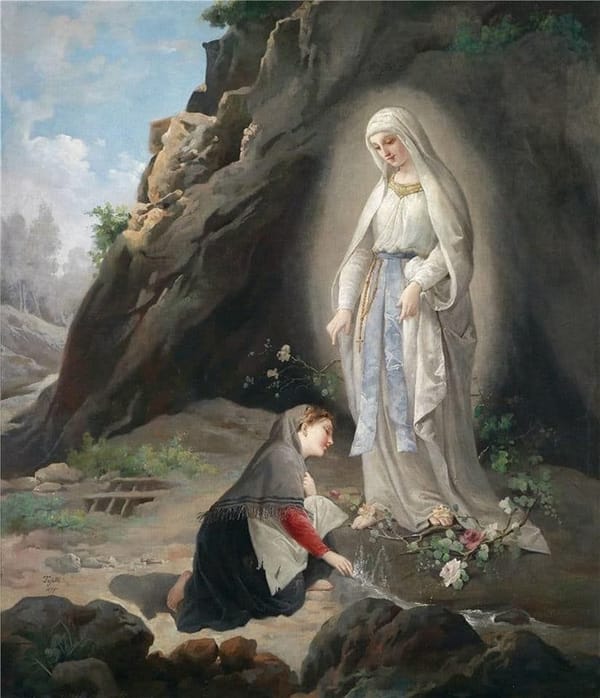
February 11: Our Lady of Lourdes
My bow shall appear in the clouds and I will remember My covenant with you.1
The lessons at Matins on February 11, 1854 (Thursday in Sexagesima week) recalled these words, and the world soon learned that on this very day Mary had appeared, more fair than the sign of hope which typified her at the time of the deluge.
Portents, the realization of which we see in these days, were being multiplied. Mankind had grown old, and seemed about to perish in a deluge more dreadful than the former one. ‘I am the Immaculate Conception,’ said the Mother of divine grace to the humble child whom she chose at such a time to bear her message to the captain of the Ark of salvation. She pierced the gathering darkness with the light of that sublime privilege which the supreme pilot, to his eternal glory, had declared three years before to be dogma.
Indeed, if, as the beloved disciple says, it is our faith to which victory on earth is promised,2 and if faith is nourished by light—what individual dogma is there which so presupposes and recalls all other dogmatic truths, and at the same time throws such light upon them? It is a royal crown on the brow of the victorious queen, resplendent like the rainbow which breaks through the clouds with all the glories of heaven.
But perchance it was still necessary to open the eyes of the blind to these splendours, to inspire courage into hearts saddened by hell’s denials, and to infuse strength to make an act of faith into so many understandings weakened by the education of these days. The Immaculate Virgin summoned the multitudes to the scene of her blessed visit, and both sweetly and strongly succoured the weakness of souls by healing bodies. She smiled upon publicity, welcomed investigation, and confirmed by the authority of miracles her own words and the definition of the Vicar of Christ.
The Psalmist said that the works of God tell His praises in all tongues,3 and St. Paul taxes with folly and impiety those who will not accept this testimony.4 So, too, we may say that the men of these times have no excuse if they do not recognize the blessed Virgin in her works. May she extend the field of her beneficence and take pity on that worst of diseases—that weakness of soul which refuses to see out of a secret fear of the conclusions to be drawn from the evidence, and struggles against the truth until the mind is filled with contradictions and the heart with darkness, so that it seems as though the reason itself were given over to that reprobate sense5 which St. Paul describes as striking the pagans in their flesh.
The things that take place at Lourdes are as famous as any events of contemporary history. Let us listen to the short account which the Church has enshrined in the Liturgy:
‘O Mary, conceived without sin, pray for us who have recourse to thee!’ Thou didst teach us this prayer in 1830 as a safeguard against the dangers of the future. In 1846 the two shepherds of La Salette reminded us of thy tears and exhortations: ‘Pray for poor sinners, pray for the world which is so disturbed.’ To-day the little seer of the grotto of Massabielle brings us thy message: ‘Penitence! Penitence! Penitence!’
We desire to obey thee, O blessed Virgin, to combat in ourselves and all around us that enemy of mankind who is our only real enemy, and sin, that supreme evil which is the source of all others. Praise be to the Almighty, who saved thee from all stain of sin, and thus inaugurated in thee the full restoration of our fallen race. Praise be to thee, who, having no debts of thy own, didst pay our debts with the Blood of thy Son and the tears of His Mother, thus reconciling heaven and earth and crushing the head of the serpent.
Prayer, expiation—the Church from apostolic times has ever urged these thoughts upon us during the days which immediately precede Lent. Dear Mother in heaven, we bless thee for having thus united thy voice to that of our Mother on earth. The world no longer desired, no longer understood, the infallible but indispensable remedy offered by the justice and mercy of God to the misery of man.
Men seemed to have forgotten the words: 'Except you do penance, you shall all perish.’6 Thy pity wakes us from this fatal stupor, O Mary. Thou knowest our weakness, and hast mingled sweetness in the bitter draught. Thou lavishest temporal favours upon man in order that he may ask of thee eternal blessings. We will not be like those children who welcome their mother’s caresses, but neglect her admonitions and the corrections which her tenderness sought to make acceptable. We will pray and suffer in union with Jesus and thee. By thine assistance during this Lent we will be converted and do penance.
Tuesday of Septuagesima Week
The serpent’s promises had stifled, in Eve’s heart, every sentiment of love for the God that had created her and loaded her with blessings: she is ambitious to be God like Him! Her faith, too, is wavering; she is not sure that God may not have deceived her, by threatening her with death should she disobey His command. Flushed by pride, she looks up to the forbidden fruit; it seems good to eat, and it is fair to her eyes.* So that her senses too conspire against God, and against her own happiness. The sin is already committed in her heart; it needs but a formal act to make it complete. She cares for nothing but self; God is no more heeded than if He did not exist. She stretches forth her daring hand; she plucks the fruit; she puts it to her mouth, and eats!
God had said that if she broke His commandment she should die; she has eaten, she has sinned, and yet she lives as before! Her pride exults at this triumph, and, convinced that she is too strong for God’s anger to reach her, she resolves on making Adam a partner in her victory. Boldly she hands him the fruit, which she herself has eaten without any evil coming to her. Whether he was emboldened by the impunity of his wife’s sin, or, from a feeling of blind affection, wished to share the lot of her who was the 'flesh of his flesh and bone of his bones,’ our first father, also, forgets all he owes to his Creator, and, as though there had never been aught of love between him and his God, he basely does as Eve suggests: he eats of the fruit, and by that act ruins himself and all his posterity.
No sooner have they broken the tie which united them with God, than they sink into themselves. As long as God dwells in the creature, whom He has raised to the supernatural state, his being is complete; but, let that creature drive his God away from himself by sin, and he finds himself in a state worse than nothing—the state of evil. That soul which, a moment before, was so beautiful and pure, is a hideous wreck. Thus is it with our first parents: they stand alone; creatures without God; and an intolerable shame seizes them. They thought to become gods, they aspired at infinite being; see them now:—sinners, the prey of concupiscence. Hitherto, their innocence was their allsufficient garb; the world was obedient to them; they knew not how to blush, and there was nothing to make them fear; but now, they tremble at their nakedness, and must needs seek a place wherein to hide!
The same self-love that had worked their ruin, had made them forget the greatness and goodness of God, and despise His commandment. Now that they have committed the great sin, the same blindness prevents them from even thinking of confessing it, or asking the forgiveness of the Master they have offended. A sullen fear possesses them. They can think of nothing but how and where to hide!
In Dominica Tyrophagi
* Gen. iii. 6. ↩︎
| Previous Monday of Septuagesima Week | Next Tuesday of Septuagesima Week |