Daily reading
Septuagesima
Double · February 12 · Sanctoral
February 12, 2020
From Dom Guéranger’s The Liturgical Year.
A Double leads the weekday.Rubric
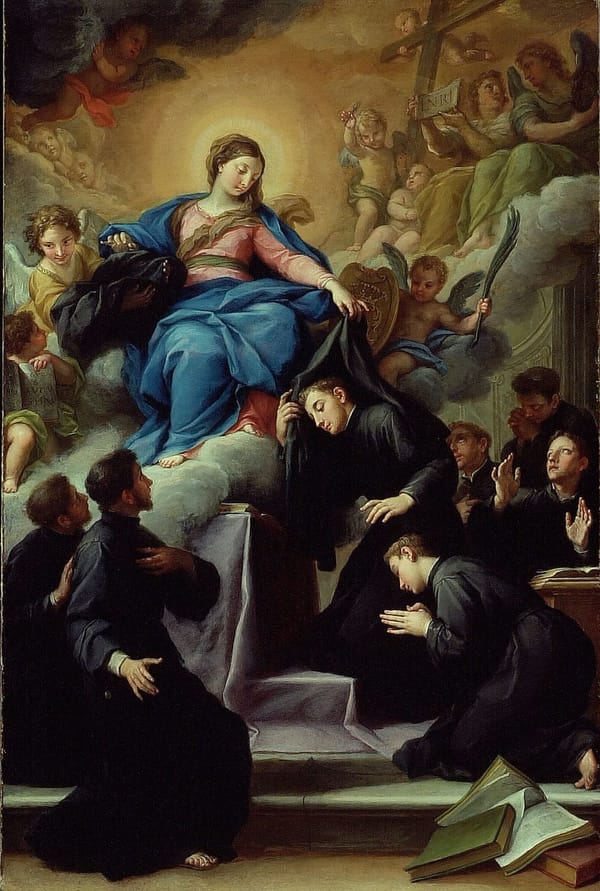 |
February 12: The Seven Holy Founders of the Order of Servites, Confessors
Clouds are gathering over Holy Church. We are reminded on every side of the approach of those days when our Emmanuel will show Himself to us in the pitiable state to which our sins have brought Him. Bethlehem is so soon followed by Calvary. We shall find the Mother of divine grace at the foot of the Cross as we found her at Ephrata. She brought forth her firstborn in joy, but now in tears she is to bring forth those brothers of His whose birth cost her so much. We have shared her joy, and we shall not refuse to weep and suffer with her.
Let us take for our models the saints whom the Church honours to-day. They passed their lives in the contemplation of our Lady’s sorrows, and the Order which they founded has the special mission to spread this devotion. St. Francis of Assisi raised the standard of the Cross anew in a world grown cold. The work of redemption seemed to be taken up afresh, and, as on the great Friday Jesus would not manifest Himself without Mary, the Servites completed the work of the Founder of the Friars Minor. Men regained confidence as they meditated on the Passion of the Son and the Compassion of the Mother.
The two feasts consecrated to the Dolours of our Lady will teach us in due course what place her compassion had in the economy of the Redemption. The Queen of heaven herself showed her predilection for the Order which made itself her apostle, in the striking outpouring of holiness which marked its origin. The simultaneous blooming of seven lilies, gathered on earth to-day by the angels, was a sight new even to heaven. Peter of Verona had a vision of them when they were implanting themselves on Monte Senario; and the future martyr saw the blessed Virgin smile as she gazed on that mountain where countless other flowers sprang up to perfume holy Church. Florence, the city of flowers, had never before given such blooms to God. Hell multiplied its attacks against the noble city, but could not prevail against Mary within its walls. We shall be reminded of these things by the feasts of St. Juliana Falconieri and St. Philip Benizi, which were established before the one we are keeping to-day. Let us unite our gratitude to that which the Church feels for the Religious family of the Servites. The world owes to them the grace of a new development in the knowledge and love of the Mother of God, who became our Mother at the price of unparalleled sufferings.
The lessons read by the Church on this day speak of the merits of our Saints and the favours with which our Lady rewarded their fidelity. February 11, the day first chosen as their common feast, is not the anniversary of the death of any one of them, but the day on which, in the year 1304, after passing through many vicissitudes, their Order obtained the definitive approbation of the Church.
You made the sorrows of Mary your own, and now she shares her eternal joys with you. The vine with its miraculously ripening grapes, which prefigured your fruitfulness in a frozen world, still yields a sweet odour in this land of exile, and the faithful still appreciate its fruit. Philip and Juliana have long been honoured as branches of this blessed vine, and to-day we pay our homage to the sevenfold root from which they sprang. You rejoiced in the obscurity which covered the life upon earth of the Queen of saints herself, but to-day the glory of Mary pierces all clouds, and no shadow can withdraw the servants from the radiance which surrounds the Mistress. May your glory be increased by the favours you bestow upon men! Teach an aged world to seek warmth at the fire whence you draw a love strong enough to triumph over the world and sacrifice self for God.
O Heart of Mary, pierced by the sword of sorrow, furnace of love which throughout all eternity feeds the fires of the very Seraphim, be our model, our refuge, and our consolation until the dawn of that blissful day which is to be the end of our exile in this vale of tears.
Wednesday of Septuagesima Week
Wednesday of Septuagesima Week
The guilty pair appear before the great God, whom they have offended; and instead of acknowledging their guilt, they seek to palliate and excuse it. But divine justice pronounces their condemnation, and the sentence will be felt by their posterity, even to the last generation. The two beings, that had committed the heinous crime, had been enriched with every gift of nature and grace. It was not with them, as it is with us. Concupiscence which gives us an inclination for what is wrong; ignorance and forgetfulness which cloud the intellect of fallen man, these miseries had nothing whatever to do with the fall of our first parents. They sinned through sheer ingratitude. They began by weighing the proposal of revolt, when they ought to have spurned it with indignation and conquered by flight. Then, by degrees, the proposed crime seemed no great harm, because, though God would lose their obedience, they would gain by the disobedience! And at length, the love of God was made to give place to the love of self, and they declared their independence! Yet God had mercy on them, because of their posterity.
The angels were all created at one and the same instant, and each of them was subjected to the trial, which was to decide his eternal future. Each angel depended on his own act, on his own choice between fidelity to his Creator and rebellion against Him; so that they who rebelled drew on themselves the eternity of God’s chastisement. The human race, on the contrary, existed not save as represented in its two first parents, and was plunged by and with them into the abyss of God’s reprobation: therefore, God, who spared not the angels, mercifully spared the human race.
But let us listen to the three sentences pronounced by God after the fall of man. The first is against the serpent, and is the severest. The curse, which is already upon him, is deepened, and the pardon, which is about to be promised to the human race, is to be given in the form of an anathema against that wicked spirit, that has dared to war with God in the work of His hands.
'I will put enmities between thee and the woman; she shall crush thy head.’1 Thus does God avenge Himself on His enemy. The victory won over the woman is made to turn against the proud conqueror, and become his humiliation and his defeat. In his fiendish craft, he had directed his first attack, not against the man, but against the woman. She, by nature, was weaker and more credulous; and if he conquered her, he hoped—too well, alas!—that Adam would be led to turn against his Creator, in order not to displease the creature. All happened as he willed it: but now, see how God uses the woman to foil and punish him. He enkindles in her heart an implacable hatred against His and our enemy. This cruel serpent may raise his proud head, and, here and there, find men that will adore him: the day will come, when a woman’s foot shall crush this head, which refused to bend before God. This daughter of Eve, whom all generations are to call blessed,2 shall be prefigured by other women: by Debbora, Judith, Esther, and others, all celebrated for their victories over the serpent. She shall be followed, until the end of time, by an uninterrupted succession of Christian virgins and matrons, who, with all their weakness, shall be powerful in co-operating with God’s designs, and, as the apostle says, ‘the unbelieving husband shall be sanctified by the believing wife.’3
Thus will God punish the serpent’s pride. Before pronouncing upon our first parents the sentence they have deserved, He promises to bless their posterity, and pours into their own hearts a ray of hope.
In Dominica Tyrophagi.
| Previous Tuesday of Septuagesima Week | Next Wednesday of Septuagesima Week |