Daily reading
Septuagesima
Double of the II Class · February 24 · Sanctoral
February 24, 2020
From Dom Guéranger’s The Liturgical Year.
A Double of the II Class leads the weekday.Rubric

|
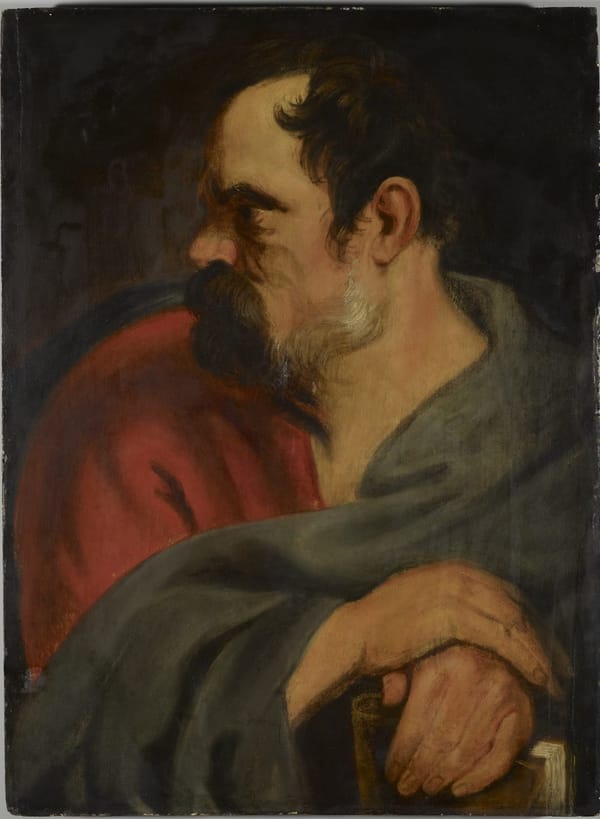
February 24: St. Mathias, Apostle
In leap-year, the feast of St Mathias is kept on February 25.
An apostle of Jesus Christ, St. Mathias, is one of the blessed choir which the Church would have us honour during the season of Septuagesima. Mathias was one of the first to follow our Saviour; and he was an eye-witness of all His divine actions up to the very day of the Ascension. He was one of the seventy-two disciples; but our Lord had not conferred upon him the dignity of an apostle. And yet, he was to have this great glory, for it was of him that David spoke, when he prophesied that another should take the bishopric1 left vacant by the apostasy of Judas the traitor. In the interval between Jesus’ Ascension and the descent of the Holy Ghost, the apostolic college had to complete the mystic number fixed by our Lord Himself, so that there might be the twelve on that solemn day, when the Church, filled with the Holy Ghost, was to manifest herself to the Synagogue. The lot fell on Mathias;2 he shared with his brother-apostles the persecution in Jerusalem, and, when the time came for the ambassadors of Christ to separate, he set out for the countries allotted to him. Tradition tells us that these were Cappadocia and the provinces bordering on the Caspian Sea.
The virtues, labours, and sufferings of St. Mathias have not been handed down to us: this explains the lack of proper lessons on his life, such as we have for the feasts of the rest of the apostles. Clement of Alexandria records in his writings several sayings of our holy apostle. One of these is so very appropriate to the spirit of the present season, that we consider it a duty to quote it. 'It behoves us to combat the flesh, and make use of it, without pampering it by unlawful gratifications. As to the soul, we must develop her power by faith and knowledge.’3 How profound is the teaching contained in these few words! Sin has deranged the order which the Creator had established. It gave the outward man such a tendency to grovel in things which degrade him, that the only means left us for the restoration of the image and likeness of God unto which we were created, is the forcible subjection of the body to the spirit. But the spirit itself, that is, the soul, was also impaired by original sin, and her inclinations were made prone to evil; what is to be her protection? Faith and knowledge. Faith humbles her, and then exalts and rewards her; and the reward is knowledge. Here we have a summary of what the Church teaches us during the two seasons of Septuagesima and Lent. Let us thank the holy apostle, on this his feast, for leaving us such a lesson of spiritual wisdom and fortitude. The same traditions, which give us some Blight information regarding the holy life of St. Mathias, tell us that his apostolic labours were rewarded with the palm of martyrdom. Let us celebrate his triumph by the following stanzas, which are taken from the Menææa of the Greeks.
Hymn (Die IX. Augusti)
Monday of Quinquagesima Week
The life of a faithful Christian, like that of the patriarch Abraham, is neither more nor less than a courageous journeying onwards to the place destined for him by his Creator. He must put aside everything that could impede his progress, nor must he look back. This is, undoubtedly, hard doctrine; but if we reflect, for a moment, on the dangers which surround fallen man during his earthly pilgrimage, and on what our own sad experience has taught us, we shall not think it hard or strange, that our Saviour has made the renouncing and denying of ourselves an essential condition of our salvation. But, independently of this, is it not far better to put our life under God’s guidance, than to keep it in our own? Are we so wise or so strong, as to be able to guide ourselves? We may resist as we please, but God is our sovereign Lord and Master; and by giving us free-will, whereby we may either resist His will or follow it, He has not abdicated His own infinite rights to His creatures’ obedience. Our refusal to obey would not make Him less our Master.
Had Abraham, after receiving the divine call, chosen to remain in Chaldea, and refused to break up the home which God had bade him leave, God would then have selected some other man to be the patriarch of His chosen people, and father of that very family, which was to have the Messias as one of its children. This substitution of one for another in the order of grace is frequently forced upon divine justice; but what a terrible punishment it is for him that caused the substitution! When a soul refuses salvation, heaven does not therefore lose one of its elect: God, finding that He is despised by the one He called, offers the grace to another, until His call is followed.
The Christian life consists in this untiring, unreserved obedience to God. The first effect of this spirit of submission is, that it takes the soul from the region of sin and death, wherein she was wasting away her existence; it takes her from the dark Chaldea, and places her in the promised land of light. Lest she should faint on her way. along the narrow path, and fall a victim to the dangers which never leave her because they are within herself, God asks her for sacrifices, and these brace her. Here, again, we have Abraham for our model. God loves him, and promises him the richest of blessings; He gives him a son, as pledge of the promise; and then, shortly after, tests the holy patriarch's devotedness, by commanding him to slay with his own hand this dear child, on whom he has been told to build his hopes!
Man’s path on earth is sacrifice. We cannot go out from evil except by the way of self-resistance, nor keep our footing on good ground but by constant combating. Let us imitate Abraham: fix our eyes steadfastly on the eternal hills, and consider this world as a mere passing dwelling, a tent, put up for a few days. Our Jesus has said to us: ‘I came not to send peace, but the sword; for I came to separate.'1 Separation, then, and trials are sure to be sent us; but we are equally sure that they are for our good, since they are sent us by Him who so loved us, that He became one of ourselves. But this same Jesus has also said: ‘Where thy treasure is, there too is thy heart.’2 Christians! can our treasure be in this wretched world? No it must be in that fair land above. There, then, must we be, in desire and affection.
These are the thoughts the Church would have us meditate upon during these days, which immediately precede the forty of Lent. They will help to purify our hearts and make them long to be with their God. The noise of the world’s sins and scandals reaches our ears: let us pray, that the kingdom of God may come to us and to those poor sinners; for God’s infinite mercy can change them, if He will, into children of Abraham. Not a day passes but He so changes many a sinner. He has, perhaps, shown that miracle of His mercy to us, and those words of the apostle may be applied to us: 'You, who some time were afar off, are now made nigh (to God) by the Blood of Christ.'3
Let us pray for ourselves and for all sinners, in these beautiful words of the Mozarabic breviary.
Prayer
| Previous February 23: St. Peter Damian, Cardinal and Doctor of the Church | Next Monday of Quinquagesima Week |