Daily reading
Lent
Double · March 7 · Sanctoral
March 7, 2020
From Dom Guéranger’s The Liturgical Year.
A Double leads the weekday.Rubric
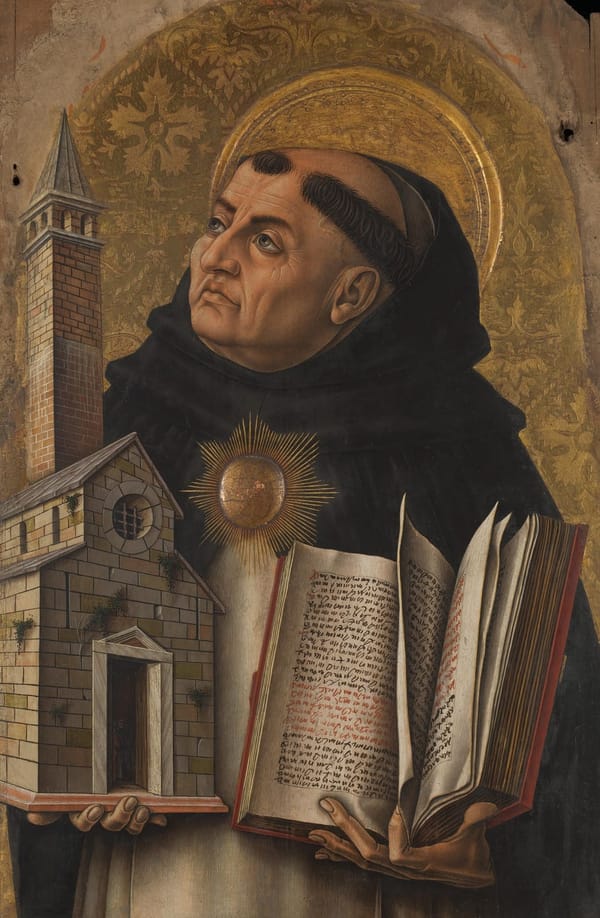 |
March 7: St. Thomas of Aquin, Doctor of the Church
The saint we are to honour to-day is one of the sublimest and most lucid interpreters of divine truth. He rose up in the Church many centuries after the apostolic age, nay, long after the four great Latin doctors, Ambrose, Augustine, Jerome, and Gregory. The Church, the ever young and joyful mother, is justly proud of her Thomas, and has honoured him with the splendid title of the angelical doctor, on account of the extraordinary gift of understanding wherewith God had blessed him; just as his contemporary and friend, St. Bonaventure, has been called the seraphic doctor, on account of the wonderful unction which abounds in the writings of this worthy disciple of St. Francis. Thomas of Aquin is an honour to mankind, for perhaps there never existed a man whose intellect surpassed his. He is one of the brightest ornaments of the Church, for not one of her doctors has equalled him in the clearness and precision wherewith he has explained her doctrines. He received the thanks of Christ Himself, for having well written of Him and His mysteries. How welcome ought this feast of such a saint to be to us during this season of the year, when our main study is our return and conversion to God! What greater blessing could we have than to come to the knowledge of God? Has not our ignorance of God, of His claims, and of His perfections, been the greatest misery of our past lives? Here we have a saint whose prayers are most efficacious in procuring for us that knowledge, which is unspotted, and converteth souls, and giveth wisdom to little ones, and gladdeneth the heart, and enlighteneth the eyes.1 Happy we if this spiritual wisdom be granted us! We shall then see the vanity of everything that is not eternal, the righteousness of the divine commandments, the malice of Bin, and the infinite goodness wherewith God treats us when we repent.
Let us learn from the Church the claims of the angelical doctor to our admiration and confidence.
The Dominican Order, of which St. Thomas is one of the greatest ornaments, has inserted the three following hymns in its liturgy of his feast:
Hymn
Laudans turba fidelium,
Errorum pulso nubilo
Per novi solis radium.
Fudit thesauros gratiæ:
Donis pienus ex æthere
Morum et sapientiæ.
Verbi coruscant faculæ,
Scripturæ sacræ Numinis,
Et veritatis regulæ.
Clarus vitæ munditia,
Splendens miris prodigiis,
Dat toti mundo gaudia.
Simulque sancto Flamini,
Qui sancti Thomæ merito
Nos cœli jungat agmini.
and give praise to God,
who has made a new sun to shine in our world,
and disperse the clouds of error.
that Thomas shed his treasures of heavenly light.
Heaven had enriched him
with gifts of virtue and wisdom:
we have derived a brighter knowledge of the Word,
the understanding of the divine Scriptures
and the rules of truth.
the light of his spotless life,
and the splendour of his miracles,
have filled the universe with joy.
and to the Holy Ghost.
And may our God, by the intercession and merits of his saint,
admit us into the choir of the blessed in heaven.
Hymn
Claram ducens originem,
Subit ætatis teneræ
Prædicatorum Ordinem.
Splendens in cœtu nubium,
Plusquam doctores cæteri
Purgans dogma Gentilium.
In lucem pandit abdita,
Dum supra sensus hominum
Obscura facit cognita.
Quadripartite pervius;
Fit Gedeonis gladius,
Tuba, lagena, radius.
Simulque sancto Flamini,
Qui sancti Thomæ merito,
Nos cœli jungat agmini.
Thomas, while in the bloom
of youth, embraced
the Order of Preachers.
brightly does he shine amidst the luminaries of earth,
and, more than any doctor of the Church,
refutes the doctrines of the Gentiles.
and brings to light the hidden gems of truth,
for he teaches us what the mind of man
had else never understood.
like to that four-branched river of paradise.
He made him to be her Gedeon’s sword,
her trumpet, her vase, her torch.
and to the Holy Ghost.
And may our God, by the intercession and merits of his saint,
admit us into the choir of the blessed in heaven.
Hymn
Thomæ felicem exitum,
Qui pervenit ad gaudia
Per Verbi vitæ meritum.
Thecam thesauri gratiæ,
Cum Christus Thomam efficit
Hæredem regni gloriæ.
Et funeris integritas,
Mira fragrans suavitas,
Ægris collata sanitas.
Terræ, ponto, et superis;
Nos juvet suis precibus,
Deo commendet meritis.
Simulque sancto Flamini,
Qui sancti Thomæ merito
Nos cœli jungat agmini.
the happy death of thy Thomas deserves a hymn of praise.
By the merits of him that is the Word of life,
he is now in endless joy.
of grace was welcomed as a guest.
It was there that he received from Christ
the inheritance of eternal glory.
he has loft us his glorious relics
which breathe forth a heavenly fragrance,
and work cures for the suffering sick.
earth, and sea, and heaven, all may give him praise.
May his prayers and merits
intercede for us with God.
and to the Holy Ghost.
And may our God, by the intercession and merits of his saint,
admit us into the choir of the blessed in heaven.
How shall we worthily praise thee, most holy Doctor! How shall we thank thee for what thou hast taught us? The rays of the divine Sun of justice beamed strongly upon thee, and thou hast reflected them upon us. When we picture thee contemplating truth, we think of those words of our Lord: 'Blessed are the clean of heart, for they shall see God.’2 Thy victory over the concupiscence of the flesh merited for thee the highest spiritual delights; and our Redeemer chose thee, because of the purity of thy angelic soul, to compose for His Church the Office whereby she should celebrate the divine Sacrament of His love. Learning did not impair thy humility. Prayer was ever thy guide in thy search after truth; and there was but one reward for which, after all thy labours, thou wast ambitious, the possession of God.
Thy life, alas! was short. The very masterpiece of thy angelical writings was left unfinished. But thou hast not lost thy power of working for the Church. Aid her in her combats against error. She holds thy teachings in the highest estimation, because she feels that none of her saints has ever known so well as thou, the secrets and mysteries of her divine Spouse. Now, perhaps more than in any other age, truths are decayed among the children of men;3 strengthen us in our faith, procure us light. Check the conceit of those shallow self-constituted philosophers, who dare to sit in judgment on the actions and decisions of the Church, and to force their contemptible theories upon a generation that is too ill-instructed to detect their fallacies. The atmosphere around us is gloomy with ignorance; loose principles, and truths spoilt by cowardly compromise, are the fashion of our times; pray for us; bring us back to that bold and simple acceptance of truth, which gives life to the intellect and joy to the heart.
Pray, too, for the grand Order which loves thee so devoutly, and honours thee as one of the most illustrious of its many glorious children. Draw down upon the family of thy patriarch St. Dominic the choicest blessings, for it is one of the most powerful auxiliaries of God’s Church.
We are on the eve of the holy season of Lent, preparing for the great work of earnest conversion of our lives. Thy prayers must gain for us the knowledge both of the God we have offended by our sins, and of the wretched state of a soul that is at enmity with its Maker. Knowing this, we shall hate our sins; we shall desire to purify our souls in the Blood of the spotless Lamb; we shall generously atone for our faults by works of penance
Saturday in Ember Week of Lent
The Station is in the basilica of Saint Peter on the Vatican, where the people were wont to assemble towards evening, that they might be present at the Ordination of the priests and sacred ministers. This day was called Twelve-Lesson-Saturday, because, formerly, twelve passages from the holy Scriptures were read, as upon Holy Saturday. The Mass, during which the Ordinations were given, was celebrated during the night; so that by the time it was over, the Sunday had begun. Later on, the Ordination Mass was said early on the Saturday, as we now have it; but in memory of the ancient practice, the Gospel for Saturday is repeated on the Sunday. The same is observed on the Saturday in the Advent Ember week; because the Ordination Mass of that season was also anticipated.
Collect
Lesson
Cap. xxvi.In diebus illis: Locutus est Moyses ad populum dicens: Quando compleveris decimam cunctarum frugum tuarum, loqueria in conspectu Domini Dei tui: Abstuli quod sanctificatum eat de domo mea, et dedi illud levitæ et advenæ, et pupillo ao viduæ, sicut jussisti mihi: non præterivi mandata tua, neo sum oblitua imperii tui. O bedi vi voci Domini Dei mei, et feci omnia eicut præcepisti mihi. Respice de sanctuario tuo, et de excelso cœlorum habitaculo, et benedio populo tuo Israël, et terræ quam dedisti nobis, eicut jurasti patribus nostris, terræ lacte et melle manan ti. Hodie Dominus Deus tuus præcepit tibi ut facias mandata hæc atque judicia; et custodias et impleas ex toto corde tuo, et ex tota anima tua. Dominum elegisti hodie, ut sit tibi Deus, et ambules in viis ejus, et custodias cæremonias illius, et mandata atque judicia, et obedias ejus imperio. Et Dominus elegit te hodie, ut sis ei populus peculiaris, sicut locutus est tibi, et custodias omnia præcepta illius: et faciat te excelsiorem cunctis gentibus quas cbeavit, in laudem, et nornen, et gloriam suam: ut sis populus sanctus Domini Dei tui, si cut locutus est.
Ch. xxvi.In those days: Moses spoke to the people, saying: When thou hast made an end of tithing all thy fruits thou shalt speak thus in the sight of the Lord thy God: I have taken that which was sanctified out of my house, and I have given it to the levite and to the stranger, and to the fatherless and to the widow, as thou hast commanded me; I have not transgressed thy commandments, nor forgotten thy precepts. I have obeyed the voice of the Lord my God, and have done all things as thou hast commanded me. Look from thy sanctuary, and thy high habitation of heaven, and bless thy people Israel, and the land which thou hast given us, as thou didst swear to our fathers, a land flowing with milk and honey. This day the Lord thy God hath commanded thee to do these commandments and judgments, and to keep and fulfil them with all thy heart, and with all thy soul. Thou hast chosen the Lord this day to be thy God, and to walk in his ways and keep his ceremonies and precepts, and judgments, and obey his command. And the Lord hath chosen thee this day to be his peculiar people, as he hath spoken to thee, and to keep all his commandments; and to make thee higher than all nations, which he hath created, to his own praise, and name, and glory; that thou mayst be a holy people of the Lord thy God, as he hath spoken.
God here assures us that a nation, which is faithful in observing the laws regarding the divine service, shall be blessed above other nations. History is one long illustration of the truth of this promise. Of all the nations which have fallen, there is not one that has not brought the chastisement upon itself by its neglect of the Law of God. At times, the Almighty delays to strike; but it is only that the chastisement may be the more evident and produce a more salutary effect upon mankind. When we would know the future of a country, we need only observe how it comports itself with regard to the laws of the Church. If its own laws are based on the principles and practices of Christianity, that country is sound, in spite of certain weaknesses here and there: revolutions may disturb its peace, but it will triumph over all. If the bulk of its people is faithful in the observance of external practices prescribed by the Church: for example, if they observe the Lord’s day and the holy fast of Lent; there is a fund of morality in that country, which is sure to draw down upon it the blessings of heaven. Irreligious men will scoff at all this, and call it superstition, prejudice of weak minds, and out of date for an age of progress like ours, but if their theories were to rule, and a country, which up to this time had been practically Catholic, were to seek progress by infringing the law of Christian ritual, it would, in less than a hundred years, find that public and private morality had lost ground, and its own security would be menaced. Man may talk and write as he likes: God wishes to be served and honoured by His people, and it is for Him to prescribe what are to be the forms of this service and adoration. Every injury offered to external worship, which is the great social link, is an injury to the interests of mankind. Even were there not the word of God for it, it is but just that such a consequence should follow.
Gospel
Cap. xvii.In illo tempore: Assumpsit Jesus Petrum, et Jacobum, et Joannem fratrem ejus, et duxit illos in montem excelsum seorsum: et transfiguratus est ante eos. Et resplenduit facies ejus sicut sol, vestimenta autem ejus facta sunt alba sicut nix. Et ecce apparuerunt illis Moyses et Elias cum eo loquentes. Respondens autem Petrus dixit ad Jesum: Domine, bonum est nos hic esse: si vis, faciamus hic tria tabernacula, tibi unum, Moysi unum, et Eliæ unum. Adnuc eo loquente, ecce nubes lucida obumbravit eos. Et ecce vox de nube, dicens: Hic est Filius meus dilectus, in quo mihi bene complacui: ipsum audite. Et audientes discipuli, ceciderunt in faciem suam, et timuerunt valde. Et accessit Jesus, et tetigit eos, dixitque eis: Surgite et nolite timere. Levantes autem oculos suos, neminem viderunt nisi solum Jesum. Et descendentibus illis de monte, præcepit eis Jesus, dicens: Nemini dixeritis visionem, donee Filius hominis a mortuis resurgat.
Ch. xvii.At that time: Jesus taketh unto him Peter and James, and John his brother, and bringeth them up into a high mountain apart: and he was transfigured before them. And his face did shine as the sun: and his garments became white as snow. And behold there appeared to them Moses and Elias talking with him. Then Peter answering, said to Jesus: Lord, it is good for us to be here; if thou wilt, let us make here three tabernacles, one for thee, and one for Moses, and one for Elias. And as he was yet speaking, behold a bright cloud overshaded them. And lo, a voice out of the cloud, saying: This is my beloved Son, in whom I am well pleased: hear ye him. And the disciples hearing, fell upon their face, and were very much afraid. And Jesus came and touched them, and said to them: Arise and fear not. And they, lifting up their eyes, saw no one, but only Jesus. And as they came down from the mountain, Jesus charged them, saying: Tell the vision to no man, till the Son of Man be risen from the dead.
This Gospel, which, as we have already explained, is to be repeated to-morrow, is the one that is read in the Mass of to-day’s Ordinations. The following is the interpretation given by the ancient liturgists, among whom we may especially mention the learned abbot Rupert. The Church would have us think upon the sublime dignity which has been conferred upon the newly ordained priests. They are represented by the three apostles, who were taken by Jesus to the high mountain, and favoured with the sight of His glory. The rest of the disciples were left below; Peter, James, and John were the only ones permitted to ascend to Thabor, and they, when the time should come, were to tell their fellow-apostles, and the whole world, how they had seen the glory of their Master, and heard the words of the Father declaring the Divinity of the Son of Man. ‘This voice,’ says St.Peter, ‘coming down to Him from the excellent glory: This is My beloved Son, in whom I have pleased Myself; hear ye Him. And this voice we heard, brought from heaven, when we were with Him in the holy mount.’1 In like manner, these priests who have just been ordained, and for whom you have been offering up your prayers and fast, will enter into the cloud with the Lord. They will offer up the Sacrifice of your salvation in the silence of the sacred Canon. God will descend into their hands, for your sake; and though they are mortal and sinners, yet will they, each day, be in closest communication with the Divinity. The forgiveness of your sins, which you are now preparing to receive from your heavenly Father, is to come to you through their hands; their superhuman power will bring it down from heaven upon your souls. It is thus that God has cured our pride. The serpent said to us, through our first parents: ‘Eat of this fruit, and you shall be as gods.’We unfortunately believed the tempter, and the fruit of our transgression was death. God took pity on us, and resolved to save us; but it is by the hands of men that He would save us, and this in order to humble our haughtiness. His own eternal Son became Man, and He left other men after Him, to whom He said: ‘As the Father hath sent Me, I also send you.’2 Let us, then, show honour to these men, who have, this very day, been raised to so high a dignity. One of the duties imposed on us by our holy religion is respect to the priesthood.
This is Saturday; let us have recourse to Mary, the refuge of sinners. Let us put under her maternal protection the humble penances we are now going through; for this end we may make use of the following sequence, taken from the Cluny missal:
Sequence
Mundi hujus spes Maria,
Ave plena gratia.
Maris portus ad quem rei
Currunt cum fiducia.
Cunctis demens et benigna,
Operum suffragio.
Nudis Martha et Maria,
Mentis desiderio.
Sic flos flori patuisti,
Pietatis gratia.
Regem regum peperisti,
Virgo viri nescia.
Quem lactasti et pavisti,
More matris debito.
Et Regina facta pridem,
Operum pro merito.
Apud Regem ut ruina
Relaxentur debita.
A reatu expurgatos,
Pietate solita.
dear Mother of Jesus,
and hope of the world!
O haven of the sea, where sinners
confidently seek shelter and repose.
and, by thy powerful prayers,
thou art kind and loving to all.
Thou art, by thy loving affection,
both Martha and Mary to the needy.
the flower that, by its rich graces,
bloomed to the divine Flower, thy Jesus.
thou didst give birth to the King of kings,
thou that wast a pure Virgin.
and, using a mother’s privilege,
thou didst feed him at thy breast.
and in reward for thy merits,
thou art made the Queen of heaven and earth.
to him that is our King,
beseeching him to pardon us poor fallen sinners.
and, having obtained us the new life of remission of our sins,
bring us to the kingdom, there to reign for ever.
| Previous March 6: Sts. Felicitas and Perpetua, Martyrs | Next Saturday in Ember Week of Lent |