Daily reading
Movable from Easter · Temporal
March 24, 2020
From Dom Guéranger’s The Liturgical Year.
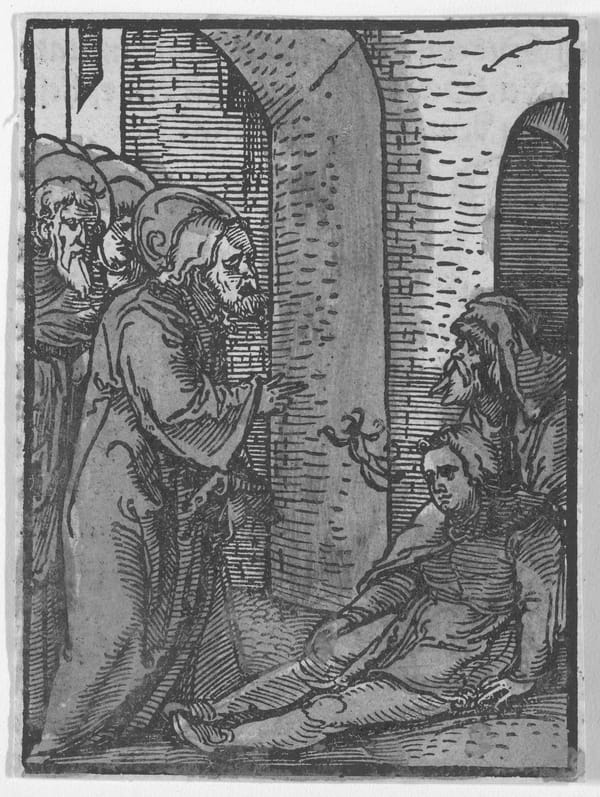
Tuesday of the Fourth Week of Lent
The Station is in the church of Saint Laurence in Damaso; so called, because it was built, in the fourth century, in honour of the glorious archdeacon of Rome, by Pope St. Damasus, whose body rests here.
Collect
Epistle
Cap. xxxii.In diebus illis, locutus est Dominus ad Moysen, dicens: Descende de monte: peccavit populus tuus, quem eduxisti de terra Ægypti. Recesserunt cito de via, quam ostendisti eis: feceruntque sibi vitulum conflatilem, et adoraverunt, atque immolantes ei hostias, dixerunt: Isti sunt dii tui, Israël, qui te eduxerunt de terra Ægypti. Rursumque ait Dominus ad Moysen: Cemo quod populus iste duræ cervicis sit: dimitte me, ut irascatur furor meus contra eos, et deleam eos, faciamque te in gentem magnam. Moyses autem orabat Dominum Deum suum, dicens: Cur, Domine, irascitur furor tuus contra populum tuum, quem eduxisti de terra Ægypti in fortitudine magna, et in manu robusta? Ne, quæso, dicant Ægyptii: Callide eduxit eos, ut interficeret in montibus, et deleret e terra: quiescat ira tua, et esto placabilis super nequitia populi tui. Recordare Abraham, Isaac, et Israël, servorum tuorum, quibus jurasti per temetipsum, dicens: Multiplicabo semen vestrum sicut Stellas cceli; et universam terram hanc, de qua locutus sum, dabo semini vestro, et possidebitis eam semper. Placatusque est Dominus ne faceret malum, quod locutus fuerat adversus populum suum,
Ch. xxxii.In those days, the Lord spoke to Moses saying: Go, get thee down from the mountain: thy people, which thou hast brought out of the land of Egypt, hath sinned. They have quickly strayed from the way which thou didst show them; and they have made to themselves a molten calf, and have adored it, and sacrificing victims to it, have said: These are thy gods, O Israel, that have brought thee out of the land of Egypt. And again the Lord said to Moses: I see that this people is stiff-necked: let me alone that my wrath may be kindled against them, and that I may destroy them, and I will make of thee a great nation. But Moses besought the Lord his God, saying: Why, O Lord, is thy indignation enkindled against thy people, whom thou hast brought out of the land of Egypt, with great power, and with a mighty hand? Let not the Egyptians say, I beseech thee: He craftily brought them out, that he might kill them in the mountains, and destroy them from the earth; let thy anger cease and be appeased upon the wickedness of thy people. Remember Abraham, Isaac and Israël thy servants, to whom thou swarest by thy own self, saying: I will multiply your seed as the stars ofheaven; and this whole land that I have spoken of, I will give to your seed, and you shall possess it for ever. And the Lord was appeased from doing the evil which he had spoken against his people.
When the world first received the preaching of the Gospel, idolatry was the prevailing crime. For many centuries after, all the catechumens, who were instructed in the true faith, were tainted with it. It was in order to inspire them with a horror of their past lives, that the Church read to them, on this day, the terrible words of God, who, had not Moses interceded, was about to exterminate His people, because they had relapsed into idolatry; and this, after He had worked in their favour the most unheard-of miracles, and had come in person to give them His Law. The worship of false gods is no longer to be found amongst us; but it exists in all those countries, where the Gospel has been preached and rejected. Strange as it may sound, yet it is most true: Europe, with all its civilization, would return to idolatry, were it to lose the faith of our Lord Jesus Christ. Not much more than a centqry ago, an idol was erected to reason; it had its altar, its decorations and its incense; and they who paid homage to it were Europeans! Individuals or peoples, once slaves to Satan, are not their own masters to say, ‘We will go thus far in sin, and no farther’The descendants of Noe, notwithstanding the terrible lesson given to them by the deluge, fell into idolatry; nay, Abraham was called by God from the rest of men, lest he should be led away by the almost universal corruption. Let us be grateful to the Church, who, by her teachings of faith and morals, preserves us from this degrading abomination; and let us resist our passions, which, if the light of faith were taken from us, would lead us to idolatry.
Gospel
Cap. vii.In illo tempore: Jam die festo mediante, ascendit Jesus in templum, et docebat. Et mirabantur Judæi, dicentes: Quomodo hic litteras scit, cum non didicerit? Responds eis Jesus, et dixit: Mea doctrina non est mea, sed ejus qui misit me. Si quis voluerit voluntatem ejus facere, cognoscet de doctrina, utrum ex Deo sit an ego a meipso loquar. Qui a semetipso loquitur, gloriam propriam quærit: qui autem quærit gloriam ejus qui misit eum, hic verax est, et injustitia in illo non est. Nonne Moyses dedit vobis legem? et nemo ex vobis facit legem. Quid me quæritis interficere? Respondit turba, et dixit: Dæmonium habes: quis te quærit interficere? Respondit Jesus, et dixit eis: Unum opus feci, et omnes miramini. Propterea Moyses dedit vobis circumcisionem (non quia ex Moyse est, sed ex patribus): et in Sabbato circumciditis hominem. Si circumcisionem accipit homo in Sabbato, ut non solvatur lex Moysi: mihi indignamini quia totum hominem sanum feci in Sabbato? Nolite judicare secundum faciem, sed justum judicium judicate. Dicebant ergo quidam ex Jerosolymis: Nonne hic est quem quærunt interficere? Et ecce palam loquitur, et nihil ei dicunt. Numquid vere cognoverunt principes quia hic est Christus? Sed hunc scimus unde sit: Christus autem cum venerit, nemo scit unde sit. Clamabat ergo Jesus in templo docens, et dicens: Et me scitis, et unde sim scitis: et a meipso non veni, sed est verus qui misit me, quem vos nescitis. Ego scio eum: quia ab ipso sum, et ipse me misit. Quærebant ergo cum apprehendere: et nemo misit in ilium manus, quia nondum venerat hora ej us. De turba autem multi crediderunt in eum.
Ch. vii.At that time: About the midst of the feast, Jesus went up into the temple and taught. And the Jews wondered, saying: How doth this man know letters, having never leamed? Jesus answered them, and said: My doctrine is not mine, but his that sent me. If any man will do the will of him, he shall know of the doctrine whether it be of God, or whether I speak of myself. He that speaketh of himself, seeketh his own glory; but he that seeketh the glory of him that sent him, he is true, and there is no injustice in him. Did not Moses give you the law? And yet none of you keepeth the law. Why seek you to kill me? The multitude answered and said: Thou hast a devil: who seeketh to kill thee? Jesus answered, and said to them: One work I have done, and you all wonder. Therefore Moses gave you circumcision (not because it is of Moses, but of the fathers); and on the Sabbath-day you circumcise a man. If a man receive circumcision on the Sabbath-day that the law of Moses may not be broken, are you angry at me, because I have healed the whole man on the Sabbath-day? Judge not according to the appearance, but judge just judgment. Some therefore of Jerusalem said: Is not this he whom they seek to kill? And behold he speaketh openly, and they say nothing to him. Have the rulers known for a truth that this is the Christ? But we know this man whence he is. But when the Christ cometh, no man knoweth whence he is. Jesus therefore cried out in the temple, teaching and saying: You both know me, and you know whence I am; and I am not come of myself, but he that sent me is true, whom you know not; I know him because I am from him, and he hath sent me. They sought therefore to apprehend him; and no man laid hands on him, because his hour was not yet come. But of the people many believed in him.
This Gospel carries our thoughts to the sacrifice of ihe divine Lamb, which is to be offered up in Jerusalem. The hour has not yet come, but it is fast approaching. His enemies are already seeking how they may put Him to death. So blinded are they by their passions, that they accuse Him of being a violater of the Sabbath, because He healed the sick, by the simple act of His will, on the Lord’s day! In vain does Jesus refute their prejudices, by reminding them that they themselves have no scruple in fulfilling the law of circumcision on this day, or (as He said to them, on another occasion) in drawing out of the pit an ass or an ox that may have fallen in.1 They are deaf to all He says; they are men of one idea, and it is, that their victim shall not escape death. His miracles are incontestable, and all are wrought out of a motive of mercy and love. The only time He refuses to work one, is when His enemies ask Him to satisfy their curiosity and pride by letting them see a sign. This exercise of His power of working miracles, far from exciting them to admiration and gratitude, only incites them to envy, and in their envy, they declare, not only that He acts by Beelzebub,2 but that He has a devil within Him. We shudder at such a blasphemy. Yet, such is the pride of these Jewish doctors that they care neither for common sense nor for religion, and their hearts thirst more and more for the Blood of Jesus. Whilst some of the people allow themselves to be seduced by their leaders into the same feelings against Jesus, others, who affect to be indifferent, reason about Him, and then declare it to be their opinion that this Jesus does not realize in Himself the character of the promised Messias! They argue that, when the Christ cometh no one will know whence He is. But have not the prophets declared that He is to be of the family of David? Now every Jew knows well enough that Jesus is of that royal race. Besides, they own that there is to be something mysterious about the Messias, and that He is to come from God. Had they listened with docile attention to the teachings of Jesus—teachings which He had confirmed by numerous miracles—they would have been enlightened both as to His temporal birth, and to His being the Son of God. But indifference and the perversity of the human heart keep them in culpable ignorance; and, perhaps, on the day of His death, they will join in the cry: ‘Let His Blood be upon us and upon our children!’3
The Greek liturgy supplies us with the following humble act of contrition. We take it from the hymn composed by St. Andrew of Crete.
Canon Magnus
(Feria V. Hebdomadæ V. Jejuniorum)
March 24: St. Gabriel, the Archangel
So far in the Church’s calendar, we have not met with any feast in honour of the holy angels. Amidst the ineffable joys of Christmas night, we mingled our timid but glad voices with the hymns of these heavenly spirits, who sang around the crib of our Emmanuel. The very recollection brings joy to our hearts, saddened as they now are by penitential feelings and by the near approach of the mournful anniversary of our Jesus’ death. Let us, for a moment, interrupt our sadness, and keep the feast of the Archangel Gabriel. Later on, we shall have Michael, Raphael, and the countless host of the angel guardians; but to-day, the eve of the Annunciation, it is just that we should honour Gabriel. Tomorrow we shall see this heavenly ambassador of the blessed Trinity coming down to the Virgin of Nazareth; let us, therefore, recommend ourselves to him, and beseech him to teach us how to celebrate, in a becoming manner, the grand mystery of which he was the messenger.
Gabriel is one of the first of the angelic kingdom. He tells Zachary that he stands before the face of God.1 He is the angel of the Incarnation, because it is in this mystery, which apparently is so humble, that the power of God is principally manifested: and Gabriel signifies the strength of God. We find the Archangel preparing for this sublime office, even in the old Testament. First of all, he appeared to Daniel, after this prophet had had the vision of the Persian and Grecian empires; and such was the majesty of his person that Daniel fell on his face trembling.2 Shortly afterwards, he appeared again to the same prophet, telling him the exact time of the coming of the Messias: ‘Know thou and take notice: that from the going forth of the word to build up Jerusalem again, unto Christ the Prince, there shall be seven weeks and sixty-two weeks,’3 that is, sixty-nine weeks of years.
When the fulness of time had come, and heaven was about to send the last of the prophets, who, after preaching to men the approach of the Messias, is to show Him to the people, saying: ‘Behold the Lamb of God, who taketh away the sins of the world,’ Gabriel descends from heaven to the temple of Jerusalem, and prophesies to Zachary the birth of John the Baptist,4 which was to be followed by that of Jesus Himself.
Six months later on, the holy Archangel again appears on the earth; and this time it is Nazareth that he visits. He brings the great message from heaven. Angel as he is, he reveres the humble Maid, whose name is Mary; he has been sent to her by the most high God, to offer her the immense honour of becoming the Mother of the eternal Word. It is Gabriel that receives the great Fiat, the consent of Mary; and when he quits this earth, he leaves it in possession of Him, for whom it had so long prayed in those words of Isaias: Drop down Dew, O ye heavens!5
The hour at length came, when the Mother of the Emmanuel was to bring forth the blessed Fruit of her virginal womb. Jesus was born amidst poverty; but heaven willed that His crib should be surrounded by fervent adorers. An angel appeared to some shepherds, inviting them to go to the stable near Bethlehem. He is accompanied by a multitude of the heavenly army, sweetly singing their hymn: ‘Glory to God in the highest, and on earth peace to men of good will!’ Who is this angel that speaks to the shepherds, and seems as the chief of the other blessed spirits that are with him? In the opinion of several learned writers, it is the Archangel Gabriel, who is continuing his ministry as messenger of the good tidings.6
Lastly, when Jesus is suffering His agony in the garden of Gethsemani, an angel appears to Him, not merely as a witness of His sufferings, but that he might strengthen Him under the fear His human nature felt at the thought of the chalice of the Passion He was about to drink.7 Who is this angel? It is Gabriel, as we learn not only from the writings of several holy and learned authors, but also from a hymn which the holy See has permitted to be used in the liturgy, and which we give below.
These are the claims of the great Archangel to our veneration and love; these are the proofs he gives of his deserving his beautiful name, the strength of God. God has employed him in each stage of the great work, in which He has chiefly manifested His power; for Jesus, even on His cross, is the Power of God,8 as the apostle tells us. Gabriel prepares the way for Jesus. He foretells the precise time of His coming; he announces the birth of His Precursor; he is present at the solemn moment when the Word is made Flesh; he invites the shepherds of Bethlehem to come to the crib, and adore the divine Babe; and when Jesus, in His agony, is to receive strength from one of His own creatures, Gabriel is found ready in the garden of Gethsemani, as he had been at Nazareth and Bethlehem.
Let us, then, honour the angel of the Incarnation. For this purpose, let us recite in his praise some of the pieces which liturgical piety has composed for his feast. The two following hymns are from the old Franciscan breviary:
Hymn I
Plectra tangentes fidibus canoris,
Inclytus quando Gabriel ab alto
Fulget Olympo.
Hodie nobis, simul Angelorum,
Plurimis Christum venerans triumphis,
Concio tota.
Concinat noster chorus, ipse quando est
Unus ex septem, Domino qui adstant
Jussa sequentes.
Exstat a summis Gabriel ubique
Lætus, et mundo reserat secreta
Omnipotentis.
Pacis æternæ speciale munus,
Quo poli tandem teneamus aulam
Semper ovantes.
Patris, ac Nati, pariterque sancti
Spiritus cujus resonat per omnem
Gloria mundum.
and strike the tuneful lyre;
’tis the great Gabriel that comes in all his brightness
from the high heavens.
and with him comes the whole
host of angels, singing in varied hymns
the praise of Christ.
sing the praises of Gabriel the prince,
for he is one of the seven
that stand before the Lord and do his biddings.
for he is the messenger of heaven,
nay the mediator that reveals to the world
the secret decrees of the omnipotent God.
messenger to us of the special gift of eternal peace,
wherewith we may finally reach heaven,
and everlastingly rejoice.
Son, and Holy Ghost, whose glory is proclaimed
through the whole world,
grant us this our prayer.
Hymn II
Cantemus Domino jam nova cantica;
Hac hora Gabriel nam fuit omnibus
Vitæ nuntius optimus.
Humano generi protulit; insuper
Devictis pariter funditus hostibus,
Victor surgit ab inferis.
Oremus precibus ccelica Numina:
Praesertim Dominum, qui dedit angelum
Curam qui gerit hominum.
Quæ mundo Gabriel munera conferat?
Banctas hic animas visere Dominum
Præsto ducit in æthera.
Pro nobis miseris poscito gratiam;
Fac et propitium, qui valet omnia,
Nobis ut veniam afferat.
and sing your new canticles to the Lord;
for it is at this hour that was sent
the most welcome messenger of life to the world.
brought forth our Lord, for the salvation of mankind:
and at the same, that he arose from the grave,
having defeated his enemies.
make supplication to the heavenly spirits;
let us pray especially to the God
who gave us an angel to guard us.
brought by Gabriel to the world?
He it is that leads holy souls to heaven,
there to contemplate our Lord.
pray for us miserable sinners.
Propitiate him that can do all things,
and obtain for us his pardon.
The Dominican breviary contains this beautiful hymn in honour of the holy Archangel:
Hymn
Quem de principibus signat Emmanuel:
A. quo promeruit discere Daniel
Hirci prodigium feri.
Monstras hebdomadum sacrata tempora:
Quæ nos ætherei germine Principis,
Ditabunt bene gaudiis.
Affers a superis lætaque nuntia,
Quod mater, sterili corpore, pignora
Longævo pariet patri.
Hoc sacræ veniens tu piene Virgini
Longo mysterium pandis ab ordine,
Verum quod pariet Deum.
Implesti, reserans ccelica nuntia:
Et tecum celebrat turba canentium
Nati mysterium Dei.
Dum sudor madidum sanguine conficit,
Adstas a superis, ut calicem bibat,
Assensum Patris indicans.
Confirma fidei munere cælico:
Da nobis gratiam, nos quoque gloriam
Per cuncta tibi sæcula.
whom our Emmanuel selected from the rest of the heavenly princes,
that thou shouldst expound unto Daniel
the mystery of the savage goat.
and didst tell him of the sacred weeks,
which were to give us the birth of the King of heaven,
and enrich us with plenteous joy.
the wondrous and gladsome tidings that Elizabeth,
though barren, and Zachary,
though old, should have a son.
this thou didst announce in all the fulness
of the mystery to the holy virgin,
telling her that she was to be the true Mother of God.
when thou didst tell them the heavenly tidings;
and with thee a host of angels sang
the praises of the newborn God.
when a bloody sweat bathed his limbs,
thou didst leave heaven to be near him,
and offer him the chalice that his Father willed him to drink.
strengthen Catholic hearts with the heavenly gift of faith.
Give us grace,
as we to thee give glory for ever.
The whole human race is indebted to thee, O Gabriel! and, on this day, we would fain pay thee the honour and gratitude we owe thee. Thou wast moved to holy compassion on seeing the miseries of the world; for all flesh had corrupted its way, and the forgetfulness of God increased with each new generation of men. Then did the Most High commission thee to bring to the world the good tidings of its salvation. How beautiful thy steps, O prince of the heavenly court, as thou earnest down to this our humble sphere! How tender and fraternal is thy love of man, whose nature, though so inferior to thine own, was to be raised, by the mystery of the Incarnation, to union with God Himself! With what respectful awe didst thou approach the Virgin, who surpassed all the angels in holiness!
Blessed messenger of our redemption, whom God selects as His minister when He would show His power, we beseech thee, offer the homage of our gratitude to Him that thus sent thee. Help us to pay the immense debt we owe to the Father, who so loved the world, as to give it His only-begotten Son;9 to the Son, who emptied Himself, taking the form of a servant;10 and to the Holy Ghost, who rested on the Flower that sprang up out of the root of Jesse.11
’Tis thou, O Gabriel! that taughtest us the salutation wherewith we should greet Mary full of grace. Thou wast the first to pronounce these sublime words, which thou broughtest from heaven. The children of the Church are now, day and night, repeating these words of thine; pray for us that we may say them in such a manner, that our blessed Mother may find them worthy of her acceptance.
Angel of strength, friend of mankind! continue thy ministry of aiding us. We are surrounded by terrible enemies: our weakness makes them bold; come to our assistance, procure us courage. Pray for us during these days of conversion and penance. Obtain for us the knowledge of all we owe to God in consequence of that ineffable mystery of the Incarnation, of which thou wast the first witness. We have forgotten our duties to the Man-God, and we have offended Him: enlighten us, that so, henceforth, we may be faithful to His teachings and examples. Raise up our thoughts to the happy abode where thou dwellest; assist us to merit the places left vacant by the fallen angels, for God has reserved them for His elect among men.
Pray, O Gabriel, for the Church militant, and defend her against the attacks of hell. The times are evil; the spirits of malice are let loose, nor can we make stand against them, unless with God’s help. It is by His holy angels that He gives victory to His bride. Be thou, O strength of God! foremost in the ranks. Drive heresy back, keep schism down, foil the false wisdom of men, frustrate the policy of the world, arouse the well-minded from apathy; that thus the Christ whom thou didst announcemay reign over the earth He has redeemed, and that we may sing together with thee and the whole angelic choir: ‘Glory be to God, peace to men!’
| Previous Monday of the Fourth Week of Lent | Next March 24: St. Gabriel, the Archangel |