Daily reading
Semidouble · Movable from Easter · Temporal
March 28, 2020
From Dom Guéranger’s The Liturgical Year.
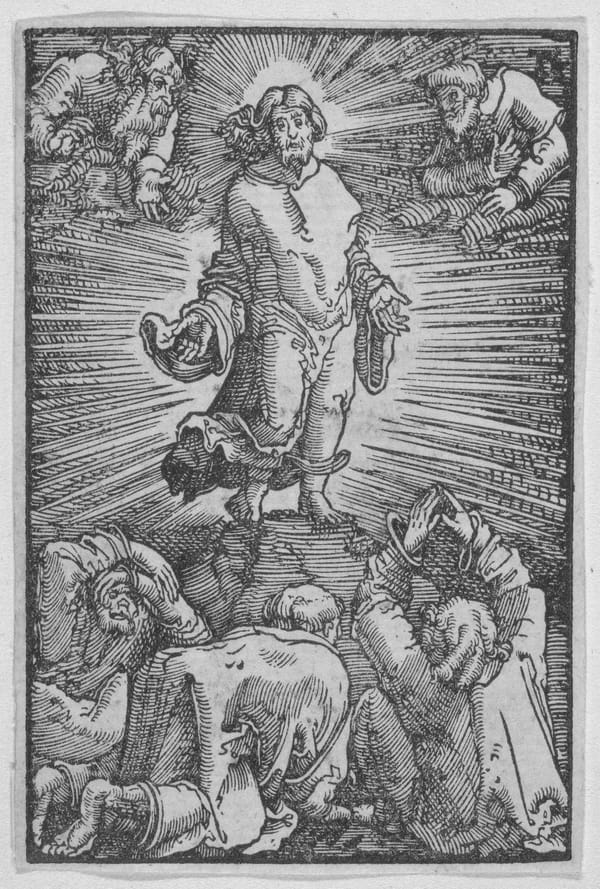
Saturday of the Fourth Week of Lent
This Saturday, in the early ages of Christianity, was called Sitientes, from the first word of the Introit of the Mass, in which the Church addresses her catechumens in the words of Isaias, and invites them that thirst after grace, to come and receive it in the holy Sacrament of Baptism. At Rome, the Station was originally in the basilica of Saint Laurence outside the walls; but it was found inconvenient, on account of its great distance from the city; and the church of Saint Nicholas in carcere, which is within the walls, was selected for to-day’s Station.
Collect
Epistle
Cap. xlix.Hæc dicit Dominus: In tempore placito exaudivi te, et in die salutis auxiliatus sum tui: et servavi te, et dedi te in fædus populi, ut susci tares terrain, et possideres hæreditates dissipatas; ut diceres his qui vincti sunt: Exite: et his qui in tenebris: Revelamini. Super vias pascentur, et in omnibus planis pascua eorum. Non esurient, neque sitient, et non percutiet eos æstus et sol: quia miserator eorum reget eos, et ad fontes aquarum potabit eos. Et ponam omnes montes meos in viam, et semitae mese exaltabuntur. Ecce isti de longe venient, et ecce illi ab aquilone et mari, et isti de terra australi. Laudate, cceli, et exsulta, terra; jubilate, montes, laudem: quia consolatus est Dominus populum suum, et pauperum suorum miserebitur. Et dixit Sion: Dereliquit me Dominus, et Dominus oblitus est mei. Numquid oblivisci potest mulier infantem suum, ut non misereatur filio uteri sui? Et si illa oblita fuerit, ego tamen non obliviscar tui, dicit Dominus omnipotens.
Ch. xlix.Thus saith the Lord: In an acceptable time I have heard thee, and in the day of salvation I have helped thee; and I have preserved thee, and given thee to be a covenant of the people, that thou mightiest raise up the earth and possess the inheritances that were destroyed; that thou mightest say to them that are bound: Come forth; and to them that are in darkness: Show yourselves. They shall feed in the ways, and their pastures-shall be in every plain. They shall not hunger nor thirst, neither shall the heat nor the sun strike them: for he that is merciful to them shall be their shepherd, and at the fountains of waters he shall give them drink. And I will make all my mountains a way, and my paths shall be exalted. Behold these shall come from afar, and behold these from the north and from the sea, and these from the south country. Give praise, O ye heavens, and rejoice, O earth; ye mountains, give praise with jubilation; because the Lord hath comforted his people, and will have mercy on his poor ones. And Sion said: The Lord hath forsaken me, and the Lord hath forgotten me. Can a woman forget her infant, so as not to have pity on the son of her womb? And if she should forget, yet will I not forget thee, saith the Lord almighty.
How these words of love must have consoled the hearts of our catechumens! Never did our heavenly Father express His tender mercy towards us in more glowing terms; and He bade His prophet deliver them to us. He gives the whole earth to His Son, Jesus Christ, our Incarnate Lord, not that He may judge and condemn it, as it deserves, but that He may save it.1 This divine Ambassador, having come on the earth, tells all that are galled by fetters, or that sit in the gloomy shadow of death, to come to Him, promising them liberty and light. Their hunger shall be appeased, and their thirst quenched. They shall no longer pant under the scorching rays of the sun, but shall be led by their merciful Shepherd to the cool shades on the banks of the water of life. They came from every nation under heaven: the fountain, the font, shall be the centre where all the human race is to meet. The Gentile world is to be henceforth called Sion, and the Lord loveth the gates of this new Sion above all the tabernacles of Jacob.2 God had not forgotten her during the long ages of her idol worship; His love is tender as that of the fondest mother; yea, and though a mother’s heart may forget her child, God never will forget His Sion. You, then, who received Baptism at your very entrance into the world, but have, since then, served another master besides Him to whom you swore perpetual allegiance at the font, be of good heart! If the grace of God has found you submissive, if the holy exercises of Lent and the prayers offered for you by the C hurch have had their effect, and you are now preparing to make your peace with God, read these words of your heavenly Father, and fear not! How can you fear? He has given you to His own Son; He has told Him to save, heal, and comfort you. Are you in the bonds of sin? Jesus can break them. Are you in spiritual darkness? He is the light of the world, and can dispel the thickest gloom. Are you hungry? He is the Bread of life. Are you thirsty? He is the fountain of living water. Are you scorched, are you burnt to the very core, by the heat of concupiscence? Ewen so, poor sufferers! you must not lose courage; there is a cool fountain ready to refresh you, and heal all your wounds; not indeed the first font, which gave you. the life you have lost; but the second Baptism, the divine Sacrament of Penance, which can restore you to grace and purity!
Gospel
Cap. viii.In illo tempore: Locutus est Jesus turbis Judæorum, dicens: Ego sum lux mundi: qui sequitur me, non ambulat in tenebris, sed habebit lumen vitae. Dixerunt ergo ei pharisæi: Tu de teipso testimonium perhibes: testimonium tuum non est verum. Respondit Jesus, et dixit eis: Et si ego testimonium perhibeo de meipso, verum est testimonium meum: quia scio unde veni, et quo vado: vos ftutem nescitis unde venio, aut quo vado. Vos secundum carnem judicatis: ego non judico quemquam: et si judico ego, judicium meum verum est: quia solus non sum, sed ego, et qui misit me, Pater. Et in lege vestra scriptum est, quia duorum hominum testimonium verum est. Ego sum qui testimonium perhibeo de meipso: et testimonium perhibet de me, qui misit me, Pater. Dicebant ergo ei: Ubi est Pater tuus? Respondit Jesus: Neque me scitis, neque Patrem meum: si me sciretis, forsitan et Patrem meum sciretis. Hæc verba locutus est Jesus in gazophylacio, docena in templo: et nemo apprehendit eum, quia necdum venerat hora ejus.
Ch. viii.At that time: Jesus spoke to the multitude of the Jews, saying: I am the light of the world; he that followeth me, walketh not in darkness, but shall have the light of life. The pharisees therefore said to him: Thou givest testimony of thyself; thy testimony is not true. Jesus answered and said to them: Although I give testimony of myself, my testimony is true: for I know whence I came and whither I go, but you know not whence I come, or whither I go. You judge according to the flesh, I judge not any man. And if I do judge, my judgment is true; because I am not alone, but I and the Father that sent me. And in your law it is written, that the testimony of two men is true. I am one, that give testimony of myself; and the Father that sent me, giveth testimony of me. They said therefore to him: Where is thy Father? Jesus answered: Neither me do you know, nor my Father; if you did know me, perhaps you would know my Father also. These words Jesus spoke in the treasury, teaching in the temple: and no man laid hands on him, because his hour was not yet come.
What a contrast between the tender mercy of God, who invites all men to receive His Son as their Redeemer, and the obduracy of heart wherewith the Jews receive the heavenly Ambassador! Jesus has proclaimed Himself to be the Son of God, and, in proof of His divine origin, has, for three long years, wrought the most astounding miracles. Many of the Jews have believed in Him, because they argued that God could never have authorized falsity by miracles; and they therefore accepted the doctrine of Jesus as coming from heaven. The pharisees hate the light, and love darkness; their pride will not yield even to the evidence of facts. At one time they denied the genuineness of Jesus’ miracles; at another, they pretended to explain them by the agency of the devil. Then, too, they put questions to Him of such a captious nature, that, in what way soever Jesus answered, they might accuse Him of blasphemy, or contempt for the Law. To-day, they have the audacity to make this objection to Jesus’ being the Messias: that He gives testimony in His own favour! Our blessed Lord, who knows the malice of their hearts, deigns to refute their impious sarcasm; but He avoids giving them an explicit answer. It is evident that the light is passing from Jerusalem, and is to bless other lands. How terrible is this punishment of a soul that abuses the truth, and rejects it by an instinctive hatred! Her crime is that sin against the Holy Ghost, which shall not be forgiven, neither in this world, nor in the world to come.3 Happy he that loves the truth, though it condemns his evil passions, and troubles his conscience! Such an one proves that he reveres the wisdom of God; and if it do not altogether rule his conduct it does not abandon him. But happier far he that yields himself wholly to the truth, and, as a humble disciple, follows Jesus. He walketh not in darkness; he shall have the light of life. Let us, then, lose no time, but take at once that happy path marked out for us by Him who is our light and our life. Keeping close to His footsteps, we went up the rugged hill of Quarantana, and there we witnessed His rigid fast; but now that the time of His Passion is at hand, He invites us to follow Him up another mount, that of Calvary, there to contemplate His sufferings and death. Let us not hesitate; we shall be repaid: we shall have the light of life.
Let us end these first four weeks of Lent with a hymn to our blessed Lady, the Mother of mercy. Saturday is always sacred to her. The hymn we give is taken from the ancient Roman-French missals.
Sequence
Gratia plena.
Dominus tecum,
Virgo serena.
In mulieribus,
Quæ peperieti
Pacem hominibus,
Et angelis gloriam.
Fructus ventris tui,
Qui cohæredes
Ut essemus sui,
Nos fecit per gratiam.
Mundo tam suave,
Contra carnis jura
Genuisti prolem,
Novum Stella solem,
Nova genitura.
Leonis et Agni,
Salvatoris Christi
Templum exstitisti;
Sed virgo intacta.
Panis et Pastoris,
Virginum Regina,
Rosa sine spina,
Genitrix es facta.
Tu mater es misericordiæ,
De lacu fæcis et miseriæ
Theophilum reformans gratiæ.
Tu Mater es Regis et filia,
Per te reis donatur venia,
Per te justis confertur gratia.
Verbi Dei celia,
Et solis aurora,
Per quam lux est orta,
Natum tuum ora,
Et in regno claritatis,
Quo lux lucet sedula,
Collocet per sæcula.
full of grace!
The Lord is with thee,
O gentle Virgin!
among women,
for thou didst bring forth
peace to men
and glory to the angels.
is the fruit of thy womb Jesus,
who, by his grace,
made us to be
his coheirs.
which sounded so sweetly to the world,
thou didst conceive,
and not by nature’s laws.
Thou wast the new star
that wast to bring forth a new Sun.
wast the temple
of our Saviour Jesus Christ
(who united in his person the little and the great),
the Lion and the Lamb.
O rose without thorns!
Thou wast made Mother of him
who is our Sun, our Dew,
our Bread, and our Shepherd.
thou art the Mother of mercy,
bringing grace to Theophilus,
by drawing him out of the den of filth and misery.
for thou art both Mother and Daughter of its King.
By thee, the guilty obtain pardon;
by thy prayers, the just receive grace.
O tabernacle of the Word,
O aurora of the divine Sun,
by whom Light arose to the world!
pray for us to thy Son,
and introduce us
into the kingdom of. brightness,
where perpetual light shines for ever.
March 28: St. John Capistran, Confessor
|
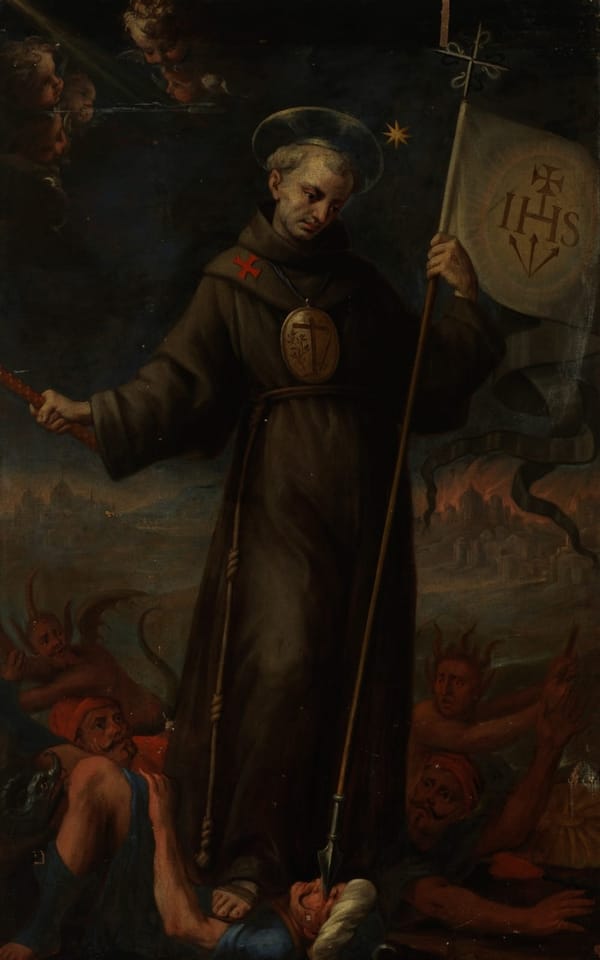
The nearer the Church approaches to the end of her earthly existence, the more she seems to love to enrich her cycle with feasts that recall the glorious past. Indeed, one of the objects of the sacred Liturgy is to keep before our minds all that God has done for us. ‘Remember the days of old: think upon every generation,’1 said God to His people in the alliance of Sinai. It was a law in Jacob that the fathers should hand on these traditions to their children, who were in their turn to transmit them to their descendants.2 The Church has taken the place of the ancient Israel and her annals speak, even more than those of the Jewish people, of the manifestations of divine power. The children of the new Sion have more right than the sons and daughters of Juda to say, as they look back on the past: ‘Thou art thyself my king and my God, who commandest the saving of Jacob.’
At the time when the defeat of the Iconoclasts was being completed in the East, a new and most terrible war was beginning in which the West was to fight for the sake of civilization and for the cause of the Incarnate Word of God. Like a sudden torrent, Islam overwhelmed Eastern Europe, reaching even to Gaul, and for a thousand years it disputed, foot by foot, with Christ and His Chutch, the land occupied by the Latin races. The glorious Crusades of the twelfth and thirteenth centuries, which attacked this power in its very centre, only succeeded in paralyzing it for the time being. In Spain the struggle continued until the triumph of the Cross was complete, but in other parts of Europe Christian princes forgot the traditions of Charlemagne and St. Louis, grew weary of the holy war, and gave themselves up to the pursuit of their private ambition, so that the Crescent was able once more to defy the Christian powers and renew its plan of universal conquest.
In 1453 Byzantium, the capital of the Eastern empire, fell before the Turkish janissaries, and three years later Mahomet II. invested Belgrade on the very outskirts of the Western empire. It might have been expected that all Europe would hasten to the aid of the besieged fortress, for if this last dyke were to fall, Hungary, Austria and Italy would be overwhelmed and the peoples of the North and West would share the fate of the East, that life in death, that irremediable sterility of soil and intelligence which still holds captive the once brilliant Greece. But this imminent danger only resulted in deepening the breach in Christian unity, and the Christian nations were at the mercy of a few thousand infidels. Only the Papacy was true to itself in the midst of all this egoism and perfidy. Truly Catholic in its thoughts, its labours, its sufferings, as in its joys and triumphs, it took up the common cause which had been basely betrayed by kings and princes. The powerful were deaf to the Pope’s appeals, but he turned to the humble and, trusting more in prayer to the God of armies than in military tactics, he sought for the deliverers of Christendom among the poor.
It was then that John Capistran, the saint of to-day, attained the consummation of his glory and his sanctity. At the head of a few poor men of good-will, unknown peasants gathered together by the Franciscan Friars, this ‘poor man of Christ’ undertook to defeat the strongest and best organized army of the century. On July 14, 1456, he broke through the Ottoman lines with John Hunyades, the only one of the Hungarian nobles who would accompany him, and revictualled Belgrade; and on July 22, feeling that he could no longer endure the defensive, he threw himself, to the stupefaction of Hunyades, on the enemy entrenchments. His troops were armed only with flails and pitchforks, and their only strategy was the name of Jesus. John had inherited this victorious battle-cry from his master, Bernardine of Siena. The Psalmist said: ‘Some trust in chariots and some in horses: but we will call upon the name of the Lord our God.’3 This name, so holy and so terrible, proved once more the salvation of the people. At the end of that memorable day twenty-four thousand Turks lay dead on the field of battle; three hundred cannon and all the spoils of the infidels were in the hands of the Christians, and Mahomet II. was seeking a distant hiding-place for his shame. The news of this victory, so like that of Gedeon,4 reached Rome on August 6, and Pope Callistus III. decreed that henceforth the Universal Church should keep a solemn commemoration of the Transfiguration of Our Lord on that day, for it was with the soldiers of the Cross as with the heroes of Israel,5 ‘they got not the possession of the land by their own sword: neither did their own arm save them, but thy right hand and thy arm and the light of thy countenance because thou wast pleased with them,’ as with Thy beloved Son on Mount Thabor.6
Let us read the life of St. John Capistran as related in the Liturgy:
‘The Lord is with thee, O most valiant of men. Go in this thy strength and thou shalt deliver Israel out of the hand of Madian. Know that I have sent thee.’7 Thus did the angel of the Lord salute Gedeon when he chose him from among the least of his people8 to fulfil a high destiny. Thus do we in our turn salute thee, O glorious son of St. Francis of Assisi, and we beseech thee to be our constant aid. The enemy whom thou didst defeat on the field of battle is no longer an imminent peril for the West, but there is a greater danger, as Moses said to his people after their deliverance from Egypt: ‘Take heed and beware lest at any time thou forget the Lord thy God . . . lest after thou hast eaten and art filled, hast built goodly houses . . . and shalt have herds of oxen and flocks of sheep and plenty of gold and of silver, and of all things; thy heart be lifted up and thou remember not the Lord who brought thee out of the house of bondage.’9 If the Turk had conquered in that struggle of which thou wert the hero, what would have become of the civilization of which we are so proud? Since thy day the Church has had once more to champion the cause of Society, which the heads of the nations no longer seem to understand. May the need of giving expression to the gratitude which is due to her preserve her children from the forgetfulness which is the great evil of the present generation. We thank God for the feast of to-day; it is a perpetual memorial of His goodness and of the noble deeds of His saints. Help us to conquer in that warfare which is being incessantly carried on within our own souls against the world, the flesh, and the devil. May the name of Jesus put our enemies to flight, may His Cross be our standard and lead us through the death of self-love to the triumph of the Resurrection.
| Previous Friday of the Fourth Week of Lent | Next March 28: St. John Capistran, Confessor |