Daily reading
Paschal Time
Double of the I Class · Movable from Easter · Temporal
April 14, 2020
From Dom Guéranger’s The Liturgical Year.
A Double of the I Class leads; St. Justin Martyr and Sts. Tiburtius, Valerian and Maximus are commemorated.Rubrics

|
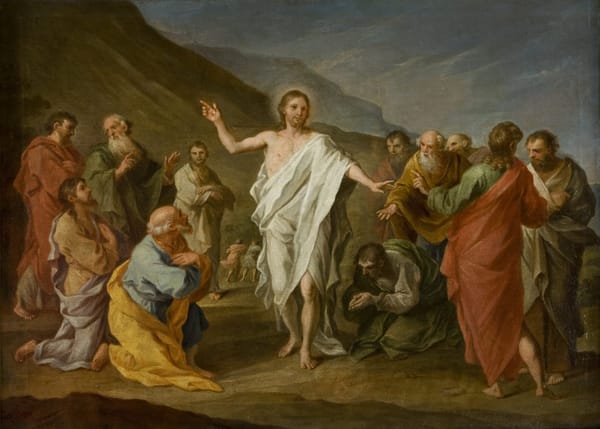
Easter Tuesday
OUR Pasch is the Lamb, and we meditated upon the mystery yesterday: now let us attentively consider those words of sacred Scripture, where, speaking of the Pasch, it says: 'It is the Phase, that is, the passage of the Lord.' God himself adds these words: 'I will pass through the land of Egypt that night, and will kill every first-born in the land of Egypt, both man and beast; and against all the gods of Egypt I will execute judgements.’1 So that the Pasch is a day of judgement, a day of terrible justice upon the enemies of God; but for that very reason, it is a day of deliverance for Israel. The lamb is slain; but his immolation is the signal of redemption to the holy people of the Lord.
The people of Israel are slaves to the cruel Pharaoh. Their bondage is the heaviest that can be. Their male children are to be put to death. The race of Abraham, on which repose the promises of the world’s salvation, is doomed. It is time for God to interpose: the Lion of the tribe of Juda, he whom none can resist, must show himself.
But in this, the Israelites are a type of another and a far more numerous people, the whole human race; and it is the slave of Satan, a tyrant worse than Pharaoh. Its bondage is at its height. It is debased by the vilest idolatry. It has made every base thing its god; and the God that made all things is ignored or blasphemed. With a few rare exceptions out of each generation, men are the victims of hell. Has God's creation of man, then, been a failure? Not so. The time is come for him to show the might of his arm: he will pass over the earth, and save mankind.
Jesus, the true Israelite, the true Man come down from heaven, he too is made a captive. His enemies have prevailed against him, and his bleeding, lifeless Body has been laid in the tomb. The murderers of the just One have even fixed a seal upon the sepulchre, and set a guard to watch it. Here again the Lord must pass, and confound his enemies by his triumphant passage.
In that Egypt of old, each Israelite family was commanded to slay and eat the Paschal Lamb. Then at midnight the Lord passed, as he had promised, over this land of bondage and crime. The destroying angel followed, slaying with his sword the first-born of the Egyptians, 'from the first-born of Pharaoh, who sat on his throne, unto the first-born of the captive woman that was in prison, and all the first-born of the cattle.’2 A cry of mourning resounded through Mesraïm: but God is just, and his people was made free!
The same victory was gained in the Resurrection which now gladdens us. The midnight was over, and the last shades of darkness were fleeing from before the rising light: it was then that our Lord passed through the sealed stone of his tomb, unperceived by his guards. His Resurrection was a stroke of death to his first-born people, who had refused to receive him as their Messias, or to ‘know the time of their visitation.’3 The Synagogue was hard of heart, like Pharaoh; it would fain have held captive him of whom the prophet had said, that he would be 'free among the dead.’4 Hereupon a cry of impotent rage was heard in Jerusalem: but God is just, and Jesus made himself free!
And oh! what a happiness was this passage of our Lord for the human race! He had adopted us as his brethren, and loved us too tenderly to leave us slaves of Satan: therefore, he would have his own Resurrectionbe ours too, and give us light and liberty. The firstborn of Satan were routed by such a victory; the power of hell was broken. Yet a little while, and the altars of the false gods shall everywhere be destroyed; yet a little while, and man, regenerated by the preaching of the Apostles, shall acknowledge his Creator and abjure his idols: for this is the day which the Lord hath made: ‘it is the Phase, that is, the passage of the Lord’!
But observe how the two mysteries—the Lamb and the Passover—are united in our Pasch. The Lord passes, and bids the destroying angel slay the first-born in every house, the entrance of which is not marked with the blood of the lamb. This is the shield of protection; where it is, there divine justice passes by and spares. Pharaoh and his people are not signed with the blood of the lamb: yet have they witnessed the most extraordinary miracles, and suffered unheard-of chastisements. All this should have taught them that the God of Israel is not like their own gods, which have no power; but their heart is hard as stone, and neither the works nor the words of Moses have been able to soften it. Therefore does God strike them and deliver his people.
But this very people, this Israel, ungratefully turns against his deliverer; he is content with the types of the good things promised; he will have no other lamb but the material one. In vain do the prophets tell him that ‘a Lamb is to be sent forth, who shall be King of the earth; that he shall come from the desert to the mount of the daughter of Sion.’5 Israel refuses to acknowledge this Lamb as his Messias; he persecutes him and puts him to death; and persists in putting all his confidence in the blood of victims that have no longer the power to propitiate the anger of God. How terrible will be the Passage of the Lord over Jerusalem, when the sword of the Roman legions shall destroy a whole people!
Satan, too, and his wicked angels, had scoffed at this Lamb; they had despised him, as being too meek and humble to be dreaded; and when they saw him shedding his Blood on the Cross, a shout of exultation rang through the regions of hell. But what was their dismay, when they saw this Lamb descending like a lion into limbo, and setting free from their bondage the countless prisoners of the four thousand previous years? and after this returning to our earth, and inviting all mankind to receive 'the liberty of the glory of the children of God’?6
O Jesus! how terrible is thy Passover to thine enemies! but how glorious for them that serve thee! The people of Israel feared it not, because their houses were marked with the blood of the figurative lamb. We are more favoured than they: our Lamb is the Lamb of God, and thy Blood is signed, not upon our dwellings, but upon our souls. Thy prophet foretold the great mystery when he said that on the day of thy vengeance upon Jerusalem, they would be spared whose foreheads should be marked with the Tau.7 Israel despised the prophecy, which is our joy. The Tau is the sign of thy Cross, dear Jesus! It is thy Cross that shields, and protects, and gladdens us in this Pasch of thy Passover, wherein thy anger is all for thine enemies, and thy blessings all for us!
At Rome, the Station for to-day is in the basilica of St Paul. The church is impatient to lead her white-robed troop of neophytes to the Apostle of the gentiles. Though he is not the foundation of the Church, yet is he companion of Peter's labours in Rome, his fellow-martyr, and the preacher of the Gospel to the gentiles. As he says of himself,8 he has laboured to form children in God—who could tell the number he has given to Christ? How must he rejoice to see these newly made Christians approach his sacred shrine, there to receive instruction from his epistles, wherein he still speaks to all generations!
Mass
The Introit, taken from the Book of Ecclesiasticus, celebrates the sublime wisdom of St Paul, who is the ever pure source whereat the people of God drink instruction and strength, and so prepare their souls for eternal life.
Introit
In the Collect, the Church gives thanks to God for rendering her fruitful, and thus giving her, every Easter, a mother's joy. She then prays for her new children, that they may have the grace to persevere in the imitation of their risen Lord.
Collect
Epistle
Cap. xiii.In diebus illis: Surgens Paulus, et manu silentium indicens, ait: Viri fratres, filii generis Abraham, et qui in vobis timent Deum, vobis verbum salutis hujus missum est. Qui enim habitabant Jerusalem, et principes ejus ignorantes Jesum, et voces prophetarum, quæ per omne sabbatum leguntur, judicantes impleverunt, et nullam causam mortis invenientes in eo, petierunt a Pilato, ut interficerent eum. Cumque consummassent omnia quæ de eo scripta erant, deponentes eum de ligno, posuerunt eum in monumento. Deus vero suscitavit eum a mortuis tertia die; qui visus est per dies multos his, qui simul ascenderant eum eo de Galilæa in Jerusalem: qui usque nunc sunt testes ejus ad plebem. Et nos vobis annuntiamus eam, quæ ad patres nostros repromissio facta est: quoniam hanc Deus adimplevit filiis nostris, resuscitans Jesum Christum Dominum nostrum.
Ch. xiii.In those days: Paul standing up, and with his hand bespeaking silence, said: Men, brethren, children of the stock of Abraham, and whosoever among you fear God, to you the word of this salvation is sent. For they that inhabited Jerusalem, and the rulers thereof, not knowing him nor the voices of the prophets which are read every Sabbath, judging him have fulfilled them, and finding no cause of death in him, they desired of Pilate that they might kill him. And when they had fulfilled all things that were written of him, taking him down from the tree, they laid him in a sepulchre. But God raised him up from the dead the third day: who was seen for many days by them who came up with him from Galilee to Jerusalem, who to this present are his witnesses to the people. And we declare unto you, that the promise which was made to our fathers, this same God hath fulfilled to our children, raising up Jesus Christ our Lord.
This discourse, which was made at Antioch in Pisidia, in the synagogue, shows us that the Doctor of the gentiles followed the same method in his instructions as did the prince of the Apostles. The great subject of their preaching was the Resurrection of Christ; for it is the fundamental truth, it is the fact above all others, which proves the divine mission of the Son of God upon earth. It is not enough to believe in Christ crucified; we must also believe in Christ risen. The Resurrection is not only the indisputable fact on which rests the whole certainty of our faith, but it is also the dogma which energizes the whole Christian world. Nothing ever happened on this earth which produced a like impression. See how throughout the whole world it is now celebrated by millions of men of every race and nation! Nineteen centuries have passed away since the relics of St Paul were first laid in this tomb on the Ostian Way: during that time, how many events have happened which in their time were looked on as of momentous importance, and are now completely forgotten? For more than two hundred years the storm of persecution was almost ceaseless over Christian Rome; it even became necessary, in the third century, to remove these sacred remains, and hide them, for a time, in the catacombs. After this came Constantine, who built this basilica, and erected the triumphal arch near the altar, under which lies the body of the Apostle. Since then, how many changes have taken place in the world! Dynasties, empires, forms of government, have succeeded each other, and only one institution has stood unchanged—the Church. Every year, during these fifteen centuries, she has gone to the basilica of St Paul, and there, near his tomb, has read this discourse in which the Apostle proclaimed the Resurrection of Christ to the Jews. Seeing such perpetuity, such unchangeableness, even in things like this, we cannot help exclaiming: Oh! truly, Christ is risen! He is the Son of God! for man could never have given duration to any work of his hand. Our Pasch alone tells us who Jesus is. Let us learn from the circumstance suggested to us by to-day’s Epistle how the dazzling beauty of our risen Jesus is reflected even in the minutest details of our happy worship, the Liturgy.
Gradual
The Sequence, Victimæ Paschali, p. 145.
Gospel
Cap. xxiv.In illo tempore: Stetit Jesus in medio discipulorum suorum, et dixit eis: Pax vobis: ego sum, nolite timere. Conturbati vero, et conterriti, existimabant se spiritum videre. Et dixit eis: Quid turbati estis, et cogitationes ascendunt in corda vestra? Videte manus meas, et pedes, quia ego ipse sum: palpate et videte: quia spiritus carnem et ossa non habet, sicut me videtis habere. Et cum hoc dixisset, ostendit eis manus et pedes. Adhuc autem illis non credentibus, et mirantibus præ gaudio, dixit: Habetis hic aliquid, quod manducetur? At illi obtulerunt ei partem piscis assi, et favum mellis. Et cum manducasset coram eis, sumens reliquias, dedit eis. Et dixit ad eos: Hæc sunt verba, quæ locutus sum ad vos, cum adhuc essem vobiscum, quoniam necesse est impleri omnia, quæ scripta sunt in lege Moysi, et prophetis, et Psalmis de me. Tunc aperuit illis sensum ut intelligerent Scripturas. Et dixit eis: quoniam sic scriptum est, et sic oportebat Christum pati, et resurgere a mortuis tertia die: et prædicari in nomine ejus pœnitentiam et remissionem peccatorum in omnes gentes.
Ch. xxiv.At that time: Jesus stood in the midst of his disciples, and said to them: Peace be to you: it is I, fear not. But they being troubled and frighted, supposed they saw a spirit. And he said to them: Why are you troubled, and why do thoughts arise in your hearts? See my hands and my feet, that it is I myself; handle me and see: for a spirit hath not flesh and bones, as you see me to have. And when he had said this, he showed them his hands and his feet. But while they yet believed not, and wondered for joy, he said: Have you here anything to eat? And they offered him a piece of broiled fish, and a honey-comb. And when he had eaten before them, taking the remains he gave to them. And he said to them: These are the words which I spoke to you while I was yet with you, that all things must needs be fulfilled, which are written in the law of Moses, and in the prophets, and in the Psalms, concerning me. Then he opened their understanding, that they might understand the Scriptures. And he said to them: thus it is written, and thus it behoved Christ to suffer, and to rise again from the dead the third day: and that penance and remission of sins should be preached in his name unto all nations.
Jesus shows himself to all his Apostles, on the evening of the day on which he rose from the grave; and he greets them with the wish of peace. He wishes the same to us, during this feast of the Pasch. He desires to establish peace among us—peace between man and God, peace in the conscience of the repentant sinner, peace between man and man by the forgiveness of injuries. Let us welcome this wish of our risen Lord, and jealously preserve the peace he thus deigns to bring us. At his birth in Bethlehem, the angels announced this peace to men of good will; but now it is Jesus himself who brings it to us, for he has accomplished his work of pacification by dying for us on the Cross. The first word he addresses to his Apostles, and through them to us, is Peace! Let us lovingly accept the blessing, and show ourselves to be, in all things, children of peace.
The conduct of the Apostles, on this occasion, deserves our attention. They believe in their Lord's Resurrection; they eagerly announced the great event to the two disciples of Emmaus: but how weak is their faith! They are troubled and frighted at Jesus' sudden apparition; and when he graciously permits them to handle him, they are overpowered with joy, and yet there is a certain inexplicable doubt still lingering in their minds. Our Lord has to condescend even to eat in their presence, in order fully to convince them that it is really himself and not a phantom. What a strange inconsistency there is in all this! Had they not already believed and confessed the Resurrection of their Master, before receiving this visit? We have a lesson to learn here: it is, that there are some people who believe, but their faith is so weak that the slightest shock would endanger it; they say they have faith, but it is of the most superficial kind. And yet, without a lively and vigorous faith, what can we do in the battle we have to be incessantly waging against the devil, the world, and our own selves? He who wrestles with an enemy is desirous to have a sure footing; if he stand on slippery ground, he is sure to be thrown. Nothing is so common nowadays as unstable faith, which believes as long as there is nothing to try it: but let it be put to the test, and it gives way.
One principal cause of this weakness of faith is that subtle naturalism, which now fills the atmosphere in which we live, and which it is so difficult not to imbibe. Let us earnestly pray for an invincible and supernatural faith, which may be the ruling principle of our conduct, which may never flinch, and may triumph over both our internal and external enemies. Thus shall we be able to apply to ourselves those words of the Apostle St John: ‘This is the victory which overcometh the world, our faith.’9
In the Offertory, the Church speaks to us, in the words of the royal prophet, of the fountains of water which sprang up at the thunder of God’s bidding. This voice of the Most High was made known to the earth by the preaching of the Apostles, and, in a special manner, by that of St Paul. The fountains are the baptismal fonts, from which our neophytes came regenerated unto life everlasting.
Offertory
The Church prays, in the Secret, that the Sacrifice she is about to offer may aid us to pass safely on to that infinite glory to which Baptism first opened to us the way.
Secret
In the Communion Anthem we have St Paul himself speaking to the neophytes, and telling them what manner of life they must henceforth lead, in order to resemble their divine model, their risen Jesus.
Communion
The Church makes the above words of the Apostle the subject of her concluding Prayer: she begs that her new children, who have just partaken of the Paschal Mystery, may persevere in the new life of which this holy Sacrament is the chief support.
Postcommunion
Vespers
The Vespers are the same as on Easter Sunday, excepting the Magnificat Antiphon, and the Collect, which are as follows:
Antiphon of the Magnificat
The Collect is given above, in the Mass, p. 200.
On the third day of the creation, the waters, which covered the earth, were gathered together at the word of the Son of God, and flowed into the hollows prepared for them. The seas thus formed, the surface of the earth became habitable for those beings that were soon to be called forth from nothingness. On this day, then, the angels first beheld the place where we are to have a temporary sojourn. The time will come when this very Son of God, who now separates the waters from the earth, will himself inhabit it, after having assumed our human nature. Let us offer him our earth, as his rightful domain, over which, as also over heaven, all power has been given to him.10 The Mozarabic breviary gives us the following beautiful prayer, in which are explained the mysteries hidden under the text that describes this third day’s creation:
Capitula
Let us again borrow from the ancient Liturgies the formulas used in the celebration of Easter. We find in the Missal of the Gothic Church of Spain this magnificent Preface; it is an eloquent and fervent summary of all the grand things said by the Fathers regarding the Pasch.
Illatio
We subjoin to this Mozarabic Preface a hymn taken from the Roman-French Missal of the Middle Ages. It was a favourite Easter hymn with the people of those days; and though somewhat unpolished, is full of vigour. The chant that accompanied it, and which would fatigue any singer of modem times, is, in spite of its occasional want of smoothness, very melodious and expressive.
Sequence
Rutilat per orbem
Hodie dies in qua
Christi lucida
Narrantur ovanter prælia.
Quem Christus triumphavit pulchre,
Castra
Illius perimens teterrima.
Qua caruimus omnes vita.
Felix proles Mariæ,
Qua epulamur modo una.
Sit celsa
Regina illa,
Generans regem
Spoliantem tartara,
Pollentem
Jam in æthera.
Suscipe benignus
Præconia nostra
Sedule tibi canentia.
Victor ubique,
Morte superata,
Polorum possidens
Gaudia.
O celsa,
O pulchra dementia
Christi melliflua,
O alma.
Qui nostram antiquam
Leviasti sarcinam.
Agni benignissimi
Empta,
Florida
Micat hæc aula.
Qui lavit facinora,
Tribuit dona fulgida.
Jam miror hodierna,
Tanta
Indignus pandere
Modo sacramenta.
Ortus de tribu Juda,
Leo potens surrexisti in gloria.
Agnus visus es in terra.
Regna petens supera:
Justis reddens præmia,
In sæcula
Dignantur ovantia.
Quid valet nunc fraus tua?
Igneis nexus loris
A Christi victoria.
Quis audivit talia
Miracula?
Ut mors mortem sic superaret:
Rei perciperent talem gratiam?
Cur manes adhuc inverecunda?
Respice christicolas,
Qualiter læti canunt inclyta
Redemptori carmina.
Nobis laxans crimina,
Solve nexorum vincula.
Fac tecum resurgere
Ad beatam gloriam,
Digna rependens merita.
through the world
the bright fair day,
whereon are triumphantly told
the splendid combats of Christ.
the haughty enemy,
and routed his most
wicked hosts.
whereby we were all deprived of life!
Happy the fruit of Mary,
whereon we all now feed together!
be that noble
Queen,
The mother of the King,
who robbed hell
of its prey,
And now reigns in heaven above.
graciously receive
the hymns
we devoutly sing to thee.
Universal Conqueror!
thou didst vanquish death,
and enter into the joys
of heaven.
how sublime,
how beautiful,
how sweet,
how tender art thou!
that didst lighten
our heavy weight of old!
of the infinitely merciful Lamb,
the Church glitters
with the ruby flowers
of her redemption.
washed away our sins,
loads us with precious gifts.
of this day's wonders,
I am unworthy
to proclaim
its great mysteries.
Child of the tribe of Juda!
thou didst rise in glory, a lion in strength.
Thou wast seen on earth as a gentle lamb.
Thou hast ascended to the kingdom above:
And there thou mercifully rewardest
the just with the rewards
of everlasting joy.
what now hath thy craft profited thee?
The victory of Christ
has bound thee fast in fetters of fire.
Who hath heard
of miracles like these?
That death should so conquer death?
That criminals should receive favour like unto this?
hast thou no shame, that thou canst continue so?
See how the Christians rejoice,
singing to the Redeemer
their holy hymns.
forgive us our sins,
loosen our fetters.
may rise with thee to heavenly glory,
and to their just merits
give recompense.
April 14: St. Justin Martyr
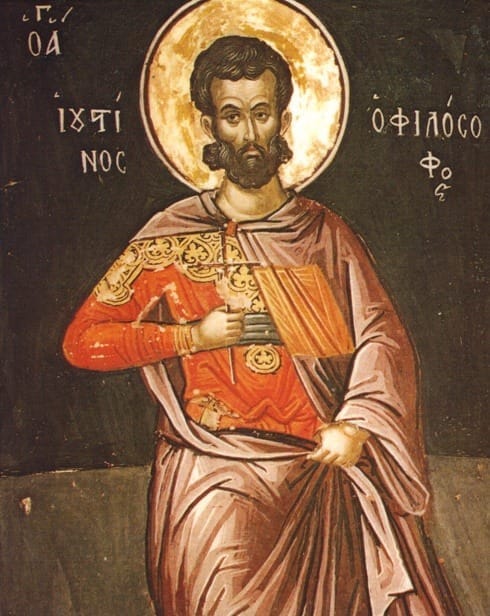 |
YESTERDAY Spain sent one of her princes to represent her at the court of the Conqueror of Death. To-day Christ receives with equal honour the representative of learning in the service of religion. The philosopher’s mantle worn by Justin is as splendid as the royal purple of Hermenegild, for both prince and philosopher have washed their robes in their own blood, mingled with that of the Lamb, and these robes have become the insignia of their eternal glory. But the victory of Christ’s champions is not felt in heaven only—the blood of the martyrs makes the very earth fruitful. In spite of heresy, Catholic Spain was born from the royal blood of Hermenegild, and paganism, by sacrificing Justin to its own hatred, inspired new vigour into the seed sown in Rome by SS Peter and Paul. On this very day the sacred cycle brings before us SS Valerian, Tiburtius, and Maximus, the glorious triumvirate won to Christ by the immortal Cecily, who embodies so nobly the Roman faith defended with such love and learning by Justin. When she was born. Justin’s public disputations with the adversaries of Christianity were filling Rome with his victorious refutations of paganism. His writings, which he boldly caused to penetrate even to the imperial throne, carried the light to regions which he could not reach by his spoken word. The lictor’s axe, in striking off the head of the apologist, gave more force to his demonstrations than had been given by his powerful logic, when for the first time he overcame the powers of hell and put an end to a fierce persecution.
The world, courted on all sides by a thousand different schools, which by their contradictions seemed bent on making the discovery of truth impossible, was now in a position to recognize sincerity. Marcus Aurelius had succeeded Antoninus Pius, and he claimed to enthrone philosophy in his own person. His ideal of perfection was the satisfaction of self and the contempt of others, and he passed from dogmatic scepticism to the establishment of the Moral Law, delivering his ‘Thoughts ‘to the admiration of his courtiers without caring for the reformation of their morals. Justin, had been seeking truth from boyhood, in order to find justice. He was not discouraged by the ill-success of his early efforts, and did not make the delay of the dawn an excuse for denying the existence of the light. When, at God's chosen time, he found Wisdom, he longed to communicate her to all, little and great, and devoted his life to the work, making naught of the labours and sufferings by which he solemnly confessed his faith before the world. What man of good faith could hesitate to choose between the Christian hero and the crowned sophist who put him to death? Who would not, like Cecily, pour scorn upon the pretensions of those false philosophers who have made themselves masters of the world and who give no proof of their love for wisdom beyond their determination to shut the mouths of those who preach it?
Philosophy, baptized in the blood of this convert, is henceforward Christian for ever. Her distressing sterility is at an end. The testimony of martyrdom which she has now given to truth in token of faithful service, atones for all the monstrous offences of her early years. She will always be distinct from faith, but henceforth she will be the helpmeet of this heavenly virtue. Human reason will be strengthened by the alliance and will be able to arrive at trustworthy conclusions. But woe to reason if she forgets her consecration to Christ, ignores the mystery of the Incarnation, and declares herself satisfied with a purely natural explanation of the origin of man, the end of creation, and the Moral Law. The natural light, which enlightens every man that comes into the world, is unquestionably from the Word, and that is its glory. But since the divine Word, in addition to the honour thus done to reason, has given to humanity a higher and more direct manifestation of himself, he does not intend that man should divide his gifts, leave on one side the faith which prepares the way for vision, and content himself with the gleam of light which would have been sufficient for the state of pure nature. The Word is one, as man, to whom he manifests himself, is one; and this manifestation is made at one and the same time, though in different ways, namely, by reason and faith. If man withdraws himself from the supernatural light, he will be rightly punished by the withdrawal of that natural light, which he thought to be his own, and the world will be plunged into unreasoning foolishness.
Let us read the account given by the Church of the martyr philosopher and give glory to our Risen Lord, whose triumph is enhanced by the consecration to him of all the glory gained by men.
We hail in thee, O Justin, one of the noblest trophies of the divine Conqueror of Death. Thou wast bom in the kingdom of darkness, but thou didst early seek to break the chains of falsehood which bound thee like so many others. Thou didst love Wisdom even before thou didst know her, and she too had chosen thee.1 But she ‘will not enter into a malicious soul, nor dwell in a body subject to sins.’2 Many men seek to hide their self-love under the beautiful name of Philosophy, and to find in her an excuse for all their vices; but thou didst seek for knowledge out of a desire to know and love the truth and obey her laws. This purity of heart and mind brought thee near to God and made thee worthy to meet in the ways of life the living Wisdom whom thou art now enjoying in the full light of eternity.3 The Church has honoured thee, and rightly, with the name of the Admirable Philosopher, for thou wast the first to realize that a Philosophy which is worthy of the name—a true love of wisdom—cannot confine its researches within the abstract domain of pure reason; for reason is only the gateway into those higher regions where Wisdom reveals herself in person to the love that seeks her with a sincere heart.
It is written of souls like thee that ‘the multitude of the wise is the welfare of the whole world.’4 But true philosophers who, like thee, understand that the aim of the wise man is to attain to the vision of God5—to reach the most holy God by the way of obedience6—are rare in .these days. The independence of reason is the only dogma on which the sophists of the present day are agreed. Their sect is characterized by a false eclecticism, which allows each one to make his own system and choose what most appeals to him out of the positive affirmations of different schools and religions. Thus they proclaim that reason, though supreme in their eyes, has so far produced no trustworthy conclusions, and that the last word of science is scepticism or universal doubt. It is hardly becoming for such men to reproach the Church with despising reason. On the contrary, the Church has but lately, in the Vatican Council,7 emphasized and exalted the mutual help rendered by faith and reason in leading men to God, and she casts out of her fold those who deny to human reason the power to affirm with certainty the existence of God our Lord and Creator. When seeking to define in these days the respective value of faith and reason, without either separating or confusing them, the Church had but to listen to the testimony of Christian philosophers in all centuries, beginning with thee, for their works, which complete one another, are full of this dcctrine.
Thou wast as faithful as thou wert brave, O valiant martyr! In thy day the Church had not been forced by contests with heresy to seek for new terms of expression whose very precision soon became indispensable, but thy writings prove to us that the doctrine was the same though the phraseology was less clear. Be thou blessed by all the children of the Church for this demonstration of the identity of our belief with that of the second century. Be thou blessed for thy careful distinction between that which was dogma to be held by all, and those private opinions on lesser points to which the Church in thy day left liberty as she has ever done.
Do not disappoint the confidence of the Mother of all mankind. Though so many centuries have passed since thy martyrdom, she wishes her children to pay thee greater honour to-day than they have done in past ages. She was once recognized as queen of the nations, but now her situation is what it was in the days when thou didst defend her against hostile powers. Raise up new apologists. Teach them that the assaults of hell may be repelled by zeal, firmness and eloquence. But they must not have false ideas as to the nature of the combat entrusted to their honour by the Church. They have to defend a queen. The Spouse of the Son of God could never permit her champions to solicit for her the protection accorded to a slave. Truth has its rights—or, rather, it is truth alone that has the right to claim liberty. Our apologists, O Justin, must, like thee, make the State ashamed not to grant to the Church a liberty accorded to all sects. But Christian champions may not rest satisfied with a toleration extended equally to Christ and Satan, They must cry with thee, even when fresh violence is threatened: ‘Our cause is just, for we, and we alone, speak the truth.’8
April 14 (the Same Day): Sts. Tiburtius, Valerian and Maximus, Martyrs
LET us affectionately welcome the brave triumvirate of martyrs, presented today to our Risen Jesus by the Roman Church of the second century. The first is Valerian, the chaste and noble spouse of Cecily; he wears on his brow a wreath of roses and lilies. The second is Tiburtius, Valerian's brother, and like him, a convert of Cecily; he shows us the triumphant palm he won so speedily. Maximus is the third; he witnessed the combat and the victory of the two brothers, imitated their example, and followed them to heaven. The immortal Cecily is the queen of this holy group; she taught them to be martyrs; she has a right to our remembrance on this day of their feast. She herself shared in their glorious privilege of suffering and dying for the name of Christ. She won the crown five months later, on September 16, according to the most ancient calendars; her feast, however, is no longer kept on that day. The solemnity of November 22, formerly preceded by a vigil, is marked in the Roman breviary as the day of her martyrdom; it is, in reality, the anniversary of the dedication of her magnificent basilica in Rome.
The Church makes a commemoration of our three great martyrs to-day.
The following lesson is extremely short. The reason is, that this feast is very ancient; and in the early ages of the Church, simple offices, as they are called, were extremely frequent; and it was only for great feasts that three nocturns were said each with three lessons.
Holy and precious fruits of the great Cecily's apostolate! we this day unite with the blessed Spirits in celebrating your entrance into the court of heaven. Thou, O Valerian, wast led to faith, and to the sublimest of all virtues, by thy noble spouse; thou wast the first to enter into the joy of the Lord; but in a few days thy Cecily followed thee, and the love begun on earth was made eternal in heaven. Speaking of thee and her, an angel said that your roses and lilies should never fade; their fragrance of love and purity is sweeter by far now than when they bloomed here below. Thou, O Tiburtius! brother of these two angels of earth! thou owest to them thy beautiful palm; thou art a sharer in their eternal happiness, and the three names, Cecily, Valerian, and Tiburtius, are to be for ever united in the admiration of angels and men. The sight of the two brothers suffering so bravely for Christ inflamed thy ambition, O Maximus, to imitate them; the God of Cecily became thine; thou didst shed thy blood for him; and he, in return, has placed thee in heaven near Cecily, Valerian and Tiburtius, to whom, whilst on earth, thou wast so inferior by birth and position.
Now, therefore, O holy martyrs, be our protectors, and hear the prayers we address unto you. Speak in our favour to the immortal King, for whom you so bravely fought and died; ask him to fill our hearts with his love, and make us generous like you. You despised this fleeting life; we too must despise it, if we would share in the happiness you now enjoy, the sight of our Risen Lord. The battle we have to fight may, perhaps, be different from yours; but the reward that awaits us is, like your own, everlasting. Rather than betray Christ, you laid down your lives; our duty is the same—we must die rather than sin. Pray for us, O holy martyrs, that our lives may henceforward be such as will honour this year's Pasch. Pray also for the Church of Rome, your Mother; her days of trial have returned; she has a right to count upon your intercession for the help she needs.
| Previous Easter Monday | Next April 14: St. Justin Martyr |