Daily reading
Paschal Time
Double · April 21 · Sanctoral
April 21, 2020
From Dom Guéranger’s The Liturgical Year.
A Double leads the weekday.Rubric
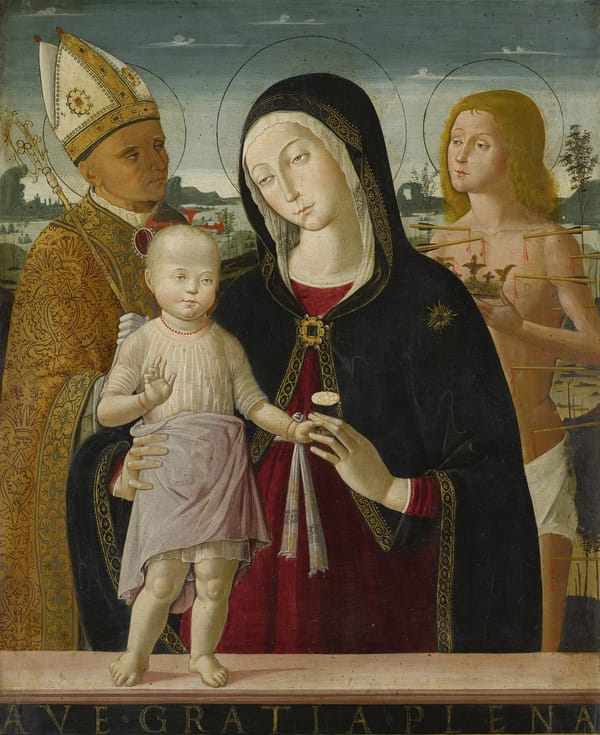 |
April 21: St. Anselm, Bishop, and Doctor of the Church
A MONK, a Bishop, a Doctor of the Church—such was the Saint whose feast comes to gladden us on this twenty-first day of April. He was a martyr, also, at least in desire, and we may add, in merit too—for he did enough to earn the glorious palm. When we think of Anselm, we picture to ourselves a man in whom are combined the humility and meekness of the cloister with the zeal and courage of the episcopal dignity; a man who was both a sage and a saint; a man whom it was impossible not to love and respect.
He left his native country of Piedmont for the Monastery of Bec in France, where he became a Benedictine monk. Being elected Superior, he realized in himself the type of an Abbot, as drawn by St Benedict in his Rule: ‘He that is made Abbot,’ says the holy Patriarch, ‘should study to give help rather than to give commands,’1 We read that the love entertained for Anselm by his brethren was beyond description. His whole time was devoted to them, either in giving them spiritual direction, or in communicating to them his own sublime knowledge of the sacred sciences. After governing them for several years, he was taken from them, and compelled to accept the dignity of Archbishop of Canterbury. He was a worthy successor of Augustine, Dunstan, Elphege, and Lanfranc; and by his own noble example of courage, he prepared the way for the glorious martyr Thomas, who succeeded him in less than a century.
As bishop, his whole life was spent in fighting for the liberty of the Church. Though gentle as a lamb by nature, he was all energy for this great cause. He used to say: ‘Christ would not have his Spouse be a slave; there is nothing in this world that God loves more than the liberty of his Church.’ There was a time when the Son of God allowed himself to be fettered with bonds in order that he might loosen us from the chains of our sins; but now that he has risen in triumph from the dead, he wills that his Spouse should be, like himself, free. She cannot otherwise exercise the ministry of salvation confided to her by her divine Lord; and yet there is scarcely a single hundred years of her existence in which she has not had to fight for this holy liberty. The rulers of this earth, with very few exceptions, have ever been jealous of her influence, and have sought to lessen it by every possible means. In our own times there are numbers of her children who do not even know that she has any rights or privileges; they would be at a loss to understand you, if you told them that she is the Spouse of Christ, and therefore a queen; they think it quite enough for her, if she enjoy the same amount of freedom and toleration as the sects she condemns; and they cannot see how, under such conditions as these, the Church is not the kingdom he wished her to be, but a mere slave. St Anselm would have abominated all such theories as these; so does every true Catholic. He is not driven into disloyalty to the Church by the high-sounding words, progress and modern society; he knows that there is nothing on earth equal to the Church; and when he sees the world convulsed by revolutions, he knows that all comes from the Church having been deprived of her rights. One of these is that she should not only be recognized, in the secret of our conscience, as the one only true Church, but that, as such, she should be publicly confessed and outwardly defended against every opposition or error. Jesus, her divine Founder, promised to give her all nations as her inheritance; he kept his promise, and she was once the Queen and Mother of them all. But nowadays, a new principle has been asserted, to the effect that the Church and all sects must be on an equal footing as far as the protection of the State goes. The principle has been received with acclamation, and hailed as a mighty progress achieved by modern enlightenment: even Catholics, whose previous services to religion had endeared them to our hearts and gained our confidence, have become warm defenders of the impious theory.
Trying as were the times when St Anselm governed the See of Canterbury, they were spared the humiliation of producing and ratifying such doctrine as this. The tyrannical interference of the Norman kings was an evil far less injurious than the modern system, which is subversive of the very idea of a Church. Open persecution would be a boon, compared to the fashionable error of which we are speaking. A winter torrent brings desolation in its track: but in the summer, when the flood is over, nature brings back her verdure and flowers. The errors which now prevail are like a great sea that gradually sweeps over the whole earth: and when the Church can find no spot whereon to rest, she will take her flight to heaven, and men must expect the speedy coming of the judge.
Anselm was not only the zealous and heroic defender of the rights and privileges of the Church; he was also a light to men by his learning. The contemplation of revealed truths was his delight. He studied them in their bearings one upon the other, and his writings occupy a distinguished place in the treatises of Catholic Theology. God had blessed him with extraordinary talent. Amidst all the troubles and anxieties and occupations of his various duties, he found time for study. Even when passing from place to place, as an exile, he was intent on the meditation of the mysteries of religion, thus preparing those sublime reflections which he has left us on the articles of our Faith.
The Church gives us, in her Liturgy, the following sketch of our Saint’s life:
We take the following Responsories and Antiphons from an office approved by the Holy See:
℣. Afflictions await me; but I fear none of them, so that I may consummate my course.* And your joy shall soon be changed into mourning, alleluia.℟. When the Fathers were assembled in Council, Urban, the Pope, cried out: Where art thou, Father and Master Anselm, Archbishop of the English? Come up here to us; fight for thine own and our Mother, and help us, alleluia.℣. Blessed be thy wisdom, and blessed the word of thy mouth!* Come up here to us; fight for thine own and our Mother, and help us, alleluia.
The following hymn is from the same Office:
Hymn
Laurea doctor redimitus astat:
Festus Anselmo chorus æmuletur
Dicere carmen.
Sæculi florem pereuntis horret;
Atque Lanfranci documenta quærens,
Intrat eremum.
Fertur immotæ fidei volatu:
Dogmatum puros latices an ullus
Altius hausit?
Te voves charæ soboli: benignis
Debiles portas humeris, alacres
Prævius hortans.
Quid times luctam? properant triumphi;
Exteras gentes, generosus exsul,
Lumine reples.
Parta, cui Christus nihil ante ponit,
Urget Anselmum: studio quis aequo
Vindicat ipsam?.
Pontifex summus tibi fert honores;
Te fides poscit: siluere Patres:
Dogma tuere.
Sis ad æternam Triadem, precamur,
Cuncta cui dignas resonent per orbem
Sæcula laudes.
a true monk, a doctor with his laurel wreath upon him.
Let our festive choir sing
fervently a hymn in his praise.
so wise, indeed, that he trampled on the flower of this perishable world,
and fled to solitude,
that he might receive instruction from Lanfranc.
he entered into the mysteries of the Word.
Did any mortal drink more fully
than he of the limpid fount of Truth?
thou didst tenderly care for thy flock.
Thou didst carry the weak upon thy shoulders
and encourage the fervent by thine own example.
O fear not the combat! Triumph shall be thine.
When he sends thee into exile, thou wilt shine,
as a generous light, upon lands beyond the sea.
which he won for us by redeeming us,
excited Anselm’s zeal.
Never had it a braver defender than he.
The Supreme Pontiff showed thee great honour,
when, in the presence of the Fathers, he said to thee:
‘Fight for the faith! Defend our dogmas!’
be mindful of the holy flock!
Intercede for us to the Blessed Three,
to whom be worthy praise from all for ever.
O holy Pontiff Anselm! beloved of God and men! the Church, whose cause thou didst so zealously defend on earth, celebrates, this day, thy praise, and honours thee as one of her dearest Saints. Thy meekness, condescension and charity gave thee a resemblance to Jesus, the Good Shepherd. Like him, thou couldst truly say: I know my sheep, and my sheep know me.2 Thou didst watch over them day and night, lest the wolf should come and find them unprotected. Far from fleeing at his approach, thou didst go forth to meet him, and nothing could induce thee to yield to his sacrilegious tyranny. Heroic champion of the Church's liberty! protect it in these our days, when there is not a country left where it is not insulted or ignored. Raise up in every place pastors with a spirit of holy independence such as thou hadst; that thus the faithful may take courage and that every Christian may boldly and proudly confess that he himself is a member of the Church, and that the interests of our spiritual mother are far more deserving of our solicitude than those of the whole world besides.
God had gifted thee, O Anselm, with that Christian philosophy which bows down to the teachings of faith, and which, being thus purified by humility, is elevated to the intelligence of the sublimest truths. The Church, in acknowledgement of the benefits she derived from thy learning, has conferred upon thee the title of Doctor, which for a long time was confined to those great men who lived in the early Christian Ages, and whose writings are the reflex of the preaching of the Apostles. Thy teaching has been deemed worthy of being numbered with that of the ancient Fathers, for it came from the same divine Spirit, and was the result of prayer rather than of study. Obtain for us, O holy Doctor, that ‘our faith,' like thine, ‘may seek understanding,'Nowadays, there are many who blaspheme what they know not;3 but there are many also who know little or nothing of what they believe. Hence arise a deplorable confusion of ideas, compromises are made between truth and error, and the only true doctrines are despised, scouted, or at least undefended. Pray to our heavenly Father, O Anselm, that he would bless the world with holy and learned men, who may teach the path of truth, and dispel the mists of error; that thus the children of the Church may not be led astray.
Look down with affection, O holy Pontiff, on the venerable Order, which, when God called thee from the vanities of the world, received thee, made thee one of her children, gave thy soul its life, and thy mind the light of wisdom. She claims thy protection. Thou art a son of the great Patriarch Benedict: forget not thy brethren. Bless them in France, where thou didst first embrace the Monastic Life; bless them in England, where thou wast Primate, and yet still the humble monk. Pray for the two countries, for both are dear to thee. Faith is weak in one; and heresy reigns supreme in the other. Beseech our Lord to show his mercy to both: he is all-powerful, and he turns not a deaf ear to the prayers of his Saints. If, in his justice, he have decreed not to restore to these two countries their ancient Catholic constitution, pray that, at least, the number of souls saved may be great, that conversions may be frequent, and that the labourers sent at the eleventh hour to the vineyard may emulate the zeal of them that were first called!
Tuesday of the Second Week after Easter
WHAT are these wounds in the midst of thy hand?1 Such was the exclamation of the Prophet Zacharias, who lived five hundred years before the Birth of our Emmanuel: and we are almost forced to use it, now that we behold the Wounds that shine so brightly in the glorified Body of our Risen Lord. His hands and feet bear the mark of the nails, and his side that of the spear; the Wounds are as visible and as deep as when he was first taken down from the Cross. Put in thy finger hither, said Jesus, holding out his wounded hands to Thomas; put thy hand into my Side!2
We assisted at this wonderful interview on Sunday last—the incredulity of the disciple was made an occasion for the most incontestable proof of the Resurrection: but it also taught us that, when our Lord rose from the tomb, he retained in his glorified Flesh the stigmata of his Passion. Consequently, he will retain them for ever, inasmuch as no change can have further place in his Person. What he was the moment after his Resurrection, that will he be for all eternity. But we are not to suppose that these sacred stigmata, which tell of his humiliation on Calvary, are in the slightest degree a lessening of his glory. He retains them because he wishes to do so; and he wishes it, because these Wounds, far from attesting defeat or weakness, proclaim his irresistible power and triumph. He has conquered death; the Wounds received in the combat are the record of his victory. He will enter heaven on the day of his Ascension, and the rays of light which beam from his Wounds will dazzle the eyes of even the angels. In like manner, as the holy Fathers tell us,3 his martyrs who have imitated him in vanquishing death will also shine with special brightness in those parts of their bodies where they were tortured.
And is not our Risen Jesus to exercise, from his throne in heaven, that sublime mediatorship for which he assumed our human nature? Is he not to be ever disarming the anger of his Father justly irritated by our sins? Is he not to make perpetual intercession for us, and obtain for mankind the graces necessary for salvation? Divine Justice must be satisfied; and what would become of poor sinners, were it not that the Man-God, by showing the precious Wounds on his Body, stays the thunderbolts of heaven, and makes mercy preponderate over judgement?4 O sacred Wounds! the handiwork of our sins, and now our protection! we shed bitter tears when we first beheld you on Calvary; but we now adore you as the five glories of our Emmanuel! Hail most precious Wounds! our hope and our defence!
And yet the day will come when these sacred stigmata, which are now the object of the angels’ admiration, will be again shown to mankind, and many will look upon them with fear; for, as the Prophet says: They shall look upon him whom they have pierced.5 These men, who, during life, heeded neither the sufferings of the Passion, nor the joys of the Resurrection, but rather despised and insulted them, will have treasured up for themselves the most terrible vengeance; for could it be that a God could be crucified, and rise again, and both to no purpose? We can understand how sinners will say, on that last day: Fall upon us, ye mountains! and ye hills, cover us!6—‘hide us from the sight of these Wounds, which now dart upon us the lightnings of angry justice!’
O sacred Wounds of our Risen Jesus! be a source of mercy and joy, on that dread day, to all them that spent the Easters of their earthly pilgrimage in rising to a holy life! Happy the disciples who were privileged to gaze upon you during these forty days! and happy we, if we venerate and love you! Let us here borrow the devout words of St Bernard:7 ‘Where can I that am weak find security and rest, but in the Wounds of Jesus? The greater is his power to. save, the surer am I in my dwelling there. The world howls at me, the body weighs me down, the devil sets snares to take me: but I fall not, for I am on the firm rock. I have sinned a grievous sin; my conscience will throw me into trouble, but not into despair, for I will remember the Wounds of my Lord. Yes, he was wounded for our iniquities!8 What I have not of mine own I take to myself from the Heart of my Jesus, for it is overflowing with mercy. Neither are there wanting outlets, through which it may flow—they have pierced his hands and feet9 and with a spear they have opened his side, enabling me, through these chinks, to suck honey out of the rock, and oil out of the hardest stone,10 that is, to taste and see how sweet is the Lord.11 He thought thoughts of peace,12 and I knew it not, for who hath known the mind of the Lord? or who hath been his counsellor?13 But the nail that wounded is the key that opened to me to see the design of the Lord. I looked through the aperture, and what saw I? The nail and Wound both told me that truly God was in Christ reconciling the world to himself.14 The iron pierced his soul,15 and reached even to his heart, so that henceforth he cannot but know how to compassionate with me in my infirmities. The secret of his heart is revealed by the Wounds of his Body; the great mystery of mercy is revealed—the bowels of the mercy of our God, in which the Orient from on high hath visited us.16 What, O Lord, could more clearly show me than do thy Wounds, that thou art sweet and mild, and plenteous in mercy?’17
Let us express our Paschal joy, to-day, in the words of a charming sequence of the eleventh century. We have taken it from a missal of the Abbey of Murbach:
Sequence
Ecclesia Christi canat,
Ob quam patrem matremque deserens,
Se vestiit natura,
Et synagogam respuit.
Tuo sacro latere
Sacramenta manarunt illius;
Conservatur in salo saeculi.
Sed portas offracturus,
Hanc etiam hostibus Illius Eruiturus,
Tyranno Goliath, Quem lapillo
Prosternis unico.
Amoena, Christe,
Ludit in pace
Omnis Ecclesia tute in horto;
Resurgens, Christe,
Hortum florentis
Paradisi tuis Obstructum
Diu, reseras, Domine,
Rex regum.
a canticle to her Beloved,
who out of love for her, left father and mother,
clad himself with our nature,
and cast off the Synagogue.
O Christ,
flowed from thy sacred Side.
on the wood of thy Cross.
but thou didst break its gates:
and, to deliver her from her enemies,
the tyrant Goliath, and with a single stone
didst lay him low.
under the shade
of the pleasant Vine,
enjoys peace,
and safely lives in the garden.
By thy Resurrection,
O Lord, King of kings,
thou openest the long-closed garden
of thy flowery Paradise.
- Zach. xiii 6. ↩︎
- St John xx 27. ↩︎
- St Augustine De Civitate Dei, Lib. xxii, Cap. xxix. St Ambrose In Lucam, Lib. x. ↩︎
- St James ii 13. ↩︎
- Zach. xii 12. ↩︎
- St Luke xxiii 30. ↩︎
- In Cantica, Serm. lxi ↩︎
- Isa. liii 5. ↩︎
- Ps. xxi 17. ↩︎
- Deut. xxxii 13. ↩︎
- Ps. xxxiii 9. ↩︎
- Jer. xxix 11. ↩︎
- Rom. xi 34. ↩︎
- 2 Cor. v 19. ↩︎
- Ps. civ 18. ↩︎
- St Luke i 78. ↩︎
- Ps. lxxxv 5. ↩︎
| Previous Monday of the Second Week after Easter | Next Tuesday of the Second Week after Easter |