Daily reading
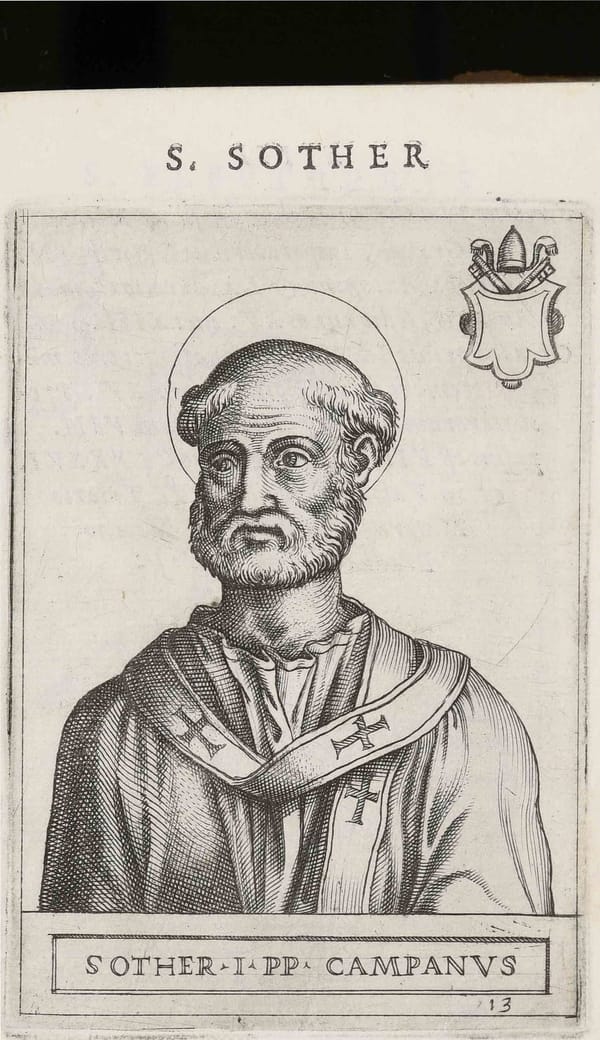
April 22: Sts. Soter and Caius, Popes and Martyrs
THE palms of two martyred Popes are intertwined and grace this day of the Calendar. Soter suffered for Christ in the second, and Caius in the third century; a hundred years separate them; and yet we have the same energy of faith, the same jealous fidelity to keep intact the depositum left by Christ to his Church. What human society ever existed that produced heroes for century after century? The Society, however, which was founded by Christ—in other words, the Church—is based on that traditional devotedness which consists in laying down one's life for the faith. And if so, we may be sure that the spirit of martyrdom would show itself in them that were the Heads and Fathers of this Society. The first thirty successors of St Peter paid dearly for the honour of the Supreme Pontificate; they were martyrs. How grand the throne of our Risen Jesus, surrounded as it is by all these Kings clad in their triumphant scarlet robes!
Soter was the immediate successor of Anicetus, whose feast we kept on the 17th of this month. Time has effaced the details of his life. Eusebius, however, gives us a fragment of a letter written by St Dionysius, bishop of Corinth, wherein thanks are expressed to the Pontiff for the alms he sent to the faithful of that Church, during a famine. An Apostolic Letter was sent with these alms; and St Dionysius tells us that it was read in the assemblies of the faithful, together with the one addressed to the same Church, in the preceding century, by St Clement. The Roman Pontiffs have ever united charity to their fidelity in preserving pure the deposit of our faith. With regard to Caius, he suffered death in the terrible persecution under Diocletian: and little more than a mere mention of his name is given in the annals of Christian Rome. We cannot, therefore, be surprised at the brevity wherewith the Liturgy speaks of these two martyred Popes. We subjoin the Lessons given in the Breviary.
O holy Pontiffs! you are of the number of those who went through the great tribulation,1 and passed, through fire and water,2 to the eternal shores of heaven. The thought of Jesus’ victory over death gave you courage: you remembered how his Passion was followed by a glorious Resurrection. By imitating him in laying down your lives for your sheep, you have taught us how we also should think no sacrifice too great to be made for our faith. Obtain for us this heroic courage. Baptism has numbered us among the soldiers of Christ; confirmation has given us the spirit of fortitude; we must then be ready for battle. It may be that, even in our own times, a persecution may rage against the Church; at all events, we have to fight against ourselves, the spirit of the world, and Satan; support us by your prayers. You were once the Fathers of the Christian people; you are still animated with the pastoral charity which then filled your hearts. Protect us, and make us loyal to the God, whose cause was so dear to you when here on earth.
Wednesday of the Second Week after Easter
WE are not to suppose that because the sacred Humanity of our Risen Jesus is resplendent with glory and majesty, it is therefore less accessible to mortals. His kindness and condescension are the same as before; nay, he seems to have become more affectionate than ever, and more desirous to be with the children of men. Surely we have not forgotten what happened during the joyous octave of the Pascli! His affectionate greeting to the holy Women, when on their way to the sepulchre; his appearing to Magdalen under the form of a gardener; his conversation with the two disciples of Emmaus, and the means he took to make them recognize him; his showing himself, on the Sunday evening, to the Ten, greeting them with his Peace be to you, allowing them to touch him, and even condescending to eat with them; his amiably bidding Thomas, on the eighth day, convince himself of the reality of the Resurrection by feeling the Wounds; his meeting his disciples at the Lake of Genesareth, blessing their fishing, and providing them with a repast on the bank—all this is proof of the tender love and intimacy wherewith our Saviour treated his creatures during the forty days after his Resurrection.
As to his visits to his blessed Mother, we shall have another occasion for speaking of them; to-day we will consider him in the midst of his disciples. So frequently is he with them, that St Luke calls it an appearing to them for forty days.1 The apostolic college is reduced to eleven; for the place of the traitor Judas is not to be filled up till after our Lord’s Ascension, immediately before the descent of the Holy Ghost. How beautiful in their simplicity are these future messengers of the Good Tidings to mankind!2 A short while ago they were weak and hesitating in their faith; they forgot all they had seen and heard; they fled from their Master in the hour of trial. As he had foretold it to them, they were scandalized at his humiliations and death. The news of his Resurrection made little impression upon them; they even disbelieved it. And yet they found him so affectionate, so gentle in his reproaches, that they soon resumed the confidence and intimacy they had had with him during his mortal life. Peter, who had been the most unfaithful, as well as the most presumptuous, of all, has now regained his position of the most honoured of the Apostles, and, in a few days hence, is to receive a special proof of Jesus’ having forgotten his past disloyalty. He and his fellow Apostles can think of nothing now but Jesus. When he is with them they feast on the beauty and glory of his appearance. His words are dearer to them than ever, for they understand them better, now that they have been enlightened by the mysteries of the Passion and Resurrection. They eagerly listen to all that he says, and he says more than formerly, because he is so soon to leave them. They know that the day will soon come when they will no longer be able to hear his voice; they, therefore, treasure up his words as though they were his last will, and how could they better fit themselves for the mission he has entrusted to them? It is true they do not, as yet, fully enter into all the mysteries they are to preach to the world—they could not even remember so many sublime things—but Jesus tells them that he will soon send upon them the Holy Ghost, who will not only give them courage, but will also bless them with spiritual understanding, and will enable them to remember all that he, Jesus, has taught them.3
Nor must we forget the holy women, those faithful companions of Jesus, who followed him up to Calvary, and were the first to be rewarded with the joys of the Resurrection. Their divine Master could not overlook them now: he praises their devotedness, he encourages them; he takes every opportunity of repaying them. Heretofore, as the Gospel tells us,4 they provided him with food; now that he needs no earthly nourishment he feasts them with his dear presence; they see him, they hear his words; the very thought that he is soon to be taken from them makes these happy days doubly precious to them. They are the venerable mothers of the Christian people; they are our illustrious ancestors in the Faith; and on the day of the descent of the Holy Ghost, we shall find them with the Apostles in the Cenacle receiving the Tongues of Fire. Woman is to be represented on that glorious occasion, when the Church is to be made manifest before the world; the women of Calvary and the sepulchre are chosen for this office, and right well do they deserve to share in the bright joys of Pentecost.
Let us recite the following sequence in honour of our dear Jesus, who passes these forty days with his Apostles and the holy women. It was composed by Adam of St Victor:
Sequence
Lux succedit tenebris,
Morti resurrectio;
Lætis cedant tristia,
Cum sit major gloria
Quam prima confusio;
Umbram fugat veritas,
Vetustatem novitas,
Luctum consolatio.
Quod praeit in capite,
Membra sperent singula.
Pascha novum Christus est,
Qui pro nobis passus est,
Agnus, sine macula.
Prædam Christus eruit.
Quod Samson praecinuit.
Dum leonem lacerat.
David, fortis viribus,
A leonis unguibus
Et ab ursi faucibus
Gregem patris liberat.
Samson, Christum figuravit,
Cujus mors victoria.
Samson dictus Sol eorum:
Christus lux est electorum Quos illustrat gratia.
Botrus fluit in dilectae penetrai Ecclesiae.
Musto gaudent debriari
Gentium primitiae.
In regales transit usus:
Saccus fit soccus gratiæ,
Caro victrix miseriae.
Dei regnum perdiderunt;
Sed non deletur penitus
Cain, in signum positus.
Lapis iste nunc electus,
In trophæum stat erectus et in caput anguli.
Novam creat creaturam,
Tenens in se ligaturam
Capiti gloria,
Membrisque concordia!
Light follows darkness,
and resurrection death.
Sorrow gives place to joy,
for our glory is greater than
was our former shame.
Truth dispels the shadow;
the new what was old;
and consolation mourning.
Let the members hope to have
what now their Head enjoys.
Our new Pasch is Christ
—the spotless Lamb
that was slain for us.
from the enemy that surrounded us.
It is the victory prefigured by Samson,
when he tore the lion to pieces;
and by the powerful David,
when he rescued his father’s flock
from the lion’s grasp
and the bear's jaw.
he was a type of Christ, whose death was a victory.
Samson signifies their Sun:
so is Christ the Light of his elect,
for he makes his grace shine upon them.
the vine-stream flows into the store-house of the beloved Church.
and the first-fruits of the Gentiles
drink their fill and are glad.
is made a robe for kings:
that garment is the Flesh that triumphed over suffering,
and became an ornament of grace.
because they put the King to death;
they are not utterly destroyed,
for, like Cain, they are set as a sign.
is now the chosen one,
set up as a trophy, and made the chief corner-stone.
he creates us new creatures;
he unites in himself the two peoples (Jew and Gentile).
to our head!
and to the members peace!
| Previous Tuesday of the Second Week after Easter | Next Wednesday of the Second Week after Easter |