Daily reading
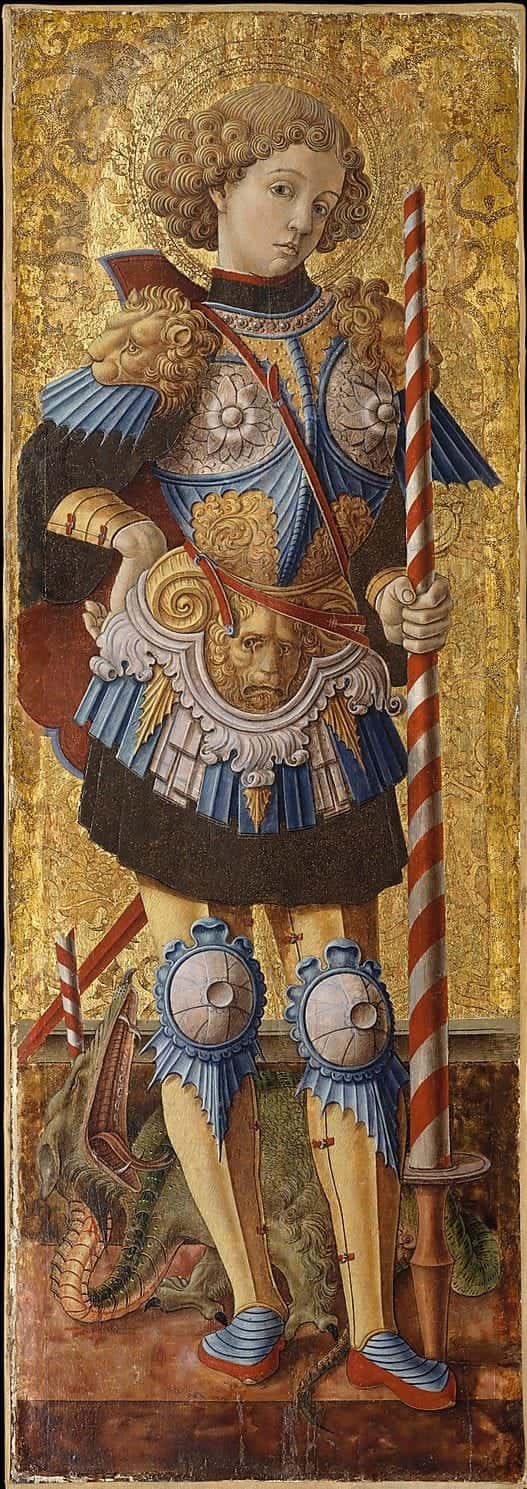
April 23: St. George, Martyr
CLAD in his bright coat of mail, mounted on his war-steed, and spearing the dragon with his lance, George, the intrepid champion of our Risen Jesus, comes to gladden us today with his feast. From the East, where he is known as the great Martyr, devotion to St George soon spread in the Western Church, and our Christian armies have always loved and honoured him as one of their dearest patrons. His martyrdom took place in Paschal Time; and thus he stands before us as the guardian of the glorious sepulchre, just as Stephen, the Protomartyr, watches near the crib of the Infant God.
The Roman Liturgy gives no lessons on the life of St George; but, in their stead, reads to us a passage from St Cyprian on the sufferings of the martyrs. This derogation from the general rule dates from the fifth century. At a celebrated Council held in Rome in the year 496, Pope St Gelasius drew up, for the guidance of the faithful, a list of books which might or might not be read without danger. Among the number of those that were to be avoided, he mentioned the ‘Acts of St Georg,' as having been compiled by one who, besides being an ignorant man, was also a heretic. In. the East, however, there were other ' Acts ' of the holy martyr, totally different from those current in Rome; but they were not known in that city. The cultus of St George lost nothing, in the holy city, by this absence of a true legend. From a very early period, a church was built in his honour; it was one of those that were selected as Stations, and gave a Title to a Cardinal; it exists to this day, and it is called Saint George in Velabro (the Veil of Gold) .
The Bollandists were in possession of several copies of the forbidden ‘Acts '; they found them replete with absurd stories, and, of course, they rejected them. Father Papebroch has given us other and genuine ‘Acts ' written in Greek, and quoted by St Andrew of Crete. They bring out the admirable character of our martyr, who held an important post in the Roman army during the reign of the Emperor Diocletian. He was one of the first victims of the great persecution and suffered death at Nicomedia. Alexandra, the Emperor's wife, was so impressed at witnessing the Saint’s courage, that she professed herself a Christian, and shared the crown of martyrdom with the brave soldier of Christ.
As we have already said, devotion to St George dates from a very early period. St Gregory of Tours gives us several proofs of its having taken root in Gaul. St Clotilde had a singular confidence in the holy martyr, and dedicated to him the Church of her dear Abbey of Chelles. But this devotion became more general and more fervent during the Crusades, when the Christian armies witnessed the veneration in which St George was held by the Eastern Church, and heard the wonderful things that were told of his protection on the field of battle. The Byzantine historians have recorded several remarkable instances of the kind; and the Crusaders returned to their respective countries publishing their own experience of the victories gained through the Saint's intercession. The Republic of Genoa chose him for its patron; and Venice honoured him as its special protector, after St Mark. But nowhere was St George so enthusiastically loved as in England. Not only was it decreed in a Council held at Oxford, in the year 1222, that the feast of the Great Martyr should be observed as one of obligation; not only was devotion to the valiant soldier of Christ encouraged, throughout Great Britain, by the first Norman Kings; but there are documents anterior to the invasion of William the Conqueror, which prove that St George was invoked as the special patron of England even so far back as the ninth century. Edward III did but express the sentiment of the country when he put the Order of the Garter, which he instituted in 1330, under the patronage of the warrior Saint. In Germany, King Frederic III founded the Order of St George in the year 1468.
St George is usually represented as killing a dragon; and where the representation is complete, there is also given the figure of a princess, whom the Saint thus saves from being devoured by the monster. This favourite subject of both sacred and profane art is purely symbolical, and is of Byzantine origin. It signifies the victory won over the devil, by the martyr's courageous profession of faith; the princess represents Alexandra, who was converted by witnessing the Saint’s heroic patience under his sufferings. Neither the ' Acts ' of St George nor the hymns of the Greek Liturgy allude to the martyr's having slain a dragon and rescued a princess. It was not till after the fourteenth century that this fable was known in the West; and it arose from a material interpretation of the emblems with which the Greeks honoured St George, and which were introduced among us by the crusaders.
Although, as has been said, the Office of St George in the Roman Breviary has been taken from the Common of Martyrs in Paschal Time, the following historical lesson has recently been approved for the Dioceses of England:
Let us, in honour of our glorious patron, recite the following stanzas, taken from the Menæa of the Greek Church:
Hymn (Die XXIII Aprilis)
Thou, O George, art the glorious type of a Christian soldier. Whilst serving under an earthly monarch, thou didst not forget thy duty to the King of heaven. Thou didst shed thy blood for the faith of Christ; and he, in return, appointed thee protector of Christian armies. Be their defender in battle, and bless with victory them that fight in a just cause. Protect them under the shadow of thy standard; cover them with thy shield; make them the terror of their enemies. Our Lord is the God of Hosts; and he frequently uses war as the instrument of his designs, both of justice and mercy. They alone win true victory who have heaven on their side; and such soldiers, when on the battle-field, seem to the world to be doing the work of man, whereas it is the work of God they are furthering. Hence are they more generous, because more religious, than other men. The sacrifices they have to make, and the dangers they have to face, teach them unselfishness. What wonder, then, that soldiers have given so many martyrs to the Church!
But there is another warfare, in which we Christians are all enlisted, and of which St Paul speaks, when he says: Labour as a good soldier of Christ; for no man is crowned, save he that striveth lawfully.1 That we have thus to strive and fight during our life, the same Apostle assures us in these words: Take unto you the armour of God, that ye may be able to resist in the evil day, and to stand in all things perfect. Stand, therefore, having your loins girt about with truth, and having on the breastplate of justice, and your feet shod with the preparation of the Gospel of peace. In all things taking the shield of faith, wherewith ye may be able to extinguish all the fiery darts of the most wicked one. And take unto you the helmet of the hope of salvation, and the sword of the spirit, which is the word of God.2 We, then, are soldiers, as thou wast, O holy martyr! Before ascending into heaven, our divine leader wishes to review his troops; do thou present us to him. He has loaded us with honours, notwithstanding our past disloyalties; we must, henceforth, prove ourselves worthy of our position. In the Paschal Communion which we have received, we have a pledge of victory; how can we ever be so base as to permit ourselves to be conquered! Watch over us, O sainted warrior! Let thy prayers and example encourage us to fight against the dragon of hell. He dreads the armour we wear; for it is Jesus himself that prepared it for us, and tempered it in his own precious Blood: may we, like thee, present it to him whole and entire, when he calls us to our eternal rest!
There was a time when the whole Christian world loved and honoured thy memory with enthusiastic joy: but now, alas! this devotion has grown cold, and thy feast passes unnoticed by thousands. O holy martyr! avenge this ingratitude by imitating thy divine King, who maketh his sun to rise upon both good and bad; take pity on this world, perverted as it is by false doctrines, and tormented at this very time by the most terrible scourges. Have compassion on thy dear England, which has been seduced by the dragon of hell, and by him made the instrument for effecting his plots against the Lord and his Christ. Take up thy spear as of old; give the monster battle, and emancipate the isle of Saints from his slavish yoke. Heaven and earth join in this great prayer! In the name of our Risen Jesus, aid thine own and once devoted people to a glorious resurrection!
Thursday of the Second Week after Easter
THE Apostles and holy women are not the only ones to enjoy the presence of our Risen Jesus: a countless people of the just made perfect claim and have the happiness of seeing and reverencing the sacred humanity of their beloved King. The magnificence of the Resurrection has caused us somewhat to forget those venerable captives of Limbo, with whom the soul of our Redeemer spent the hours that elapsed between his Death and Resurrection. They were the friends of God, and were awaiting in Abraham's bosom (as the Scripture expresses it) the dawning of light eternal. From the hour of None (three o'clock) of the great Friday till the daybreak of Sunday, the soul of our Emmanuel abode with these holy prisoners, who were thus put in possession of infinite happiness. But when the hour of his triumph came, how was the Conqueror of Death to leave behind him these souls whom he had enfranchised by his Death and Resurrection? At the moment fixed by the eternal decree, Jesus' Soul passes from Limbo to the sepulchre, and is reunited to his Body; but he is accompanied by a jubilant choir of other souls—the souls of the long-imprisoned Saints.
On the day of the Ascension, they will form his court, and rise together with him; but Heaven’s gate is not yet open, and they must needs wait for these forty days to pass, during which our Redeemer will organize his Church. They are invisible to the eyes of men, but they dwell in the space above this lowly earth, where once they passed their days, and merited an eternal recompense. Adam again sees the land which he had tilled in the sweat of his brow; Abel is in admiration at the power of the divine Blood, which has sued for mercy, whereas his prayed but for vengeance;1 Noe looks upon this globe, and finds it covered with an immense multitude of men, all of whom are descendants of his three sons; Abraham, the father of believers, Isaac also, and Jacob, hail the happy moment when is to be fulfilled the promise which was made to them, that all generations should be blessed in him who was to be bom of their race; Moses recognizes his people, in whose midst the Messias (whom he had announced,2 and who is greater than he),3 has found so few followers and so many enemies; Job, who represents the elect among the Gentiles, is filled with joy at seeing his Redeemer living,4 in whom he had hoped in all his trials; David, fired with holy enthusiasm, is preparing canticles for heaven, grander far than those he has left us, to be sung in praise of the Incarnate God, who has espoused our human nature; Isaias and the other Prophets behold the literal fulfilment of all they had foretold; in a word, this countless army of saints, formed from the elect of all times and countries, is grieved at finding the earth a slave to the worship of false gods; they beseech our Lord, with all the earnestness of prayer, that he would hasten the time for the preaching of the Gospel, which is to rouse from their sleep them that are seated in the shadow of death.
As the elect, when they rise from their graves on the last day, will ascend through the air to meet Christ5 as eagles who gather together wheresoever the body may be;6 so now these holy souls cluster around their divine Deliverer. He is their attraction; seeing him, speaking with him, is truly a heaven on earth to them. Jesus indulges these Blessed of his Father, who are soon to possess the Kingdom prepared for them from the foundation of the world;7 he allows them to follow and accompany him; and thus does he pass the days which are to be spent before that glorious one of his triumphant Ascension.
What must not have been the happiness of the faithful and chaste Joseph in being thus near his adopted Son—his Creator? with what affection must he not have looked upon his virginal Spouse, who has been made, at the foot of the Cross, the Mother of men! Who could describe the delight wherewith Anne and Joachim gaze upon their daughter, the august Mother whom all generations shall call ‘blessed’?8 And John, the Precursor—how must he not have exulted at seeing her, at whose voice he was sanctified in his Mother’s womb, and who has given to the world the Lamb that taketh all sin away! How affectionately must not these ransomed souls have looked upon the Apostles, those future conquerors of the world, who are now being prepared for the combat by their divine Master! It is through them that the earth once brought to the knowledge of the true God will be ever sending up elect ones to heaven until time shall give place to eternity.
Let us to-day honour these hidden but august witnesses of what God's mercy is preparing for the world’s salvation. We shall soon see them ascending to heaven, of which they will take possession in the name of mankind, that has been redeemed by Christ. Let us not forget how, on their way from Limbo to Heaven, they rested with Jesus for forty days on this earth of ours, where they themselves had once lived and merited an eternal crown. Their visit brought a blessing with it; and their departure was the signal for us to follow them—it opened the way to the blissful home, which is one day to be ours!
The following sequence, taken from the Cluny Missal of 1523, is appropriate to the reflections we have just been making:
Sequence
Concio cantica,
Organa subnectens
Hypodorica.
Deo tartarea
Rumpenti, decanta
Nunc symphonia.
Resurgens, gaudia
Mundo gestat colenda.
Mirantes perdita
Cocyti confinia,
Intrante illo
Vita beata.
Tremescit daemonum
Plebs valida.
Fletuum alta:
Repagula
Quis sic audax fregerit,
Mirantur nunc fortia.
Redit cum turma
Gloriosa,
Et timida
Refovet discipulorum corda.
Hujus trophæa
Admirantes,
Flagitamus nunc
Voce decliva.
Mereamur pretiosa
Colere ut pascha:
In qua sacrata
Prae fulgore contueri
Lucis exordia.
O holy choir,
mourning,
but full of hope.
to the divine King,
who has broken down
the gates of hell.
and rising from the tomb,
brings festive joy to the world.
wonder
at the strange event.
he is Eternal Life,
and they see his power.
of demons
tremble with fear,
and weep,
asking each other,
who this may be that dares to break
the massive bolts.
our Lord returns to earth,
surrounded by a glorious troop;
and hastens to console
the timid hearts of his disciples.
who celebrate
his noble victory,
beseech him
in humble prayer,
to celebrate the great Pasch,
in the choir of Virgins.
sanctified by light,
to see
the Source of Light.
| Previous Wednesday of the Second Week after Easter | Next Thursday of the Second Week after Easter |