Daily reading
Paschal Time
Double · April 24 · Sanctoral
April 24, 2020
From Dom Guéranger’s The Liturgical Year.
A Double leads the weekday.Rubric
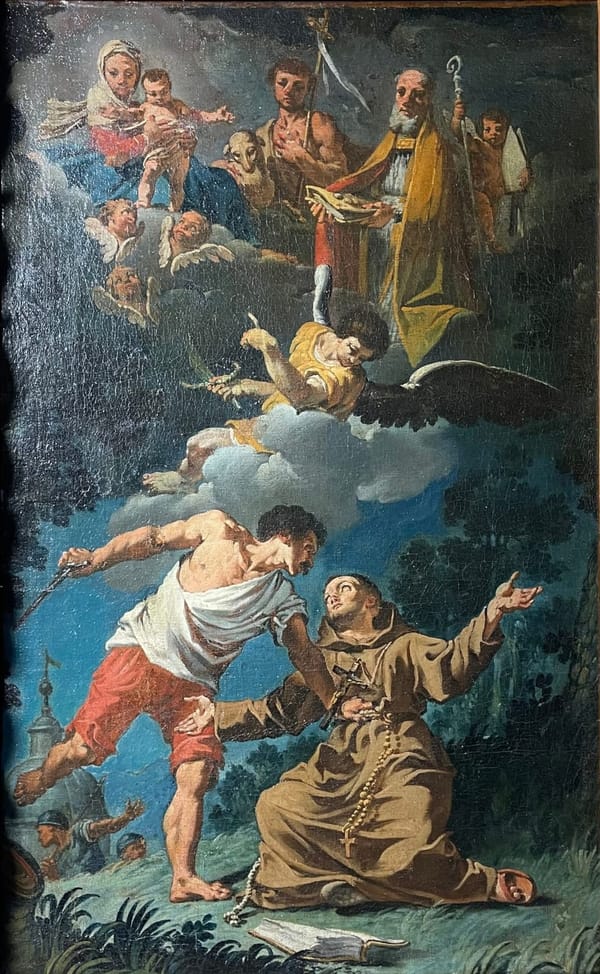 |
April 24: St. Fidelis of Sigmaringen, Martyr
OUR Risen Lord would have around him a bright phalanx of martyrs. Its privileged members belong to the different centuries of the Church’s existence. Its ranks open today to give welcome to a brave combatant, who won his palm, not in a contest with paganism, as those did whose feasts we have thus far kept, but in defending his mother, the Church, against her own rebellious children. They were heretics that slew this day’s martyr, and the century that was honoured with his triumph was the seventeenth.
Fidelis was worthy of his beautiful name. Neither difficulty nor menace could make him fail in his duty. During his whole life, he had but the glory and service of his divine Lord in view: and when the time came for him to face the fatal danger, he did so, calmly but fearlessly, as behoved a disciple of that Jesus who went forth to meet his enemies. Honour, then, be to-day to the brave son of St Francis! truly he is worthy of his seraphic Patriarch, who confronted the Saracens, and was a martyr in desire!
Protestantism was established and rooted by the shedding of torrents of blood; and yet Protestants count it as a great crime that, here and there, the children of the true Church made an armed resistance against them. The heresy of the sixteenth century was the cruel and untiring persecutor of men, whose only crime was their adhesion to the old faith—the faith that had civilized the world. The so-called Reformation proclaimed liberty in matters of religion, and massacred Catholics who exercised this liberty, and prayed and believed as their ancestors had done for long ages before Luther and Calvin were bom. A Catholic who gives heretics credit for sincerity when they talk about religious toleration, proves that he knows nothing of either the past or the present. There is a fatal instinct in error, which leads it to hate the Truth; and the true Church, by its unchangeableness, is a perpetual reproach to them that refuse to be her children. Heresy starts with an attempt to annihilate them that remain faithful; when it has grown tired of open persecution it vents its spleen in insults and calumnies; and when these do not produce the desired effect, hypocrisy comes in with its assurances of friendly forbearance. The history of Protestant Europe, during the last three centuries, confirms these statements; it also justifies us in honouring those courageous servants of God who, during that same period, have died for the ancient faith.
Let us now respectfully listen to the account given us, in the Liturgy, of the life and martyrdom of St Fidelis; we shall find that the Church has not grown degenerate in her Saints.
How truly couldst thou, O Fidelis! say with the Apostle: I have finished my course!1 Yea, thy death was even more beautiful than thy life, holy as that was. How admirable the calmness wherewith thou didst receive death! how grand the joy wherewith thou didst welcome the blows of thine enemies—thine, because they were those of the Church! Thy dying prayer, like Stephen's, was for them; for the Catholic, while he hates heresy, must love the heretics who put him to death. Pray, O holy martyr, for the children of the Church. Obtain for them an appreciation of the value of faith, and of the favour God bestowed on them when he made them members of the true Church. May they be on their guard against the many false doctrines which are now current through the world. May they not be shaken by the scandals which abound in this age of effeminacy and pride. It is faith that is to bring us to our Risen Jesus: and he urges it upon us by the words he addressed to Thomas: Blessed are they that have not seen and have believed!2 Of this number we wish to be: and therefore is it that we cling to the Church, the sovereign mistress of faith. We wish to believe her, and not human reason, which has neither the power to fathom the word of God, nor the right to sit in judgement over it. Jesus has willed that this holy faith should come down to us bearing on itself the strengthening testimony of the martyrs; and each age has had its martyrs. Glory to thee, O Fidelis, who didst win thy palm by combating the errors of the pretended Reformation! Take a martyr’s revenge, and pray without ceasing to our Jesus, that he would bring all heretics back to the faith and to union with the Church. They are our brethren by baptism; pray for them, that they may return to the Fold, and that we may one day celebrate with them the true Paschal banquet, wherein the Lamb of God gives himself to be our food, not figuratively, as in the Old Law, but really and truly, as fits the New Covenant.
Friday of the Second Week after Easter
LET us to-day turn to another subject. Let us think of that unfortunate Jerusalem, which, a few days since, re-echoed with the blasphemous cry: Away with him! Away with him! Crucify him! Is the city impressed by the great events that have taken place in her midst? Is the report still afloat of the sepulchre’s being found empty? Have Jesus’ enemies succeeded in tranquillizing the public mind by their lying scheme? They have summoned the soldiers who were set to guard the tomb, and have bribed them to say that they neglected their duty, that they fell asleep, and that the disciples came in the meanwhile, and stole away their Master’s corpse. As to the punishment due to this infraction of military discipline, the soldiers are told that they need be under no apprehension, inasmuch as they are assured that every excuse shall be made to the governor in case of need.1
Such is the final effort made by the Synagogue to make the world forget the name of Jesus of Nazareth! She would convince men that he was a mere contemptible impostor, who deserved his ignominious death, and will now be execrated for the posthumous attempt at a Resurrection! And yet, in a few years hence, the name of Jesus will be known and loved far beyond the walls of Jerusalem or the territory of Judea—it will be held in blessing in the furthermost parts of the earth. Let a hundred years pass, and the adorers of this Jesus will be found in every country. After three centuries paganism will own itself beaten; the idols will roll in the dust; the majesty of the Cæsars will humble itself before the Cross. And thou, O blind and obstinate Jew! wilt have it that he whom thou didst blaspheme and crucify is not risen, although he be now the King of the earth—the loved Monarch of a boundless empire! Read thy heaven-given prophecies, which thou hast handed down to us. Do they not tell thee that the Messias is to be despised—reputed with the wicked,2 and treated as one of them? But do they not likewise tell thee that his sepulchre shall he glorious?3 With all other men the grave puts an end to their name and their glory; whereas with Jesus his sepulchre is the trophy of his victory; we proclaim him to be the Messias, the King of ages, the Son of God, because by his own death he conquered death.
But Jerusalem is carnal-minded; and the humble Nazarene has not flattered her pride. His miracles were undeniable; the wisdom and authority of his words surpassed everything that had ever been heard; his goodness and compassion even exceed the miseries he is come to allay—but Israel has seen nothing, heard nothing, understood nothing; and now he remembers nothing. Alas! his fate is sealed, and it is himself that has sealed it. Five centuries before this, Daniel had thus prophesied: The people that shall deny him (Christ) shall not he his.4 Let them, therefore, that would escape the most terrible chastisement ever sent upon man, lose no time in recognizing the risen Jesus as the Messias.
A heavy atmosphere broods over the deicide city. Her people have said: Let his Blood he upon us and upon our children!—so indeed it is: it hangs like a storm-cloud of vengeance over Jerusalem, and, forty years hence, will send forth its thunderbolts of slaughter, fire, destruction, and a desolation which shall continue even to the end.5 Impostors will rise up, giving themselves out as the Messias. Jerusalem knows that the time for the fulfilment of the prophecies is come; and hence the credulity of her people in siding with these pretenders. Seditions are the consequence of this fanaticism. At length Rome is obliged to interfere. She sends her legions; and having drowned the rebellion with a deluge of blood, she banishes Israel from his country, making him a Cain-like wanderer on the face of the earth.
Why do not these unhappy Jews acknowledge, as the Messias, this Jesus whom they have crucified? Why still expect a fulfilment which has been so evidently accomplished? Why pass by, with sullen unrepentance, this empty sepulchre which is ever protesting against them? Have they not clamoured for the shedding of innocent Blood? They have but to confess this crime—this fruit of their pride—and they will be pardoned. But if they persist in defending what they have done, there is no hope for them—their chastisement will be blindness of heart, they will walk on in darkness even to the abyss, and hell will be their eternity. Bethphage and Mount Olivet are still echoing with the cry of Hosanna to the Son of David! O Israel! thou hast yet time! repeat this acclamation of thy loyalty! The hours are passing swiftly by; the solemnity of Pentecost will soon be upon us. On that day the law of the Son of David is to be promulgated, and the law of Moses will be abrogated, for its work is done and its figures are turned into realities. On that day thou wilt feel two peoples within thy womb6 one, weak in number, but destined to conquer all nations by leading them to the true God, will humbly and lovingly acknowledge for their King this Crucified and Risen Son of David; the other, proud and haughty, will obstinately blaspheme its Messias, and will become, by its ingratitude, the type of voluntary hardness of heart. It denies, even to this day, the Resurrection of its victim; but the chastisement which is to lie upon it to the end of time proves that he who punishes is God—the God of truth, whose anathemas are infallible.
Let us honour the Resurrection of our divine Messias by offering him this Easter sequence of the ancient Missal of St Gall.
Sequence
Atque pulchritudo
In cruce victoriam,
Est mortis principatus,
Est peccati veteris
Chirographum,
Immolatur victima
Pro ovili,
De Edom qui venerat,
Et de Bosra.
Serpentini vulneris
Sanat morsum.
Reconciliatur mundus:
Per lignum nunc redemptus,
Per lignum in Adam venditus.
Sociatur matutinis,
Factura novissima,
Restaurans cœli dispendia.
Vitam mundi portans
Atque pretium,
Tu vectis es botri
Nati in vineis
Engaddi.
Inimicitias solvens
Iis qui erant prope
Dans pacem,
Et his qui a longe.
Mundum attrahis,
Amplexando tuis
Hinc inde brachiis.
Ima perforans,
Vinctos, quos absolvis,
Ad summa erigis.
Hac dierum summa constructum,
Quam tetragrammaton
Adam græce colligit,
In te dissolvendum obtulit
Sed, ut mundum
Salvet quadrifidum,
Reaedificat post triduum.
Cruce tollens crimina mundi,
Da, ut in augmento
Charitatis, fidei, spei,
Crucis sacrosanctae valeamus,
Cum sanctis omnibus,
Dimensiones comprehendere,
Carnem macerantes,
Crucis almae bajulos
Tua trahas post vestigia.
Ibi ad tribunal, judex, tuum
Simus sanctae
Crucis per signaculum,
Quia regnavit a ligno Deus.
praise magnify
on the Cross.
the empire of death;
the handwriting
of the sin that was of old;
the Paschal Lamb
for the flock;
by him that came from Edom
and Bosra.
that cures the sting
of the serpent’s wound.
brought back into God's favour;
it was, in Adam, sold by a tree,
and by a tree is now redeemed.
the last made of creatures
is associated with the morning stars,
and repairs heaven’s losses.
that bearest the Life
and Ransom of the world
—thou art the staff,
bearing upon thee the cluster of grapes
from the vineyards of Engaddi.
who taketh enmities away,
and giveth peace
to them that are afar off,
and to them that are nigh.
thou drawest the whole world
to thyself, and, with thy two arms,
embracest all mankind.
thou penetratest into the depths below,
and raisest to heaven
the captives thou loosest.
—which had been built in the number of days
expressed by the four Greek letters composing Adam’s name
—he offered it that it might be destroyed;
but he raised it up again
in three days,
that he might save
the four quarters of the world.
that by the Cross takest away the sins of the world!
grant, that by our growth
in faith, hope, and charity,
we may be able to comprehend,
with all the Saints,
the measure of the Holy Cross;
and mortifying our flesh,
we may carry the dear Cross,
and be drawn by thee to walk in thy footsteps.
grant, O divine Judge,
that, by the sign of the holy Cross,
we may be so, when standing before thy tribunal,
‘That the Lord hath reigned from the Wood.’
| Previous Thursday of the Second Week after Easter | Next Friday of the Second Week after Easter |