Daily reading
Paschal Time
Double · May 2 · Sanctoral
May 2, 2020
From Dom Guéranger’s The Liturgical Year.
A Double leads the weekday.Rubric
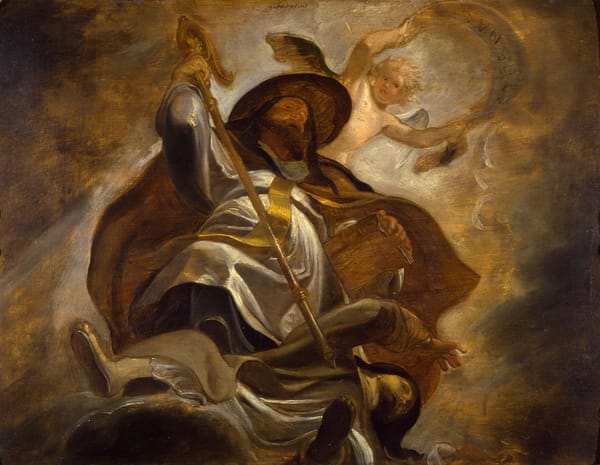 |
May 2: St. Athanasius, Bishop and Doctor of the Church
THE court of our divine King, during this grandest of seasons, is brilliant beyond measure; and, to-day, it is gladdened by the arrival of one of the most glorious champions that ever fought for his holy cause. Among the guardians of the word of truth, confided by Jesus to the earth, is there one more faithful than Athanasius? Does not his very name remind us of dauntless courage in the defence of the sacred deposit, of heroic firmness and patience in suffering, of learning, of talent, of eloquence—in a word, of everything that goes to form a Saint, a Bishop, and a Doctor of the Church? Athanasius lived for the Son of God; the cause of the Son of God was that of Athanasius: he who blessed Athanasius, blessed the eternal Word; and he who insulted Athanasius insulted the eternal Word.
Never did our holy faith go through a greater ordeal than in the sad times immediately following the peace of the Church, when the bark of Peter had to pass through the most furious storm that hell has, so far, let loose against her. Satan had vainly sought to drown the Christian race in a sea of blood; the sword of persecution had grown blunt in the hands of Diocletian and Galerius; and the Cross appeared in the heavens, proclaiming the triumph of Christianity. Scarcely had the Church become aware of her victory when she felt herself shaken to her very foundation. Hell sent upon the earth a heresy which threatened to blight the fruit of three hundred years of martyrdom. Arius began his impious doctrine, that he who had hitherto been adored as the Son of God was only a creature, though the most perfect of all creatures. Immense was the number, even of the clergy, that fell into this new error; the Emperors became its abettors; and had not God himself interposed, men would soon have set up the cry throughout the world that the only result of the victory gained by the Christian religion was to change the object of idolatry, and put a new idol, called Jesus, in place of the old ones.
But he who had promised that the gates of hell should never prevail against his Church, faithfully fulfilled his promise. The primitive faith triumphed; the Council of Nicæa proclaimed the Son to be consubstantial with the Father; but the Church stood in need of a man in whom the cause of the consubstantial Word should be, so to speak, incarnated—a man with learning enough to foil the artifices of heresy, and with courage enough to bear every persecution without flinching. This man was Athanasius: and everyone that adores and loves the Son of God, should love and honour Athanasius. Five times banished from his See of Alexandria by the Arians, who even sought to put him to death, he fled for protection to the West, which justly appreciated the glorious confessor of Jesus' divinity. In return for the hospitality accorded him by Rome, Athanasius gave her of his treasures. Being the admirer and friend of the great St Antony, he was a fervent admirer of the monastic life, which, by the grace of the Holy Ghost, had flourished so wonderfully in the deserts of his vast patriarchate. He brought the precious seed to Rome, and the first monks seen there were the ones introduced by Athanasius. The heavenly plant became naturalized in its new soil; and though its growth was slow at first, it afterwards produced fruit more abundantly than it had ever done in the East.
Athanasius, who has written so admirably upon that fundamental dogma of our faith—the divinity of Christ —has also left us most eloquent treatises on the mystery of the Pasch: they are to be found in the Festal Letters which he addressed each year to the churches of his patriarchate of Alexandria. The collection of these Letters, which were once thought to have been irretrievably lost, was found, a few years back, in the monastery of St Mary of Scete, in Egypt. The first, for the year 329, begins with these words, which beautifully express the sentiments we should feel at the approach of Easter: ' Come, my beloved brethren, celebrate the feast; the season of the year invites you to do so. The Sun of justice, by pouring out his divine rays upon you, tells you that the time of the solemnity is come. At such tidings, let us keep a glad feast; let not the joy slip from us with the fleeting days, without our having tasted of its sweetness.’ During almost every year of his banishment, Athanasius continued to address a Paschal Letter to his people. The one in which he announces the Easter of 338, and which he wrote at Treves, begins thus: ' Though separated from you, my brethren, I cannot break through the custom which I have always observed, and which I received from the tradition of the Fathers. I will not be silent; I will not omit announcing to you the time of the holy annual feast, and the day on which you must keep the solemnity. I am, as you have doubtless been told, a prey to many tribulations; I am weighed down by heavy trials; I am watched by the enemies of truth, who scrutinize everything I write, in order to rake up accusations against me and thereby add to my sufferings; yet notwithstanding, I feel that the Lord strengthens and consoles me in my afflictions. Therefore do I venture to address to you the annual celebration; and from the midst of my troubles, and despite the snares that beset me, I send you, from the furthermost part of the earth, the tidings of the Pasch, which is our salvation. Commending my fate into God’s hands, I will celebrate this feast with you; distance of place separates us, but I am not absent from you. The Lord who gives us these feasts, who is himself our feast, who bestows upon us the gift of his Spirit—he unites us spiritually to one another, by the bond of concord and peace.’
How grand is this Pasch, celebrated by Athanasius, an exile on the Rhine, in union with his people who keep their Easter on the banks of the Nile! It shows us the power of the Liturgy to unite men and make them, at one and the same time, and despite the distance of countries, enjoy the same holy emotions and feel the same aspirations to virtue. Greeks or Barbarians, we have all the same mother-country, the Church; but that which, after faith, unites us all into one family, is the Church’s Liturgy. Now there is nothing in the whole Liturgy so expressive of unity as the celebration of Easter. The unhappy Churches of Russia and the East, by keeping Easter on a different day from that on which it is celebrated by the rest of the Christian world, show that they are not a portion of the One Fold of which our Risen Jesus is the One Shepherd.
We will now read the sketch of the life of St Athanasius, given in the Breviary.
The Greek Church, which celebrates the feast of our Saint at another season of the year, is enthusiastic in her admiration of his virtues. The following stanzas are from the hymn she sings in his praise:
Hymn (Die XVIII Januarii)
Thou wast throned, O Athanasius! on the Chair of Mark in Alexandria; and thy name is emblazoned near his on the sacred cycle. He left Rome, sent by Peter himself to found the second patriarchal See; and thou, three centuries later, didst visit Rome, as successor of Mark, to seek protection from Peter's successor against them that were disturbing thy venerable See by injustice and heresy. Our Western Church was thus honoured by thy presence, O intrepid defender of the faith. She looked on thee with veneration as the glorious exile, the courageous confessor; and she has chronicled thy sojourning in her midst as an event of the greatest interest.
Intercede for the country over which was extended thy patriarchal jurisdiction; but forget not this Europe of ours, which gave thee hospitality and protection. Rome defended thy cause; she passed sentence in thy favour, and restored thee thy rights; make her a return, now that thou art face to face with the God of infinite goodness and power. Protect and console her Pontiff, the successor of that Julius who so nobly befriended thee fifteen hundred years ago. A fierce tempest is now raging against the Rock on which is built the Church of Christ; and our eyes have grown wearied looking for a sign of calm. Oh! pray that these days of trial be shortened, and that the See of Peter may triumph over the calumnies and persecutions which are now besetting her, and endangering the faith of many of her children.
Thy zeal, O Athanasius! checked the ravages of Arianism; but this heresy has again appeared, in our own times, and in almost every country of Europe. Its progress is due to that proud superficial learning which has become one of the principal perils of the age. The Eternal Son of God, consubstantial with the Father, is blasphemed by our so-called philosophers, as being only Man—the best and greatest of men, they say, but still only Man. They despise all the proofs which reason and history adduce of Jesus' divinity; they profess a sort of regard for the Christian teaching which has hitherto been held, but they have discovered (so they tell us) the fallacy of the great dogma which recognizes in the Son of Mary the Eternal Word who became incarnate for man’s salvation. O Athanasius, glorious Doctor of holy Mother Church! humble these modem Arians; expose their proud ignorance and sophistry; undeceive their unhappy followers, by letting them see how this false doctrine leads either to the abyss of the abominations of pantheism, or to the chaos of scepticism, where all truth and morality are impossibilities.
Preserve within us, by the influence of thy prayers, the precious gift of faith, wherewith our Lord has mercifully blessed us. Obtain for us that we may ever confess and adore Jesus Christ as our eternal and infinite God; ' God of God; Light of Light; True God of True God; Begotten, not made; who, for us men, and for our salvation, took Flesh, of the Virgin Mary.’ May we grow each day in the knowledge of this Jesus, until we join thee in the face-to-face contemplation of his perfections. Meanwhile, by means of holy faith, we will live with him on this earth that has witnessed the glory of his Resurrection. How fervent, O Athanasius, was thy love of this Son of God, our Creator and Redeemer! This love was the very life of thy soul, and the stimulus that urged thee to heroic devotedness to his cause. It supported thee in the combats thou hadst to sustain with the world, which seemed leagued together against thy single person. It gave thee strength to endure endless tribulations. Oh! pray that we may obtain this love—a love which is fearless of danger, because faithful to him for whom we suffer—a love which is so justly due, seeing that he, though the Brightness of his Father's glory, and Infinite Wisdom, emptied himself, taking the form of a servant, and humbled himself, becoming obedient unto death, even to the death of the Cross.* How else can we make him a return for his devotedness to us except by giving him all our love, as thou didst, O Athanasius! and by ever singing his praise in compensation for the humiliations which he endured in order to save us?
* Philipp, ii 7, 8. ↩︎
Saturday of the Third Week after Easter
THE Saturday brings us back to Mary. Let us again contemplate her prerogatives; and yet, whilst so doing, let us still keep our thoughts on holy Church, which has been the subject of our meditations during this week. Let us, to-day, consider the relations existing between Mary and the Church: they will make us the better understand these two mothers of mankind.
Before taking possession of the Church, which was to be proclaimed before all nations on the day of Pentecost, the Man-God made a worthy prelude to this kingly possession by uniting himself with her, who is so deservedly styled the mother and representative of the human race. This was Mary. Of the family of David, Abraham and Sem; immaculate, from the first moment of her existence, as were our first parents when they came from their Creator's hands; and destined for the grandest honour which could be conferred on a mere creature; Mary was, during her sojourn here on earth, the inheritance and co-operatrix of the Incarnate Word: she was the Mother of all the living.1 She, in her single person, was what the Church, collectively, has been from the day of its foundation. Her office of Mother of God surpasses all her other glories; still, we must not overlook, but on the contrary admire and love them.
Mary was the first creature that fully corresponded with the intentions which induced the Son of God to come down from heaven. He found in her the most lively faith, the firmest hope, and the most fervent love. Never had human nature, perfected by grace, offered to God an object so worthy of his acceptance. Before celebrating his union with the human race, as its Shepherd, Jesus was the Shepherd of this single sheep, whose merits and dignity surpass those of the rest of mankind, even supposing it to have been always and in all things faithful to its God.
Mary, therefore, represented the Christian Church before it existed in itself. The Son of God found in her not only a Mother, but the faithful worshipper of his Divinity from the first moment of his Incarnation. We saw on Holy Saturday how Mary’s faith withstood the test of Calvary and the tomb, and how this faith, which never faltered, kept alive on the earth the light which was never to be quenched, and which was soon to be confided to the collective Church, whose mission was to win over all nations to the divine Shepherd.
It was not Jesus’ will that his Blessed Mother should exercise a visible and outward postulate, save in a limited degree. Besides, he was not to leave her here till the end of time. But, just in the same way as, from the day of his Ascension, he made his Church co-operate with him in all that he does for his elect, so likewise did he will, during his mortal life, that Mary should have her share in all the works done by him for our salvation. She, whose formal consent had been required before the Eternal Word took flesh in her womb, was present, as we have already seen, at the foot of the Cross, in order that she, as a creature, might offer him, who offered himself as God, our Redeemer. The Mother’s sacrifice blended with that of the Son, and this raised her up to a degree of merit which the human mind could never calculate. Thus it is, though in a less perfect manner, the Church unites herself, in unity of oblation, with her divine Spouse, in the sacrifice of the Altar. It was to be on the day of Pentecost that the Church’s maternity would be proclaimed to the world; Mary was invested with the office of Mother of men, as Jesus was hanging upon his Cross. When his Side was opened with the spear, that the Church, born from the Water and Blood of Redemption, might come forth, Mary was there to receive into her arms this future mother, whom she had hitherto so fully represented.
In a few days we shall behold Mary in the Cenacle; the Holy Ghost will enrich her with new gifts, and we shall have to study her mission in the early Church. Let us close the considerations we have been making to-day by drawing a parallel between our two Mothers, who, though one is so far above the other in dignity, are nevertheless closely united to each other.
Our heavenly Mother, who is also the Mother of Jesus, is ever assisting our earthly Mother, the Church, with heavenly aid. Mary exercises over her, in each of her existences—Militant, Suffering or Triumphant—an influence of power and love. She procures to the Church the victories she wins; she enables her to go through the tribulations and trials which beset her path. The children of one are children of the other; both have a share in giving us spiritual birth—one, the 'Mother of divine grace,1 by her all-powerful prayers; the other, by the word of God and holy baptism. If when we depart this life, our admission to the beatific vision is to be retarded on account of our sins, and our souls are to descend to the abode of Purgatory, the suffrages of our earthly Mother will follow us, and alleviate or shorten our sufferings; but our heavenly Mother will do still more for us during that period of expiation, so awful and yet so just. In heaven the elect are rejoiced at the sight of the Church Triumphant, though she be still Militant on earth; and who can describe the joy these happy children must feel at seeing the glory of the Mother that begot them in Christ? but with how much gladder ecstasy must not these same citizens of heaven gaze upon Mary, that other Mother of theirs, who was their Star on the stormy sea of life, who never ceased to watch over them with most loving care, who procured them countless aids to salvation, and who, when they entered heaven, received them into those same maternal arms which heretofore carried the divine Fruit of her womb—that First-Born,2 whose brothers and joint-heirs we are called to be!
As long as we dwell in this vale of tears, which is now being turned into a paradise by the presence of our Risen Jesus, let us sometimes think of Mary's joys. Last Saturday we borrowed a hymn from the ancient Churches of Germany, in order to celebrate her Seven Joys; let, us do the same to-day.
Sequence
Sponsa Christi singularis,
Jocundata nimium
Per salutis nuntium:
Casta Mater et fœcunda,
Et suprema gaudia
Nostro cordi nuntia.
Quæ tam mire fœcundata
Genuisti filium,
Velut sidus radium;
Partu semper fœcundari.
Atque corde steriles
Fac clementer fertiles.
Cujus novum filium
Magi cum muneribus
Placant flexis genibus;
Nos illorum munera
Deo ferre tribue
Semper et assidue.
Jam in templo præsentatus
Simeonis manibus
Tollitur cum laudibus:
Ut et illum nos geramus
Puris semper cordibus
Et sinceris mentibus.
Laetabaris nimio,
Resurgente filio
Mortis ab imperio:
Pia, nos resurgere,
Sursum tolle variis
Cor oppressum vitiis.
Conspexisti visibus
Ire tuum filium
Ad paternum solium:
Hujus vitæ terminum,
Valeamus libere
Sine metu cernere.
Quam post vitæ terminum
Dulcis Jesu dextera
Vexit super sidera:
Sublevamen sceleris,
Et post hanc miseriam
Duc ad veram patriam.
dearest Spouse of Christ!
for the angel of our salvation
announced to thee an exceeding great joy.
O Virgin Mother!
and speak to our heart
of the joys that never end.
in that thou didst conceive of the Holy Ghost,
and bring forth thy Child,
as the star emits its ray.
in works of salvation.
Take these barren hearts of ours,
and by thy merciful prayers make them fertile.
at the adoration and gifts
paid by the Magi
to thy new-born Babe.
pray that we may ever imitate them,
and give to God
what their gifts signified.
at the praises spoken by Simeon,
when, at thy presenting Jesus in the Temple,
he took the Child in his arms.
that we may serve thy Son
with purity
and earnestness of heart.
all thy soul’s power
be glad at thy Son's rising
from the grasp of death.
that we may rise from our sins,
and have our hearts set free
from the pressure of its many vices.
the happiness to see thy Son
ascend into heaven,
where he is seated on his Father’s throne.
of the world
we may without fear
welcome his return.
who after thy life’s course was run,
wast raised up
by thy sweet Jesus above the stars.
may be raised from our sins,
and after this miserable life
be led to our true country.
| Previous Friday of the Third Week after Easter | Next Saturday of the Third Week after Easter |