Daily reading
Paschal Time
Double of the I Class · Movable from Easter · Temporal
May 3, 2020
From Dom Guéranger’s The Liturgical Year.
A Double of the I Class leads; the Finding of the Holy Cross and Sts. Alexander I, Eventius and Theodulus, and Juvenal are commemorated.Rubrics

|
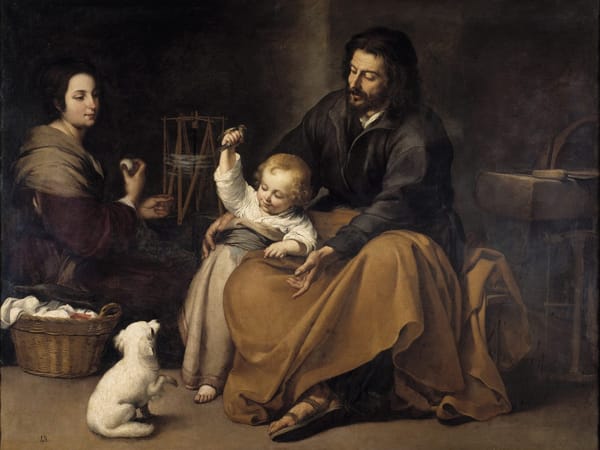
The Solemnity of Saint Joseph, Spouse of the B. V. Mary, Patron of the Universal Church
THE Easter mysteries are superseded to-day by a special subject, which is offered for our consideration. The holy Church invites us to spend this day in honouring the Spouse of Mary, the Foster-Father of the Son of God. And yet, as we offered him the yearly tribute of our devotion on March 19, it is not, properly speaking, his feast that we are to celebrate to-day. It is a solemn expression of gratitude offered to Joseph, the Protector of the Faithful, the refuge and support of all that invoke him with confidence. The innumerable favours he has bestowed upon the world entitle him to this additional homage. With a view to her children's interests, the Church would, on this day, excite their confidence in this powerful and everready helper.
Devotion to St Joseph was reserved for these latter times. Though based on the Gospel, it was not to be developed in the early ages of the Church. It is not that the faithful were in any way checked from showing honour to him who had been called to take so important a part in the mystery of the Incarnation; but divine Providence had its hidden reasons for retarding the liturgical homage to be paid, each year, to the Spouse of Mary. As on other occasions, so here also; the East preceded the West in the special cultus of St Joseph: but in the fifteenth century the whole Latin Church adopted it, and since that time it has gradually gained the affections of the faithful. We have treated of the glories of St Joseph on March 19; the present feast has its own special object, which we will at once proceed to explain.
The goodness of God and our Redeemer's fidelity to his promises have ever kept pace with the necessities of the world; so that in every age appropriate and special aid has been given to the world for its maintaining the supernatural life. An uninterrupted succession of seasonable grace has been the result of this merciful dispensation, and each generation has had given to it a special motive for confidence in its Redeemer. Dating from the thirteenth century, when, as the Church herself assures us, the world began to grow cold,1 each epoch has had thrown open to it a new source of graces. First of all came the feast of the most Blessed Sacrament, with its successive developments of Processions, Expositions, Benedictions and the Forty Hours. After this followed the devotion to the Holy Name of Jesus (of which St Bernardine of Siena was the chief propagator) and that of Via Crucis or Stations of the Cross. with its wonderful fruit of compunction. The practice of frequent Communion was revived in the sixteenth century, owing principally to the influence of St Ignatius and the Society founded by him. In the seventeenth was promulgated the devotion to the Sacred Heart of Jesus, which was firmly established in the following century. In the nineteenth, devotion to the Holy Mother of God made such progress as to form one of the leading supernatural characteristics of the period. The Rosary and Scapular, which had been handed down to us in previous ages, regained their place in the affections of the people; pilgrimages to the sanctuaries of the Mother of God, which had been interrupted by the influence of Jansenism and rationalism, were renewed; the Archconfraternity of the Sacred Heart of Mary spread throughout the whole world; numerous miracles were wrought in reward for the fervent faith of individuals; in a word, the nineteenth century witnessed the triumph of the Immaculate Conception—a triumph which had been looked forward to for many previous ages.
Now devotion to Mary could never go on increasing as it has done, without bringing with it a fervent devotion to St Joseph. We cannot separate Mary and Joseph, were it only for their having such close connection with the mystery of the Incarnation—Mary, as being the Mother of the Son of God; and Joseph, as being guardian of the Virgin’s spotless honour, and Foster-Father of the divine Babe. A special veneration for St Joseph was the result of increased devotion to Mary. Nor is this reverence for Mary's Spouse to be considered only as a just homage paid to his admirable prerogatives: it is, moreover, a fresh and exhaustless source of help to the world, for Joseph has been made our protector by the Son of God himself. Hearken to the inspired words of the Church’s Liturgy: ‘Thou, O Joseph! art the delight of the blessed, the sure hope of our life, and the pillar of the world.’2 Extraordinary as is this power, need we be surprised at its being given to a man like Joseph, whose connections with the Son of God on earth were so far above those of all other men? Jesus deigned to be subject to Joseph here below; now that he is in heaven, he would glorify the creature to whom he consigned the guardianship of his own childhood and the honour of his Mother. He has given him a power which is above our calculations. Hence it is, that the Church invites us on this day to have recourse, with unreserved confidence, to this all-powerful protector. The world we live in is filled with miseries which would make stronger hearts than ours quake with fear; but let us invoke St Joseph with faith, and we shall be protected. In all our necessities, whether of soul or body—in all the trials and anxieties we may have to go through—let us have recourse to St Joseph, and we shall not be disappointed. The king of Egypt said to his people when they were suffering from famine: Go to Joseph!3 the King of Heaven says the same to us: the faithful guardian of Mary has greater influence with God than Jacob's son had with Pharaoh.
As usual, God revealed this new spiritual aid to a privileged soul, that she might be the instrument of its propagation. It was thus that were instituted several feasts, such as those of Corpus Christi, and of the Sacred Heart of Jesus. In the sixteenth century St Teresa (whose writings were to have a world-wide circulation) was instructed by heaven as to the efficacy of devotion to St Joseph: she has spoken of it in the Life (written by herself) of Teresa of Jesus. When we remember that it was by the Carmelite Order (brought into the Western Church in the thirteenth century) that this devotion was established among us, we cannot be surprised that God should have chosen St Teresa, who was the reformer of that Order, to propagate the same devotion in this part of the world. The holy solitaries of Mount Carmel—devoted as they had been, for so many centuries, to the love of Mary—were not slow in feeling the connection that exists between the honour paid to the Mother of God and that which is due to her virginal Spouse. The more we understand St Joseph’s office, the clearer will be our knowledge of the divine mystery of the Incarnation. As when the Son of God assumed our human nature, he would have a Mother; so also would he give to his Mother a protector. Jesus, Mary and Joseph—these are the three whom the ineffable mystery is continually bringing before our minds.
The words of St Teresa are as follows: 'I took for my patron and lord the glorious St Joseph, and recommended myself earnestly to him. I saw clearly . . . that he rendered me greater services than I knew how to ask for. I cannot call to mind that I have ever asked him at any time for anything which he has not granted: and I am filled with amazement, when I consider the great favours which God hath given me through this blessed Saint, the dangers from which he hath delivered me, both of body and soul. To other Saints, our Lord seems to have given grace to succour men in some special necessity; but to this glorious Saint, I know by experience, to help us in all: and our Lord would have us understand that, as he was himself subject to him upon earth—for St Joseph having the title of father, and being his guardian, could command him—so now in heaven he performs all his petitions. I have asked others to recommend themselves to St Joseph, and they too know this by experience; and there are many who are now of late devout to him, having had experience of this truth.'4
We might quote several other equally clear and fervent words from the writings of this seraphic virgin. The faithful could not remain indifferent to such teaching as this. The seed thus sown produced its fruit; slowly, it is true, but surely. Even in the first half of the seventeenth century, there prevailed amidst the devout clients of St Joseph a presentiment that the day would come when the Church, through her Liturgy, would urge the faithful to have recourse to him as their powerful Protector. In a book published in the year 1645, we find these almost prophetic words: ‘O thou bright sun, thou father of our days! speed thy onward course, and give us that happy day, whereon are to be fulfilled the prophecies of the saints. They have said, that in the latter ages of the world, the glories of St Joseph will be brought to light; that God will draw aside the veil, which has hitherto prevented us from seeing the wondrous sanctuary of Joseph's soul; that the Holy Ghost will inspire the faithful to proclaim the praises of this admirable Saint, and to build monasteries, churches and altars in his honour; that, throughout the entire kingdom of the Church militant, he shall be considered as the special protector, for he was the protector of the very Founder of that kingdom, namely, our Lord Jesus Christ; that the Sovereign Pontiffs will, by a secret impulse from heaven, ordain that the feast of this great Patriarch be solemnly celebrated through the length and breadth of the spiritual domain of St Peter; that the most learned men of the world will use their talents in studying the divine gifts hidden in St Joseph, and that they will find in him treasures of grace incomparably more precious and plentiful than were possessed by even the choicest of the elect of the Old Testament, during the whole four thousand years of its duration.'5
These ardent wishes have been fulfilled. It is now more than a century ago that the Carmelites sought and obtained the approbation of the Holy See for an Office in honour of the Patronage of St Joseph. A great number of dioceses obtained permission to use it. A Sunday was selected for the celebration of this new feast, in order that the faithful might be, in a way, compelled to keep it; for the Feast of St Joseph in March is not a day of obligation in all lands, and, as it always falls during Lent, it cannot be kept on a Sunday, since the Sundays of Lent exclude a feast of that rite. That the new feast might not be attended with the same risk of being unnoticed, it was put upon a Sunday —the third Sunday after Easter, that thus the consolations of such a solemnity might be blended with the Paschal joys. The new feast went on gradually spreading from one diocese to another; till at last, there was unexpectedly issued an Apostolic Decree, dated September 10, 1847, which ordered it to be kept throughout Christendom. The Church was on the eve of severe trials; and her glorious Pontiff, Pius IX, by a sacred instinct, was prompted to draw down on the flock entrusted to him the powerful protection of St Joseph, who assuredly has never had greater miseries and dangers to avert from the world, than those which threaten the present age.
Let us, then, henceforth have confidence in the patronage of St Joseph. He is the father of the faithful, and it is God's will that he, more than any other saint, should have power to apply to us the blessings of the mystery of the Incarnation—the great mystery whereof he, after Mary, was the chief earthly minister.
In the Greek Liturgy this third Sunday after Easter is called the Sunday of the Paralytic, because a special commemoration is made of the miracle wrought by our Saviour at the Probatica.
The Roman Church begins to-day, in her Office of Matins, the Book of St John's Apocalypse.
Mass
On this feast, dedicated to St Joseph as Protector of the Faithful, the Church, in the Introit of the Mass, speaks to us of the confidence we should have in the protection of God; she uses the words of the royal Prophet, and would have us make them our own. Now Si Joseph is the minister of this divine protection, and God promises it to us, if we address ourselves to this his incomparable servant.
Introit
Ps. Qui regis Israel, intende: qui deducis velut ovem Joseph, ℣. Gloria Patri.
Adjutor.
Ps. Give ear, O thou that rulest Israel: thou that leadest Joseph like a sheep. ℣. Glory, etc.
The Lord, etc.
In the Collect, the Church lays stress upon God's choosing St Joseph as Mary's Spouse, and teaches us that one of the consequences of this choice was our having a protector who will be ready to assist us by his all-powerful intercession, as often as we pray to him.
Collect
If this feast be kept on the Sunday, a commemoration of the third Sunday after Easter is then made, by this Collect:
Epistle
Cap. xlix.Filius accrescens Joseph, filius accrescens et decorus aspectu: filiae discurrerunt super murum. Sed exasperaverunt eum, et jurgati sunt, invideruntque illi habentes jacula. Sedit in forti arcus ejus, et dissoluta sunt vincula brachiorum et manuum illius per manus potentis Jacob: inde pastor egressus est lapis Israel. Deus patris tui erit adjutor tuus, et omnipotens benedicet tibi benedictionibus cœli desuper. Benedictionibus abyssi jacentis deorsum, benedictionibus uberum et vulvae. Benedictiones patris tui confortatae sunt benedictionibus patrum ejus: donec veniret desiderium collium aeternorum: fiant in capite Joseph, et in vertice Nazaræi inter fratres suos.
Ch. xlix.Joseph is a growing son, a growing son and comely to behold: the daughters run to and fro upon the wall. But they that held darts, provoked him, and quarrelled with him, and envied him. His bow rested upon the strong, and the bands of his arms and his hands were loosed, by the hands of the mighty one of Jacob: thence he came forth a Shepherd, the stone of Israel. The God of thy father shall be thy helper, and the Almighty shall bless thee with the blessings of heaven above, with the blessings of the deep that lieth beneath, with the blessings of the breasts and of the womb. The blessings of thy father are strengthened with the blessings of his fathers: until the Desire of the everlasting hills shall come: may they be upon the head of Joseph, and upon the crown of the Nazarite among his brethren.
This magnificent prophecy of the dying Jacob, wherein he makes known to his son Joseph the glorious destiny which awaits himself and his children, is most appropriate to this feast; it reminds us of the beautiful comparison drawn by St Bernard between the two Josephs. We refer our readers to March 19, where they will find the passage to which we allude, and in which we are told that the first Joseph was a type of the second. After prophesying what was to happen to his ten eldest sons, the Patriarch Jacob speaks, with marked partiality, concerning the son of Rachel. After speaking of his comeliness, he alludes to the persecution he received from his brothers, and to the wondrous ways whereby God delivered him out of their hands, and exalted him to glory and power. The words he uses may well be applied to the second Joseph, the Spouse of Mary, and the Protector of the Faithful; for who better deserves the title of Shepherd and Stone (i.e., strength) of Israel? We are all of us his family: he affectionately watches over us: and in our troubles we may rely upon him with all confidence, as our staunch unfailing defender. St Joseph's inheritance is the Church, sanctified and made fruitful by the ceaseless blessing of the Waters of Baptism; it is in the Church that he exercises his beneficent power upon all who confide in him. Jacob promised the most lavish blessings upon the first Joseph; and these blessings were to last till the Saviour, thedesire of the everlasting hills should come, when the second Joseph would begin his ministry—a ministry of help and protection, which would continue till the second coming of the Son of God. Finally, if the first Joseph be spoken of, in this prophecy, as a Nazarite (that is, one consecrated to God) and as a Saint among his Brethren, the second Joseph is to fulfil the prediction still more literally; for not only will his sanctity surpass that of Jacob’s son, but his very home will be Nazareth. In that city he will dwell with Mary; to that city he will return after the exile in Egypt; in that city he will terminate his holy career; in a word, Jesus, the Eternal Word, shall be called a Nazarite,6 because he is to live in that city with his Foster-Father.
In the first Alleluia-Versicle, we have St Joseph speaking to us; he encourages us to have recourse to him, and promises us untiring protection. In the second the Church prays for her children, that they may have the grace to imitate the purity of Mary’s Spouse: her prayer is addressed to him.
Alleluia. ℣. Fac nos innocuam, Joseph, decurrere vitam, sitque tuo semper tuta patrocinio. Alleluia.
Alleluia. ℣. Obtain for us, O Joseph, to lead an innocent life; and may it ever be safe through thy Patronage. Alleluia.
Gospel
Cap. iii.In illo tempore: Factum est autem cum baptizaretur omnis populus, et Jesu baptizato et orante, apertum est cœlum: et descendit Spiritus Sanctus corporali specie sicut columba in ipsum: et vox de coelo facta est: Tu es Filius meus dilectus, in te complacui mihi. Et ipse Jesus erat incipiens quasi annorum triginta, ut putabatur, filius Joseph.
Ch. iii.At that time: It came to pass, when all the people were baptized, that Jesus also being baptized, and praying, heaven was opened: and the Holy Ghost descended in a bodily shape, as a dove, upon him: and a voice came from heaven: Thou art my beloved Son; in thee I am well pleased. And Jesus himself was beginning about the age of thirty years: being, as it was supposed, the son of Joseph.
Being, as it was supposed, the Son of Joseph! Jesus’ filial affection for his Mother, his jealousy for the honour of the purest of Virgins, led him to treat Joseph as his father, and to allow himself to be called the Son of Joseph! Joseph heard the Son of God call him ‘father.’ He had charge of, he laboured for the maintenance of the Son of the Eternal Father. He was the head of the Holy Family at Nazareth, and Jesus recognized his authority. The plan of the Mystery of the Incarnation required that these relations should exist between the Creator and the Creature. As the Son of God, now that he is seated at the right hand of the Eternal Father, has kept our human nature indissolubly united with his divine Person; so likewise has he retained the feelings he had, when here on earth, for Mary and Joseph. With regard to Mary, his love for her, as his Mother, has but increased; and as to Joseph, it is impossible to suppose that the affection and respect he had for him have now ceased to exist in the Heart of the Man-God. No mortal was ever on such terms of intimacy and familiarity with Jesus as Joseph was. Jesus was grateful to Joseph for the paternal care he received from him; what more natural than to believe that Jesus now repays him with special honours and power in heaven? It is the belief of the Church; it is the conviction of the faithful; it is the motive which suggested the present feast.
The words of the Offertory are taken from Psalm 147. Jerusalem, that is, the Church, is bidden to rejoice, because of the means of defence which God has given her against her enemies. One of the greatest of the blessings thus conferred upon her is St Joseph's Protection.
Offertory
In the Secret, the Church prays that we may imitate the Carpenter of Nazareth in his detachment from earthly things.
Secret
Then a commemoration of the Third Sunday after Easter is made, if required, by the following Secret:
Secret
The proper Preface that follows has recently been granted by the Holy See for use in all Masses of St Joseph:
Preface
The Communion-Anthem is a sentence taken from St Matthew’s Gospel, wherein we find the glorious title of our holy Protector: Joseph, the husband of Mary; and the still more glorious one of Mary: Of whom was bom Jesus.
Communion
Holy Church prays, in the Post communion, that St Joseph, who is our Protector during this present life, may intercede for us in what concerns our eternal welfare.
Postcommunion
The priest then adds, if need be, this commemoration of the Third Sunday after Easter:
Postcommunion
The following Gospel of the Third Sunday after Easter is read at the end of Mass.
Cap. xvi.In illo tempore: Dixit Jesus discipulis suis: Modicum, et jam non videbitis me, et iterum modicum, et videbitis me: quia vado ad Patrem. Dixerunt ergo ex discipulis ejus ad invicem: Quid est hoc, quod dicit nobis: Modicum, et non videbitis me, et iterum modicum, et videbitis me, et quia vado ad Patrem? Dicebant ergo: Quid est hoc, quod dicit, Modicum? nescimus quid loquitur. Cognovit autem Jesus, quia volebant eum interrogare, et dixit eis: De hoc quæritis inter vos, quia dixi, Modicum, et non videbitis me: et iterum modicum, et videbitis me? Amen, amen dico vobis: quia plorabitis, et flebitis vos, mundus autem gaudebit: vos vero contristabimini, sed tristitia vestra vertetur in gaudium. Mulier cum parit, tristitiam habet, quia venit hora ejus: cum autem pepererit puerum, jam non meminit pressurae propter gaudium: quia natus est homo in mundum. Et vos igitur nunc quidem tristitiam habetis; iterum autem videbo vos, et gaudebit cor vestrum: et gaudium vestrum nemo tollet a vobis.
Ch. xvi.At that time: Jesus said to his disciples: A little while, and now you shall not see me: and again a little while, and you shall see me; because I go to the Father. Then some of his disciples said one to another: What is this he saith to us: A little while, and you shall not see me: and again a little while, and you shall see me, and because I go to the Father? They said therefore: What is this that he saith: A little while? we know not what he speaketh. And Jesus knew that they had a mind to ask him; and he said to them: Of this do you inquire among yourselves, because I said: a little while, and you shall not see me; and again, a little while, and you shall see me? Amen, amen, I say to you, that you shall lament and weep, but the world shall rejoice: and you shall be made sorrowful, but your sorrow shall be turned into joy. A woman when she is in labour, hath sorrow, because her hour is come: but when she hath brought forth the child, she remembereth no more the anguish, for joy that a man is bom into the world. So also you now indeed have sorrow but I will see you again, and your heart shall rejoice; and your joy no man shall take from you.
Vespers
Psalm, Dixit Dominus, page 82
Psalm, Confitebor, page 83
Psalm, Beatus vir, page 84
Psalm, Laudate pueri, page 85
Psalm 116
Quoniam confirmata est super nos misericordia ejus: * et veritas Domini manet in æternum.
For his mercy is confirmed upon us: and the truth of the Lord remaineth for ever.
Capitulum (Gen. xlix)
Hymn7
Te cuncti resonent christiadum chori,
Qui clarus meritis junctus es inclytæ
Casto fœdere Virgini.
Admirans, dubio tangeris anxius,
Afflatu superi Flaminis Angelus
Conceptum puerum docet.
Ægypti profugum tu sequeris plagas:
Amissum Solymis quæris, et invenis,
Miscens gaudia fletibus.
Palmamque emeritos gloria suscipit;
Tu vivens, Superis par, frueris Deo,
Mira sorte beatior.
Da Joseph meritis sidera scandere:
Ut tandem liceat nos tibi perpetim
Gratum promere canticum.
May the choirs of Christendom resound with thy name,
for great are thy merits,
who wast united by a chaste alliance to the holy Virgin.
a cruel doubt afflicts thy heart;
but an Angel visits thee, telling thee that she had conceived
of the Holy Ghost the Child she bore in her womb.
and go with the little fugitive to Egypt’s distant land.
When he was lost in Jerusalem, thou didst seek after him;
and having found him, thy tears were mingled with joy.
has crowned their life; they receive their glory when they have won the palm:
but thou, by a strangely happy lot, hadst, even during life, what the blessed have
in heaven —thou hadst the sweet society of thy God.
and may the intercession of Joseph aid us to reach heaven;
that there we may sing to thee
our eternal hymn of grateful love.
Antiphon of the Magnificat
A commemoration is then made of the Third Sunday after Easter, if necessary, by the following Antiphon, Versicle, and Prayer:
Many ages passed away, and thy glories had not been made known to the world; but even then, thou wast one of mankind's most powerful intercessors. Most affectionately didst thou fulfil thy office as head of the great human family, whereof the Incarnate Word was a member. Nations and individuals experienced the benefit of thy prayers; but there was not the public acknowledgement of thy favours—there was not the homage of gratitude, which is now offered to thee. The more perfect knowledge of thy glories, and the honour paid to thee as the Protector of mankind—these were reserved for our own unhappy times, when the state of the world is such as to require help beyond that which was granted to former ages. We come before thee, O Joseph! to honour the unlimited power of thine intercession, and the love thou bearest for all the children of the Church, the Brethren of Jesus.
Thou, O Mary! art pleased at seeing us honour him, whom thou didst so tenderly love. Never are our prayers so welcome to thee as when they are presented to thee by his hands. The union formed by heaven between thyself and Joseph will last for all eternity; and the unbounded love thou hast for Jesus is an additional motive for thee to love him who was the FosterFather of thy Child, and the guardian of thy Virginity. O Joseph! we also are the children of Mary, thy Spouse; treat us as such, bless us, watch over us, and receive the prayers which, now more than ever, the Church encourages us to present to thee.
Thou art ‘the pillar of the world'—columen mundi; thou art one of the foundations whereon it rests; because of thy merits and prayers, our Lord has patience with it, in spite of the iniquities which defile it. How truly may we say of these our times: There is now no saint; truths are decayed from among the children of men!8 How powerful then must not thine intercession be, to avert the indignation of God, and induce him to show us his mercy! Grow not weary of thy labour, O thou universal Protector! The Church of thy Jesus comes before thee on this day, beseeching thee to persevere in thy task of love. See this world of ours, now it is become one great volcano of danger by the boasted liberty granted to sin and heresy! Delay not thine aid, but quickly procure for us what will give us security and peace.
Whatever may be our necessities, thou art willing and able to assist us. We may be the poorest and last among the children of the Church; it matters not: thou lovest us with all the affectionate compassion of a Father. What a joy is not this to our hearts, O Joseph! We will therefore turn to thee in our spiritual wants. We will beg thee to assist us in gaining the virtues whereof we stand in need, in the battles we have to fight against the enemies of our souls, and in the sacrifices which duty asks at our hands. Make us worthy to be called thy children, O thou Father of the Faithful! Nor is thy power limited to what regards our eternal welfare; daily experience shows us how readily thou canst procure for us the blessing of God upon our temporal interests, provided they are in accordance with his divine will. Hence it is that we hope for thy protection and aid in what concerns our worldly prospects. The house of Nazareth was confided to thy care; deign to give counsel and help to all them that make thee the patron of all that regards their earthly well-being.
Glorious Guardian of the Holy Family! the family of Christendom is placed under thy special patronage; watch over it in these troubled times. Hear the prayers of them that seek thine aid, when about to choose the partner who is to share with them the joys and the sorrows of this world, and help them to prepare for their passage to eternity. Maintain between husbands and wives that mutual respect which is the safeguard of their fidelity to each other. Obtain for them the pledge of heaven’s blessings. Fill them with such reverence for the holy state to which they have been called, that they may never deserve the reproach given by St Paul to certain married people of that day, whom he compares to heathens, who know not God.9
Grant us, also, O Joseph, another favour. There is one moment of our lives which is the most important of all, since eternity depends upon it: it is the moment of our death. And yet we feel our fear abated by the thought that God’s mercy has made thee the special patron of the dying. Thou hast been entrusted with the office of making death happy and holy to those who invoke thee. To whom could such a prerogative have been given more appropriately than to thee, O Joseph! whose admirable death was one of the sublimest spectacles ever witnessed by angels or by men, for Jesus and Mary were by thy side as thou didst breathe forth thy soul. Be, then, our helper at that awful hour of our death. We hope to have Mary’s protection, for we daily pray to her that she would aid us at the hour of our death; but we know that Mary is pleased at our having confidence in thee, and that where thou art, she also is sure to be. Encouraged by thy fatherly love, O Joseph! we will calmly await the coming of our last hour; for if we are careful in recommending it to thee, thou wilt not fail to take it under thy protection.
The gladness of to-day’s feast has been united with the Paschal joy: still, it is but just that the latter should have its own expression apart. We will therefore end the day by offering to our Risen Lord the following Preface: it is taken from the ancient Gothic Missal, published by Dom Mabillon.
Contestatio
(Indie Sabbato, octava Paschœ)
- Frigescente mundo. Collect for the Feast of the Stigmata of St Francis. ↩︎
- Cœlitum, Joseph, decus atque nostræ Certa spes vitæ, columenque mundi. (Hymn for Lauds of the Feast of the Solemnity of St Joseph.) ↩︎
- Gen. xli 55. ↩︎
- The Life of St Teresa (translated by David Lewis, 1870), p. 34. ↩︎
- La gioire de Saint-Joseph, par le P. Jean Jacquinot, de la Compagnie de Jesus. Dijon, 1645. ↩︎
- St Matt ii 23. ↩︎
- In the Monastic Rite, it is preceded by this Responsory: ℟. breve. Constituit eum dominum domus suae, * Alleluia, alleluia. Constituit ℣. Et principem omnis possessionis suæ. * Alleluia. Gloria Patri. Constituit. ↩︎
- Ps. xi 2. ↩︎
- 1 Thess. iv 5. ↩︎
May 3: The Finding of the Holy Cross
|
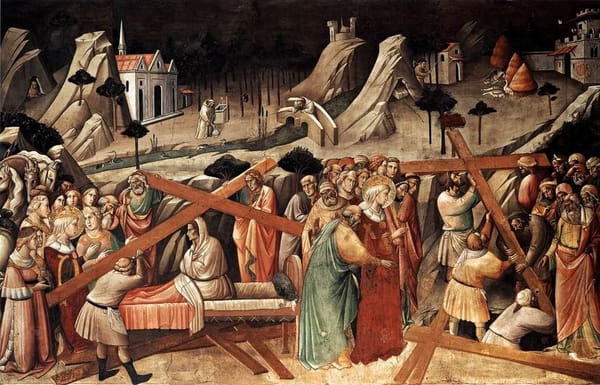
IT was most just that our divine King should show himself to us with the sceptre of his power, to the end that nothing might be wanting to the majesty of his empire. This sceptre is .the Cross; and Paschal Time was to be the season for its being offered to him in glad homage. A few weeks back, and the Cross was shown to us as the instrument of our Emmanuel's humiliation and as the bed of suffering whereon he died; but has he not since then conquered Death? and what is his Cross now but a trophy of his victory? Let it then be brought forth to our gaze and let every knee bend before this sacred Wood, whereby our Jesus won the honour and praise we now give him!
On the day of his birth at Bethlehem we sang these words of the Prophet Isaias: A child is bom unto us, and a son is given unto us, and his government is upon his shoulder.1 We have seen him carrying this Cross upon his shoulder; as Isaac carried the wood for his own immolation; but now it is no longer a heavy burthen. It is shining with a brightness that ravishes the eyes of the angels; and after having received the veneration of man as long as the world lasts, it will suddenly appear in the clouds of heaven, near the Judge of the living and the dead—a consolation to them that have loved it, but a reproach to such as have treated it with contempt or forgetfulness.
Our Saviour did not think the time between his Resurrection and Ascension a fitting one for glorifying the instrument of his victory. The Cross was not to be brought into notice until it had subjected the world to him whose glory it so eloquently proclaimed. Jesus was three days in the tomb; his Cross is to lie buried, unknown to men, for three centuries: but it is to have its resurrection, and the Church celebrates this resurrection to-day. Jesus would, in his own good time, add to the joy of Easter by miraculously revealing to us this sacred monument of his love for mankind. He entrusts it to our keeping—it is to be our consolation—as long as this world lasts: is it not just that we should love and venerate it?
Never had Satan's pride met with such a humiliation as when he saw the instrument of our perdition made the instrument of our salvation. As the Church expresses it in her Preface for Passiontide: ‘He that overcame mankind by a Tree, was overcome by a Tree.' Thus foiled, he vented his fury upon this saving Wood, which so bitterly reminded him both of the irresistible power of his conqueror and of the dignity of man who had been redeemed at so great a price. He would fain have annihilated the Cross; but knowing that this was beyond his power, he endeavoured to profane it, and hide it from view. He therefore instigated the Jews to bury it. At the foot of Calvary, not far from the sepulchre, was a deep hole. Into this was the Cross thrown, together with those of the two thieves, the Nails, the Crown of Thoms, and the Inscription or Title written by Pilate. The hole was then filled up with rubbish and earth, and the Sanhedrim exulted in the thought of its having effaced the memory of the Nazarene, who could not save himself from the ignominious death of the Cross.
Forty years after this, Jerusalem was destroyed by the Romans, the instruments of God’s vengeance. The Holy Places were desecrated by the idolaters. A small temple to Venus was erected on Calvary, and another to Jupiter over the Holy Sepulchre. By this, the pagans intended derision; whereas, they were perpetuating the knowledge of two spots of most sacred interest. When peace was restored under Constantine, the Christians had but to remove these pagan monuments, and their eyes beheld the holy ground that had been bedewed with the Blood of Jesus, and the glorious Sepulchre. As to the Cross, it was not so easily found. The sceptre of our divine King was to be raised up from its tomb by a royal hand. The saintly Empress Helen, Constantine's mother, was chosen by heaven to pay to Jesus—and that, too, on the very spot where he had received his greatest humiliations—the honours which are due to him as the King of the world. Before laying the foundations of the Basilica of the Resurrection, this worthy follower of Magdalen and the other holy women of the sepulchre was anxious to discover the instrument of our salvation. The Jews had kept up the tradition of the site where it had been buried: the Empress had the excavations made accordingly. With what holy impatience she must have watched the works! and with what ecstasy of joy did she behold the redeeming Wood, which, though not at first distinguishable, was certainly one of the three Crosses that were found! She addressed a fervent prayer to the Saviour, who alone could reveal to her which was the trophy of his victory; the bishop, Macarius, united his prayers with hers; and their faith was rewarded by a miracle that left them no doubt as to which was the true Cross.
The glorious work was accomplished, and the Church was put in possession of the instrument of the world’s Redemption. Both East and West were filled with joy at the news of this precious discovery, which heaven had set on foot, and which gave the last finish to the triumph of Christianity. Christ completed his victory over the pagan world by raising thus his standard—not a figurative one, but his own real standard—his Cross, which, up to that time, had been a stumbling-block to the Jews, and foolishness to the Gentiles; but before which every Christian is henceforth to bend his knee.
Helen placed the holy Cross in the Basilica which had been built by her orders, and which covered both the glorious Sepulchre and the hill of the Crucifixion. Another Church was erected on the site where the Cross had lain concealed for three hundred years, and the faithful are enabled, by long flights of steps, to go down into the deep grotto which had been its tomb. Pilgrims came from every part of the world to visit the hallowed places where our Redemption had been wrought, and to venerate the sacred Wood of the Cross. But God’s merciful providence willed not that the precious pledge of Jesus’ love for mankind should be confined to one sanctuary only, however venerable it might be. Immediately after its discovery, Helen had a very large piece cut from the Cross; and this fragment she destined for Rome, the new Jerusalem. The precious gift was enshrined in the Basilica built by her son Constantine in the Sessorian garden, which was afterwards called the Basilica of Holy-Cross-in-Jerusalem.
By degrees, other places were honoured by the presence of the Wood of the Holy Cross. So far back as the fourth century, we have St Cyril of Jerusalem attesting that many of the pilgrims used to obtain small pieces of it, and thus carried the precious treasure into their respective countries; and St Paulinus of Nola, who lived in the same century, assures us that these many gifts lessened not the size of the original relic. In the sixth century, the holy Queen St Radegonde obtained from the Emperor Justin II a large piece from the fragment that was in the imperial treasury of Constantinople. It was for the reception of this piece of the True Cross into France that Venantius Fortunatus composed the Vexilla Regis—that beautiful hymn which the Church uses in her Liturgy as often as she celebrates the praise of the Holy Cross. After several times losing and regaining it, Jerusalem was at length for ever deprived of the precious relic. Constantinople was a gainer by Jerusalem’s loss. From Constantinople, especially during the Crusades, many churches of the West procured large pieces. These again supplied other places; until at length the Wood of the Cross was to be found in almost every town of any importance. There is scarcely to be found a Catholic who, some time or other in his life, has not had the happiness of seeing and venerating a portion of this sacred object. How many acts of love and gratitude have not been occasioned by this? And who could fail to recognize, in this successive profusion of our Jesus’ Cross, a plan of divine providence for exciting us to us appreciation of our Redemption, on which rest all our hopes of eternal happiness?
How dear, then, to us should this day be, which blends together the recollection of the holy Cross and the joys of the Resurrection of that Jesus who by the Cross has won the throne to which we shall soon see him ascend! Let us thank our Heavenly Father for his having restored to mankind a treasure so immensely precious as is the Cross. Until the day comes for it to appear with himself in the clouds of heaven, Jesus has entrusted it to his Spouse, as a pledge of his second coming. On that day, he will collect together all the fragments by his divine power; and the Tree of Life will then gladden the elect with its dazzling beauty, and invite them to eternal rest beneath its refreshing shade.
The Liturgy gives us the following history of the great event we are celebrating today:
Both the Eastern and Western Churches abound in liturgical compositions in honour of the holy Cross. We offer our readers a selection from these, beginning with the glorious verses of Venantius Fortunatus:
Fulget Crucis mysterium,
Qua Vita mortem pertulit,
Et morte vitam protulit.
Mucrone diro, criminum
Ut nos lavaret sordibus,
Manavit unda et sanguine.
David fideli cannine,
Dicendo nationibus:
Regnavit a ligno Deus.
Ornata Regis purpura,
Electa digno stipite,
Tam sancta membra tangere.
Pretium pependit sæculi,
Statera facta corporis,
Tulitque praedam tartari.
Paschale quæ fers gaudium,
Piis adauge gratiam,
Reisque dele crimina.
Collaudet omnis spiritus;
Quibus Crucis victoriam
Largiris, adde præmium.
the mystery of the Cross shines upon us
—that Cross on which Life suffered death,
and by his Death gave life.
that by the Water and the Blood
which flowed from the wound
he might cleanse us from sin.
the prophecy foretold
in David’s truthful words:
‘God hath reigned ffom the Tree.’
beautified by the scarlet of the King,
and chosen as the noble trunk
that was to touch such sacred limbs.
on whose arms hung the ransom of the world!
It was the balance wherein was placed the Body of Jesus,
and thereby hell lost its prey.
that bringest us the Paschal joy.
Increase the grace of the good
and cleanse sinners from their guilt.
thou fount of salvation!
and by the Cross, whereby thou gavest us victory,
give us too our recompense.
The Roman Church has the following Responsories and Antiphons in her Office for this feast. They are full of unction, and breathe a fragrance of antiquity:
Our Latin Churches of the Middle Ages are fervent in their hymns in honour of the holy Cross. The first we select is the celebrated sequence of Adam of Saint-Victor:
Sequence
Nos qui Crucis exsultamus speciali gloria:
Nam in Cruce triumphamus,
Hostem ferum superamus
Dulce melos
Tangat cœlos;
Dulce lignum
Dulci dignum
Credimus melodia:
Cum vox vitam non remordet, dulcis est symphonia.
Per quam Crucem sibi gaudent vitæ dari munera.
Dicant omnes, et dicant singuli:
Ave salus totius sæculi, arbor salutifera!
Fuit hæc salutis ara
Rubens Agni sanguine,
Agni sine macula,
Qui mundavit sæcula
Ab antiquo crimine!
Per quam Christus, rex cœlorum,
Ad se trahit omnia;
Forma cujus hoc ostendit
Quæ terrarum comprehend it quatuor confinia.
Nec recenter est inventa crucis hæc religio:
Ista dulces aquas fecit;
Per hanc silex aquas jecit Moysis officio.
Nisi Cruce munit homo superliminaria:
Neque sensit gladium,
Nec amisit filium
Quisquis egit talia.
Spem salutis est adepta
Pauper muliercula:
Sine lignis fidei
Nec lecythus olei
Valet, nec farinula.
Sub figuris
Ista latent,
Sed jam patent
Crucis beneficia;
Reges credunt,
Hostes cedunt;
Sola Cruce,
Christo duce,
Unus fugat millia.
In profundum vidit mersas una cum Maxentio:
Fusi Thraces, caesi Persæ,
Sed et partis dux adversæ victus ab Hemclio.
Semper facit et victores;
Morbos sanat et languores, reprimit dæmonia;
Dat captivis libertatem,
Vitæ confert novitatem:
Ad antiquam dignitatem Crux reduxit omnia.
Vera mundi salus, vale!
Inter ligna nullum tale fronde, flore, germine;
Medicina Christiana,
Salva sanos, ægros sana:
Quod non valet vis humana fit in tuo nomine.
Consecrator Crucis, audi,
Atque servos tuæ Crucis
Post hanc vitam, veræ lucis transfer ad palatia;
Quos tormento vis servire,
Fac tormenta non sentire;
Sed quum dies erit iræ.
Confer nobis et largire sempiterna gaudia.
we who have so special a reason to exult in it;
for it is in the Cross that we triumph,
and gain the victory of life over our fierce enemy.
reach the heavens,
for our faith
tells us
that this sweet Wood
is worthy of sweet songs.
is not a reproach to the life we lead, then is our music sweet.
whereby they have been blessed with the gifts of life.
Let each and all thus sing:
Hail, thou saving Tree, thou salvation of the world!
was this altar of salvation,
that was crimsoned with the Blood
of the spotless Lamb,
who purified the world
from its old iniquity!
whereby Christ, the King of heaven,
draws all things to himself.
Its very shape shows
that it takes in the four parts of the earth.
nor does the honour that is paid it date from modern times.
It was the Cross that made the bitter waters sweet;
it was with the Cross that Moses struck the rock, and made the waters flow.
of him who marked not the door-posts with the Cross.
But he that so marked them
neither felt the destroying sword,
nor lost his first-born son.
found her salvation
whilst picking sticks.
Without the Wood of faith,
there is nor oil
nor meal.
hidden under
scriptural figures,
but now made manifest
to the world.
Kings have embraced the faith,
and enemies are put to flight.
With the Cross alone,
under the leader Christ,
one man routs a thousand.
and all his fleet drowned in the deep.
The Thracians were dispersed, the Persians slaughtered,
and the leader of the hostile troops vanquished.
and victory to its soldiers;
cures all disease and sickness; checks the devil;
sets captives free;
gives newness of life;
restores all things to their former dignity.
the world's true salvation!
No tree can yield such shade or flower or fruit as thine.
O Medicine of Christian life!
keep the healthy strong, and give health to the sick.
What man cannot, of his own strength, he can do in thy name.
hear the prayers of them that celebrate the praises of thy Cross.
We are the servants of thy Cross
—oh! take us, after this life, to the courts of true light.
Grant that we who honour the instrument of thy sufferings,
may escape the sufferings of hell:
and when the day of thy wrath comes,
give us to enjoy eternal bliss.
The following hymn is taken from the ancient Roman-French Breviaries for this feast:
Hymn
Vera spes nostra, vera ferens gaudia,
Signum salutis, salus in periculis,
Vitale lignum Vitam portans omnium.
In te redempti, dulce decus sæculi,
Semper laudamus, tibi semper canimus,
Per lignum servi, per te lignum liberi.
Nos a privatis, Christe, munda maculis,
Humilitatem miseratus fragilem,
Per Crucem sanctam lapsis dona veniam.
Populum cunctum Crucis per signaculum,
Morbos averte corporis et animæ;
Hoc contra signum nullum stet periculum.
Sit coæqualis laus Sancto Spiri tui,
Civibus summis gaudium sit Angelis,
Honor in mundo sit Crucis Inventio.
our true hope, that bringest us true joy,
the standard of salvation, our protection in danger,
the living Tree, that bearest him who is the life of all!
tire not in praising and hymning thee as the adorable and life-giving Cross.
We were made slaves by a tree;
by thee, O Tree, were we made freedmen.
by thy holy Cross, cleanse us from our own guilty stains,
have pity on our human frailty,
and grant pardon to them that have fallen.
bless, sanctify thy whole people;
avert from them every malady of body and mind;
let no danger prevail against this sign.
praise coequal be to the Holy Ghost!
May the Finding of the Cross be a joy to the angel citizens of heaven,
and a glory to the world!
From the liturgical compositions produced by the Greek Church in honour of the holy Cross, we select the following Canon, or hymn. It was written by St Theodore the Studite:
Hymn
Christ Crucified is the power and wisdom of God,2 Thus spoke thine Apostle, O Jesus! and we are witnesses of the truth of his words. The Synagogue thought to dishonour thee by nailing thee to a Cross, for it was written in the Law: Cursed is he that hangeth on a tree.3 But, lo! this gibbet, this tree of infamy, is become the trophy of thy grandest glory! Far from dimming the splendour of thy Resurrection, the Cross enhances the brilliance of thy magnificent triumph. Thou wast attached to the Wood—thou tookest on thyself the curse that was due to us; thou wast crucified between two thieves; thou wast reputed as an impostor, and thine enemies insulted thee in thine agony on this bed of suffering. Hadst thou been but man, O Son of David! all this would have disgraced thy name and memory; the Cross would have been the ruin of thy past glory: but thou art the Son of God, and it is the Cross that proves it. The whole world venerates thy Cross. It was the Cross that brought the world into submission to thee. The honours that are now paid it more than make amends for the insults that were once offered it. Men are not wont to venerate a cross; but if they do, it is the Cross on which their God died. Oh! blessed be he that hung upon the Tree! And do thou, dearest crucified Jesus! in return for the homage we pay to thy Cross, fulfil the promise thou madest us: And I, if I be lifted up from the earth, will draw all things unto myself.4
That thou mightest the more effectually draw us, thou this day permittedst us to find the very Wood, whereon thou didst stretch forth thy divine arms to embrace us. Thou hast deigned to give us this holy instrument of thy victory which is to shine near thee in the heavens on the day of judgement; thou hast mercifully confided it to our keeping, in order that we might thence derive a salutary fear of divine Justice, which demanded thy death on this Wood in atonement for our sins. Thou also gavest us this most precious relic, that it might excite us to a devoted love for thee, O divine Victim! who, that we might be blessed, didst take upon thyself the maledictions due to our sins. The whole world is offering thee to-day its fervent thanks for so inestimable a gift. Thy Cross, by being divided into countless fragments, is in all places, consecrating and protecting by its presence every country of the Christian world.
Oh! that we had St Helen's spirit, dear Jesus, and knew, as she did, the breadth, and length, and height, and depth of the mystery of thy Cross.5 Her love of the mystery made her so earnest in her search for the Cross. And how sublime is the spectacle offered to us by this holy Empress! She adorns thy glorious Sepulchre; she raises thy Cross from its |rave; who was there, that ever proclaimed with such solemnity as this, the Paschal Mystery? The Sepulchre cries out to us: ‘He is risen: he is not here!’ The Cross exclaims: ‘I held him captive but for a few passing hours: he is not here! He is resplendent in the glory of his Resurrection!’ O fross! O Sepulchre! how brief was the period of his humiliation, and how grand the kingdom he won by you! We will adore in you the place where his feet stood,6 making you the instruments of our Redemption, and thereby endearing you to our respectful love for ever. Glory, then, be to thee, O Cross! dear object of this day’s festival! Continue to protect this world where our Jesus has left thee. Be its shield against Satan. Help us to remember that union of sacrifice and triumph which will support us in all our crosses, for it is by thee, O Cross! that Christ conquers, and reigns, and commands. Christus vincit, Christus regnat, Christus imperat.
May 3 (the Same Day): Sts. Alexander I, Pope, Eventius and Theodulus, Martyrs, and Juvenal, Bishop and Confessor
A HOLY Pope and martyr comes to-day to lay his bright crown at the foot of the triumphant Cross whereby he won his victory. It is Alexander, the fifth successor of St Peter. Let us honour this venerable witness of the faith, who is now receiving the devout homage of the Church Militant, and who, for long ages past, has been enjoying in heaven the company of our Risen Jesus. The Passion of his divine Master was ever present to his mind, whilst here on earth; and the Church has registered in her annals his addition to the Canon of the Mass of four words in which he expresses the fact of our Lord’s having instituted the august mystery of the Eucharist the day before he suffered.
We owe to the same holy Pontiff another institution most dear to Catholic piety. It is by him that the Church received the sacramental which is such an object of terror to Satan, and which sanctifies everything it touches—Holy Water. This is an appropriate day for us to renew our faith in this powerful element of blessing, which heretics and infidels have so frequently made the subject of their blasphemies, but whose use will ever serve as one of the distinguishing marks between them that are and them that are not children of the Church. Water, the instrument of our regeneration, and salt, the symbol of immortality, form, under the Church’s blessing, this sacramental, in which we should have the greatest confidence. The sacramentais, like the sacraments, derive their efficacy from the blood of our Redeemer, the merits of which are applied to certain material objects by the power of the priesthood of the new law. Indifference for these secondary means of salvation would be not only an indiscretion, but a sin; and yet in these days of weak faith nothing is so common as this indifference. There are Catholics for whom Holy Water is as though there were no such thing in existence; the continual use made of it by the Church is a lesson lost to them; they deprive themselves, without a single regret, of the help wherewith God has thus provided them, both to strengthen their weakness and to purify their souls. May the holy Pontiff Alexander pray for them, that their faith may become more what it ought to be; and that they may begin to value the supernatural aids which God, out of pure mercy to them, has so profusely bestowed on his Church.
The Church commemorates with St Alexander two holy priests, Eventius and Theodulus, who suffered with him, and St Juvenal, bishop of Nami and Confessor, whose death occurred on the same day. A short account of the latter has been added to the lesson in commemoration of the martyrs.
Receive, O holy Pontiff, on this day, sacred to the Cross of thy divine Master, the devout homage of the Christian people. It was by the way of the Cross that thou didst this day ascend to heaven; it is but just that thy praise should be mingled with those which we are giving to the sacred instrument of our Redemption. Intercede for us with him who shed his blood for us upon this Tree of Life: may he graciously accept our celebration of his triumphant Resurrection and the hymns we sing in honour of his Cross. Pray for us that our faith may increase; that thus we may appreciate the divine economy of the Redemption, whereby our Lord Jesus Christ deigned to employ for our salvation those very elements which the enemy had perverted to our destruction. Drive far from us that wretched rationalism which, whilst approving of certain usages of the Church because they happen to fit in with its fancies, presumes to treat all the rest with disdain. Pray also for the holy Church of Rome! She invokes thy name on this thy feast; prove to her that she is still dear to thee.
| Previous May 2: St. Athanasius, Bishop and Doctor of the Church | Next May 3: The Finding of the Holy Cross |