Daily reading
Paschal Time
Double · May 4 · Sanctoral
May 4, 2020
From Dom Guéranger’s The Liturgical Year.
A Double leads the weekday.Rubric
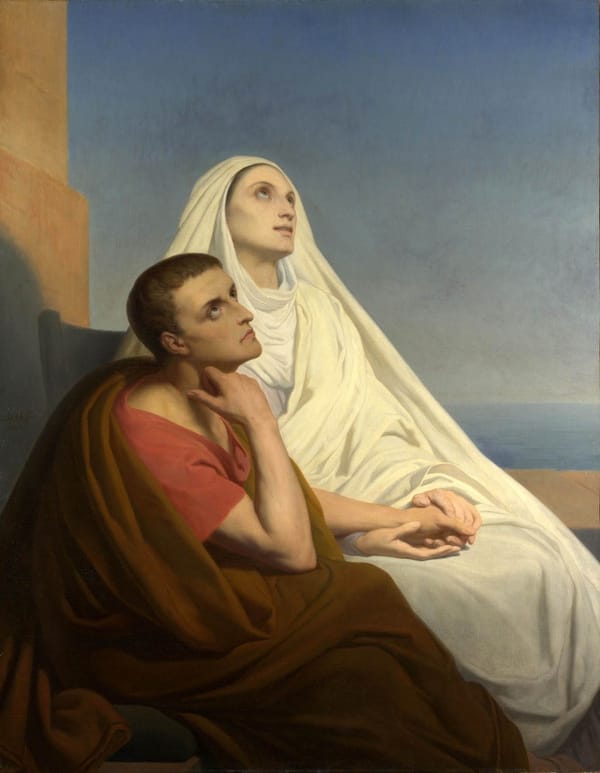 |
May 4: St. Monica, Widow
IN the company of our Risen Lord there are two women, two mothers, of whom we have often had to speak during the last few weeks: they are Mary, mother of James the Less and Thaddeus, and Salome, mother of 'James the Great and John the beloved disciple. They went with Magdalen to the Sepulchre on the Resurrection morning; they carried spices to anoint the Body of Jesus; Angels spoke to them; and, as they returned to Jerusalem, our Lord appeared to them, greeted them, and allowed them to kiss his sacred feet. Since that day, he has repaid their love by frequently appearing to them; and on the day of his Ascension from Mount Olivet, they will be there, together with our blessed Lady and the Apostles, to receive his farewell blessing. Let us honour these faithful companions of Magdalen, these models of the love we should show to our Lord in his Resurrection; let us also venerate them as mothers who gave four Apostles to the Church.
But lo! on this fourth morning of beautiful May, there rises, near to Mary and Salome, another woman, another mother. She, too, is fervent in her love of Jesus. She, too, gives to Holy Church a treasure—the child of her tears, a Doctor, a Bishop, and one of the grandest Saints of the New Law. This woman, this mother, is Monica, doubly mother of Augustine. This masterpiece of God's grace was produced on the desert soil of Africa. Her virtues would have been unknown till the day of judgement, had not the pen of the great bishop of Hippo, prompted by the holy affection of his filial heart, revealed to us the merits of this woman, whose life was humility and love, and who now, immortalized in men’s esteem, is venerated as the model and patroness of Christian mothers.
One of the great charms of the book of Confessions is Augustine’s fervent praise of Monica’s virtues and devotedness. With what affectionate gratitude he speaks, throughout his whole history, of the untiring constancy of this mother who, seeing the errors of her son, 1 wept over him more than other mothers weep over the dead body of their children.’1 Our Lord, who from time to time consoles with a ray of hope the souls he tries, had shown to Monica in a vision the future meeting of the son and mother; she had even heard a holy bishop assure her that the child of so many tears could never be lost: still the sad realities of the present weighed heavily on her heart; and both her maternal love and her faith caused her to grieve over this son, who kept away from her, yea, who kept away from her because he was unfaithful to his God. The anguish of this devoted heart was an expiation which would at a future period be applied to the guilty one; fervent and persevering prayer, joined with suffering, prepared Augustine’s second birth; and, as he himself says, ‘she went through more when she gave me my spiritual than when she gave me my corporal birth.’2
At last, after long years of anxiety, the mother found at Milan this son of hers who had so cruelly deceived her, when he fled from her roof to go and risk his fortune in Rome. She found him still doubting the truth of the Christian religion, but tired of the errors that had misled him. Augustine was not aware of it, but he had really made an advance towards the true faith. ‘She found me,’ says he, ‘in extreme danger, for I despaired of ever finding the truth. But when I told her that I was no longer a Manichean, and yet not a Catholic Christian, the announcement did not take her by surprise. She leaped for joy at being made sure that one half of my misery was gone. As to the other, she wept over me, as dead indeed, but to rise again; she turned to thee, O my God, and wept, and in spirit brought me and laid the bier before thee, that thou mightest say to the widow's son: Young man! I say to thee, arise! Then would he come to life again, and begin to speak, and thou couldst give him back to his mother! . . . Seeing then that although I had not yet found the truth, I was delivered from error, she felt sure that thou wouldst give the other half of the whole thou hadst promised. She told me in a tone of gentlest calm, but with her heart full of hope, that she was confident, in Christ, that before leaving this world, she would see me a faithful Catholic.’3
At Milan, Monica formed acquaintance with the great St Ambrose, who was the instrument chosen by God for the conversion of her son. ‘She had a very great affection for Ambrose,' says Augustine, ' because of what he had done for my soul; and he too loved her, because of her extraordinary piety, which led her to the performance of good works, and to fervent assiduity in frequenting the Church. Hence, when he saw me, he would frequently break out in her praise, and congratulate me on having such a mother.’4 The hour of grace came at last. The light of faith dawned upon Augustine, and he began to think of enrolling himself a member of the Christian Church; but the pleasures of the world, in which he had so long indulged, held him back from receiving the holy sacrament of baptism. Monica's prayers and tears won for him the grace to break this last tie. He yielded and became a Christian.
But God would have this work of his divine mercy a perfect one. Augustine, once converted, was not satisfied with professing the true faith; he aspired to the sublime virtue of continence. A soul favoured as his then was could find no further pleasure in anything that this world had to offer him. Monica, who was anxious to guard her son against the dangers of a relapse into sin, had been preparing an honourable marriage for him; but Augustine came to her one day, accompanied by his friend Alypius, and told her that he was resolved to aim at the most perfect life. Let us listen to the Saint's account of this interview with his mother; it was immediately after he had been admonished by the voice from heaven: ‘We (Augustine and Alypius) go at once to my mother's house. We tell her what has taken place; she is full of joy. We tell her all the particulars; she is overpowered with feelings of delight and exultation. She blessed thee, O my God, who canst do beyond what we ask or understand. She saw that thou hadst done more for me than she had asked of thee, with her many piteous and tearful sighs . . . . Thou hadst changed her mourning into joy even beyond her wishes, yea, into a joy far dearer and chaster than she could ever have had in seeing me a father of children.’5 A few days after this, and in the Church of Milan, a sublime spectacle was witnessed by angels and men: Ambrose baptized Augustine in Monica's presence.
The saintly mother had fulfilled her mission: her son was regenerated to truth and virtue, and she had given to the Church the greatest of her Doctors. The evening of her long and laborious life was approaching and she was soon to find eternal rest in the God for whose love she had suffered so much. The son and mother were at Ostia, waiting for the vessel that was to take them back to Africa. ‘I and she were alone,’ says Augustine, ‘and were standing near a window of our lodging, which commanded a view of the garden. We were having a most charming conversation. Forgetting the past, and stretching forward to the things beyond, we were talking about the future life of the Saints, which eye hath not seen, nor ear heard, nor hath it ascended into man's heart . . . . And whilst thus talking about it and longing for it, our hearts seemed to bound forward and reach it. We sighed, and left the first-fruits of our spirit there, and returned to the sound of our own voice . . . . Then my mother said to me: “ My son! as far as I am concerned, there is nothing now that can give me pleasure in this life. I know not what I can do, or why I should be here, now that I have nothing to hope for in this world. There was one thing for which I desired to live somewhat longer, and it was to see thee a Catholic Christian before my death. My God has granted me this and more, for I see that thou hast despised earthly pleasures and become his servant. What do I here?”’6
She had not long to wait for the divine invitation. She breathed forth her pure soul a few days after this incident, leaving an indelible impression upon the heart of her son, a name most dear and honoured to the Church, and a perfect example of the purest and holiest maternal affection to Christian mothers.
The life and virtues of St Monica are thus briefly portrayed in to-day’s Liturgy:
The Middle Ages have left us several liturgical pieces composed in honour of St Monica; but most of them are poor. The sequence we select is not without merit; it has even been attributed to Adam of Saint-Victor.
Sequence
Atque suæ piæ matris laudes et præconia
Decantemus, venerantes
Et optata celebrantes hodie solemnia.
Vita clara, Christo chara, hæc beata Monica
De profano propagatum,
Jam nunc parit suum natum in fide catholica.
Quo effulsit tam præclarum lumen in Ecclesia!
Multo fletu seminavit,
Germen ubi reportavit metens in lætitia.
O quam miro tunc gestivit Spiritus tripudio,
Cernens natum fide ratum,
Sed et Christo jam sacratum toto mentis studio!
Et in eis Christum pavit, mater dicta pauperum;
Curam gerens infirmorum,
Lavit, stravit, et eorum tersit sordes vuinerum.
Quam transfigunt amorosa crucifixi stigmata!
His accensa sic ploravit,
Lacrymis quod irrigavit pavimenti schemata.
Stat a terris elevata cubiti distantia;
Mente rapta exsultavit:
‘Volitemus,’ exclamavit, ‘Ad cœli fastigia.’
Advocata et patrona sis pro tuis filiis,
Ut dum carne exuemur,
Nato tuo sociemur paradisi gaudiis.
and of his holy mother.
Let us devoutly celebrate
the beloved solemnity of this day.
well instructed in the faith, edifying in her conduct, and dear to Christ.
Her son was born of a pagan father;
but she gave him a second birth—she brought him to the Catholic faith.
through which shone forth so bright a light within the Church!
Monica sowed in much weeping,
but she reaped her fruit in joy.
Oh! how grand was the gladness that filled her soul,
when she saw her son staunch in faith,
yea, and devoted with his whole heart to Christ!
for she ministered to them in their necessities, and gave to Christ the food she gave to them.
She took care of the sick,
washed them, nursed them, and dressed their wounds.
with compassion for the dear Wounds of her crucified Lord!
She wept for love when she thought upon them,
and her tears bedewed the spot on which she prayed.
she was raised from the ground
and in her rapture exclaimed with joy:
‘Let us fly to heaven above!'
be to us thy children an advocate and patroness,
that so, when we quit the flesh, we may be united to Augustine,
thy son, in the joys of paradise.
O thou model of mothers! Christendom honours thee as one of the most perfect types of human nature regenerated by Christ. Previous to the Gospel, during those long ages when woman was kept in a state of abjection, a mother’s influence on her children was feeble and insignificant; her duties were generally limited to looking after their bodily well-being; and if some mothers of those times have handed their names down to posterity, it is only because they taught their sons to covet and win the passing glory of this world. But we have no instance in pagan times of a mother training her son to virtue, following him from city to city that she might help him in the struggle with error and the passions, and encourage him to rise after a fall; we do not meet with one who devoted herself to continual prayer and tears, with a view to obtain her son's return to truth and virtue. Christianity alone has revealed a mother's mission and power.
What forgetfulness of thyself, O Monica, in thine incessant endeavour to secure Augustine's salvation! After God, thou livest for him, and to live for thy son in such a way as this, is it not living for God, who deigns to use thee as the instrument of his grace? What carest thou for Augustine's glory and success in this world when thou thinkest of the eternal dangers and of the eternal separation from God and thee to which he is exposed. There is no sacrifice which thy maternal heart is not ready to make in order to satisfy the divine justice: it has its rights and thou art too generous not to satisfy them. Thou waitest patiently, day and night, for God's good time to come. The delay only makes thy prayer more earnest. Hoping against all hope, thou at length feelest within thy heart the humble but firm conviction that the object of all these tears can never be lost. Moved with mercy towards thee, as he was towards the sorrowing mother of Naim, he speaks with that voice which nothing can withstand: ‘Young man! I say to thee, arise!’ and he gives him to his mother,’7 he gives thee the dear one whose death thou hadst so bitterly bewailed, but from whom thou couldst not tear thyself.
What a recompense of thy maternal love is this! God is not satisfied with restoring thee Augustine full of life; this son of thine rises at once from the very depths of error and sin to the highest virtue. Thou hadst prayed that he might become a Catholic and break certain ties which were both a disgrace and danger to him; when lo! one single stroke of grace has raised him to the sublime state of the Evangelical Counsels. Thy work is more than done, O happy mother! Speed thee to heaven; where till thy Augustine joins thee, thou art to gaze on the saintly life and works of this son, whose salvation is due to thee and whose glory, even while he sojourns here below, sheds a bright halo over thy venerated name.
From the eternal home where thou art now happy with this son who owes to thee his life both of earth and heaven, cast a loving look, O Monica, on the many Christian mothers who are now fulfilling on earth the hard but noble mission which was once thine. Their children are also dead with the death of sin; and they would restore them to true life by the power of their maternal love. After the Mother of Jesus, it is to thee that they turn, O Monica, whose prayers and tears were once so efficacious and so fruitful. Take their cause in hand; thy tender and‘devoted heart cannot fail to compassionate them in the anguish which was once thine own. Maintain their courage; teach them to hope. The conversion of these dear ones is to cost them many a sacrifice; procure them the generosity and fortitude to pay the price thus asked of them by God. Let them remember that the conversion of a soul is a greater miracle than raising a dead man to life; and that divine justice demands a compensation which they, the mothers of these children, must be ready to make. This spirit of sacrifice will destroy that hidden egotism which is but too frequently mingled with what seems to be affection of the purest kind. Let them ask themselves if they would rejoice as thou didst, O Monica, at finding that a vocation to the Religious life was the result of the conversion they have so much at heart. If they are thus disinterested, let them not fear; their prayers and sufferings must be efficacious; sooner or later, the wished-for grace will descend upon the prodigal, and he will return to God and to his mother.
Monday of the Fourth Week after Easter
OUR Risen Jesus is not satisfied with establishing his Church and constituting the hierarchy which is to govern it in his name to the end of time; he also confides in his disciples his divine word, that is, the truths he is come to reveal to mankind, into which truths he has given them an insight during the three years preceding his Passion. The word of God, which is also called revelation, is, together with grace, the most precious gift that heaven could bestow upon us. It is by the word of God that we know the mysteries of his divine essence, the plan according to which he framed the creation, the supernatural end he destined for such of his creatures as he endowed with understanding and free-will, the sublime work of redemption by the Incarnation of the Second Person of the Blessed Trinity—in a word, the means whereby we are to honour and serve him, and attain the end for which we were made.
From the very commencement of the world, God revealed his word to man; later on, he spoke by the prophets; but when the fulness of time came, he sent upon the earth his Only Begotten Son, that he might complete this first revelation. We have seen how, for three years, Jesus has been teaching men, and how, in order that he might make them the more easily understand his words, he has stooped to their littleness. Though his teaching was of the sublimest possible character, yet did he make it so intelligible that no instruction could be compared to his in clearness. It was for this reason that he made use of simple parables, whereby he conveyed his divine truths to the mind of his hearers. His Apostles and disciples, who were afterwards to preach his Gospel to the world, received from him frequent special instructions; although, until the accomplishment of the mysteries of his Death and Resurrection, they were slow in understanding his teaching. Since his Resurrection, they are better able to appreciate his instructions, for not only are his words more telling now that he is in the glory of his triumph over death, but the minds of his hearers have become more enlightened by the extraordinary events that have occurred. If he could say to them at the Last Supper: I will not now call you servants; but I have called you my friends: because all things whatsoever I have heard from my Father, I have made known unto you;1 how must he not treat them now that he has repeated to them the whole of his teaching, given them the whole word of God, and is on the eve of sending the Holy Spirit upon them, in order to perfect their understanding, and give them power to preach the Gospel to the entire world?
O holy word of God! O holy revelation! through thee are we admitted into divine mysteries, which human reason could never reach. We love thee, and are resolved to be submissive to thee. It is thou that givest rise to the grand virtue, without which it is impossible to please God;2 the virtue which commences the work of man's salvation, and without which this work could neither be continued nor finished. This virtue is faith. It makes our reason bow down to the word of God. There comes from its divine obscurity a light far more glorious than are all the conclusions of reason, how great soever may be their evidence. This virtue is to be the bond of union in the new society which our Lord is now organizing. To become a member of this society, man must begin by believing; that he may continue to be a member, he must never, not even for one moment, waver in his faith. We shall soon be hearing our Lord saying these words: He that believeth and is baptized shall be saved; but he that believeth not shall be condemned.3 The more clearly to express the necessity of faith, the members of the Church are to be called by the beautiful name of the faithful: they who do not believe are to be called infidels.
Faith, then, being the first link of the supernatural union between man and God, it follows that this union ceases when faith is broken, that is, denied; and that he who, after having once been thus united to God, breaks the link by rejecting the word of God, and substituting error in its place, commits one of the greatest of crimes. Such a one will be called a heretic, that is, one who separates himself; and the faithful will tremble at his apostasy. Even were his rebellion to the revealed word to fall upon only one article, still he commits enormous blasphemy; for he either separates himself from God as being a deceiver, or he implies that his own created, weak, and limited reason is superior to eternal and infinite Truth.
As time goes on, heresies will rise up, each attacking some dogma or other; so that scarcely one truth will be left unassailed; but all this will serve for little else than to bring out the revelation purer and brighter than before. There will, however, come a time, and that time is our own, when heresy will not confine itself to some one particular article of faith; but will proclaim the total independence of reason, and declare revelation to be a forgery. This impious system will give itself the high-sounding name of rationalism, and these are to be its leading doctrines: Christ's mission a failure and his teaching false; his Church an insult to man's dignity; the eighteen centuries of Christian civilization a popular illusion! The followers of this school, the so-called philosophers of modem times, would have subverted all society, had not God come to its assistance, and fulfilled the promise he made, of never allowing his revealed word to be taken away from mankind, nor the Church, to whom he confided his word, to be destroyed.
Others go not so far as this. They do not pretend to deny the benefits conferred on the world by the Christian religion; the facts of history are too evident to be contested: still, as they will not submit their reason to the mysteries revealed by God, they have a way peculiar to themselves for eliminating the clement of faith from this world. As every revealed truth, and every miracle confirmatory of divine interposition, is disagreeable to them, they attribute to natural causes every fact which bears testimony to the Son of God being present among us. They do not insult religion, they simply pass it by; they hold that the supernatural serves no purpose; people, they say, have taken appearances for realities. The laws of history and common sense count for nothing. Agreeably to their system, which they call naturalism, they deny what they cannot explain; they maintain that the people of the past eighteen centuries have been deceived, and that the Creator cannot suspend the laws of nature, just as the rationalists teach that there is nothing above reason.
Are reason and nature, then, to be obstacles to our Redeemer’s love for mankind? Thanks be to his infinite power, he would not have it so! As to reason, he repairs and perfects her by faith; and he suspends the laws of nature, that we may cheerfully believe the word whose truth is guaranteed by the testimony of miracles. Jesus is truly risen; let reason and nature rejoice; for he has ennobled and sanctified them by the glad mystery.
Let us proclaim the triumph of the Redeemer whom we adore. Let us make our own this sequence of the Cluny Missal of 1523.
Sequence
Leo de tribu Juda.
Mors vicit mortem,
Et mors nostra est vita.
Mira bella, et stupenda satis
Inter oves victoria.
Ut moriens superaret fortem
Cum callida versutia.
Domum ejus ingressus
Est Rex aeternus,
Et averni confregit vasa.
Drachmam secum quæ perierat
Asportavit, et patefecit regni claustra.
Paradisi porta
Quæ clausa fuerat
Per lignum vetitum
Et lethale in primaevo.
Quam clauserat Eva conditori,
Clauseratque cunctis
Postmodum natis
De stirpe sua.
Quæ commisit protoplastus,
Reseravit dextra per stirpis materiam.
Susceperat mors indemnem,
Quem tenere numquam potuerat propter culpam.
Dum ambiit illicita.
Quæ tenebat juste
Perdidit acquisita.
Ampliare voluerat in secessu,
Et remansit evacuata.
Hic verus est agnus legalis
Qui multis se manifestavit figuris,
Tandem se hostiam pro mundo
Dedit Patri ut redimeret membra sua.
Hic lapis est angularis,
Quem reprobaverunt aedificantes.
Jam factus est in caput anguli
Super omnes in excelso.
Regnum ejus magnum
Et potestas ejus prima per sæcula.
the Lion of the Tribe of Juda, hath conquered.
Death hath conquered death;
and that Death is our Life.
Strange was the war, and stupendous the victory
that was seen by the flock of Christ.
When he, by his Death,
vanquished the strong and crafty enemy.
The Eternal King
forced the enemy’s house,
and broke the armour of hell.
He brought back the groat that was lost,
and opened the gates of heaven.
Heaven’s gate,
that had been shut, at the beginning of the world,
by the forbidden fruit,
which brought death;
The gate, which Eve had closed
against him from whom she had been formed
and against all the children
that were to be born of her race;
Yea, what our first parent thus sinfully closed,
was thrown open by the right hand of the God that assumed our flesh.
Death laid hands on him
on whom it had no claim because he was free from sin;
And by thus coveting
what was not its own,
it lost what it hitherto had justly held.
By wishing to add to its prey,
it was made to yield up what it had devoured.
Christ is the true Lamb,
that was foretold in the Law under manifold figures,
and who, at length, offered himself to the Father
as a Victim for the world's redemption.
This is the Corner-Stone,
rejected by the builders.
He is now the Head of the Corner,
set high above all the rest.
His kingdom is great, and his power supreme:
they are for ever and ever.
| Previous May 3 (the Same Day): Sts. Alexander I, Pope, Eventius and Theodulus, Martyrs, and Juvenal, Bishop and Confessor | Next Monday of the Fourth Week after Easter |