Daily reading
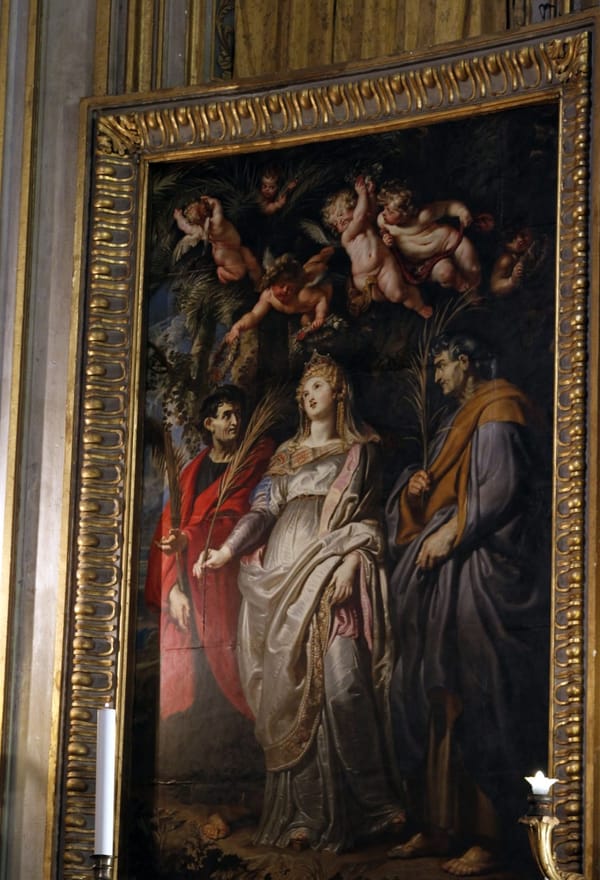
May 12: Sts. Nereus and Achilleus, Martyrs, and St. Flavia Domitilla, Virgin and Martyr
SO far in our Paschal season, the choir of Virgin martyrs has not yet offered to Jesus its crown of roses and lilies. It does so to-day, by presenting to him the noble Flavia Domitilla, the fairest flower of Rome, that was cut down by the sword of martyrdom in the first age of the Christian faith. It was under the persecution of Domitian—during which John the Evangelist was condemned to be burned alive in the cauldron of boiling oil—that Flavia Domitilla was honoured with banishment and death for the sake of our Redeemer, whom she had chosen for her Spouse. She was of the imperial family, being a niece of Flavius Clemens, who adorned the consular dignity by martyrdom. She was one of the Christians belonging to the court of the Emperor Domitian, who show us how rapidly the religion of the poor and humble made its way to the highest classes of Roman life. A few years previous to this, St Paul sent to the Christians of Philippi the greetings of the Christians of Nero's palace.1 There is still extant, not far from Rome, on the Ardeatine Way, the magnificent subterranean cemetery which Flavia Domitilla ordered to be dug on her prædium, and in which were buried the two martyrs, Nereus and Achilleus, whom the Church honours to-day together with the noble virgin who owes her crown to them.
Nereus and Achilleus were in Domitilla’s service.2 Hearing them one day speaking of the merit of virginity, she there and then bade farewell to all worldly pleasures, and aspired to the honour of being the Spouse of Christ. She received the veil of consecrated virgins from the hands of Pope St Clement: Nereus and Achilleus had been baptized by St Peter himself. What glorious reminiscences for one day!
The bodies of these three Saints reposed, for several centuries, in the Basilica, called the Fasciola, on the Appian Way; and we have a Homily which St Gregory the Great preached in this Church on their feast. The holy Pontiff dwelt on the vanity of the earth’s goods; he encouraged his audience to despise them by the example of the three martyrs whose relics lay under the very altar around which they were that day assembled.
These Saints, [said he] before whose tomb we are now standing, trampled with contempt of soul on the world and its flowers. Life was then long, health was uninterrupted, riches were abundant, parents were blessed with many children; and yet, though the world was so flourishing in itself, it had long been a withered thing in their hearts.3
Later on, in the thirteenth century, the Fasciola having been almost reduced to ruins by the disasters that had befallen Rome, the bodies of the three Saints were translated to the Church of St Adrian, in the Forum. There they remained till the close of the sixteenth century, when the great Baronius, who had been raised to the Cardinalate, with the title of Saints Nereus and Achilleus, resolved to repair the Church that was thus entrusted to his care. Through his munificence, the naves were restored; the history of the three martyrs was painted on the walls; the marble pulpit, from which St Gregory preached the Homily, was brought back, and the Homily itself was graven, from beginning to end, on the back; and the Confession was enriched with mosaics and precious marbles, preparatory to its receiving the sacred relics, of which it had been deprived for three hundred years.
Baronius felt that it was high time to put an end to the long exile of the holy martyrs, whose honour was now so specially dear to him. He organized a formal triumph for their return. Christian Rome excels in the art of blending together the forms of classic antiquity and the sentiments inspired by faith. The chariot, bearing a superb canopy, under which lay the relics of the three martyrs, was first led to the Capitol. On reaching the top of the clivus Capitolinus, the eye met two inscriptions, placed parallel with each other. On one were these words: ' To Saint Fla via Domitilla, Virgin and Martyr of Rome, the Capitol, purified from the wicked worship of demons, and restored more perfectly than by Flavius Vespasian and Domitian, Emperors, kinsmen of the Christian Virgin.' On the other: ‘The Senate and People of Rome to Saint Flavia Domitilla, Virgin and Martyr of Rome, who, by allowing herself to be put to death by fire for the faith of Christ, brought greater glory to Rome than did her kinsmen, the Emperors Flavius Vespasian and Domitian, when, at their own expense, they restored the Capitol, that had twice suffered from fire.'
The reliquaries of the martyrs were then placed on an altar that had been erected near the equestrian statue of Marcus Aurelius. After being venerated by the faithful, they were replaced on the chariot, which descended by the opposite side of the Capitol. The procession soon reached the triumphal arch of Septimius Severus, on which were hung these two inscriptions:
To the holy Martyrs Flavia Domitilla, Nereus and Achilleus, the best of citizens, the Senate and People of Rome, for their having honoured the Roman name by their glorious death, and won peace for the Roman commonwealth by shedding their blood.
To Flavia Domitilla, Nereus and Achilleus, the invincible Martyrs of Christ Jesus, the Senate and People of Rome, for their having honoured the City by the noble testimony they bore to the Christian Faith.
Following the Via Sacra, the procession was soon in front of the triumphal arch of Titus, the monument of God’s victory over the deicide nation. On one side were inscribed these words: 'This triumphal arch, formerly dedicated and raised to the Emperor Titus Flavius Vespasian, for having brought the rebellious Judea under the yoke of the Roman people, is now, by the Senate and People of Rome, more auspiciously dedicated and consecrated to Flavia Domitilla, kinswoman of the same Titus, for having, by her death, increased and furthered the Christian Religion.'
On the other side of the arch was the following inscription: ‘To Flavia Domitilla, Virgin and Martyr of Rome, kinswoman of the Emperor Titus Flavius Vespasian, the Senate and People of Rome, for her having, by shedding her blood and laying down her life for the Faith, rendered a more glorious homage to the death of Christ than did the said Titus, when by divine inspiration he destroyed Jerusalem, to avenge that same death.'
Leaving on the left the Coliseum, the hallowed ground whereon so many martyrs had fought the battle of faith, they passed under the triumphal arch of Constantine, which so eloquently speaks of the victory of Christianity, both in Rome and the Empire, and which still bears on it the name of the Gens Flavia, of which the first Christian Emperor was a member. The two following inscriptions were attached to the arch:
To Flavia Domitilla, Nereus and Achilleus, the Senate and People of Rome. On this sacred way, whereon so many Roman Emperors received triumphal honours for having brought various provinces into subjection to the Roman People, these martyrs receive to-day a more glorious triumph, for that they con quered, by a greater courage, the conquerors themselves.
To Flavia Domitilla, the Senate and People of Rome. Twelve Emperors, her kinsmen, conferred honour on the Gens Flavia and on Rome herself by their deeds of fame; but she, by sacrificing all human honours and life itself for Christ's sake, rendered greater service to both family and City than they.
The procession then continued its route along the Appian Way, and at length reached the Basilica. Baronius, assisted by a great number of Cardinals, received the precious relics, and took them with great respect to the Confession of the High Altar. Meanwhile the choir sang this Antiphon of the Pontifical: * Enter, ye Saints of God! for a dwelling hath been prepared for you by the Lord. The faithful people have followed you on your way, that ye may intercede for them with the majesty of the Lord. Alleluia!'
The following is the account of our three martyrs as given in the Liturgy:
How grand was the triumph which Rome gave to you, O holy martyrs, so many centuries after your glorious deaths! How true it is that there is no glory here on earth which can bear comparison with that of the saints! Where are now those twelve Emperors, thy kinsmen, O Domitilla? Who cares for their remains? Who even cherishes their memory? One of them was sur~ named ‘the delight of mankind '; and now how many there are who have never heard of his existence! Another, the last of the twelve, had the glory of proclaiming the victory won by the Cross over the Roman Empire; Christian Rome honours and loves his name; but the homage of religious devotion is not given to him, but to thee, O Domitilla, and to the two martyrs whose names are now associated with thine.
Who does not recognize the power of Jesus' Resurrection in the love and enthusiasm wherewith a whole people welcome your holy relics, O martyrs of the living God? Fifteen hundred years had elapsed; and yet your lifeless remains were greeted with a transport of joy, as though you yourselves were there, and living. It was because we Christians know that Jesus, who is the first-born of the dead,4 has risen from the grave; and that you, like him, are one day to rise in glory. Therefore do the faithful honour by anticipation the immortality which, at a future period, is to be given to your bodies, once slain for Jesus' sake; they already see by faith the future brightness which is to be imparted to your flesh; and thus they proclaim the dignity which the Redemption has given to man, to whom death is now but a transition to true life, and the tomb but a resting-place where the body is consigned, as seed to the earth, to be restored in a hundredfold of richer beauty.
Happy they who, as the prophecy says, have washed their robes and have made them white in the Blood of the Lamb!5 But happier they, says Holy Church, who, after being thus purified, have mingled their own blood with that of the divine Victim! for by so doing they have filled up in their flesh those things that are wanting of the sufferings of Christ.6 Hence, their intercession is powerful, and we should address our prayers to them with love and confidence. Befriend us, then, O holy martyrs Nereus, Achilleus, and Domitilla! Obtain for us an ardent love for our Risen Jesus; perseverance in the new life which he has conferred upon us; detachment from the things of this world, and a determined resolution to trample them beneath our feet, should they become a danger to our eternal salvation. Pray for us, that we may be courageous in resisting our spiritual enemies, ever ready to defend our holy faith, and earnest in our endeavours to gain that kingdom which is to be borne away by violence.7 Be the defenders of the holy Roman Church, which fervently celebrates your memory each year. You, Nereus and Achilleus, were converts of Peter; and thou, Domitilla, wast the spiritual daughter of Clement, Peter's successor; protect the Pontiff who now governs the Church—the Pontiff, in whom Peter still lives—the Pontiff, the successor of Clement. Dispel the storms which are threatening the Cross on the Capitol, and pray for the inhabitants of Rome, that they may be staunch to the faith.
- Phil, iv 22. ↩︎
- The Acts of these two Saints—which were drawn up long after their martyrdom, and on which were formed the Lessons of to-day’s Office—call them “eunuchs”: but it is a mistake of the compiler, who belongs to the fifth or sixth century. The introduction of eunuchs into the Imperial Court, and into the Roman families, is of a later date than the reign of Domitian. ↩︎
- Homil. xxviii in Evang. ↩︎
- Apoc. i 5. ↩︎
- Ibid. vii 14. ↩︎
- Coloss. i 24. ↩︎
- St Matt. xi 12. ↩︎
May 12 (the Same Day): St. Pancras, Martyr
A FOURTH martyr claims our veneration on this twelfth day of May. Like the three others, he culled his palm at Rome. But whilst they died for the faith at the very commencement of the Christian era, Pancras was not called to the glorious combat till the persecution under Diocletian—the last and greatest effort of pagan Rome against the Church. Our young hero was only fourteen years of age; but he was old enough to be a brave martyr, and he has been honoured by a commemoration in Paschal Time. The venerable Church in the Holy City which is dedicated to him, and which gives a title to one of the Cardinals, was built on the site of the cemetery where his body was buried. The following commemoration is made of him in the Matins of this feast:
Divine grace, which called thee to the crown of martyrdom, selected thee, O Pancras, from the distant land of Phrygia, and led thee to the capital of the empire—the centre of every vice and every error of paganism. Thy name, like those of millions of others who were better known to the world, had else been quite forgotten. But now, though thy earthly career was soon ended, the name of Pancras is loved and venerated throughout the whole earth: it is breathed at the altar, in the prayers which accompany the sacrifice of the Lamb. How camest thou, dear youthful martyr, by this celebrity, which will last to the end of the world? It was because, having imitated Jesus' Death by suffering and shedding thy blood for his name, thou hast been made a sharer in the glory of his immortality. In return for the honour we pay thee, deign to aid us by thy protection. Speak of us to Jesus, who is our divine Master, as he was thine. In this vale of our exile, we sing our Alleluia for his Resurrection, which has filled us with hope; obtain for us, by thy prayers, that we may sing Alleluia with thee in heaven, where it will be eternal, and be prompted, not by the gladness of hope, but by the bliss of possession.
Tuesday of the Fifth Week after Easter
THE third sacrament—the Holy Eucharist—is so intimately connected with our Redeemer's Passion that its institution could not be deferred till the Resurrection had taken place. On Maundy Thursday, we honoured the solemn act whereby our Jesus prepared for the morrow’s sacrifice, by instituting the mystery of his Body and Blood, which are really immolated in the Eucharistic Supper. The Apostles were not only admitted, as all future generations were to be, to partake of the divine Food, which giveth life to the world,1 but they moreover received power from Jesus, the Priest for ever,2 to do what he himself had just done. The great Mystery was inaugurated; the new priesthood was instituted: and now that Jesus is risen from the dead, he makes known to his Apostles the whole importance of the gift bestowed upon mankind at the Last Supper; he bids them begin the exercise of the sublime power conferred on them, as soon as the Holy Ghost, by descending upon the earth, shall give to the Church the signal for her using the prerogatives wherewith she has been endowed; and, finally, he teaches how they are to perform this special function of their Priesthood.
At the Last Supper, the Apostles were still carnal-minded men. They were taken up with the sad event that was about to happen, and overcome with grief at their divine Master telling them that that was the last Pasch he was to keep with them. They were not, therefore, in a fit state to appreciate what it was that Jesus had done for them, when he uttered those words: Take ye and eat; this is my Body. Drink ye all of this; for this is my Blood. Still less did they understand the greatness of the power they received, of doing what their Lord himself had just done in their presence. Now that Jesus is risen from the grave, he unfolds all these mysteries to them. The sacrament of the Eucharist was not instituted during these days, but it was made known, explained, and glorified by its divine institutor: and this circumstance gives a fresh lustre to the sacred season we are now going through.
Of all the sacraments, there is not one that can be compared in dignity to that of the Eucharist. The others give grace; this gives us the very Author of grace. The others are only sacraments; this is both a sacrament and a sacrifice. We will endeavour to explain it in all its magnificence, when we come to the bright feast of Corpus Christi. Let us for the present pay the tribute of our loving adoration to our Jesus, the Living Bread, that giveth life to the world.3 Let us acknowledge his immense love for his sheep. He seems to be on the point of leaving them that he may return to his Father, and yet his love retains him amongst them by means of this august mystery, wherein he is truly though invisibly present.
Be thou blessed, then, O Son of the Eternal Father! who, even in the days of the ancient covenant, didst assure us that thy delights are to be with the children of men.4 Thou provest it now by this wonderful sacrament, which reconciles thy two announcements, apparently so contradictory: thy leaving us, and thy abiding ever in our midst.
Be thou blessed for having provided for the nourishment of our souls as well as for that of our bodies. At Christmas we welcomed thy birth at Bethlehem, which signifies a House of Bread. Thou wast both the Saviour who was born for us, and the Food that came down from heaven to nourish our souls.
Be thou blessed, who, not satisfied with working the greatest of wonders at the Last Supper, by changing bread into thy Body and wine into thy Blood, hast also willed that this same miracle should be renewed, everywhere and to the end of time, for the support and consolation of our souls.
Be thou blessed in that thou hast put no limits to our longing after this Bread of Life. On the contrary, thou biddest us make it our daily Bread, and this in order that we may not faint in the way of this our exile.
Be thou blessed for the generosity wherewith, out of thy desire to communicate thyself unto us, thou hast exposed thyself to the blasphemies of heretics, to the sacrileges of bad Christians, and to the indifference of the tepid.
Be thou blessed, O divine Lamb, who enrichest the new Pasch by the shedding of thy Blood, and invitest the new Israel to a banquet where thy sacred Body is offered as nourishment to thy faithful; there do they receive life at its very source, and share in the ineffable joys of thy Resurrection.
Be thou blessed, O Jesus, for having instituted, in the Holy Eucharist, not only the greatest of the sacraments, but also a sacrifice which surpasses all others; a sacrifice whereby we are enabled to offer to the divine Majesty the only homage that is worthy of him, give him thanks in keeping with his favours to us, make him a superabundant atonement for our sins, and finally beg and obtain from him all the graces of which we stand in need.
Be thou blessed, O Emmanuel, who, having promised to give us this heavenly Food, didst fulfil thy promise on the eve of thy Passion, and gavest us this adorable sacrament as the testament of thy love. In the interval between thy Resurrection and Ascension, thou didst reveal to thine Apostles the excellency of thy gift, that so we might receive it with becoming faith.
We offer thee, dear Jesus, this homage of our faith. We confess that in this august Mystery the bread is changed into thy Body, and the wine into thy Blood: and we believe it, because thou hast said it, and because thou canst do all things.
In praise of our Paschal Lamb, who gives himself to us to be our nourishment, let us recite the following beautiful canticle, composed by Notker for the Church of Saint Gall.
Sequence
Esu potuque dignas,
Praebeant omnes se Christianae animae.
Ipse summus Pontifex.
Ejus illita sacrosancto cruore, tuta a clade Canopica,
In mari rubro sunt obruti.
Pedes tutentur adversus viperas;
Contra canes jugiter manu bajulent;
Quo de barathro victor rediit.
Ornatibus Christo consurgens, fideles admonet,
Cum eo victuros.
to partake of the Paschal Lamb,
by holy lives.
for their sakes, as an oblation to the Father.
of the Lamb; they are protected from the slaughter that fell upon Egypt,
were engulfed in the Red Sea.
let them protect their feet against vipers;
to defend themselves against dogs;
whereby he rose again victorious from the tomb.
rises together with Christ. She teaches us,
are to share in Jesus’ victory.
| Previous Monday of the Fifth Week after Easter | Next May 12 (the Same Day): St. Pancras, Martyr |