Daily reading
Paschal Time
Double · Movable from Easter · Temporal
May 19, 2020
From Dom Guéranger’s The Liturgical Year.
 |
Rogation Days: Tuesday
To-day, again, the great Litany, the supplication, is heard from the house of the Lord: the solemn procession re-appears in the streets of the city, and in the quiet lanes of the country. Let us take our share in this sacred rite; let us blend our voice with that of our mother, and join the cry that pierces the clouds: Kyrie eleison! Lord have mercy on us! Let us think, for a moment, of the countless sins that are being committed, day and night; and let us sue for mercy. In the days of Noe, all flesh had corrupted its way;1 but men thought not of asking for mercy. The flood came, and destroyed them all,2 says our Saviour. Had they prayed, had they begged God’s pardon, the hand of His justice would have been stayed, and the flood-gates of heaven would not have been opened.3 The day is to come, when not water as heretofore, but fire, is suddenly to be enkindled by the divine wrath, and is to burn the whole earth. It shall burn even the foundations of the mountains;4 it shall devour sinners, who will be resting then, as they were in the days of Noe, in a false security.
Persecuted by her enemies, decimated by the martyrdom of her children, afflicted by numerous apostasies from the faith, and deprived of every human aid, the Church will know that the terrible chastisement is at hand, for prayer will then be as rare as faith. Let us, therefore, pray; that thus the day of wrath may be put off, the Christian life regain something of its ancient vigour, and the end of the world not be in our times. There are even yet Catholics in every part of the world; but their number has visibly decreased. Heresy is now in possession of whole countries, that were once faithful to the Church. In others, where heresy has not triumphed, religious indifference has left the majority of men with nothing of Catholicity but the name, seeing that they neglect even their most essential obligations without remorse. Among many of those who fulfil the precepts of the Church, truths are diminished.5 The old honesty of faith has been superseded by loose ideas and half- formed convictions. A man is popular in proportion to the concessions he makes in favour of principles condemned by the Church. The sentiments and actions of the saints, the conduct and teaching of the Church, are taxed with exaggeration, and decried as being unsuited to the period. The search after comforts has become a serious study; the thirst for earthly goods is a noble passion; independence is an idol to which everything must be sacrificed; submission is a humiliation which must be got rid of, or, where that cannot be, it must not be publicly acknowledged. Finally, there is sensualism, which, like an impure atmosphere, so impregnates every class of society, that one would suppose there was a league formed to abolish the cross of Christ from the minds of men.
What miseries must not follow from this systematic setting aside of the conditions imposed by God upon His creatures? If the Gospel be the word of infinite Truth, how can men oppose it without drawing down upon themselves the severest chastisements? Would that these chastisements might work the salvation of them that have provoked them! Let us humble ourselves before the sovereign holiness of our God, and confess our guilt. The sins of men are increasing both in number and in enormity. The picture we have just drawn is sad enough; what would it have been, had we added such abominations as these, which we purposely excluded: downright impiety; corrupt doctrines, which are being actively propagated throughout the world; dealings with satan, which threaten to degrade our age to the level of pagan times; the conspiracy organized against order, justice, and religion, by secret societies? Oh! let us unite our prayer with that of holy Church, and say to our God: From Thy wraths deliver us, O Lord!
The Rogation days were instituted for another end besides this of averting the divine anger. We must beg our heavenly Father to bless the fruits of the earth; we must beseech Him, with all the earnestness of public prayer, to give us our daily bread. ‘The eyes of all,’ says the psalmist, ‘hope in Thee, O Lord! and Thou givest them food in due season. Thou openest Thy hand, and fillest with blessing every living creature.'6 In accordance with the consoling doctrine conveyed by these words, the Church prays to God, that He would, this year, give to all living creatures on earth the food they stand in need of. She acknowledges that we are not worthy of the favour, for we are sinners. Let us unite with her in this humble confession; but, at the same time, let us join her in beseeching our Lord to make mercy triumph over justice. How easily could He frustrate the self-conceited hopes, and the clever systems of men! They own that all depends on the weather; and on whom does that depend? They cannot do without God. True, they seldom speak of Him, and He permits Himself to be forgotten by them; but 'He neither sleepeth nor slumbereth, that keepeth Israel.’7 He has but to withold His blessing, and all their progress in agricultural science, whereby they boast to have made famine an impossibility, is of no effect. Some unknown disease comes upon a vegetable; it causes distress among the people, and endangers the social order of a world that has secularized itself from the Christian law, and would at once perish, but for the mercy of the God it affects to ignore.
If, then, our heavenly Father deign, this year, to bless the fruits of the earth, we may say, in all truth, that He gives food to them that forget and blaspheme Him, as well as to them that make Him the great object of their thoughts and of their service. Men of no religion will profit by the blessing, but they will not acknowledge it to be His; they will proclaim more loudly than ever, that nature’s laws are now so well regulated by modern science, that she cannot help going on well! God will be silent, and will feed the men who thus insult Him. But why does He not speak? Why does He not make His wrath felt? Because His Church has prayed; because He has found the ten just men,8 that is, the few for whose sake He mercifully consents to spare the world. He therefore permits these learned economists, whom He could so easily disconcert, to go on talking and writing. Thanks to this His patience, some of them will grow tired of their impious absurdity; an unexpected circumstance will open their eyes to the truth, and they will, one day, join us both in faith and in prayer. Others will go deeper and deeper into blasphemy; they will go on to the last, defying God’s justice, and fulfilling in themselves that terrible saying of holy Scripture: ‘The Lord hath made all things for Himself; the wicked also for the evil day.’9
We, who glory in the simplicity of our faith, who acknowledge that we have all from God and nothing from ourselves, who confess that we are sinners and undeserving of His gifts, will ask Him, during these three days, to give us the food we require; we will say to Him, with holy Church: That Thou vouchsafe to give and preserve the fruits of the earth: We beseech Thee, hear us! May He have pity on us in our necessities! Next year, we will return to Him with the same earnest request. We will march, under the standard of the cross, through the same roads, making the air resound with the same litanies. We will do this with all the greater confidence, at the thought that our holy mother is marshalling her children in every part of Christendom, in this solemn and suppliant procession. For thirteen hundred years has our God been accustomed to receive the petitions of His faithful people, at this season of the year; He shall have the same homage from us; nay, we will endeavour, by the fervour of our prayer, to make amends for the indifference and ignorance which are combining to do away with old Catholic customs, which our forefathers prized and loved.
The Mass is the same as yesterday’s, page 144.
We offer our readers the following prayer, taken from the ancient Gallican liturgy, and composed at a period when the observance of the Rogation days was in its first fervour.
Prayer (Contestatio)
May 19: St. Peter Celestine, Pope
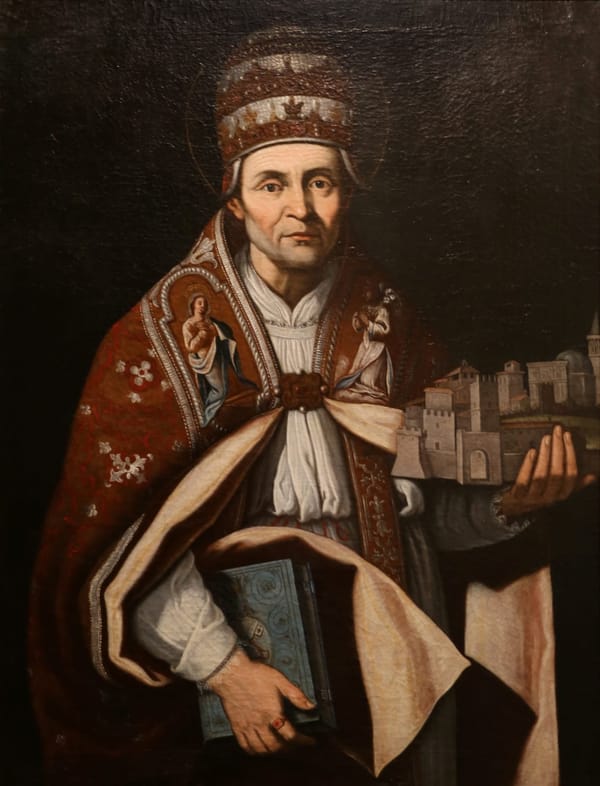 |
OUR Paschal season, which has already given us the admirable Doctor St Leo, brings before us to-day the humble Peter Celestine. He was, like Leo, sovereign pontiff, but no sooner was he throned on the chair of Peter than he left it and returned to solitude. Among the long list of sainted men who compose the venerable series of Roman Pontiffs, our Lord would have one in whose person was to be represented the virtue of humility; that honour was conferred on Peter Celestine. He was dragged from the quiet of his solitude, compelled to ascend the throne of St Peter, and made to hold in his trembling hand the keys of the kingdom of heaven. The holy hermit, whose eyes had been ever fixed on his own weakness, had then to provide for the necessities of the whole Church. In his humility, he judged himself to be unequal to so heavy a responsibility. He resigned the tiara, and begged to be permitted to return to his dear hermitage. His divine Master, Christ, had, in like manner, concealed his glory, first in thirty years of hidden life, and then, later on, under the cloud of his Passion and Sepulchre. The sunshine of the Pasch came; the gloom was dispersed, and the Conqueror of Death arose in all his splendour. He would have his servants share in his triumph and glory; but their share is to be greater or less, according to the measure in which they have, here on earth, imitated his humility. Who, then, could describe the glory which Peter Celestine receives in heaven, as a recompense for the profound humility which made him more eager to be unknown than the most ambitious of men could be for honour and fame? He was great on the pontifical throne, and still greater in his solitude; but his greatness, now that he is in heaven, surpasses all human thought.
Holy Church speaks his praise in these few lines; their simplicity admirably harmonizes with the hermit Pope, whose life they narrate:
Thou didst obtain, O Celestine, the object of thy ambition. Thou wast permitted to descend from the Apostolic Throne, and return to the quiet of that hidden life, which for so many years had been thy delight. Enjoy to thy heart's content the holy charm of being unknown to the world, and the treasures of contemplation in the secret of the face of God.1 But this life of obscurity must have an end; and then the Cross—the Cross which thou hast loved above all earthly possessions—will rise up in brightness before thy cell door, and summon thee to share in the Paschal triumph of him who came down from heaven to teach us this great truth, that he that humbleth himself shall be exalted.2 Thy name, O Celestine, will for ever shine on the list of Roman Pontiffs; thou art one of the links of that glorious chain which unites Holy Church with Jesus, her Founder and her Spouse; but a still greater glory is reserved for thee—the glory of being for ever with this same Risen Jesus. Holy Church, which during the short period of thy holding the keys of Peter, was obedient to thee, has now for centuries paid, and will continue to the end of the world to pay thee the tribute of her devotion, because she recognizes in thee one of God's elect, one of the princes of the heavenly court. And we, O Celestine, we also are invited to ascend where thou art, and contemplate, together with thee, the most beautiful among the children of men,3 the Conqueror of sin and hell. But there is only one path that can lead us thither; it is the path thou didst tread—the path of humility. Pray for us that we may be solidly grounded in this virtue, and desire it with all our hearts; that we may change our miserable self-esteem into an honest self-contempt; that we may despise all human glory, and be courageous, yea, cheerful under humiliation; and that thus having drunk of the torrent, as did our divine Master, we may one day, like him, lift up our heads,4 and cluster round his throne for all eternity.
May 19 (the Same Day): St. Pudentiana, Virgin
THIS same nineteenth of May has another glory attached to it; it is the day on which died the noble virgin Pudentiana. That name carries us back to the very first age of the Christian Church. She was a daughter of a wealthy Roman, called Pudens, a kinsman of the Pudens spoken of by St Paul, in his second Epistle to Timothy.1 She and her sister Praxedes had the honour of being numbered among the earliest members of the Church, and both of them consecrated their virginity to Jesus Christ. Upon their father’s death, the two sisters distributed their fortune to the poor, and devoted their whole time to good works. It was the eve of the persecution under Antoninus. Pudentiana, though scarcely sixteen years of age, was ripe for heaven, and winged her flight to her divine Spouse when the storm was at its height. Her sister survived her many years: we shall commemorate her saintly memory on July 21.
Pudentiana’s house, which in her grandfather’s time had been honoured by St Peter’s presence, was made over by the holy virgin herself to Pope Pius I, and the divine mysteries were celebrated in it. It is now one of the most venerable churches of Rome, and is the Station for the Tuesday of the third week of Lent.
Pudentiana is a tender floweret offered to our Risen Jesus by the Roman Church. Time has diminished nought of the fair lily’s fragrance; and pure as her very name, her memory will live in the hearts of the Christian people even to the end of the world.
The eulogy passed upon her by the holy Liturgy is but a commemoration; and yet says so much, and will say it each year, as long as time itself shall last.
Like the dove of Noe’s Ark, that found not where to rest her feet on the guilty earth, thou didst take thy flight, O Pudentiana, and rest in the bosom of Jesus, thy Spouse. Thus will it be at the end of the world, when the souls of the elect shall have been reunited to their bodies: they will fly like eagles to their King, and will cluster around him as the object of all their desires.2 They will flee from this sinful earth, as thou didst from the abominations of pagan Rome, that was drunk with the blood of the martyrs.3 We celebrate thy departure, dear youthful Saint, with a feeling of hope for our own future deliverance; we honour thy entrance into thy eternal home, and we long to be there, together with thee. Oh! gain for us detachment from all transitory things, intenser love of the new life which came to us with Easter, and indifference as to what concerns that other lower life, which is not that of our Risen Lord. Thou wast a daughter of the holy Church of Rome; pray, then, for thy mother. She is suffering now as she did during the pontificate of Pius I. After having reigned over Christian nations for centuries, she is now abandoned and disowned by the very people that owe all they have to her, and yet are now turning her own blessings against her. Use thine influence, O Pudentiana! assist and protect thine and our dearest mother.
| Previous May 18: St. Venantius, Martyr | Next May 19: St. Peter Celestine, Pope |