Daily reading
Semidouble · Movable from Easter · Temporal
May 20, 2020
From Dom Guéranger’s The Liturgical Year.

Rogation Days: Wednesday
For the third time, holy Church marshals her children in procession, and makes a solemn appeal to the divine mercy. Let us follow her sacred standard, and join her in invoking the intercession of the saints. The Litany, in which we pray to all the choirs of the heavenly Jerusalem, is both a magnificent and a powerful prayer: it is the Church triumphant uniting with the Church militant in praying for the salvation of the world.
O Mary! Mother of God, Virgin of virgins, miracle of divine power, exercise in our favour thy maternal mediation with Him, who, though God, is thy Son!
Michael the invincible, Gabriel, welcome messenger of our salvation, Raphael, affectionate physician of them that are suffering; Angels and Archangels, who watch over us, and co-operate in the work of our salvation; all ye choirs of blessed spirits, who are waiting for your ranks to be filled up by the elect of earth: intercede for your brethren, your clients!
John the Baptist, precursor of the Lamb of God; Joseph, spouse of Mary Immaculate, and foster-father of the Son of God; patriarchs, the glorious forefathers of the human race, and ancestors of the Messias; prophets, who foretold His coming, and described the events of His life, that so the earth might recognize Him as its promised Redeemer: remember us who are living in this exile, through which you also passed!
Peter, universal pastor, that holdest the keys of the kingdom of heaven; Paul, apostle of the Gentiles, armed with the sword of the word, and immolated by the sword of martyrdom; Andrew, crucified like thy master; James the Greater, son of thunder, founder of the Catholic kingdom; John, the beloved disciple, the adopted son and guardian of Mary, evangelist and prophet; Thomas, apostle of the Indies, pierced to death by a spear; James the Less, surnamed the 'brother of the Lord ’; Philip, who didst preach the Gospel to the Scythians, and wast crucified at Hierapolis; Bartholomew, the teacher and martyr of Armenia; Matthew, the evangelist, who didst carry the faith into the scorching regions of Ethiopia; Simon, by whose zeal Mesopotamia was led to the knowledge of Christ; Thaddeus, the courageous destroyer of the idols of Egypt; Mathias, chosen to fill up the place of the traitor Judas, and well worthy of the honour; Barnabas, Paul’s companion, and the light of the isle of Cyprus; Luke, disciple of the apostle of the Gentiles, and historian of the Incarnate Word; Mark, disciple of Peter, under whose direction thou wrotest the Gospel of salvation: we devoutly honour you as our fathers in the faith; pray for and with us!
Disciples of our Lord, who, though not raised to the rank of apostles, were chosen by Him to be their fellow-labourers, and who, on the day of Pentecost, were filled with the Holy Ghost; dear Innocents of Bethlehem, first-fruits of the martyrs: deign to join us in our supplications!
Stephen the crowned, Laurence the brave and cheerful winner of immortal laurels, Vincent the victorious,—the glorious triumvirate of deacons; Fabian, pontiff designated by a dove sent from heaven; Sebastian, dauntless soldier of holy Church; John and Paul, Cosmas and Damian, Gervasius and Protasius, brothers by nature and by martyrdom; oh! all ye holy martyrs, protect us under the shadow of your palms!
Sylvester, pontiff of peace; Gregory, vicar both of the meekness and of the authority of Christ; Ambrose, whose eloquence was sweet as honey, and whose courage was as that of a lion; Augustine, doctor of doctors, and apostle of divine charity; Jerome inspired interpreter of the Scriptures; Martin thaumaturgus of the west, and Nicholas, wonder-worker in the east; holy pontiffs, holy doctors of the Church, lead back to Christ all His sheep that have gone astray.
Antony, the glory of the desert, and the conqueror of satan; Benedict, the Abraham of the new Testament, whose children are countless as the stars of heaven; Bernard, pillar of the Church, and favourite of the Mother of God; Dominic, preacher of divine truth, and scourge of heresy; Francis friend and spouse of poverty, crucified together with Christ; we honour you all; enkindle within our souls the desire of Christian perfection!
Priests of the Lord; holy monks, and hermits, and confessors: pray for us who implore your aid!
Mary Magdalene, once a sinner, but afterwards a saint, whose devotedness to Jesus was so generous and fervent: obtain for us that compunction of heart, which makes amends for sin by love!
Agatha and Lucy, beautiful flowers of fair Sicily; Agnes, who followest the Lamb whithersoever He goeth; Cecily, wreathed with thy roses and lilies, and queen of sweet melody; Catharine the wise virgin that confoundest the false wisdom of philosophers; Anastasia, the valiant woman that didst triumph over the trials of life and the severity of tortures; oh! all ye holy virgins, spouses of Jesus, look with compassion on us who are dwelling in this land of exile!
All ye holy men and women, saints of God, who now reign in heaven above, think of us your brethren, who mourn in this vale of tears. We, too, are created for eternal happiness; and yet the vanities of time engross our thoughts and affections. Make intercession for us, that, henceforth, we may walk worthy of God, who hath called us unto His kingdom and glory.1
The Litany is finished; and for the third time, the holy Sacrifice is about to work reconciliation between our God and us His guilty children. Let us hope that He will make this a year of peace and plenty; and next year, when the Church invites us to join her in this public supplication for pardon, may the number of those who respond to her call, be such as to merit an increase of every blessing!
The Mass is given above, page 144. Let us assist at it with a deep conviction of our own insufficiency to make atonement for our sins, and yet with a firm confidence in the infinite merits of the Paschal Lamb, our risen Jesus.
The ancient Church of Gaul used to recite the following prayer on this third of the Rogation days. It will aid us to a spirit of penance.
Prayer (Immolatio)
The third morning of the Rogation days is over; the hour of noon has come, and from it we begin to count the hours of the last day which the Son of God is to spend upon earth in His visible presence. During these three days, we seem to have forgotten that the time of separation is close upon us; but no: the thought of our coming trial has often presented itself, and the humble supplications we have been presenting to heaven, in union with holy Church, have prepared us to celebrate the last mystery achieved by our Emmanuel on earth.
The disciples are all assembled in Jerusalem. They are grouped around the blessed Mother, in the cenacle, awaiting the hour when their divine Master is to appear to them for the last time. Recollected and silent, they are reflecting upon all the kindness and condescension He has been lavishing upon them during the last forty days; they are ruminating upon the instructions they have received from His sacred lips. They know Him so well now! They know in very deed that He came out from the Father.2 As to what regards themselves, they have learned from Him what their mission is: they have to go, ignorant men as they are, and teach all nations;3 but (Oh sad thought!) He is about to leave them; yet a little while, and they shall not see Him!4
What a contrast between their sorrow and the smiling face of nature, which is decked out in her best, for she is going to celebrate the triumphant departure of her Creator! The earth is blooming with the freshness of her first-fruits, the meadows have put on their richest emerald, the air is perfumed with blossom and flower; and all this loveliness of spring is due to the bright sun that shines upon the earth to give her gladness and life, and is privileged to be, both by its kingly splendour and the successive phases of its influence upon our globe, the grand symbol of our Emmanuel’s passage through this world.
Let us go back in thought to the dismal days of the winter solstice. The sun looked then so pallid; his triumph over night was slow and short; he rose, and sank again, often without our seeing him; his light had a certain timid reserve about it, and his heat was, for weeks, too feeble to rescue nature from the grasp of frost. Such was our divine Sun of justice, when first He came on earth; His rays made but little way in the world’s thick gloom; He kept His splendour in, lest men should be dazzled by too sudden a change from darkness to light. Like the material sun, He gained upon the world by slow advances; and even so, His progress was shrouded by many a cloud. His sojourn in the land of Egypt, His hidden life at Nazareth, were long periods during which He was wholly lost sight of. But when the time came for Him to show Himself, His glory shone forth, with all its magnificence, upon Galilee and Judea; He spoke as one having power,5 His works bore testimony to His being God,6 and the people hailed Him with the cry of 'Hosanna to the Son of David!'
He was almost at the zenith of His glory, when suddenly came the eclipse of His Passion and Death. For some hours, His enemies flattered themselves that they had for ever put out His light. Vain hope! On the third day, our divine Sun triumphed over this final obstruction, and now stands in the firmament, pouring out His light upon all creation, but warning us that His course is run. For He can never descend; there is no setting for Him; and here finishes the comparison between Himself and the orb of day. It is from heaven itself that He, our beautiful Orient, is henceforth to enlighten and direct us, as Zachary foretold at the birth of the Baptist.7 The royal prophet, too, thus exultingly sang of Him: 'He hath rejoiced, as a giant, to run the way: His going out is from the highest heaven, and His circuit even to the summit thereof: and there is no one that can hide himself from His heat.’8
This Ascension, which enthroned our Emmanuel as the eternal centre of light, was, by His own decree, to take place on one of the days of the month which men call May, and which clothes in its richest beauty the creation of this same God, who, when He had made it, was pleased with it, and found it very good.9 Sweet month of May! Not gloomy and cold like December, which brought us the humble joys of Bethlehem; not lowering and clouded like March, when the Lamb was sacrificed on Calvary; but buoyant with sunshine, and flowers, and life, and truly worthy to be offered, each year, to Mary, the Mother of God, for it is the month of her Jesus’ triumph.
O Jesus! our Creator and our Brother! our eyes and heart have followed Thee from Thy first rising upon our world. We have celebrated, in the holy liturgy, each of Thy giant steps. But Thy very growth in beauty and brightness told us that Thou must one day leave us, to go and take possession of the place that was alone worthy of Thee, the throne at the right hand of Thine eternal Father. The splendour that has been on Thee since Thy Resurrection, is not of this world; Thou canst no longer abide among us. Thou hast remained here below, for these forty days, only for the sake of consolidating Thy work; and tomorrow the earth that has been blessed with Thy presence for three and thirty years, will be deprived of its privilege and joy. We rejoice at Thy approaching triumph, as did Thy blessed Mother, Thy disciples, Mary Magdalene and her companions; but we are sad at the thought of losing Thee, and Thou wilt forgive us. Thou wast our Emmanuel, our ‘God with us'; henceforth, Thou art to be our Sun, our King, reigning from the throne of heaven, and we shall no longer be able to hear Thee, nor see Thee, nor touch Thee, O Word of life!10 Still, dearest Jesus, we say to Thee with all our hearts: Glory and love be to Thee, for Thou hast treated us with infinite mercy! Thou owedst nothing to us; we were unworthy of a single look from Thee; and yet Thou camest down to this sinful earth, Thou hast dwelt among us, Thou hast paid our ransom by Thy Blood, Thou hast re-established peace between God and man. Oh, yes! it is most just that Thou shouldst now return to Him that sent Thee.11 The Church, Thy bride, consents to her exile; she thinks only of what is most glorious to her Jesus; and she thus addresses Thee, in the words of the Canticle: 'Flee away, O my Beloved! and be swift as the roe and as the young hart, and ascend to the mountains, where the flowers of heaven exhale their sweet fragrance!’12 Can we, poor sinners as we are, refuse to imitate this loving resignation of her, who is Thy bride, and our mother?
May 20: St. Bernardine of Siena, Confessor
|
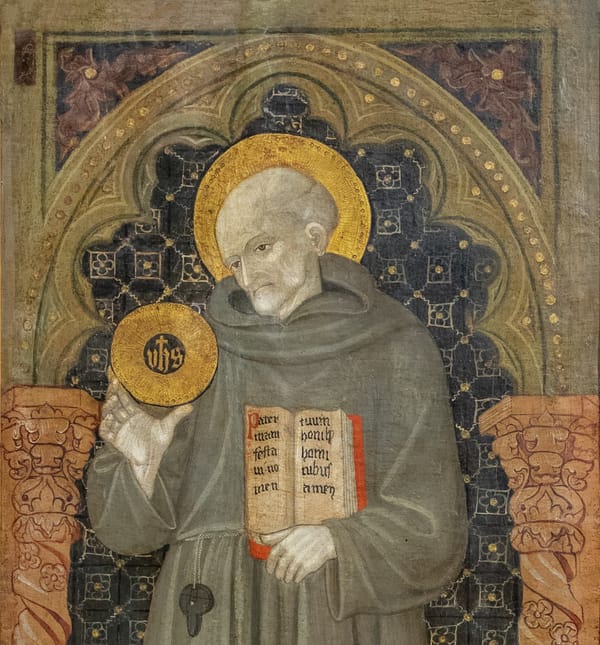
IN that season of the liturgical year when we were kneeling in love and prayer around the crib of the Infant Jesus, one day was devoted to the celebration of the glory and sweetness of his Name. Holy Church was full of joy when she pronounced the dear Name chosen from all eternity by her heavenly Spouse; and mankind found consolation in the thought that the great God who might so justly have bid us call him the Just and the Avenger, willed us henceforth to call him the Saviour. The devout Bemardine of Siena, whose feast we keep to-day, stood then before us, holding in his hands this ever blessed Name, surrounded with rays. He urged the whole earth to venerate with love and confidence the sacred name which expresses the whole economy of our salvation. The Church, ever attentive to what is for the good of her children, adopted the beautiful device. She encouraged them to receive it from the Saint, as a shield that would protect them against the darts of the evil spirit, and as an additional means of reminding ourselves of the exceeding charity wherewith God has loved this world of ours. And finally, when the loveliness of the holy Name of Jesus had won all Christian hearts, she instituted in its honour one of the most beautiful solemnities of Christmastide.
Bemardine, the worthy son of St Francis of Assisi, returns to us on this twentieth day of May, and the sweet flower of the holy Name is, of course, in his hand. But it is not now the prophetic appellation of the newborn Babe; it is not the endearing Name, respectfully and lovingly whispered by the Virgin-Mother over the crib; it is the Name whose sound has gone through the whole creation, it is the trophy of the grandest of victories, it is the fulfilment of all that was prophesied. The Name of Jesus was a promise to mankind of a Saviour; Jesus has saved mankind, by dying and rising again; he is now Jesus in the full sense of the word. Go where you will, and you hear this Name—the Name that has united men into the one great family of the Church.
The chief priests of the Synagogue strove to stifle the Name of Jesus, for it was even then winning men’s hearts. They forbade the Apostles to teach in this Name; and it was on this occasion that Peter uttered the words which embody the whole energy of the Church: We ought to obey God rather than men.1 The Synagogue might as well have tried to stay the course of the sun. So too, when the mighty power of the Roman Empire set itself against the triumphant progress of this Name, and would annul the decree that every knee should bow at its sound,2 its attempt was a complete failure, and at the end of three centuries the Name of Jesus was heard and loved in every city and hamlet of the Empire.
Armed with this sacred motto, Bernardine traversed the towns of Italy, which at that period (the fifteenth century) were at enmity with each other, and not unfrequently torn with domestic strifes. The Name of Jesus, which he carried in his hand, became as a rainbow of reconciliation; and wheresoever he set it up, there every knee bowed down, every vindictive heart was appeased, and sinners hastened to the sacrament of pardon. The three letters (I H S) which represent this Name, became familiar to the faithful; they were everywhere to be seen carved, or engraven, or painted; and the Catholic world thus gained a new form whereby to express its adoration and love of its Saviour.
Bernardine was a preacher of inspired eloquence. He was also a distinguished master in the science of sacred things, as is proved by the writings he has left us. We regret not being able, from want of space, to give our readers his words on the greatness of the Paschal mystery; but we cannot withhold from them what he says regarding the apparition of Jesus to his Blessed Mother after the Resurrection. They will be rejoiced at finding unity of doctrine on this interesting subject existing between the Franciscan school, represented by St Bemardine, and the school of St Dominic, whose testimony we have already given on the Feast of St Vincent Ferrer.
'From the fact of there being no mention made in the Gospel of the visit wherewith Christ consoled his Mother after his Resurrection, we are not to conclude that this most merciful Jesus, the source of all grace and consolation, who was so anxious to gladden his disciples by his presence, forgot his Mother, who he knew had drunk so deeply of the bitterness of his Passion. But it has pleased divine Providence that the Gospel should be silent on this subject; and this for three reasons.
‘In the first place, because of the firmness of Mary's faith. The confidence which the Virgin-Mother had of her Son's rising again had never faltered, not even by the slightest doubt. This we can readily believe, if we reflect on the special grace wherewith she was filled, she the Mother of the Man-God, the Queen of angels, and the Mistress of the world. To a truly enlightened mind, the silence of the Scripture on this subject says more than any affirmation could have done. We have learned to know something of Mary by the visit she received from the angel, when the Holy Ghost overshadowed her. We met her again at the foot of the Cross, where she, the Mother of Sorrows, stood nigh her dying Son. If then the Apostle could say: As ye are partakers of the sufferings, so shall ye he also of the consolation:3 what share must not the Virgin-Mother have had in the joys of the Resurrection? We should hold it as a certain truth that her most sweet Jesus, after his Resurrection, consoled her first of all. The holy Roman Church would seem to express this, by celebrating at Saint Mary Major's the Station of Easter Sunday. Moreover, if from the silence of the Evan-gelists you would conclude that our Risen Lord did not appear to her first, you must go farther, and say that he did not appear to her at all, inasmuch as these same Evangelists, when relating the several apparitions, do not mention a single one as made to her. Now, such a conclusion as this would savour of impiety.
'In the second place, the silence of the Gospel is explained by the incredulity of men. The object of the Holy Spirit, when dictating the Gospels, was to describe such apparitions as would remove all doubt from carnalminded men with regard to the Resurrection of Christ. The fact of Mary's being his Mother would have weakened her testimony, at least in their eyes. For this reason she was not brought forward as a witness, though most assuredly there never was or will be any creature (the humanity of her Son alone excepted) whose assertion better deserved the confidence of every truly pious soul. But the text of the Gospel was not to adduce any testimonies, save such as might be offered to the whole world. As to Jesus' apparition to his Mother, the Holy Ghost has left it to be believed by those that are enlightened by his light.
'In the third place, this silence is explained by the sublime nature of the apparition itself. The Gospel says nothing regarding the Mother of Christ after the Resurrection; and the reason is, that her interviews with her Son were so sublime and ineffable that no words could have described them. There are two sorts of visions: one is merely corporal, and feeble in proportion; the other is mainly in the soul, and is granted only to such as have been transformed. Say, if you will, that Magdalen was the first to have the merely corporal vision, provided that you admit that the Blessed Virgin saw, previously to Magdalen, and in a far sublimer way, her Risen Jesus, that she recognized him, and enjoyed his sweet embraces in her soul, more even than in her body.'4
Let us now read the Life of our Saint, as given, though too briefly, in the Lessons of to-day's Office:
How beautiful, O Bernardine, are the rays that form the aureole round the Name of Jesus! How soft their light on that eighth day after his birth, when he received this Name! But how dazzling, now that this Jesus achieves our salvation, not only by humiliation and suffering, but by the triumph of his Resurrection! Thou comest to us, O Bernardine, in the midst of the Paschal glory of the Name of Jesus. This Name, for which thou didst so lovingly and zealously labour, gives thee to share in its immortal victory. Now therefore, pour forth upon us, even more abundantly than when thou wast here on earth, the treasures of love, admiration and hope, of which this divine Name is the source, and cleanse the eyes of our soul, that we may one day be enabled to join thee in contemplating its beauty and magnificence.
Apostle of peace! Italy, whose factions were so often quelled by thee, may well number thee among her protectors. Behold her now a prey to the enemies of Jesus, rebellious against the Church of God, and abandoned to her fate. Oh! forget not that she is thy native land, that she was obedient to thy preaching, and that thy memory was long most dear to her. Intercede in her favour; deliver her from her oppressors; and show that when earthly armies fail, the host of heaven can always save both cities and countries.
Illustrious son of the great patriarch of Assisi! the seraphic Order venerates thee as one of its main supports. Thou didst reanimate it to its primitive observance; continue now from heaven to protect the work thou didst commence here on earth. The Order of St Francis is one of the grandest consolations of holy Mother Church; make this Order for ever flourish, protect it in its trials, give it increase in proportion to the necessities of the faithful; for thou art the second Father of this venerable family, and thy prayers are powerful with the Redeemer, whose glorious Name thou didst confess upon earth.
| Previous May 19 (the Same Day): St. Pudentiana, Virgin | Next May 20: St. Bernardine of Siena, Confessor |