Daily reading
Paschal Time
Double · Movable from Easter · Temporal
May 26, 2020
From Dom Guéranger’s The Liturgical Year.
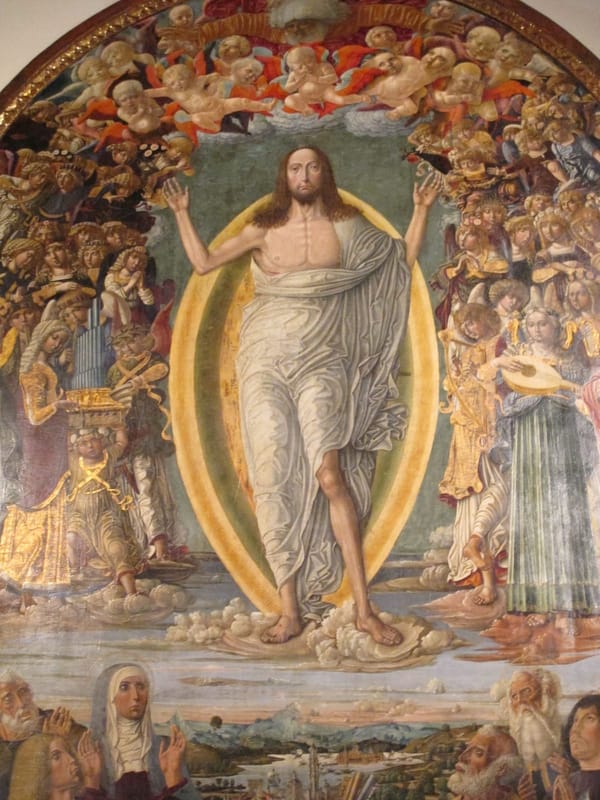 |
Tuesday within the Octave of the Ascension
The Lord of glory has ascended into heaven, and, as the apostle says, He has gone thither as our forerunner;1 but how are we to follow Him to this abode of holiness, we whose path is beset with sin, we who are ever needing pardon rather than meriting anything like glory? This brings us to another consequence of the exhaustless mystery of the Ascension; let us give it our closest attention. Jesus has gone to heaven, not only that He may reign as King, but also that He may intercede for us as our High Priest, and, in this quality, obtain for us both the pardon of our sins and the graces we need for following Him to glory. He offered Himself on the cross as a victim of propitiation for our sins; His precious Blood was shed as our superabundant ransom; but the gate of heaven remained shut against us, until He threw it open by His own entrance into that sanctuary, where He was to exercise His eternal office of’Priest according to the order of Melchisedech.’2 By His Ascension into heaven, His priesthood of Calvary was transformed into a priesthood of glory. He entered with the veil of His once passible and mortal Flesh,3 within the veil of His Father’s presence, and there is He our Priest for ever.
How truly is He called Christ, that is,’the Anointed!’ for, no sooner was His divine Person united to the human Nature, than He received a twofold anointing: He was made both King and High Priest. We have already meditated upon His kingship; let us now contemplate His priesthood. He gave proofs of both during His life among us on earth; but it was only by His Ascension that their unclouded splendour was to be declared. Let us, then, follow our Emmanuel, and see Him as our High Priest.
The apostle thus describes the office of a high priest.’He is taken from among men, and is ordained for men in the things that appertain to God that he may offer up gifts and sacrifices for sins’:4 he is appointed their ambassador and mediator with God. Jesus received this office and ministry, and He is fulfilling it in heaven. But, that we may the better appreciate the grand mystery, let us study the figures given of it in the holy Scriptures, and developed by St. Paul in his sublime Epistle; they will give us a precise idea of the grandeur of our Jesus’ pontifical character.
Let us go in thought to the temple of Jerusalem. First of all there is the spacious uncovered court with its porticoes; in the centre stands the altar, whereon are slain the victims of the various sacrifices, and from the altar there radiate a number of conduits, through which flows the blood. We next come to a more sacred portion of the edifice; it is beyond the altar of holocausts, is covered in, and is resplendent with all the riches of the east. Let us respectfully enter, for the place is holy, and it was God Himself who gave to Moses the plan of the various fittings which adorn it with their mysterious and rich beauty: the altar of incense, with its morning and evening cloud of fragrance; the seven-branched candlestick, with its superb lilies and pomegranates; the table of the loaves of proposition, representing the offering made by man to Him who feeds him with the harvests of the earth. And yet it is not here, though the walls are wainscoted with the bright gold of Ophir, that is centred the great majesty of Jehovah. At the extreme end of the temple there is a veil of precious texture, richly embroidered with figures of the Cherubim, and reaching to the ground: it is there, beyond this veil, that the God of Abraham, Isaac, and Jacob, has fixed the abode of His presence; it is there, also, that rests the ark of the covenant, over which two golden Cherubim spread their wings. It is called the Holy of holies, and no one, under pain of death, may draw aside the veil, or look, or enter within the hallowed precinct, where the God of hosts deigns to dwell.
So then, man is banished from the place wherein God dwells; he is unworthy to enter into so holy a presence. He was created that he might see God and be eternally happy with that vision; but, because of sin, he is never to enjoy the sight of God. There is a veil between himself and Him who is his last end; neither can he ever remove that veil. Such is the severe lesson given to us by the symbolism of the ancient temple.
But there is a merciful promise, and it gives a gleam of hope. This veil shall one day be raised up, and man shall enter within: on one condition, however. Let us return to the figurative temple, and we shall learn what this condition is. As we have already noticed, none was allowed to enter the Holy of holies; there was but one exception, and that was in favour of the high priest, who might, once a year, penetrate beyond the veil. Yet even he had certain conditions to observe. If he entered without holding in his hands a vessel containing the blood of two victims, previously immolated by him for his own and the people’s sins, he was to be put to death; if, on the contrary, he faithfully complied with the divine ordinances, he would be protected by the blood he carried in his hands, and might make intercession for himself and all Israel.
How beautiful and impressive are these figures of the first covenant! but how much more so their fulfilment in our Jesus’ Ascension! Even during the period of His voluntary humiliations, He made His power felt in this sacred dwelling of God’s Majesty. His last breath on the cross rent the veil of the Holy of holies, hereby signifying to us that man was soon to recover the right he had lost by sin, the right of admission into God’s presence. We say soon; for Jesus had still to gain the victory over death, by His Resurrection; He had to spend forty days on earth, during which He, our High Priest, would organize the true priesthood that was to be exercised in His Church to the end of time, in union with the priesthood He Himself was to fulfil in heaven.
The fortieth day came, and found all things prepared: the witnesses of the Resurrection had proclaimed the victory of their master; the dogmas of faith had all been revealed; the Church had been formed; the sacraments had been instituted: it was time for our High Priest to enter into the Holy of holies, accompanied by the holy souls of limbo. Let us follow Him with the eye of our faith. As He approached, the veil, that had closed the entrance for four thousand years, was lifted up. Jesus enters. Has He not offered the preparatory sacrifice?—not the figurative sacrifice of the old law, hut the real one of His own Blood P And having reached the throne of the divine Majesty, there to intercede for us His people, He has but to show His eternal Father the wounds He received, and from which flowed the Blood that satisfied every claim of divine justice. He would retain these sacred stigmata of His sacrifice, in order that He might ever present them, as our High Priest, to the Father, and so disarm His anger.’My little children,’ says St. John in his first Epistle, ‘I write these things to you, that ye may not sin; but, if any man do sin, we have an advocate with the Father, Jesus Christ the just.’5 Thus, then, beyond the veil, Jesus treats of our interests with His Father; He gives the merits of His sacrifice their full efficacy; He is the eternal High Priest, whose advocacy is irresistible.
St. John, who was granted a sight of the interior of heaven, gives us a sublime description of this twofold character of our divine Head,—Victim and yet King, sacrificed and yet immortal. He shows us the throne of Jehovah, round which are seated the four-and-twenty ancients, the four symbolical living creatures, and then the seven spirits burning like lamps before it. But the prophet does not finish his description here. He bids us look at the right hand of Him who sits on the throne. There we perceive a Lamb standing and as it were slain: slain and yet standing, for He is radiant with glory and power.6 We should be at a loss to understand the vision, had we not our grand mystery of the Ascension to explain it; but now, all is clear. We recognize in the Lamb, portrayed by the apostle, our Jesus, the Word eternal, who, being consubstantial with the Father, is seated on the same throne with Him. Yet is He also the Lamb; for He assumed to Himself our flesh, in order that He might be sacrificed for us as a victim; and this character of victim is to be for ever upon Him. Oh! see Him there, in all His majesty as Son of God, standing in the attitude of infinite power, yet withal, He will not part with the semblance of the immolated. The sword of sacrifice has left five wounds upon Him, and He would keep them for eternity. Yes, it is identically the same meek Lamb of Calvary, and He is to be for ever consummating in glory the immolation He perfected on the cross.
Such are the stupendous realities seen by the angels within the veil;7 and when our turn comes to pass that veil, we also shall be enraptured with the sight. We are not to be left outside, as were the Jewish people when, once each year, their high priest entered into the Holy of holies. We have the teaching of the apostle:’The fore-runner, Jesus, our High Priest, has entered within the veil for us.’8 For us! Oh what music there is in these two words: for us! He has led the way; we are to follow! Even at the commencement, He would not go alone; He would have the countless legion of the souls of limbo to accompany Him: and ever since then, the procession into heaven has been one of unbroken magnificence. The apostle tells us that we, poor sinners as we are, are already saved by hope;9 and what is our hope, but that we are one day to enter into the Holy of holies? Then shall we blend our glad voices with those of the angels, the four-and- twenty ancients, the myriads of the blessed, in the eternal hymn:’To the Lamb that was slain, power, and divinity, and wisdom, and strength, and glory, and benediction, for ever and ever! Amen.’10
We offer our readers, to-day, the following sequence, composed by the pious Notker, in the ninth century, for the abbey of Saint Gall.
Sequence
Cunctis concedat esse Christianis,
Amatoribus suis.
Mediator nostrae naturae
Ac divinae.
Æthera novus homo
Transvolans.
Stipant, ad Patrem
Reversurum.
Cum lactanti adhuc
Stella tibi serviret
Et angeli?
Rem novam et dulcem
Dedisti, Domine,
Sperandi cœlestia.
Levando super sidereas metas,
Regum Domine.
Tuos replent apostolos,
Quis dedisti cernere
Te cœlos pergere.
In cœlis tibi occurrunt
Novem ordines,
Diu dispersum a lupis,
Gregem unum,
Bone Pastor,
Tu dignare custodire.
who love him, that this day may be
to them a happy one!
thou unitest in thyself the two natures
of God and Man.
thou the new Man,
didst ascend into heaven.
paid the homage of their service to thee,
when thou returnedst to thy Father;
when we remember how,
when thou wast a Babe at thy Mother’s breast,
a star united with the angels in serving thee?
gavest to the inhabitants of earth
a new and sweet sentiment:
the hope of heaven,
—which thou, O King of kings, hadst truly assumed,
—above the highest stars.
the hearts of thine apostles,
whom thou permittedst to see thee
mounting up to heaven!
did the nine choirs of angels go forth
to meet thee as thou enteredst heaven,
the sheep, thy one flock,
that had long been scattered by wolves!
Good shepherd!
vouchsafe to watch over this thy flock!
Prayer
Prayer
May 26: St. Philip Neri, Confessor
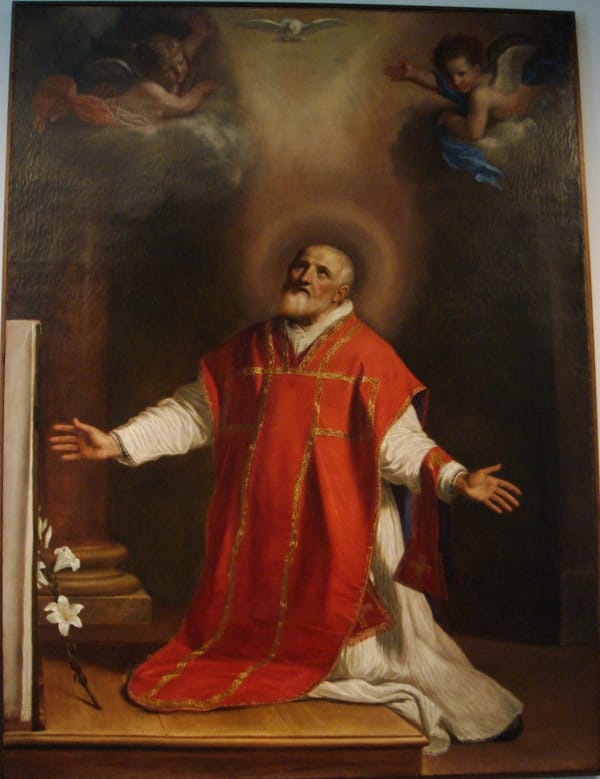 |
AS we have already said, joy is the leading feature A of the Paschal season—a supernatural joy which springs from our delight at seeing the glorious triumph of our Emmanuel, and from the happiness we feel at our own being delivered from the bonds of death. This interior joy was the characteristic of the Saint whom we honour to-day. His heart was ever full of a jubilant enthusiasm for what regards God; so that we could truly apply to him those words of Scripture: A secure mind is like a continual feast.1 One of his latest disciples, the illustrious Father Faber, tells us in his beautiful treatise, Growth in Holiness, that cheerfulness is one of the chief means for advancing in Christian perfection. We will therefore welcome with gladness and veneration the benevolent and light-hearted Philip Neri, the Apostle of Rome, and one of the greatest Saints produced by the Church in the sixteenth century.
Love of God—but a love of the most ardent kind, and one that communicated itself to all that came near him—was our Saint’s characteristic virtue. All the Saints loved God; for the love of God is the first and greatest of the commandments: but Philip’s whole life was, in an especial manner, the fulfilment of this divine precept. His entire existence seemed to be but one long transport of love for his Creator; and had it not been for a miracle of God’s power and goodness, this burning love would have soon put an end to his mortal career. He was in his twenty-ninth year, when one day—it was within the octave of Pentecost—he was seized with such a vehemence of divine charity that two of his ribs broke, thus making room for the action of the heart to respond freely to the intensity of the love of the soul. The fracture was never healed; it caused a protrusion which was distinctly observable; and, owing to this miraculous enlargement of the region of the heart, Philip was enabled to live fifty years more, during which time he loved his God with a fervour and strength which would do honour to one already in heaven.
This seraph in human flesh was a living answer to the insults heaped upon the Catholic Church by the so-called Reformation. Luther and Calvin had called this Holy Church the harlot of Babylon; and yet she had, at that very time, such children as Teresa of Spain, and Philip Neri of Rome, to offer to the admiration of mankind. But Protestantism cared little or nothing for piety or charity; its great object was the throwing off the yoke of restraint. Under pretence of religious liberty, it persecuted them that adhered to the true faith; it forced itself by violence where it could not enter by seduction; but it never aimed at or thought of leading men to love their God. The result was that wheresoever it imposed its errors, devotedness was at an end—we mean that devotedness which leads man to make sacrifices for God or for his neighbour. A very long period of time elapsed after the Reformation before Protestantism ever gave a thought to the infidels who abounded in various parts of the globe: and if, later on, it organized what it calls its missions, it chose a strange set of men to be the apostles of its Bible Societies. It has made a recent discovery; it has found out that the Catholic Church is prolific in Orders and Congregations devoted to works of charity. The discovery has excited it to emulation; and among its other imitations, it can now boast of having Protestant Sisters of Charity. To a certain point, success may encourage it to persevere in these tardy efforts; but anything like the devotedness of Catholic institutions is an impossibility for Protestantism, were it only for this reason, that its principles are opposed to the Evangelical Counsels, which are the great sources of the spirit of sacrifice, and are prompted by a motive of the love of God.
Glory, then, to Philip Neri, one of the worthiest representatives of charity in the sixteenth century! It was owing to his zeal that Rome and Christendom at large were replenished with a new life by the frequentation of the sacraments and by the exercises of Catholic piety. His word, his very look, used to excite people to devotion. His memory is still held in deep veneration, especially in Rome, where his feast is kept with the greatest solemnity on this twenty-sixth day of May. He shares with Saints Peter and Paul the honour of being patron of the Holy City. Formerly, on his feast, the Pope went, with great solemnity, to the Church of St Mary in Vallicella, and paid the debt of gratitude which the Holy See owes to the Saint who accomplished such great things for the glory of our holy Mother the Church.
Philip had the gift of miracles; and though seeking to be forgotten and despised, he was continually surrounded by people who besought him to pray for them, either in their temporal or spiritual concerns. Death itself was obedient to his command, as in the case of the young prince Paul Massimo. The young prince, when breathing his last, desired that Philip should be sent for, in order that he might assist him to die happily. The Saint was saying Mass at the time. As soon as the holy Sacrifice was over, he repaired to the palace; but he was too late; he found the father, sister and the whole family in tears. The young prince had died after an illness of sixty-five days, which he had borne with most edifying patience. Philip fell upon his knees; and, after a fervent prayer, he put his hand on the head of the corpse, and called the prince by his name. Thus awakened from the sleep of death, Paul opened his eyes, and looking at Philip, said to him: ‘My Father!’ He then added these words: ‘I only wished to go to confession.’ The assistants left the room, and Philip remained alone with the prince. After a few moments the family were called back; and in their presence, Paul began to speak to Philip regarding his mother and sister who had been taken from him by death, and whom he loved with the tenderest affection. During the conversation, the prince's face regained all it had lost by sickness. His animation was that of one in perfect health. The saint then asked him if he would wish to die again. ‘Oh! yes,’ answered the prince, ‘most willingly; for I should then see my mother and sister in heaven.’ ‘Take then’ said Philip, ‘take thy departure for heaven, and pray to the Lord for me.’ At these words, the young prince expired once more, and entered into the joys of eternal life, leaving his family to mourn his departure, and venerate a Saint such as Philip.
He was almost continually visited by our Lord with raptures and ecstasies; he was gifted with the spirit of prophecy, and could read the secrets of the conscience. His virtues were such as to draw souls to him by an irresistible charm. The youth of Rome, rich and poor, used to flock to him. Some he warned against danger; others he saved, after they had fallen. The poor and sick were the object of his unceasing care. He seemed to be everywhere in the city by his works of zeal, which gave an impulse to piety that has never been forgotten.
Philip was convinced that one of the principal means for maintaining the Christian spirit is preaching the word of God: hence he was most anxious to provide the faithful with apostolic men, who would draw them to God by good and solid preaching. He established, under the name of The Oratory, an institute which still exists, the object of which is to encourage Christian piety among the people. By founding it, Philip aimed at securing the services, zeal, and talent of priests who are not called to the Religious life, but who, by uniting their labours together, would produce great good to the souls of men.2
Thus did he afford to priests, whose vocation does not lead them to the Religious state, the great advantages of a common rule and mutual good example, which are such powerful aids both in the service of God and in the exercise of pastoral duties. But the holy Apostle was a man of too much faith not to have an esteem of the Religious life as a state of perfection. He never lost an opportunity of encouraging a vocation to that holy state. The Religious Orders were indebted to him for so many members, that his intimate friend and admirer, St Ignatius of Loyola, used playfully to compare him to a bell, which calls others to Church, yet never goes in itself!
The awful crisis of the sixteenth century, through which the Christian world had to pass, and which robbed the Catholic Church of so many provinces, was a source of keenest grief to Philip during the whole of his life. His heart bled at seeing so many thousand souls fall into the abyss of error and heresy. He took the deepest interest in the efforts that were made to reclaim those that had been led astray by the pretended Reformation. He kept a watchful eye on the tactics wherewith Protestantism sought to maintain its ground. The ‘Centuries of Magdeburg,’ for example, suggested to his zeal a counterbalance of truth. The ‘Centuries’ was a series of historical essays, whereby the Reformers sought to prove that the Roman Church had changed the ancient faith, and introduced superstitious practices in the place of those that were used in the early ages of Christianity. A work like this, with its falsified quotations, its misrepresentation and its frequent invention of facts, was destined to do great injury; and Philip resolved to meet it by a work of profound erudition—a true history, compiled from authentic sources. One of the fathers of his Oratory, Cæsar Baronius, was just the man for such an undertaking; and Philip ordered him to take the field against the enemy. The Ecclesiastical Annals were the fruit of this happy thought; and Baronius himself, at the beginning of Book VIII, acknowledges that Philip was the originator of the work. Three centuries have passed away since then. It is easy for us, with the means which science now puts into our hands, to detect certain imperfections in the Annals; at the same time, it is acknowledged on all sides that they form by far the truest and finest History of the Church of the first twelve hundred years—which is as far as the learned Cardinal went. Heresy felt the injury it must needs sustain by such a History. The sickly and untrustworthy erudition of the Centuriators could not stand before an honest statement of facts; and we may safely assert that the progress of Protestantism was checked by the Annals of Baronius, which showed that the Church was then as she had ever been—the pillar and ground of the truth.3 Philip's sanctity and Baronius’ learning secured the victory. Numerous conversions soon followed, consoling the Church for the losses she had sustained. And if in these our own days there are so many returning to the ancient faith, it is but fair to attribute the movement, in part at least, to the success of the historical method begun by the Annals.
Let us now read the liturgical account of the virtues and holy deeds of the Apostle of Rome in the sixteenth century:
Philippus Nerius piis honestisque parentibus Florentiae natus, ab ipsa ineunte ætate non obscura dedit futuræ sanctitatis indicia. Adolescens ampla patrui hereditate dimissa, Romam se contulit; ubi philosophia ac sacris litteris eruditus, totum se Christo dicavit. Ea fuit abstinentia, ut sæpe jejunus triduum permanserit. Vigiliis et orationibus intentus, septem Urbis ecclesias frequenter visitans, apud Cœmeterium Callisti in cœlestium rerum contemplatione pernoctare consuevit. Sacerdos ex obedientia factus, in animarum salute procuranda totus fuit, et in confessionibus audiendis ad extremum usque diem perseverans, innumeros pene filios Christo peperit; quos verbi Dei quotidiano pabulo, sacramentorum frequentia, orationisassiduitate, aliisque piis exercitationibus enutriri cupiens, Oratorii congregationem instituit.
Thy whole life, O Philip, was one long act of love of Jesus; but it was also one untiring effort to make others know and love him, and thus secure the end for which they were created. Thou wast the indefatigable Apostle of Rome for forty years, and no one could approach thee without receiving something of the divine ardour that filled thy heart. We too would fain receive of thy fulness of devotion; and therefore we pray thee to teach us how to love our Risen Jesus. It is not enough that we adore him and rejoice in his triumph—we must love him; for he has permitted us to celebrate the various mysteries of his life on earth, with a view to our seeing more and more clearly how deserving he is of our warmest love. It is love that will lead us to the full appreciation of his Resurrection, that bright mystery which shows us all the riches of the Sacred Heart. The new life which he put on by rising from the tomb, teaches us more eloquently than ever how tenderly he loves us, and how earnestly he importunes us to love him in rerum. Pray for us, O Philip, that our heart and our flesh may rejoice in the Living God!4 Now that we have relished the mystery of the Pasch, lead us to that of the Ascension; prepare our souls to receive the Holy Spirit at Pentecost; and when the august mystery of the Eucharist beams upon us, with all its loveliness, in the approaching festival, the very day that ushered thee into the unveiled vision of thy Jesus, intercede for us, that we may receive and relish that Living Bread, which giveth life to the world!5
The sanctity that shone on thee, O Philip, was marked by the impetuosity of thy soul's longing after her God; and all they that held intercourse with thee, quickly imbibed thy spirit—which, in truth, is the only one that contents our Redeemer’s Heart. Thou hadst the talent of winning souls, and leading them to perfection by the path of confidence and generosity. In this great work, thy method consisted in having none; thus imitating the Apostles and ancient Fathers, and trusting to the power of God’s own word. It was by thee that the frequentation of the sacraments was restored—that surest indication of the Christian spirit. Pray for the faithful of our times, and come to the assistance of so many souls that are anxiously pursuing systems of spirituality which have been coined by the hands of men, and which but too frequently retard or even impede the intimate union of the creature with his Creator.
Thy love of the Church, O Philip, was most fervent: there can be no true sanctity without it. Though thy contemplation was of the sublimest kind, yet did it not make thee lose sight of the cruel trials which this holy Spouse of Christ had to endure in those sad times. The successful efforts of heresy stimulated thy zeal: oh! obtain for us that keen sympathy for our holy faith which will make us take an interest in all that concerns its progress. It is not enough for us that we save our own souls; we must, moreover, ardently desire and do our utmost to obtain the advancement of God’s kingdom on earth, the extirpation of heresy, and the exaltation of our holy Mother the Church: if these are not our dispositions, how can we call ourselves children of God? May thy example urge us to take to heart the sacred cause of our common Mother. Pray too for the Church militant, of which thou wast one of the bravest soldiers. Shield with thy protection that Rome which loves thee so devoutly because of the services which she received at thy hands. Thou didst lead her children to holiness during thy mortal career; bless her and defend her now that thou art in heaven.
May 28: St. Augustine, Bishop and Apostle of England
[In Dom Guéranger's The Liturgical Year, the feast day of St. Augustine of Canterbury is marked on May 26, as it is traditionally celebrated in the United Kingdom. In the calendar for the Extraordinary Form in the United States, his feast is kept on May 28.–Ed.]
From Dom Guéranger's The Liturgical Year.
FOUR hundred years had scarcely elapsed since the glorious death of Eleutherius, when a second Apostle of Britain ascended from this world, and on this same day, to the abode of eternal bliss. We cannot but be struck by the fact that the names of our two Apostles appear on the Calendar together: it shows us that God has his own special reasons in fixing the day for the death of each one among us. We have more than once noticed these providential coincidences, which form one of the chief characteristics of the liturgical cycle. What a beautiful sight is brought before us to-day, of the first Archbishop of Canterbury, who, after honouring on this day the saintly memory of the holy Pontiff from whom England first received the Gospel, himself ascended into heaven, and shared with Eleutherius the eternity of heaven’s joy! Who would not acknowledge in this, a pledge of the predilection wherewith heaven has favoured this country, which, after centuries of fidelity to the truth, has now for more than three hundred years been an enemy to her own truest glory?
The work begun by Eleutherius had been almost entirely destroyed by the invasion of the Saxons and Angles; so that a new mission, a new preaching of the Gospel, had become a necessity. It was Rome that again supplied the want. St Gregory the Great was the originator of the great design. Had it been permitted him, he would have taken upon himself the fatigues of this apostolate to our country. He was deeply impressed with the idea that he was to be the spiritual Father of these poor islanders, some of whom he had seen exposed in the market-place of Rome, that they might be sold as slaves. Not being allowed to undertake the work himself, he looked around him for men whom he might send as Apostles to our island. He found them in the Benedictine monastery where he himself had spent several years of his life. There started from Rome forty monks, with Augustine at their head, and they entered England under the standard of the Cross.
Thus the new race that then peopled the island received the faith, as the Britons had previously done, from the hands of a Pope; and monks were their teachers in the science of salvation. The word of Augustine and his companions fructified in this privileged soil. It was some time of course before he could provide the whole nation with instruction; but neither Rome nor the Benedictines abandoned the work thus begun. The few remnants that were still left of the ancient British Christianity joined the new converts; and England merited to be called, for long ages, the ‘Island of Saints.’
The history of St Augustine’s apostolate in England is of thrilling interest. The landing of the Roman missioners, and their marching through the country, to the chant of the Litany; the willing and almost kind welcome given them by king Ethelbert; the influence exercised by his queen Bertha, who was a Frenchwoman and a Catholic, in the establishment of the faith among the Saxons; the baptism of ten thousand neophytes, on Christmas day, and in the bed of a river; the foundation of the metropolitan see of Canterbury, one of the most illustrious Churches of Christendom on account of the holiness and noble doings of its Archbishops; all these admirable episodes of England’s conversion are eloquent proofs of God’s predilection of our dear land. Augustine’s peaceful and gentle character, together with his love of contemplation amidst his arduous missionary labours, gives an additional charm to this magnificent page of the Church’s history. But who can help feeling sad at the thought that a country, favoured as ours has been with such graces, should have apostatized from the faith; have repaid with hatred that Rome which made her Christian; and have persecuted with unheard-of cruelties the Benedictine Order to which she owed so much of her glory?
We subjoin the following Lessons on the life of our Apostle, taken from an Office approved by the Holy See:
We also give the following hymn in honour of our Apostle, which has also been approved by the Holy See:
Hymn
Tuum canas apostolum;
Et filium Gregorii
Laudes piis concentibus.
Messem dedisti plurimam,
Quæ sanctitatis floribus
Diu refulges inclyta.
Stipatus intrat Angliam:
Vexilla Christi proferens,
Dux pacis adfert pignora.
Verbum salutis spargitur:
Fidem quin ipse barbarus
Rex corde prompto suscipit.
Undisque lota fluminis,
Ipsa die renascitur
Qua sol salutis ortus est.
E sede pascas siderum:
In matris ulnas anxiæ
Gregem reducas devium.
Quæ rore jugi gratiæ
Vitem rigas: ut pristina
Fides resurgens floreat.
sing a hymn to thine Apostle!
Praise in holy song
the son of Gregory!
thou gavest a rich harvest,
and for ages wast famed
for thy flowers of sanctity.
having with him his forty brethren.
He bears the standard of Christ.
He is the leader, and brings the pledges of peace.
the word of salvation is spread through the land.
Yea, the king himself, though a barbarian,
receives the faith with a ready heart.
it is baptized in the river's stream,
and is born to its new life,
on the very day that the Sun of Justice rose upon our earth.
from thy heavenly throne feed thy children.
Thy flock has gone astray;
lead it back to the arms of its anxious Mother.
the dew of grace upon thy vine!
grant that the ancient faith
may rise again and flourish in our land!
O Jesus, our Risen Lord! thou art the life of nations, as thou art the life of our souls. Thou biddest them know and love and serve thee, for they have been given to thee for thine inheritance; and at thine own appointed time, each of them is made thy possession.1 Our own dear country was one of the earliest to be called; and when on thy Cross thou didst look with mercy on this far island of the West. In the second Age of thy Church, thou didst send to her the heralds of thy Gospel; and again in the sixth, Augustine, thine Apostle, commissioned by Gregory, thy Vicar, came to teach the way of truth to the new pagan race that had made itself the owner of this highly favoured land.
How glorious, dear Jesus, was thy reign in our fatherland! Thou gavest her bishops, doctors, kings, monks, and virgins, whose virtues and works made the whole world speak of her as the 'Isle of Saints'; and it is to Augustine, thy disciple and herald, that thou wouldst have us attribute the chief part of the honour of so grand a conquest. Long indeed was thy reign over this people, whose faith was lauded throughout the whole world; but, alas! an evil hour came, and England rebelled against thee; she would not have thee to reign over her.2 By her influence, she led other nations astray. She hated thee in thy Vicar; she repudiated the greater part of the truths thou hast revealed to men; she put out the light of faith, and substituted in its place the principles of private judgement, which made her the slave of countless false doctrines. In the mad rage of her heresy, she trampled beneath her feet and burned the relics of the Saints, who were her grandest glory; she annihilated the Monastic Order, to which she owed her knowledge of the Christian faith; she was drunk with the blood of the martyrs; she encouraged apostasy, and punished adhesion to the ancient faith as the greatest of crimes.
By a just judgement of God she has become a worshipper of material prosperity. Her wealth, her fleet, and her colonies—these are her idols, and she would awe the rest of the world by the power they give her. But the Lord will, in his own time, overthrow this colossus of power and riches; and as it was in times past, when the mightiest of kingdoms was destroyed by a stone which struck it on its feet of clay,3 so will people be amazed, when the time of retribution comes, to find how easily the greatest of modem nations was conquered and humbled. England no longer forms a part of thy kingdom, O Jesus! She separated herself from it, by breaking the bond that had held her so long in union with thy Church. Thou hast patiently waited for her return; yet she returns not. Her prosperity is a scandal to the weak; so that her own best and most devoted children feel that her chastisement will be one of the severest that thy justice can inflict.
Meanwhile, thy mercy, O Jesus, is winning over thousands of her people to the truth, and their love of it seems fervent in proportion to their having been so long deprived of its beautiful light. Thou hast created a new people in her very midst, and each year the number is increasing. Cease not thy merciful workings; that thus these faithful ones may once more draw down upon our country the blessing she forfeited when she rebelled against thy Church.
Thy mission, then, O holy Apostle Augustine! is not yet over. The number of the elect is not filled up; and our Lord is gleaning some of these from amidst the tares that cover the land of thy loving labours. May thine intercession obtain for her children those graces which enlighten the mind and convert the heart. May it remove their prejudices, and give them to see that the Spouse of Jesus is but One, as he himself calls her;4 that the faith of Gregory and Augustine is still the faith of the Catholic Church at this day; and that three hundred years’ possession could never give heresy any claim to a country which was led astray by seduction and violence, and which has retained so many traces of ancient and deep-rooted Catholicity.
May 26 (the Same Day): St. Eleutherius, Pope and Martyr
THIS twenty-sixth of May is also honoured by the memory of one of those early Pontiffs who, like Urban, were the foundations of the Church in the age of persecution. Eleutherius ascended the papal throne in the very midst of the storm that was raised by Marcus Aurelius and Commodus. It was he that received the embassy sent to Rome by the martyrs of Lyons; and at the head of them that were thus sent was the great St Irenæus. This illustrious Church, which was then so rich in martyrdom, would offer its palms to Christian Rome, in which, to use St Irenæus’ own expression, it recognized ‘the highest sovereignty.’1
Peace, however, was soon restored to the Church, and the remainder of Eleutherius’ pontificate was undisturbed. In the enjoyment of this peace, and with his name, which signifies a freeman, this Pontiff is an image of our Risen Jesus, who, as the Psalmist says of him, is free among the dead.2
The Church honours St Eleutherius as a martyr, as she does the other Popes who hved before Constantine, and of whom almost all shed their blood in the persecutions of the first three centuries. Sharing, as they did, in all the sufferings of the Church, governing it amidst perils of every description, and seldom or never knowing what peace was, these three and thirty Pontiffs have every right to be considered as martyrs.
It is a special glory for Eleutherius that he was the Apostle of our own dear country. The Romans had made Britain one of their colonies, and thus brought the island into intercourse with the rest of the world. Divine Providence chose the peaceful years of Eleutherius as the time for uniting it to the Church, at least in some measure. This was in the second century. But later on, our England was to become the Island of Saints; and this same day gives us our second Apostle, St Augustine.
Thy name, O Eleutherius, is the name of every Christian that has risen with Christ. The Pasch has delivered us all, emancipated all, made us all freemen. Pray for us that we may ever preserve that glorious liberty of the children of God, of which the Apostle speaks.3 By it were we freed from the chains of sin, which consigned us to death; from the slavery of Satan, who would fain have robbed us of our last end; and from the tyranny of the world, which was deceiving us by its false maxims. The new life given to us by our Pasch is one that is all of heaven, where our Jesus is awaiting us in glory; to lose it would be to return to slavery. Holy Pontiff! pray for us, that when the Pasch of next year comes, it may find us in that happy liberty which is the fruit of our having been redeemed by Christ.4
There is another kind of liberty of which the world boasts, and for the acquiring whereof it sets men at variance with men. It consists in avoiding as a crime all subjection and dependence, and in recognizing no authority except the one appointed by our own elections, which we can remove as soon as we please. Deliver us, O holy Pontiff, from this false liberty, which is so opposed to the Christian spirit of obedience, and is simply the triumph of human pride. In its frenzy, it sheds torrents of blood; and with its pompous cant of what it calls the rights of man, it substitutes egoism for duty. It acknowledges no such thing as truth, for it maintains that error has its sacred rights; it acknowledges no such thing as good, for it has given up all pretension to prevent evil. It puts God aside, for it refuses to recognize him in those who govern. It puts upon man the yoke of brute force: it tyrannizes over him by what it calls a Majority; and it answers every complaint that he may make against injustice by the jargon of Accomplished Facts. No, this is not the liberty into which we are called by Christ, our Deliverer. We are free, as St Peter says, and yet make not liberty a cloak for malice.5
O holy Pontiff! show thyself still a Father to the world. During thy peaceful reign thy throne was near to that of the Cæsars, who governed the city of the Seven Hills. They were the rulers of the world, and yet thy name was revered in every part of their Empire. Whilst the material power held the sword suspended over thy head, the faithful of various distant lands were flocking to Rome, there to venerate the Tomb of Peter, and pay homage to thee his successor. When Lucius sent ambassadors from his island, they turned not their steps to the Emperor's palace, but to thy humble dwelling. They came to tell thee that a people was called by divine grace to receive the Good Tidings, and become a portion of the Christian family. The destinies of this people, which thou wast the first to evangelize, were to be great in the Church. The Island of Britain is a daughter of the Roman
Church; and the attempts she is now making to disown her origin are useless. Have pity on her, O thou who wast her first Apostle! Bless the efforts which are being everywhere made to bring her back to unity with the Church. Remember the faith of Lucius and his people; and show thy paternal solicitude for a country which thou didst lead to the faith.
| Previous May 25 (the Same Day): St. Urban, Pope and Martyr | Next May 26: St. Philip Neri, Confessor |