Daily reading
Paschal Time
Double · Movable from Easter · Temporal
May 27, 2020
From Dom Guéranger’s The Liturgical Year.
 |
Wednesday within the Octave of the Ascension
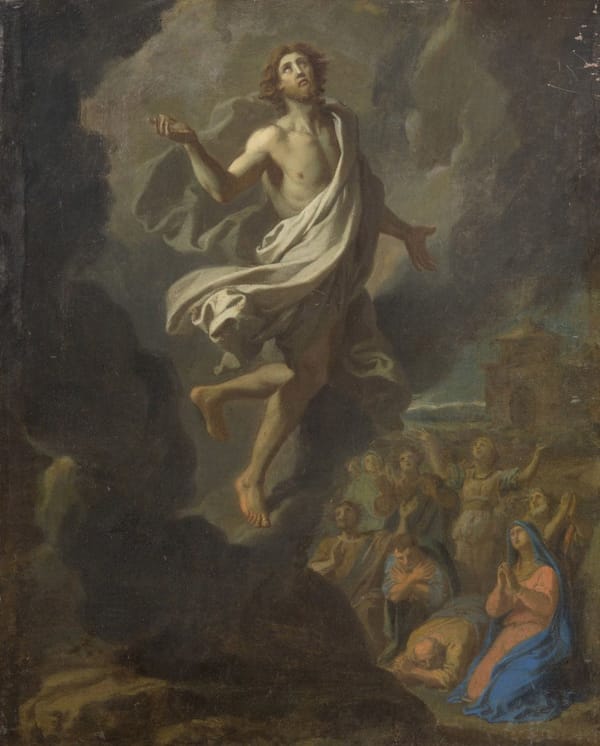
Let us now look upon the earth, for our eyes have hitherto been riveted upon the heaven into which our Jesus has entered. Let us see what effects the mystery of the Ascension has produced on this land of our exile. These effects are of the most extraordinary nature. This Jesus, who ascended into heaven unknown to the city of Jerusalem, and whose departure, when it did become known, excited neither regret nor joy among the men of that generation,—now, eighteen hundred years after His departure from us, finds the whole earth celebrating the anniversary of His glorious Ascension. Our age is far from being one of earnest faith; and yet there is not a single country on the face of the globe, where, if there be a church or chapel or even a Catholic home, the feast of Jesus’ Ascension is not being now kept and loved.
He lived for three-and-thirty years on our earth. He, the eternal Son of our God, dwelt among His creatures, and there was only one people that knew it. That one favoured people crucified Him. As to the Gentiles, they would have thought Him beneath their notice. True, this beautiful’light shone in the darkness; but the darkness did not comprehend it; He came unto His own, and His own received Him not.’1 He preached to His chosen people; but His word was that seed which falls on stony ground, and takes no root, or is cast among thorns and is choked; it could with difficulty find a plot of good ground, wherein to bring forth fruit.2 If, thanks to His infinite patience and goodness, He succeeded in keeping a few disciples around Him, their faith was weak and hesitating, and gave way when temptation came.
And yet, ever since the preaching of these same apostles, the name and glory of Jesus are every where; in every language, and in every clime, He is proclaimed the Incarnate Son of God; the most civilized, as well as the most barbarous nations, have submitted to His sweet yoke; in every part of the universe men celebrate His birth in the stable of Bethlehem, His death on the cross whereby He ransomed a guilty world, His resurrection whereby He strengthened the work He came to do, and His Ascension, which gives Him, the Man-God, to sit at the right hand of His Father. The great voice of the Church carries to the uttermost bounds of the earth the mystery of the blessed Trinity, which He came to reveal to mankind. This holy Church, founded by Him, teaches the truths of faith to all nations, and in every nation there are souls who are docile to her teaching.
How was this marvellous change brought about? What has given it stability during these eighteen hundred years? Our Saviour Himself explains it to us, by the words He spoke to His apostles after the last Supper: ‘It is,’ said He,’expedient to you that I go.’3 What means this, but that there is something more advantageous to us than having Him visibly present amongst us? This mortal life is not the time for seeing and contemplating Him, even in His human Nature. To know Him, and relish Him, even in His human Nature, we stand in need of a special gift; it is faith. Now, faith in the mysteries of the Incarnate Word did not begin its reign upon the earth, until He ceased to be visible here below.
Who could tell the triumphant power of faith? St. John gives it a glorious name; he says:’It is the victory which overcometh the world.’4 It subdued the world to our absent King; it subdued the power and pride and superstitions of paganism; it won the homage of the earth for Him who has ascended into heaven, the Son of God and the Son of Mary, Jesus.
St. Leo the Great, the sublime theologian of the mystery of the Incarnation, has treated this point with his characteristic authority and eloquence. Let us listen to his glorious teaching.’Having fulfilled all the mysteries pertaining to the preaching of the Gospel and to the new Covenant, our Lord Jesus Christ ascended into heaven, in the sight of His disciples, on the fortieth day after His Resurrection; hereby withdrawing His corporal presence, for He was to remain at the right hand of His Father until should be filled up the measure of time decreed by God for the multiplication of the children of the Church, and He (Jesus) should again come, and in the same Flesh wherewith He ascended, to judge the living and the dead. Thus, therefore, that which in our Redeemer had hitherto been visible passed into the order of mysteries. And to the end that faith might be grander and surer, teaching took the place of sight; which teaching was to be accepted by the faithful with hearts illumined by heavenly light.
This faith, increased by our Lord’s Ascension, and strengthened by the gift of the Holy Ghost, was proof against every trial; so that neither chains, nor prisons, nor banishment, nor hunger, nor fire, nor wild beasts, nor all the ingenuity of cruelty and persecution, could affright it. For this faith, not only men, but even women, not only beardless boys but even tender maidens, fought unto the shedding of their blood, and this in every country of the world. This faith cast out devils from such as were possessed, cured the sick, and raised the dead to life. The blessed apostles themselves,—who, though they had so often witnessed their Master’s miracles and heard His teachings, turned cowards when they saw Him in His sufferings, and hesitated to believe His Resurrection,—these same, I say, were so changed by His Ascension, that what heretofore had been a subject of fear, then became a subject of joy. And why? Because the whole energy of the soul’s contemplation was raised up to Jesus’ Divinity, now seated at the right hand of His Father; the vigour of the mind’s eye was not dulled by the bodily vision, and they came to the clear view of the mystery, namely, that He neither left the, Father when He descended upon the earth, nor left His disciples when He ascended into heaven.
Never, then, was Jesus so well known, as when He withdrew Himself into the glory of His Father’s majesty, and became more present by His Divinity in proportion as He was distant in His Humanity. Then did faith, made keener, approach to the Son coequal with His Father; she needed not the handling of the bodily substance of her Christ,—that bodily substance, whereby He is less than His Father, The substance of His glorified Body is the same; but our faith was to be of so generous a kind, that we were to go to the coequal Son, not by a corporal feeling, but by a spiritual understanding. Hence, when Mary Magdalene, who represented the Church, threw herself at the feet of the risen Jesus, and would have embraced them, He said to her: Touch Me not, for I am not yet ascended to My Father; as though He would say: I will not that thou come to Me corporally, or that thou know Me by the testimony of thy senses. I have a sublimer recognition in store for thee; I have prepared something far better for thee. When I shall have ascended to My Father, then shalt thou feel Me in a higher and truer way; for thou shalt grasp what thou touchest not, and believe what thou seest not.’5
The departure of our Emmanuel was, therefore, the opening of that reign of faith, which is to prepare us for the eternal vision of the sovereign Good; and this blessed faith, which is our very life, gives us, at the same time, all the light compatible with our mortal existence, for knowing and loving the Word consubstantial with the Father, and for the just appreciation of the mysteries which this Incarnate Word wrought here below in His Humanity. It is now eighteen hundred years since He lived on the earth; and yet we know Him better than His disciples did before His Ascension. Oh! truly it was expedient for us that He should go from us; His visible presence would have checked the generosity of our faith; and it is our faith alone that can bridge over the space which is to be between Himself and us until our ascension comes, and then we shall enter within the veil.
How strangely blind are those who see not the superhuman power of this element of faith, which has not only conquered, but even transformed, the world! Some of them have written long treatises to prove that the Gospels were not written by the evangelists: we pity their ravings. But these great discoverers have another difficulty to get over, and so far they have not attempted to grapple with it; we mean the living Gospel which is the production of the unanimous faith of eighteen centuries, and is the result of the courageous confession of so many millions of martyrs, of the holiness of countless men and women, of the conversion of so many both civilized and uncivilized nations. Assuredly He,—who after having spent a few short years in one little spot of earth, had but to disappear in order to draw men’s hearts to Himself so that the brightest intellects and the purest minds gave Him their faith,—must be what He tells us He is: the eternal Son of God. Glory, then, and thanks to Thee O Jesus! who to console us in Thine absence, hast given us faith, whereby the eye of our soul is purified, the hope of our heart is strengthened, and the divine realities we possess tell upon us in all their power! Preserve within us this precious gift of Thy gratuitous goodness; give it increase; and when our death comes,—that solemn hour which precedes our seeing Thee face to face,—Oh, give us the grand fullness of our dearest faith!
One of the most northern of the Churches, now, alas! a slave to Lutheranism, shall provide us to-day with a hymn in honour of the mystery we are celebrating. It is a sequence taken from the last missal of Abo, in Finland. It was composed in the fourteenth or fifteenth century.
Sequence
Festos choros ducite,
Christo triumphante;
Redit cum victoria,
Capta ducens spolia,
Tuba jubilante.
Hodie dominicum
Germen gloriatur!
Terrae fructus hodie
Super thronos curiæ
Cœli sublimatur.
Moyses, et populum
Trahit ad spectaculum
Stant suspensis vultibus,
Intendentes nubibus
Jesum subducentibus,
Viri Galilaei.
Elisaeo duplex datur
Spiritus et pallium:
Alta Christus dum conscendit,
Servis suis mnas appendit
Gratiarum omnium.
Luctum gerens non inanem,
Crucis usus baculo;
Redit turmis cum duabus,
Angelis et animabus,
Et thesauri sacculo.
Qui de mortis
Victor portis
Introit cum gloria;
Rex virtutum,
Cujus nutum
Et obtutum
Trina tremit regia.
Ad consessus solium,
Donec suppedaneos,
Victos vel spontaneos,
Ponat inimicos.
Fruitur potissimis;
Redit ex novissimis,
Judicans ex intimis
Justos et iniquos.
Veni cum clementia:
Dum sistemur ante thronum
Tua in præsentia:
Fac misericordiam;
In perennem transfer vitam
Ad futuram gloriam.
and sing your festive songs,
for it is the triumph of Christ!
He returns to heaven, leading thither
the trophies he has won; and as he ascends,
the jubilant sound of the trumpet is heard.
that is this day conferred on the Son of God!
The fruit of our earth
is this day exalted
above all the thrones
of the heavenly court.
and people flock to see
the grandeur of the mystery:
stand looking up
to the cloud
that received him
out of their sight.
he gave his twofold
spirit and his mantle to Eliseus:
when Jesus ascended into heaven,
he gave to his servants
the talents of his grace.
enduring sufferings of wondrous avail to us,
and the staff he used was the cross.
He returned to heaven with two troops,
—of angels, and of souls (set free from limbo),
—and laden with treasures.
who, having conquered
the gates of death,
entered heaven with glory.
He is the King of hosts,
at whose bidding
and presence
the triple creation trembles.
to sit with him on his throne,
until he make his enemies
bow down before him,
vanquished by force or love.
he receives supreme honour;
he is to come again upon our earth
to judge the consciences of all,
saints and sinners.
come in thy mercy,
when we are to appear
before thee seated on thy throne.
and give us to ascend
to the endless life
of future glory.
Again the Mozarabic breviary offers us one of its beautiful prayers for this octave.
Prayer
May 27: St. Bede the Venerable, Confessor and Doctor of the Church
THE blessing given by our Lord as he ascended into heaven has revealed its power in the most distant pagan lands, and during these days the liturgical cycle bears witness to a concentration of graces upon the west of Europe.
The band of missionaries begged of Pope Eleutherius by the British king Lucius has been followed by the apostolate of Augustine, the envoy of Gregory the Great, and to-day, as though impatient to justify the lavish generosity of heaven, England brings forward her illustrious son, the Venerable Bede. This humble monk, whose whole life was spent in the praise of God, sought his divine Master in nature and in history, but above all in holy Scripture, which he studied with a loving attention and fidelity to tradition. He who was ever a disciple of the ancients, takes his place to-day among his masters as a Father and Doctor of the Church.
He thus sums up his own life: 'I am a priest of the monastery of the blessed Apostles Peter and Paul. I was bom on their land, and ever since my seventh year I have always lived in their house, obserying the Rule, singing day by day in their church, and making it my delight to learn, to teach or to write. Since I was made a priest, I have written commentaries on the holy Scripture for myself and my brethren, using the words of our venerated Fathers and following their method of interpretation. And now, good Jesus, I beseech thee, thou who hast given me in thy mercy to drink of the sweetness of thy word, grant me now to attain to the source, the fount of wisdom, and to gaze upon thee for ever and ever.’*
The holy death of the servant of God was one of the most precious lessons he left to his disciples. His last sickness lasted fifty days, and he spent them, like the rest of his life, in singing the psalms and in teaching. As the Feast of the Ascension drew near, he repeated over and over again with tears of joy the Antiphon: ‘O king of glory, who hast ascended triumphantly above the heavens, leave us not orphans, but send us the promise of the Father, the Spirit of truth.’ He said to his disciples in the words of St Ambrose: ‘I have not lived in such a sort as to be ashamed to live with you, but I am not afraid to die, for we have a good Master.’ Then, returning to his translation of the Gospel of St John and a work, which he had begun, on St Isidore, he would say: ‘I do not wish my disciples to be hindered after my death by error nor to lose the fruit of their studies.’
On the Tuesday before the Ascension he grew worse, and it was evident that the end was near. He was full of joy and spent the day in dictating and the night in prayers of thanksgiving. The dawn of Wednesday morning found him urging his disciples to hurry on their work. At the hour of Terce they left him to take part in the procession made on that day with the relics of the saints. One of them, a child, who stayed with him, said: 'Dear master, there is but one chapter left; hast thou strength for it?’ ‘It is easy,' he answered with a smile; ‘take thy pen, cut it and write—but make haste.' At the hour of None, he sent for the priests of the monastery and gave them little presents, begging them to remember him at the altar. All wept. But he was full of joy, saying: ‘It is time for me, if it so please my Creator, to return to him who made me out of nothing, when as yet I was not. My sweet Judge has well ordered my life, and now the time of dissolution is at hand. I desire to be dissolved and to be with Christ. Yea, my soul longs to see Christ my king in his beauty.’
So did he pass this last day. Then came the touching dialogue with Wibert, the child mentioned above. ‘Dear master, there is yet one sentence more.' 'Write quickly.' After a moment: ‘It is finished,’ said the child. 'Thou sayest well,' replied the blessed man. ‘It is finished. Take my head in thy hands and support me over against the Oratory, for it is a great joy to me to see myself over against that holy place where I have so often prayed.’ They had laid him on the floor of his cell. He said: ‘Glory be to the Father, and to the Son, and to the Holy Ghost,’ and when he had named the Holy Ghost, he yielded up his soul.
The following account of this holy monk is given in the Breviary:
‘Glory be to the Father, and to the Son, and to the Holy Ghost’ is the hymn of eternity. Before the creation of the angels and of man, God, in the concert of the three divine Persons, sufficed for his own praise, and this praise was adequate, infinite and perfect, like the divinity. This was the only praise worthy of God. However magnificently the world may hymn its Creator in the thousand voices of nature, its praise is always below the divine Object. But, in the designs of God, creation was one day to send up to heaven an echo of that melody which is threefold and yet one, for the Word was to take flesh, through the operation of the Holy Ghost, in the womb of Mary, and was to be Son of Man as truly as he is Son of God. Then the canticle of creation fully and perfectly re-echoed the adorable harmonies once known only to the blessed Trinity. Since that day a man who has understanding finds his perfection in such conformity to the Son of Mary, that he may be one with the Son of God in the divine concert wherein God is glorified.
This, O Bede, was thy life, for understanding was given thee. It was fitting that thy last breath should be spent in that song of love which had filled thy mortal life, and that thus thou shouldst enter at once into a glorious and blessed eternity. May we profit by that supreme lesson, which sums up all the teaching of thy grand and simple life!
Glory be to the almighty and merciful Trinity! These words form the close of the cycle of the mysteries which terminate at this time in the glorification of the Father, our sovereign Lord, by the triumph of the Son our Redeemer, and the inauguration of the reign of the Holy Ghost, our sanctifier. How splendid were the triumph of the Son and the reign of the Holy Ghost in the Isle of Saints in the days when Albion, twice given by Rome to Christ, shone like a priceless jewel in the diadem of the Spouse! O thou who wast the teacher of the English in the days of their fidelity, do not disappoint the hopes of the supreme Pontiff who has in our days extended thy cult to the Universal Church; but rekindle in the hearts of thy countrymen their former love for the Mother of all mankind.
* Bede, Hist, Eccl. cap. ult. ↩︎
May 27 (the Same Day): St. John I, Pope and Martyr
THE palm of martyrdom was won by this holy Pope, not in a victory over a pagan persecutor, but in battling for the Church’s liberty against a Christian king. But this king was a heretic, and therefore an enemy of every Pontiff that was zealous for the triumph of the true faith. The state of Christ’s Vicar here on earth is a state of combat; and it frequently happens that a Pope is veritably a martyr, without having shed his blood. St John I, whom we honour to-day, was not slain by the sword; a loathsome dungeon was the instrument of his martyrdom; but there are many Popes who are now in heaven with him, martyrs like himself, who never even passed a day in prison or in chains: the Vatican was their Calvary. They conquered, yet fell in the struggle with so little appearance of victory, that heaven had to take up the defence of their reputation, as was the case with that angelic Pontiff of the eighteenth century, Clement XIII.
The Saint of to-day teaches us, by his conduct, what should be the sentiment of every worthy member of the Church. He teaches us that we should never make a compromise with heresy, nor approve the measures taken by worldly policy for securing what it calls the rights of heresy. If the past ages, aided by the religious indifference of Governments, have introduced the toleration of all religions, or even the principle that ‘all religions are to be treated alike by the state,’ let us, if we will, put up with this latitudinarianism, and be glad to see that the Church, in virtue of it, is guaranteed from legal persecution; but as Catholics, we can never look upon it as an absolute good. Whatever may be the circumstances in which Providence has placed us, we are bound to conform our views to the principles of our holy faith, and to the infallible teaching and practice of the Church—out of which, there is but contradiction, danger and infidelity.
The holy Liturgy thus extols the virtues and courage of our Saint:
Thy fair palm, O holy Pontiff, was the reward of proclaiming the spotless holiness of the Church of Christ. She is the glorious Church, as St Paul calls her, having neither spot nor wrinkle;1 and, for that very reason she can never consent to yield to heresy any of the inheritance given her by her divine Lord. Nowadays, men form their calculations on the interests of this passing world, and are resolved to regulate society independently of the rights of the Son of God, from whom proceeds all social order, as well as all truth. They have deprived the Church of her external constitution and influence; and at the same time, they give encouragement to the sects that have rebelled against her. O holy Pontiff, teach us to realize what divine truth is, and how error can never create prescription against her rights. Then shall we submit to the unhappy necessities handed down to us by the fatal triumph of heresy, without accepting, as a sign of progress, the principle and law that ‘all religions are on an equality.’ In thy prison, brave martyr, thou didst proclaim the rights of the one only Church; preserve us, who are living during that revolt which was foretold by the Apostle,2 from those cowardly compromises, dangerous prejudices, and culpable want of solid instruction, which are the ruin of so many souls; and may our last words, on leaving this world, be those that were taught us by our Jesus himself: Heavenly Father! Hallowed be thy Name! May thy Kingdom come!
| Previous May 26 (the Same Day): St. Eleutherius, Pope and Martyr | Next May 27: St. Bede the Venerable, Confessor and Doctor of the Church |