Daily reading
Semidouble · Movable from Easter · Temporal
May 29, 2020
From Dom Guéranger’s The Liturgical Year.
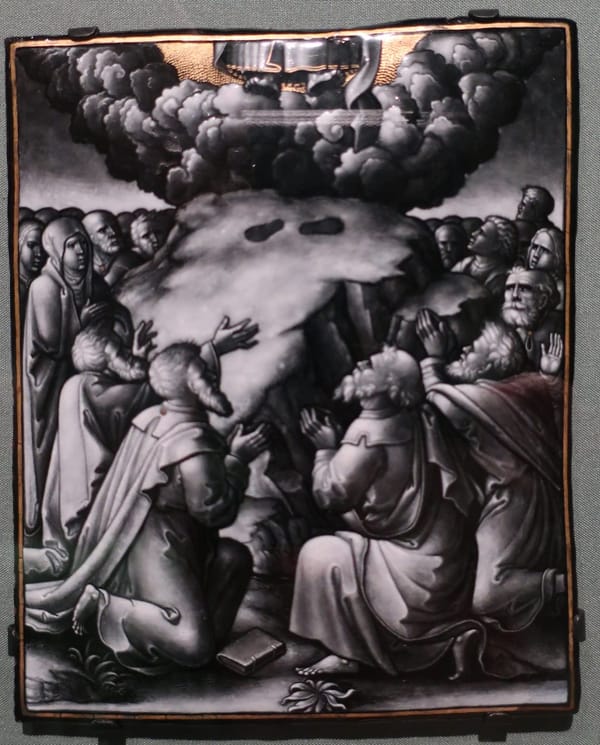
Friday after the Octave of the Ascension
The octave is over; the mystery of the glorious Ascension is completed; and our Jesus is never again to be seen upon this earth, until He comes to judge the living and the dead. We are to see Him only by faith; we are to approach Him only by love. Such is our probation; and if we go well through it, we shall, at last, be permitted to enter within the veil, as a reward for our faith and love.
Let us not complain of our lot; rather let us rejoice in that hope, which, as the apostle says, confoundeth not.1 And how can we be otherwise than hopeful, when we remember that Jesus has promised to abide with us even to the consummation of the world?2 He will not appear visibly; but He will be always really with us. How could He abandon His bride the Church? And are not we the children of this His beloved bride?
But this is not all: Jesus does something more for us. One of His last words was this, which shows us how dearly He loved us: ‘I will not leave you orphans.’3 When He used those other words, upon which we have been meditating during the last few days, ‘It is expedient for you that I go’, He added: ‘For if I go not, the Paraclete will not come to you.’4 This Paraclete, this comforter, is the Holy Ghost, the Spirit of the Father and of the Son; He is to descend upon us a few short hours hence; He will abide with us, making us feel His presence by His works, until Jesus shall again come from heaven that He may take His elect from a world which is to be condemned to eternal torments for its crimes. But the Holy Ghost is not to come until He be sent; and as the sacred text implies, He is not to be sent, until ‘Jesus shall have been glorified.’5 He is coming that He may continue the great work, which was to be begun by the Son of God, and carried on by Him as far as the eternal decrees had ordained.6
Jesus laboured in this work, and then entered into His rest, taking with Him our human nature, which, by assuming it, He had exalted to the divine. The Holy Ghost is not to assume our humanity; but He is coming to console us during Jesus’ absence; He is coming to complete the work of our sanctification. It was He that produced those prodigies which we have been admiring: the faith and love of man in and for Jesus. Yes, it is the Holy Ghost who produces faith in the soul; it is the Holy Ghost who ‘pours the charity of God into our hearts.’7
So, then, we are about to witness fresh miracles of God’s love for man! A few hours hence, the reign of the Holy Ghost will have begun on earth. There is but the interim of this one short day, for to-morrow evening the solemnity of Pentecost will be upon us. Let us then linger in our admiration of our Emmanuel. The holy liturgy has daily gladdened us with His presence, beginning with those happy weeks of Advent, when we were awaiting the day on which the Virgin Mother was to give us the ever blessed Fruit. And now He is gone! O sweet memories of the intimacy we enjoyed with our Jesus, when we were permitted to follow Him day by day, we have you treasured within us! Yea, the holy Spirit Himself is coming to impress you still deeper on our hearts; for Jesus told us that, when the Paraclete should come to us, He would help us to remember all that we have heard, and seen, and felt in the company of the God who deigned to live our life that so He might teach us to live His for all eternity.8
Neither let us forget how, when quitting this His earthly home,—where He was conceived in Mary’s womb, where He was born, where He spent the three and thirty years of His mortal life, where He died, where He rose from the grave, and from which He ascended to the right hand of His Father—He left upon it an outward mark of His love. He left the impress of His sacred feet upon Mount Olivet, as though He felt separating Himself from the earth to which so many years and mysteries had endeared Him. St. Augustine, St. Paulinus of Nola, Saint Optatus, Sulpicius Severus, and the testimony of subsequent ages, assure us of the prodigy.
These venerable authorities tell us that when the Roman army, under Titus, was encamped on Mount Olivet while besieging Jerusalem, divine Providence protected these holy marks, the farewell memorial left by our Lord to His blessed Mother, to His disciples, and to us: it is here that He stood when last seen on earth, it is here that we shall again see Him when He comes to judge mankind. Neither the rude tramp of the soldiers, nor the ponderous chariots, nor the horses’ hoofs, were permitted to efface or injure the sacred footprints. Yes, it was on this very mount, forty years after the Ascension, that the Roman banner was first unfurled, when the time of God’s vengeance came upon the city of deicide. Let us call to mind, firstly, how the angels announced that the same Jesus, who had just ascended, would again come to judge us; and secondly, how our Lord Himself had compared the two awful events, the destruction of Jerusalem, and the end of the world. These sacred marks of Jesus’ feet are, therefore, the memorial of His affectionate farewell, and the prophecy of His return as our terrible Judge. At the foot of the hill lies the valley of Josaphat, the valley of the judgement; and the prophet Zacharias has said: ‘His feet shall stand, in that day, upon the mount of Olives, which is over against Jerusalem, towards the east.’9 Let us humbly give admission to the feeling of fear, wherewith our Lord thus inspires us, that we may be more solidly grounded in His love; and let us affectionately venerate the spot on which our Emmanuel left the impress of His feet. The holy empress, St. Helen, was entrusted with the sublime mission of finding and honouring the objects and places that our Redeemer had sanctified by His visible presence. Mount Olivet was sure to elicit her devoted zeal. She ordered a magnificent church of circular form to be built upon it; but when the builders came to pave the church with rich marble, they were prevented, by a miraculous power, from covering the spot on which were imprinted the holy footmarks. The marble broke into a thousand pieces, which struck them on the face; and after several attempts, they resolved to leave that part of the rock uncovered.
This fact is attested by many holy and creditable authors, several of whom lived in the fourth century, when it occurred. But our Lord would do more than keep open to our view these His last footprints, which seem to be ever saying to us: ‘Your Jesus is but now gone, and will soon return.’ He would, moreover, have them teach us that we are to follow Him to heaven. When the time came for roofing the church, the men found that they had not power to do it; the stones fell as often as they attempted to put them up, and the building was left roofless, as though it had to be our reminder that the way opened by Jesus on the summit of Mount Olivet is ever open for us, and that we must be ever aspiring to rejoin our divine master in heaven.
In his first sermon for the feast of the Ascension, St. Bernardine of Siena relates an edifying story, which is in keeping with the reflections we have been making. He tells us that a pious nobleman, desirous of visiting the places that had witnessed the mysteries of our Redemption, passed the seas. Having reached Palestine, he would begin his pilgrimage by visiting Nazareth, and there, on the very spot where the Word was made Flesh, he gave thanks to the infinite love that had drawn our God from heaven to earth, in order that He might save us from perdition. The next visit was to Bethlehem, where our pilgrim venerated the place of our Saviour’s birth. As he knelt on the spot where Mary adored her new-born Babe, the tears rolled down his cheeks, and, as St. Francis of Sales says (for he also has related this affecting story), ‘he kissed the dust whereon the divine Infant was first laid.’10
Our devout pilgrim, who bravely travelled the country in every direction, went from Bethlehem to the banks of the Jordan; he stopped near Bothabara, at a little place called Bethany, where St. John baptized Christ. The better to honour the mystery, he went down into the bed of the river, and entered with much devotion into the water, thinking within himself how that stream had been sanctified by its contact with Jesus’ sacred Body. Thence he passed to the desert, for he would follow, as nearly as might be, the footsteps of the Son of God; he contemplated the scene of our Master’s fasting, temptation, and victory. He next went on towards Thabor; he ascended to the top, that he might honour the mystery of the Transfiguration, whereby our Saviour gave to three of His disciples a glimpse of His infinite glory.
At length, the good pilgrim entered Jerusalem. He visited the cenacle; and we can imagine the tender devotion wherewith he meditated on all the great mysteries that had been celebrated there, such as Jesus’ washing His disciples’ feet, and the institution of the Eucharist. Being resolved to follow his Saviour in each station, he passed the brook Cedron, and came to the garden of Gethsemani, where his heart well-nigh broke at the thought of the bloody sweat endured by the divine Victim of our sins. The remembrance of Jesus’ being manacled, fettered, and dragged to Jerusalem, next filled his mind. ‘He at once starts off,’ says the holy bishop of Geneva, whom we must allow to tell the rest of the story: ‘treading in the footsteps of his beloved Jesus; he sees Him dragged to and fro, to Annas, to Caiphas, to Pilate, to Herod: buffetted, scoffed at, spit upon, crowned with thorns, made a show of to the mob, sentenced to death, laden with a cross, and meeting, as He carries it, with His heart-broken Mother and the weeping daughters of Jerusalem.
The good pilgrim mounts to the top of Calvary, where he sees in spirit the cross lying on the ground, and our Saviour stretched upon it, while the executioners cruelly nail Him to it by His hands and feet. He sees them raise the cross and the Crucified in the air, and the Blood gushing from the wounds of the sacred Body. He looks at the poor Mother, who is pierced through with the sword of sorrow; he raises up his eyes to the Crucified, and listens with most loving attention to His seven words; and, at last, sees Him dying, and dead, and His side opened with a spear, so that the sacred Heart is made visible. He watches how He is taken down from the cross, and carried to the tomb; and as he treads along the path all stained with his Redeemer’s Blood, he sheds floods of tears. He enters the sepulchre, and buries his heart side by side with his Jesus’ Corpse.
After this, he rises again together with Him; he visits Emmaus, and thinks on all that happened between Jesus and the two disciples. Finally, he returns to Mount Olivet, the scene of the Ascension; and seeing there the last footprints of his dear Lord, he falls down and covers them with untiring kisses. Then, like an archer stretching his bowstring to give his arrow speed, he concentrates into one intense act the whole power of his love, and stands with his eyes and hands lifted up towards heaven: “Jesus!” he says, “O my sweet Jesus! where else am I now to go on earth seeking thee? Ah Jesus! my dearest Jesus, let this heart of mine follow thee yonder!” Saying this, his heart kept darting upwards to heaven, for the brave archer had taken too sure an aim, to miss his divine object.’11
St. Bernadine of Siena tells us, that the companions and attendants of the noble pilgrim, seeing that he was sinking under the vehemence of his desire, hastened to call a physician, that they might bring him to himself again. But it was too late: the soul had fled to her God, leaving us an example of the love that the mere contemplation of the divine mysteries can produce in man’s heart. And have not we been following these same mysteries, under the guidance of the holy liturgy? God grant that we may now keep within us the Jesus whom we have had so truly given to us! And may the holy Spirit, by His coming visit, maintain and intensify in our souls the resemblance to our divine King which we have thus received!
In order the more worthily to celebrate the great mystery which closed yesterday, and the equally glorious one which begins to-morrow, we place between the two the sublime canticle, wherein the royal psalmist prophesies both the Ascension and the Christian Pentecost. The sixty-seventh Psalm (composed for the reception of the Ark of the Covenant on Mount Sion) is, as St. Paul himself has interpreted it,12 a prophecy of Jesus’ triumphant Ascension into heaven. It begins by celebrating the victory gained by Christ over His enemies by His Resurrection; it proceeds to speak of the favours bestowed upon the Christian people; it shows us the combats and triumphs of the Church; in a word, it puts before us the commencement of the work by our Emmanuel, and its consummation by the Holy Ghost. With a view to facilitating the understanding of this mysterious psalm, we give a commentary rather than a translation; and in doing so, we offer to our readers the interpretation given by the early fathers.
Psalm 67
Etenim non credentes, inhabitare Dominum Deum.
Ut intingatur pes tuus in sanguine: lingua canum tuorum ex inimicis, ab ipso.
May 29: St. Mary Magdalen de Pazzi, Virgin
|
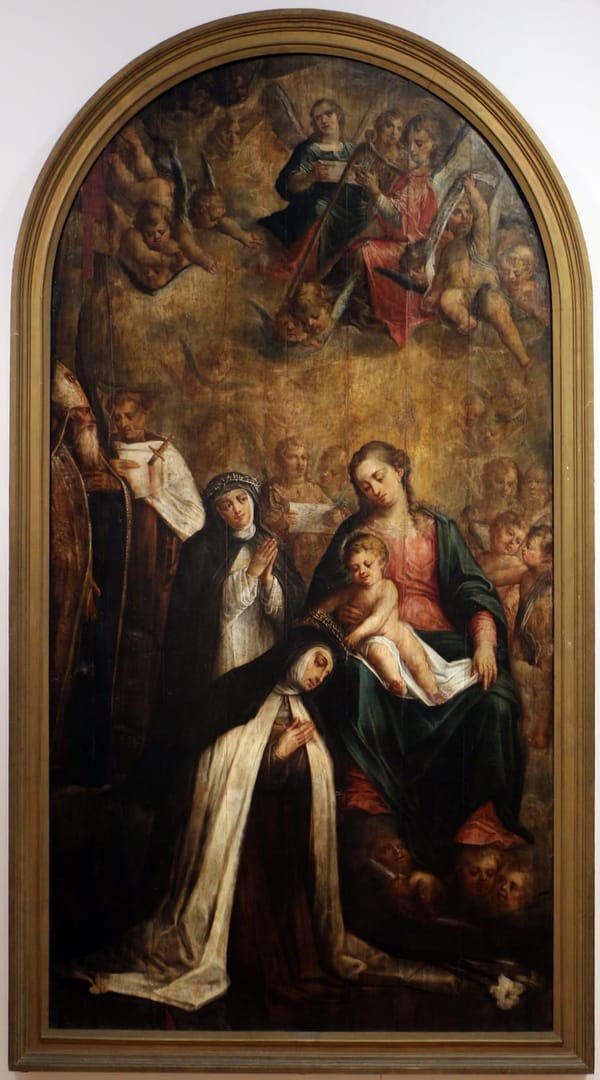
OUR Paschal Calendar gives us three illustrious virgins of beautiful Italy. We have already kept the feast of the valiant Catharine of Siena; in a few days we shall be honouring the memory of Angela dei Merici, surrounded by her school-children; to-day it is the fair lily of Florence, Magdalen de Pazzi, who embalms the whole Church with the fragrance of her name and intercession. She devoted herself to the loving imitation of our crucified Jesus; was it not just that she should have some share in the joy of his Resurrection?
Magdalen de Pazzi was one of the brightest ornaments of the Order of Carmel, by her angelic purity, and by the ardour of her love for God. Like St Philip Neri, she was one of the grandest manifestations of the divine charity that is found in the true Church. Magdalen in her peaceful cloister, and Philip in his active labours for the salvation of souls—both made it their ambition to satisfy that desire expressed by our Jesus when he said: I am come to cast fire on the earth; and what will I, hut that it he kindled?1 The life of this Spouse of Christ was one continued miracle. Her ecstasies and raptures were almost of daily occurrence. The lights given to her regarding the mysteries were extraordinary; and in order to prepare her for those sublime communications, God would have her go through the severest trials of the spiritual life. She triumphed over them all; and her love having found its nourishment in them, she could not be happy without suffering; for nothing else seemed to satisfy the longings of the love that burned within her. At the same time, her heart was filled to overflowing with charity for her neighbour: she would have saved all mankind, and her charity to all, even for their temporal well-being, was something heroic. God blessed Florence on her account; and she so endeared herself to its people by her admirable virtues, that devotion to her, even to this day, which is more than three hundred years since her death, is as fervent as ever it was.
One of the most striking proofs of the divine origin and holiness of the Church is to be found in such privileged souls as Magdalen de Pazzi, on whom we see the mysteries of our salvation acting with such direct influence. God so loved the world as to give it his Only Begotten Son;2 and this Son of God deigns to love some of his creatures with such special affection, and to lavish upon them such extraordinary favours, that all men may have some idea of the love wherewith his Sacred Heart is inflamed for this world, which he redeemed at the price of his Blood. Happy those Christians that appreciate and relish these instances of Jesus' special love! Happy they that can give him thanks for bestowing such grits on some of our fellowcreatures! They have the true light; whereas they that have an unpleasant feeling at hearing of such things, and are angry at the thought that there can be between God and any soul an intimacy of which they are not worthy, prove that there is a great deal of darkness in their faith.
We regret extremely that we have not space for a fuller development of the character and life of our Saint. We therefore proceed at once to the Lessons given in her Office. Even they are too short, and give us but an imperfect idea of this admirable spouse of Christ.
Charitate erga proximum singulariter enituit; nam sæpe noctes ducebat insomnes, vel obeundis sororum ministeriis, vel inserviendo infirmis occupata, quarum aliquando ulcera lambens sanavit. Infidelium et peccatorum perditionem amare deflens, se ad quælibet pro illorum salute tormenta paratam offerebat. Multis ante obitum annis, universis cœli deliciis, quibus copiose affluebat, heroica virtute renuntians, illud frequenter in ore habebat: Pati, non mori. Tandem longa et gravissima infirmitate exhausta, transivit ad Sponsum die vigesima quinta Maji anno millesimo sexcentesimo septimo, expleto anno quadragesimo primo ætatis suæ. Eam multis in vita et post mortem miraculis claram Clemens Nonus sanctarum Virginum numero adscripsit: cujus corpus in præsentem diem incorruptum conservatur.
She was remarkable for her charity towards others. She would frequently sit up the whole night, either doing the work of the sisters, or waiting upon the sick, whose sores she sometimes healed by sucking the wounds. She wept bitterly over the perdition of infidels and sinners, and offered to suffer every sort of torment so that they might be saved. Several years before her death she heroically besought our Lord to take from her the heavenly delights wherewith he favoured her; and was frequently heard saying these words: ‘To suffer; not to die.' At length, worn out by a long and most painful illness, she passed hence to her Spouse, on the twenty-fifth of May, in the year 1607, having completed the forty-first year of her age. Many miracles having been wrought by her merits, both before and after death, she was canonized by Pope Clement the Ninth. Her body is, even to this day, preserved from corruption.
Thy life here below, O Magdalen, resembled that of an angel sent by God to assume our weak and fallen nature and be subject to its laws. Thy soul ceaselessly aspired to a life which was all heavenly, and thy Jesus was ever giving thee that thirst of love which can only be quenched by the waters of life everlasting.3 A heavenly light revealed to thee such admirable mysteries, such treasures of truth and beauty, that thy heart, unequal to the sweetness thus given to it by the Holy Ghost, sought relief in sacrifice and suffering. It seemed to thee as though there was but one way of making God a return for his favours—the annihilation of self.
Seraphic lover of our God! how are we to imitate thee? what is our love, when we compare it to thine? And yet we can imitate thee. The year of the Church's Liturgy was thy very life. Each of its seasons did its work in thee, and brought thee new light and love. The divine Babe of Bethlehem, the bleeding Victim of the Cross, the glorious Conqueror of Death, the Holy Ghost radiant with his seven gifts—each of these great realities enraptured thee; and thy soul, renewed by the annual succession of the mysteries, was transformed into him who, that he might win our hearts, gives these sublime celebrations to his Church. Thy love of souls was great during thy sojourn here; it is more ardent now that thou art in possession of the Sovereign Good; obtain for us, O Magdalen, light to see the riches which enraptured thee, and love to love the treasures which enamoured thee. O riches! O treasures! is it possible that they are ours too?
| Previous Thursday within the Octave of the Ascension | Next May 29: St. Mary Magdalen de Pazzi, Virgin |