Daily reading
After Pentecost
Double · Movable from Easter · Temporal
June 12, 2020
From Dom Guéranger’s The Liturgical Year.
 |
Friday within the Octave of Corpus Christi
God has satisfied the intense desires of man’s heart. The house of the marriage-feast, built by divine Wisdom on the top of mountains, has had flowing unto it all the nations of earth.1 Yesterday, the whole Catholic world was animated with sentiments of love towards the adorable Sacrament; and the people said to each other, in a holy transport of gratitude: ‘Come! let us go up to the mountain of the Lord, and to the house of the God of Jacob.’ Yesterday, the Bud of the Lord was seen by us all in magnificence and glory;2 this divine Bud, this rich ear of corn that has sprung up from our earth, was carried in triumph, and excited the enthusiasm of the faithful, making them rejoice before It, as they that rejoice in the harvest.3 It was a heavenly harvest, that had been the expectation of nations. It was the precious ear of corn, despised indeed by Israel, but gleaned by Ruth, the stranger, in the field of the true Booz, in Bethlehem.
It is for this day of the great meeting of nations, foretold by Isaias, that the Lord had kept reserved on the mountain the feast on a victim such as had never been seen before, a feast of wine, the richest and purest.4 The poor have eaten at this banquet, and they have given fervent praise to their God; the rich have eaten, and have fallen down in adoration; and all the ends of the earth, prostrate in His sacred Presence, have recognized that He who thus gave them to feast was Christ their King.5 'This,' they said, ‘is our God, we have waited for Him;6 we have patiently waited for Him; He was the desire of our soul; we desired Him in the night, and, in the morning early, our first thoughts were upon Him; He is the Lord, and His remembrance could not be effaced, even through the long ages of expectation.7 Thou, O Lord, art my God, I will exalt Thee, and give glory to Thy name, for Thou hast done wonderful things; Thy designs of old, faithful; faithfully hast Thou fulfilled Thy eternal decrees.’8
These expressions of love on the part of the human race were but a feeble echo to the infinite love which God vouchsafed to have for His creature man. The divine Spirit, who has achieved the wonderful union between the children of Adam and eternal Wisdom, shows us, everywhere in the Scriptures, that this Wisdom was impatient of delay, that He was taking each obstacle as it came, and removing it, and was preparing, in countless ways, for the marriage-feast so much longed for.
We will devote these first two days of the octave to considering the leading features in the history of this eucharistic preparation; we shall be well repaid by the additional light which these truths will reflect upon the dogma itself. We are going to review the loving ways whereby eternal Wisdom sought, for so many long ages, to bring about His own union with ourselves. As a matter of course, we clothe these truths in Scripture language, for the Scriptures are our guide in this research; it is they that tell us the workings of the divine intentions in our regard. How, then, do the Scriptures speak of these, before the mystery of the Incarnation was actually accomplished?
The second Person of the adorable Trinity is there brought before us under the name of Wisdom: until the time of His union with man being accomplished in the most perfect degree possible, that is, in our Lord Jesus Christ, this is the name under which He passes in the Scriptures, a name which gives Him the appearance of a Bride. But once the mystery of perfect union is achieved, another name is given Him, the name of Spouse, or Bridegroom. His other name of Wisdom seems almost forgotten; and yet, in the ages of lively faith, it was not so; the people of those days were too full of the Scriptures to forget it. Thus we find the first Christian emperor dedicating, to this ruler and centre of his every thought, the trophy of his victory over paganism, and that of the triumph of the martyrs. ‘All burning with love for the Wisdom of God,' says Eusebius,9 Constantine consecrated the ancient Byzantium, which he called by his own name, to the God of the martyrs;10 and dedicated to eternal Wisdom the grandest structure of this new Rome, Saint Sophia, which for many ages was the finest Christian church in the world. Like our forefathers in the faith, let us, too, honour divine Wisdom, and gratefully think upon the love which urged Him, from all eternity, to unite Himself to man!
It is this love that explains the mysterious joy, which, as the Scripture tells us, He had at the beginning of time, when this world of ours was being gradually developed in all the beauty of its fresh creation; for sin had not then come in, to break the harmony of this work of the Most High. At each additional manifestation of creative power, Wisdom takes delight, and by His delight, adds a new charm to this the future scene of the divine marvels, planned as those have been by His love. This Wisdom is delighted at the omnipotence which produces creation; He plays every day, as the creation goes on; He plays in this world, for each progress in its formation brings man nearer, man whose palace it is, and His delights are to be with the children of men.11
Incomprehensible love! It precedes, though it foresees sin; and though foreseeing it, loves not the less! It has its divine delights to be with us, and we have attractions for it, in spite of all the bitterness caused by the sight of our future black ingratitude! The fall of man will, as one of its terrific consequences, modify much and cruelly the earthly existence which Wisdom is to have upon our earth. But in order that we may the more easily understand, and more fully appreciate, how immense must that love be, which could be proof against such obstacles, let us turn our thoughts, to-day, to the course that these loving intentions would have taken, had man persevered in the state of innocence. Although the sacred Scriptures were written for the benefit of fallen man, and are ever telling us of the mystery of the restoration of the sinful world, yet do they make frequent allusions to God’s original intention; and with these to guide us, it is not difficult to mark out the leading features of the primitive plan.
Wisdom, speaking of Himself, says: ‘The Lord possessed me, ir the beginning of His ways.’12 Is He not the first of all creatures?13 Not, of course, as to that divine form of which the apostle speaks, and by which Wisdom is equal to God,14 but in that human existence, which He has selected, in preference to all other possible natures, for the one whereby to unite Himself with finite being. That selection was one of an unlimited and most gratuitous love; it made the type and law of entire creation to be One who would so closely resemble us human beings. What an honour! We are told in holy Writ that the most high and almighty Creator created wisdom before all things, and created her in the Holy Ghost; and that, taking her as His type, and number, and measure, He poured her out upon all His works, and upon all flesh.15 When the fullness of the appointed time came, divine Wisdom Himself was to come, giving to all creation, of which He was the head and centre, its purpose and meaning. He was to blend and unite with the infinite homage, which resulted from His own divine personality, the homage of every existing creature, and thus give perfection to the external glory of the Father by His own eternal and infinite adoration. Then was to appear the dignity of that human nature, chosen by divine Wisdom, from the beginning, to be His created form, and the instrument of that homage to the Father, which is perfect and divine, because of the personal union of this created nature with the Nature of God the Son. Eternal Wisdom will thus be one with the Son of the purest of virgins; the nuptial-song will be taken up by all creatures, both in earth and heaven; and through this Son of Man, who will then be called the Spouse, Wisdom will continue, to the end of time, in the soul of every individual that does not refuse the honour, the ineffable mystery of His divine marriage with our nature.
He wishes, then, to unite Himself with each one of us. But what means will He adopt for this deifying union? Of all the Sacraments, which our Lord might have instituted after His Incarnation, in the supposition of man’s not forfeiting his state of innocence, there is not one, says Suarez, which has so many probabilities on its side, as the Eucharist; there is not one which, in itself, is so desirable, and so independent of sin; for the notion of expiation, which, in our present state, lingers about It, as the memorial of Jesus’ Passion, may be prescinded from It without affecting the essence of the Sacrament—that essence being the real Presence of our Lord, and the close union whereby He unites us to Himself.16 It is the same with the Eucharist as a Sacrifice: the primary notion of sacrifice, as we shall see further on, does not absolutely include the idea of sin. So that, when Christ, as the head of the human family, comes into this world, to offer up a Sacrifice in the name of us all, that Sacrifice will be one which is worthy of His Father and of Himself. Spouse as He is, and by virtue of the divine unction Priest too, it is by the Eucharist as a Sacrifice that He will act in this twofold character; for by that Sacrifice He brings the human race into union with Himself by the embrace of the sacred Mysteries; and, when He has divinized it by union with Himself, making it one body of which He is the Head, He offers it to His eternal Father.
But for the coming of the Spouse there must be a numerous retinue, to do Him honour and tell His praises, when the day arrives for His entrance into the banquet-hall; and from now till the time when earth, being peopled enough, shall have ready for her King-Priest a court that is worthy of Him, so many ages are to intervene! What will Wisdom be doing in the interval? We have already seen how in the early days of creation He played before His Father, and was all transported with delight. But when the work was done, the Creator withdrew into the repose and rest of the seventh day. Seated on His Father’s right hand, in the splendours of the Saints, will Wisdom wait inactive for that day to come, when He, who has begotten Him before the day-star and has betrothed Him to human nature, shall send Him down to this earth, there to consummate the alliance, for which He has been eternally longing? The sacred Scriptures give a very different description of Him, during the time preceding His actual coming. They tell us that Wisdom is so active, though so gentle, that He is more active than all active things, and was everywhere, and put Himself in every place, and in the Prophets, so that He was easily found by them that wished to find Him; He even anticipated their research, and was more ready to show Himself, than they could possibly be to find Him. If any soul was intent, like some early riser, to find Him, He soon met such a seeker; nay, Himself went about seeking for such as were worthy of Him, and when He met them in the ways, here or there in this wide world, this beautiful Wisdom would show Himself to them with all cheerfulness. Thus do the Scriptures describe Wisdom as engaged during the ages preceding His Incarnation. He does not, as yet, quit the throne of glory on which He sitteth, lighting up all heaven with His beauty, but He is preparing the day of His marriage, by impressing it on man’s mind and notice in every possible way; He meets him at every turn to speak of it, to tell him of how He, Wisdom, loves him; He selects certain symbols of the wondrous mysteries He intends to achieve when the time comes. Let us take one of these symbols for our lesson to-day, that we may not lose a particle of what Jesus has ever done to make Himself known. But before we go further, let us listen to the Scripture character drawn of this beautiful Wisdom: He is the brightness of eternal light, and the unspotted mirror of God’s majesty, and the image of His goodness; holy, one, manifold, subtle, eloquent, active, undefiled, sure, sweet, loving that which is good, quick, which nothing hindereth, beneficent, gentle, kind, steadfast, assured, secure, having all power, overseeing all things, and containing all spirits, intelligible, pure, subtile!17 And now to a choice symbol chosen by Jesus, whereby He spoke of Himself, before He came to the nuptials.
The Lord God, says Scripture, had planted a paradise of pleasure from the beginning, wherein He intended to place man, whom He was not to create till the sixth day. In the midst of this paradise there grew a tree of singular beauty, to which God had attached a great mystery; its name was the tree of life. A river, with four streams, watered this garden of delights;18 it was shown later on to Saint john as a river of water of life, dear as crystal, proceeding from the throne of God and of the Lamb.19 The tree and the river bear no allusion to future sin; they had been put in paradise, the abode of innocence, before man himself; they are portions of the primitive plan of God; and therefore, in themselves, signify only what has reference to the state of innocence. Now, an ancient writer, published under the name of St. Ambrose, says: ‘The tree of life in the midst of paradise, is Christ in the midst of His Church.’20 ‘So then,’ says St. Augustine, ‘Christ was the tree of life; neither would God have man to live in paradise, without presenting to him mysteries of things spiritual under corporal forms. In the other trees, therefore, he had food; but in that one (of life), he had a sacred symbol (sacramentum). And what is it that was symbolized, but Wisdom, of which it is said, She is a tree of life to them that lay hold on her?21 For it is right to give to Christ the name of a thing which had been made in order to signify Him.’22 St. Hilary, too, bears testimony to this same traditional interpretation. After quoting the same text from Proverbs, he says: ‘Wisdom, which is Christ, is called the tree of life; because, as we are taught by the authority of the Prophets, on account of its being a symbol (sacramentum) of His future Incarnation and Passion, our Lord compared Himself to a tree, when He said: A tree is known by its fruit . . . . This tree, then, is living; yea, not living only, but rational also, for it gives its fruit when it wills, and, as the Psalm says, in its own time. And what is that time? That of which the apostle speaks, when he says that God might make known unto us the mystery of His will, according to His good pleasure which He had purposed in him, in the dispensation of the fullness of times: the dispensation of the fruit, then, is reserved for the fullness of times.’23 But what is to be the fruit of this tree—the leaves of which fall not off,24 and are for the healing of the nations25—but divine Wisdom, in His own very self and substance? In His divine form He is the food of the angels too; but He is to be that of man in His two Natures, that thus, by His Flesh, reaching man’s soul, He may fill that soul with His Divinity, as it was beautifully expressed in the Office composed by Blessed Juliana.26
Thus, therefore, divine Wisdom had preceded man in paradise: Adam was not yet there, but Wisdom was; for His love made Him hasten thither, and take up His abode there, ready to receive man on his arrival, in that tree of life, which He, together with the Most High, had planted in the garden of delights. Speaking of this tree, the bride of the Canticle said: ‘As the apple-tree among the barren trees of the woods, so is my Beloved among the sons of men; I sat down under His shadow whom I desired, and His fruit was sweet to my palate.’27 This sweet fruit of the tree of life was a figure of the Eucharist.
But how is this? we were yesterday invited by Wisdom to eat bread in His house, and not fruit in His garden. What means this change of language? It is because man has brought about an immense change of purpose: in his pride, he has eaten of a fruit which was not good, a forbidden fruit, the eating of which has ruined him; he has been driven from the garden of delights; Cherubim and a flaming sword have been placed, to keep the way of the tree of life. Instead of fruits of paradise, the food of man is, henceforth, to be bread, which costs toil and sweat, bread, which means grinding under a millstone, and burning with fire. Such is the sentence passed on man by a justly angered God.28 But alas! this most just condemnation is to go far beyond the guilty one; it will strike man, but it will strike divine Wisdom, too, who has given Himself to man to be his food and companion. In the immensity of His love, Wisdom will not abandon this fallen nature of man; He will, that He may save it, take upon Himself all the consequences of the fall, and, like fallen man, will become passible and mortal. The marriage-feast is not to be in Eden, as was first intended. Poor Eden! she had been so exquisitely prepared for that feast; she had her fragrant fields of loveliest emerald, and her fruit which was so fair to behold, and so pleasant to eat of,29 and so immortalizing with a youth that was to last for ever! To reach man, now that he is fallen, eternal Wisdom must make His way through the briars and thickets of His new abode. The marriage-feast will be kept in a house, which it has cost Him infinite pains to build to Himself, as a cover against the miseries of the land of exile. And as to the food served for the banquet, it is not to be the fruit spontaneously yielded by the tree of life; it is to be the divine Wheat, ground by suffering, and baked on the altar of the cross.
All history culminates in the sacrifice of our Lord, and all creation converges to it, as to its centre. The reason of this is, that, in the creation and government of the world, God seeks His own glory, as the last end for which He does all His works. Now, the Sacrifice offered by the Incarnate Word alone gives to God the infinite glory due to His sovereign majesty. The Christians of the first ages of the Church thoroughly understood all this. It is the idea which inspired the fine Preface of the liturgy given under the name of St. James, in the eighth book of the Apostolic Constitutions. We wish we could give our readers the whole of this liturgy: we intend, however, to quote, during the days of this octave, some of the most striking passages.
Constitutio Jacobi.
And, after all these, thou madest by him this visible world and all that is in it. For thou art he that stretchedst out the heavens as a tent, and settedst the earth upon nothing, by thine only will; that madest night and day; that, in the heavens, placedst the sun to rule the day, and the moon to rule the night, and inscribedst a choir of stars in heaven unto the praise of thy magnificence; thou dividedst the great sea from the land, replenishing the one with animals little and great, and filling the other with creatures, both tame and wild, crowning it with herbs, beautifying it with flowers, enriching it with seeds.
We will close this day with the several hymns, composed under the direction of Blessed Juliana; they were used for each of the Little Hours of the Office, which preceded that of St. Thomas. It was a custom of the Church of Liège to vary the hymns, at these Hours, according to the different seasons and feasts.
At Prime
Qui ob salutem mentium
Coelestis alimouiæ
Nobis præstas remedium;
Rege momentis omnibus,
Et beatis accelera
Vitam dare cum civibus.
who, for the salvation of souls,
grantest us the remedy of a food
that comes from heaven.
and works; and give us speedily
to spend our life
with the blessed citizens of heaven.
At Tierce
Pietatis mysteria
Mentes pascunt dulcedine,
Qua satiant coelestia.
Nobis commune gaudium,
Illis quod sese præstitit,
Nobis quod se non abstulit.
the mystery of love
feeds our souls with a sweetness,
which contents even them that are in heaven.
let us have one same joy,
for, to them he gave himself,
and us he did not leave.
At Sext
Laudisque Sacrificium,
Cœnam tui da numinis
Tuæ carnis post prandium.
Ad hoc cruci configeris,
Et irrisus ludibriis
Crudeli morte plecteris.
O Sacrifice of praise!
grant us the banquet of thy Divinity,
after this of thy Flesh.
thou wast nailed to the cross,
and derided with scoffs,
wast made to suffer a cruel death.
At None
Lux beata credentium,
Redemptionis hostia,
Tuarum pastus ovium;
Diræ mortis supplicio
Nos de lacu miseriae
Educ, qui clamas: Sitio.
Præsta, per almum Spiritum:
Quibus hoc das edulium
Prosperum serves exitum.
the blessed light of believers,
the victim of redemption,
and the pasture of thy sheep!
of thy cruel death,
lead us from the abyss of misery,
O thou that criest: I thirst.
grant through the Spirit of love,
that we, to whom thou givest such nourishment as this,
may be brought by thee to a prosperous end.
- Is. ii. 2. ↩︎
- Ibid. iv. 2. ↩︎
- Ibid. ix. 3. ↩︎
- Ibid. xxv. 6. ↩︎
- Ps. xxi. 27-30. ↩︎
- Is. xxv. 9. ↩︎
- Is. xxvi. 8, 9. ↩︎
- Ibid. xxv. 1. ↩︎
- De Vita Constant. lib. iii. cap. 48. ↩︎
- Ibid. ↩︎
- Prov. viii 30, 31. ↩︎
- Ibid. viii. 22. ↩︎
- Ecclus. i. 4. ↩︎
- Philipp, ii 6. ↩︎
- Ecclus. i. 4. 8-10. ↩︎
- De Sacr. Disp. iii. sect. 3. ↩︎
- Wisd. vii. 22-26; vi. 13-17; ix. 4, 10. ↩︎
- Gen. ii. 8-10. ↩︎
- Apoc. xxii. 1. ↩︎
- Append. Ambros, In Apocalyps. c. ii. v. 7. ↩︎
- Prov. iii. 18. ↩︎
- De Genes. ad Litt. lib. 8. ↩︎
- Tract in psalm. 1, 9, 10. ↩︎
- Ps. i. 3. ↩︎
- Apoc. xxii. 2. ↩︎
- Page 146. ↩︎
- Cant. ii. 3. ↩︎
- Gen. iii. 19. ↩︎
- Gen. ii. 9. ↩︎
June 12: St. John a S. Facundo or of Sahagun, Confessor
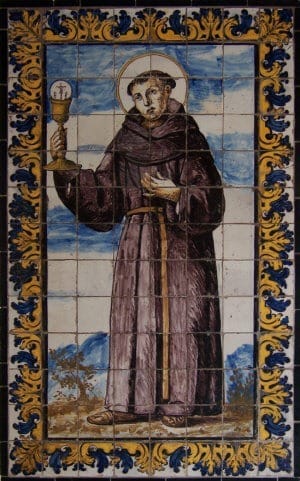 |
THE kingdom which the apostles are commissioned to establish upon earth is a reign of peace. Such was the promise pledged by heaven to earth, on that glorious night wherein Emmanuel was given to us. And on that other night which witnessed our Lord’s last farewell at the Supper, did not the Man-God base the New Testament upon the double legacy which he bequeathed to his Church, of his sacred Body and Blood, and of this peace announced of yore by Bethlehem’s angels?1 A peace unknown till then here below; a peace all his own, because, as he said, it proceeds from him, but still is not himself; this gift substantial and divine is no other than the Holy Ghost in Person! Like to some sacred leaven, this peace has been spread amongst us during this time of Pentecost. Men and nations alike have felt the secret influence. Man, at strife with heaven and divided against himself, was indeed justly punished for his insubordination to God by the ascendancy of the senses in his revolted flesh; but he now sees harmony once again established in his own being, and his appeased God treating as a son the obstinate rebel of former days. The sons of the Most High are to form a new people, stretching their confines unto earth’s furthest bounds. Seated in the beauty of peace, to use the Prophet’s expression,2 this blessed race shall see all nations flocking to its midst, and shall draw down, here below, the goodwill of heaven.
Whereas formerly nations were constantly at strife and wreaking vengeance in many a bloody combat that knew no end but the extermination of the vanquished, once baptized, they recognize each other as sisters, according to the filiation of the Father who is in heaven. Faithful subjects of the one pacific King, they yield themselves up to the Holy Ghost that he may soften their manners; and if war, the result of sin, must needs sometimes come, wofully reminding man of the consequences of the fall, this inevitable scourge will henceforth have at least some law besides that of might. The right of all nations, that Christian right which pagan antiquity rejected, the faith of treaties, the arbitration of the Vicar of Christ, supreme controller of the consciences of kings, these, and only these, can eliminate occasions of bloody discord. Thus there were to be ages in which the ‘peace of God,’ or the ‘truce of God,’ or a thousand such loving artifices of the common mother, would prevail to restrict the number of years and of days wherein the sword might be allowed to remain unsheathed against human life; were these limits outstepped, the transgressor's blade would be snapped in twain by the power of the spiritual sword, more dreaded, in those days, than warrior's steel. Such is the power of the Gospel that, even in these present days of universal decadence, the fiercest adversary respects a disarmed foe; so that after a battle victors and vanquished, meeting like brothers, lavish the same cares both corporal and spiritual on the wounded of either camp. Such is the persistent energy of the supernatural leaven which has been working progressive transformation in mankind for eighteen hundred years, and is even still acting upon those who would fain deny its power!
He whom we are honouring to-day is one of the most glorious instruments of this marvellous conduct of divine Providence. Heaven-born peace mingles her placid ray with the brilliant aureole that wreaths his brow. A noble son of Catholic Spain, he knew how to prepare the future glory of his country, as well as any mailed hero that laid Moor prostrate in the dust. Just as the eight hundred years' crusade that drove the crescent from Iberian soil was closing, and the several kingdoms of this magnanimous land were blending together under one sceptre, this lowly hermit of St Augustine was laying within hearts the foundation of that powerful unity which would inaugurate the glory of Spain's sixteenth century. When he first appeared, rivalries engendered too easily by a false point of honour in a nation armed to the teeth sullied the fair land of Spain with the blood of her sons, slain by Christian hands. As he now stands before us receiving the Church's homage, we behold discord at his feet, overthrown and vanquished by his defenceless hand.
Let us read his life as related in the liturgy.
O blessed Saint, well hast thou earned the privilege of appearing in the heavens of holy Church during these weeks that are radiant with the light of Pentecost. Long ago did Isaias thus portray the loveliness of earth, on the morrow of the coming down of the Paraclete: ‘How beautiful upon the mountains are the feet of them that bring good tidings, and that preach peace: of them that preach salvation; that say to Sion: Thy God shall reign!’3 What the prophet thus admired was the sight of the apostles taking possession of the word, in God's name. But in what did thine own mission differ from theirs thus enthusiastically pictured by the inspired pencil? The same Holy Ghost animated thy ways and theirs; the same pacific King beheld his sceptre by thy hand made yet more steadfast in its sway over a noble nation of his vast empire. Peace, the one object of all thy labours here below, is now thine eternal recompense in heaven, where thou reignest with him. Thou dost now experience the truth of thy Master's word, when he said of such as resemble thee by working to establish peace at least within the territory of their own hearts: ‘Blessed are the peacemakers, for they shall be called the children of God!’4 Yea, rest then, dear Saint, in thy Father's inheritance, into which thou hast entered; rest in the beatific repose of the Holy Trinity that inundates thy soul, and may we here, afar off on this chilly earth below, feel something of that genial peacefulness!
Vouchsafe to lavish upon thine own land of Spain the same succour which in thy lifetime was so precious to her. No longer does she hold that pre-eminence in Christendom which became hers just after thy glorious death. Would that thou couldst now persuade her that never can her greatness be recovered by lending an ear to the deceptive whisperings of false liberty! But that which could in bygone days render her so strong and powerful can do so again if she draw down upon her the benedictions of him by whom alone kings reign.5 Devotedness to Christ, that was her glory; devotedness to truth, that was her treasure! Revealed truth is alone that whereby men enter into true liberty: Truth will make you free.6 Truth alone is able to bind in unity indissoluble the many minds and wills that make up a nation; powerful is that bond, for it secures strength to a country beyond her frontiers and peace to her within. Apostle of peace, remind thine own people, and teach the same to all, that absolute fidelity to the Church's doctrines is the sole ground whereon Christians may seek and find concord.
June 12 (the Same Day): Saint Leo the Third, Pope and Confessor
The fragrance of Christmas is suddenly wafted around us, while we are in the midst of Pentecost! Leo III, as he speeds his flight from earth, sheds upon us the perfumed memory of that day, whereon the Infant God was pleased to manifest, by his means, the plenitude of His principality over all nations. Christmas Day of the year 800 witnessed the proclamation of the Holy Empire. The obscurity and poverty which had, eight centuries previously, ushered in the Birth of the Son of God, had for its object the drawing of men’s hearts; but this feebleness, so full of tenderness and condescension, was far from expressing the fullness of the mystery of the Word made Flesh. The Church tells us so, every year, as this blessed night of love comes round: ‘A Child is bom to us, and upon His shoulder is the sign of principality; His name shall be called the Wonderful, the Mighty, the Father of the world to come, the Prince of peace.’1 Peace, this day, once more shines upon the cycle: the peace of Christ, indisputably Victor and King! More even in one respect than our St. John of to-day, does Leo III deserve the united gratitude of the faithful. Here he stands like a new Sylvester, in presence of a new Constantine; by him alone is the complete victory of the Word Incarnate absolutely revealed.
Christ had successively triumphed over the false gods, over Byzantine Caesarism, and over barbarian hordes. A new society had sprung up, governed by princes who confessed that they held their crowns of the Man-God alone. To the old Roman empire founded on might, to Cæsarism, crushing the world with the iron teeth of its domination,2 rather than binding it together, was to succeed that confederation of baptized nations, which was to be called Christendom. But whence the unity needed for so vast a body? Who the chief amongst such a multitude of princes equal in birth and in rights? On what basis can the primacy of such a chieftain stand? Who may summon him? who point out the chosen of the Lord and anoint him with so potent an anointing, that his right to the first place in the councils of kings shall be undisputed by the strongest amongst them? The Holy Ghost, brooding over the chaos of peoples, as in the beginning over the dark waters,3 had long been elaborating this new creation, which must declare the glory of our Emmanuel:4 the new empire thus prepared would, as it were of itself, spring forth unto light, out of circumstances preordained strongly and sweetly,5 by eternal Wisdom.
Up to this period, the uncontested primacy of the spiritual power had stood majestic and alone, amidst Christian kingdoms. Though weakest of them all, ever did Peter’s successor behold earth prostrate at his feet; the city of the Cæsars had become his; Rome, by his voice, commanded all nations. Nevertheless, his authority, unarmed and defenceless, would have need at times to repel such assaults of violence as had already more than once imperilled the sacred patrimony which secured the independence of Christ’s Vicar. For the spiritual power, when once able to appear in sublime magnificence, became itself the object of sacrilegious ambition, the coveted prey of blackest perfidy. Leo III himself had lately experienced this in his own sacred person. A powerful lord, in conjunction with certain unworthy clerics, banded together by one common greed for gain, had beguiled the Pontiff into an ambush; his body had been mutilated, his eyes and tongue tom out, and his life preserved only by miracle; more wondrous still, his sight and speech had been afterwards restored by divine intervention. All Rome, witnessing this prodigy, was loud in heartfelt thanksgiving. God had indeed delivered His anointed; but the assassins had remained, nevertheless, masters of the city until the victorious troops of the Frankish king brought back the illustrious victim and reinstated him in his palace. Still this noble triumph was of itself no guarantee against future peril; for it had been preceded by other such victories, likewise due to the ever ready arm of the eldest daughter of the Roman Church. When her protecting sword was again withdrawn, leaving the work of restoration scarcely accomplished, new plots within or outside of Rome would soon be again set in motion for the usurpation of either the spiritual or temporal power of the Papacy. From the coast of the Bosphorus, too, the depraved successors of Constantine only applauded such intrigues, even keeping conspirators and traitors in secret pay.
Such a state of things could no longer continue. The sovereign Pontiff must necessarily look around, to find some security less precarious for the great interests confided to his keeping; the peace of the whole Christian world, the peace of souls as well as of nations, demanded that the highest authority upon earth should not be left at the mercy of ceaseless cabals. It was by no means sufficient that, at the hour of peril, the Vicar of Jesus Christ should be able to depend upon the fidelity of one nation, or of one prince. Some permanent institution was needed, not only to repair, but to ward off, every blow aimed by violence or by perfidy against Rome. Christian society was, by this time, advanced enough to furnish materials for the carrying out of such a noble conception. Already indeed, Pepin le Bref, by abandoning his Italian conquests into the hands of the apostolic See, had unreservedly constituted the temporal sovereignty of the Roman Pontiffs. But, though the use of the sword in self defence belongs to the Popes by right, just as much as to any king in his own states, yet, even when absolutely unable to act otherwise, personal use of armed force must ever be distasteful to the successor of him whom the Man-God appointed, here below, as the Vicar of His love.6 On the other hand, he well knows that he must maintain those sacred rights for which he has to answer to both God and man. Monarch as he is, Peter’s successor would be at liberty to choose from amongst the kings of the west (all of whom gloried in being his sons) one prince to whom he might confide the office of protector and defender of holy Church. Head as he is of the whole spiritual army of the elect, porter of heaven’s gates, depositary of grace and of infallible truth, he could invite the said prince to the honour of his alliance. Sublime indeed would such an alliance be, the legitimacy whereof bears the palm over that of all treaties ever concluded between potentates. Such an alliance, inasmuch as it is intended to guarantee the rights of the King of kings in the person of His representative, would entail certain obligations, it is true, on the recipient; but, at the same time, it would single him out to lofty privileges. Intrinsically vain and powerless are nobility of race, vastness of territory, glory of arms, and brilliancy of genius, to exalt a prince above his peers; such a greatness merely springs from earth, and outstrips not man’s limits. But the ally of Pontiffs would possess a dignity touching upon the heavenly; for such are the sacred interests whereof he would assume the filial guardianship. Without in the least encroaching on the domain of other kings, his compeers in other respects, or derogating from their independence, he must hold it his right, as accredited protector of his mother the Church, to carry the sword whithersoever the spiritual authority is aggrieved or requires his concurrence, in the accomplishment of the divine mission of teaching and saving souls. In this sense, his power must be universal, because the mission of holy Church is universal. So real this power, so distinct from every other, that to express it a new diadem must needs be added to the regal crown already his by inheritance; and a fresh anointing, different from the usual royal unction, must manifest in his person superiority over all other kings, chieftainship of the Holy Empire, of the Roman empire renewed, ennobled, and limitless as the earthly dominion assigned to Jesus Christ by the eternal Father.
Verily this magnificent conception unveils before us the boundless empire of the Word Incarnate, in all its wondrous plenitude! He alone possesses fully, by right of birth, by right of conquest, the universality of nations;7 He alone can delegate, for and by His Church, such power to kings. Who then may tell the splendour of that Christmas festival, whereon Charlemagne the greatest of princes, prostrate before the Infant God, beheld his anterior glories eclipsed by the pomp of that unexpected title, whereby he was officially appointed lieutenant of the divine Child couched in the humble crib! Beside the tomb of the first of Popes, of him that was crucified by the orders of a Caesar, Leo III, in the plenitude of his sole authority, reconstituted the empire; in Peter’s name, on Peter’s tomb, he linked once more the broken chain of the Caesars. Henceforth, before the eyes of all nations, the Pope and the emperor (to use the language of the papal bulls) will appear as two luminaries directing earth’s movements; the Pope, as the faithful image of the Sun of justice; the emperor, as deriving his light from the radiance cast on him by the supreme Pontiff.
Too often, indeed, will parricides stand up in revolt, and turn against the Church the sword that should be brandished only in her defence. But even these will serve only to demonstrate more clearly that the Papacy is verily the one source of empire. True, the day may come when German tyrants, rejected as unworthy by the Roman Pontiffs, will lay violent hands on the eternal city, creating antipopes, with a view to the aggrandizement of their own power. But by the very fact of carrying their insolence so far as to get themselves crowned champions of St. Peter by these pseudo-vicars of Christ, on the very tomb of the prince of the apostles, they will prove that society in those days could acknowledge no title to greatness, save such as either came, or seemed to come, from the apostolic See. The abuses and crimes, everywhere to be met with on history’s page, must not allow us Christians to forget that the value of an epoch or of an institution must, as regards God and His Church, be measured only by the progress derived thence by truth. Even though the Church suffer from the violence of rightful or of intruded emperors, she nevertheless rejoices much to see her Spouse glorified by the faith of nations, still recognizing how, through Christ, all power resides in her alone. Children of the Church, let us judge of the Holy Empire, as the Church, our mother, judges of it: it was the highest expression ever given to the influence and power of the Popes. To this glorification of Christ in His Vicar did Christendom owe its thousand years of existence.
Space fails us, or gladly would we here describe in detail the gorgeous liturgical function used during the middle-ages, in the ordination of an emperor. The Ordo Romanus, wherein these rites are handed down to us, is full of the richest teachings clearly revealing the whole thought of the Church. The future lieutenant of Christ, kissing the feet of the Vicar of the Man-God, first made his profession in due form: he ‘guaranteed, promised, and swore fidelity to God and blessed Peter pledging himself on the holy Gospels, for the rest of his life to protect and defend, according to his skill and ability, without fraud or ill intent, the Roman Church and her ruler in all necessities or interests affecting the same.’ Then followed the solemn examination of the faith and morals of the elect, almost word for word the same as that marked in the Pontifical at the consecration of a bishop. Not until the Church had thus taken sureties regarding him who was to become in her eyes, as it were, an extern bishop, was she content to proceed to the imperial ordination. While the apostolic suzerain, the Pope, was being vested in pontifical attire for the celebration of the sacred Mysteries, two cardinals clad the emperor elect in amice and alb; then they presented him to the Pontiff, who made him a clerk, and conceded to him, for the ceremony of his coronation, the use of the tunic, dalmatic, and cope, together with the pontifical shoes and the mitre. The anointing of the prince was reserved to the Cardinal Bishop of Ostia, the official consecrator of popes and emperors. But the Vicar of Jesus Christ himself gave to the new emperor the infrangible seal of his faith, namely the ring; the sword, representing that of the Lord of armies, the most potent One, chanted in the Psalm;8 the globe and sceptre, images of the universal empire and of the inflexible justice of the King of kings; lastly, the crown, a sign of the glory reserved in endless ages as a reward for his fidelity, by this same Lord Jesus Christ, whose figure he had just been made. The giving of these august symbols took place during the holy Sacrifice. At the Offertory, the emperor laid aside the cope and the ensigns of his new dignity; then, clad simply in the dalmatic, he approached the altar and there fulfilled, at the Pontiff’s side, the office of subdeacon, the servitor, as it were, of holy Church and the official representative of the Christian people. Later on, even the stole was given him: as recently as 1530, Charles V on the day of his coronation, assisted Clement VII in quality of deacon, presenting to the Pope the paten and the Host, and offering the chalice together with him.
The Christmas day of the year 800, witnessed not indeed the display of all this sacred pageantry; for these splendid rites reached full development only in course of centuries. Up to the last moment, Leo III had kept wholly secret the grand project conceived in his heart. But none the less solemn was this marvellous historic fact, when Rome, at the sight of the golden crown placed by the Pontiff’s hand on the row of the new Caesar, re-echoed the cry: To Charles, the most pious, the ever august, the monarch crowned by God, to the great and pacific emperor of the Romans, life and victory!’ This creation of an empire by the sole power and will of the supreme Pontiff, on such a day, and for the sole service of the interests of our Emmanuel, verily puts the finishing stroke to that which the birth of the Son of God was meant to achieve. As year by year this august Christmas festival returns, let us remember Leo the Third’s work,9 and so enter more and more fully into the touching antiphons of that day: The King of peace, whom the whole earth desireth to see, hath shown His greatness. He is magnified above all the kings of the earth.’
The account of this holy Pope’s life we here borrow from the ‘Proper of the city of Rome.’
Commissioned by the Lion of Juda to complete His own victory, thou, O Leo, didst constitute His kingdom, and proclaim His empire. Apostles had preached, martyrs had shed their blood, confessors had toiled and suffered, to win that great day whereon thou didst crown the labour of eight centuries; by thee, the Man-God could then rule supreme over the social edifice, not only as Pontiff in the person of His vicar, but as Lord-paramount and King in the person of His lieutenant, the armed defender of holy Church, the civil head of all Christendom. Thy work lasted as long as the eternal Father permitted the glory of His Son to shine in full splendour over the world. After a thousand years, when the divine light be came too strong for their weakened and diseased eyes, men turned away from holy Church and renounced her mighty works. They replaced God by self; the power of Christ, by the sovereignty of the people; institutions sprung from centuries of toil, by the instability of ephemeral chartas; bygone union, by the isolation of nationalities; and within each of these, anarchy. In this dark age, every utopia of man’s wild brain is called light, and every step towards nonentity is called progress! Thus the Holy Empire is no more; like Christendom itself, it can henceforth be but a name in history: and history too must soon cease to be, for the world is verging on the final term of its destinies.
Great for ever shall thy glory be, in endless ages, O thou by whom eternal Wisdom hath manifested the grandeur of His wondrous ways. A docile instrument in the hand of the Holy Ghost for the glorification of our Emmanuel, thy firmness was equalled only by thy gentleness; and this humble sweetness of thine attracted the eyes of the Lamb, the Ruler of the earth.10 Praying like Him, under the stroke of treason, for thy murderers, thou hadst to pass through thy day of humiliation, through a day of crushing anguish and of death-agony; but therefore was it given thee to distribute the spoils of the strong;11 and then, for centuries, the will of the Lord to be prosperous in thy hand,12 according to the plan which thou didst trace.
Even in these unhappy times, so unworthy of thee, vouchsafe to bless our earth. Strengthen those whom universal apostasy has as yet left unshaken. Make them by faith cling loyally to Christ; hold them ever aloof from liberalism, that fatal error whereby, men would fain remain Christians whilst actually refusing to acknowledge Christ’s kingship over all creation. What an insult to the eternal Father is such a wild notion as this; what a misconception of the mystery of the Incarnation! O holy Pontiff, make it to be clearly understood that safety is not to be sought at the hands of lying compromise with rebels; that the time is nigh, when God’s kingdom will assert itself, when the upheaving of nations against the Lord and against His Christ will be mocked by Him who dwelleth in the heavens.13 On that day, none may contest the origin of all power. On that day of wrathful vengeance, happy he who hath kept the oath of allegiance sworn to his King in Baptism!14 Like the prophet of Patmos, the faithful will easily recognize that King, when the heavens opening out a way before His feet, He shall come to crush the nations; for all the crowns of the whole earth shall rest upon His head, and He shall bear written upon the vesture of His human Nature: King of kings and Lord of lords.15
- The Office of Matins, Christmas day. ↩︎
- Dan. ii. 40. ↩︎
- Gen. i. 2; Apoc. xvii. 15. ↩︎
- Ps. xviii. 2. ↩︎
- Wisd. viii. 1. ↩︎
- Ambr. in Luc. x. ↩︎
- Ps. ii. 8. ↩︎
- Ps. xliv. 4. ↩︎
- See ‘Christmas’ Vol. I. where mention is made of this historic event in its proper place. ↩︎
- Is. xvi. 1. ↩︎
- Ibid. liii. 12. ↩︎
- Ibid. 10. ↩︎
- Ps. ii. ↩︎
- Ibid. lxii. 12. ↩︎
- Apox. xix ↩︎
June 12 (the Same Day): St. Basilides and Companions, Martyrs
BESIDE John of Sahagun, the apostle of peace, are grouped four warriors of our Lord's army. Thus peace and war go this day hand in hand, and form but one in the kingdom of the Son of God. The threefold peace preached by Christ—namely, man’s peace with his God, with himself, and with his brethren and fellowcitizens in the holy city—is to be won only at the cost of combat with Satan, the flesh, and the world, which is the ‘accursed city.’ Together with the Church, let us blend in one united homage our praises of the glorious confessor of these later ages, and of the stern veterans of persecuting times.
From you we learn, O soldiers of Jesus Christ, the nature of that peace which he came to bring upon earth to men of goodwill. Its reward is no other than God himself, who, by it and together with it, communicates himself to such as are worthy. Its invigorating sweetness overpowers every sensitive feeling, even that of tortures such as Christians, after your example, must be ready to undergo in order to preserve intact this priceless treasure. Amidst torments and beneath the deathstroke, this peace upheld you, keeping your mind and heart free, fixed on heaven alone:* this same peace now forms for ever your eternal beatitude, in the presence of the undivided Trinity. Whatsoever be the varied condition of our life here below, lead us, O holy martyrs, by the path of this perfect peace, fraught as it necessarily is with valour and love, unto the repose of endless bliss.
* Phil. iv 7. ↩︎
| Previous June 11: St. Barnabas, Apostle | Next June 12: St. John a S. Facundo or of Sahagun, Confessor |