Daily reading
After Pentecost
Double · Movable from Easter · Temporal
June 13, 2020
From Dom Guéranger’s The Liturgical Year.
 |
Saturday within the Octave of Corpus Christi
Man has been cast forth from Eden, and has gone into the dreary land of his exile. He has nothing left him of the tree of life, but the recollection that it was once his. It remains in the happy land where it was first planted; how could it go after the sinner man, now that he is banished into the vale of tears? No! it remains in paradise; far from the abode of suffering, and out of mortals' sight, it continues in all its loveliness, bearing testimony to the primitive intentions of God, which were peace, innocence, and love. The day will come when we shall see it again, for it is to be one of the charms of the new earth, into which our Lord will lead His chosen people on the day of the great Pasch, and of the restoration of all things.1 Happy day! after which, as the apostle tells us, every creature longeth, bowed down as it now is, and made subject, by reason of a fault which was not its own, to the inconstancy of ceaseless change. Man, who, against the creature’s will, subjected it to the servitude of corruption, keeps up within it the hope that, the time of deliverance being come, it, too, will partake, in its own way, of the glorious liberty of the children of God.2 The glory of the new paradise will be greater than that of the one of old; for, it is not under the veil of symbols, or in a passing way, that the deifying union is to be fulfilled, but divine Wisdom will give Himself, and for ever, and without veil, to man, in an eternal embrace.
And yet this union, whose permanent enjoyment is to make the eternal bliss of heaven, is to be contracted even now, and on this very earth of ours; for it is the economy of the divine plan, that, in all things, the future life should have its roots in the present one, and should be but the revelation, in the light of glory, of the ineffable realities formed here by grace. What, then, after the fall, will be the conditions of the alliance, from which eternal Wisdom has not been turned by the sin committed by His creature man?
Oh the depth of the riches of this Wisdom ef God!3 His love is strong as death,4 and, even after man’s disloyalty, will be infinitely admirable in its delicate ways of gaining its object. There is to be nothing unbecoming in the alliance He is bent on! He will admit no compromise with the depravity which has befallen our now sinful race! His mercy is infinite; and, through that, He has pardoned the offence, the moment the offender expressed his sorrow; but the pardon is not one which was to mean no compensation, no expiation on man’s side; that would have ill-suited the dignity of such a Spouse as He. And since sinful man cannot offer an adequate expiation, He, Wisdom, undertakes to pay the culprit’s whole debt, and give him back the holiness he has forfeited; this done, He will take our human nature, and espouse her to Himself as His much-loved bride. ‘I will espouse thee unto Me, in justice and judgment,’ says this God to man, by His prophet Osee.5
And He adds: ‘I will espouse thee unto Me in faith.’6 For, just as the entrance of divine Wisdom into this world, which He conies to save from pride by humility, is to be without exterior parade or glory, so, likewise, the divine union is to be accomplished in the mystery of the sacred Species of the nuptial banquet, and these Species will offer nought to view but the appearance of bread and wine, such as one could find on any table. But faith will see through that veil; and the unspeakable dignity conferred on the children of men by this heavenly food, will reflect its brightness on the whole creation.
The whole world of creatures, each in its own way, was in expectation of this marvellous manifestation, which was to be made upon the sons of God,7 by the union to be contracted between Wisdom and man. The prophet thus speaks of this universal expectation: ‘And it shall come to pass in that day, I will hear, saith the Lord, I will hear the heavens; and they shall hear the earth; and the earth shall hear the corn, and the wine, and the oil; and these shall hear Jezrahel.’8 Jezrahel means the seed or race of God. God will give to man, through corn and wine, the substance to be offered in the mysteries; and, through oil, the priesthood, which is to transform them into the marriage-dowry, in the very action of the Sacrifice. It is to be by the Sacrifice, and by Blood, that this alliance of justice and love is to be contracted.
We read in Scripture that Moses was one day traversing the desert; he had on him a legal transgression; the angel of the Lord met him, and was about to slay him, when Sephora, the wife of this future leader of Israel, averted the divine vengeance by the rough and speedy circumcision of her son, Eliezer: then marking with his blood the feet of the guilty one, she said to him: ‘A spouse of blood art thou to me.’9 Thus, and with far greater truth, could divine Wisdom say to the human race; for He is not to save, He is not to be united with man, except by the Blood of this Son of Man, who is one in person with that same Wisdom.
Nay, far from lessening, this very sight of man’s misery has increased the ardour of His love. Later on this Man-God will say: ‘I have a baptism, wherewith I am to be baptized: and how am I straitened until it be accomplished!’10 It was the same from the very first: no sooner has expiation been shown as the royal way, whereby humanity is to be restored to Him, and again made worthy of Him, by the shedding of divine Blood—Wisdom has ever had that thought before Him. He is impatient for the great immolation of Calvary; and until its time comes, He will suggest to His people rites and sacrifices figurative of that one Sacrifice, and of the banquet of the adorable Victim, the marriage-feast.
His garden, the place of His delight, is no longer paradise; it is this parched earth of ours, where man has now, more than ever, need of being loved of God. Ye Cherubim, whom God has stationed to guard the tree of life,’tis well that sinful man be kept from approaching it. But the flaming sword ye hold in your hands, will not prevent divine Wisdom from leaving paradise, and joining our human race here in its banishment. He was not only the tree, but He is, likewise, the river of life. Speaking of Himself, He says, in the Book of Ecclesiasticus: ‘Like a brook out of a river of a mighty water, as though I were but a mere channel of a river, I came out of paradise. I said: “I will water My garden of plants, and I will water abundantly the fruits of My meadow.” And behold! My brook became a great river, and My river became like a sea; for I make doctrine to shine forth unto all, as the morning light, and I will declare it afar off, yea, even to the most distant ages. I will penetrate to all the lower parts of the earth, and will visit all that sleep, and will enlighten all that hope in the Lord.’11
This living light, which from early morning enlightens the whole earth with divine Wisdom, is the varied teaching of prophecies and figures, which were given by God through the course of ages, and, from the very moment of man’s creation, put the shadow of the Messias upon the whole universe. By means of this manifold teaching, Wisdom conveyeth Himself, through nations, into holy souls;12 rouses man up, when discouragement makes him slumber;13 cherishes his hopes, and bids him hope, by looking at the future. Those bloody sacrifices, which were prescribed immediately after man’s departure from Eden, as the ritual expression of his early worship of God, will be offered up by all after generations; and even when idolatry shall have led mankind into the abyss of every crime, those sacrifices will raise up their voice, and keep up the prophecy which they are intended to proclaim—the prophecy of a Victim, who will be one of infinite worth. The stream of primitive traditions will, as it flows through time and space, become impregnated with foreign elements, and transmit many a worthless or even dangerous material; still, it is through the rite of sacrifice, observed by the whole world, that the desire and expectation of Christ will be maintained among all nations.14 Satan, that old serpent thief, may succeed in inducing men to build altars to himself, and on those altars offer him sacrifice, which is due to God alone; but he cannot stifle the voice of truth which accompanies every sacrifice, the voice which teaches that an innocent and pure victim may be substituted in place of guilty man, and work his expiation. This will arouse the notion of the promised Mediator in many a soul bewildered by the orgies of this satanic worship; and here, again, the very sight of the serpent was made to be the cure of them he had stung, and became the sign and ensign of the son of Jesse.15 O root of Jesse! root of the Wisdom of the Most High! who is there that can understand the depth of Thy counsels, or penetrate the devices of Thy immense love?16 Verily, Thou art more beautiful than any light of day; for that light yields when night comes on; whereas Thou, O Wisdom, art overcome by no evil, be it as black as sin!17
All those ancient sacrifices were powerless to produce grace; their very multiplicity proved their inability to do so;18 but what they could and did effect was the keeping alive in mankind the remembrance of the fall, and the expectation of a Redeemer; they were, likewise, the basis of those supernatural acts, which are requisite for man’s justification and salvation. But, besides their representing the redemptive element, which the fall of man has introduced into the plan of God, these bloody sacrifices express, also, the union of God with His creature, which was the primary and chief object of creation. That union was to be effected in the banquet prepared by Wisdom, the eucharistie banquet, wherein He, Wisdom, the Son of God, was to be received by man, and thus united with him. This sublime mystery was also expressed by those figurative sacrifices, wherein the people partook of the viotims offered: for, in the Eucharist, the Victim is the Man-God, offered to God, and eaten of by man; the Deity is appeased by the Blood of the divine Lamb, and mankind is restored, because nourished by His Flesh, which thus feeds him to a new and divine life. Such was the general law observed by all nations, when offering sacrifice: the portion intended for God was consumed by fire, and thus transmitted to heaven; but another portion of the same victim was taken and eaten by the people: and all this signified that there was communion between heaven and earth, and that the receivers were all made one, because they all partook of the same sacred food. How admirably are thus grouped together all the mysteries of God’s goodness towards His creature man! And what a prophecy this was! It was unceasing, for it was proclaimed each time a sacrifice was offered up, and there were thousands every day. It was thus that the divine Lamb, whom they foretold, was slain from the very beginning of the world;19 His Blood, in all these early ages, was applied, through hope and faith, to the souls of men, and cleansed them from their sins; and the mysterious ritual, with its inspired code of prescriptions, was keeping man on the alert, and preparing him for the banquet of the nuptials of the Lamb.20 Then, let Wisdom extol His own triumph! It is He who caused that in the heavens there should rise a light which never fails, and covers the whole earth as with a cloud; He alone has compassed the circuit of heaven, has penetrated into the bottom of the deep, has traversed the waves of the sea, and has stood in all the earth, and in every people, as the King of all, holding the chief rule, and vanquishing, strongly and sweetly, the hearts of all, both high and low.21
Meanwhile, the time of banishment is running on; the long period of expectation is more than half over. The nearer the realization of the promised alliance comes, the more ardent are the longings of chosen souls. As to our Jesus Himself, He seems to desire a preparation of a more telling kind than any of these others that have preceded. He will turn His attention to the very spot where He is to dwell on this earth. And where is that? His Father, the Creator of all things, whose every word is fulfilled by His Son, has a chosen people; and among these He would have His Son be nationalized, if we may reverently use such a word. He said to Him: ‘Let thy dwelling be in Jacob, and thine inheritance in Israel!’22 In obedience to this His Father’s will, He establishes Himself in Sion, He takes His rest in the holy city, and fixes His power in Jerusalem.23 Jerusalem! It is the city of peace, and is to be the scene of such stupendous mysteries! It is here that Isaac, the child of promise, had come carrying on his shoulders the wood for his self-sacrifice; here his father was about to slay him, when a ram was mysteriously substituted; and the mount of the one true Sacrifice was thus selected. It is here, also, that there then lived a king-priest, who bore the likeness of the Son of God;24 it was Melchisedech; and when Abraham, the father of believers, came to him, this Melchisedech offered what was to be the sacrifice of the alliance to come, a sacrifice of bread and wine; and thereby showed to Abraham, who saw into the future, the day of Christ, his Son.25
It is at the very period, when the world at large has fallen into idolatry, and offered to false gods the homage of its sacrifices, that divine Wisdom leads into this chosen dwelling-place the people of whom He is to be born as Man; it is the fulfilment of the command: Let thy dwelling be in Jacob! let thine inheritance be in Israel! In this one people Wisdom will maintain His Father’s claims, and keep alive and pure the light of the expectation of nations. He delivers it, at the cost of countless prodigies, from the Egyptian bondage.26 The feast of the Paschal Lamb—slain the same day on which, at a future time, is to be celebrated the Supper of the Lord, and the immolation of the true Lamb—is the signal of deliverance, and of a triumphant march, through the waters of a sea, to the mount of the alliance: the chosen people becomes the bride of God,27 the priestly kingdom, and the holy nation.28 Figure, in all things, of God’s true people traversing the desert of this world, Israel drinks of the waters which come from the rock, and the Rock is Christ;29 a bread rained down daily from heaven, strengthens him amidst the fatigues of journey and battle; and this bread of angels, as the Scripture terms it, took any taste the eater wished it to have.30 God Himself dwells with Israel under his tents. He has had a tabernacle made for him, on the plan of one shown by God on the mount; and in front of this tabernacle there is an altar, on which a chosen family, consecrated by oil of unction, may alone offer, under the direction of a high-priest, the manifold legal sacrifices, each of which points to some excellency or other of the one great Sacrifice of the future. From this altar, on which burns a fire that is never quenched, there goes up to heaven without interruption the smoke of the flesh and blood of the victims slain. They are a supplication for the coming of that saving Host, which is to put an end to these hecatombs. There are also offerings of flour and wine, the necessary accompaniment of holocausts and peace-offerings; these prefigure the august Memorial which is to keep up and perfect the divine Sacrifice of the cross, by an unbloody application of it. There is, in these early days, a sacrifice which goes under the name of a memorial; it is an offering by itself, consisting of fine flour, and unleavened loaves and wafers.31 Then, there are the proposition loaves; they are kept within the veil, as the most holy of the sacrifices, as being a perpetual memorial of sacrifice and covenant;32 and what a mysterious, yet unmistakable, figure is all this of the future eucharistic Presence, kept up in the Church under the sacred Species, even when the celebration of the mysteries is over!
As there is but one altar in Jacob, which, by its oneness, points towards Him who, at a future time, is to be both victim and altar; so there is but one place, the tabernacle and its surroundings, and later on the temple and the holy city, where it is lawful to celebrate those sacred banquets of communion, which, according to universal custom, close the sacrifice in which they are offered. The last time that Moses had his people assembled around him, in the plains of the Jordan, he thus spoke to them: ‘Beware lest thou offer thy holocaust in every place that thou shalt see. In the place which the Lord your God shall choose, that His name may be therein, thither shall ye bring your holocausts, and victims, and tithes, and the firstfruits of your hands. There shall ye feast before the Lord your God, ye and your sons and your daughters, your men-servants and maid-servants, and the levite that dwelleth in your cities; and thou shalt rejoice, and be refreshed, before the Lord thy God, in all things, whereunto thou shalt put thy hand.’33
The material prosperity promised to the Jewish people, as a reward of his faithfully observing the numerous figurative prescriptions of the law of Sinaï, was itself but a figure of the spiritual blessings which were to transform the soul, and prepare it for the coming of divine Wisdom in the flesh. But Israel is slow to raise himself above material things. He easily falls a prey to all the scandals he witnesses among the Gentiles. Severe punishments teach him that he is not safe, except in keeping the law given to him. He keeps the letter of the ritual precepts with scrupulous exactitude, but sees nothing of their chief meaning, which is the Redeemer to come, and the spiritual dispositions which those outward observances were intended to prompt. God is continually warning him by the prophets, and seeking to reclaim him to the spirit of His divine institutions. Thus, in the psalms, He remonstrates with him, but with such paternal affection that one can scarcely suspect a complaint, though there is a most bitter one: 'Hear, O My people! and I will speak: O Israel! and I will testify unto thee. I am God, thy God. I will not reprove thee for thy sacrifices; and thy burnt-offerings are always in My sight. I will not take calves out of thy house, nor he-goats out of thy flocks; for all the beasts of the wood are Mine, the cattle on the hills, and the oxen. I know all the fowls of the air, and with Me is the beauty of the field. If I should be hungry, I would not tell thee; for the world is Mine, and the fullness thereof. Shall I eat the flesh of bullocks? or shall I drink the blood of goats? Offer unto God the sacrifice of praise, and pay thy vows unto the Most High! . . . The sacrifice of praise shall glorify Me; and there is the way by which I will show him the salvation of God,' that is, my Christ, who is the Saviour signified by all these sacrifices!34 Later on, however, to this people, stiff-necked and uncircumcised in heart and ears,35 which has gone deeper and deeper into outward formalism, and knows no other virtue or perfection, God speaks in strong language, expressing His disgust for sacrifices, which they have robbed of the only worth they possessed in His eight, that is, their prophetic sense. ‘To what purpose do ye offer Me the multitude of your victims?’ says He by the prophet Isaias, ‘I am full; I desire not holocausts of rams, and fat of fatlings, and blood of calves, and lambs, and buck-goats. When ye came to appear before Me, who required these things at your hands, that ye should walk, (defiling) My courts? Offer sacrifice no more in vain: your incense is an abomination unto Me!’36 But these warnings are not heeded; pride increases in the carnal Jew, in proportion to his narrow heart and views. He dreams of a Messias who is to be an earthly conqueror. As to the true Messias, whose divine characteristics are foretold by the victims offered in sacrifice, this Jew will deny Him, for he finds Jesus too closely resembling these poor victims, by His sufferings and meekness.
Then comes the last of the prophets, Malachias. He turns to the Gentiles: they have been less favoured than Israel, but they have kept up the expectation of a Saviour, and, when He comes, they will lovingly receive Him. Malachias announces the final abrogation of a worship which had been so perverted, and the substitution of a divine memorial, which shall be the same in all places, and shall make all people one, by their ail partaking of the great Sacrifice to come: I have no pleasure in you, saith the Lord of hosts, to the priests of Israel; I will not receive a gift of your hand; for, from the rising of the sun, even to the going down, My name is great among the Gentiles, and in every place there is sacrifice, and there is offered unto My name a clean oblation.37
The fullness of time has come; then, bless God, O ye Gentiles! Make the voice of His praise to be heard!38 Too long, life has been to you but the empty dream of night. You hungered after the fruit of life; you thirsted for living water. But, like the hungry man who dreams of a sumptuous repast, yet never satisfies the hunger which gnaws him; like the thirsty man who dreams that he drinks, yet, on waking, is tormented with the same burning thirst, and finds his soul still empty; so was the multitude of your erring people.39 Yet, now, behold! The standard of Jesse appears on the mountain, and rallies you around it. Ye Gentiles, that once were strangers, feed now to your hearts content, in the deserts turned into fruitfulness!40 The water from the rock flows plentifully through your once parched lands. The glory of Libanus, the beauty of Carmel and Saron, adorn your hills, and refresh your lonely plains; your wilderness shall rejoice, and flourish like the lily.41 Rain shall be given to your seed; and the bread of the corn of your land shall be delicious.42 ’Tis just it should be so; for, shall the labourer plough all day long? Shall he be ever opening and harrowing his ground? No; the time comes when, having made smooth the surface of his field, he sows and scatters his seeds, and puts wheat in the rows he has marked. Such is the providence shown to the Gentiles by the Lord God of hosts; and thereby He evinces both the sureness of His divine counsels, and the magnificence of His justice.43
Eternal Wisdom had not given up the mysterious designs of His love. He kept close to the fallen human race, even when He severely chastised it. He owed it to Himself to put guilty man to the test, so to make him feel, before raising him up, how deep had been his fall. It was on this account that He permitted him to be overtaken by night, and fear, and anguish; He Himself sends him sufferings, in order that, having thus brought him to sound the frightful depth of his misery, He might trust Himself to the safe welcome and keeping of His creature’s humility. This done, He would raise him up by repentance, and strengthen him with hope, and, joyously meeting him, disclose to him again His divine charms, and enrich him with the treasures which are in the keeping of His love.44
This is Saturday; let us turn to Mary, who was made for us Gentiles the seat of Wisdom. In her chaste womb was wrought the mystery of mercy, which had been the expectation of all the long ages past. Her most pure blood provided the substance of that spotless Body wherewith the most beautiful of the sons of men contracted the indissoluble alliance of our nature with eternal Wisdom. Mary’s soul is enraptured at seeing the ineffable mystery of these divine nuptials effected in her chaste womb. She is that enclosed garden, where, more delightedly than in the early days of the universe, Wisdom enjoys light and love; the flowery couch of the Canticle,45 perfumed, by the holy Spirit, with the sweetest fragrance; the glorious tabernacle, incomparably more holy than that of Moses. It is within her, under the immaculate veil of her flesh, that, by the unspeakable embrace of the two natures in the unity of God’s only-begotten Son, the Holy Ghost pours forth the unction, which makes Him Spouse, and, at the same time, Priest for ever according to the order of Melchisedech.
Let man, then, be of good courage; the Bread of heaven, the Bread of the covenant, has at last come down upon our earth; and although nine months must pass before the great night comes, when He is to be made visible to us all in Bethlehem, yet, even now, the High Priest is at His work in this His holy temple. ‘Sacrifice and oblation Thou wouldest not,’ He says to His eternal Father; ‘but a Body Thou hast fitted unto Me. Holocausts for sin did not please Thee. Then said I: “Behold I come;” in head of the book it is written of Me, that I should do Thy will, O God!’46
We will close, to-day, our selections from the Office of the Blessed Juliana, by the following hymn; it is assigned to Compline in the ancient books of the Church of St. Martin-au-Mont.
Hymn for Compline
Christus noster vere potus,
Caro Christi vere cibus,
Sanguis Christi vere potus.
Quam assumpsit de Virgine:
Verus sanguis quem bibimus,
Quem effudit pro homine.
Verbum caro comeditur;
Per quod viget religio,
Per quod coelum ingredimur.
Totus plenus, et gratiæe,
Alvo gestatus Virginis,
Rex est aeternae gloriae.
Saginemur pinguedine;
Ut tam pii viatici
Delectemur dulcedine.
O redemptorum gloria!
O requies humilium!
Æterna confer gaudia.
Praesta per almum Spiritum;
Quibus hoc das edulium,
Prosperum serves exitum.
Christ is truly our drink;
the Flesh of Christ is truly our meat,
the Blood of Christ is truly our drink.
from the Virgin, is what we eat;
the true Blood, which he shed for man,
is what we drink.
is truly eaten; it is on him
that our worship rests,
and by him that we enter heaven.
of sweetness and grace,
is the King of eternal glory,
that was carried in the Virgin’s womb.
that we may find delight
in the sweetness of a viaticum
so full of mercy.
O glory of the redeemed!
O repose of the humble!
grant us eternal joys.
grant, through the Spirit of love,
that we, to whom thou givest such nourishment as this,
may be brought by tbee to a prosperous end.
We will continue our selections from the magnificent Preface given in the liturgy of the eighth book of the. Apostolic Constitutions.
Constitutio Jacobi
Tu es qui Abrahamum liberasti avita impietate, et mundi haeredem constituisti, ipsique Christum tuum apparere fecisti. Qui Melchisedecum pontificem divini cultus designasti. Qui Isaacum effecisti filium promissionis. Qui Jacobum ad Ægyptum introduxisti.
’Twas thou deliveredst Abraham from the impiety of his forefathers, and madest him the heir of the world, and showedst him thy Christ. ’Twas thou appointedst Melchisedech to be high-priest of thy divine worship; thou that madest Isaac the son of the promise; thou that broughtest Jacob into Egypt.
- Apoc. xxii. 2. ↩︎
- Rom. viii. 19-22. ↩︎
- Rom. xi. 33. ↩︎
- Cant. viii. 6. ↩︎
- Osee ii. 19. ↩︎
- Ibid. 20. ↩︎
- Rom. viii. 19. ↩︎
- Osee ii. 21-22. ↩︎
- Exod. iv. 24-26. ↩︎
- St. Luke xii. 50. ↩︎
- Ecclus. xxiv. 41-45. ↩︎
- Wisd. vii. 27. ↩︎
- Ps. cxviii. 28. ↩︎
- Gen. xlix. 10; Agg. ii. 8. ↩︎
- Num. xxi. 6-9; Is. xi. 10. ↩︎
- Ecclus. i. 6. ↩︎
- Wisd. vii. 29, 30. ↩︎
- Heb. x. 1-4. ↩︎
- Apoc. xiii. 8. ↩︎
- Apoc. xix. 7-9. ↩︎
- Ecclus. xxiv. 6-11. ↩︎
- Ecclus. xxiv. 12, 13. ↩︎
- Ibid. 15. ↩︎
- Heb. vii. 3. ↩︎
- St. John viii. 56. ↩︎
- Wisd. x. 15. ↩︎
- Exeh. xvi; Osee ii, etc. ↩︎
- Exod. xix. 6. ↩︎
- 1 Cor. x. 4, 11. ↩︎
- Wisd. xvi. 20-29. ↩︎
- Levit. ii. 2, 9. ↩︎
- Ibid, xxiv. 7-9. ↩︎
- Deut. xii. 7, 11-13. ↩︎
- Ps. xlix. 7-14, 23. ↩︎
- Acts vii. 51. ↩︎
- Is. i. 11-13. ↩︎
- Malach. i. 10, 11. ↩︎
- Ps. lxv. 8. ↩︎
- Is. xxix. 7, 8. ↩︎
- Ibid. v. 17. ↩︎
- Is. xxxv. 1, 2, 7. ↩︎
- Ibid. xxx. 23. ↩︎
- Ibid, xxviii. 24-29 ↩︎
- Ecclus. iv. 18-21. ↩︎
- Cant. i. 15. ↩︎
- Heb. x. 5-7. ↩︎
June 13: St. Anthony of Padua, Confessor
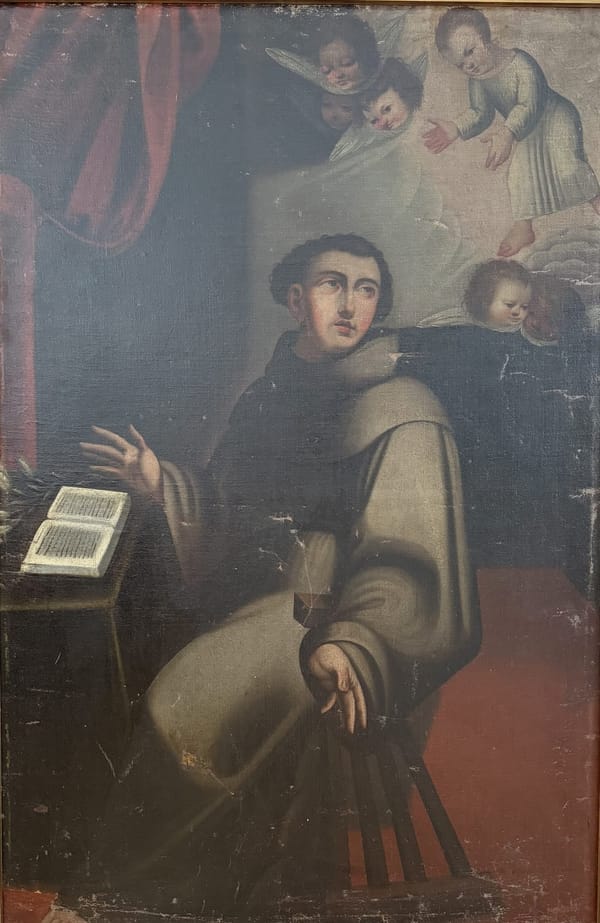 |
REJOICE thee, happy Padua, rich in thy priceless treasure!1 Anthony, in bequeathing thee his body, has done more for thy glory than the heroes who founded thee on so favoured a site, or the doctors who have illustrated thy famous university!
The days of Charlemagne were past and gone: yet the work of Leo III still lived on, despite a thousand difficulties. The enemy, now at large, had sown cockle in the field of the divine householder; heresy was springing up here and there, whilst vice was growing apace in every direction. In many an heroic combat, the Popes, aided by the monastic Order, had succeeded in casting disorder out of the sanctuary itself: still the people, too long scandalized by venal pastors, were fast slipping away from the Church. Who could rally them once more? Who wrest from Satan a reconquest of the world? At this trying moment the Spirit of Pentecost, ever living, ever present in holy Church, raised up the sons of St Dominic and of St Francis. The brave soldiers of this new militia, organized to meet fresh necessities, threw themselves into the field, pursuing heresy into its most secret lurking-holes, and thundering against vice in every shape and wheresoever found. In town or in country, they were everywhere to be seen confounding false teachers by the strong argument of miracle as well as of doctrine; mixing with the people, whom the sight of their heroic detachment easily won over to repentance. Crowds flocked to be enrolled in the Third Orders instituted by these two holy founders, to afford a secure refuge for the Christian life in the midst of the world.
The best known and most popular of all the sons of St Francis is Anthony, whom we are celebrating this day. His life was short; at the age of thirty-five he took his flight to heaven. But a span so limited allowed, nevertheless, of a considerable portion of time being directed by our Lord to preparing this chosen servant for his destined ministry. The all-important thing in God's esteem, where there is question of fitting apostolic men to become instruments of salvation to a greater number of souls, is not the length of time which they may devote to exterior works, but rather the degree of personal sanctification attained by them, and the thoroughness of their self-abandonment to the ways of divine Providence. As to Antony, it may almost be said that, up to the last day of his life, eternal Wisdom seemed to take pleasure in disconcerting all his thoughts and plans. Out of his twenty years of religious life, he passed ten amongst the Canons Regular, whither the divine call had invited him at the age of fifteen, in the full bloom of his innocence; and there, wholly captivated by the splendour of the liturgy, occupied in the sweet study of the Holy Scriptures and of the fathers, blissfully lost in the silence of the cloister, his seraphic soul was ever being wafted to sublime heights, where (so it seemed) he was always to remain, held and hidden in the secret of God's face. Suddenly, behold! the divine Spirit urges him to seek the martyr's crown: and presently he is seen emerging from his beloved monastery, and following the Friars Minor to distant shores, where already some of their number had won the glorious palm. Not this, however, but the martyrdom of love, was to be his. Falling sick and reduced to impotence before his zeal could effect anything on the African soil, he was recalled by obedience to Spain, but was cast by a tempest on the Italian coast.
It happened that St Francis was just then convoking his entire family, for the third time, in general chapter. Anthony, unknown, lost in this vast assembly, beheld at its close each of the friars in turn receive his appointed destination, whereas to him not a thought was given. What a sight! The scion of the illustrious family de Bouillon and of the kings of the Asturias completely overlooked in the throng of holy poverty’s sons! At the moment of departure the Father Minister of the Bologna province, remarking the isolated condition of the young religious whom no one had received in charge, admitted him, out of charity, into his company. Accordingly, having reached the hermitage of Monte Paolo, Anthony was deputed to help in the kitchen and in sweeping the house, being supposed quite unfitted for anything else. Meanwhile, the Augustinian Canons, on the contrary, were bitterly lamenting the loss of one whose remarkable learning and sanctity, far more even than his nobility, had, up to this, been the glory of their Order.
The hour at last came, chosen by Providence, to manifest Anthony to the world; and immediately, as was said of Christ himself, the whole world went after him.2 Around the pulpits where this humble friar preached there were wrought endless prodigies in the order of nature and of grace. At Rome he earned the surname of ‘ark of the covenant'; in France, that of 'hammer of heretics.' It would be impossible for us here to follow him throughout his luminous course; suffice it to say that France, as well as Italy, owes much to his zealous ministry.
St Francis had yearned to be himself the bearer of the gospel of peace throughout the fair realm of France, then sorely ravaged by heresy; but in his stead, he sent thither Anthony, his well-beloved son, and, as it were, his living portrait. What St Dominic had been in the first crusade against the Albigenses, Anthony was in the second. At Toulouse was wrought that wondrous miracle of the famished mule turning aside from the proffered grain in order to prostrate in homage before the sacred Host. From the province of Berry, his burning word was heard thundering in various distant provinces; whilst heaven lavished delicious favours on his soul, ever childlike amidst the marvellous victories achieved by him, and the intoxicating applause of an admiring crowd. Under the very eyes of his host, at a lonely house in Limousin, the Infant Jesus came to him radiant in beauty; and throwing himself into his arms, covered him with sweetest caresses, pressing the humble friar to lavish the like on him. One feast of the Assumption Anthony was sad, because a phrase then to be found in the Office seemed to throw a shade of discredit on the fact of Mary’s body being assumed into heaven together with her soul. Presently, the Mother of God herself came to console her devoted servant, in his lowly cell, assuring him of the truth of the doctrine of her glorious Assumption; and so left him, ravished with the sweet charms of her countenance and the melodious sound of her voice. Suddenly, as he was preaching at Montpellier, in a church of that city thronged with people, Anthony remembered that he had been appointed to chant the Alleluia at the conventual Mass in his own convent, and he had quite forgotten to get his place supplied. Deeply pained at this involuntary omission, he bent his head upon his breast: whilst standing thus motionless and silent in the pulpit, as though asleep, his brethren saw him enter their choir, sing his verse, and depart; at once his audience beheld him recover his animation, and continue his sermon with the same eloquence as before. In this same town of Montpellier another well-known incident occurred. When engaged in teaching a course of theology to his brethren, his commentary on the Psalms disappeared; but the thief was presently constrained, even by the fiend himself, to bring back the volume, the loss whereof had caused our saint so much regret. Such is commonly thought to be the origin of the popular devotion, whereby a special power of recovering lost things is ascribed to St Anthony. However this may be, it is certain that, from the very outset, this devotion rests on the testimony of startling miracles of this kind; and in our own day constantly repeated favours of a similar nature still confirm the same.
The following is the abridgement of this beautiful life, as given in the liturgy.
Want of space obliges us to be very meagre in the number we give of liturgical pieces; but we cannot omit here the miraculous Responsory, as it is called, the composition whereof is attributed to St Bonaventure. It continues still to justify its name, in favour of those who recite it in the hour of need. In the Franciscan breviary it is the eighth responsory of the office of St Antony of Padua. At a very early date, this, together with the nine Tuesdays in our Saint's honour, became a very popular devotion and was fraught with immense fruits of grace.
The Miraculous Responsory
O glorious Anthony, the simplicity of thine innocent soul made thee a docile instrument in the hand of the Spirit of love. The Seraphic Doctor, St Bonaventure, hymning thy praises, takes for his first theme thy childlike spirit, and for his second thy wisdom which flowed therefrom. Wise indeed wast thou, O Anthony, for, from thy tenderest years, thou wast in earnest pursuit of divine Wisdom; and wishing to have her alone for thy portion, thou didst hasten to shelter thy love in some cloister, to hide thee in the secret of God’s face, the better to enjoy her chaste delights. Silence and obscurity in her sweet company was thine heart's one ambition; and even here below her hands were pleased to adorn thee with incomparable splendour. She walked before thee; and blithely didst thou follow, for her own sake alone, without suspecting how all other good things were to become thine in her company.3 Happy a childlike spirit such as thine, to which are ever reserved the more lavish favours of eternal Wisdom!
'But,' exclaims thy sainted panegyrist, 'who is really a child nowadays? Humble littleness is no more; therefore love is no more. Naught is to be seen now but valleys bulging into hills, and hills swelling into mountains. What saith Holy Writ? “When they were lifted up, thou hast cast them down.”4 To such towering vaunters, God saith again: "Behold I have made thee a small child ”; but exceedingly contemptible among the nations5 such infancy is. Wherefore will ye keep to this childishness, O men, making your days an endless series of inconstancy, boisterous and vain effort at garnering wretched chaff? Other is that infancy which is declared to be the greatest in the land of true greatness.6 Such was thine, O Anthony! and thereby wast thou wholly yielded up to Wisdom's sacred influence.’7 In return for thy loving submission to God our Father in heaven, the populace obeyed thee, and fiercest tyrants trembled at thy voice.8 Heresy alone dared once to disobey thee, dared to refuse to hearken to thy word: thereupon, the very fishes of the sea took up thy defence; for they came swimming in shoals, before the eyes of the whole city, to listen to thy preaching which heretics had scorned. Alas! error, having long ago recovered from the vigorous blows dealt by thee, is yet more emboldened in these days, claiming even sole right to speak. The offspring of Manes, whom, under the name of Albigenses, thou didst so successfully combat, would now, under the new appellation of freemasonry, have all France at its beck; thy native Portugal beholds the same monster stalking in broad daylight almost up to the very altar; and the whole world is being intoxicated by its poison. O thou who dost daily fly to the aid of thy devoted clients in their private necessities, thou whose power is the same in heaven as heretofore upon earth, succour the Church, aid God's people, have pity upon society, now more universally and deeply menaced than ever. O thou ark of the covenant, bring back our generation, so terribly devoid of love and faith, to the serious study of sacred letters, wherein is so energizing a power. O thou hammer of heretics, strike once more such blows as will make hell tremble and the heavenly powers thrill with joy.
| Previous June 12 (the Same Day): St. Basilides and Companions, Martyrs | Next June 13: St. Anthony of Padua, Confessor |