Daily reading
After Pentecost
Double · Movable from Easter · Temporal
June 18, 2020
From Dom Guéranger’s The Liturgical Year.

|
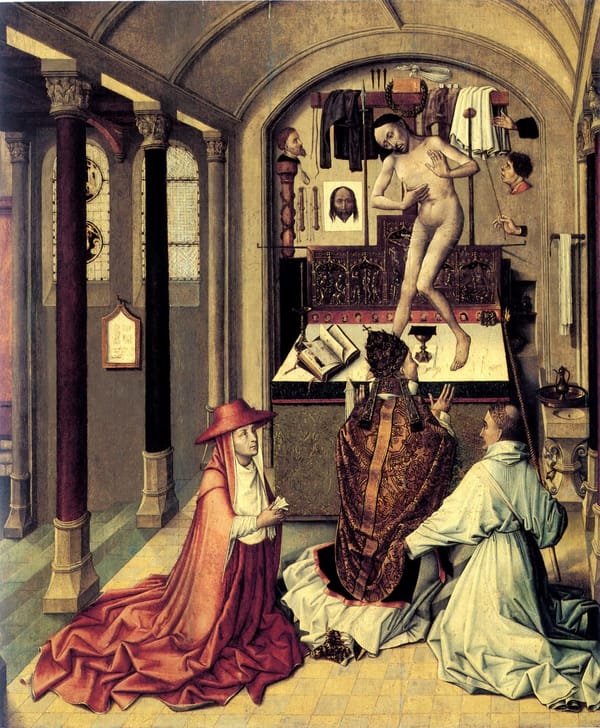
Thursday, the Octave of Corpus Christi
The bright octave, consecrated to the glory of the blessed Sacrament, closes to-day; and although we began the subject three days before the feast itself, we have been able to do little more than slightly touch upon the sublime subject proposed for our consideration and love by the Church. The Memorial left us by our Lord of all His wondrous mercies1 far exceeds the measure of our poor thoughts, and the capabilities of human language; such is the extremity of the infinite love, which God bears to His own2 creatures, that no possibility of ours could make it a return such as it deserves.
Eternal Wisdom was, even from His Father’s bosom, betrothed to human nature. He came down into this world, which sin had marred, and there He found man, who had become the slave of sin;3 He assumed the nature of man: He was thus able to make a Sacrifice, which gives infinite glory and full satisfaction to God, and He perfected His union with His creature, by means of that divine banquet, at which, as food and drink, He Himself is served; for He is the divine Victim4 immolated on the cross and at our altars.
O man! O child of Adam, that wast formed of earthy slime,5 what art thou, that thou shouldst be remembered in the court of heaven?6 Thou desired one of the everlasting hills7—for we may apply this name even to thee—what hast thou done, that thou shouldst thus be glorified?8 Yet doubt it not, thou hast had all these favours. ‘Let not my few weak words stagger thee,’ cries out St. Cyril, the brave defender at Ephesus of the sacred nuptials, of which the Eucharist is what the fathers call the glorious extension, ‘heed not my unworthiness, but listen to the voice, respect the authority, of them that have gone before us, and have preached these truths. They were not men of the common sort, they were not men undeserving of notice, who went about, like hired criers, to proclaim these things on the highroads; no, they were such men as the great Solomon, who was sent as the herald of the King of kings; he sat on his high throne, and proclaimed the mysteries of the Most High; he was clad in scarlet robes, and wore a diadem on his brow, and he was the one to publish the mandate of the God who makes and unmakes kings.’9
Christians! ye people of kings,10 who are to have crowns and thrones yonder in heaven,11 it is to you this Solomon speaks. Your dignity is great. Listen to this herald of God; learn whence comes your greatness, and live up to it. ‘Hearken, ye kings, and understand! Give ear, ye kings! To you are these my words. If ye love your thrones and your sceptres, love wisdom, that ye may reign for ever. I preferred this wisdom before kingdoms and thrones; I loved her above all treasures, and health, and beauty, and chose to have her instead of light. What this wisdom is, and what her origin, I will declare, and I will not hide from you the mysteries of God; but will seek wisdom out from the beginning of her birth, and bring the knowledge of her to light, and will not pass over the truth. I have learned her without guile, and I communicate her to you without envy. Receive, therefore, instruction by my words, and it shall be profitable unto you.’12 Would to God, that we had been able to tell the wonderful mystery we have been celebrating! Divine Wisdom Himself has been pressing us, during all these days, to study the excellencies of that sacred Bread, which yields delights to the kings, His guests.13 The Church has kept close to the throne of her Jesus, that cloud in which He dwells out of love for us.14 She is full of love for Him; He has given her unity by the Sacrament of union; and she, like a strong compact city, summons her tribes of Israel,15 the holy nation, the people of the redeemed, the chosen race of the priests and kings,16 to come together again on this octave-day, that they may testify their faith, and sing their love, and be grateful for the peace which the holy Eucharist secures to them, and for the abundance of grace and blessing it gives to these her children.17 These days of universal joy and festivity around the holy Host were revealed by the Holy Ghost to the son of Sirach; and the vision made him exclaim: ‘Wisdom shall praise her own self, and shall be honoured in God, and shall glory in the midst of her people, and shall open her mouth in the churches of the Most High, and shall glorify herself in the sight of His power. And in the midst of her own people, she shall be exalted, and shall be admired in the holy assembly. And in the multitude of the elect, she shall have praise, and among the blessed (of the Father) she shall be blessed.’18
‘Blessed the man,’ continues the inspired writer, still speaking in the future, ‘that shall dwell in wisdom! Blessed the man that considereth her ways in his heart, and hath understanding in her secrets, who goeth after her as one that traceth, and prepareth for her snares of love;19 who looketh in at her windows, and hearkeneth at her door! Blessed is he that lodgeth near her house, and, fastening a pin in her walls, shall set up his tent nigh unto her, where good things shall rest in his lodging for ever. He shall set his children under her shelter, and shall lodge under her branches. He shall be protected under her covering from the heat, and shall rest in her glory.’20
O house of God, house of the feasting of kings,21 filled with the fragrance of sweetest incense!22 Better is one day in thy precincts, than a thousand elsewhere. It is a joy to my soul to think of days spent there!23 The poor bird that once was lonely, and sat moaning on a roof that could never give her rest,24 here, in the house of God, finds all she wants. The turtle-dove, having found at the altar of her Lord a nest for her young ones,25 has no further solicitude. In the secret of that little cloud, far from the conflicts and disturbances of the world, and where there is no contradiction of tongues—there, from early dawn, eternal Wisdom is pouring out upon souls the multitude of His light and sweetness;26 there, each of the Church’s hours, choirs will be singing psalms and canticles of praise and joy around the tabernacle,27 wherein resides the Lamb who, though slain, is ever living,28 beautiful on His throne of love, the Hod of gods in our Sion.29
Truly, He abides among us; our earth has received the mystery of the marriage-feast, of the divine espousals with human nature, and she ever possesses the Lord her Hod dwelling with her in the Eucharist. O thou gladness of morning!30 O heavenly wine that bringest forth virgins!31 O happy moments, wherein the beauty of Jesus, whose full vision is the joy of the angels, gives itself under the sacramental veil to our souls, you leave behind you something more than a joyous recollection. The altar of Sacrifice, and the house of the great Banquet, both continue as the throne ever occupied by our King; they are the earthly abode of that Wisdom, who, though He is seated at the right hand of the Father in the brightness of the saints,32 and is loved by the Lord of all things,33 yet has not changed towards us poor children of men; He still delights to be with us, and keep up His loved union with us; and, as He tells us He did at the beginning, so He still loves this world of ours, and, to use His own word, He still plays with it.34 On the throne of His tabernacle, He, beautiful Wisdom, receives the adorations of them that rule this world, for it is from Him they have their crowns and sceptres; and when they have wisdom, it is from Him they have it, and they asked Him for it on bended knees.35 On that same throne He hears and grants the prayer of those little ones, little by humility and simplicity of heart, whom He so sweetly presses to go to Him;36 they are attracted to Him by His divine loveliness and riches;37 and they go to Him, that He may teach them how to love Him and fill their treasures to the brim.38
Glory be to the Lamb, whose Sacrifice has given us this wonderful Presence in the blessed Sacrament I To Him be power, and divinity, and wisdom, and strength, and honour, and glory, and benediction, for ever and ever!39 By His lovely light40 let us, as a close to this day and the octave, respectfully contemplate what this ineffable permanence is, which thus secures to us in its fullness, to the end of time, the great mystery of faith.
How different is the divine Lamb of the true Passover, from that ancient one of the Jewish people, which we now so well understand!41 In prescribing the rites to be observed in the sacrifice of the figurative Paschal Lamb, which was to be eaten but once a year, Moses laid down this strict injunction: ‘Neither shall there remain anything of it until morning’;42 nothing was to be left, all was to be consumed! Let us listen, now, to an apostle of the new Law: it is Andrew, brother of Peter; he is speaking to a Roman proconsul, and, through him, to all the Gentiles: ‘Every day, I offer up to the almighty God, who is one and true, not the flesh of oxen, nor the blood of goats, but the spotless Lamb, upon the altar; of whose Flesh the whole multitude of the people eat; and the Lamb that is sacrificed, remains whole and living.’43
‘How can that be?’ asks the proconsul. ‘Become a disciple and thou shalt learn,' replies Andrew. But that could not be: the representative of the pagan world was officially appointed to persecute the crucified Jesus in His members; and as to the sublime dogma he had just heard, and which was the very basis of the religion proscribed by the State, he had but one way of dealing with it and its preacher: laugh at it, and hang Andrew on the cross. The apostle thus sealed his testimony by his death, leaving to the Holy Ghost, who had inspired him with the words he had spoken,44 the future victory which that teaching was to win. His brother-apostles, who had been his fellow-guests at the last Supper, also laid down their lives for Jesus and His doctrine; and, by that sacrifice of themselves, they made themselves food to the same dear Lord. So did Andrew. He followed the counsel of the Wise Man: ‘When thou shalt sit to eat with a prince, consider diligently what is set before thy face, and lay this to thy heart, and know that it behoveth thee to give a like feasting to the prince.’45 Having, therefore, been fed with Jesus’ cross in the banquet of His Body at the last Supper, as St. Augustine expresses it,46 Andrew made a right noble return.
And so was it with the other martyrs, who came after him: the joy they showed, in the midst of their tortures, kept up the proof of the power that exists in the precious Wine and heavenly Bread, which can thus gladden man’s heart and make it brave.47 The time would come, when the demonstration of the mystery of faith, so sublimely expressed by the apostle St. Andrew, would convince the world; not indeed by the force of argument, or by the clever sequel of learned deductions, but by the world itself becoming transformed from paganism to Christianity. That transformation was an impossibility, as far as the world’s own misery and power were concerned; and yet it was an undeniable fact; and it was the result of an irresistible influence: the influence of the divine leaven, which, in the language of the Gospel, was put into the whole measure of flour at the last Supper. From south to north, from east to west, everywhere throughout the globe, the children of the Church now sing these words, which are but St. Andrew’s expression that has triumphed over the world, won its faith, and is set to rhythm and music: ‘Christ’s Flesh is food, and His Blood is drink; yet is He whole under each Species. He is not cut by the receiver, nor broken, nor divided: He is taken whole. He is received by one, He is received by a thousand; the one receives as much as all; nor is He consumed, who is received And when the Sacrament is broken, waver not, but remember that there is as much under each fragment as is hidden under the whole. Of the substance there is no division; it is but the sign that is broken; and He who is the Signified, is not thereby diminished, either as to state or stature.’48
The Church’s doctrine is this: that ‘under each Species, and under each part of each Species, there is contained, truly, really, and substantially, the Body and the Blood, together with the Soul and Divinity of our Lord Jesus Christ, and therefore the whole Christ.’49 Of themselves, it is true, the words of Consecration in the Sacrifice do but produce what they signify; and therefore, exclusively and isolatedly, under the twofold Species, produce the Body and the Blood; but our risen Lord, who liveth now for ever, remains indivisible. As the apostle teaches us, Christ, rising again from the dead, dieth now no more; for, in that He died to sin (that is, because of our sin), He died once; but in that He liveth, He liveth unto God.50 Therefore, wheresoever, in virtue of the words of consecration, there is the most holy Body, or the Blood of our Redeemer, there also, by an essential and necessary concomitance, is the whole entire sacred Humanity, united with the Word.
And here, for the sake of greater precision, we are going to adopt the scholastic phraseology. And firstly, the change of bread into the Body, and of wine into the Blood, is one of substance into substance; but in this miraculous change, very appropriately, on that account, called trans-substantiation, the accidents or modes of the two terms of the change are in no way altered or destroyed. So that, being deprived of their natural subject, or support, the species, or appearances of bread and wine are immediately sustained by God’s omnipotence, and they produce and receive the same impressions as they would do if they were joined to their own proper substances. They are the sacramental sign; and although they do not inform the Body of Christ, that is, do not give It their own qualities or properties, yet they determine and maintain Its presence, so long as these species are not essentially modified. As regards the Body of our Lord—which, in Its own true substance, is substituted for the substance alone of bread and wine—It is withdrawn, by the sacred formula, from those mysterious laws of extension, which are so far from being thoroughly understood by human science; It is whole under the whole species, and whole under each sensible portion of the species; and, in this, It resembles spiritual substances, such as, for instance, the soul of man, which is whole in his whole body, and whole in each member of the same. Such, then, is the mystery of the sacramental state: whilst present to us under the dimensions of the Host, and not beyond them, by reason of His substance being independent of our known laws of extension, Christ our Lord abides in Himself precisely what He is in heaven. As St. Thomas of Aquin expresses it: ‘The Body of Christ, in the Sacrament, retains all Its accidents, as a necessary consequence; and Its several parts are just as they are in His sacred Body, although they are not subject to the conditions of external space.’51
The very notion of Sacrifice required this passive appearance; in the same way that the idea of a banquet, in which He is received, determined what was to be the peculiar nature of the sacramental elements selected by our divine Lord. Of course, when we behold the sacred Host, we must banish every such thought as bondage, or actual suffering, or laborious virtues, on the part of the divine Guest who dwells under the sacred Species: under this external passiveness or apparent death, there abound life, and love, and the beauty of the Lamb, who has vanquished death, and who is the immortal King of ages.
He resides under the white Host, with all His power and brightness, the most beautiful of the children of men;52 He has all those admirable proportions, and all the perfect finish of those divine members, which were formed from the flesh of the most beautiful of the daughters of Adam, and the purest of virgins. Let us venerate, with all the respect we are capable of, those feet, which were watered by the tears of the repentant Magdalene, and dried with her hair,53 and embalmed with the sweetest ointment, beforehand, as Jesus emphasised her act, when He praised it;54 those feet of our merciful Redeemer, more beautiful than the feet of them who bring us the tidings of His having come among us;55 they are bright, beyond the brightness of fine brass when in a burning furnaoe.56 Let us send our reverential kisses, beyond the veil, to those hands, which are spotless, and consecrated for the office of High Priest;57 those hands, which worked at the wood in Joseph’s shop; those hands, which scattered blessings and miracles throughout the land of Israel; they are there, under that Host, just as the bride of the Canticle saw and described them, bright as gold, formed to the model of perfection, and full of something extremely precious, which she called hyacinths,58 and which perhaps signify those wounds of which the prophet speaks, saying, ‘horns are in His hands, and there is His strength hid.’59 Would that we might look beneath the little cloud which hides from us that divine head, the admiration of the angels; that face, once disfigured, and buffeted, and covered all over with reproaches, out of love for us,60 but now resplendent as the sun when he shineth in his power!61 O mouth of our Jesus, thou instrument of the Word, whose voice is as the sound of many waters,62 and whose breathing is death to the wicked!63 O lips, which our Scriptures tell us, are as lilies dropping choice myrrh!64 And you, O eyes, which shed tears over Lazarus,65 and now are lighting up with your brightness66 the abode of the saints! Oh! that we might see all, see Thee Thyself, Jesus, beneath the mystery and the veil! But no! the mystery and the veil may not be removed; and surer are we, than if our eyes were the witnesses, that Thou, O Beloved of our hearts, art behind our wall, looking at us through the lattices;67 and this is enough to make us adore Thee. Verily the sweetest test to which Thou couldst put our love, was that we should have faith in this mystery of the adorable Sacrament!
O precious Blood, thou price of our ransom, shed profusely on this earth, but now again within the sacred veins of Jesus! thou art now, as during His years here below, diffusing thy life-giving qualities to His divine members, under the action of that sacred Heart, which we are so solemnly to honour to-morrow! Most holy Soul of Jesus, present in the Sacrament as form substantial68 of that most perfect Body, which, through thee, is the ever-living Body of the Man-God, thou possessest within thee all the treasures of eternal Wisdom.69 Thou hadst the office intrusted to thee, of putting into a varied and sensible language the ineffable beauty of that Wisdom of the Father, who was taken with love for the children of men, and desired, by a manifestation which they could understand, to secure their love to Himself! Every word, every step, of Jesus, every mystery of His public or hidden life, was a gradual revelation, to us men, of that divine brightness. Truly, as we have it in the Gospel, this Wisdom, like the grace that was within Him, advanced in His manifestation to the creatures, whose love He had come down from heaven to win.70 When, at length, He had achieved all His work—given us His teachings, and examples, and mysteries, those marvellous manifestations of His own infinite perfections—He gave them perpetuity, that so all ages to come might possess them and benefit by them; He fixed them, so to say, in the Sacrament of love, that abiding source of grace and light to men, that living Memorial, wherein divine love is ever ready to bestow upon us the graces of the wonderful works He has wrought by His Incarnation. ‘The Flesh, the Blood of Christ, is the Word made manifest,’ says St. Basil; ‘it is Wisdom made visible by the Incarnation and by all that mystery of His life in the flesh, whereby He unfolds to us all moral perfection, and all the beautiful, both natural and divine. It is that which is the food of our soul, and which is preparing her, even in this world, for the contemplation of the divine realities.’71
The solemn Exposition, during which the blessed Sacrament has been receiving our most fervent homage of adoration and love, is concluded, as it began, with a procession. As soon as the Vespers are over (and they are the same as those of the feast, page 273), the deacon takes the monstrance from the throne, and gives it to the priest. The sacred Host is once more carried outside the church, with the same holy ceremonies, and chants, and joyous worship of the faithful. Again It has all nature doing homage to the Creator; It sanctifies every place through which It is carried; drives away the hostile power which, as the apostle tells us, seeks to infest this air;72 blesses our streets and our country lanes, and imparts to our fields a pledge of rich harvest. It is then brought back to the church, not to leave the hallowed precincts again, save for the sake of the dying, to strengthen them for their last long journey, or for the sick, that It may be administered to them, since they are not able to go to their Lord. The Benediction is then given to the adoring assembly, and the sacred Host is replaced in the tabernacle.
Whilst these sentiments of faith and love are so active within us, let us give them expression, by the beautiful hymn, Adoro te devote: it was composed by the Angelic Doctor, St. Thomas of Aquin; and it is hard to say which of the two predominates in these verses, the theological science of the saint, or his humble and glowing love.
But when the tabernacle-door closes upon Jesus in His holy Sacrament, our hearts will still continue with Him. This octave always brings with it such an increase of light regarding the great Mystery! It has been so, this year. More than ever, for the future, will we love and reverence the Banquet which is, and produces, all that we have been considering during these days: we know so much better now, than formerly, the perfections of eternal Wisdom, who has given Himself to us in the Eucharist; we will let Him guide us into all grace and truth.
Rhythmus S. Thomæ
Quæ sub his figuris vere latitas:
Tibi se cor meum totum subjicit,
Quia te contemplans totum deficit.
Sed auditu solo tuto creditur.
Credo quidquid dixit Dei Filius,
Nil hoc verbo veritatis verius.
At hic latet simul et humanitas;
Ambo tamen credens atque confitens,
Peto quod petivit latro pœnitens.
Deum tamen meum te confiteor.
Fac me tibi semper magis credere,
In te spem habere, te diligere.
Panis vivus, vitam præstans homini:
Præsta meæ menti de te vivere,
Et te illi semper dulce sapere.
Me immundum munda tuo sanguine,
Cujus una stilla salvum facere
Totum mundum quit ab omni scelere.
Oro fiat illud quod tam sitio:
Ut te revelata cernens facie
Visu sim beatus tuæ gloriæ.
who truly liest concealed under these forms:
to thee my whole heart subjects itself,
because it finds itself quite lost in contemplating thee.
but the hearing alone may be safely believed.
I believe whatsoever the Son of God has spoken;
nothing is more true than this word of truth.
but here the humanity also lies hid:
but I believe and confess them both,
and ask for what the penitent thief asked.
yet do I confess thee to be my God.
Oh! grant that I may ever believe in thee, more and more,
and put my hope in thee, and love thee.
O living Bread, that givest life to man!
Grant that my soul may ever live on thee,
and may ever relish thy sweetness.
cleanse me, an unclean sinner, with thy Blood,
one drop whereof
could save the whole world from all its guilt.
I beseech thee, let that be done,
for which I do so thirst: that I may see thine unveiled face,
and be happy in the vision of thy glory.
The devout Ratpert, monk of St. Gall, friend of Notker, and, like him, a writer of liturgical compositions, shall provide us with an appropriate conclusion to this our octave of Corpus Christi, in the following devout hymn, which he composed for the faithful of the ninth century.
Ad Eucharistiam Sumendam
Corporis immensi, Sanguinis atque tui.
Tu licet indignis propitiare tuis:
Prosit ut invictis appropiare sacris.
Purificans corpus, cor pariterque pius.
Interea terris dans medicamen opis.
Summeque pascentes protege Pastor oves.
Consolidans dono nos sine fine tuo.
Tu pietate tua, Rex, rege castra tua.
Spiritus atque potens, trinus et unus apex.
honouring the gifts bestowed upon us of the adorable Body and Blood.
have mercy on us thy servants, though unworthy ones.
that our approaching these triumphant sacred Mysteries may be to our profit.
the holy angel who will lovingly cleanse both our body and soul.
giving us meanwhile, here on earth, the restoring power.
O best of shepherds, protect us thy sheep, now feeding on it!
for ever strengthen us by the gift
do thou in thy mercy, O King, rule thine own soldiers!
and the all-powerful Spirit, the perfect Three and One giver of the gifts.
- Ps. cx. 4. ↩︎
- St. John xiii. 1. ↩︎
- Heb. ii. 14, 15. ↩︎
- Prov. ix. 2. ↩︎
- Gen. ii. 7. ↩︎
- Ps. viii. 5. ↩︎
- Gen. xlix. 26. ↩︎
- Job vii. 17. ↩︎
- Hom. div. x in Myst. cœn. ↩︎
- St. Matt. xxv. 34. ↩︎
- Apoc. v. 9, 10. ↩︎
- Wisd. vi. vii. passim. ↩︎
- Gen. xlix. 20. Cf. ant. 3 Laud. in die festi. ↩︎
- Ecclus. xxiv. 7. ↩︎
- Ps. cxxi. 3, 4. ↩︎
- 1 St. Pet. ii.9. ↩︎
- Ps. cxxi. 4-8. ↩︎
- Ecclus. xxiv. 1-4. ↩︎
- Juxta græc. ↩︎
- Ecclus. xiv. 22-27. ↩︎
- Ps. xli. 5. ↩︎
- Ecclus. xxiv. 20, 21. ↩︎
- Ps. lxxxiii. 2, 11. ↩︎
- Ps. ci. 8. ↩︎
- Ibid. lxxxiii. 4. ↩︎
- Ibid. xxx. 20, 21. ↩︎
- Ibid. xxvi. 6. ↩︎
- Apoc. v. 6. ↩︎
- Ps. lxxxiii. 8. ↩︎
- Ps. xxix. 6. ↩︎
- Zach. ix. 17. ↩︎
- Ps. cix. 3. ↩︎
- Wisd. viii. 3. ↩︎
- Prov. viii. 31. ↩︎
- Ibid. 14-16. ↩︎
- Prov. ix. 4; St. Mark x. 14. ↩︎
- Ecclus, xxiv. 26. ↩︎
- Prov. viii. 21. ↩︎
- Apoc. v. xii. ↩︎
- Ibid. xxi. 23. ↩︎
- Paschal Time, vol. 1. ↩︎
- Exod. xii. 10. ↩︎
- Pass. S. Andr. ap. Lipom. ↩︎
- St. Matt. x. 20. ↩︎
- Prov. xxiii. 1, 2. juxta græc. ↩︎
- In Ps. c. ↩︎
- Ps. ciii. 15. ↩︎
- Sequen. Lauda Sion. ↩︎
- Conc. Trid. Sess. xiii. can. 1, 3. ↩︎
- Rom. vi. 9, 10. ↩︎
- P. 3. Q,. lxxvi. a, 4; Sent. lib. 4. dist. 10, art. 2. ↩︎
- Ps. xliv. 3. ↩︎
- St. Luke vii. 37, 38. ↩︎
- St. Mark xiv. 8. ↩︎
- Is. lii. 7. ↩︎
- Apoc. i. 15. ↩︎
- Lev. xxi. 10. ↩︎
- Cant. v. 14. ↩︎
- Hab. iii. 4. ↩︎
- Lam. iii. 30. ↩︎
- Apoc. i. 16. ↩︎
- Ibid. 15. ↩︎
- Is. xi. 4. ↩︎
- Cant. v. 13. ↩︎
- St. John xi. 35. ↩︎
- Apoc. i. 14. ↩︎
- Cant. ii. 9. ↩︎
- Concil. Vienn. ↩︎
- Col. ii. 3. ↩︎
- St. Luke ii. 52. ↩︎
- Epist. viii. ↩︎
- Eph. ii. 2; vi. 12. ↩︎
June 18: St. Ephraem the Syrian, Deacon, Confessor, and Doctor of the Church
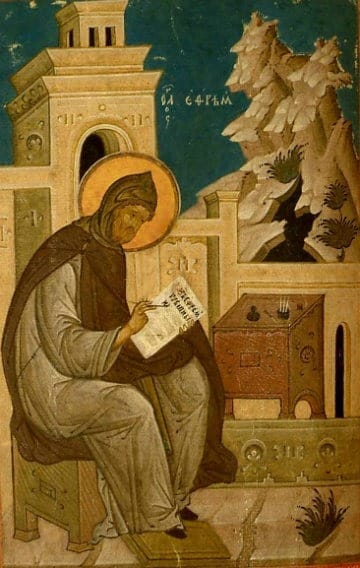 |
ST EPHRAEM, monk and deacon, the contemporary of St Athanasius, St Basil, St Gregory of Nazianzen and St Gregory of Nyssa, was with them one of the glories of the Christian East so rich in testimonies to faith and sanctity during the first centuries. He takes his place in the liturgical cycle among the doctors of the Universal Church. It is only fitting that the ancient piety of Edessa and Nisibis should be represented in the Roman calendar.
by him who was always held to be the most illustrious of her sons. St Ephraem was honoured by the whole Church for the depth and vastness of his doctrine, and the whole Catholic world rejoiced when Pope Benedict XV pronounced him worthy to be placed among the great doctors of the Church both Greek and Latin. No one was more worthy than the celebrated Deacon of Edessa of such an honour. Even during his lifetime men delighted to honour him with such titles as illustrious ‘ doctor of the universe,' ‘prophet and sun of the Syrians,’ ‘pillar of the Church,' and ‘harp of the Holy Spirit.’1 All the Orthodox fathers and doctors from St Basil, St John Chrysostom and St Jerome down to St Francis de Sales and St Alphonsus Liguori are unanimous in his praise.2 Seldom has reputation been more brilliant, authority more universally acknowledged than that of the humble Syrian monk: less than twenty years after his death his writings were read publicly in church after the Scriptures.3 As theologian, poet and orator his literary work was immense. His writings comprise commentaries on the Scriptures, theological discourses and poems, moral and ascetic treatises, hymns in praise of Almighty God, our Lady and the saints. These form an inestimable treasure where successive generations have found not only weapons wherewith to combat error but also food to strengthen their souls. The works of St Ephraem, written in Syriac, were at an early date translated not only into Greek, but also into all the languages of the East—Coptic, Ethiopian, Arabic and Armenian—so that his hymns and canticles are to be found in all the liturgical books of the Syriac Church, both Orthodox and Uniate, which thus remains indebted to his fruitful genius.
St Ephraem was bom in Mesopotamia, very probably at Nisibis, on the frontier of the Roman Empire and Persia, at the beginning of the fourth century. Tradition says that his father fulfilled the duties of a priest to an idol in that town, but that his mother may have been a Christian.4 In any case he does not appear ever to have taken part in idolatrous worship, for we know that in his youth he was a member of the household of James, the bishop of Nisibis, one of the three hundred and eighteen fathers of the Council of Nicæa. He received baptism, and under the guidance of this bishop gave himself to prayer, to all the practices of Christian asceticism, to reading and profound study of the Scriptures. It was during this time that he acquired his remarkable knowledge and love of the Holy Scriptures so noticeable in all his writings and which is one of his chief characteristics. Later on he said: 'He who applies himself with simplicity and purity of heart to the study of the Sacred Books will receive the knowledge of God. Some people glory in conversing familiarly with the great ones of the earth, with princes and kings, but let it be your glory to converse with the Holy Ghost in the presence of the angels of God by reading the divine Scriptures, for it is the Holy Ghost who there speaks to you. Spare no pains to become familiar with this study.’5
The first verses of 'Hymns of Nisibis' show us what Ephraem was to James and his successors. These poems, the earliest of his that have come down to us, give us a picture of the times in which he lived. James, Babou and Vologesus found him a zealous auxiliary, intent upon upholding their authority, drawing men to them and ardently desirous of reform. His great influence on the people was shown especially when Nisibis was besieged by Sapor, king of the Persians. During those perilous days he incessantly encouraged the citizens to resist the enemy, strengthening the besieged by his word and example, until his courage and his prayer forced the enemy to acknowledge their powerlessness and retire. Later on, when as a result of the disastrous campaign of the emperor Julian against the Persians, his successor Jovian was forced to cede Eastern Mesopotamia with Nisibis to Sapor, Ephraem joined the emigrants who left for ever a town where Christians could no longer dwell in security.
From Nisibis St Ephraem went to Edessa, which name is for ever associated with his. On the west of the town there rises a hill on whose rocky slopes are numerous caves and tombs in which lived many anchorites. St Ephraem in his turn came to seek, among the rocks of the holy mountain, a retreat which would enable him to devote himself to prayer, study and penitential exercises. His knowledge of sacred sciences, however, could not long remain hidden, and disciples soon began to gather around him. This was the period of his literary activity, which was so great as to be almost miraculous. It was during the ten years that he passed in the capital of Osrhoene that he wrote most of his works. It was also the period of his greatest activity in religious affairs, and it seems certain that the School of Edessa, famous under the name of the Persian School, owes to him, if not its existence, at least a great part of its renown.
However, Edessa could not escape the ravages to which the spread of the heresies of Arms, Manes, Marcion and other sowers of discord subjected the whole world, and we owe a great number of St Ephraem’s theological discourses and poems to his solicitude in combating heresy under all its forms, and to his care in safeguarding the purity of faith among the Christians of the town. In obedience to the inspiration of divine grace,6 he left his solitude for a time to pour forth to the faithful exhortations so rich in imagery, so full of unction and of doctrine, that to this day the heart of the reader is moved. The holy doctor inveighs with much vigour against the Arians, who deny the Divinity of Christ. The following passage occurs in one of his sermons on the Passion: ‘The King of kings who is above all kings is the only Saviour Jesus, who sits at the right hand of his Father. He is his Word, his strength, his mighty arm; he descended from the height of heaven to the depths of the earth and ascended into heaven. He came down in secret, he ascended openly, he came down as the Word, he ascended with a human body, he descended and ascended according to his own will. Blessed be he who has acted according to his power. Men should be astonished and should admire the providence of the author of all grace who has abased himself even to us. Blessed be he who in his goodness has drawn from the ocean of his mercy the life that he has bestowed upon us. The Son of God is God, and God of God, he descended from heaven and conversed upon earth, he the power of preaching. The consuming fire which fell from heaven has become a dew for mankind, he who is all on fire has hidden his flame, the vehement God has restrained himself, there is no thunder in his voice nor lightning in his movements, the terrible God has hidden his majesty, the powerful God his force, wholly in heaven, he was wholly upon earth. When you consider him in heaven there is nothing to which you can liken him; when you consider him upon earth he seems to you to be simply a man. If you look towards heaven millions of angels serve him, and seraphim without number cry before him, Holy, holy, holy. If you look towards earth he is confined in a human body. “The foxes have holes, and the birds of the air have nests, but he who is the Son of God has not where to lay his head.”7 Indeed, where could he, who is the refuge of all, have sought shelter? Where could he have rested his head, he who is the pillar that sustains the universe, who upholds the earth and the heavens in either hand, and who in the hollow of his hand holds the seas and the world?’8
With equal energy and with remarkable doctrinal precision, St Ephraem asserts the prerogatives of St Peter. In the person of our Lord speaking to Simon Peter he says: ‘I have established you, Simon my disciple, as the foundation of holy Church. Formerly I called you Peter because you upheld my building, you are the overseer of those who construct the Church upon earth. If they wish to build that which is evil, you, who are the foundation, will prevent them. You are at the source of my doctrine, you are the chief of my disciples, it is through you that I will quench the thirst of all nations, the quickening sweetness that I give belongs to you, I have chosen you as the firstfruits of my disciples to be the inheritor of my treasures. I have given you the keys of my kingdom; I have given all my treasures into your power.’9
It is interesting to receive such testimony from the mouth of him whom all the Eastern Christians reverence as their greatest doctor and consider their special glory. But few of the fathers of the first centuries of Christianity have spoken so explicitly on the subject of the Holy Eucharist as the Deacon of Edessa. He discredits in advance all the sophistry put forth at the time of the Reformation, and thus comments on the words of the institution of the Sacrament of the Body and Blood of our Lord: ‘Do not believe that what I have just given to you is bread, receive it, eat it, do not crumble it away. That which I have called my Body, truly is so. The smallest morsel is sufficient to sanctify millions of souls and suffices to give life to those who receive it. Receive and eat with faith, do not waver, for it is my Body, and he who partakes of it with faith partakes of the fire of the Holy Spirit. It seems to him who partakes without faith to be but ordinary bread, but to him who with faith partakes of the Bread consecrated in my name, if he be pure it preserves his purity, if a sinner it obtains his pardon. Let those who reject, despise or outrage this Bread know that of a certainty they do outrage to the Son, who has called and has made bread to be his Body. Take and eat, and by it partake of the Holy Spirit, for it is truly my Body, and he who eats thereof has eternal life. It is the Bread of heaven come down from on high unto us. The manna which the Israelites ate in the desert, the manna which they gathered and which they despised although it fell from heaven, was a figure of the spiritual food you have just received. Take ye all of it and eat, in eating this Bread you eat my Body, the true source of the redemption.’10
In St Ephraem's time the people of Edessa still took pleasure in the poetical compositions of Bardesanes and his son Harmonius. A hundred and fifty years previously these impious men had spread abroad the errors of Gnosticism by means of these writings, and therefore St Ephraem, in his indefatigable zeal for the purity of the faith, resolved to defeat the heresy with its own arms. ‘When he saw how the inhabitants of Edessa delighted in songs,’ says his biographer, ‘he instituted plays and dances of his own for the young folk. He established choirs of nuns, whom he taught to sing hymns having a refrain between the verses. These hymns embody beautiful thoughts and spiritual instruction on the Nativity, the Baptism, the Fast and deeds of our Lord, the Passion, Resurrection and Ascension, as well as on the confessors, on Penance and the faithful departed. The religious came together on Sunday, on great feasts and on the festivals of the martyrs, and he in the midst of them like a father accompanied them on his harp. He divided them into two choirs, so that they might sing alternately, and taught them the various musical airs with such success that the whole town came to listen. Thus his adversaries were put to shame and disappeared.11
Readers of the Liturgical Year will have often noticed and admired the spirit of faith and tender piety which fills the poems of St Ephraem, whether he celebrates the mystery of the birth of our Saviour and borrows the voices of the Shepherds and Magi to render homage to the Infant God,12 or whether he extols the humility of St John the Baptist,13 or, again, in order to console mourners, he sings of the happiness of young children caught up to heaven in their innocence.14 But never does this harp of the Holy Ghost sound forth in more harmonious tones than when it sings of Mary and extols her incomparable virginity, her divine maternity or her merciful protection of mankind.15 It is well known that the eloquent Deacon of Edessa was one of the earliest of the fathers whose testimony to the privilege of the Immaculate Conception of the Blessed Virgin was brought forward. He addresses our Lord and his Mother in these words: 'Thou, O Lord, and thy Mother are the only ones who are perfectly beautiful in every respect, for in thee, O Lord, there is no blemish, and in thy Mother there is no stain.’16 The last years of St Ephraem's life were marked by an heroic act which seems to have made a great impression upon his contemporaries. There was a terrible famine in Edessa, which brought many other evils in its train. Moved by so much suffering, the holy anchorite left his cell for a time and took up his abode in the town. By his fervent exhortations he implored the rich to come to the help of their less fortunate fellow-citizens, and he knew how to call forth abundant alms, which he himself distributed. At the same time, by his arrangement, all who were sick were brought together, and night and day he laboured to procure for them such assistance and relief as the nature of their case demanded. He did not abandon his charitable ministrations until the city again enjoyed food in plenty.
St Ephraem returned once more to his solitude, and, feeling that his end was near, he composed for his disciples his last testament, a touching discourse of considerable length in which the dominant features of his character shine forth—his faith, hope, charity, humility, and zeal for the orthodox belief. We quote a few passages which reveal the characteristics of the soul of this great monk.
I, Ephraem, am dying, and I am writing a last testament so that I may leave to each one a souvenir in order that my friends may remember me even if only on account of my words. Alas! my life is finished and the term of my years is ended. The warp is finished and the threads must be cut. The lamp is nearly empty of oil, my days and my hours are fled away. The hired soldier has completed his year, the stranger has finished his time. My guards and executioners surround me on all sides. I groan and there is none to hear; I ask mercy and there is none to deliver me. Woe is thee, Ephraem, because of the judgement when thou wilt appear before the tribunal of the Son and thine acquaintance will stand on either side of thee. There will be thy shame; woe to him who shall be confounded there. O Jesus, be thou the Judge of Ephraem; do not hand him over to another to be judged, for he whom God will judge shall receive mercy at the tribunal.
I swear by him who descended from Mount Sinai, and who spoke upon the rock, by his mouth who said Eloi, and the bowels of the earth were shaken, by him who was sold by Judas and scourged in Jerusalem, by the might of him who was buffeted and by the majesty of him who was spit upon, by the three fiery names and by the one authority and will, that I have never separated myself from the Church nor have I ever doubted the power of God. If in my mind I have ever magnified the Father more than the Son may I be deprived of his loving mercy, and if I have ever lessened the authority of the Holy Spirit may blindness come upon me. If my life has not been in conformity with my speech may I be cast into exterior darkness, and if I speak hypocritically may I bum with the ungodly. If I recount these things through pride may our Lord condemn me at the judgement . . . .
When I think of my past life my knees tremble and my teeth chatter, and when I call to mind my deeds I am overcome with horror. For I have never done anything good, nothing worthy of praise since the day of my birth. Do not embalm me for burial, such honour is not due to me; do not place sweet perfumes upon my body, I am not worthy of such distinction. Bum the incense in the sanctuary, but encompass me with your prayers. Offer sweet perfumes to God and chant psalms for my soul. Instead of pouring perfumes and sweet savours over my body remember me in your prayers, for of what use are sweet odours to a dead man who has no senses with which to perceive them? Carry your incense to the house of God and there bum it that others may benefit thereby. Do not bury that which decays in silk which is useless to it, but rather leave in the pit that which cannot appreciate honours. Luxury belongs to the rich, the dunghill to the poor. Authority belongs to the royal family, but abjection and humility to the stranger and wayfarer . . . .
Come, brethren, hearken unto me, for it is decreed that I may live no longer. Help me on my journey by your prayers, psalms and sacrifices. When the thirty days are over make a memento of me, brethren, for the dead are helped by the masses offered by the living . . . .
The one thing that gives me courage and hope before God is that I have never insulted my Saviour and no blasphemy has ever been uttered by my lips. Those who hated thee, Lord, I have hated and have abhorred thy enemies.17 Write my words upon your hearts and be mindful of what I say, for after I am dead evil persons will come among you in the clothing of sheep, but inwardly they are ravening wolves.18 Their speech is sweet, but the desires of their hearts are bitter; they have the appearance of good, but they are the messengers of Satan. Fly from them and from their doctrines; do not go near them, for you know that whoever is found in a place where outrage has been offered to the king has to come into court to be questioned according to law. Even if he can prove he was not guilty he will be condemned for want of zeal. Do not sit with heretics nor associate with apostates. It would be better to dwell with a demon than with a renegade. For if you abjure the demon he will flee, for he cannot stand before the name of Jesus, but even were you to exorcise the apostate ten thousand times he would not cease from his wickedness nor renounce his folly. It would be better to teach demons than to try to convince heretics. Demons bore witness, saying, “Thou art the Son of God,”19 but infidels and heretics daily contend pertinaciously that he is not the Son of God. Satan himself who dwells in them confesses the truth, but they assiduously deny it . . . .
O my disciples, hear my precepts and be mindful of my words. Do not depart from my faith nor be untrue to my lessons. When you hear of seditions and tumults in the world be constant and hold fast to the truth and your faith . . . .
Farewell, my friends, and pray for me, my beloved. The time has come for the merchant to return to his own country. Woe is me, my merchandise is gone and my riches are all spent. No one weeps over the death of the holy, because they pass from death to life; but weep for me, brethren, for we have wasted our days and hours in idleness. May peace abide on the earth and may her sons be joyful. May peace abide in the Church and may the persecution of the malicious cease. May the wicked become just and be converted from their sins.
Hail, O angel guide, who leadest the soul out of the body, parting them asunder that they may remain separated until the general resurrection . . . .20
Let us now read the account given of the illustrious Deacon of Edessa by the Church in her office of matins. The lessons record the chief features of this fruitful life.
Thy glory, O Ephraem, shines henceforward throughout the whole world. Let us join our feeble praise to that of East and West, which, in admiration of thy virtue, rises to thee this day. But we know that this praise will not be pleasing to thee unless we follow thy teaching and example in our lives. Help us to walk in those paths which thy writings and deeds have marked out so clearly for us, and above all strengthen our faith. Thou hast said that there is no richer man than he who has the faith. At a time when everything seems to conspire to diminish or obscure the truth, when ignorance joins with false doctrine to lessen its brightness and deter souls, obtain for us a holy eagerness to receive the doctrine of the Church, the expression of eternal truth; help us to be earnest in our search and zealous to keep and uphold it in all its purity. Inspire in us that hatred of error with which thy burning words inflamed the hearts of the faithful of Edessa, and which at thy death thou didst leave to them as thy last counsel and most precious gift.
O holy anchorite, help us to acquire all the Christian virtues, encourage within our souls the interior life, the sources of which, as thou hast taught us, are to be found where Christ himself has placed them—'that is, in the Sacraments, in the observance of the precepts of the Gospel and in the various exercises of piety which the liturgy affords and which the authority of the Church recommends to us.’21 We pray that by these means the virtue of charity, that is above all others, that is characterized by all the dispositions especially dear to Almighty God and is unable to exist without the presence of many other virtues, may ever be increasing in our souls. For, according to one of thine own graceful comparisons, even as the royal diadem lacks lustre if one of the gems is missing, so love of God and our neighbour cannot be perfect unless it be united in the other virtues.22
In order that we may dwell in charity and may safeguard our weakness from error and vice, we will live in fear of the last judgement, that terrible day thou hast described so eloquently, when the earth, sea and sky will be burnt up by a spark from the divine fire, when all men will be called upon to undergo a searching examination into each thought, word and deed. By thine assistance may we be faithful to our baptismal promises, so that on the last day we may be found worthy to take our place among the elect.
O holy doctor, who now before the divine altar and the Ruler of life art, with the angels, adoring the Blessed Trinity, be mindful of us and obtain for us the pardon of our sins that we may rejoice in the eternal happiness of the heavenly kingdom.23
- S Greg. Nyss., Vita S Ephraem; Lamy, S Ephraem Syri Hymni et Sermones, I Proleg. ↩︎
- Bened. XV Litt. encyl. Principi Apostolorum. ↩︎
- S Hier. De script. eccl., c. cxv. ↩︎
- Assemani, Bibl. Orient. i 26; Lamy, op. cit., iv, p. xxvii; Bouvy, “Les Sources historiques de la vie de saint Ephrem,” Revue augustinienne, Janvier, 1903. ↩︎
- Serm. de patientia et consummatione hujus sæculi. ↩︎
- S Greg, Nyss., op. cit. ↩︎
- St Matt. viii 20. ↩︎
- Discours sur la Passion, De Lamy, “ Étude de Patrologie orientale, saint Ephrem,” V Université catholique, 1890. ↩︎
- De Lamy, Discours sur la Passion, loc. cit. ↩︎
- De Lamy, Discours sur la Passion, loc. cit. ↩︎
- Rubens Duval, Littérature syriaque, p. 21. ↩︎
- Christmas, vol. i, p. 220; vol. ii, Passim. ↩︎
- Pentecost, vol. iii, p. 302. ↩︎
- Ibid., vol. vi, p. 193. ↩︎
- Bened. XV, loc. cit. ↩︎
- Carm. Nisib., n. 27. ↩︎
- Ps. cxxxviii 21. ↩︎
- St Matt. vii 15. ↩︎
- Ibid. viii 29. ↩︎
- Rubens Duval, Journal Asiatique, 1901. ↩︎
- Bened. XV, loc. cit. ↩︎
- Serm. de vita et exercit. monast. ↩︎
- S Greg. Nyss., loc, cit. ↩︎
June 18 (the Same Day): Sts. Mark and Marcellian, Martyrs
WE have already met with these noble athletes of to-day's feast; for on January 20, when celebrating St Sebastian, the brave defender of holy Church, Mark and Marcellian appeared at his side as the noblest conquest won by the sainted head of the praetorian guards. There are other heroes, likewise gained over by his zealous intrepidity, whose names gild the pages of the Martyrology; but these two, whose festival we are keeping, were the immediate occasion of Sebastian's leading to God so goodly a troop of valiant Christians. Their conversion prepared Sebastian’s martyrdom, by reason of his apostolate in their regard; and their glory eternally redounds to him around whom in heaven they form a resplendent phalanx.
Captivity, torments, and even the sentence of death pronounced upon them, had failed to shake the courage of these two brethren. A trial yet more terrible awaited them—namely, the sight forced upon them of the heartbroken grief caused to all they loved on earth by their sentence of condemnation; for their family, not being Christian, knew no bounds to sorrow. Their father and mother bent down by years, the wife of each, surrounded by a group of weeping children, all uttering bitterest reproaches against these soldiers of Christ for the destitution into which their coming death would plunge the survivors: such was the dire attack! Sebastian, profiting by the liberty his position afforded to approach the Christians in prison, was ever their comfort and encourager. He failed not to be present at this scene, for his noble heart fully realized how dangerously severe such a trial must be for souls as yet unscathed by any personal peril. The danger he knew might be imminent at that moment: wherefore, scorning his own safety, he there and then revealed himself a Christian, in order to hold out a strengthening hand to the two brethren. Moreover, God lent such wondrous efficacy to his words, that they converted even the pagans there assembled. Thus Mark and Marcellian had the joy of beholding those whose piteous complaints had a moment before so painfully thrilled their souls, now applauding their constancy and demanding baptism. Their unbounded happiness was evident all through their final conflict, which opened heaven to them, and which is related as follows in this short Lesson:
The Holy Ghost filled you with strength, O glorious martyrs; and the love which he poured into your hearts changed into exquisite delights torments that terrify our cowardice. Yet after all, of how much less account are those tortures that touched but your perishable body, compared with that intense anguish of soul over which you so nobly triumphed? The dire grief of those whom you held dearer far than life, and whom, to all appearance, you needs must leave in hopeless woe, was verily the culminating pitch of your martyrdom. Those alone can fail to realize this, who deserve the reproach cast by St Paul upon the pagans of his day, that they are without affection:1 when the world once more presents such a hateful spectacle as this, then will be the sign of the last day's near approach, so says the same apostle.2 Nevertheless, human love must cede to that of God: he that loveth father or mother more than me is not worthy of me: and he who loveth son or daughter more than me is not worthy of me.3 You understood all this, dear martyrs; your relatives, who would separate you from our Lord, became enemies in your eyes.4 At that very instant, Jesus, who can never let himself be outdone in generosity, restored these dear ones to you, by taking them, through a miracle of grace, together with you and because of your example, unto himself. Thus do you complete for us the instructions already given by Julitta and her boy, by Vitus and his glorious companions. Obtain for us, ye victors in such keen trials, an ever growing courage and love proportionate to our increase in the light and in the knowledge of our duty to God.
| Previous Wednesday within the Octave of Corpus Christi | Next June 18: St. Ephraem the Syrian, Deacon, Confessor, and Doctor of the Church |