Daily reading
After Pentecost
Double of the I Class · Movable from Easter · Temporal
June 19, 2020
From Dom Guéranger’s The Liturgical Year.
A Double of the I Class leads; St. Juliana Falconieri and Sts. Gervase and Protase are commemorated.Rubrics

|
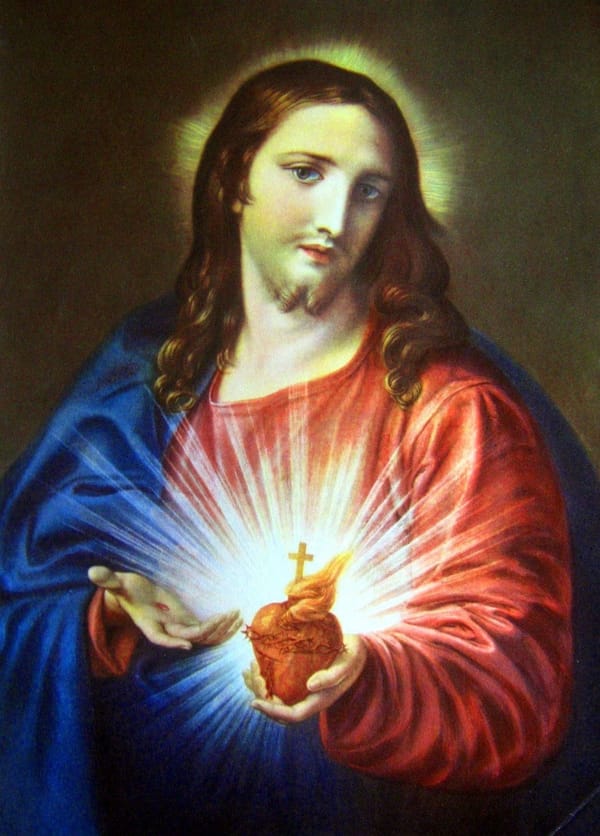
The Feast of the Sacred Heart of Jesus (Friday after the Octave of Corpus Christi)
A new ray of light shines to-day in the heaven of holy Church, and its light brings warmth. The divine Master given to us by our Redeemer, that is, the Paraclete Spirit, who has come down into this world, continues His teachings to us in the sacred liturgy. The earliest of these His divine teachings was the mystery of the Trinity; and we have worshipped the blessed Three: we have been taught who God is, we know Him in His own nature, we have been admitted, by faith, into the sanctuary of the infinite Essence. Then this Spirit, the mighty wind of Pentecost,1 opened to our souls new aspects of the truth, which it is His mission to make the world remember;2 and His revelation left us prostrate before the sacred Host, the Memorial which God Himself has left us of all His wonderful works.3 To-day it is the sacred Heart of the Word made flesh that this holy Spirit puts before us, that we may know and love and adore it.
There is a mysterious connexion between these three feasts, of the blessed Trinity, Corpus Christi, and the sacred Heart. The aim of the Holy Ghost, in all three, is to initiate us more and more into that knowledge of God by faith, which is to fit us for the face-to-face vision in heaven. We have already seen how God, being made known to us, by the first, in Himself, manifests Himself to us, by the second, in His outward works; for the holy Eucharist is the memorial, here below, in which He has brought together, and with all possible perfection, all those His wondrous works. But by what law can we pass so rapidly, so almost abruptly, from one feast, which is all directly regarding God, to another, which celebrates the works done by Him to and for us? Then again: how came the divine thought, the eternal Wisdom, from the infinite repose of the eternally blessed Trinity, to the external activity of a love for us poor creatures, which has produced what we call the mysteries of our redemption? The Heart of the Man-God is the solution of these difficulties; it answers all such questions, and explains to us the whole divine plan.
We knew that the sovereign happiness which is in God, we knew that the life eternal communicated from the Father to the Son, and from these two to the Holy Ghost, in light and love, was to be given by the will of these three divine Persons to created beings; not only to those which were purely spiritual, but likewise to that creature whose nature is the union of spirit and matter, that is, to man. A pledge of this life eternal was given to him in the Sacrament of the Eucharist. It is by the Eucharist that man, who has already been made a partaker of the divine nature4 by the grace of the sanctifying Spirit, is united to the divine Word, and is made a true member of this only-begotten Son of the Father. Though it hath not yet appeared what we shall be, says St. John, still we are now the sons of God; we know that, when He shall appear, we shall be like to Him;5 for we are called to live, as the Word Himself does, in the society of His eternal Father for ever and ever.6
But the infinite love of the sacred Trinity, which thus called us frail creatures to a participation in Its own blessed life, would accomplish this merciful design by means of another love, a love more like that which we ourselves can feel; that is, the created love of a human Soul, evinced by the beatings of a Heart of flesh like our own. The Angel of the great Counsel, who is sent to make known to the world the merciful designs of the Ancient of days, took to Himself, in order to fulfil His divine mission, a created, a human form; and this would enable men to see with their eyes, yea, and even touch with their hands, the Word of life, that life eternal which was with the Father, but appeared even unto us.7 This human nature, which the Son of God took into personal union with Himself, from the womb of the Virgin-Mother, was the docile instrument of infinite love, but it was not absorbed into, or lost in, the Godhead; it retained its own substance, its special faculties, its distinct will, which will ruled, under the influence of the divine Word, the acts and movements of His most holy Soul and adorable Body. From the very first instant of its existence, the human Soul of Christ was inundated, more directly than was any other creature, with that true light of the Word, which enlighteneth every man who cometh into this world;8 it enjoyed the face-to-face vision of the divine Essence; and therefore took in, at a single glance, the absolute beauty of the sovereign Being, and the wisdom of the divine decree which called finite beings into a participation of infinite bliss. It understood its sublime mission, and conceived an immense love for man and for God. This love began simultaneously with life, and filled not only His Soul, but impressed, in its own way, the Body too, the moment it was formed from the substance of the Virgin-Mother by the operation of the Holy Ghost. The effect of His love told, consequently, upon His Heart of true human flesh; it set in motion those beatings, which made the Blood of redemption circulate in His sacred veins.
For it was not with Him as with other men, the pulsations of whose hearts are, at first, the consequence of nothing but the vital power which is in the human frame; until, when reason has awakened, emotions produce physical impressions, which quicken or dull the throbbings of the heart. With the Man-God it was not so: His Heart, from the very first moment of its life, responded to the law of His Soul’s love, whose power to act upon His human Heart was as incessant, and as intense, as is the power of organic vitality—a love as burning at the first instant of the Incarnation, as it is this very hour in heaven. For the human love of the Incarnate Word, resulting from His intellectual knowledge of God and of creatures, was as perfect as that knowledge, and therefore as incapable of all progress; though, being our Brother, and our model in all things, He, day by day, made more manifest to us the exquisite sensibility of His divine Heart.
At the period of Jesus’ coming upon this earth, man had forgotten how to love, for he had forgotten what true beauty was. His heart of flesh seemed to him as a sort of excuse for his false love of false goods: his heart was but an outlet, whereby his soul could stray from heavenly things to the husks of earth, there to waste his power and his substance.9 To this material world, which the soul of man was to render subservient to its Maker’s glory—to this world, which, by a sad perversion, kept man’s soul a slave to his senses and passions—the Holy Ghost sent a marvellous power, which, like a resistless lever, would replace the world in its right position: it was the sacred Heart of Jesus; a Heart of flesh, like that of other human beings, from whose created throbbings there would ascend to the eternal Father an expression of love, which would be a homage infinitely pleasing to the infinite Majesty, because of the union of the Word with that human Heart. It is a harp of sweetest melody, that is ever vibrating under the touch of the Spirit of love; it gathers up into its own music the music of all creation, whose imperfections it corrects, whose deficiencies it supplies, tuning all discordant voices into unity, and so offering to the glorious Trinity a hymn of perfect praise. The Trinity finds its delight in this Heart. It is the one only organum, as St. Gertrude calls it,10 the one only instrument which finds acceptance with the Most High. Through it must pass all the inflamed praises of the burning Seraphim, just as must the humble homage paid to its God by inanimate creation. By it alone are to come upon this world the favours of heaven. It is the mystic ladder between man and God, the channel of all graces, the way whereby man ascends to God, and God descends to man.
The Holy Ghost, whose master-piece it is, has made it a living image of Himself; for although in the ineffable relations of the divine Persons, He is not the source of love, He is its substantial expression, or in theological language, the term; it is He who inclines the holy Trinity to those works outside Itself, which produce creatures; and then, having given them being, and to some life, He (the holy Spirit) pours out upon them all the effusion of their Creator’s love for them. And so it is with the love which the Man-God has for God and Man: its direct and, so to say, material expression is the throbbing it produces upon His sacred Heart; and again, it is by that Heart, that, like the Water and Blood which came from His wounded Side, He pours out upon the world a stream of redemption and grace, which is to be followed by the still richer one of glory.
One of the soldiers, as the Gospel tells us, opened Jesus’ Side with a spear, and immediately there came out blood and water.11 We must keep before us this text and the fact it relates, for they give us the true meaning of the feast we are celebrating. The importance of the event here related is strongly intimated, by the earnest and solemn way in which St. John follows up his narration. After the words just quoted, he adds: ‘And he that saw it hath given testimony of it, and his testimony is true. And he knoweth that he saith true, that ye also may believe; for these things were done, that the Scripture might be fulfilled.’12 Here the Gospel refers us to the testimony of the Prophet Zacharias, who after predicting that the Spirit of grace would be poured out upon the house of David and the inhabitants of Jerusalem,13 says: ‘They shall look upon Him whom they pierced.’14
And when they look upon His side thus pierced, what will they see there, but that great truth which is the summary of all Scripture and of all history: ‘God so loved the world, as to give it His only-begotten Son; that whosoever believeth in Him, may not perish, but may have eternal life.15 This grand truth was, during the ages of expectation, veiled under types and figures; it could be deciphered but by few, and even then only obscurely; but it was made known with all possible clearness on that eventful day, when, on Jordan’s banks,16 the whole sacred Trinity manifested who was the Elect, the chosen One, of the Father—the Son in whom He was so well pleased.17 It was Jesus of Nazareth, the Son of Mary. But there was another revelation, of deepest interest to us, which had still to be made: it was—how, and in what way, would the eternal life brought by Jesus into the world, pass from Him into each one of us? This second revelation was made to us, when the soldier’s spear opened the divine source, and there flowed from it that Water and Blood, which, as the Scripture tells us, completed the testimony of the blessed Three. ‘There are three,’ says St. John, ‘who give testimony in heaven: the Father, the Word, and the Holy Ghost: and these three are One. And there are three that give testimony on earth: the Spirit, and the Water, and the Blood: and these three are one,’ that is, they are one, because they concur in giving the one same testimony. ‘And this,’ continues St. John, ‘is the testimony: that God hath given to us eternal life, and that this life is in His Son.’18 These words contain a very profound mystery; but we have their explanation in to-day’s feast, which shows us how it is through the Heart of the Man-God that the divine work is achieved, and how, through that same Heart, the plan which was conceived, from all eternity, by the Wisdom of the Father, has been realized.
To communicate His own happiness to creatures, by making them, through the Holy Ghost, partakers of His own divine nature,19 and members of His beloved Son—this was the merciful design of the Father; and all the works of the Trinity, outside Itself, tend to the accomplishment of that same. When the fullness of time had come, there appeared upon our earth He that came by water and blood, Jesus Christ; not by water only, but by water and blood. The Spirit, who, together with the Father and the Son, has already on the banks of Jordan given His testimony, gives it here again, for St. John continues: ‘And it is the Spirit which testifieth, that Christ is the truth;20 and that He spoke the truth when He said of Himself, that He is Life.21 The Spirit, as the Gospel teaches us,22 comes forth with the water from the fountains of the Saviour,23 and makes us worthy of the precious Blood, which flows together with the water. Then does mankind, thus born again of water and the Holy Ghost, become entitled to enter into the kingdom of God;24 and the Church, thus made ready for her Spouse in those same waters of Baptism, is united to the Incarnate Word in the Blood of the sacred Mysteries. We, being members of that holy Church, have the same union with Christ; we are bone of His bones, and flesh of His flesh;25 we have received the power to be made adopted sons of God,26 and sharers, for all eternity, of the divine life, which He, the Son by nature, has in the bosom of the Father.
On, then, thou Jew! though ignorant of the nuptials of the Lamb, give the signal of their being accomplished. Lead the Spouse to the nuptial bed of the cross; He will lay Himself down on that most precious Wood, which His mother, the Synagogue, has made to be His couch; she prepared it for Him, on the eve of the day of His alliance, when from His sacred Heart His bride is to come forth, together with the Water which cleanses her, and the Blood which is to be her dower. It was for the sake of this bride, that He left His Father, and the bright home of His heavenly Jerusalem; He ran, as a giant, in the way of His intense love; He thirsted, and the thirst of desire gave Him no rest. The scorching wind of suffering which dried up His bones, was less active than the fire which burned in His Heart, and made its beatings send forth, in the agony in the garden, the Blood which, on the morrow, was to be spent for the redemption of His bride. He has reached Calvary, it is the end of His journey; He dies; He sleeps, with His burning thirst upon Him. But the bride, who is formed for Him during this His mysterious sleep, will soon rouse Him from it. That Heart, from which she was born, has broken, that she might come forth; broken, it ceased to beat; and the grand hymn which, through it, had been so long ascending from earth to heaven, was interrupted; and creation was dismayed at the interruption. Now that the world has been redeemed, man should sing more than ever the canticle of his gratitude: and the strings of the harp are broken! Who will restore them? Who will re-awaken in the Heart of Jesus the music of its divine throbbings?
The new-born Church, His bride, is standing near that opened side of her Jesus; in the intensity of her first joy, she thus sings to God the Father: ‘I will praise Thee, O Lord, among the people, and I will sing unto Thee among the nations.’ Then, to her Jesus: ‘Arise, Thou, my glory! my psaltery, my harp, arise!’27 And He arose in the early morning of the great Sunday; His sacred Heart resumed its melody, and, with it, sent up to heaven the music of holy Church, for the Heart of the Spouse belongs to His bride, and they are now two in one flesh.28
Christ, being now in possession of her who has wounded His Heart,29 gives her, in return, full power over that sacred Heart of His, from which she has issued. There lies the secret of all the Church’s power. In the relations existing between husband and wife, which were created by God at the beginning of the world, and (as the apostle assures us) in view of this great mystery of Christ and the Church,30 man is the head,31 and the woman may not domineer in the government of the family. Has the woman, then, no power? She has power, and a great power: she must address herself to her husband’s heart, and gain all by love. If Adam, our first father, sinned, it was because Eve used, and for evil, her influence over his heart, by misleading him, and us in him. Jesus saves us, because the Church has won His Heart; and that human Heart could not be won, without the Divinity also being moved to mercy. And here we have the doctrine of devotion to the sacred Heart of Jesus, as far as regards the principle upon which it rests. In this its primary and essential notion, the devotion is as old as the Church herself, for it rests on this truth, which has been recognized in every age: that Christ is the Spouse, and the Church is His bride.
The fathers and holy doctors of the early ages had no other way, than this, of expounding the mystery of the Church's formation from Jesus’ side; and the words they used—though always marked by that reserve which was called for by so many of their hearers being as yet uninitiated—were taken as the text for the sublime and fearless developments of later ages. ‘The initiated,’ says St. John Chrysostom, ‘know the mystery of the Saviour’s fountains; from those, that is, from the Blood and the Water, the Church was formed; from those same, came our Mysteries; so that, when thou approachest the dread chalice, thou must come up to it, as though thou wert about to drink of that very Side of Christ.’32 ‘The Evangelist,’ says St. Augustine, 'made use of a word which has a special import, when he said: the soldier opened Jesus’ Side with a spear. He did not say struck the Side, or wounded the Side, or anything else like that; hut he said he opened Jesus’ Side. He opened it; for that Side was like the door of life; and when it was opened, the Sacraments (the Mysteries) of the Church came through it . . . This was predicted by that door which Noe was commanded to make in the side of the Ark, through which were to go those living creatures which were not to be destroyed by the deluge; and all these things were a figure of the Church.’33
‘Enter thou into the rock, and hide thee in the pit,’34 says Isaias; and what means this, but, ‘enter into the Side of thy Lord?’ as the expression is interpreted, in the thirteenth century, by Guerric, a disciple of St. Bernard, and Abbot of Igny.35 St. Bernard himself thus comments the thirteenth and fourteenth verses of the second chapter of the Canticle: 'Come my dove, in the clefts of the rock, in the hollow places of the wall:36 O beautiful clefts of the rock, wherein the dove takes safe shelter, and fearlessly looks at the hawk that hovers about! . . . And what may I see through that opening? The iron hath pierced His soul, and His Heart hath come near; so that, through the cleft, the mystery of His Heart is made visible, that great mystery of love, those bowels of the mercy of our God.... What else art thou, O Lord, but treasures of love, but riches of goodness? . . . I will make my way to those full store-cellars. I will take the prophet’s advioe, and will leave the cities; I will dwell in the rock, and be like the dove that maketh her nest in the mouth of the hole in the highest place.37 Sheltered there, as Moses was in the hole of the rock,38 I will see my Lord, as He passes by.’39 In the next century, we have the Seraphic Doctor, St. Bonaventure, telling us in his own beautiful style, how the new Eve was born from the Side of Christ, when in His sleep; and how the spear of Saul was thrown at David, and struck the wall,40 as though it would make its way into Him, of whom David was but a type, that is, Christ, who is the rock,41 the mountain-cave where are salubrious springs, the shelter where doves build their nests.42
Our readers will not expect us to do more than give them this general view of the great mystery, and tell them how the holy doctors of the Church spoke of it. As far as St. Bernard and St. Bonaventure are concerned, the devotion to the mystery of Christ’s side opened on the cross, is but a part of that which they would have us show to the other wounds of our Redeemer. The sacred Heart, as the expression of Jesus’ love, is not treated of, in their writings, with the explicitness wherewith the Church would afterwards put it before us. For this end, our Lord Himself selected certain privileged souls, through whose instrumentality He would bring the Christian world to a fuller appreciation of the consequences which are involved in the principles admitted by the whole Church.
It was on January 27 in the year 1281, in the Benedictine monastery of Helfta, near Eisleben, in Saxony, that our divine Lord first revealed these ineffable secrets to one of the community of that house, whose name was Gertrude. ‘She was then in the twenty-fifth year of her age. The Spirit of God came upon her, and gave her her mission. She saw, she heard, she was permitted to touch, and what is more, she drank of, that chalice of the sacred Heart, which inebriates the elect. She drank of it, even whilst in this vale of bitterness; and what she herself so richly received, she imparted to others, who showed themselves desirous to listen. St. Gertrude’s mission was to make known the share and action of the sacred Heart in the economy of God’s glory and the sanctification of souls; and, in this respect, we cannot separate her from her companion, St. Mechtilde.
On this special doctrine regarding the Heart of the Man-God, St. Gertrude and St. Mechtilde hold a very prominent position among all the saints and mystical writers of the Church. In saying this, we do not except even the saints of these later ages, by whom our Lord brought about the public, official worship, which is now given to His sacred Heart. These saints have spread the devotion, now shown to it, throughout the whole Church; but they have not spoken of the mysteries it contains within it, with that set purpose, that precision, that loveliness which we find in the ‘Revelations’ of the two saints, Gertrude and Mechtilde.
It was the beloved disciple, who had rested his head upon Jesus’ breast at the Supper, and perhaps heard the beatings of the sacred Heart—the disciple who, when standing at the foot of the cross, had seen that Heart pierced with the soldier’s spear—who announced to Gertrude its future glorification. She asked him how it was that he had not spoken, in his writings in the new Testament, of what he had experienced when he reclined upon Jesus’ sacred Heart. He thus replied: “My mission was to write, for the Church which was still young, a single word of the uncreated Word of God the Father, that uncreated Word, concerning which the intellect of the whole human race might be ever receiving abundant truth, from now till the end of the world, and yet would never fully comprehend it. As to the sweet eloquence of those throbbings of His Heart, it is reserved for the time when the world has grown old, and has become cold in God’s love, that it may regain favour by the hearing such revelation.” (The Legate of Divine Love. Bk. iv. ch. 4.)
‘Gertrude was chosen as the instrument of that revelation; and what she has told us is exquisitely beautiful. At one time, the divine Heart is shown to her as a treasure, which holds all riches within it; at another, it is a harp played upon by the holy Spirit, and the music which comes from it gladdens the blessed Trinity, and all the heavenly court. It is a plenteous spring, whose stream bears refreshment to the souls in purgatory, strength and every other grace to them that are still struggling on this earth, and delights which inebriate the blessed in the heavenly Jerusalem. It is a golden thurible, whence there ascend as many different sorts of fragrant incense, as there are different races of men, for all of whom our Redeemer died upon the cross. It is an altar, upon which the faithful lay their offerings, the elect their homage, the angels their worship, and the eternal High Priest offers Himself as a sacrifice. It is a lamp suspended between heaven and earth. It is a chalice out of which the saints, but not the angels, drink, though these latter receive from it delights of varied kinds. It was in this Heart that was formed and composed the Lord’s Prayer, the Pater noster; that prayer was the fruit of Jesus’ Heart. By that same sacred Heart are supplied all the negligences and deficiencies which are found in the honour we pay to God, and His blessed Mother and the saints. The Heart of Jesus makes itself as our servant, and our bond, in fulfilment of all the obligations incumbent on us; in it alone do our actions derive that perfection, that worth, which makes them acceptable in the eyes of the divine Majesty; and every grace, which flows from heaven to earth, passes through that same Heart. When our life is at its close, that Heart is the peaceful abode, the holy sanctuary, ready to receive our souls as soon as they have departed from this world; and having received them, it keeps them in itself for all eternity, and beatifies them with every delight!’43
By thus revealing to Gertrude the admirable mysteries of divine love, included in the doctrine which attaches to the sacred Heart of Jesus, the holy Spirit was, so to say, forestalling the workings of hell, which, two centuries later on, were to find their prime mover in that same spot. Luther was born at Eisleben, in the year 1483. He was the apostle, after being the inventor, of theories the very opposite of what the sacred Heart reveals. Instead of the merciful God, as known and loved in the previous ages, Luther would have the world believe Him to be the direct author of sin and damnation, who creates the sinner for crime and eternal torments, and for the mere purpose of showing that He could do anything, even injustice! Calvin followed; he took up the blasphemous doctrines of the German apostate, and rivetted the protestant principles by his own gloomy and merciless logic. By these two men, the tail of the dragon dragged the third part of the stars of heaven.44 In the seventeenth century, the old enemy put on hypocrisy in the shape of Jansenism; changing the names of things, but leaving the things unchanged, he tried to get into the very centre of the Church, and there pass off his impious doctrines; and Jansenism—Which, under the pretext of safeguarding the rights of God’s sovereign dominion, aimed at making men forget that He was a God of mercy—was a favourable system, wherewith the enemy might propagate his so-called Reformation. God, who so loved the world,45 beheld mankind discouraged or terrified, and behaving as though in heaven there was little mercy, and less love. This earth was to be made to see that its Creator had loved it with affectionate love; that He had taken a Heart of flesh in order to bring that infinite love within man’s reach and sight; that He made that human Heart, which He had assumed, do its work, that is, beat and throb from love, just as ours do; for He had become one of ourselves, and, as the prophet words it, had taken the cords of Adam.46 That Heart felt the thrill of joy when duty-doing made us joyous; it felt a weight and pang when it saw our sorrows; it was gladsome when it found that, here and there, there would be souls to love it in return. How were men to be told all this? Who would be chosen to fulfil the prophecy made by Gertrude the Great? Who would come forth, like another Paul or John, and teach the world, now grown old, the language of the divine throbbings of Jesus’ Heart?
There were then living many men noted for their learning and eloquenoe; but they would not suit the purpose of God. God, who loves to choose the weak in order to oonfound the strong,47 had seleoted for manifesting the mystery of the sacred Heart, one whom the world knew not:—a religious woman, living in a monastery which had nothing about it to attract notice. As, in the thirteenth century, He had passed by the learned men, and even the great saints, who were then living, and selected the Blessed Juliana of Liège as instrument for bringing about the institution of the Corpus Christi feast, so in this present case: He would have His sacred Heart glorified in His Church by a solemn festival; and He imparts and intrusts His wish to the humble Visit andine of Paray-le-Monial, now known and venerated, throughout the world, under the name of Blessed Margaret-Mary. The mission thus divinely given to her, was to bring forward the treasure, which had been revealed to St. Gertrude, and which, all the long interval, had been known to only a few privileged souls. Sister Margaret-Mary was to publish the secret to the whole world, and make the privilege cease, by telling every one how to possess it. Through this apparently inadequate instrument, the sacred Heart of Jesus was a heavenly reaotion offered to the world against the chilliness which had settled on its old age: it became a touching appeal to all faithful souls that they would make reparation for all the contempt, and slight, and coldness, and sins, wherewith our age treats the love of our Lord and Saviour Christ Jesus.
‘I was praying before the blessed Sacrament on one of the days during the octave1 (of Corpus Christi, June 1675) says Blessed Margaret, ‘and I received from my God exceeding great graoes of His love. And feeling a desire to make some return, and give Him love for love, I heard Him say: “Thou canst not make me a greater, than by doing that which I have so often asked of thee.” He then showed me His divine Heart, and said: “Behold this Heart, which has so loved men, as that it has spared nothing, even to the exhausting and wearing itself out, in order to show them its love; and instead of acknowledgment I receive, from the greater number, nothing but ingratitude, by their irreverences and sacrileges, and by the coldness and contempt wherewith they treat Me, in this Sacrament of love. But what I feel most deeply is, that they are hearts consecrated to Me, which thus treat Me. It is on this account, that I make this demand of thee: that the first Friday after the octave of the blessed Sacrament be devoted to a special feast in honour of My Heart; that thou wilt go to Communion on that day; and give it a reparation of honour by an act of amendment, to repair the insults it has received during the time of its being exposed on the altar. I promise thee, also, that My Heart will dilate itself, that it may pour forth, with abundance, the influences of its divine love upon those who shall thus honour it, and shall do their best to have such honour paid to it”.’
By thus calling His servant to be the instrument of the glorification of His sacred Heart, our Lord made her a sign of contradiction, just as He Himself had been.48 It took more than ten years for Blessed Margaret to get the better, by patience and humility, of the suspicions wherewith she was treated by the little world around her, and of the harsh conduct of the Sisters who lived with her in the same monastery, and of trials of every sort. At last, on June 21 in the year 1686, the Friday after the octave of Corpus Christi, she had the consolation of seeing the whole Community of Paray-le-Monial kneeling before a picture, which represented the Heart of Jesus as pierced with a spear; it was the Heart by itself; it was encircled with flames, and a crown of thorns, with the cross above it, and the three nails. That same year, there was begun, in the monastery, the building of a chapel in honour of the sacred Heart; and Blessed Margaret had the happiness of seeing it finished and blessed. She died shortly afterwards, in the year 1690. But all this was a very humble beginning: where was the institution of a feast, properly so called? and where its solemn celebration throughout the Church?
So far back as the year 1674, our Lord had, in His own mysterious way, brought Margaret-Mary to form the acquaintance of one of the most saintly Religious of the Society of Jesus then living; it was Father De la Colombière. He recognized the workings of the holy Spirit in this His servant, and became the devoted apostle of the sacred Heart, first of all at Paray-le-Monial, and then, later on, in England, where he was imprisoned by the heretics, and merited the glorious title of Confessor of the faith. This fervent disciple of the Heart of Jesus died in the year 1682, worn out by his labours and sufferings; but the Society, in a body, inherited his zeal for the propagation of devotion to the sacred Heart. At once, numerous confraternities began to be formed, and everywhere chapels were built in honour of that same Heart. Hell was angry at this great preaching of God’s love. The Jansenists were furious at this sudden proclamation, at this apparition, as St. Paul would say, of the goodness and kindness of God our Saviour;49 for it aimed at restoring hope to souls, in which they had sowed despondency. The big world must interfere; and it began by talking of innovations, of scandals, of even idolatry; at all events, this new devotion was, to put it mildly, a revolting dessecting of the sacred Body of Christ! Erudite pamphlets were published, some theological, some physiological, to prove that the Church should forbid the subject! Indecent engravings were circulated, and indignant witticisms were made, in order to bring ridicule upon those for whom the world had coined the name of Cordicolæ, or Heart worshippers.50
But human wisdom, or human prejudice, or even human ridicule, cannot withstand God’s purposes. He wished that human hearts should be led to love, and therefore worship, the sacred Heart of their Redeemer; and He inspired His Church to receive the devotion which would save so many souls, though the world might not take heaven’s view. The apostolic See had witnessed all this; and at last gave its formal sanction. Rome had frequently granted Indulgences in favour of the devotions privately practised towards the sacred Heart; she had published innumerable Briefs for the establishment of local confraternities, under that title; and in the year 1765, in accordance with the request made by the bishops of Poland and the arch-confraternity of the sacred Heart at Rome, Pope Clement XIII issued the first pontifical decree in favour of the feast of the Heart of Jesus, and approved of a Mass and Office which had been drawn up for that feast. The same favour was gradually accorded to other Churches, until at length, on August 23, 1856, Pope Pius IX of glorious mcmory, at the instance of all the bishops of France, issued the decree for inserting the feast of the sacred Heart on the calendar, and making obligatory its celebration by the universal Church.
The glorification of the Heart of Jesus called for that of its humble handmaid. On September 18, 1864, the beatification of Margaret-Mary was solemnly proclaimed by the same sovereign Pontiff, who had put the last finish to the work she had begun, and given it the definitive sanction of the apostolic See.
From that time forward, the knowledge and love of the sacred Heart have made greater progress, than they had done during the whole two previous centuries. In every quarter of the globe, we have heard of communities, religious Orders, and whole dioceses, consecrating themselves to this source of every grace, this sole refuge of the Church in these sad times. Thousands, from every country, have gone on pilgrimage to the favoured sanctuary of Paray-le-Monial, where it pleased the divine Heart to first manifest Itself, in its visible form, to us mortals.
We now put before our readers the Mass, which has been approved of for our feast.
Mass
In the liturgy of this feast, there is scarcely any mention made of the Heart of Flesh assumed by our Saviour. When, in the last century, there was question of approving a Mass and Office in honour of the sacred Heart, the Jansenists, who had zealous partisans even in Rome, excited so much opposition, that the apostolic See did not deem it prudent to speak openly, at that early period, on the points which some so angrily disputed. It, however, readily granted, both to Portugal and the Republic of Venice, an Office, in which the Heart of Jesus, victim of love, and pierced with a spear, was offered to the adorations of the faithful. But in the Mass and Office which Rome afterwards gave for the general use, she, out of a motive of prudence, kept to the glorification of our Redeemer’s love, of which it could not reasonably be denied that His Heart of Flesh was the true and direct symbol.
Thus, the Introit, which is taken from Jeremias, extols the infinite mercies of Him, whose Heart has not cast off the children of men.
Introit
Ps. Misericordias Domini in aeternum cantabo: in generationem et generationem.℣. Gloria Patri. Miserebitur.
Ps. The mercies of the Lord I will sing for ever: to generation and generation.℣. Glory, etc. He will have mercy.
The Church, deeply moved with gratitude for the immense blessings brought to her by the sacred Heart, prays, in her Collect, that her children may have the grace to appreciate those divine benefits, and receive, with holy joy, the fruits they are intended to produce.
Collect
Epistle
Cap. xii.Confitebor tibi, Domine, quoniam iratus es mihi: conversus est furor tuus, et consolatus es me. Ecce Deus Salvator meus, fiducialiter agam, et non timebo: quia fortitudo mea, et laus mea Dominus, et factus est mihi in salutem. Haurietis aquas in gaudio de fontibus Salvatoris, et dicetis in die illa: Confitemini Domino, et invocate nomen ejus: mementote quoniam excelsum est nomen ejus. Cantate Domino quoniam magnifice fecit: annuntiate hoc in universa terra. Exsulta, et lauda, habitatio Sion: quia magnus in medio tui Sanctus Israel.
Ch. xii.I will give thanks to thee, O Lord, for thou wast angry with me; thy wrath is turned away, and thou hast comforted me. Behold, God is my Saviour; I will deal confidently, and will not fear: because the Lord is my strength, and my praise, and he is become my salvation. You shall draw waters, with joy, out of the Saviour’s fountains, and you shall say, in that day: Praise ye the Lord, and call upon his name: remember that his name is high. Sing ye to the Lord, for he hath done great things: show this forth, in all the earth. Rejoice, and praise, O thou habitation of Sion: for great is he that is in the midst of thee, the Holy One of Israel.
‘My people have done two evils,’ said God, in the ancient Covenant: ‘they have forsaken Me, the fountain of living water, and have digged to themselves cisterns, broken cisterns, that can hold no water.’51 How wonderful is this complaint! It is made by infinite love, on seeing His proffered benefits refused. And what is still more wonderful, the God thus slighted by His ungrateful children, who pretend to find their happiness in something which is not Himself, overlooks the insult, to consult for the remedying of their misery. He is touched at seeing these poor mistaken children trying to get their burning thirst quenched by created things, whereas He alone can quench it. Material goods, and outward beauty, have misled them, and made them slaves to their sensual appetites: their soul, which was created for infinite good, has thought it might find its rest in those feeble and flittering reflections of the sovereign beauty—reflections and images which were intended to lead them to the divine reality. How lead back to the living fountain the poor creature who has been made a dupe of the mirage of the desert, and is rushing on deeper and deeper into the scorching sands? O Israel! sing praise to thy Lord! And thou, Sion, bless thy God for His infinite mercy towards thee! Water has sprung forth from the Rock which thou hast met in the wilderness, where the madness of thy guilty fever kept thee a wanderer. On the very steep which was precipitating thee downwards towards the flesh, thou hast met thy Jesus; He has made Himself thy companion on the way of this earth’s life; He is God, but He has been made Flesh, that so, for thy soul’s good, He might draw thee as the prophet foretold, with the cords of Adam,52 that is, by the love and loveliness of that Heart of Flesh, lead thee to the object which was to satisfy thine own heart, and for which thou wast created. Thus made captive to the Infinite by the bands of this love which Jesus showed thee,53 thou hast found thyself within reach of the fountain of water, which springeth up into life everlasting;54 and thy joy at finding thy Saviour’s fountains has made thee loathe the muddy water of the broken cisterns of old. Thy thirst keeps on, but the water is ever there for thee to drink in as deeply as thou wiliest: thou hast the sacred Heart, which was opened for thee by the soldier’s spear. Thirst, and drink, and both for ever!
The immense love which fills the Heart of the Man-God, and has led Him to undergo unparalleled sufferings in order to save us; the meekness and humility of that divine Heart, which He Himself would have us take as the chief characteristic of His whole life: these are the mysteries proposed by the Gradual and Alleluia-verse, that we may know them, and let them influence our conduct.
Gradual
Gospel
Cap. xix.In illo tempore: Judæi (quoniam Parasceve erat) ut non remanerent in cruce corpora Sabbato (erat enim magnus dies ille Sabbati) rogaverunt Pilatum ut frangerentur eorum crura, et tollerentur. Venerunt ergo milites: et primi quidem fregerunt crura, et alterius, qui crucifixus est cum eo. Ad Jesum autem cum venissent, ut viderunt eum jam mortuum, non fregerunt ejus crura; sed unus militum lancea latus ejus aperuit, et continuo exivit sanguis et aqua. Et qui vidit testimonium perhibuit: et verum est testimonium ejus.
Ch. xix.At that time: the Jews, (because it was the Parasceve), that the bodies might not remain upon the cross on the Sabbath-day, (for that was a great Sabbath-day), besought Pilate that their legs might be broken, and that they might be taken away. The soldiers therefore came: and they broke the legs of the first, and of the other that was crucified with him. But after they were come to Jesus, when they saw that he was already dead, they did not break his legs; but one of the soldiers with a spear opened his side, and immediately there came out blood and water. And he that saw it, hath given testimony: and his testimony is true.
We have already explained this passage of St. John’s Gospel; and, in doing so, we brought it into juxtaposition with certain texts from the first Epistle of the same apostle, which throw such light on what the Gospel relates regarding the opening of Jesus’ aide. Let us imitate our mother the Church, who hears these mysterious words with such profound attention. This Gospel tells us of the beautiful path by which she first came: she was born from the Heart of the Man-God. She could not have had any other beginning than this; for she is the work, by excellence, of His love; and it is for this His Bride, that He has accomplished all His other works. Eve was taken from Adam’s side, in figure of a future mystery; but, for the very reason of its being a type and a prediction, no trace was to be left of the fact itself. But in the mysterious fulfilment of the figure, that is, in Jesus’ side being opened that His Bride the Church might come forth, the trace was to remain for ever. As often as she looks at this wound, she is reminded of her glorious origin; and that open side is like a ceaseless reminder that she has but to go to that sacred Heart, and there she will find everything she needs for her children.
The Offertory is taken from Psalm cii, that magnificent hymn of love and gratitude, which extols the numberless favours and infinite mercies of God.
Offertory
Let us, in the Secret, unite with the Church in imploring of our Lord to enkindle within our souls the flames of His holy love, that thus our hearts may be in unison with that of our great High Priest, who offers a Sacrifice which is both His own and ours.
After the Secret, follows the Preface; it is that of the holy cross. Jesus was still attached to the sacred Wood, when His Heart was pierced and opened. The choice of such a Preface was an act of reverential love paid, by our holy mother, to the glorious instrument which gave her life by working her redemption.
Secret
Preface
In order to excite in her children the sentiments of reparation to the sacred Heart, which are so much in the spirit of this feast, the Church, at the moment of Communion, reminds them how their Jesus was abandoned, when in the midst of the sufferings which He endured out of love for us.
Communion
The Church, who has just been so closely united with her Spouse in these sacred Mysteries, is able to understand, all the more fully, the lessons given to her by the sacred Heart. She prays that her children may increase in true humility, may abhor the pride which is so rife in this fallen world, and prove themselves to be the disciples of Him, who was meek and humble of heart.
Postcommunion
We here give the three hymns of this feast; they are full of beauty and sublime teaching.
Hymn for Vespers
Christe Redemptor omnium,
Lumen Patris de lumine,
Deusque verus de Deo.
Mortale corpus sumere,
Ut novus Adam redderes
Quod vetus ille abstulerat:
Terræ, marisque et siderum,
Errata patrum miserans,
Et nostra rumpens vincula.
Vis illa amoris inclyti:
Hoc fonte gentes hauriant
Remissionis gratiam.
Passumque ad hoc est vulnera,
Ut nos lavaret sordibus
Unda fluente et sanguine.
Sanctoque sit Spiritui:
Quibus potestas, gloria,
Regnumque in omne est sæculum.
Christ, Redeemer of all men,
Light of the Father’s Light,
and true God of God!
to assume a mortal body,
that thou, the new Adam, mightest restore
what the old one had taken from us.
this earth, and sea and stars,
had pity on the sins of our first parents,
and broke our chains.
depart from thy Heart;
and let all nations come to this fount,
and thence draw the grace of pardon
for this it suffered the wounds,
that it might cleanse us from our defilements,
by the Water and Blood which flowed from it.
and to the Holy Ghost!
To whom are power, glory,
and the kingdom, for all ages!
Hymn for Matins
Et sæva nostrorum cohors
Cor sauciavit innocens
Merentis hand tale Dei.
Peccata nostra dirigunt,
Ferrumque dirae cuspidis
Mortale crimen acuit.
Christo jugata nascitur:
Hoc ostium arcæ in latere est
Genti ad salutem positum.
Ceu septiformis fluvius;
Stolas ut illic sordidas
Lavemus Agni in sanguine.
Quæ cor beatum lacerent;
Sed æmulemur cordibus
Flammas amoris indices.
Hoc, sancte, dona, Spiritus,
Quibus potestas, gloria,
Regnumque in omne est saeculum.
host of our sins has wounded
the innocent Heart of our God,
who deserved far other treatment!
of the soldier who brandishes it;
and deadly sin it is,
that sharpens the steel of the cruel lance.
the bride of Christ:
this opened Side is the door set in the side of the Ark
for the salvation of his people.
like a sevenfold stream;
that there, in the Blood of the Lamb,
we may wash our sullied robes.
which wound that blessed Heart;
yea, rather let us strive to kindle within our hearts the flames which burn round his,
and are symbols of its love.
and thou, O holy Spirit!
To whom are power, glory,
and the kingdom, for all ages!
Hymn for Lauds
Non servitutis veteris,
Sed gratiæ, sed veniæ,
Sed et misericordiae.
Intemeratum foederis,
Templum vetusto sanctius,
Velumque scissum utilius.
Ictu patenti voluit,
Amoris invisibilis
Ut veneremur vulnera.
Passus cruenta et mystica,
Utrumque sacrificium
Christus sacerdos obtulit.
Quis non redemptus diligat,
Et corde in isto seligat
Æterna tabernacula?
Sanctoque sit Spiritui:
Quibus potestas, gloria,
Regnumque in omne est sæculum.
not of the old bondage,
but of grace, and of pardon,
and of mercy.
thou temple, holier than the one of old!
Thou veil, that wast torn,
but by a tearing of such great boon to us.
with this open wound,
that we might see (through it) the wounds of thine unseen love,
and venerate them.
Christ, our High Priest,
having suffered both cruelly and mystically,
offered the twofold Sacrifice.
Who would not love him, by whom he has been redeemed?
Who would not wish to take up his abode
for ever in this his Jesus’ Heart?
and to the Holy Ghost!
To whom are power, glory,
and the kingdom, for all ages!
- Acts ii. 2. ↩︎
- St. John xiv. 26. ↩︎
- Ps. cx. 4. ↩︎
- 2 St. Pet. i. 4. ↩︎
- 1 St. John iii. 2. ↩︎
- Ibid. i. 3. ↩︎
- Ibid. 2. ↩︎
- St. John i. 9. ↩︎
- St. Luke xv. 13. ↩︎
- Legatus divina pietatis; lib. ii. c. 23; lib. iii. c. 25. ↩︎
- St. John xix. 34. ↩︎
- Ibid. 35, 36. ↩︎
- Zach. xii. 10. ↩︎
- Ibid. as quoted by St. John xix. 37. ↩︎
- St. John iii. 16. ↩︎
- St. Luke iii. 21, 22. ↩︎
- Is. xlii. 1. ↩︎
- 1 St. John v. 7, 8, 11. ↩︎
- 2 St. Pet. i. 4. ↩︎
- l St. John v. 6. ↩︎
- St. John v. 26. ↩︎
- Ibid. vii. 37-39. ↩︎
- Is. xii. 3. ↩︎
- St. John iii. 5. ↩︎
- Gen. ii. 23; Eph. v. 30. ↩︎
- St. John i. 12. ↩︎
- Ps. cvii. 1-4. ↩︎
- Gen. ii. 24; Eph. v. 31. ↩︎
- Cant. iv. 9. ↩︎
- Eph. v. 32. ↩︎
- 1 Cor. xi. 3. ↩︎
- In Joan. Hom. lxxxiv. 5. ↩︎
- In Joan. Tract. cxx. 2. ↩︎
- Is. ii. 10. ↩︎
- In Dom, Palm. Semi iv. ↩︎
- Cant. ii. 13, 14. ↩︎
- Jerem. xlviii. 28. ↩︎
- Exod. xxxiii. 22. ↩︎
- S. Bern. in Cant. Serm. lxi. ↩︎
- 1 Kings xviii. 10, 11. ↩︎
- 1 Cor. x. 4. ↩︎
- Lignum vitæ. ↩︎
- Preface to the Revelations of St. Gertrude translated into French from the new Latin edition, published by the Benedictine Fathers of Solesmes. ↩︎
- Apoc. xii. 4. ↩︎
- St. John iii. 16. ↩︎
- Osee. xi. 4. ↩︎
- l Cor. i. 27. ↩︎
- St. Luke ii. 34. ↩︎
- Tit. iii. 4. ↩︎
- In the year 1720, the city of Marseilles was visited by a plague. It had been brought by a vessel that had come from Syria. As many as a thousand a day fell victims to the scourge. Thc Parliament, which was mainly composed of Jansenists, had, of course, fled; and there was nothing being done to stay the contagion from spreading. The bishop, Monseigneur de Belzunce, assembled such of his priests as had been spared; and, standing in the avenue which is now called by his name, he solemnly consecrated his diocese to the sacred Heart of Jesus. At once the plague abated, and gradually disappeared. Two years later, however, it again showed itself, and threatened to repeat its fierce onslaught; but it was arrested in consequence of the city magistrates binding themselves and their successors for all future ages, by a vow, to the solemn acts of public worship, which, up to this present day, have proved a protection and a glory to the city of St. Lazarus.
These events were noised throughout the world, and were the occasion of the feast of the sacred Heart being kept, not only as hitherto, in the monasteries of the Visitation Order, but in several dioceses of France.
That noble, but tried, kingdom, is now erecting a national monument in honour of the sacred Heart of Jesus; it is the splendid church now being built on Monmartre, near Paris. May that loving Heart of our Lord bless His devoted France, the eldest daughter of the Church! Like the Church, she is under terrible trials; and as they are companions in affliction, may they, through the mercy of the Heart of Jesus, be soon united in prosperity, aud work together for the happiness of the world! ↩︎ - Jerem. ii. 13. ↩︎
- Osee xi. 4. ↩︎
- Ibid. ↩︎
- St. John iv. 14. ↩︎
June 19: St. Juliana Falconieri, Virgin
THIS day witnesses the close of the pilgrimage of one who was miraculously supplied with the divine Viaticum. Juliana presents herself at heaven's gate, showing upon her heart the impress of the sacred Host. The lily emblazoned on the city escutcheon of Florence glistens with fresh radiance to-day, for it was she who gave birth to our saint, as well as to so many others, some of whom have already beamed across our path, and some are about to follow; all of them brilliant in sublime virtues practised within the ancient walls of this 'city of flowers,' under the delighted glance and the urging influence of the Spirit of love. But what shall we say of the glory of the mountains which nobly crown this fair city, a diadem lovely in men's eyes, and still more so to angels’ gaze? What of Vallombrosa, and, farther in the blue distance, of Camaldoli, of Alberno? all sacred fortresses, at whose feet hell trembling howls, all sacred reservoirs of choicest grace, guarded by seraphim, whence flow in gushing streams, more abundant and more pure than Arno’s tide, living waters of salvation on all the smiling land around!
In 1233, just thirty-seven years previous to Juliana's birth, Florence seemed destined to be, under the holy influence of such a neighbourhood, a very paradise of sanctity; so common did the higher Christian life become, of such everyday occurrence were supernatural prodigies. The Mother of divine grace was then multiplying her gifts. On a certain festival of the Assumption seven of the citizens, the most distinguished for nobility of blood, fortune and public offices of trust, were suddenly inflamed by a heavenly desire to consecrate themselves unreservedly to the service of our Lady. Presently, as these men passed along bidding adieu to the world, babes at the breast cried out all over the city: ‘Behold the Servants of the Virgin Mary!’ Among the innocents whose tongues were thus unloosed to announce the divine mysteries was the new-born son of the illustrious family of Benizi. He was named Philip, and had first seen the light on the very feast of the Assumption, whereon Mary had just founded, for her glory and that of her divine Son, the Order of the Servites.
We shall have to return to this child, who was to be the chief propagator of the new Order; for holy Church celebrates his birthday into heaven on the morrow of the octave of the Assumption. He was destined to be Juliana’s spiritual father. In the meantime the seven invited by Mary to the festival of penitence, who all, persevering faithful unto death, are inscribed on the catalogue of the saints, had retired three leagues from Florence to the desert of Monte Senario. There our Lady, during seven years, formed them to the great work of which they were the predestined though unwitting instruments. According to his wont, the Holy Ghost, during all this preparatory season, though of long duration, kept from them every idea save that of their own sanctification, employing them in the mortification of the senses and in a spirit of exclusive contemplation of the sufferings of our Lord and those of his blessed Mother. Two amongst them daily came down to the city to beg bread for themselves and their companions. One of these illustrious mendicants was Alexius Falconieri, the most eager for humiliations amongst all the seven. His brother, who, still continuing in the world, held one of the highest positions amongst the citizens, was in every way worthy of this blessed man, and paid homage to his heroic self-abasement. He likewise took an honourable share in the united gift bestowed, with the concurrence of all classes of these religious citizens, upon the solitaries of Monte Senario, whereby a magnilicent church was added to the poor retreat they had been induced to accept, for greater convenience, at the gates of Florence.
To honour the mystery wherein their sovereign Lady declared herself to be the humble servant of the Lord, this church and monastery of the Servites of Mary received the title of the ‘Annunziata.’ Among the marvels which wealth and art in succeeding ages have lavished upon its interior, the principal treasure, which puts all the rest in the shade, is a primitive fresco of the angelical salutation, dating from the lifetime of the founders, the painter whereof, more devout to Mary than skilful with his pencil, deserved to be aided by the hands of angels. Signal favours obtained without interruption through this sacred picture still attract flocks of devout visitors. If the city of the Medici and of the Tuscan Grand Dukes, though swallowed up by the universal brigandage of the house of Savoy, has preserved better than many others the lively piety of better days, she owes it to this ancient Madonna, as well as to the numerous saints who seem gathered within her walls to serve as a cortège of honour for our Lady.
These details seem necessary to throw light on the abridged account given in the liturgy regarding our saint. Juliana, bom of a sterile mother and of a father advanced in years, was the reward of the zeal displayed for the 'Annunziata' by her father, Carissimo Falconieri. Beside this picture of the Madonna was she to spend her life and to yield up her last breath. Close by it her sacred relics now repose. Educated by her uncle, St Alexius, in the love of Mary and of humility, she devoted herself from her very youth to the Order founded by our Lady, ambitious for no title but that of Oblate, which would entail upon her the duty of serving, in the lowest rank, the Servant of God’s Mother. For this reason she was later on acknowledged to be the foundress of the Third Order of the Servites, and was superioress of the first community of these female tertiaries, surnamed 'Mantellatæ.' But her influence extended further still, so that the whole Order, both the men and the women alike, hail her as their mother; for it was indeed she who put the finishing stroke to the work of its foundation and gave it the stability it has possessed for centuries.
The Order, which had become marvellously extended during forty years of miraculous existence, was just then, under the government of St Philip Benizi, passing through a dangerous crisis, the more to be feared because the storm had taken rise in Rome itself. There was question of everywhere carrying into effect the canons of the councils of Lateran and Lyons, prohibiting the introduction of new Orders into the Church. Now the institute of the Servites being posterior to the first of these councils, Innocent V was resolved on its suppression. The superiors had already been forbidden to receive any novice to profession or to clothing; and whilst awaiting the definitive sentence, the goods of the Order were considered, beforehand, as already having devolved on the Holy See. Philip Benizi was about to die, and Juliana was but fifteen years of age. Nevertheless, enlightened from on high, the saint did not hesitate: he confided the Order into Juliana's hands, and so slept in the peace of our Lord. The event justified his hopes: after various catastrophes, which it were long to relate, Benedict XI, in 1304, gave to the Servites the definitive sanction of the Church. So true is it that in the counsels of divine Providence rank, age and sex count for naught! The simplicity of a soul that has wounded the Heart of the Spouse is stronger in her humble submission than highest authority; and her secret prayer prevails over powers established by God himself.
To serve Mary was the only nobility that had any attraction in thine eyes, O Juliana! To share her dolours was the only recompense which thy generous soul, in its lowliness, could desire. Thy desires were granted: but from her lofty throne the Queen of angels and of men, who confessed that she was the handmaid of the Lord and that God had regard to her humility,* was also pleased to exalt thee, like herself, above all the mighty ones. Counteracting that hidden silence wherein thou wouldst fain have had the human brilliancy of thy pedigree forgotten and lost for ever, she hath made thy holy glory eclipse the fair honour of thy sires in Florence; so that if the name of Falconieri has now a world-wide fame, it is on thy account, O humble tertiary, O lowly servant of the Servites of our Lady! Further still: in that fair home of true nobility, in yonder city of God, where ranks are distinguished by the varying degree of radiance shed by the Lamb on the brow of each one of the elect, thou dost shine resplendent with an aureole, which is nothing less than a participation of Mary’s glory. Just as she acted in regard of holy Church after the Ascension of our Lord, so didst thou in respect of the Servite Order; for whilst leaving to others external action and the authority to rule souls, thou wast none the less, in thy lowliness, the real mistress and mother of the new family chosen by God. More than once, in other centuries likewise, has the Mother of God been pleased thus to glorify her faithful imitators, by making them become, beyond all calculation of their own, faithful copies of herself. Just as in the family confided to Peter by her divine Son our Lady was the most submissive of all to the rule of Christ’s Vicar and that of the other apostles, whereas all knew right well that she was their Queen and the very fountain-head of the graces of consolidation and growth that were inundating the Church; so, O Juliana, the weakness of thy sex and age in no way restrained a strong religious Order from proclaiming thee its light and its glory. This was because the Most High, ever liberal in his gifts, was pleased to grant to thy youthfulness results which he refused to the greater maturity, to the genius, yea, to the sanctity of thy father, St Philip Benizi!
Continue, then, to shield thy devout family of Servites of Mary: stretch forth thy protecting mantle over every religious Order severely tried in these days. May Florence, through thine aid, ever hold in most precious remembrance the favours lavished on her by our Lady and the saints, because of her faith, in the good days of old. May holy Church ever have more and more cause to sing thy power as a bride over the heart of the divine Spouse. In return for the signal grace he bestowed on thee as the crown of thy life and the consummation of his love in thee, be propitious to us in our last struggle: obtain for us that we may not die unhelped by the reception of the holy Viaticum. The whole of this portion of the cycle is illumined with the rays of the adorable Host, proposed to our profound worship in so special a manner, at this season, by another Juliana. Oh! may that sweet Host be the one love of our life's career! May it be our strong bulwark in life's final combat! May our death be nothing else than a passing from the divine banquet of earth’s land of shadows up to the delights of eternal union!
* St Luke i 48, 52. ↩︎
June 19 (the Same Day): Sts. Gervase and Protase, Martyrs
THE mere commemoration made to-day of these two glorious brethren, whose names were formerly so celebrated throughout the West, must not lessen their merit in our eyes. The Holy Spirit, whose function it is to maintain within the bride of Jesus that divine mark of holiness whereby she is to be, up to the day of doom, for ever recognizable both to angels and to men, ceases not in every generation to raise up new saints, who more especially attract the devout homage of that particular period to which their virtues have served as an example and of which they are the distinctive glory. In thus honouring her children whose brilliant virtues add fresh jewels to her vesture, holy Church is moved by a sentiment of gratitude to the Paraclete for present benefits; yet these later manifestations can never make her forgetful of those wrought within her by the same divine Spirit in her earlier days. Gervase and Protase are indeed no longer honoured by the solemn feast preceded by a vigil, mentioned in the sacramentary of Gelasius; but they still occupy their important place in the Roman litanies, as representatives of the great martyr host. To these two, in preference to a vast array of martyrs whose festivals are now of a rite superior to theirs, does holy Church turn in the most solemn of all her supplications; whether it be in holy processions to implore the averting of scourges and the obtaining of blessings for this present life; or whether the sacred assembly of the whole Christian people, prostrate together with the Pontiff, unite in imploring the grace of abundant consecration to flow upon altars and temples, or upon priests, virgins, or kings.
We learn from the historians of sacred rites, that the Introit of the Mass of our two holy martyrs, The Lord will give peace unto his people, is a monument of the confidence of St Gregory the Great in their powerful succour. Filled with gratitude for results already obtained, he committed to their care, in the selection of this antiphon, the complete pacification of Italy, then a prey to Lombard invasion and to the petty vengeance of the Byzantine court.
Two centuries previously St Ambrose had had a first experience of the special power of pacification which it seemed our Lord Christ had attached to the very bones of these his glorious witnesses in return for their having given their life for him. The empress Justina and the Arian Auxentius now for a second time directed against the bishop of Milan a united assault of the powers of earth and of hell; and Ambrose, thus again ordered to abandon his Church, replied: ‘It were unseemly in a priest to deliver up the temple.’1 Upon the soldiers sent to lend main force to the invaders of the sacred precincts he threatened sentence of excommunication, if they passed one step farther; and they, knowing that they had engaged themselves to God by their baptism before having done so to their prince, thereupon refused to commit the sacrilege. To the court, terrified at the universal indignation that had ensued, and now praying him to quell the popular excitement aroused by these odious measures, he replied: ‘It is in my power not to excite it; but to appease it belongs only to God.’ When such troops as could be assembled, composed exclusively of Arians, were at length surrounding the basilica wherein was Ambrose, his faithful people were there to be seen gathered around him, in the name of the undivided and ever tranquil Trinity, sustaining, by the sole force of divine psalmody and sacred hymns, a novel kind of siege. But the last act of this two years' war levied against a disarmed man, the event which completed the overthrow of heresy, was the discovery of the relics of Gervase and Protase, precious treasures unconsciously possessed by Milan, and now revealed to their bishop by a heavenly inspiration.
Let us hearken to the bishop himself recounting these facts to his sister Marcellina in all the sweet simplicity of his great soul. Long consecrated by the Supreme Pontiff himself to the Spouse of virgins, Marcellina was one of those all-powerful in humility, who are almost invariably placed by our Lord side by side with the great historic names of holy Church, to be their stay and support before God; ignored co-operatrices in deeds the most brilliant, whose intervention by prayer and suffering must, for the most part, remain concealed until the day when eternal realities shall be revealed. Ambrose had already kept his sister informed of the details of the first campaign directed against him: ‘In almost every letter,’ he says, ‘thou dost anxiously inquire about what affecteth the Church; well then, here it is. The day after that on which thou didst send me the account of thy dreams, the weight of heavy disquietude fell upon us.’2 The following letter, on the contrary, breathes already of triumph and liberty regained:
The brother to the lady, his sister, dearer to him than are his eyes and his life. It is my wont to leave thy holiness ignorant of nothing that passeth here in thine absence: know also then, that we have found martyrs. For of a truth, when I was engaged about the dedicating of the basilica which thou knowest, many began to call upon me with one voice, saying: Dedicate it after the manner of the Roman basilica. I replied: I will do so, if I find relics of martyrs. Thereupon there came upon me, as it were, the glowing heat of a presage. What shall I say? The Lord hath bestowed his grace. Despite the fears of the very clerics themselves, I ordered the earth to be dug up about the spot facing the balustrade of SS Felix and Nabor. I found the wished-for signs. Men even came forward bringing possessed persons on whom we might impose hands; and it so fell out, that at the very first sight of the holy martyrs, while we as yet had not broken silence, a3 woman from among them was instantly seized and thrown to the ground before the holy tomb. We found therein two men of wondrous stature, as in the times of the ancients; all the bones entire, and a quantity of blood. There was a vast concourse of people during these two days. Wherefore these details? Towards evening we transported the holy bodies (in their entirety and laid out in a fitting manner) to the basilica of Fausta; there vigil was kept all night, and imposition of hands; on the morrow, the translation to the basilica which they call the Ambrosian. During the transit, a blind man was cured.4
Ambrose then goes on to relate to Marcellina the discourse pronounced by him on this occasion. We can cite only one passage:
O Lord Jesus, I give thee thanks for having raised up in our midst the spirit of thy holy martyrs, at a time in which thy Church is in need of greatest succour. Be it known unto all what kind of defenders I desire; such as can defend and yet attack not. Holy people, lo! I have gained such for you, they are useful to all, hurtful to none! Such are the guardians I desire, such my soldiers. On their account I have no envy to fear; yea, I wish their succour to be profitable to those even who are jealous of me. So then let them come, let them behold my guards: I deny not my being surrounded by arms such as these! Even as in the case of the servant of Eliseus, when the Syrian army was besieging the prophet, God hath opened our eyes. Behold us, brethren, freed from no light shame: to have had defenders, and not to have known it! . . . Behold how from an ignoble sepulchre, noble remains have been taken, trophies at last brought to light. Gaze upon this tomb still wet with blood, glorious stains, marks of victory! See these relics inviolable in their hiding-place, laid just in the very same order wherein they were placed the first day! Look at this head separated from the shoulders! Our old men now begin to remember having formerly heard these martyrs named, and to have read the inscription on their tomb. Our city had lost her own martyrs, she who had borne away those of foreign cities! Although this is God's gift, still I cannot refuse to see therein a great grace, whereby our Lord Jesus has vouchsafed to render the time of my episcopate illustrious. Not deserving to be myself a martyr, I have procured these martyrs for you. Let them be brought in then; bring hither these victorious victims, let them take their place where Christ is the Victim; but on the altar be he who suffered for all, and under the altar be they whom his Passion redeemed. I had destined this spot for myself; since fitting it is that the Pontiff should repose where he hath been wont to present the Oblation; but I cede my right to sacred victims: this place was due unto martyrs.5
In fact, Ambrose did come, ten years later, to take his own place under the altar of the Ambrosian basilica; he occupied the Epistle side, leaving that of the Gospel to the two martyrs. In the ninth century one of his successors, Angilbert, placed the three venerable bodies together, in one same sarcophagus of porphyry, which was placed lengthways of the altar, above the two primitive tombs. There, after the lapse of a thousand years, on August 8, 1871, owing to necessary repairs being made in the basilica, they once more reappeared; not this time amidst blood, as the fourth century had disclosed our martyrs, but under a sheet of water, deep and limpid; a touching image of that water of Wisdom,6 which flowed so copiously from the lips of Ambrose himself, now the principal occupant of this holy tomb. There, not far from the tomb of St Marcellina, itself also an altar, the pilgrim of these days, with soul brimful of bygone memories, may still venerate these precious relics; for they are united in one crystal shrine where, placed under the immediate protection of the Roman Pontiff Pius IX,7 they await the glorious day of resurrection.
The brief legend of these two martyrs runs as follows:
Though short is the account of your combat, O holy martyrs, because few are the details handed down to us concerning you, still may we cry out with St Ambrose when he first presented you to the populace: ‘That eloquence is best which springs from blood; for blood is a voice of thunder, re-echoing from earth to heaven.’8 Oh! make us to understand its potent accents! Ever must the veins of a Christian be ready to pour forth testimony to God, our Redeemer! Say, is there no blood left in our impoverished veins? Oh! cure our generation of such a hopeless state of lingering decline; what physicians may not, Jesus Christ can always do!
Up then, glorious brethren; teach us the royal road of devotedness and suffering! Surely not in vain have our feeble eyes been granted to contemplate you, in these our days, even as did Ambrose; if God, after the lapse of so many ages, has once more revealed the sight of you, he must therein have intentions not unlike those he had in bygone times! Therefore, dear saints, may he vouchsafe to raise up, through your intercession, mankind and our present society from the degradation of a fatal servility; to banish error, to save the Church, who cannot indeed perish, but whom he loves to deliver by means of her saints. Doth it not behove you, generous martyrs, to recognize by signal favours the protection lavished by the successor of Peter on your relics, despite his own captivity? May Milan be worthy of you and of her Ambrose! Deign lovingly to visit the various lands both near and afar, formerly enriched with the blood found near your tomb. France was specially devout to you, placing no fewer than five of her cathedrals under your glorious invocation; may she not look for particular help at your hands? Oh! rouse once more her piety of bygone days; free her from false sects, from traitors! Let the day soon come when she may step forth once again the soldier of God!
| Previous Thursday, the Octave of Corpus Christi | Next June 19: St. Juliana Falconieri, Virgin |