Daily reading
Vigil · June 23 · Sanctoral
June 23, 2020
From Dom Guéranger’s The Liturgical Year.
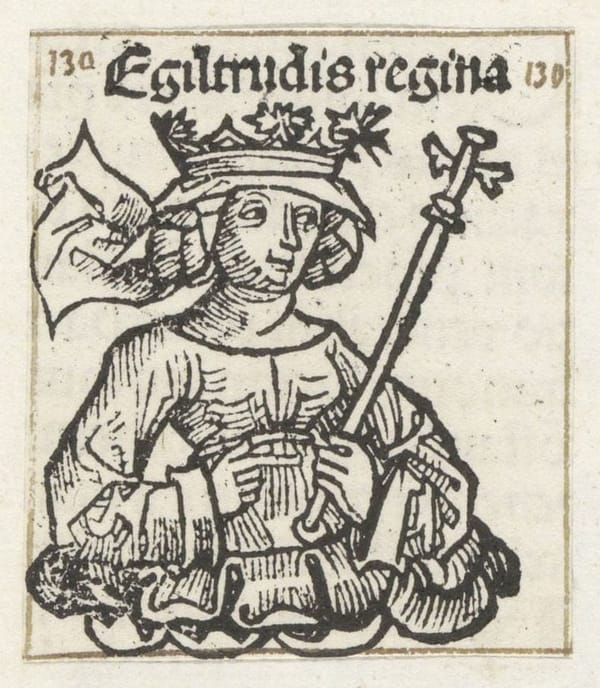
June 23: St. Etheldreda, Queen, Virgin, and Abbess
ETHELDREDA, or Audrey, whom the Church offers to our veneration to-day, was one of the most popular saints among our English forefathers. She was bom in the middle of the seventh century, about a.d. 630, at Exning, near Newmarket, in Suffolk, and was the third daughter of Anna, the Christian king of East Anglia. In a meadow outside the village is still shown the brook in which, as village tradition tells us, the future queen and saint was baptized by St Felix, first bishop of Dunwich. Much against her will, for she had vowed herself to the religious life, she was given in marriage to Tondbert, a prince of East Anglia, who bestowed upon her the Isle of Ely as a dowry. He respected her vow, and on his death a short time after, she was married to Ecgfrid, king of Northumbria, with whom she lived twelve years in such manner as to keep all the while the glory of her virginal integrity, as St Bede the Venerable, to whom we owe the facts of her life, attests. She afterwards retired to the monastery of Coldingham, near Berwick-on-Tweed, where she was veiled a nun by St Wilfrid, bishop of York. In 673 she built a monastery on her property at Ely and was made its first abbess. There she became, in the words of Bede, ‘the virgin-mother of many virgins consecrated to God, instructing them by the example of her heavenly life and by her holy admonitions.’ She died on June 23, a.d. 679, in the sixth year of her abbacy, ‘being taken to the Lord in the midst of her own people,’ and, as she had herself ordered, was buried among them in a wooden coffin. During her last illness she was afflicted with a violent pain in her jaw and neck, and was wont to say: ‘I most certainly know that I deservedly bear the weight of this illness on my neck, on which, I remember, when I was very young, I carried the superfluous weight of pearls and jewels. I believe the divine goodness would for this reason have me endure this pain in my neck, that I may be absolved from the guilt of my former vanity, sending me now, instead of gold and precious stones for my neck, this swelling and burning.’
Sixteen years after Etheldreda's death her sister Sexburga, who had succeeded her as abbess, removed her incorrupt body and placed it in a white marble coffin, a relic of ancient Roman art found near the walls of Grantchester (Cambridge). During the ages that followed Etheldreda's shrine became one of the most famous places of pilgrimage in England, and many were the miracles wrought through the intercession of the virgin-queen. After various translations the white marble tomb containing the saint’s relics was placed in the new presbytery of Ely Cathedral built in a.d. 1257, and there it remained for two centuries until the overthrow of religion when it was demolished and the relics dispersed. The incorrupt hand of St Etheldreda escaped destruction and is in the possession of Catholics.
The Roman Breviary gives us the following lessons on the life of the saint.
Let us make our prayer to God for the intercession of this glorious virgin-queen in the words holy Church makes use of on this her feast day. 'O God, who year by year dost gladden us by the festival of blessed Etheldreda thy virgin: mercifully grant that we who admire the splendid examples of her chastity may be helped by her merits.’
June 23 (the Same Day): The Vigil of St. John the Baptist
THERE was in the days of Herod the king of Judea, a certain priest named Zachary, of the course of Abia, and his wife was of the daughters of Aaron, and her name Elizabeth. And they were both just before God, walking in all the commandments and justifications of the Lord without blame. And they had no son, for that Elizabeth was barren, and they both were well advanced in years. And it came to pass, when he executed the priestly function in the order of his course before God, according to the custom of the priestly office, it was his lot to offer incense, going into the temple of the Lord; and all the multitude of the people was praying without at the hour of incense. And there appeared to him an angel of the Lord, standing on the right side of the altar of incense. And Zachary seeing him was troubled, and fear fell upon him; but the angel said to him: Fear not, Zachary, for thy prayer is heard; and thy wife Elizabeth shall bear thee a son, and thou shalt call his name John: and thou shalt have joy and gladness, and many shall rejoice in his nativity. For he shall be great before the Lord: and shall drink no wine nor strong drink: and he shall be filled with the Holy Ghost even from his mother's womb. And he shall convert many of the children of Israel to the Lord their God. And he shall go before him in the spirit and power of Elias; that he may turn the hearts of the fathers unto the children, and the incredulous to the wisdom of the just, to prepare unto the Lord a perfect people.1
This page which the Church reads to us to-day is precious in the annals of the human race, for here begins the Gospel itself, here we have the first word of the good tidings of salvation. Man had not been kept in total ignorance of heaven's plans for the rescue of our fallen race and the gift of a Redeemer, but weary and long had been this period of expectation, since the day when first the sentence pronounced against the accursed serpent pointed out to Adam and Eve a future wherein man should be healed by the Son of the woman, and God also by him should be avenged. Age upon age rolled on, and the promise, still unaccomplished, gradually assumed certain developments. Each generation saw the Lord, by means of the prophets, adding some new feature to the characteristics of this Brother of our race; in himself so great that the Most High would call him ‘my Son’;2 so impassioned for justice that he would shed the last drop of his Blood to ransom earth's whole debt.3 A Lamb in his immolation, he would rule the earth by his gentleness;4 though springing from Jesse's root, yet was he to be the desired of the Gentiles;5 more magnificent than Solomon,6 he would graciously hearken to the love of these poor ransomed souls: taking the advance of their longing desires, he is fain to announce himself as the Spouse descending from the everlasting hills.7 The Lamb laden with the crimes of the world, the Spouse awaited by the bride—such was to be this Son of Man, Son likewise of God, the Christ, the Messias promised unto earth. But when will he come, this desired of nations? Who will point out unto earth her Saviour? Who will lead the bride to the Bridegroom?
Mankind, gone forth in tears from Eden, had stood with wistful gaze fixed on futurity. Jacob, when dying, hailed from afar this beloved Son whose strength would be that of the lion, whose heavenly charms, still more enhanced by the blood of the grape, rapt him in inspired contemplation on his deathbed.8 In the name of the Gentile world, Job, seated on the dunghill whereon his flesh was falling to pieces, gave response to ruin in an act of sublime hope in his Redeemer and his God.9 Breathlessly panting under the pressure of his woe and the fever of his longing desires, mankind beheld century roll upon century, while consuming death continued its ravages, while his craving for the expected God waxed hotter within his breast. Thus, from generation to generation, what a redoubling of imploring prayer, what a growing impatience of entreaty! Oh! that thou wouldst rend the heavens and wouldst come down!10 ‘Enough of promises,’ cries out the devout St Bernard, together with all the fathers, speaking in the name of the Church of the expectation, and commenting the first verse of the Canticle of Canticles; ‘enough of figures and of shadows, enough of others’ parleying! I understand no more of Moses; no voice have the prophets for me; the Law which they bear has failed to restore life to my dead.11 What have I to do with the stammerings of their profane mouths,12 I to whom the Word hath announced himself? Aaron's perfumes may not compare with the oil of gladness poured out by the Father on him whom I await.13 No more deputies, no more servants for me: after so many messages, let him come at last, let him come himself!’
Prostrate, in the person of the worthiest of her sons, upon the heights of Carmel, the Church of the expectation will not raise herself up till appears in the heavens the proximate sign of salvation's rain-cloud.14 Vainly, even seven times, shall it be answered her that as yet naught can be descried arising seawards; still prolonging her prayer and her tears, her lips parched by the ceaseless drought, and cleaving to the dust, she will yet linger on, awaiting the appearance of that fertilizing cloud, the light cloud that beareth her God under human features. Then, forgetting her long fasts and weary expectant years, she will rise upon her feet, in all the vigour and beauty of her early youth; filled with the gladness the angel announceth to her, in the joy of that new Elias, whose birthday this Vigil promises on the morrow, she will follow him, the predestined Precursor running, more truly than did the ancient Elias,15 before the chariot of Israel’s king.
We borrow from the Mozarabic Breviary the following beautiful liturgical formula, which will imbue us thoroughly with the spirit of the feast.
Capitula
Let us here add two prayers from the Sacramentary of Gelasius.
Prayers
| Previous June 22 (the Same Day): St. Paulinus, Bishop and Confessor | Next June 23 (the Same Day): The Vigil of St. John the Baptist |