Daily reading
After Pentecost
Double · June 25 · Sanctoral
June 25: St. William, Abbot
From Dom Guéranger’s The Liturgical Year.
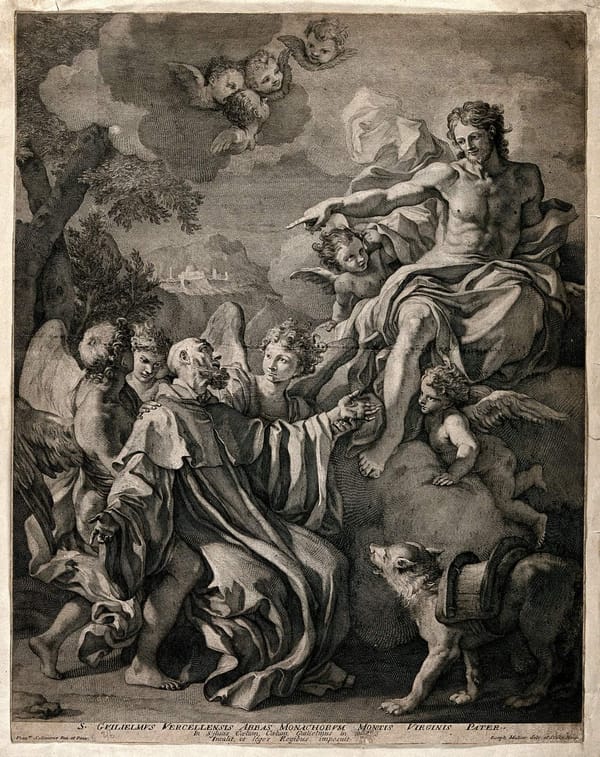 |
MARTYRS are numerous on the cycle during the octave of St John. But not only in martyrdom's peerless glory does our Lord reveal the power of his grace, or the victorious force of example left to the world by his Precursor. At the very outset we have presented to our homage one of those countless athletes of penance, who succeeded John in the desert; one of those who fleeing, like him, in early youth, a society wherein their souls’ foreboding told of only peril and annoy, consecrated a lifetime to Christ’s complete triumph within them over the triple concupiscence, thus bearing witness to the Lord, by deeds which the world ignores, but which make angels to rejoice and hell to tremble. William was one of the chiefs of this holy militia. The Order of Monte-Vergine, which owes its origin to him, has deserved well of the monastic institute and of the whole Church in the south of Italy, wherein God has been pleased, at different times, to raise up a dyke against the encroaching waves of sensual pleasures by the stern spectacle of austere virtue.
Both personally and by his disciples, William’s mission was to infuse into the kingdom of Sicily, then in process of formation, that element of sanctity upon which every Christian nation must necessarily be based. In southern, just as in northern Europe, the Norman race had been providentially called in to promote the reign of Jesus Christ. Just at this moment, Byzantium, powerless to protect against Saracen invasion the last vestiges of her possessions in the West, was anxious nevertheless to hold the Churches of these lands fast bound in that schism into which she had recently been drawn by the intrigues of Michael Cerularius. The Mohammedans had been forced to recoil before the sons of Tancred and Hauteville; and now, in its turn, Greek perfidy had been outwitted and unmasked by the rude simplicity of these men, who quickly learnt to oppose no other argument to Byzantine knavery than the sword. The Papacy, though for a moment doubtful, soon came to understand of what great avail these newcomers would be in feudal quarrels, the jar and turmoil whereof were to extend far and wide for yet two centuries more, leading at last to the long struggle betwixt sacerdotalism and Cæsarism.
All through this period, as has ever been the case since the day of Pentecost, the Holy Ghost was directing every event for the ultimate good of the Church. He it was who inspired the Normans to give solidity to their conquests by declaring themselves vassals of the Holy See, and thus fixing themselves on the apostolic rock. But at the same time, both to recompense their fidelity at the very opening of their career, and to render them more worthy of the mission which would have ever been their honour and their strength had they but continued so to understand it, the Holy Spirit gave them saints. Roger I beheld St Bruno interceding for his people in the solitudes of Calabria, and there also he was miraculously saved by that blessed man from an ambush laid by treason. Roger II was now given another such heavenly aid to bring him back again into the paths of righteousness from which he had too often strayed: the example and exhortations of the founder of MonteVergine.
The life of our saint is thus recorded in the Lessons for his feast:
Following the footsteps of John, thou didst understand, O William, the charms of the wilderness; and God was pleased to make known by thee how useful are such lives as thine, spent far from the world and apparently wholly unconcerned with human affairs. Complete detachment of the senses disengages the soul, and makes her draw nigh to the sovereign Good; solitude, by stifling earth's tumult, permits the voice of the Creator to be heard. Then man, enlightened by the very Author of the world concerning the great interests that are at stake in his work, becomes in the Creator's hands an instrument at once powerful and docile for carrying out these interests, which are at the same time those of the creature himself and of nations. Thus didst thou become, O illustrious saint, the bulwark of a great people, who found in thy word the rule of right; in thine example, the stimulus of lofty virtue; in thy superabundant penance, a compensation to God for the excesses of its princes. The countless miracles which accompanied thine exhortations were not without an eloquence of their own, in the eyes of new nations among whom success of arms had created violence and had lashed up passion to fury: that wolf, for instance, which, after having devoured the ass of the monastery was enforced by thee to take its victim's place in humble service; or again, that hapless woman, who, beholding thee inaccessible to the scorching flames on that bed of burning coals, renounced her criminal life and was led by thee into paths even of sanctity!
Many a revolution, upheaving the land wherein once thou didst pray and suffer, has but too well proved the instability of kingdoms and dynasties that seek not first the kingdom of God and his justice. In spite of the oblivion into which thy teaching and example have been thrown, protect the land wherein God granted thee graces so stupendous, that land which he vouchsafed to confide to thy powerful intercession. Faith still lives in its people; keep it up, notwithstanding the efforts of the enemy in these sad days; make it also produce fruits in virtue's fields. Amidst many trials, thy monastic family has been able, up to this present age of persecution, to propagate itself and to serve the Church: obtain that it, together with all other religious families, may show itself, unto the end, stronger than the tempest. Our Lady, whom thou didst serve valiantly, is at hand to second thine efforts; from that sanctuary whose name has outlived the memory of the poet who unconsciously sang her glories,* may Mary ever smile upon the thronging crowds that year by year toil up the holy mount, hailing the triumph of her virginity; may she accept at thy hands our hearts' homage and desire, although we cannot in very deed accomplish this sacred pilgrimage!
* Virg. Ecl. iv. ↩︎
| Previous June 24: The Nativity of St. John the Baptist | Next June 26: Sts. John and Paul, Martyrs |