Daily reading
Vigil · June 28 · Sanctoral
June 28, 2020
From Dom Guéranger’s The Liturgical Year.
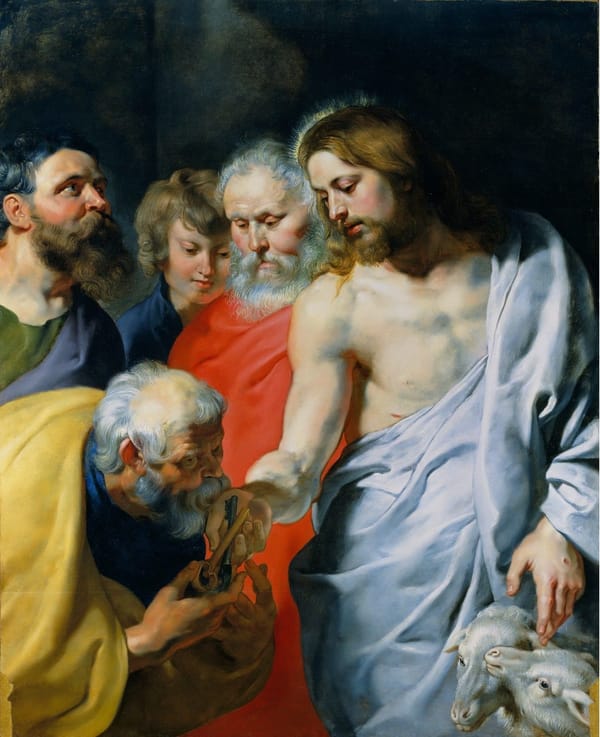
June 28: The Vigil of the Holy Apostles Sts. Peter and Paul
JOHN the Baptist, placed on the confines of the two Testaments, closes the prophetic age, the reign of hope, and opens the era of faith which possesses the long-expected God, though as yet without beholding him in his Divinity. Thus even before the octave is ended wherein we pay our homage to the son of Zachary, the confession of the apostles is added to the Precursor's testimony to the Word the Light. Tomorrow all heaven will re-echo with the solemn protestation first heard at Caesarea Philippi: 'Thou art Christ, the Son of the living God;' and Simon Bar-Jona, because of this oracle uttered by him, will be the chosen Rock, supporting the divine structure, the Church. To-morrow he will die, sealing this glorious declaration with his blood; but he will yet live on, in the person of each Roman Pontiff, that he may thus guard this precious testimony in all its integrity, even to the day when faith will give place to the eternal vision. Coupled with Peter in his labours, the Doctor of the Gentiles shares his triumph this day; and Rome, more indebted to these two princes than to all her stout warriors of old, who laid the world prostrate at her feet, beholds their double victory fix for ever upon her noble brow the diadem of spiritual royalty.
Let us, then, recollect ourselves, preparing our hearts in union with holy Church, by faithfully observing this vigil. When the obligation of thus keeping up certain days of preparation previous to the festivals is strictly maintained by a people, it is a sign that faith is still living amongst them; it proves that they understand the greatness of that which the holy liturgy proposes to their homage. Christians in the West, we who make the glory of SS Peter and Paul our boast, let us remember the Lent in honour of the apostles begun by Greek schismatics on the close of the Paschal solemnities, and continued up to this day. The contrast between them and ourselves will be of a nature to stir up our fervour, and to control those tendencies wherein softness and ingratitude hold too large a share. If certain concessions have, for grave reasons, been reluctantly made by the Church, so that the fast of this vigil is no longer observed, let us see therein a double motive for holding fast to her precious tradition. Let us make up by fervour, thanksgiving and love, for the severity lacking in our observance, which is yet still maintained by so many Churches notwithstanding their schismatical separation from Rome.
The recital of the following beautiful formulas will help to inspire us with the spirit of the feast. The first is taken from the Gothic-Gallic Missal: it is the benediction which, according to the ancient rite used in France, was given to the people before the Communion on the feast of the apostles. The prayers which follow it are from the Leonine Sacramentary.
The Benediction
In thy clemency, look upon thy people, O thou who givest the heavens to be opened, by Peter with the key, and by Paul with the sword,
So that the leaders going first, thither may the flock at length come, whither have already arrived by one same step, both the Pastor by the gibbet, and the Teacher by the sword. Through our Lord, etc.
Prayers
July 3 [June 28]: St. Irenæus, Bishop and Martyr
TO-DAY the Church of Lyons presents to the admiration of the whole world her own great doctor, the valiant Irenæus, who shines as the light of the West.1 But whilst contemplating him confirming with his blood the doctrine he had preached, let us hearken to his words bearing testimony to holy Church, words of world-wide celebrity, confounding hell and closing the mouth of heresy. May we not say that it was in order to afford us instruction so appropriate for to-morrow's festival that eternal Wisdom made choice of this particular day for his martyr’s triumph? Let us hearken to this zealous pupil of Polycarp and of the first disciples of the apostles; let us hearken to him who for this very reason is considered to be the most authentic witness to the faith in all the Churches of the second century, all which Churches (these are his own words when bishop of Lyons) bow down before Rome, as to their mistress and mother. ‘For,’ he continues, ' it behoves all the rest because of her superior principality to agree with her; in her do all the faithful of whatsoever place preserve ever pure the faith once preached to them. Great and venerable above all others because of her antiquity, known to all, founded by Peter and Paul, the two most glorious of the apostles, her bishops are, by their succession, the channel whereby apostolic tradition is transmitted to us in all its integrity: in such sort, that whosoever differs from her in his belief, by this fact alone stands confounded.'2
The rock on which the Church is built stood all unmoved at that early age, as now, against the efforts of false science. Yet not without peril was the attack then made by the Gnostics, with their multiplex heresy and all its guileful plots put into strange concurrence by powers of evil otherwise the most opposed one to the other. It would almost seem as though Christ had wished to prove the strength of the foundations he had laid, by thus permitting hell to direct against the Church a simultaneous assault of all the errors to which the world then was, or ever would become, a prey. Simon the magician, already ensnared by Satan in the nets of the occult sciences, was chosen by the prince of darkness as his lieutenant in the enterprise. Unmasked at Samaria by the Vicar of the Man-God, he had begun against Simon Peter a jealous struggle that would by no means end with the tragic death of the father of heresies, but which in the following century was to be continued more desperately than ever, through disciples formed by him. Saturinus, Basilides, Valentine, all applied the premises of the master, diversifying them, according to the instincts bred at the time, by existing forms of corruption of mind and heart. This proceeding was the more avowed since Magus' aim had been to form an alliance between philosophies, religions and aspirations in themselves incompatible. There was no aberration, from Persian dualism or Hindu idealism to Jewish cabals or Greek polytheism, that did not mutually proffer the hand of friendship in this reserved sanctuary of the Gnosis; there already were the heterodox conceptions of Arius and Eutyches being formulated; there, taking movement and life in advance, were to be recognized in a strange pantheistic romance the wildest oddities of the hollow dreams of German metaphysics. God, an abyss, rolling from fall to fall, till at last reaching matter, there to become conscious of himself in human nature, and to return then by annihilation into eternal silence: this is the sum total of Gnostic dogma, engendering, for its morality, a mixture of transcendent mysticism and impure practices; for its political form, laying the basis of communism and modern nihilism.
Such a spectacle as this of the Gnostic Babel, piling up its incoherent materials on the waters of pride and impure passions, was well calculated to bring out in bold relief the unity of the City of God, so rapidly advancing, though but in her commencement. St Irenæus, chosen by God to oppose to the Gnosis arguments of his own powerful logic, and to re-establish, in opposition thereunto, the true sense of Holy Scripture, excelled most of all when, in face of a thousand sects bearing on their brow the visible mark of the father of discord and lies, he pointed to the Church maintaining as sacred throughout the universe the whole of tradition, just as received from the apostles. Faith in the truth that the world is wholly governed by the Holy Trinity, whose work it is, faith in the mystery of justice and mercy, which, leaving the angels in their fall, raised up our flesh in Jesus, the well-beloved, the Son of Mary, our God, our Saviour and our King: such was the deposit confided to earth by Peter and Paul, by the apostles and their disciples.3 'The Church therefore,’ argues St Irenæus, with enthusiastic piety and learning, ‘having received faith, guards it with all diligence, making the whole world wherein she lives dispersed to become but one single house: collected in unity, she believes with one soul, with one heart, with one voice she preaches, teaches, transmits doctrine, as having but one mouth. For, although there be in the world divers languages, that by no means prevents tradition remaining one in its sap. The Churches founded in Germany, or amidst the Iberians or the Celts, believe not otherwise, teach not otherwise, than do the Churches of the East, of Egypt, of Libya, or those established in the centre of the world. But as the sun, God’s creature, is ever the same and remains one in the whole world, so does the teaching of truth shine resplendent, enlightening every man who is willing to come to the knowledge of the truth. Even though the chief men in the Churches be unequal in the art of speaking well, tradition is not thereby impaired: he who explains eloquently cannot possibly give it increase; he who speaks with less abundance cannot thereby diminish it.’4
O sacred unity, O precious faith deposited like a source of eternal youthfulness in our hearts, they indeed know thee not, who turn themselves away from holy Church! Afar from her, they lose also Jesus and all his gifts. 'For where the Church is, there likewise is the Spirit of God; and, where the Spirit of God is, there likewise is the Church, there all grace. Woe to them who alienate themselves from her! They suck not in life from the nourishing breasts to which their mother invites them, they slake not their thirst at the clear fountain of the Lord’s Body; but, afar from the rock of unity, they drink the muddy waters of cisterns dug in fetid slime where there is not a drop of the water of truth.’5 What will their vain science avail to sophists, with all their empty foolish formulas? ‘Oh!’ cries out the bishop of Lyons elsewhere, in accents which seem to have been borrowed later on by the author of the Imitation,6 ‘how far better is it to be ignorant, or a man of little learning, and to draw nigh unto God by love! What use is there in knowing much, in seeming to understand much, if one be an enemy to his Lord? Wherefore Paul doth thus exclaim: “Knowledge puffeth up, but charity builds up.”7 Not that he reproved the true science of God; for if so he had condemned himself in the first place; but he saw that there were some who, exalting themselves under pretext of knowledge, no longer knew how to love. It were better to know nothing at all, to be ignorant of the meaning of everything, and yet to believe in God and to be possessed of charity. Let us avoid vain puffing up which would make us fall away from love, the life of the soul; let Jesus Christ, the Son of God, crucified for us, be our only science.’8
Rather than here bring forward the genius of the eminent controversialist of the second century, it is a pleasure to cite from his treatises such passages as give an insight into his great soul, and reveal traits of a sanctity so loving and so sweet. ‘When, at last, the Spouse cometh,' says he, speaking of those unfortunate men whom he longed to reclaim, 'their science will not keep their lamp lighted, and they will find themselves excluded from the nuptial chamber.'9
In numberless places in the midst of closely strung arguments, he who may be styled the grandson of the beloved disciple betrays his own heart. Whilst following, for instance, the track of Abraham, he shows the path that leads to the Spouse: his mouth can then no longer cease to utter the name that fills his thoughts. We recognize in these touching words of his the apostle who had quitted country and home to advance the kingdom of God in the land of the Gauls: 'Abraham did well to abandon his earthly relatives to follow the Word of God, to exile himself together with the Word, so as to live with him. The apostles did well, too, in order to follow the Word of God, to quit their boats and their father. We, likewise, who have the same faith as Abraham, we do well, carrying our cross as Isaac did the wood, to follow in his footsteps. In Abraham man learnt that it is possible to follow the Word of God, and thus were his steps made firm in this blessed way.10 The Word, on his part, nevertheless, disposed man for the divine mysteries by figures throwing light on the future.11 Moses espoused an Ethiopian, who thus became a daughter of Israel: and by these nuptials of Moses, those of the Word were pointed out; for by this Ethiopian was signified the Church that hath come forth from the Gentiles;12 whilst awaiting the day wherein the Word himself will come to wash away, with his own hands, the defilements of the daughter of Sion, at the banquet of the Last Supper.13 For it is fitting that the temple be pure in which the Bridegroom and bride are to taste of the Spirit of God; and just as it is not becoming in a bride to seek to take a spouse for herself, but she must wait until she be sought out, so our flesh cannot of itself rise to the majesty of the divine throne; but when the Spouse cometh, then he will raise her up, and she will not so much possess him as be possessed by him.14 The Word made Flesh will assimilate her wholly to himself in all fullness, and will render her precious in the eyes of the Father, by reason of her conformity to his visible Word.15 Then will the union with God in love be consummated. Divine union is life and light; it imparts the enjoyment of all the good things of God; it is eternal of its very nature, just as these good things themselves likewise are. Woe to those who withdraw of their own accord; their chastisement comes less from God than from themselves, and from the free choice whereby, turning from God, they have lost all the good things of God.'16
The loss of faith being the most radical and the deepest of all causes of estrangement from God, it is not surprising to observe the horror which heresy inspired in those days, when union with God was the one treasure longed for by all conditions and ages of life. The name Irenæus signifies peace; and justifying this beautiful name, his condescending charity once led the Roman Pontiff himself to withhold the thunders he was on the point of hurling; the question at issue was one of no small importance—it was the celebration of Easter. Nevertheless, Irenæus himself relates with regard to his master Polycarp, how, when being asked by the heretic Marcion if he knew him, he replied: 'I know thee to be the firstborn of Satan.'17 He also tells us that St John, hearing that Cerinthus was in the same public edifice into which he had just entered, fled precipitately, for fear, as he said, that because of this enemy of truth the walls of the building would crumble down upon them all: 'so great,' remarks the bishop of Lyons, ‘was the fear the apostles and their disciples had of communicating, even by word, with any one of those who altered truth.’18 He who was styled by the companions of SS Pothinus and Blandina, in their prison, ‘the zelator of the Testament of Christ,'19 was on this point, as on all others, the worthy heir of John and Polycarp. Far from becoming hardened thereby, his heart, like that of his venerable masters, drew from this purity of mind that limitless tenderness of which he gave proof in regard to those erring ones whom he hoped to win back. What could be more touching than the letter written by Irenæus to one of these unhappy men whom the mirage of novel doctrines had inveigled into the gulf of error: 'O Florinus, this teaching is not that transmitted to us by the ancients, the disciples of the apostles. I used to behold thee at the side of Polycarp; though shining at court thou didst none the less seek to be pleasing unto him. I was then but a child, yet the things that happened at that time are more vivid in my recollection than those of yesterday; for indeed childhood's memories form, as it were, a part of the very soul; they grow with her. I could point out the very spot where sat blessed Polycarp while he conversed with us; I could describe exactly his bearing, his address, his manner of life, his every feature, and the discourses he made to the crowd. Thou rememberest how he used to tell us of his intercourse with John and the rest of those that had seen the Lord, and with what a faithful memory he repeated their words; what he had learnt from them respecting our Lord, his miracles, his doctrine, all these things Polycarp transmitted to us, as having himself received them from the very men that had beheld with their eyes the Word of life; all of what he told us was conformable to the Scriptures. What a grace from God were these conversations of his! I used to listen so eagerly, noting everything down, not on parchment, but on my heart; and now, by the grace of God, I still live on it all. Hence, I can attest before God, if the blessed apostolic old man had heard discourses such as thine he would have stopped his ears, saying, as was his wont: “O God most good, to what sort of times hast thou reserved us!” Then would he have got up quickly, and would have fled from that place of blasphemy.'20
It is time to give the liturgical narrative of the history of this great bishop and martyr.
Oh! what a crown is thine, most noble Pontiff! Man must confess himself utterly unable to count the pearls with which it is adorned. For in the arena where thou didst win it, a whole people were thy fellow-combatants; and as each martyr, one by one, ascended to his throne in heaven, he proclaimed thy glory, for he owed his crown to thee. Twenty-five years previously the blood of Blandina and her companions had been shed, and, thanks to thee, had produced a hundredfold. Thy care had brought that fruitful seed to germinate from the soil that had received it in the early days of Christianity, and now the small colony of the faithful, scattered in its midst, had become the very city itself. Formerly the amphitheatre was spacious enough for the effusion of the martyrs' blood; but now the sacred stream flows in torrents along the streets and squares. O glad day that made Lyons become Rome's rival and the holy city of the Gauls!
The sons of those that died with thee have ever remained faithful to Jesus Christ; do thou, together with Mary, whose position and dignity thou didst so admirably expound to their fathers,21 and with the Precursor of the Man-God who so fully shares their love, protect them against every scourge whether of body or of soul. Spare France; drive far from her the invasion of a false philosophy which is attempting to revive the aberrations of Gnosticism. Cause truth once more to shine upon the eyes of so many whom heresy, under these multiform disguises, separates from the one fold. O Irenæus, maintain Christians in that peace which alone deserves the name; keep ever pure the minds and hearts of those whom error has not yet sullied. Prepare us now to celebrate befittingly the two glorious apostles Peter and Paul, and the powerful principality of the mother of all the Churches.
- Theodoret. Hæretic. fabul. 1 5. ↩︎
- Cont. Hæres. III, iii 2. ↩︎
- Cont. Hæres. I, x 1. ↩︎
- Cont. Hæres. I, x 2. ↩︎
- Ibid. III, xxiv 1, 2. ↩︎
- De Imit. Christi, Lib. I, cap. 1-5. ↩︎
- 1 Cor. viii 1. ↩︎
- Cont. Hæres. II, xxvi 1. ↩︎
- Cont. Hæres. II, xxvii 2. ↩︎
- Ibid. IV, v 3, 4. ↩︎
- Ibid. xx ii. ↩︎
- Ibid. 12. ↩︎
- Ibid. xxii 1. ↩︎
- Cont. Hæres. V, ix 4. ↩︎
- Ibid. xvi 2. ↩︎
- Ibid. xxvii 2. ↩︎
- Ibid. III, iii 4. ↩︎
- Cont. Hæres. III, iii 4. ↩︎
- Epist. Martyi. Lugdun. et Vienn. ad Eleuther, Pap. ↩︎
- Epist. ad Florinum. ↩︎
- Cont. Hæres. V, xix. ↩︎
| Previous June 27: The Fourth Day within the Octave of St. John the Baptist | Next July 3 [June 28]: St. Irenæus, Bishop and Martyr |