Daily reading
After Pentecost
Double · Movable from Easter · Temporal
July 12, 2020
From Dom Guéranger’s The Liturgical Year.

|
The Sixth Sunday after Pentecost
The Office for the sixth Sunday after Pentecost, which began yesterday evening, reminded us, in its Magnificat antiphon, of a repentance which has never had an equal. David, the royal prophet, the conqueror of Goliath, himself conquered by sensuality, and from adulterer become a murderer, at last felt the crushing weight of his double crime, and exclaimed : 'I do beseech thee, O Lord, take away the iniquity of thy servant, for I have done foolishly!'1
Sin is always a folly and a weakness, no matter of what kind it may be, or who he be that commits it. The rebel angel, and fallen man, may, in their pride, make efforts to persuade themselves that, when they sinned, they did not act as fools, and were not weak; but all their efforts are vain; sin must ever have this disgrace upon it, that it is folly and weakness, for it is a revolt against God, a contempt for His law, a mad act or the creature, who, being made by his. Creator to attain infinite happiness and glory, prefers to debase himself by turning towards nothingness, and then falls even lower than the nothingness from which he was taken. It is, however, a folly that is voluntary, and a weakness that has no excuse; for, although the creature have nothing of his own but darkness and misery, yet his infinitely merciful Creator, by means of His grace, which is never wanting, puts within that creature's reach divine strength and light.
It is so with even the sinner that has been the least liberally gifted; he has no reason that can justify his offences. But when he that sins is a creature who has been laden with God's gifts, and, by His divine generosity, been raised higher than others in the order of grace, oh! then the offence he commits against his benefactor is an injury that has no name. Let this be remembered by those who, like David, could say that their God has 'multiplied His magnificence' over them.2 They may, perhaps, have been led by Him into high paths which are reserved for the favoured few, and may have reached the heights of divine union : yet must they be on their guard; no one who has still to carry with him the burden of a mortal body of flesh is safe, unless by exercising a ceaseless vigilance. On the mountains, as on the plains and m the valleys, at all times and in all places, a fall is possible; but when it is on those lofty peaks which, in this land of exile, seem bordering on heaven, and but one step from the 'entrance into the powers of the Lord,'3 what a terrific fall when the foot slips there! The yawning precipices which that soul had avoided on her ascent are now all open to engulf her; abyss after abyss of crime she rushes into, and with a violence of passion that terrifies even them that have long been nothing but wickedness.
Poor fallen soul! pride, like that of satan, will now try to keep her obstinately fixed in her crimes : but, from the depths into which she has fallen, let her, like David, send forth the cry of humility; let her lament her abominations; let her not be afraid to look up, through her tears, at those glorious heights which were once her abode—an anticipated heaven. Without further delay, let her imitate the royal penitent, and say with him : 'I have sinned against the Lord!' and she will hear the same answer that he did : 'The Lord hath taken away thy sin; thou shalt not die ';4 and as with David, so also with her, God may still do grand things in her. David, when innocent, was a faithful image of Christ, who was the object of the love of both heaven and earth; David, sinner but penitent, was still the figure of the Man-God, as laden with the sins of the whole world, and bearing on His single self the merciful and just vengeance of His offended Father.
In the Mass of this Sunday, which they call the sixth of Saint Matthew, the Greeks read the account of the cure of the paralytic, which is related in the ninth chapter of that evangelist. The preceding chapter, with its episode of the centurion and the two possessed, had furnished them with the Gospels for their fourth and fifth Sundays.
Mass
It is difficult to see what connexion there is between the Mass and the Office of this Sunday, as they are at present arranged. Honorius of Autun and Durandus applied the Introit and the other sung portions which follow, to the inauguration of Solomon’s reign. At the period when those two writers lived,5 the Scripture lessons for this Sunday were taken from the first pages of the second Book of Paralipomenon, where we have the account of the glorious early days of David’s son. But, since that time, it has been the Church’s practice to continue the reading of the four Books of Kings up to the month of August, omitting altogether the two Books of Paralipomenon, which were but a practical repetition of the events already related in previous lessons. So that the connexion suggested by the two writers just mentioned has no foundation in the actual arrangement of to-day's liturgy. We must, therefore, be satisfied with taking from the Introit the teaching of what it is that constitutes the Christian's courage, viz., his faith in God's power which is always ready to help him, and the conviction of his own nothingness, which keeps him from all presumption.
Introit
The Collect gives us an admirable summing up of the strong, yet sweet, action of grace upon the whole course of Christian life. It has evidently been suggested by those words of St. James : 'Every best gift, and every perfect gift, is from above, coming down from the Father of lights.'6
Collect
The other Collects as on page 120.
Epistle
Cap. vi.Fratres, Quicumque baptizati sumus in Christo Jesu, in morte ipsius baptizati sumus. Consepulti enim sumus cum illo per baptismum in mortem : ut quomodo Christus surrexit a mortuis per gloriam Patris. ita et nos in novitate vitæ ambulemus. Si enim complantati facti sumus similitudini mortis ejus, simul et resurrectionis erimus. Hoc scientes, quia vetus homo noster simul crucifixus est, ut destruatur corpus peccati, et ultra non serviamus peccato. Qui enim mortuus est, justifìcatus est a peccato. Si autem mortui sumus cum Christo, credimus quia simul etiam vivemus cum Christo : scientes quod Christus resurgens ex mortuis, jam non moritur, mors illi ultra non dominabitur. Quod enim mortuus est peccato, mortuus est semel: quod autem vivit, vivit Deo. Ita et vos existimate, vos mortuos quidem esse peccato, viventes autem Deo in Christo Jesu Domino nostro.
Ch. vi. Brethren : all we who are baptized in Christ Jesus are baptized in his death. For we are buried together with him by baptism unto death : that as Christ is risen from the dead by the glory of the Father, so we also may walk in newness of life. For if we have been planted together in the likeness of his death, we shall be also in the likeness of his resurrection. Knowing this, that our old man is crucified with him, that the body of sin may be destroyed, to the end that we may serve sin no longer. For he that is dead is justified from sin. Now if we be dead with Christ, we believe that we shall live also together with Christ. Knowing that Christ, rising again from the dead, dieth now no more, death shall no more have dominion over him. For in that he died to sin, he died once : but in that he liveth, he liveth unto God. So do you also reckon that you are dead to sin, but alive unto God in Christ Jesus our Lord.
The Masses of the Sundays after Pentecost have, so far, given us but once a passage from St. Paul's Epistles. Hitherto SS. Peter and John have addressed the faithful at the commencement of the sacred mysteries. It may be that the Church, during these weeks which represent the early days of the apostolic preaching, has intended by this to show us the disciple of faith and the disciple of love as being the two most prominent in the first promulgation of the new Covenant, which was committed, at the outset, to the Jewish people. At that time, Paul was but Saul the persecutor, and was putting himself forward as the most rabid opponent of that Gospel which, later on, he would so zealously carry to the farthest parts of the earth. If his subsequent conversion made him become an ardent and enlightened apostle even to the Jews, it soon, became evident that the house of Jacob was not the special mission of his apostolate.7 After publicly announcing his faith in Jesus the Son of God, after confounding the Synagogue by the weight of his testimony,8 he waited in silence for the termination of the period accorded to Juda for the acceptance of the covenant; he withdrew into privacy,9 waiting for the vicar of the Man-God, the head of the apostolic college, to give the signal for the vocation of the Gentiles, and open in person the door of the Church to these new children of Abraham.10
But Israel has too long abused God's patience; the day of the ungrateful Jerusalem's repudiation is approaching,11 and the divine Spouse, after all this long forbearance with His once chosen, but now faithless bride, the Synagogue, has gone to the Gentile nations. Now is the time for the Doctor of the Gentiles to speak; he will go on speaking and preaching to them to his dying day; he will not cease proclaiming the word to them, until he has brought them back, and lifted them up to God, and consolidated them in faith and love. He will not rest until he has led this once poor, despised Gentile world to the nuptial union with Christ12—yes, to the full fecundity of that divine union of which, on the twenty-fourth and last Sunday after Pentecost, we shall hear him thus speaking : 'We cease not to pray for you, and to beg that ye may be filled with the knowledge of His will, in all wisdom and spiritual understanding; that ye may walk worthy of God, in all things pleasing Him; being fruitful in every good work . . . . Giving thanks to God the Father, who hath made us worthy to be partakers of the lot of the saints in light, . . . and hath translated us into the kingdom of His beloved Son.'13
It is to the Romans that are addressed to-day's inspired instructions of the great apostle. For the reading of these admirable Epistles of St. Paul, the Church, during the Sundays after Pentecost, will follow the order in which they stand in the canon of Scripture : the Epistle to the Romans, the two to the Corinthians, then those to the Galatians, Ephesians, Philippians, and Colossians, will be read to us in their turns. They make up the sublimest correspondence that was ever written— a correspondence where we find Paul's whole soul, giving us both precept and example how best we may love our Lord. 'I beseech you,' so he speaks to his Corinthians, 'be ye followers of me, as I also am of Christ.'14
Indeed, the Gospel,15 the kingdom of God,16 the Christian life, is not an affair of mere words. Nothing is less speculative than the science of salvation. Nothing makes it penetrate so deeply into the souls of men as the holy life of him that teaches it. It is for this reason that the Christian world counts him alone as apostle or teacher who, in his one person, holds the double teaching of doctrine and works. Thus, Jesus, the Prince of pastors,17 manifested eternal truth to men, not only by the words uttered by His divine lips, but likewise by the works He did during His life on earth. So, too, the apostle, having become a pattern of the flock,18 shows us all, in his own person, what marvellous progress a faithful soul may make under the guidance of the Holy Ghost, the Spirit of sanctification.
Let us, then, be attentive to every word that comes from this mouth, ever open to speak to the whole earth;19 but, at the same time, let us fix the eyes of our soul on the works achieved by our apostle, and let us walk in his footsteps.20 He lives in his Epistles; he abides and continues with us all, as he himself assures us, for the furtherance ana joy of our faith.21
Nor is this all. If we value, as we ought, the example and the teaching of this father of the Gentiles,22 we must not forget his labours, and sufferings, and solicitudes, and the intense love he bore towards all those who neither had seen, nor were ever to see, his face in the flesh.23 Let us make him the return of dilating our hearts with affectionate admiration of him. Let us love, not only the light, but him also who brings it to us; yea, and all them that, like him, have been getting for us the exquisite brightness from the treasures of God the Father and of His Christ. It is the recommendation made so feelingly by St. Paul himself;24 it is the intention willed by God Himself, when He confided to men like ourselves the charge of sharing with Him the imparting of this heavenly light to us. Eternal Wisdom does not show herself directly here below; she is hid, with all her treasures, in the Man-God;25 she reveals herself by Him,26 and by the Church,27 which is the mystical body of that Man-God,28 and by the chosen members of that Church, the apostles.29 We can neither love nor know her save in and by our Lord Jesus Christ;30 and we cannot love or understand Jesus unless we love and understand His Church.31 Now, in this Church, this glorious aggregate of the elect both of heaven and of earth, we should especially love and venerate those who are, in a special manner, associated with our Lord's sacred Humanity in manifesting the divine Word, who is the one centre of our thoughts both in this world and in the world to come.
According to this standard, who ever had a stronger claim than Paul to the veneration, gratitude, and love, of the faithful? Who of the prophets and holy apostles went deeper into the mystery of Christ?32 Who was like him, in revealing to the world 'the light of the knowledge of the glory of God, in the face of Christ Jesus'?33 Was there ever a more perfect teacher, or a more eloquent interpreter, of the life of union,—we mean of that marvellous union which brings regenerated humanity into the embrace of God, and continues and repeats the life of the Word Incarnate in each Christian? To him, the last and least of the saints (as he humbly calls himself), was given the grace of proclaiming to the Gentiles the unsearchable riches of Christ; to him was confided the mission of teaching to all nations the mystery of creation, the mystery hidden so long in God, the secret of the world's history—viz., the manifestation of infinite Wisdom, by the Church, in Christ Jesus our Lord.34
For, as the Church is neither more nor less than the body and mystical complement of the Man-God, so, in St. Paul’s mind, the formation and growth of the Church are but the sequel of the Incarnation; they are but the continued development of the mystery shown to the angelic hosts, when this Word Incarnate made Himself visible to them in the crib at Bethlehem. After the Incarnation, God was better known by His angels; though ever the self-same in His own unchanging essence, yet, to them, He appeared grander and more magnificent in the brilliant reflection of His infinite perfections, as seen in the Flesh of His Word. So, too, although no increase in them was possible, and their plenitude was their fixed measure, yet the created perfection and holiness of the Man-God have their fuller and clearer revelation, in proportion as the marvels of perfection and holiness, which dwell in Him as in their source, are multiplied in the world.
Starting from Him, flowing ever from His fullness,35 the stream of grace and truth36 ceaselessly laves each member of the body of the Church. Principle of spiritual growth, mysterious sap, it has its divinely appointed channels : and these unite the Church more closely to her Head, than the nerves and vessels which convey movement and life to the extremities of our body unite its several parts to the head, which directs and governs the whole frame. But, just as in the human body the life of the head and of the members is one, giving to each of them the proportion and harmony which go to make up the perfect man, so, in the Church, there is but one life, the life of the Man-God, of Christ the Head, forming His mystical body, and perfecting, in the Holy Ghost, its several members.37 The time will come when this perfection will have attained its full development; then will human nature, united with its divine Head in the measure and beauty of the perfect age of Christ, appear on the throne of the Word,38 an object of admiration to the angels, and of delight to the most holy Trinity. Meanwhile, Christ is being completed in all things and in all men;39 as heretofore at Nazareth, Jesus is still growing; and these His advancings are gradual fresh manifestations of the beauty of infinite Wisdom.40
The holiness, the sufferings, and then the glory of the Lord Jesus—in a word, His life continued in His members41—this is St. Paul’s notion of the Christian life : a notion most simple and sublime, which, in the apostle’s mind, resumes the whole commencement, progress, and consummation of the work of the Spirit of love in every soul that is sanctified. We shall find him, later on, developing this practical truth, of which the Epistle read to us to-day merely gives the leading principle. After all, what is Baptism, that first step on the road to heaven, but the neophyte's incorporation with the Man-God, who died once unto sin, that He might for ever live in God His Father? On Holy Saturday,42 after having assisted at the blessing of the font, we had read to us a similar passage from another Epistle of St. Paul,43 which put before us the divine realities achieved beneath the mysterious waters. Holy Church returns to the same teaching to-day, in order that she may recall to our minds this great principle of the commencement of the Christian life, and make it the basis of the instructions she is here going to give us. If the very first effect of the sanctification of one who, by Baptism, is buried together with Christ, be to make him a new man, to create him afresh in this Man-God,44 to ingraft his new life upon the life of Jesus whereby to bring forth new fruits,—we cannot wonder at the apostle’s unwillingness to give us any other rule for our contemplation or our practice than the study and imitation of this divine model. There, and there only, is man’s perfection;45 there is his happiness. As, then, have received the knowledge of Jesus Christ the Lord, walk ye in Him :46 for, as many of you as have been baptized in Christ, have put on Christ.’47 Our apostle emphatically tells us that he knows nothing, and will preach nothing, but Jesus.48 If we be of St. Paul's school, adopting, as we shall then do, the sentiments of our Lord Jesus Christ, and making them our own,49 we shall become other Christs, or, rather, one only Christ with the Man-God, by the sameness of thoughts and virtues, under the impulse of the same sanctifying Spirit.
Between the Epistle and the Gospel, the Gradual and Alleluia-verse come urging us to make that humble and confiding prayer which should ever be ascending to God from the Christian soul.
Gradual
Gospel
Cap. viii.In illo tempore : Quum turba multa esset cum Jesu, nec haberent quod manducarent, convocatis discipulis, ait illis : Misereor super turbam : quia ecce jam triduo sustinent me, nec habent quod manducent : et si dimisero eos jejunos in domum suam, deficient in via : quidam enim ex eis de longe venerunt. Et responderunt ei discipuli sui : Unde illos quis poterit hic saturare panibus in solitudine? Et interrogavit eos : Quot panes habetis? Qui dixerunt : Septem. Et præcepit turbæ discumbere super terram. Et accipiens septem panes, gratias agens fregit, et dabat discipulis suis ut apponerent, et apposuerunt turbæ. Et habebant pisciculos paucos : et ipsos benedixit, et jussit apponi. Et manducaverunt, et saturati sunt, et sustulerunt quod superaverat de fragmentis, septem sportas. Erant autem qui manducaverant, quasi quatuor millia : et dimisit eos.
Ch. viii.At that time : When there was a great multitude with Jesus, and had nothing to eat, calling bis disciples together, he saith to them : I have compassion on the multitude, for behold they have now been with me three days, and have nothing to eat; and if I shall send them away fasting to their home, they will faint in the way : for some of them came from afar off. And his disciples answered him : From whence can any one fill them here with bread in the wilderness? And he asked them : How many loaves have ye? Who said: Seven. And he commanded the people to sit down on the ground; and taking the seven loaves, giving thanks he broke, and gave to his disciples for to set before them, and they set them before the people. And they had a few little fishes; and be blessed them, and commanded them to be set before them. And they did eat and were filled, and they took up that which was left of the fragments, seven baskets. And they that had eaten were about four thousand : and he sent them away.
The interpretation of the sacred text is given to us by St. Ambrose, in his homily which has been chosen for this Sunday. We shall there find the same vein of thought as is suggested by the whole tenor of the liturgy assigned for this portion of the year. The holy doctor thus begins: ‘After the woman, who is the type of the Church, has been cured of the flow of blood, and after the apostles have received their commission to preach the Gospel, the nourishment of heavenly grace is imparted.’ He had just been asking, a few lines previous, what this signified : and his answer was : ‘The old Law had been insufficient to feed the hungry hearts of the nations; so, the Gospel food was given to them.’50
We were observing this day week, that the Law of Sinai, because of its weakness,51 had made way for the testament of the universal covenant. And yet, it is from Sion itself that the Law of grace has issued; here again it is Jerusalem that is the first to whom the word of the Lord is spoken.52 But the bearers of the good tidings have been rejected by the obdurate and jealous Jews; they therefore turn to the Gentiles,53 and shake off Jerusalem's dust from their feet. That dust, however, is to be an accusing testimony;54 it is soon to be turned into a rain, showering down on the proud city a more terrible vengeance than was that of fire, which once fell on Sodom and Gomorrha.55 The superiority of Juda over the rest of the human race had lasted for ages; but now all that ancient privilege of Israel, and all his rights of primogeniture, are gone; the primacy has followed Simon Peter to the west; and the crown of Sion, which has fallen from off her guilty head,56 now glitters, and will do so for ever, on the consecrated brow of the queen of nations.
Like the poor woman of the Gospel who had spent all her substance over useless remedies, the Gentile world had grown weaker and weaker by the effects of original and subsequent sins; she had put herself under the treatment of false teachers, who gradually reduced her to the loss of that law and those gifts of nature which, as St. Ambrose expresses it, had been her ‘vital patrimony.’57 At length the day came when she heard of the arrival of the heavenly physician : she at once roused herself; the consciousness of her miserable condition urged her on; her faith got the upper hand of her human respect, and brought her to the presence of the Incarnate Word; her humble confidence, which so strongly contrasted with the insulting arrogance of the Synagogue, led her into contact with Christ, and she touched Him; virtue went forth from Him,58 cured her original wound, and at once restored to her all the strength she had lost by her long period of languor.
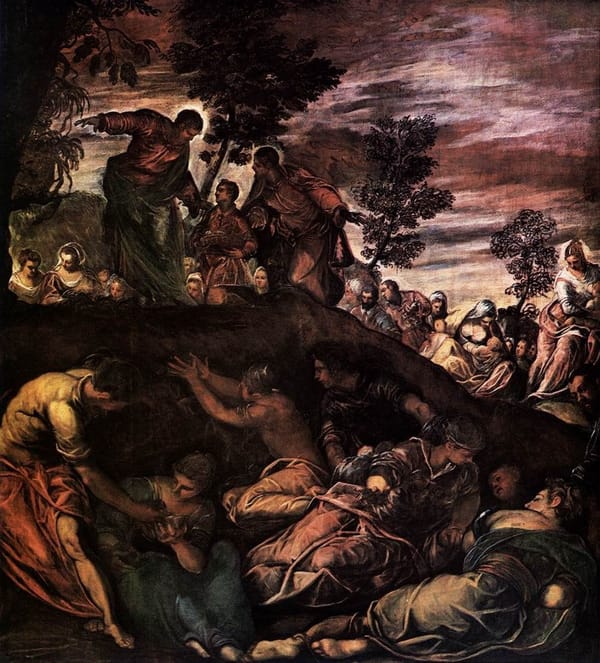
Having thus cured human nature, our Lord bade her cease her fast, which had lasted for ages; He gave her the excellent nourishment she required. St. Ambrose, whose comment we are following, compares the miraculous repast mentioned in today's Gospel with the other multiplication of loaves brought before us on the fourth Sunday of Lent; and he remarks how, both in spiritual nourishment and in that which refreshes the body, there are various degrees of excellence. The Bridegroom does not ordinarily serve up the choicest wine, He does not produce the daintiest dishes, at the beginning of the banquet He has prepared for His dear ones.59 Besides, there are many souls here below who are incapable of rising, beyond a certain limit, towards the divine and substantial light which is the nourishment of the spirit. To these, therefore— and they are the majority, and are represented by the five thousand men who were present at the first miraculous multiplication—the five loaves of inferior quality60 are an appropriate food, and one that, by its very number, is in keeping with the five senses, which, more or less, have dominion over the multitude. But, as for the privileged favourites of grace,—as for those men who are not distracted by the cares of this present life, who scorn to use its permitted pleasures, and who, even while in the flesh, make God the only king of their soul,—for these, and for these only, the Bridegroom reserves the pure wheat of the seven loaves, which, by their number, express the plenitude of the holy Spirit, and mysteries in abundance.
‘Although they are in the world,’ says St. Ambrose, ‘yet these men, to whom is given the nourishment of mystical rest, are not of the world’61 In the beginning, God spent six days in giving to the universe He had created its perfection and beauty : He consecrated the seventh to the enjoyment of His works.62 Seven is the number of the divine rest; it was also to be that of the fruitful rest of the sons of God, of perfect souls, in that peace which makes love secure, and is the source of the invincible power of the bride, as mentioned in the Canticle.63 It is for this reason that the Man-God, when proclaiming on the mount the beatitudes of the law of love, attributed the seventh to the peace-makers, or peaceable64 as deserving to be called, most truly, the sons of God.65 It is in them alone that is fully developed the germ of divine sonship,66 which is put into the soul at Baptism. Thanks to the silence to which the passions have been reduced, their spirit, now master of the flesh, and itself subject to God, is a stranger to those inward storms, those sudden changes, and even those inequalities of temperature, which are all unfavourable to the growth of the precious seed;67 warmed by the Sun of justice in an atmosphere which is ever serene and unclouded, there is no obstacle to its coming up, there is no ill-shapen growth; absorbing all the human moisture of this earth wherein it is set, assimilating the very earth itself, it Boon leaves nothing else to be seen in these men but the divine, for they have become, in the eyes of the Father who is in heaven, a most faithful image of His firstborn Son.68
‘Rightly, then,’ continues St. Ambrose, 'the seventh beatitude is that of the peaceful; to them belong the seven baskets of the crumbs that were over and above. This bread of the Sabbath, this sanctified bread, this bread of rest, is something great; and I even venture to say, that if, after thou hast eaten of the five loaves, thou shalt have eaten also of the seven, thou hast no bread on earth that thou canst look forward to.’69
But take notice of the condition specified in our Gospel, as necessary for those who aspire to such nourishment as that. ‘It is not,’ says the Saint, 'to lazy people, nor to them that live in cities, nor to them that are great in worldly honours, but to them that seek Christ in the desert, that is given the heavenly nourishment : they alone who hunger after it are received by Christ into a participation of the Word and of God’s kingdom.’70 The more intense their hunger, the more they long for their divine object and for no other, the more will the heavenly food strengthen them with light and love, the more will it satiate them with delight.
All the truth, all the goodness, all the beauty of created things, are incapable of satisfying any single soul; it must have God. So long as man does not understand this, everything good or true that his senses and his reason can provide him with, so far from being able to satiate him, is ordinarily nothing more than a distraction from the one object that can make him the happy being he was created to be, and a hindrance to his living the true life which God willed him to attain. Observe how our Lord waits for all his human schemes to fail, and then He will be his helper, if he will but permit Him. The men of our to-day's Gospel are not afraid to abide with Him in the desert, and put up with the consequent privations of meat and drink; their faith is greater than that of their brethren who have preferred to remain in their homes in the cities, and has raised them so much the higher in the order of grace; for that very reason, our Lord would not allow them to admit anything of a nature to interfere with the divine food He prepares for their souls.
Such is the importance of this entire self-abnegation for souls that aim at the highest perfection of Christian life, such, too, the difficulty which even the bravest find in reaching that total self-abnegation by their own efforts, that we see our Lord Himself acting directly upon the souls of His saints, in order to create in them that desert, that spiritual vacuum, whose very appearance makes poor nature tremble, and yet which is so indispensable for the reception of His gifts. Struggling like another Jacob with God,71 under the effort of this unsparing purification, the creature feels herself to be undergoing a sort of indescribable martyrdom. She has become the favoured object of Jesus' research; and, as He intends to give Himself unreservedly to her, so He insists on her becoming entirely His. It is with a view to this that He, in the delicate dealings of His mercy, subdues and breaks her, in order that He may detach her from creatures and from herself. The piercing eye of the Word perceives every least crease or fold of her spiritual being; His grace carries its jealous work right down to the division of soul and spirit, and reaches to the very 'joints and marrow,’ scrutinizing and unmercifully probing the thoughts and intents of the heart.72 As the prophet describes the refiner of the silver and gold which is to form the king’s crown and sceptre, so our divine Lord : 'He shall sit, refining and cleansing,'73 in the crucible, this soul so dear to Him, that He wishes to wear her as one of the precious jewels of His everlasting diadem. Nothing could exceed His zeal in this work, which, in His eyes, is grander far than the creation of a thousand worlds. He watches, He fans, the flame of the furnace, and He Himself is called 'a consuming fire.’74 When the senses have no more vile vapours to emit; when the dross of the spirit, which is the last to yield, has become detached from the gold, then does the divine Purifier show it, with complacency, to the gaze of men and angels; its lustre is all He would have it be; so He may safely produce on it a faithful image of Himself.
When the Jewish people were led forth by Moses from Egypt, they said : ‘The Lord God hath called us; we will go three days' journey into the wilderness, to sacrifice unto the Lord our God.'75 In like manner, the disciples of Jesus have retired into the wilderness, as our to-day's Gospel tells us; and, after three days, they have been fed with a miraculous bread, which foretold the victim of the great sacrifice, of which the Hebrew one was a figure. In a few moments, both the bread and the figure are to make way, on the altar before which we are standing, for the highest possible realities. Let us, then, go forth from the land of bondage of our sins; and since our Lord's merciful invitation comes to us so repeatedly, let our souls get the habit of keeping away from the frivolities of earth, and from worldly thoughts. And now as we sing the Offertory-anthem, let us beseech our Lord that He may graciously give us strength to advance farther into that interior desert, where He is always the most inclined to hear us, and where He is most liberal with His graces.
Offertory
The efficacy of our prayers depends on this—that the object of those prayers be prompted and animated by faith. The Church bas just been receiving her children's offerings for the sacrifice; she now asks, in the Secret, that we may all be endowed with faith.
Secret
The other Secrets as on page 130.
We were just admiring the work of purification, achieved by the Angel of the Covenant in His chosen souls. The Prophet Malachy, who spoke to us about this mystery of refining the elect, tells us, in the next verse, why all this is done; his words give us an explanation of the Communionanthem we are now going to chant : 'And the sacrifice of Juda and of Jerusalem shall please the Lord, as in the days of old, and in the ancient years.'76
Communion
The sacred mysteries are the true fire that purifies : they entirely cleanse from the remnants of sin every Christian that allows their divine heat to tell upon him; they also strengthen him in the path of perfection. Let us, then, unite with the Church in this prayer:
Postcommunion
The other Postcommunions, as on page 131.
Vespers
The psalms, capitulum, hymn, and versicle, as above, pages 71-81.
Antiphon of the Magnificat
- 1 Paralip. xxi. 8. ↩︎
- Ps. lxx. 21. ↩︎
- Ps. lxx. 16. ↩︎
- 2 Kings xii. 13. ↩︎
- The twelfth and thirteenth centuries. ↩︎
- St. Jas. i. 17. ↩︎
- Gal. ii. 9. ↩︎
- Acts ix. 20, 22. ↩︎
- Gal. i. 17-22. ↩︎
- Acts x. ↩︎
- Is. l. 1. ↩︎
- 2 Cor. xi. 2. ↩︎
- Col. i. 9-13. Epistle for the Twenty-fourth Sunday after Pentecost. ↩︎
- 1 Cor. iv. 16, xi.1; Phil. iii. 17; 1 Thess. i. 6. ↩︎
- 1 Thess i. 5. ↩︎
- 1 Cor. iv. 20. ↩︎
- 1 St. Pot. v. 4. ↩︎
- Ibid. 3. ↩︎
- 2 Cor. vi. 11. ↩︎
- Phil iii. 17. ↩︎
- Ibid. i. 25, 26. ↩︎
- 1 Cor. iv. 14, 15. ↩︎
- Col. ii. 1-5. ↩︎
- 2 Cor. vi. 11-13; Heb. xiii. 7. ↩︎
- Col. ii. 3. ↩︎
- 1 Cor. i. 24. ↩︎
- Eph. iii. 10. ↩︎
- Ibid. i. 23. ↩︎
- 1 Cor. ii. 6, 7. ↩︎
- 1 Cor. ii. 8. ↩︎
- St. John xv. 14; St. Luke x.16. ↩︎
- Eph. iii. 4, 5. ↩︎
- 2 Cor. iv. 6. ↩︎
- Eph. iii. 8-11. ↩︎
- St. John i 16. ↩︎
- Ibid. 14. ↩︎
- Eph. iv. 12-16. ↩︎
- Eph. ii. 6. ↩︎
- Ibid. i. 23. ↩︎
- St. Luke ii. 40, 52. ↩︎
- 2 Cor. iv. 10, 11. ↩︎
- Our Volume for Passiontide and Holy Week, p. 624. ↩︎
- Col. iii. 1-4 (the Epist. for Holy Saturday). ↩︎
- Eph. ii. 10. ↩︎
- Coloss. i. 28. ↩︎
- Ibid. ii. 6. ↩︎
- Gal. iii. 27. ↩︎
- 1 Cor. ii. 2. ↩︎
- Phil. ii. 5. ↩︎
- St. Ambr., In Luc., lib. vi. 69. ↩︎
- Heb. vii. 18, 19. ↩︎
- Isa. ii. 3. ↩︎
- Acts xiii. 46. ↩︎
- St. Luke ix. 5. ↩︎
- St. Matt. x. 15. ↩︎
- Lam. V. 16. ↩︎
- In Luc vi 56. ↩︎
- St. Luke viii. 46. ↩︎
- St. John ii. 10. ↩︎
- Hordeacci; St. John vi. 9. ↩︎
- In Luc. vi. 80. ↩︎
- Gen. ii. 1-3. ↩︎
- Cant. viii. 10. ↩︎
- St. Ambr., In Lue., vi. 80. ↩︎
- St. Matt. v. 9. ↩︎
- Heb. iii. 14. ↩︎
- 1 St. John iii. 9. ↩︎
- Rom. viii. 29. ↩︎
- In Luc., ubi supra. ↩︎
- In Luc., vi. 69. ↩︎
- Gen. xxxii. 24. ↩︎
- Heb. iv. 12, 13. ↩︎
- Mal iii. 3. ↩︎
- Deut. iv. 24. ↩︎
- Exod. iii. 18. ↩︎
- Mal. iii. 4. ↩︎
July 12: St. John Gualbert, Abbot
 |
NEVER, from the day when Simon Magus was baptized at Samaria, had hell seemed so near to conquering the Church as at the period brought before us by to-day's feast. Rejected and anathematized by Peter, the new Simon had said to the princes, as the former had said to the apostles:' Sell me this power, that upon whomsoever I shall lay hands, he may receive the Holy Ghost.' And the princes, ready enough to supplant Peter and fill their coffers at the same time, had taken upon themselves to invest men of their own choice with the government of the churches; the bishops in their turn had sold to the highest bidders the various orders of the hierarchy; and sensuality, ever in the wake of covetousness, had filled the sanctuary with defilement.
The tenth century had witnessed the humiliation of the supreme pontificate itself; early in the eleventh, simony was rife among the clergy. The work of salvation was going on in the silence of the cloister; but Peter Damian had not yet come forth from the desert; nor had Hugh of Cluny, Leo IX, and Hildebrand brought their united efforts to bear upon the evil. A single voice was heard to utter the cry of alarm and rouse the people from their lethargy; it was the voice of a monk, who had once been a valiant soldier, and to whom the crucifix had bowed its head in recognition of his generous forgiveness of an enemy. John Gualbert, seeing simony introduced into his own monastery of San Miniato, left it and entered Florence, only to find the pastoral staff in the hands of a hireling. The zeal of God's House was devouring his heart; and going into the public squares, he denounced the bishop and his own abbot, that thus he might, at least, deliver his own soul.
At the sight of this monk confronting single-handed the universal corruption, the multitude was for a moment seized with stupefaction; but soon surprise was turned into rage, and John with difficulty escaped death. From this day his special vocation was determined: the just, who had never despaired, hailed him as the avenger of Israel, and their hope was not to be confounded. But like all who are chosen for a divine work, he was to spend a long time under the training of the Holy Spirit. The athlete had challenged the powers of this world; the holy war was declared: one would naturally have expected it to wage without ceasing until the enemy was entirely defeated. And yet, the chosen soldier of Christ hastened into solitude to 'amend his life,' according to the truly Christian expression used in the foundationcharter of Vallombrosa.1 The promoters of the disorder, startled at the suddenness of the attack, and then seeing the aggressor as suddenly disappear, would laugh at the false alarm; but, cost what it might to the once brilliant soldier, he knew how to abide, in humility and submission, the hour of God’s good pleasure.
Little by little other souls, disgusted with the state of society, came to join him; and soon the army of prayer and penance spread throughout Tuscany. It was destined to extend over all Italy, and even to cross the mountains. Settimo, seven miles from Florence, and San Salvi, at the gates of the city, were the strongholds whence the holy war was to recommence in 1063. Another simoniac, Peter of Pavia, had purchased the succession to the episcopal see. John, with all his monks, was resolved rather to die than to witness in silence this new insult offered to the Church of God. His reception this time was to be very different from the former, for the fame of his sanctity and miracles had caused him to be looked upon by the people as an oracle. No sooner was his voice heard once more in Florence than the whole flock was so stirred that the unworthy pastor, seeing he could no longer dissemble, cast off his disguise and showed what he really was: a thief who had come only to rob and kill and destroy. By his orders a body of armed men descended upon San Salvi, set fire to the monastery, fell upon the brethren in the midst of the Night Office, and put them all to the sword; each monk continuing to chant till he received the fatal stroke. John Gualbert, hearing at Vallombrosa of the martyrdom of his sons, intoned a canticle of triumph. Florence was seized with horror, and refused to communicate with the assassin bishop. Nevertheless, four years had yet to elapse before deliverance could come; and the trials of St. John had scarcely begun.
St. Peter Damian, invested with full authority by the Sovereign Pontiff, had just arrived from the Eternal City. All expected that no quarter would be given to simony by its sworn enemy, and that peace would be restored to the afflicted Church. The very contrary took place. The greatest saints may be mistaken, and so become to one another the cause of sufferings by so much the more bitter as their will, being less subject to caprice than that of other men, remains more firmly set upon the course they have adopted for the interests of God and His Church. Perhaps the great bishop of Ostia did not sufficiently take into consideration the exceptional position in which the Florentines were placed by the notorious simony of Peter of Pavia, and the violent manner in which he put to death, without form of trial, all who dared to withstand him. Starting from the indisputable principle that inferiors have no right to depose their superiors, the legate reprehended the conduct of the monks, and of all who had separated themselves from the bishop. There was but one refuge for them, the Apostolic See, to which they fearlessly appealed, a proceeding which no one could call uncanonical. But there, says the historian, many who feared for themselves, rose up against them, declaring that these monks were worthy of death for having dared to attack the prelates of the Church; while Peter Damian severely reproached them before the whole Roman Council. The holy and glorious Pope Alexander II took the monks under his own protection, and praised the uprightness of their intention. Yet he dared not comply with their request and proceed further, because the greater number of the bishops sided with Peter of Pavia; the archdeacon Hildebrand alone was entirely in favour of the Abbot of Vallombrosa.2
Nevertheless, the hour was at hand when God Himself would pronounce the judgment refused them by men. While overwhelmed with threats and treated as lambs amongst wolves, John Gualbert and his sons cried to heaven with the Psalmist: 'Arise, O Lord, and help us; arise, why dost Thou sleep, O Lord? Arise, O God, and judge our cause.' At Florence the storm continued to rage. St. Saviour’s at Settimo had become the refuge of such of the clergy as were banished from the town by the persecution; the holy founder, who was then residing in that monastery, multiplied in their behalf the resources of his charity. At length the situation became so critical that one day in Lent of the year 1067 the rest of the clergy and the whole population left the simoniac alone in his deserted palace and fled to Settimo. Neither the length of the road, deep in mud from the rain, noi the rigorous fast observed by all, says the narrative written at that very time to the Sovereign Pontiff by the clergy and people of Florence, could stay the most delicate matrons, women about to become mothers, or even children. Evidently the Holy Ghost was actuating the crowd; they called for the judgment of God. John Gualbert, under the inspiration of the same Holy Spirit, gave his consent to the trial; and in testimony of the truth of the accusation brought by him against the Bishop of Florence, Peter, one of his monks, since known as Peter Igneus, walked slowly before the eyes of the multitude through an immense fire, without receivingthe smallest injury. Heaven had spoken: the bishop was deposed by Rome, and ended his days, a happy penitent, in that very monastery of Settimo.
In 1073, the year in which his friend Hildebrand was raised to the Apostolic See, John was called to God. His influence against simony had reached far beyond Tuscany. The Republic of Florence ordered his feast to be kept as a holiday, and the following words were engraved upon his tombstone:
TO JOHN GUALBERT,
CITIZEN OF FLORENCE,
DELIVERER OF ITALY.
Let us read the notice which the Church consecrates to his blessed memory, though with a few differences of detail.
O true disciple of the New Law, who didst know how to spare an enemy for the love of the Holy Cross! teach us to practise, as thou didst, the lessons conveyed by the instrument of our salvation, which will then become to us, as to thee, a weapon ever victorious over the powers of hell. Could we look upon the Cross, and then refuse to forgive our brother an injury, when God Himself not only forgets our heinous offences against His sovereign Majesty, but even died upon the Tree to expiate them? The most generous pardon a creature can grant is but a feeble shadow of the pardon we daily obtain from our Father in heaven. Still, the Gospel which the Church sings in thy honour may well teach us that the love of our enemies is the nearest resemblance we can have to our heavenly Father, and the sign that we are truly His children.
Thou hadst, O John, this grand trait of resemblance. He, who in virtue of His eternal generation is the true Son of God by nature, recognized in thee the mark of nobility which made thee His brother. When He bowed His sacred Head to thee, He saluted in thee the character of a child of God, which thou hadst just so beautifully maintained: a title a thousand times more glorious than those of thy noble ancestry. What a powerful germ was the Holy Ghost planting at that moment in thy heart! And how richly does God recompense a single generous act! Thy sanctification, the glorious share thou didst take in the Church's victory, the fecundity whereby thou livest still in the Order sprung from thee: all these choice graces for thy own soul and for so many others hung upon that critical moment. Fate, or the justice of God, as thy contemporaries would have said, had brought thy enemy within thy power: how wouldst thou treat him? He was deserving of death; and in those days every man was his own avenger. Hadst thou then inflicted due punishment upon him, thy reputation would have rather increased than diminished. Thou wouldst have obtained the esteem of thy comrades; but the only glory which is of any worth before God, indeed the only glory which lasts long even in the sight of men, would never have been thine. Who would have known thee at the present day? Who would have felt the admiration and gratitude with which thy very name now inspires the children of the Church?
The Son of God, seeing that thy dispositions were conformable to those of His Sacred Heart, filled thee with His own jealous love of the holy City for whose redemption He shed His blood. O thou that wert zealous for the beauty of the Bride, watch over her still; deliver her from hirelings who would fain receive from men the right of holding the place of the Bridegroom. In our days venality is less to be feared than compromise. Simony would take another form; there is not so much danger of bribery as of fawning, paying homage, making advances, entering into implicit contracts; all which proceedings are as contrary to the holy canons as are pecuniary transactions. And after all, is the evil any the less for taking a milder form, if it enables princes to bind the Church again in fetters such as thou didst labour to break? Suffer not, O John Gualbert, such a misfortune, which would be the forerunner of terrible disasters. Continue to support with thy powerful arm the common Mother of men. Save thy fatherland a second time, even in spite of itself. Protect, in these sad times, the Order of which thou art the glory and the father; give it strength to outlive the confiscations and the cruelties it has suffered from that same Italy which once hailed thee as its deliverer. Obtain for Christians of every condition the courage required for the warfare in which all are bound to engage.
July 12 (the Same Day): Sts. Nabor and Felix, Martyrs
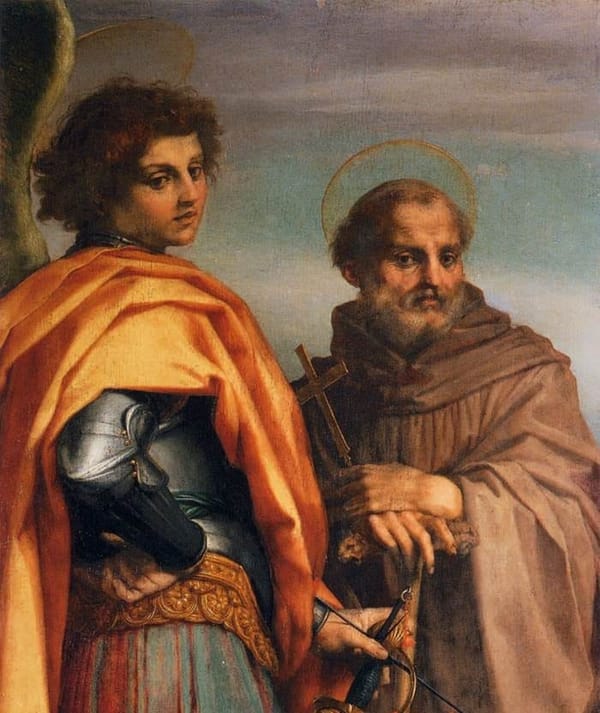
On this same day the whole Church unites in the solemn homage which Milan continues to pay, after a lapse of sixteen centuries, to two valiant witnesses of Christ. ‘Our martyrs, Felix and Nabor,’ says St. Ambrose, ‘are the grain of mustard-seed mentioned in the Gospel. They possessed the good odour of faith, though it did not appear to men; persecution arose, they laid down their arms, and bowed their heads to the sword, and immediately the grace that was hidden within them was shed abroad even to the ends of the world; so that we can now in all truth say of them: Their sound has gone forth into all the earth.'
Let us honour them and ask their intercession by the prayer which the Church addresses to God in commemoration of their glorious combat.
Collect
| Previous July 11: St. Pius I, Pope and Martyr | Next July 12: St. John Gualbert, Abbot |