Daily reading
After Pentecost
Double · Movable from Easter · Temporal
July 19, 2020
From Dom Guéranger’s The Liturgical Year.

|
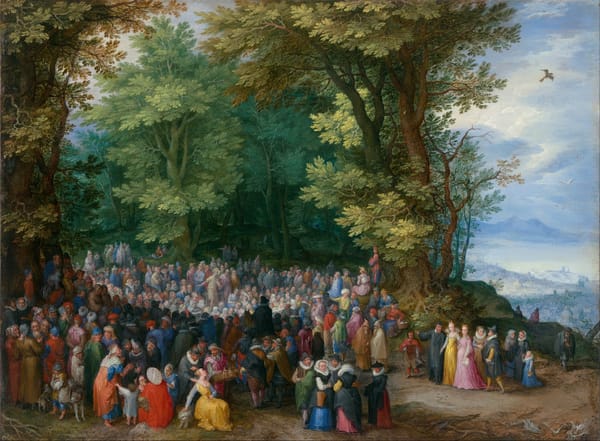
The Seventh Sunday after Pentecost
The dominical cycle of the Time after Pentecost completes to-day its first seven. Previous to the general adoption of the changes introduced into the Sunday Gospels for this portion of the year, the Gospel of the multiplication of the seven loaves gave its name to the seventh Sunday; and the mystery it contains is still evident in more than one section of to-day's liturgy.
As we have already seen, this mystery was that of the consummation of the perfect in the repose or rest of God Himself; it was the fruitful peace of the divine union. Nothing, then, could be more fitting than that Solomon, who is pre-eminently thepeaceful, the sacred and authorized chanter of the nuptial Canticle, should have been selected to come forward, on this day, to speak the praises of infinite Wisdom, and reveal her ways to the children of men. When Easter is kept as late in April as it is possible, the seventh Sunday after Pentecost is the first of the month of August; and the Church then begins, in her night Office, the lessons from the Sapiential Books. Otherwise, she continues the historic Scriptures, and that, in some years, for five weeks more; but even in that case eternal Wisdom maintains her rights to this Sunday, which the number of seven had already made hers in so special a way. For, when we cannot have the inspired instructions of Proverbs, we have Solomon's own example preaching to us in the third Book of Kings; we find him preferring Wisdom to all other treasures, and, on the throne of his father David, making her sit there with him as his inspirer and most noble Bride.
St. Jerome, who has been appointed by the Church herself as the interpreter of to-day's Scripture lessons,1 tells us that David, at the close of his life of wars and troubles, knew, as well as Solomon, the loveliness of this incomparable Bride of the Peaceful; the chill of his age was remedied by her caresses, whose very contact is purity.
‘Oh that this wisdom may be mine!’ exclaims the fervent solitary of Bethlehem; 'may she embrace me, and abide with me. She never grows old. She is ever the purest of virgins, fruitful, yet ever immaculate. I think the apostle means her when he speaks of a something that can make us fervent in spirit.2 So again, when our Lord tells us in the Gospel that, at the end of the world, the charity of many will grow cold,3 I believe it will be because wisdom will then grow rare.’4
The history of the two blind men, as related in the ninth chapter of St. Matthew, is the subject of to-day's Gospel in the Greek Church.
Mass
The Church, leaving the Synagogue in its cities which are to perish, has followed Jesus into the wilderness. Whilst the children of the kingdom5 are assisting at, without seeing it, this transmigration which is to be so fatal to them, the root of Jesse, now become the standard of nations,6 is rallying the people, and marshals them by thousands on towards the Church. From east and west, from north and south, they are pouring in, sitting down to the banquet of the kingdom,7 in company with Abraham and Isaac and Jacob. Here is our Introit; let us mingle our voices with these their glad chants.
Introit
All the opposition that men are capable of can never prevent divine Wisdom from compassing her ends. The Jewish people deny their King; but the Gentiles come forward and proclaim the Son of David. As we were just now singing in the Introit, His kingdom is extended the whole world over. In the Collect the Church asks that all evils may be removed, and that an abundance of blessings may consolidate in peace the power of the true Solomon.
Collect
The other Collects as on page 120.
Epistle
Cap. vi.Fratres, Humanum dico propter infirmitatem carnis vestræ : sicut enim exhibuistis membra vestra servire immunditiæ et iniquitati ad iuiquitatem; ita nunc exhibete membra vestra servire justifciæ in sanctificationem. Cum enim servi essetis peccati, liberi fuistis justitiæ. Quem ergo fructum habuistis tunc in illis, in quibus nunc erubescitis? Nam finis illorum mors est. Nunc vero liberati a peccato, servi autem facti Deo, habetis fructum vesferum in sanctificationem, finem vero vitam æternam. Stipendia enim peccati, mors. Gratia autem Dei, vita æterna : in Christo Jesu Domino nostro.
Ch. vi.Brethren : I speak a human thing, because of the infirmity of your flesh : for as you have yielded your members to serve uncleanness and iniquity unto iniquity; so now yield your members to serve justice, unto sanctification. For when you were the servants of sin, you were free from justice. What fruit therefore had you then in those things of which you are now ashamed? For the end of them is death. But now being made free from sin, and become servants to God, you have your fruit unto sanctification, and the end life everlasting. For the wages of sin is death; but the grace of God, life everlasting in Christ Jesus our Lord.
‘Reckon that ye are dead unto sin, but alive unto God, in Christ Jesus our Lord.’8 The apostle of the Gentiles enters to-day into the development of this leading formula of the Christian life. The Epistle of last Sunday aimed exclusively at putting it in language that could not be misunderstood; it showed us that it expresses what is meant by that Baptism which, when we are immersed in the water, unites us to Christ.
There, as in a sepulchre, the death of Jesus becomes ours, and delivers us from sin. Sold under sin9 by our first parents even before we had seen the day, and branded with its infamous stigma, our whole life belonged to the cruel tyrant. He is a master who is never satisfied with our service; he is a merciless exactor; there is scarce an hour that he does not make us feel his power over the members of our body; he does not allow us to forget that our body is his slave. But, if the life of a slave is under his master’s control, death comes at last and sets the soul free; and as to the body, the oppressor can claim nothing, once it is buried.10 Now, it was on the cross of the Man-God, who, as the apostle so strongly expresses it, was made sin11 because of our sins, that guilty human nature was considered by God's merciful justice to have become what its divine and innocent Head was. The old man that was the issue of Adam the sinner has been crucified; he has died in Christ; the slave by birth, affranchised by this happy death, has had buried under the waters of Baptism the body of sin, which carried in its flesh the mark of its slavery.
The body of sin was indeed our flesh; not that innocent flesh which originally came all pure from its Creator's hands, but the flesh which, generation after generation, was defiled by the transmission of a disgraceful inheritance. In Baptism, which the apostle calls the mysterious sepulchre, the sacred stream has not only washed away the defilement of this degraded body, but it has also set it free from those members of sin, which are the evil passions. These passions were powers of iniquity—that is, powers which deformed, and turned into uncleanness, those faculties and organs wherewith God had endowed us, that we might fulfil all justice, unto sanctification.12 At that moment of our Baptism the strong-armed tyrant forfeited his possession of us;13 that Baptism was a death which set his slave free. Sin being thus destroyed, the head of triple concupiscence has been severed, and the monster may writhe as he can; aided by grace, man thus liberated may always prevent, if he wishes, the coils of the serpent from again being joined with their head.
Yes, this is the manifold, yet single, work of holy Baptism: in the twinkling of an eye, and by its own power, it extirpates sin, and annihilates all its rights over us; but, once this is achieved, man must co-operate with the grace of the sacrament, that is, he must keep watch over his treacherous inclinations to sin, which come to life again by the slightest encouragement; he must be ever keeping up the work which his baptism-day began—that is, he must be ever cutting down the vile and noxious weeds which are ever cropping up. First, then, there is the death of sin, which, in its complete and sudden defeat of the old enemy, is the result of God's divine operation; but all this is to be followed up by a work which it belongs to the affranchised slave to do : the life-long work of mortification of the spirit and of the senses. It is the virtue of the first sacrament which is still telling on the Christian in this work of two-fold mortification; in his mortification, the sacrament is still pushing on its ceaseless work of vengeance against sin. Holy Baptism, having operated in the wretched slave of sin what God alone could empower it to achieve, summons man, now that his chains have fallen, to join it in the glorious work of maintaining his liberty; it invites him to share with it the honour of the divine victory over satan and his works.
The keeping down of the flesh will be again brought before us next Sunday, as the true indicator of liberty on this earth, and as the authentication of our being truly children of God. As the apostle says : 'Let not sin reign in your mortal body, so as to obey the lusts thereof. Neither yield ye your members as instruments of iniquity unto sin; but present yourselves to God as those that are alive from the dead, and your members as instruments of justice unto God. For sin shall not have dominion over you : for ye are not under the law, but under grace. Know ye not, that to whom ye yield yourselves servants to obey, his servants are ye whom ye obey, whether it be of sin unto death, or of obedience unto justice? But thanks be to God, that ye were the servants of sin; . . . but being freed from sin, we have been made servants of justice.'14
And shall we do less for justice than is being done everywhere in favour of our enemy, sin? Surely justice deserves that we should make greater efforts in her service than for that odious tyrant who requites his slaves with nothing but shame and death. And yet—oh admirable condescension of God to our weakness!—we have St. Paul telling us in to-day's Epistle, in the name of the Holy Ghost, that we shall be saints, we shall attain eternal life,15 if we will but serve justice with as much earnestness as we once served uncleanness and iniquity.
Let us humble ourselves at hearing such words; let us be honest, and we shall feel that they contain a reproach. Many of usmight ask : What has become of that intense ardour wherewith we once used to follow after sin? To say that we have converted our ways would be no answer, for a conversion does not paralyse our faculties; it enlists our natural energy in God's service, it even intensifies it by the very fact of its now being employed as originally intended. At all events, conversion does not lessen the activity which was in us before our conversion; it would be an insult to grace to accuse it of diminishing in us the gifts of God.
What lessons, then, may we learn by seeing how eager in the pursuit of honour, interest, or pleasure, are the votaries of the world! What earnestness, what toil, what perseverance, what frequent sufferings, what abnegation at every turn, what misplaced heroism—and all for the purpose of satisfying the seven heads of the beast, and tasting a lew drops of the poisoned cup of Babylon!16 There are many souls in hell who have gone through more fatigue and pain to procure their damnation than even the martyrs endured for Christ; and even with all that, never attaining the object they sought to obtain in this world! so true is it that the fools who are the most subservient to satan's wishes do not always succeed in enjoying, even for a single day, the vile rewards he promises his slaves.
Justice treats her followers in a very different way; she does not degrade, she does not deceive them that keep her. She blesses them with peace of mind at every step they take in duty-doing; she is ever enriching their treasure of merit; she leads them safely to the perfection of love. The life of divine union then grows, almost spontaneously, on that high ground of justice; it rests on justice, as a flower does on its stem. 'He that possesseth justice,' says the Scripture, 'shall lay hold on wisdom': he shall find delights in that divine wisdom, which surpasses all that earth could procure.17
Would it, then, be fair to hesitate to go through those toils which procure heaven for us, and are a preparation here on earth for the glories which are to be revealed in us in our eternal home? The present life, how long soever it may be, seems but momentary to a faithful soul; she is glad to give this proof of the love she bears to Him she longs for. 'Jacob,' says St. Augustine, 'gave his twice seven years of service18 for the sake of Rachel, whose name, they tell us, signifies vision of the Beginning, that is, of the Word, that is, of the Wisdom which shows us God. Every virtuous man on earth loves this Wisdom; it is for her he works and suffers, by serving justice. What he, like Jacob, aims at by his labours, is, not the fatigue for its own sake, but the possession of that which the fatigue is to bring him, namely, the fair Rachel, that is to say, rest in the Word, in whom we have the vision of the Beginning. Is there any true servant of God who can have any other thought, when he is under the influence of grace? Once converted, what is it that man wishes? What is in bis thoughts? What has he in his heart? What is it that he thus passionately loves and desires? It is the knowledge of Wisdom. Of course, man would, if he could, avoid all fatigue and suffering, and come straight to the delights which he knows are in the exquisitely beautiful and perfect Wisdom; but that cannot be in the land of the dying. "If thou desire Wisdom, keep justice; and God will give her unto thee."19 Justice here means the commandments; and the commandments prescribe works of justice, of that justice which comes of faith; and faith lives amidst the uncertainty of temptations; that by piously believing what it does not as yet understand, it may merit the happiness of understanding.
‘We are not, therefore, to find fault with the ardour of those who are desirous of possessing truth in its unveiled loveliness; what we must do, is to put order in their love, by telling them to begin with faith, and strive, by the exercise of good deeds, to arrive at the bliss they long for. Do thou love and desire, at the very outset, and above all things, this object which is so worthy of thy possession; but, let the ardour which burns within thee show itself, first of all, by its leading thee cheerfully to endure the fatigues of the road which leads to the prize, towards which thy love is all directed. Yea, and when thou has reached it, remember, thou wilt never enjoy beautiful truth in this life, without having, at the same time, still to cultivate labourious justice. How comprehensive and pure soever may be the sight granted to mortal men of the unchangeable Good, the corruptible body is a load upon the soul, and the earthly habitation presseth down the mind that museth upon many things.”20 One, then, is that to which we must tend; but many are the things we are to bear for that one’s sake.’21
In the Gradual, the Church keeps up the thought which pervades this seventh Sunday; she invites her sons to come and receive from her the knowledge of the fear of the Lord; for the fear of the Lord is the beginning of wisdom.22 The Alleluiaverse again calls upon the Gentiles, the heirs of Jacob, to celebrate in gladness the gift of God.
Gradual
Gospel
Cap. vii.In illo tempore : dixit Jesus discipulis suis : Attendite a falsis prophetis, qui veniunt ad vos in vestimentis ovium, intrinsecus autem sunt lupi rapaces : a fructibus eorum cognoscetis eos. Numquid colligunt de spinis uvas, aut de tribulis ficus? Sic omnis arbor bona fructus bonos facit : mala autem arbor malos fructus facit. Non potest arbor bona malos fructus facere : neque arbor mala bonos fructus facere. Omnis arbor, quæ non facit fructum bonum, excidetur, et in ignem mittetur. Igitur ex fructibus eorum cognoscetis eos. Non omnis, qui dicit mihi : Domine, Domine, intrabit in regnum cœlorum : sed qui facit voluntatem Patris mei, qui in cœlis est, ipse intrabit in regnum cœlorum.
Ch. vii.At that time : Jesus said to his disciples: Beware of false prophets, who come to you in the clothing of sheep, but inwardly they are ravening wolves. By their fruits you shall know them. Do men gather grapes of thorns, or figs of thistles? Even so every good tree bringeth forth good fruit, and the evil tree bringeth forth evil fruit. A good tree cannot bring forth evil fruit, neither can an evil tree bring forth good fruit. Every tree that bringeth not forth good fruit shall be cut down, and shall be cast into the fire. Wherefore by their fruits you shall know them. Not every one that saith to me, Lord, Lord, shall enter into the kingdom of heaven; but he that doth the will of my Father who is in heaven, he shall enter into the kingdom of heaven.
By rejecting the Gospel, the Jewish people have refused the light. Whilst the Sun of justice, hailed with delight by the Gentiles, is lighting up, in all splendour, the land that was once in the shadow of death,23 a black night is covering the heretofore blessed country of the patriarchs, and darkness is every hour thickening in Jerusalem. By the blindness which is leading her to destruction, the Synagogue is verifying our Lord’s words : ‘He that walketh in darkness, knoweth not whither he goeth.’24
False prophets and false Christs are numerous in Israel,25 ever since the true Messiah, whom the prophets foretold, has been ignored, and treated by His own people26 as the prophets themselves had been.27 His witnesses, the apostles, have vainly tried to induce Juda to retract the fatal denial made in the pretorium. And yet, Jada knows better than all the world beside, that the times are accomplished; for, has not the sceptre fallen from his hands?28 And Juda, who disdainfully disowns the spiritual royalty of the Saviour of men, is going on with his ceaseless expectation and search of the Christ of his own imagining,—a Messiah who will restore to him the power he has lost. The Jewish doctors have not as yet invented the sentence of Talmud, whereby they will endeavour to stifle the unpleasant prophecies which give them the lie: ‘Cursed be he, that calculates the times of the coming of Messiah!’29 What, then, must be the feelings of a people, which has for ages been living in the expectation of an event the most important that could be, now that it sees the time specified by prophecy to be fast expiring, when it will be compelled either to disavow the past, or to acknowledge, at the foot of the cross which it has set up, its most sinful error.
A strange anxiety has seized on the nation of deicides. The spirit of madness governs her determinations. In the scare of her feverish excitement, which is the very opposite of the calm and resigned expectation of her ancient patriarchs, she takes every rebel for a Christ. She, that would not have the Son of David, hails every upstart as her Messiah, and follows every adventurer that sets up the cry of war against Rome, or that cheats her with the promise of making her country independent. With such materials, Judea is soon turned into a kingdom of anarchy and confusion. The very sanctuary of the temple is made the scene of party quarrels and bloodshed. The daughter of Sion follows her false Christs into the desert;30 there organizes riot; and returns to the holy city, filling it with highwaymen, or with assassins imported from the wilderness. Long before these events, Ezechiel had thus spoken: 'Woe to the foolish prophets that see nothing! Thy prophets, O Israel, were like foxes in the deserts!’31 And Isaias had thus prophesied :
‘Therefore, the Lord shall have no joy in their young men; neither shall He have mercy on their fatherless and widows; for every one is a hypocrite and wicked, and every mouth hath spoken folly.'32
The time is close at hand : the hour is come, when they that are in Judea must flee to the mountains,'33 as our Lord had said. The Christians of Jerusalem will, as history records, soon be leaving the doomed city, under the guidance of Simeon, their bishop.34 With them departs Sion’s last hope; God is about to avenge His Christ. Already has the signal of destruction been heard, the whistle, as the prophet Isaias had foretold,35 has been heard from beyond the seas; and, as Balaam had seen it in vision, 'they are coming in galleys from Italy, to lay waste the Hebrews.'36 The leader, announced by Daniel, is approaching towards that which was once the land of promise; the appointed desolation and ruin shall remain there even after the end of the war.37
Let us leave the Jews to hurry on their own ruin; let us return to the Church, which, at the same time, is rising up, so grand and so beautiful, on the corner-stone that had been rejected by the Synagogue.38 Because of the absence of this stone, which the builders of Sion had not the wisdom to recognize as the basis indispensably necessary to their city, Jerusalem falls in Judea, but reappears, more than ever beauteous, on the hills,39 whither Cephas,40 prince of the apostles, has carried her everlasting foundation. Set firmly on the divine rock, she shall no longer fear the violence of the billows and winds, when they storm against her walls.41 False prophets, and all the workers of lies, who had so successfully sapped the walls of the ancient, will not leave the new Jerusalem in peace; for our Lord had plainly said : 'It is necessary that scandals should come';42 and the apostle, speaking of heresy (that greatest of all scandals), said : 'There must be heresies in order that they who are approved may be made manifest.’43
Indeed, for each individual Christian, as for the Church at large, the security of the spiritual building depends primarily on the firmness of the foundation, which is faith. The Holy Ghost will not build on a foundation that is unsound or unsafe. When, especially, He is to lead a soul to the higher degrees of divine union, He exacts from her, as the first condition, that her faith, too, be above the average, —a faith, that is, with heroism enough to fight successfully those battles which brace the soul, and so render her worthy of light and love. In every stage of the Christian life, however, it is faith that provides love with its enduring and substantial44 nourishment; it is faith that gives to the virtues their supernatural motives, and makes them fit to form a worthy court for their queen, charity. A soul's development never goes beyond the measure of her faith. The capaciousness of faith, and its ever-growing plenitude, and its certified conformity with truth, these are the guarantees of the progress which will be made by a just man; whereas all such holiness as affects to be guided by a faith which is cramped or false is holiness of a very dubious kind, and one that is exposed to most fearful illusions.
It was, therefore, a good and a wholesome thing that faith should be put to the test, for it grows brighter and stronger under trial. St. Paul, in his Epistle to the Hebrews, is enthusiastic in his praise of the triumphs won by the faith of our forefathers.45 Could there be denied to the new Covenant those glorious combats which constituted the eternal merit and honour of the saints who lived in the period of expectation and figures? It is by their victorious faith in the word of the promise, that all those worthy ancestors of the Christian people merited to have God Himself as their praise-giver.46 For us, who joyously have possession of that Messias who to them was but the object of heroic hope, our trial cannot be like theirs—the trial of expectation. This is quite true; and yet, heresy, which is the offspring of man's pride and hell's malice—heresy and its manifold outcomings, which are ever producing the diminution of truth in this world47—will give us occasions of merit even in our possession of what they beheld and saluted only afar off.48 Man is ever trying to intrude his foolish ideas into the truths of divine revelation; and, as to the prince of this world,49 he will do all in his power to encourage these audacious attempts at corrupting the purity of the word. But Wisdom, who is never overcome,50 will turn all these impious efforts into an occasion of glorious victories for her children. Here we have the reason why God permitted, from the very commencement of the Church’s existence, and still permits, that sects should be continually springing up. It is in the battlefield against error that the Church brings forth the armour of God,51 and shows herself all brilliant with that absolute truth which is the brightness of the Word, her Spouse;52 it is by his personal triumph over the spirit of lying, and by spontaneous adhesion to the teachings of Christ and His Church, that the Christian shows himself to be a true child of light,53 and becomes himself a light to the world.54
The combat is not without its dangers for the Christian who would hold, in all its integrity, the faith of his mother the Church. The tricks of the enemy, his studied and obstinate hypocrisy, the crafty skill wherewith he tries to stir up in the soul, almost without her knowing it, a score of little weaknesses of hers which more or less favour error—all this frequently ends in injuring the light, not perhaps in extinguishing it altogether, but in robbing it of some of us brilliancy. And yet, they who live on the teachings given us in our to-day's Gospel are sure to come off with the victory. Let us meditate upon them with gratitude and love; for it is by such teachings that eternal Wisdom grants us what we so ardently ask of Him, when in Advent we thus beseech Him : 'Come and teach us the way of prudence!'55 Prudence, the friend of a wise man,56 guardian of his treasures, and his surest defence, has no greater peril from which to keep him than shipwreck concerning the faith;57 if faith be lost, all is lost. No price is too great to give58 for that prudence of the serpent which, in a disciple of Christ, goes so admirably with the simplicity of the dove.59 If we are happy enough to possess prudence, we shall readily distinguish between those false teachers whom we must shun and those to whom we must hearken—between the falsifiers of the word and its faithful interpreters.
By their fruits shall ye know them, says our Gospel, and history confirms the words of our Redeemer. Under the sheep's clothing, which they wear that they may deceive simple souls, the apostles of falsehood ever betray their real nature. The artful language they use,60 and the flatteries they utter for gain's sake,61 cannot hide the hollowness of their works.62 They separate themselves from the flock of Christ,63 and flee from the light; for, as the apostle says : 'All things that are reproved, or deserve to be so, are made manifest by the light; and as to the things that are done by them in secret, it is a shame even to speak of them. Therefore, be ye not partakers with them.’64 The useless or rotten fruits of darkness, and 'the trees of autumn, twice dead,'65 which bear such fruits on their withered branches, both of them shall be cast into the fire. If you yourselves were heretofore darkness, now that you have become light in the Lord by Baptism, or by a sincere conversion, show yourselves to be so, and produce ‘the fruits of light, in all goodness, and justice, and truth.'66 On this condition alone can you hope to enter into the kingdom of heaven, and call yourselves disciples of that Wisdom of the Father, who, on this seventh Sunday, asks us to give Him our love.
St. James the apostle almost seems to be giving a commentary on the Gospel of this seventh Sunday, where he says : ‘Can the fig-tree, my brethren, bear grapes, or the vine figs? So neither can the salt water yield sweet. Who is a wise man and endued with wisdom among you, let him, by a good conversation (that is, by his good conduct) show his work in the meekness of wisdom.' . . . For there is a wisdom which is bitter, and misleads others; it 'descendeth not from above, but is earthly, sensual, devilish . . . . But the wisdom which is from above, first indeed is chaste, then peaceable, modest, easy to be persuaded, consenting to the good (and always sides with them), full of mercy and good fruits, without judging (the conduct of others), without dissimulation. And the fruit of justice is sown in peace to them that make peace.'67
The Offertory-anthem has been selected, according to Honorius of Autun,68 in allusion to the sacrifice of the thousand victims which were offered at Gabaon by Solomon, in the early days of his reign; when the sacrifice was ended, he was bidden to ask, what he would have God give to him : he desired and obtained wisdom, with the addition of riches and glory, for which he had not asked.69 It depends upon us, that the sacrifice which is here ready to be offered up, should be equally, and even more, accepted of God, for it is Incarnate Wisdom that is being offered to the most high God; He desires to obtain for us all the gifts of His eternal Father, and to give Himself also to us.
Offertory
Another circumstance which confirms what we have said regarding the mysterious character of this seventh Sunday, as to its being especially sacred to eternal Wisdom, is the fact that the verse of Scripture which formerly used to be joined to the present Offertory-anthem70 is the same as that which, in the Roman pontifical, opens the magnificent ceremony of the consecration of virgins : ‘And now we follow thee with all our heart, and we fear thee, and seek thy face; put us not to confusion, but deal with us according to thy meekness, and according to the multitude of thy mercies!’71 After being thrice called by the bishop, the affianced of the divine Spouse, singing these words, advance to the altar, where they are to be espoused to Him.
The Secret speaks to God of how the multiplied variety of the ancient sacrifices, such as those mentioned in the Offertory, were all made one in the oblation of our Christian sacrifice.
Secret
The other Secrets, as on page 130.
The Communion, says Honorius of Autun, gives us the prayer of Solomon, who asks wisdom of God, and obtains it.72 'If any of you,’ says St. James, 'want wisdom, let him ask of God, who giveth to all men abundantly, and upbraideth not : and it shall be given him.’73
Communion
Original sin has vitiated man to such a degree— he is so far from divine union, at his first coming into this life—that, of himself, he can neither cleanse the defilement that is on him, nor enter on the path which leads to God. It is requisite that our God, as a generous and patient physician, take our cure into His own hand; and, even when the cure is effected, should support and guide us. Let us then, in the Postcommunion, say with the Church:
Postcommunion
The other Postcommunions, as on page 131.
Vespers
The psalms, capitulum, hymn and versicle, as above, pages 71-81.
Antiphon of the Magnificat
- In II. Noct., ex Epist ad Nepotianum. ↩︎
- Rom. xii. 11. ↩︎
- St. Matt. xxiv. 12. ↩︎
- Ep. ad Nepot. 4. ↩︎
- St. Matt. viii. 12. ↩︎
- Isa. xi. 10. ↩︎
- St. Matt. viii. 11. ↩︎
- Rom. vi. 11. ↩︎
- Ibid. vii. 14. ↩︎
- Job iii. 18. ↩︎
- 2 Cor. v. 21. ↩︎
- Col. iii 5-9. ↩︎
- St. Luke xi. 21 ↩︎
- Rom. vi. 12-18. ↩︎
- Ibid. 19-23. ↩︎
- Apoc. xvii. 7. ↩︎
- Ecclus. xv. 1-8. ↩︎
- Gen. xxix. 18-30. ↩︎
- Ecclus. i. 33. ↩︎
- Wisd. ix. 15. ↩︎
- St. Augustine, Contra Faust, xxii. 50-58 (freely epitomized). ↩︎
- Ps. cx.10. ↩︎
- Isa. ix. 2. ↩︎
- St. John xii. 35. ↩︎
- St. Matt. xxiv. 24. ↩︎
- St. John i. 11. ↩︎
- St. Matt. xxiii 29-82. ↩︎
- Gen. xlix. 10. ↩︎
- Tract. Sanhedr., c. x. ↩︎
- St. Matt. xxiv. 26. ↩︎
- Ezech. xiii. 1-8. ↩︎
- Isa. ix. 17. ↩︎
- St. Matt. xxiv. 16. ↩︎
- Euseb., Hist. Eccl., iii. 5. ↩︎
- Isa. v. 26. ↩︎
- Num. xxiv. 24. ↩︎
- Dan. ix. 26, 27. ↩︎
- Ps. cxvii. 22. ↩︎
- Isa. ii. 2. ↩︎
- St. John i. 42. ↩︎
- St. Matt. vii. 24-27. ↩︎
- Ibid. xviii. 7. ↩︎
- 1 Cor. xi. 19. ↩︎
- Heb. xi. 1. ↩︎
- Ibid. 4-40. ↩︎
- Ibid. 2, 39. ↩︎
- Ps. xi. 2. ↩︎
- Heb. xi. 13. ↩︎
- St. John xvi. 11. ↩︎
- Wisd. vii. 30. ↩︎
- Eph. vi. 11-17. ↩︎
- Heb. i. 3. ↩︎
- St. John xii. 36. ↩︎
- St. Matt. v. 14. ↩︎
- First of the Great Antiphons. ↩︎
- Prov. vii. 4. ↩︎
- 1 Tim. i. 19. ↩︎
- Prov. iii. 13-19. ↩︎
- St. Matt. x. 16. ↩︎
- Eph. v. 6. ↩︎
- St. Jude. 16. ↩︎
- Eph. v. 11. ↩︎
- St. Jude 19 ↩︎
- Eph. v. 13, 12, 7. ↩︎
- St. Jude 12. ↩︎
- Eph. v. 8, 9. ↩︎
- St. James iii. 11-18. ↩︎
- Gemma Anim., iv. 57. ↩︎
- 3 Kings iii.; 2 Paralip. i. ↩︎
- Antiph. Gregor. ap. Thomasi, v. ↩︎
- Dan. iii. 40-42. ↩︎
- Honorius, ubi supra. ↩︎
- St. Jas. i. 5. ↩︎
July 19: St. Vincent de Paul, Confessor
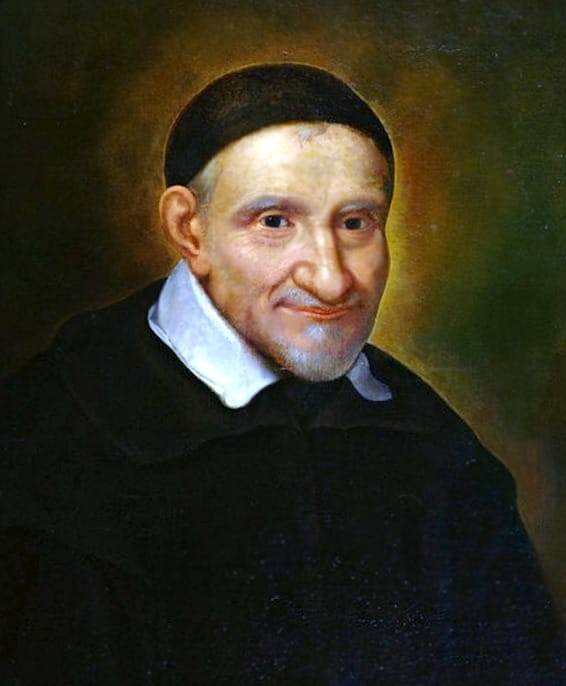 |
VINCENT was a man of faith that worketh by charity1 At the time he came into the world—viz., at the close of the same century in which Calvin was born—the Church was mourning over many nations separated from the faith; the Turks were harassing all the coasts of the Mediterranean. France, worn out by forty years of religious strife, was shaking off the yoke of heresy from within, while by a foolish stroke of policy she gave it external liberty. The Eastern and Northern frontiers were suffering the most terrible devastations, and the West and centre were the scene of civil strife and anarchy. In this state of confusion, the condition of souls was still more lamentable. In the towns alone was there any sort of quiet, any possibility of prayer. The country people, forgotten, sacrificed, subject to the utmost miseries, had none to support and direct them but a clergy too often abandoned by their bishops, unworthy of the ministry, and wellnigh as ignorant as their flocks. Vincent was raised up by the Holy Spirit to obviate all these evils. The world admires the works of the humble shepherd of Buglose, but it knows not the secret of their vitality. Philanthropy would imitate them; but its establishments of to-day are destroyed to-morrow, like castles built by children in the sand, while the institution it would fain supersede remains strong and unchanged, the only one capable of meeting the necessities of suffering humanity. The reason of this is not far to seek: faith alone can understand the mystery of suffering, having penetrated its secret in the Passion of our Lord; and charity that would be stable must be founded on faith. Vincent loved the poor because he loved the God whom his faith beheld in them. ‘O God!’ he used to say, ‘ it does us good to see the poor, if we look at them in the light of God, and think of the high esteem in which Jesus Christ holds them. Often enough they have scarcely the appearance or the intelligence of reasonable beings, so rude and so earthly are they. But look at them by the light of faith, and you will see that they represent the Son of God, who chose to be poor; He in His Passion had scarcely the appearance of a man; He seemed to the Gentiles to be a fool, and to the Jews a stumbling-block, moreover He calls Himself the evangelist of the poor: evangelizare pauperibus misit me.’2 This title of evangelist of the poor is the one that Vincent desired for himself, the starting-point and the explanation of all that he did in the Church. His one aim was to labour for the poor and the outcast; all the rest, he said, was but secondary. And he added, speaking to his sons of St. Lazare: ‘We should never have laboured for the candidates for priesthood, nor in the ecclesiastical seminaries, had we not deemed it necessary, in order to keep the people in good condition, to preserve in them the fruits of the missions, and to procure them good priests.’ That he might be able to consolidate his work in all its aspects, our Lord inspired Anne of Austria to make him a member of the Council of Conscience, and to place in his hands the office of extirpating the abuses among the higher clergy and of appointing pastors to the churches of France. We cannot here relate the history of a man in whom universal charity was, as it were, personified. But from the bagnio of Tunis, where he was a slave, to the ruined provinces for which he found millions of money, all the labours he underwent for the relief of every physical suffering were inspired by his zeal for the apostolate: by caring for the body, he strove to reach and succour the soul. At a time when men rejected the Gospel while striving to retain its benefits, certain wise men attributed Vincent's charity to philosophy. Nowadays they go further still, and in order logically to deny the author of the works they deny the works themselves. But if any there be who still hold the former opinion, let them listen to his own words, and then judge of his principles: ‘What is done for charity’s sake is done for God. It is not enough for us that we love God ourselves; our neighbour also must love him; neither can we love our neighbour as ourselves unless we procure for him the good we are bound to desire for ourselves—viz., divine love, which unites us to our Sovereign Good. We must love our neighbour as the image of God and the object of His love, and must try to make men love their Creator in return, and love one another also with mutual charity for the love of God, who so loved them as to deliver His own Son to death for them. But let us, I beg of you, look upon this Divine Saviour as a perfect pattern of the charity we must bear to our neighbour.’
The theophilanthropy of a century ago had no more right than had an atheist or a deist philosophy to rank Vincent, as it did, among the great men of its Calendar. Not nature, nor the pretended divinities of false science, but the God of Christians, the God who became Man to save us by taking our miseries upon Himself, was the sole inspirer of the greatest modern benefactor of the human race, whose favourite saying was: 'Nothing pleases me except in Jesus Christ.’ He observed the right order of charity, striving for the reign of his Divine Master, first in his own soul, then in others; and, far from acting of his own accord by the dictates of reason alone, he would rather have remained hidden for ever in the face of the Lord, and have left but an unknown name behind him.
‘Let us honour,’ he wrote, ‘the hidden state of the Son of God. There is our centre; there is what He requires of us for the present, for the future, for ever; unless His Divine Majesty makes known in His own unmistakable way that He demands something else of us. Let us especially honour this divine Master’s moderation in action. He would not always do all that He could do, in order to teach us to be satisfied when it is not expedient to do all that we are able, but only as much as is seasonable to charity and conformable to the Will of God. How royally do those honour our Lord who follow His holy Providence, and do not try to be beforehand with it! Do you not, and rightly, wish your servant to do nothing without your orders? and if this is reasonable between man and man, how much more so between the Creator and the creature!' Vincent, then, was anxious, according to his own expression, to ‘keep alongside of Providence,’ and not to outstep it. Thus he waited seven years before accepting the offers of the General de Gondi's wife, and founding his establishment of the Missions. Thus, too, when his faithful coadjutrix, Mademoiselle Le Gras, felt called to devote herself to the spiritual service of the Daughters of Charity, then living without any bond or common life, as simple assistants to the ladies of quality whom the man of God assembled in his Confraternities, he first tried her for a very long time. ‘As to this occupation,’ he wrote, in answer to her repeated petitions, ‘I beg of you, once for all, not to think of it until our Lord makes known His will. You wish to become the servant of these poor girls, and God wants you to be His servant. For God’s sake, Mademoiselle, let your heart imitate the tranquillity of our Lord’s heart, and then it will be fit to serve Him. The Kingdom of God is peace in the Holy Ghost; He will reign in you if you are in peace. Be so, then, if you please, and do honour to the God of peace and love.’
What a lesson given to the feverish zeal of an age like ours by a man whose life was so full! How often, in what we can call good works, do human pretensions sterilize grace by contradicting the Holy Ghost! Whereas Vincent de Paul, who considered himself ‘ a poor worm creeping on the earth, not knowing where he goes, but only seeking to be hidden in Thee, my God, who art all his desire,’—the humble Vincent saw his work prosper far more than a thousand others, and almost without his being aware of it. Towards the end of his long life he said to his daughters: ‘It is Divine Providence that set your congregation on its present footing. Who else was it, I ask you? I can find no other. We never had such an intention. I was thinking of it only yesterday, and I said to myself: Is it you who had the thought of founding a Congregation of Daughters of Charity? Oh! certainly not. Is it Mademoiselle Le Gras? Not at all. O my daughters, I never thought of it, your “sœur servante” never thought of it, neither did M. Portail (Vincent’s first and most faithful companion in the Mission). Then it is God who thought of it for you; Him, therefore, we must call the Founder of your Congregation, for truly we cannot recognize any other.’
Although with delicate docility, Vincent could no more forestall the action of God than an instrument the hand that uses it, nevertheless, once the divine impulse was given, he could not endure the least delay in following it, nor suffer any other sentiment in his soul but the most absolute confidence. He wrote again, with his charming simplicity, to the helpmate given him by God: 'You are always giving way a little to human feelings, thinking that everything is going to ruin as soon as you see me ill. O woman of little faith, why have you not more confidence and more submission to the guidance and example of Jesus Christ? This Saviour of the world entrusted the well-being of the whole Church to God His Father; and you, for a handful of young women, evidently raised up and gathered together by His providence, you fear that He will fail you! Come, come, Mademoiselle, you must humble yourself before God.’
No wonder that faith, the only possible guide of such a life, the imperishable foundation of all that he was for his neighbour and in himself, was, in the eyes of Vincent de Paul, the greatest of treasures. He who had pity for every suffering, even though well deserved; who, by an heroic fraud, took the place of a galley-slave in chains, was a pitiless foe to heresy, and could not rest till he had obtained either the banishment or the chastisement of its votaries. Clement XII, in the Bull of canonization, bears witness to this, in speaking of the pernicious error of Jansenism, which our saint was one of the first to denounce and prosecute. Never, perhaps, were these words of Holy Writ better verified: The simplicity of the just shall guide them: and the deceitfulness of the wicked shall destroy them.3 Though this sect expressed, later on, a supreme disdain for Monsieur Vincent, it had not always been of that mind. ‘I am,’ he said to a friend, ‘most particularly obliged to bless and thank God, for not having suffered the first and principal professors of that doctrine, men of my acquaintance and friendship, to be able to draw me to their opinions. I cannot tell you what pains they took, and what reasons they propounded to me; I objected to them, amongst other things, the authority of the Council of Trent, which is clearly opposed to them; and seeing that they still continued, I, instead of answering them, quietly recited my Credo; and that is how I have remained firm in the Catholic faith.’
But it is time to give the full account which Holy Church reads to-day in her liturgy. We will only remind our readers that in the year 1883, the fiftieth anniversary of the foundation of the St. Vincent de Paul Conferences at Paris, the Sovereign Pontiff Leo XIII proclaimed our saint the patron of the societies of charity in France.
How full a sheaf dost thou bear, O Vincent, as thou ascendest laden with blessings from earth to thy true country! O thou, the most simple of men, though living in an age of splendours, thy renown far surpasses the brilliant reputation which fascinated thy contemporaries. The true glory of that century, and the only one that will remain to it when time shall be no more, is to have seen, in its earlier part, saints powerful alike in faith and love, stemming the tide of Satan's conquests, and restoring to the soil of France, made barren by heresy, the fruitfulness of its brightest days. And now, two centuries and more after thy labours, the work of the harvest is still being carried on by thy sons and daughters, aided by new assistants who also acknowledge thee for their inspirer and father. Thou art now in the kingdom of heaven where grief and tears are no more, yet day by day thou still receivest the grateful thanks of the suffering and the sorrowful.
Reward our confidence in thee by fresh benefits. No name so much as thine inspires respect for the Church in our days of blasphemy. And yet those who deny Christ now go so far as to endeavour to stifle the testimony which the poor have always rendered to Him on thy account. Wield, against these ministers of hell, the two-edged sword, wherewith it is given to the saints to avenge God in the midst of the nations: treat them as thou didst the heretics of thy day; make them either deserve pardon or suffer punishment, be converted or be reduced by heaven to the impossibility of doing harm. Above all, take care of the unhappy beings whom these satanic men deprive of spiritual help in their last moments. Elevate thy daughters to the high level required by the present sad circumstances, when men would have their devotedness to deny its divine origin and cast off the guise of religion. If the enemies of the poor man can snatch from his death-bed the sacred sign of salvation, no rule, no law, no power of this world or the next, can cast out Jesus from the soul of the Sister of Charity, or prevent his name from passing from her heart to her lips: neither death nor hell, neither fire nor flood can stay him, says the Canticle of Canticles.
Thy sons, too, are carrying on thy work of evangelization; and even in our days their apostolate is crowned with the diadem of sanctity and martyrdom. Uphold their zeal; develop in them thy own spirit of unchanging devotedness to the Church and submission to the supreme Pastor. Forward all the new works of charity springing out of thy own, and placed by Rome to thy credit and under thy patronage. May they gather their heat from the divine fire which thou didst kindle on the earth; may they ever seek first the kingdom of God and His justice, never deviating, in the choice of means, from the principle thou didst lay down for them of 'judging, speaking, and acting, exactly as the Eternal Wisdom of God, clothed in our weak flesh, judged, spoke, and acted.’
| Previous July 18 (the Same Day): St. Symphorosa and her Seven Sons, Martyrs | Next July 19: St. Vincent de Paul, Confessor |