Daily reading
After Pentecost
Double of the II Class · Movable from Easter · Temporal
July 26, 2020
From Dom Guéranger’s The Liturgical Year.

|
The Eighth Sunday after Pentecost
In the middle ages this Sunday was called the sixth and last Sunday after the Natalis of the apostles (that is, the feast of St. Peter); it was, indeed, the last for the years when Easter had been kept as late in April as was possible; but it was only the first after that feast of St. Peter when Easter immediately followed the spring equinox.
We have already noticed the variable character of this last portion of the liturgical cycle, which is the result of Easter being kept on a different day each year; and that in consequence of this variation this week may be the second in which the Sapiential Books are read, or, what is of more frequent occurrence, the Books of Kings may still be providing the lessons for the Divine Office. In this latter case it is the ancient temple raised by Solomon, the king of peace, to the glory of Jehovah, that engages the Church's attention to-day. We shall find that the portions of the Mass which are chanted on this Sunday are closely connected with the lessons read in last night’s Office.
Let us, then, turn our reverential thought's once more to this splendid monument of the ancient Covenant. The Church is now going through that month which immediately preceded the events so momentous to Jerusalem; she would do honour to-day to the glorious and divine past which prepared her own present. Let us, like her, enter into the feelings of the first Christians, who were Juda’s own children; they had been told of the impending destruction foretold by the prophets, and an order from God bade them depart from Jerusalem. What a solemn moment that was, when the little flock of the elect,—the only ones in whom was kept up the faith of Abraham and the knowledge of the destinies of the Hebrew people—had just begun their emigration, and looked back on the city of their fathers, to take a last farewell! They took the road to the east; it led towards the Jordan, beyond which God had provided a refuge for the remnant of Israel.1 They halted on the incline of Mount Olivet, whence they had a full view of Jerusalem; in a few moments that hill would be between them and the city. Not quite forty years before the Man-God had sat down on that same spot,2 taking His own last look at the city and her temple. Jerusalem was seen in all her magnificence from this portion of the mount, which afterwards would be visited and venerated by our Christian pilgrims. The city had long since recovered from its ruins, and had, at the time we are speaking of, been enlarged by the princes of the Herodian family, so favourably looked on by the Romans. Never in any previous period of her history had Jerusalem been so perfect and so beautiful as she then was, when our fugitives were gazing upon her. There was not, as yet, the slightest outward indication that she was the city accursed of God. There, as a queen in her strength and power, she was throned amidst the mountains of which the psalmist had sung;3 her towers4 and palaces seemed as though they were her crown. Within the triple enclosure of the walls built by her latest kings, she embraced those three hills, the grandest, not only of Judea, but of the whole world: first, there was Sion, with its unparalleled memories; then, Golgotha, which had not yet been honoured on account of the holy sepulchre, and which, nevertheless, was even then attracting to itself the Roman legions, who were to wreak vengeance on this guilty land; and, lastly, Moriah, the sacred mount of the old world, on whose summit was raised that unrivalled temple, which gave Jerusalem to be the queen of all the cities of the east, for as such even the Gentiles acknowledged her.5
‘At sunrise, when in the distance there appeared the sanctuary, towering upwards of a hundred cubits above the two rows of porticoes which formed its double enclosure; when the sun cast his morning rays on that façade of gold and white marble; when there glittered the thousand gilded spires which mounted from its roof, it seemed, says Josephus, that it was a hill capped with snow, which gradually shone, and reddened, with the morning beams. The eye was dazzled, the soul was amazed, religion was roused within the beholder, and even the pagans fell down prostrate.'6 Yes, when the pagan came hither either for conquest or for curiosity, if he ever returned, it was as a pilgrim. Full of holy sentiments, he ascended the hill; and, having reached the summit, he entered by the golden gate into the gorgeous galleries which formed the outward enclosure of the temple. In the court of the Gentiles he met with men from every country. His soul was struck by the holiness of a place where he felt that there were preserved in all purity the ancient religious traditions of the human race; and he, being profane, stood afar off, assisting at the celebrations of the Hebrew worship, such as God had commanded it to be, that is, with all the magnificence of a divine vritual. The white column of smoke from the burning victims rose up before him as earth’s homage to God, its Creator and Saviour; from the inner courts there fell on his ear the harmony of the sacred chants, carrying as they did to heaven both the ardent prayer of those ages of expectation and the inspired expression of the world’s hope; and when, from the midst of the levite choirs and the countless priests who were busy in their ministry of sacrifice and praise, the high priest, with his golden crown on his head, came forth holding the censer in his hand, and entering himself alone within the mysterious veil which curtained off the Holy of holies, the stranger, though he had but a glimpse of all those splendid symbols of religion, yet confessed himself overpowered, and acknowledged the incomparable greatness of that invisible Deity, whose majesty made all the vain idols of the Gentiles seem to him paltry and foolish pretences. The princes of Asia and the greatest kings considered it an honour to be permitted to contribute, both by personal gifts of their own making and by sums taken from the national treasuries, towards defraying the expenses of the holy place.7 The Roman generals and the Cæsar themselves kept up the traditions of Cyrus8 and Alexander9 in this respect. Augustus ordered that every day a bull and two lambs should be presented in his name to the Jewish priests, and be immolated on Jehovah's altar for the well-being of the empire;10 his successors insisted on the practice being continued; and Josephus tells us that the beginning of the war was attributable to the sacrificers refusing any longer to accept the imperial offerings.11
But, if the majesty of the temple thus impressed the very pagans right up to its last days, there were reasons for an intensity of veneration and love on the part of a faithful Jew, which he alone could realize. He was the inheritor of the submissive faith of the patriarchs; as such, he was well aware that the prophetic privileges of his fatherland were but an announcement to the whole world, that it was one day to be blessed with the more real and lasting benefits of which he, the Jew, possessed but a figure; he quite understood that the hour had come when the children of God would not confine their worship within the narrow limits of one mountain or one city;12 he knew that God's true temple was then actually being built up on every hill of the Gentile world;13 and that, in its immensity, it took in all those countries of the earth into which the Blood that flowed first from Calvary had won its way. And yet, we can easily understand what a sharp pang of anguish thrilled through his patriot heart, now that God was about to consummate, before the astonished universe, the terrible consumption14 of the ungrateful people, whom He had chosen for His portion, His inheritance.15 Who is there that would not share in the grief of these holy ones of Jacob, few in number as the ears of corn gathered by the gleaner,16 and now bidding an eternal farewell to that holy, but now accursed, city? These true Israelites might well weep; they were leaving for ever, leaving to devastation and ruin, their homes, their country, and, dearest of all, that temple, which, for ages, had sanctified the glory of Israel, and given Juda the right and title to be the noblest of the nations of the earth.17
There was something even beyond all this : it was that their dear Jerusalem had been the scene of the grandest mysteries of the law of grace. Was it not in yonder temple that, as the prophets expressed it, God had manifested the Angel of the Testament,18 and given peace? The honour of that temple is no longer the exclusive right of an isolated people; for the Desired of all nations, by His going into it, has brought it a grander glory than all the ages of expectation and prophecy have imparted.19 It was under the shadow of those walls that Mary—she that was to be the future seat of Wisdom eternal—prepared within her soul and body a more august sanctuary for the divine Word than was that whose cedared and golden wainscoting made it so exquisite a shelter for the infant maiden. Yes, it was there that, when but three years old, Mary joyously mounted up the fifteen steps which separated the court of women from the eastern gate, offering to God the pure homage of her immaculate heart. Here, then, on the summit of Moriah, began, in the person of their Queen, the long line of consecrated virgins, who, to the end of time, will come offering, after her, their love to the King.20 There, also, the new priesthood found its type and model in the blessed Mother, presenting in that holy temple the world’s victim, Jesus, the new-born Child of her chaste womb. In that same dwelling, made by the hands of men; in those halls where sat the doctors, eternal Wisdom, too, seated Himself under the form of a child of twelve, instructing the very teachers of the Law by His sublime questions and divine answers.21 Every one of those courts had seen the Word Incarnate giving forth treasures of goodness, power, and heavenly doctrine. One of those porticoes was the favourite one where Jesus used to walk,22 and the infant Church made it the place of its early assemblies.23
Truly, then, this temple is holy with a holiness possessed by no other spot on earth; it is holy for the Jew of Sinai; it is holy for the Christian, be he Jew or Gentile, for here he finds that the Law ends, because here are verified all its figures.24 With good reason did our mother the Church, in her Office for this night, repeat the words which were spoken by God to Solomon : ‘I have sanctified this house which thou hast built, to put my name there for ever; and mine eyes and my heart shall be always there.'25
How, then, is it that dark forebodings are come terrifying the watchmen of the holy mount? Strange apparitions, fearful noises, have deprived the sacred edifice of that calm and peace which become the house of the Lord. At the Feast of Pentecost the priests, who were fulfilling their ministry, have heard in the holy place a commotion like that of a mighty multitude, and many voices crying out together: 'Let us go hence!' On another occasion, at midnight, the heavy brazen gate which closed the sanctuary on the eastern side, and which took twenty men to move it, has opened of itself.26 O temple, O temple, let us say it, with them that witnessed these threatening prodigies,27 why art thou troubled? why workest thou thine own destruction? Alas! we know what awaits thee! The prophet Zacharias foretold it when he said: ‘Open thy gates, O Libanus, and let fire devour thy cedars!'28
Has God forgotten His promises of infinite goodness? No : but let us think upon the terrible and just warning, which He added to the promise He made to Solomon, when he had finished building the temple : ‘But if ye and your children, revolting, shall turn away from following Me, and will not keep My commandments and My ceremonies which I have set before you, I will take away Israel from the face of the land, which I have given them; and the temple which I have sanctified to My name, I will cast out of My sight; and Israel shall be a proverb, and a by-word among all people. And this house shall be made an example of; every one that shall pass by it shall be astonished, and shall hiss, and say : "Why hath the Lord done thus to this land, and to this house?'"29
O Christian soul! thou that, by the grace of God, art become a temple30 more magnificent, more beloved in His eyes, than that of Jerusalem, take a lesson from these divine chastisements; and reflect on the words of the Most High, as recorded by Ezechiel: ‘The justice of the just shall not deliver him, in what day soever he shall sin.... Yea, if I shall say to the just, that he shall surely live, and he, trusting in his justice, commit iniquity —all his justices shall be forgotten, and, in his iniquity, which he hath committed, in the same shall he die.'31
With the Greeks, the multiplication of the five loaves and two fishes is the subject of the Gospel for this Sunday; they count it the eighth of St. Matthew.
Mass
The Introit speaks of the glory of the ancient temple, and of the holy mount. But greater far is the splendour of the Church, which is now carrying the name and praise of the Most High even to the end of the earth, far more efficiently than had done that temple which was but a figure of our mother the Church.
Introit
Not only are we incapable, of ourselves, of doing any good work, but, without the help of grace, we cannot even have a thought of supernatural good. Now, the surest means for obtaining the help that is so needed by us is to acknowledge humbly before God that we depend entirely upon Him; it is what the Church does in the Collect.
Collect
The other Collects, as on page 120.
Epistle
Cap. viii.Fratres, Debitores sumus non carni, ut secundum carnem vivamus. Si enim secundum carnem vixeritis, moriemini : si autem spiritu facta carnis mortificaveritis, vivetis. Quicumque enim Spiritu Dei aguntur, ii sunt filii Dei. Non enim accepistis spiritum servitutis iterum in timore, sed accepistis spiritum adoptionis filiorum, in quo clamamus : Abba (Pater). Ipse enim Spiritus testimonium redditi spiritui nostro, quod sumus filii Dei. Si autem filii, et hæredes : hæredes quidem Dei, cohæredes autem Christi.
Ch. viii.Brethren : We are debtors, not to the flesh, to live according to the flesh. For if you live according to the flesh, you shall die : but if by the spirit you mortify the deeds of the flesh, you shall live. For whosoever are led by the Spirit of God, they are the sons of God. For you have not received the spirit of bondage again in fear : but you have received the spirit of adoption of sons, whereby we cry : Abba (Father). For the Spirit himself giveth testimony to our spirit, that we are the sons of God. And if sons, heirs also : heirs indeed of God, and joint heirs with Christ.
The apostle and doctor of the Gentiles here goes on, forming to the Christian life the new recruits, whom his own voice and that of his fellow apostles, dispersed as they are throughout the world, are every day leading, by hundreds, to the fount of salvation. Although the Church is all attention to the events which are preparing for Judea, yet is she full of maternal solicitude for the great work of training those children whom she has given to her divine Spouse. Whilst Israel is obstinate in his fatal refusal to accept the Messiah, another family is growing up in his place; and, by its docility, richly repays our Lord for all the rebellion and slights offered Him by the children He had first made His chosen ones. They were the ancient people, and are jealous of others being now called to the same privilege. The contradictions of which Christ complains in the Psalm are anything but over; and yet, thanks to the Church, the Man-God is already the Head of the Gentiles.32
Admirable is the fruitfulness of the bride; for wonderful is the power of sanctification which she is using all through the world of various nations. Scarcely has she sprung into her beauteous existence, than she offers to her Lord and her King a new empire, consolidated in unity of love; she presents Him with a generation that is all pure in the intelligence and practice of every virtue. It is quite true, that the Holy Ghost acts directly on the souls of the newly baptized; but there is something else to be considered in the divine plan. It is this : the Word, having been made flesh, and having taken to Himself a bride (which is the visible Church on earth), whom He has made His associate in the work of man's salvation, has willed that the invisible operation of the divine Spirit, who proceeds from Him (the Word), shall not be in its normal state, unless there be added to it the extrinsic cooperation and intervention of this His bride. Not only is the Church the depository of those allpotent formulas and mysterious rites which change man’s heart into a new soil, cleansing it from thorns and weeds, making it able to produce a hundredfold, but she also sows the seed of the divine husbandman into that same soil,33 by her countless modes of teaching the truth. To the Holy Ghost, indeed, a magnificent share is due of that fecundity and that social life of the Church; still, her portion of work is exquisite; it deals with the elect taken as individuals, and consists especially in bringing them to profit by the divine energies of the sacraments which she administers, and in developing the germs of salvation which her teaching plants in their souls.
How important, then, and sublime will ever be that mission, winch is confided to those men who are set over particular churches, as teachers or directors of souls; they represent, to these isolated congregations, the common mother of all the faithful, for, in her name, they really provide for the holy Spirit those elements upon which He is to make His all-powerful action felt. For that very same reason, woe to those times when the dispensers of the divine word, having themselves nought but halved or false principles, give but weak, shrivelled seed to the souls entrusted to them! The Holy Ghost; is not bound to supply their insuffciency; ordinarily speaking, He does not supply it, for such is not the way established by Christ for the sanctification of the members of His Church.
The common mother, however, has a supplementary aid for such of her children as may be thus treated; it is her liturgy. There they will find, not only the holy sacrifice which will support them, and the graces of the Sacrament of love which will nourish spiritual life within them, but, moreover, the surest rule of conduct, and the sublimest teachings of every virtue. Such souls as these have perhaps the idea that the poor subjective system they have made for themselves is the royal road to perfection; but, if they be of an earnest good will, desirous to find the best way, God will, some happy day, lead them to find, and, finding, to appreciate, the inexhaustible and divinely given treasures of the Church's liturgy; possessing and enriching themselves with these, they will soon put aside what the prophet Isaias terms bread without strength, and water without power.34 The same prophet would thus urge them, in the Church's name, to what is best: 'All ye that thirst, come to the waters! And ye that have no money, make haste, buy, and eat. Come ye! buy wine and milk, without money, and without any price. Why spend ye money for that which is not bread, and your labour for that which doth not satisfy you? Hearken diligently to me, and eat that which is good, and your soul shall be delighted in fatness!'35 And truly there is a fact which should rouse, both to attention and gratitude, any Christian who longs to be enlightened as to the best way of getting to heaven : this fact is, that the Church herself has made a selection, for our reading, from the treasury of the Scriptures, and, in her missal, which she puts into our hands, she has inserted practical teachings from the same divine Books, which she knew were best suited to the wants of her children. A Christian, who is humbly and devoutly assiduous in the study of this admirable book of the liturgy, will abound in spiritual knowledge. His guide will say to him, and with a well-grounded assurance : 'This is the way; walk in it! And go not aside, neither to the right, nor to the left!'36 We have no need to wonder at all this; for, in the guidance of souls, the Church is far superior to the most learned doctors and to the greatest saints, all of whom were humble disciples in her school.
Let us put together the few lines which have been read to us as the Epistles of the last three Sundays, taken from that written by St. Paul to the Romans. To say nothing of their infallible truth as being inspired by the Holy Ghost, could we have had any exposition of the principles of revealed morality which could be compared to it? Clearness, simplicity of diction, earnest vehemence of exhortation–all are perfect in these few words; and yet, they are but the outward expression of the sublimest truths of Christian dogma. Let us make the barest possible summary of what these three Epistles have taught us; and we shall see how grand they are. Christ Jesus, foundation of man's salvation; His death and burial made, in Baptism, the regeneration of man; His life in God, the model of our own; the disgrace of our enslaved bodies and its removal; the sanctifying fruitfulness of every virtue substituted in our members for the poisonous roots of all vices; and, on this very Sunday, the pre-eminence of the spirit over the flesh; the duties incumbent on our spirit, if she is to maintain her superiority; what man must do, if he would preserve the liberty bestowed on him by the Spirit of love, and prove himself to be, what he really is, a son of God and joint-heir of Christ. Yes, these are the splendid realities, which are henceforth to light up in us the law of the spirit of life (that is, the law of the life we are to live by the Spirit) in Christ Jesus;37 these are the axioms of the science of salvation now taught to the whole world, which are to be substituted for both the weaknesses of the Jewish law and the empty ethics of philosophers.
For, the leading idea which pervades the whole of this sublime Epistle to the Romans is this : man, unaided by grace, is incapable of producing perfect justice and absolute good. Experience has proved it, St. Paul teaches it, the fathers will, later on, unanimously assert it, and the Church, in her Councils, will define it. True, by the mere powers of his fallen nature, man may come to the knowledge of some truths, and to the practice of some virtues; but, without grace, he can never know, and still less observe, the precepts of even the natural law, if they are taken as a whole.
From Jesus, then, from Jesus alone, comes all justice. Not only is supernatural justice, which supposes the infusion of sanctifying grace in the sinner's soul, wholly from Him; but even that natural justice, of which men are so proud, and which they say is quite enough without anything else, soon leaves one who does not cling to Christ by faith and love. Our modern world has a pompous phrase about 'the independence of the human mind let those who pretend to acknowledge no other goodness but that, go on with their boasting of being moral and honest men; but, as to us Christians, we believe what our mother the Church teaches us; and, agreeably to such teaching, we believe that 'a moral and honest man,' that is to say, a man who lives up to all the duties which nature puts upon him, can only be such here below by a special aid of our Redeemer and Saviour Christ Jesus. With St. Paul, therefore, let us be proud of the Gospel; for, as he calls it, it is the power of God,38 not only to justify the ungodly,39 but also to enrich souls, that thirst after what is right, with an active and perfect justice. 'The just man,' says the same apostle, 'liveth by faith'; and according to the growth of his faith, so is his growth in justice. Without faith in Christ, the pretension to reach perfection in good, by one’s own power and works, produces nothing but the stagnation of pride and the wrath of God.40
The Jews are a proof of it. Proud of their Law, which gave them light greater than that enjoyed by the Gentiles,41 and wishing to make their whole virtue consist in the possession of that Law, they have rejected Him who was the end of the Law, and the source of all holiness;42 they have refused to accept the Christ, who not only delivered them from tneir previous misery,43 but also brought them the knowledge of what would save them, and the strength to fulfil it;44 they have continued in their iniquity, adding sin upon sin to that contracted from their first parents, and thus 'treasuring up wrath against the day of wrath.'45 Now is being fulfilled the prediction of Isaias, whose words might very appropriately have been used by the faithful few of Israel, as they fled from Jerusalem : 'Except the Lord of hosts had left us seed, we should have been as Sodom, and we should have been like to Gomorrha.'46
‘What, then, shall we say?’ asks the apostle; and he answers his own question thus : 'That the Gentiles, who followed not after justice, have attained to justice, even the justice that is of faith. But Israel, by following after the law of justice, is not come unto the law of justice. Why so? Because they sought it, not by faith, but as it were of works; for they stumbled at the stumbling-stone, as it is written : 'behold! I lay in Sion a stumblingstone and a rock of scandal; and whosoever believeth in Him, shall not be confounded.’47
The Gradual seems to express the sentiments of the Jewish converts, who had to depart from their cities; they might thus have besought God to be henceforth their protector and a place of refuge where they might be safe. The Alleluia-versicle again sings of the glory that was once given to the Lord in Jerusalem, especially on the holy mountain where His temple was built.
Gradual
Gospel
Cap. xvi.In illo tempore : Dixit Jesus discipulis suis parabolani hanc : Homo quidam erat dives, qui habebat villicum : et hic diffamatus est apud illum quasi dissipasset bona ipsius. Et vocavit ilium, et ait illi: Quid hoc audio de te? Redde rationem villicationis tuæ : jam enim non poteria villicare. Ait autem villicus intra se : Quid faciam, quia dominus meus aufert a me villicationem? Fodere non valeo, mendicare erubesco. Scio quid faciam, ut, cura amotus fuero a villicatione, recipiant me in domos suas. Convocatis itaque singulis debitoribua domini sui, dicebat primo : Quantum debes domino meo? At ille dixit : Centum cados olei. Dixitque illi : Accipe cautionem tuam : et sede cito, scribe quinquaginta. Deinde alii dixit : Tu vero quantum debes? Qui ait : Centum coros tritici. Ait illi : Accipe litteras tuas, et scribe octoginta. Et laudavit dominus villicum iniquitatis, quia prudenter fecisset : quia filii hujus sæculi prudentiores filiis lucis in generatione sua sunt. Et ego vobis dico : Facite vobis amicos de mammona iniquitatis : ut, cum defeceritis, recipiant vos in æterna tabemacula.
Ch. xvi.At that time : Jesus spoke to his disciples this parable: There was a certain rich man who had a steward : and the same was accused unto him, that he had wasted his goods. And he called him, and said to him : How is it that I hear this of thee? give an account of thy stewardship : for now thou canst be steward no longer. And the steward said within himself : What shall I do, because my lord taketh away from me the stewardship? To dig I am not able; to beg I am ashamed. I know what I will do, that when I shall be removed from the stewardship, they may receive me into their houses. Therefore, calling together every one of his lord's debtors, he said to the first : How much dost thou owe my lord? But he said : A hundred barrels of oil. And he said to him : Take thy bill and sit down quickly, and write fifty. Then he said to another : And how much dost thou owe? Who said : A hundred quarters of wheat. He said to him : Take thy bill and write eighty. And the lord commended the unjust steward, forasmuch as he had done wisely : for the children of this world are wiser in their generation than the children of light. And I say to you : Make unto you friends of the mammon of iniquity, that when you shall fail, they may receive you into everlasting dwellings.
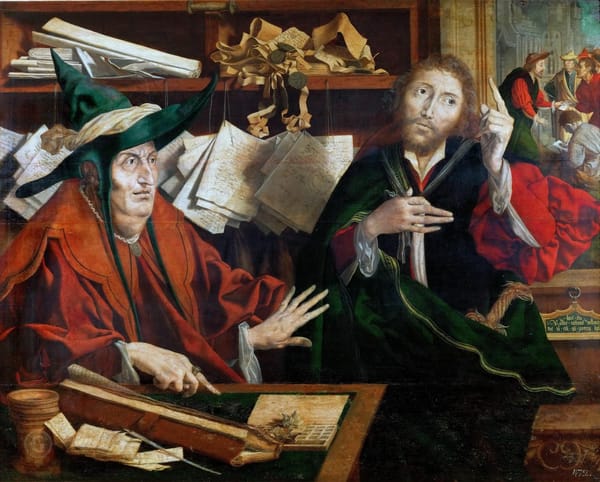
The several parts of the parable here proposed to us are easy to be understood, and convey a deep teaching. God alone is rich by nature, for to Him alone belongs the direct and absolute dominion over all things : they are His, because He made them.48 But, by sending His Son into the world under a created form, He, by this temporal mission, appointed Him heir to all the works of His hands,49 just as truly as He already was owner of the riches of the divine Nature because of His eternal generation. The rich man, then, of our Gospel is Jesus, who, in His sacred Humanity, united to the Word, is heir of all things,50 and, as such, all things of the most high God, created or uncreated, finite or infinite, belong to Him. To Him belong the heavens which proclaim His glory,51 and which, as long as they last,52 clothe Him with their garment of light;53 to Him the ocean, whose surges are but a voice that speaks His praise,54 and hushes the fury of its tempests when He bids it be still;55 to Him the earth, which gladly offers Him the homage of all its fullness.56 The grass and flowers of the meadows, the varied fruits, the fertile loveliness of the fields;57 the birds of the air and the fishes that inhabit the rivers, or that sport in the paths of the sea;58 the huge oxen as well as the tiniest insect that lives; the wild beasts of forest or mountain;59 all are His, all are subject to His rule. Silver, too, is His, and gold is His;60 and man, too, is His, and would have been eternally His servant, had not Jesus mercifully vouchsafed to divinize him, and make him a partaker of His own eternal happiness and riches.
Instead of our being His slaves or servants, He would have us be His brothers; and, when He returned from this world to His Father, whom He had also made to be ours by the grace He had infused into us,61 He sent us the Holy Ghost, who should bear testimony to us that we are the sons of God,62 and be to us the pledge of our sacred inheritance, heaven.63 O ineffable riches of the world to come! O inheritance the fullest that ever was! Our Jesus Himself is all joy at the sight of it, and, in the psalm of His Resurrection, He gives expression to that joy. We, His members and jointheirs, have a right to repeat those words after Him, and say : 'The lines are fallen unto me in goodly places; for my inheritance is goodly to me! for the Lord Himself is my portion! I will bless Him for having given me to understand my happiness!'64
But, in order that we may attain to those eternal riches, there is a condition imposed on us : we must turn to profit the visible domain of Christ; we must see that it is used in His service. The future rewards we are to have in heaven depend upon the greater or less fidelity wherewith we have employed our share of these inferior good things, for they are entrusted to us, to each of us in the measure which seemed good in God's eyes. What a divine agreement has been drawn up for us! What perfect adjustment between justice and love! Our Lord Jesus Christ has divided His property into two portions; He gives the eternal portion unreservedly to us; it is the only one that is truly great, the only one that is capable of contenting our infinite longings. As to the other portion, which, in itself, would not be worthy of the attention of beings that are made for the contemplation of the divine essence, He could not think of allowing us to set our hearts on it, neither will He permit us to have absolute dominion over it. The real possession of temporal goods belongs, therefore, to Him alone; the ownership of earthly riches, which He permits to the future joint-heirs of His own blissful eternity, is subject to numberless restrictions during their life-time, and, at their death, exhibits its essentially precarious tenure, by not being able to follow its owner beyond the grave.
For the fool, as well as for the wise man, the day will come when his soul will be required of him;65 and when the rich man, as well as the poor, will be brought before his Maker, exactly as he was on the day of his first entrance into the world,66 and it will be said to him : Give an account of thy stewardship! At that dread hour, the rule observed for the judgment will be that which our Lord revealed to us during His mortal life : ‘Unto whomsoever much is given, of him much shall be required; and to whom they have committed much, of him they will demand the more.’67 Woe, at that hour, to the servant who has comported himself as though he were the absolute master! Woe to the steward who, disregarding the trust assigned to him, has done just what his own whim suggested with the goods of which he was only the dispenser!68 When the light of eternity shall be upon him, he will understand the error of his foolish pride. He will see the shameful injustice of a life which the world perhaps thought a very decent one, but which was spent without the slightest regard to God's intentions in giving him the riches of which he boasted. He will then be entirely deprived of them all; neither will it be then in his power to make a better use of them for the future—that is, a use more in accordance with the designs of God. If he might, at least, make some restitution for the goods he has abused! if he might sue for aid from those with whom he lived upon earth! But, no! when time is over, labour is over too. He has nothing to show for all his riches; he is powerless; and when he goes before that dread tribunal, where every man is afraid that he cannot put his own accounts right, whom can he get to help him?69
Happy, therefore, if, now that time is still granted him, he would allow the thousand calls of God70 to awaken him from his false conscience. Happy if, like the steward mentioned in our Gospel, he would profit by the days he has still to live, and would say to himself those words of Job: 'What shall I do, when God shall rise to judge? And, when He shall examine, what shall I answer Him?'71
This very Judge, whom he so rightly fears, now most mercifully points out to him how he may escape the punishment due to his past mal-administration. Let him imitate the prudence of the unjust steward, and he will have praise for it from his Lord; not only because of his prudence, but because by thus spreading over God's servants the riches that were entrusted to his care, far from robbing his divine Master, he acts in strict accordance with His wishes. ‘Who thinkest thou,’ asks our Lord, ‘is the faithful and wise steward, whom his Lord setteth over His family, to give them, in due time, their measure of wheat72 and oil?'73 Alms, whether corporal or spiritual, secure us powerful friends for that awful day of our death and judgment. It is to the poor that the kingdom of heaven belongs;74 so that if we spend the riches of this present life in solacing the sufferings of the poor now that they are living here below, afterwards they will not fail to make us a return by receiving us into their future homes, the everlasting dwellings of heaven.
Such is the immediate and obvious meaning of the parable given to us to-day. But if we would go further—if we would understand the whole intention of the Church in her choice of the present Gospel—we must listen to St. Jerome, whose homily for last night’s Office is put before us as the official interpretation of the sacred text. Let us first listen to the words of Scripture which the saint quotes (they immediately follow those of our Gospel): 'He that is faithful in that which is least, is faithful also in that which is greater; and he that is unjust in that which is little, is unjust also in that which is greater. If, then, ye have not been faithful in the unjust mammon, who will trust you with that which is the true?'75 These words, says St. Jerome, were said in the presence of the scribes and pharisees; they felt that the parable was intended for them; and they derided the divine preacher. The one that was 'unjust in that which is little' is the jealous Jew, who, in the limited possession of the present life, refuses to his fellow-men the use of those goods which were created for all. If, then, you avaricious scribes are convicted of mal-administration in the management of temporal riches, how can you expect to have confided to you the true, the eternal, riches of the divine word, and the teaching of the Gentiles?76 Terrible question, which our Lord leaves thus unanswered; let these unjust stewards, the depositaries of the figurative law, deride Jesus as much as they please, and pretend that His question does not refer to them; they will soon receive the true answer, the ruin of Jerusalem.
Meanwhile, the little humble flock of the elect of Juda, leaving these hard-hearted men to the vengeance which their proud madness is hurrying on, is continuing its journey, knowing that the promises of Sion belong to it. The Offertory-anthem is the expression of their faith and their hope.
Offertory
It is from God that we receive the gifts, which He deigns to accept at our hands; and yet, the sacred mysteries, which are about to transform our oblation, do, none the less, obtain for us, by His grace, the sanctification of our present life, and the joys of eternity.
Secret
The other Secrets, as on page 130.
The hope which man has in his God could never disappoint him; what, stronger pledge could he wish for than the sweetness of the divine banquet which he is now enjoying?
Communion
The heavenly nourishment we have now received has power to renew both our souls and bodies: let us make ourselves worthy of experiencing the fullness of its effects.
Postcommunion
The other Postcommunions, as on page 131.
Vespers
The psalms, capitulum, hymn, and versicle as above, pages 71-81.
Antiphon of the Magnificat
- Isa. x. 20-23. ↩︎
- St. Mark xiii. 1-3. ↩︎
- Ps. cxxiv. 2. ↩︎
- Ps. cxxi. 7. ↩︎
- Pliny, 'Nat. Hist.,' v.15. ↩︎
- Josephus, De Bell., v. 5, translated by Champagny. ↩︎
- 2 Mach. iii. 2, 3. ↩︎
- 1 Esdras vi 7. ↩︎
- Jos., 'Antiq.,’ xi. 5. ↩︎
- Philo., Legat. ↩︎
- Jos. De bell. ii.17. ↩︎
- St. John iv. 21, 28. ↩︎
- Isa. ii. 2. ↩︎
- Ibid. x. 23. ↩︎
- Deut xxxii. 9. ↩︎
- Isa. xvii. 5. ↩︎
- Deut. iv. 6-8. ↩︎
- Mal. iii.1. ↩︎
- Agg. ii. 8, 10. ↩︎
- Ps. xliv.15, 16. ↩︎
- St. Luke ii. 46, 47. ↩︎
- St. John X. 23. ↩︎
- Acts iii. 11, v. 12. ↩︎
- Rom. x. 4. ↩︎
- 3 Kings ix. 3. ↩︎
- Jos. De Bell., vi. 5. ↩︎
- Talmud, as quoted by Sepp, 2nd part, vi. 62. ↩︎
- Zach. xi. 1. ↩︎
- 3 Kings ix. 6-8. ↩︎
- 1 Cor. in. 16, 17. ↩︎
- Ezech. xxxiii.12,13. ↩︎
- Ps. xvii. 44-46. ↩︎
- St. Luke viii. 11. ↩︎
- Isa. iii 1, xxx 20. ↩︎
- Ibid. lv. 1, 2. ↩︎
- Isa. xxx. 21. ↩︎
- Rom. viii. 2. ↩︎
- Rom. i. 16. ↩︎
- Ibid. iv. 5. ↩︎
- Ibid. i. 17, 18. ↩︎
- Ibid. ii. 17-20. ↩︎
- Ibid. x. 3, 4. ↩︎
- Ibid. iii. 25. ↩︎
- Ibid. viii. 3, 4. ↩︎
- Ibid. ii. 5. ↩︎
- Isa. i 9. ↩︎
- Rom. ix. 30-33. ↩︎
- Ps. xxiii. 2, lxxxviii.12. ↩︎
- Ps. viii. 6-8. ↩︎
- Heb. i. 2, ii. 8. ↩︎
- Ps. xviii. 2, 6. ↩︎
- Ibid. ci. 27 ↩︎
- Ibid. ciii. 2. ↩︎
- Ibid. xcii. 3, 4. ↩︎
- St. Mark iv. 39, 40. ↩︎
- Ps. xxiii. 1. ↩︎
- Ibid. xlix.11. ↩︎
- Ibid. viii. 9. ↩︎
- Ibid. xlix. 9, 10. ↩︎
- Agg. ii. 9. ↩︎
- St. John xx. 17. ↩︎
- Rom. viii. 16. ↩︎
- Eph. i. 14. ↩︎
- Ps. xv. 5-7. ↩︎
- St. Luke xii. 20. ↩︎
- Job i. 21. ↩︎
- St. Luke xii. 48. ↩︎
- Ibid. 45-47. ↩︎
- St. Matt. xxv. 9. ↩︎
- Ps. xciv. 8. ↩︎
- Job. xxxi. 14. ↩︎
- St. Luke xii. 42. ↩︎
- 2 Esdras v. 11. ↩︎
- St. Matt. v. 3. ↩︎
- St. Luke xvi. 10. 14. ↩︎
- S. Hieron., Ep. ad Algasiam, cap, vi. ↩︎
July 26: St. Anne, Mother of the Blessed Virgin Mary
|
UNITING the blood of kings with that of pontiffs, the glory of Anne’s illustrious origin is far surpassed by that of her offspring, without compare among the daughters of Eve. The noblest of all who have ever conceived by virtue of the command to ‘increase and multiply,’ beholds the law of human generation pause before her as having arrived at its summit, at the threshold of God; for from her fruit God Himself is to come forth, the fatherless Son of the Blessed Virgin, and the grandson of Anne and Joachim.
Before being favoured with the greatest blessing ever bestowed on an earthly union, the two holy grandparents of the Word made Flesh had to pass through the purification of suffering. Traditions which, though mingled with details of less authenticity, have come down to us from the very beginning of Christianity, tell us of these noble spouses subjected to the trial of prolonged sterility, and on that account despised by their people; of Joachim cast out of the temple and going to hide his sorrow in the desert; of Anne left alone to mourn her widowhood and humiliation. For exquisite sentiment this narrative might be compared with the most beautiful histories in Holy Scripture.
It was one of the great festival days of the Lord. In spite of extreme sorrow, Anne laid aside her mourning garments, and adorned her head and clothed herself with her nuptial robes. And about the ninth hour she went down to the garden to walk; seeing a laurel she sat down in its shade, and poured forth her prayer to the Lord God, saying: “God of my fathers, bless me and hear my supplication, as Thou didst bless Sara and didst give her a son!”
And raising her eyes to heaven, she saw in the laurel a sparrow's nest, and sighing she said: "Alas! of whom was I born to be thus a curse in Israel?
"To whom shall I liken me? I cannot liken me to the birds of the air; for the birds are blessed by Thee, O Lord.
"To whom shall I liken me? I cannot liken me to the beasts of the earth: for they, too, are fruitful hefore thee.
"To whom shall I liken me? I cannot liken me to the waters; for they are not barren in thy sight. and the rivers and the oceans full of fish praise thee in their heavings and in their peaceful flowing.
"To whom shall I liken me? I cannot liken me even to the earth, for the earth too bears fruit in season, and praises thee, O Lord."
And behold an angel of the Lord stood by, and said to her: "Anne, God has heard thy prayer; thou shalt conceive and bear a child, and thy fruit shall be honoured throughout the whole inhabited earth.”And in due time Anne brought forth a daughter, and said: "My soul is magnified this hour." And she called the child Mary; and giving her the breast, she intoned this canticle to the Lord:
"I will sing the praise of the Lord my God: for he has visited me and has taken away my shame, and has given me a fruit of justice. Who shall declare to the sons of Ruben that Anne is become fruitful? Hear, hear, O ye twelve tribes: behold Anne is giving suck!"1
The feast of St. Joachim, which the Church celebrates on the day following his blessed daughter's Assumption, will give us an occasion of completing the account of these trials and joys in which he shared. Warned from heaven to leave the desert, he met his spouse at the golden gate which leads to the Temple on the east side. Not far from here, near the Probatica piscina, where the little white lambs were washed before being offered in sacrifice, now stands the restored basilica of St. Anne originally called St. Mary of the Nativity. Here, as in a peaceful paradise, the rod of Jesse produced that blessed branch which the prophet hailed as about to bear the flower that had blossomed from eternity in the bosom of the Father. It is true that Sepphoris, Anne’s native city, and Nazareth, where Mary lived, dispute with the Holy City the honour which ancient and constant tradition assigns to Jerusalem. But our homage will not be misdirected if we offer it to-day to blessed Anne, in whom were wrought the prodigies, the very thought of which brings new joy to heaven, rage to Satan, and triumph to the world.
Anne was, as it were, the starting-point of redemption, the horizon scanned by the prophets, the first span of the heavens to be empurpled with the rising fires of dawn; the blessed soil whose produce was so pure as to make the angels believe that Eden had been restored to us. But in the midst of the incomparable peace that surrounds her, let us hail her as the land of victory surpassing the most famous fields of battle; as the sanctuary of the Immaculate Conception, where our humiliated race took up the combat begun before the throne of God by the angelic hosts; where the serpent’s head was crushed, and Michæl, now surpassed in glory, gladly handed over to his sweet Queen, at the first moment of her existence, the command of the Lord’s armies.
What human lips, unless touched like the prophet’s with a burning coal, could tell the admiring wonder of the angelic Powers, when the Blessed Trinity, passing from the burning Seraphim to the lowest of the nine choirs, bade them turn their fiery glances and contemplate the flower of sanctity blossoming in the bosom of Anne? The Psalmist had said of the glorious City whose foundations were now hidden in her that was once barren: The foundations thereof are in the holy mountains;2 and the heavenly hierarchies crowning the slopes of the eternal hills beheld in her heights to them unknown and unattainable summits approaching so near to God, that He was even then preparing His throne in her. Like Moses at the sight of the burning bush on Horeb, they were seized with a holy awe on recognizing the mountain of God in the midst of the desert of this world; and they understood that the affliction of Israel was soon to cease. Although shrouded by the cloud, Mary was already that blessed mountain whose base—i.e., the starting-point of her graces—was set far above the summits where the highest created sanctities are perfected in glory and love.
How justly is the mother named Anne, which signifies grace, she in whom for nine months were centred the complacencies of the Most High, the ecstasy of the angelic spirits, and the hope of all flesh! No doubt it was Mary, the daughter, and not the mother, whose sweetness so powerfully attracted the heavens to our lowly earth. But the perfume first scents the vessel which contains it, and, even after it is removed, leaves it impregnated with its fragrance. Moreover, it is customary to prepare the vase itself with the greatest care; it must be all the purer, made of more precious material, and more richly adorned, according as the essence to be placed in it is rarer and more exquisite. Thus Magdalen enclosed her precious spikenard in alabaster. The Holy Spirit, the preparer of heavenly perfumes, would not be less careful than men. Now the task of blessed Anne was not limited, like that of a material vase, to containing passively the treasure of the world. She furnished the body of her who was to give flesh to the Son of God; she nourished her with her milk; she gave to her, who was inundated with floods of divine light, the first practical notions of life. In the education of her illustrious daughter, Anne played the part of a true mother: not only did she guide Mary's first steps, but she co-operated with the Holy Ghost in the education of her soul and the preparation for her incomparable destiny; until, when the work had reached the highest development to which she could bring it, she, without a moment’s hesitation or a thought of self, offered her tenderly loved child to Him from whom she had received her.
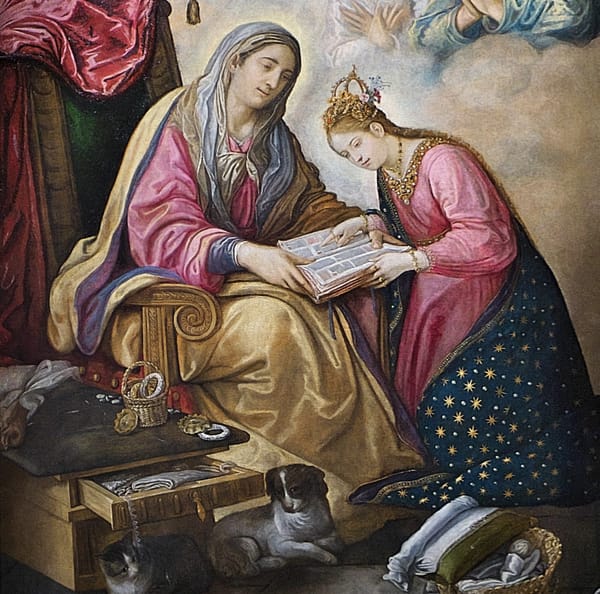
Sic fingit tabernaculum Deo—'Thus she frames a tabernacle for God.' Such was the inscription around the figure of St. Anne instructing Mary, which formed the device of the ancient guild of joiners and cabinetmakers; for they, looking upon the making of tabernacles wherein God may dwell in our churches as their most choice work, had taken St. Anne for their patroness and model. Happy were those times when the simplicity of our fathers penetrated so deeply into the practical understanding of mysteries which their infatuated sons glory in ignoring. The valiant woman is praised in the Book of Proverbs for her spinning, weaving, sewing, embroidering, and household cares: naturally, then, those engaged in these occupations placed themselves under the protection of the spouse of Joachim. More than once, those suffering from the same trial which had inspired Anne’s touching prayer beneath the sparrow’s nest, experienced the power of her intercession in obtaining for others, as well as for herself, the blessing of the Lord God.
The East anticipated the West in the public cultus of the grandmother of the Messias. Towards the middle of the sixth century a church was dedicated to her in Constantinople. The Typicon of St. Sabbas makes a liturgical commemoration of her three times in the year: on September 9, together with her spouse St. Joachim, the day after the birthday of their glorious daughter; on December 9, whereon the Greeks, a day later than the Latins, keep the feast of our Lady’s Immaculate Conception, under a title which more directly expresses St. Anne’s share in the mystery; and lastly, July 25, not being occupied by the feast of St. James, which was kept on April 30, is called the Dormitio or precious death of St. Anne, mother of the most holy Mother of God: the very same expression which the Roman martyrology adopted later.
Although Rome, with her usual reserve, did not until much later authorize the introduction into the Latin Churches of a liturgical feast of St. Anne, she nevertheless encouraged the piety of the faithful in this direction. So early as the time of Leo III3 and by that illustrious Pontiffs express command, the history of Anne and Joachim was represented on the sacred ornaments of the noblest basilicas in the Eternal City.4 The Order of Carmel, so devout to St. Anne, powerfully contributed, by its fortunate migration into our countries, to the growing increase of her cultus. Moreover, this development was the natural outcome of the progress of devotion among the people to the Mother of God. The close relation between the two cults is noticed in a concession, whereby in 1381 Urban VI satisfied the desires of the faithful in England by authorizing for that kingdom a feast of the blessed Anne. The Church of Apt in Provence had been already a century in possession of the feast; a fact due to the honour bestowed on that Church of having received, almost together with the faith, the saint's holy body, in the first age of Christianity.
Since our Lord, reigning in heaven, has willed that His blessed Mother should also be crowned there in her virginal body, the relics of Mary's mother have become doubly dear to the world, first, as in the case of others, on account of the holiness of her whose precious remains they are, and then above all others, on account of their close connection with the mystery of the Incarnation. The Church of Apt was so generous out of its abundance, that it would now be impossible to enumerate the sanctuaries which have obtained, either from this principal source or from elsewhere, more or less notable portions of these precious relics. We cannot omit to mention as one of these privileged places, the great basilica of St. Paul outside the walls; St. Anne herself, in an apparition to St. Bridget of Sweden,5 confirmed the authenticity of the arm which forms one of the most precious jewels in the rich treasury of that Church.
It was not until 1584 that Gregory XIII ordered the celebration of this feast of July 26 throughout the whole Church, with the rite of a double. Leo XIII in recent times (1879) raised it, together with that of St. Joachim, to the dignity of a solemnity of the second class. But before that, Gregory XV, after having been cured of a serious illness by St. Anne, had ranked her feast among those of precept, with the obligation of resting from servile work.
Now that St. Anne was receiving the homage due to her exalted dignity, she made haste to show her recognition of this more solemn tribute of praise. In the years 1623, 1624., and 1625, in the village of Kerouanne, near Auray, in Brittany, she appeared to Yves Nicolazic, and discovered to him an ancient statue buried in the field of Bocenno, which he tenanted. This discovery brought the people once more to the place where, a thousand years before, the inhabitants of ancient Armorica had honoured that statue. Innumerable graces obtained on the spot spread its fame far beyond the limits of the province, whose faith, worthy of past ages, had merited the favour of the grandmother of the Messias; and St. Anne d'Auray was soon reckoned among the chief pilgrimages of the Christian world.
More fortunate than the wife of Elcana, who prefigured thee both in her trial and by her name, thou, O Anne, now singest the magnificent gifts of the Lord. Where is now the proud synagogue that despised thee? The descendants of the barren one are now without number; and all we, the brethren of Jesus, children, like Him, of thy daughter Mary, come joyfully, led by our Mother, to offer thee our praises. In the family circle the grandmother's feast day is the most touching of all, when her grandchildren surround her with reverential love, as we gather around thee to-day. Many, alas! know not these beautiful feasts, where the blessing of the earthly paradise seems to revive in all its freshness; but the mercy of our God has provided a sweet compensation. He, the Most High God, willed to come so nigh to us as to be one of us in the flesh; to know the relations and mutual dependencies which are the law of our nature; the cords of Adam, with which He had determined to draw us and in which He first bound Himself. For in raising nature above itself, He did not eliminate it; He made grace take hold of it and lead it to heaven; so that, joined together on earth by their divine Author, nature and grace were to be united for all eternity. We, then, being brethren by grace of Him who is ever thy grandson by nature, are, by this loving disposition of Divine Wisdom, quite at home under thy roof; and to-day’s feast, so dear to the hearts of Jesus and Mary, is our own family feast.
Smile then, dear mother, upon our chants and bless our prayers. To-day and always be propitious to the supplications which our land of sorrows sends up to thee. Be gracious to wives and mothers who confide to thee their holy desires and the secret of their sorrows. Keep up, where they still exist, the traditions of the Christian home. Over how many families has the baneful breath of this age passed, blighting all that is serious in life, weakening faith, leaving nothing but languor, weariness, frivolity, if not even worse, in the place of the true and solid joys of our fathers. How truly might the Wise Man say at the present day: Who shall find a valiant woman? She alone by her influence could counteract all these evils; but on condition of recognizing wherein her true strength lies: in humble household works done with her own hands; in hidden, self-sacrificing devotedness; in watchings by night; in hourly foresight; working in wool and flax, and with the spindle; all those strong things which win for her the confidence and praise of her husband; authority over all, abundance in the house, blessings from the poor whom she has helped, honour from strangers, reverence from her children; and for herself in the fear of the Lord, nobility and dignity, beauty and strength, wisdom, sweetness and content, and calm assurance at the latter day.6
O blessed Anne, rescue society, which is perishing for want of virtues like thine. The motherly kindnesses thou art ever more frequently bestowing upon us have increased the Church’s confidence; deign to respond to the hopes she places in thee. Bless especially thy faithful Brittany; have pity on unhappy France, for which thou hast shown thy predilection, first, by so early confiding to it thy sacred body; later on, by choosing in it the spot whence thou wouldst manifest thyself to the world; and, again, quite recently entrusting to its sons the church and seminary dedicated to thy honour in Jerusalem. O thou who lovest the Franks, who deignest still to look on fallen Gaul as the kingdom of Mary, continue to show it that love which is its most cherished tradition. Mayest thou become known throughout the whole world. As for us, who have long known thy power and experienced thy goodness, let us ever seek in thee, O mother, our rest, security, strength in every trial; for he who leans on thee has nothing to fear on earth, and he who rests in thy arms is safely carried.
Let us offer blessed Anne a wreath gathered from the liturgy. We will first cull from the Menæa of the Greeks, as being the earliest in date:
Mensis Julii Die xxv
Ex Officio Vespertino
Let us turn to our Western lands and join in the chants of the various churches. The Mozarabic liturgy thus interprets the feelings of the once barren woman, after her prayer had been so magnificently answered:
Antiphona
Apt shall speak in the name of all Provence, and tell of its glorious honour:
Antiphon
Brittany shall declare the confidence it places in its illustrious protectress:
Responsory
Gloria Patri, et Filio, et Spiritui Sancto. * Quam in prosperis.
Glory be to the Father, and to the Son, and to the Holy Ghost. * In prosperity.
Let us all unite with Brittany in the following hymn:
Hymn
We will conclude with these beautiful formulæ of praise and prayer to our Lord, from the Ambrosian Missal of Milan:
Preface
Oratio Super Sindonem
| Previous July 25 (the Same Day): St. Christopher, Martyr | Next July 26: St. Anne, Mother of the Blessed Virgin Mary |