Daily reading
After Pentecost
Movable from Easter · Temporal
October 11, 2020
From Dom Guéranger’s The Liturgical Year.
The Sunday leads; the Motherhood of the Blessed Virgin Mary is commemorated.Rubrics

|
The Nineteenth Sunday after Pentecost
The divine Leader of God’s people is their salvation in all their distress. Did we not last Sunday see Him prove Himself such, and in a very telling way, by curing both body and soul of the poor paralytic, who was a figure of the whole human race? Let us hear His voice, in the Introit, with love and gratitude; let us promise Him the fidelity He asks of us; His Law, if we will but observe it, will preserve us from a relapse.
The anthem which follows is made up of several passages of holy Writ, without being exactly that of any one of them. The verse is taken from Psalm lxxvii.
Introit
Free both in mind and body by the omnipotent word of the Son of Man, the human race can devote itself, with all activity, to the service of God. Let us obtain from His divine Majesty, by uniting our prayer with that of the Church in her Collect, that the fatal paralysis, which was once so cruel a tyrant over our souls and faculties, may never return.
Collect
The other Collecte, as on page 120.
Epistle
Cap. iv.Fratres, Renovamini spiritu mentis vestræ, et induite novum hominem, qui secundum Deum creatus est in justitia, et sanctitate veritatis. Propter quod deponentep mendacium, loquimini veritatem unusquisque cum proximo suo : quoniam sumus invicem membra. Irascimini, et nolite peccare : sol non occidat super iracundiam vestram. Nolite locum dare diabolo : qui furabatur, jam non furetur : magis autem laboret, operando manibus suis, quod bonum est, ut habeat unde tribuat necessitatem patienti.
Ch. iv.Brethren : be renewed in the spirit of your mind; and put on the new man, who, according to God, is created in justice, and holiness of truth. Wherefore, putting away lying, speak ye the truth every man with his neighbour: for we are members one of another. Be angry and sin not. Let not the sun go down upon your anger. Give not place to the devil. He that stole, let him now steal no more; but rather let him labour, working with his hands the thing which is good, that he may have something to give to him that suffereth need.
The Epistle to the Ephesians, which was interrupted last Sunday in the manner we then described, is continued to-day by the Church. The apostle has already laid down the dogmatical principles of true holiness; he now deduces the moral consequences of those principles.
Let us call to mind how the holiness, which is in God, is His very truth—truth living and harmonious, which is no other than the admirable concert of the Three divine Persons, united in love. We have seen that holiness, as far as it exists in us men, is also union, by infinite love, with the eternal and living Truth. The Word took a Body unto Himself in order to manifest in the Flesh this sanctifying and perfect truth,1 of which He is the substantial expression;2 His Humanity, sanctified directly by the plenitude of the divine life and truth, which dwell within Him,3 became the model, as well as the means, the way, of all holiness to every creature.4 It was not sin alone, but it was, moreover, the finite nature of man that kept him at a distance from the divine life;5 but he finds in Christ Jesus, just as in God, the two elements of that life: truth and love. In Jesus, as the complement of His Incarnation, Wisdom aspires at uniting with herself all the members, also, of that human race, of which He is the Head,6 and the First-born;7 by Him the Holy Ghost, whose sacred fount He is,8 pours Himself out upon man, whereby to adapt him to his sublime vocation, and to consummate, in infinite love (which is Himself), that union of every creature with the divine Word. Thus it is that we verily partake of that life of God, whose existence and holiness are the knowledge and love of His own Word; thus it is that we are sanctified in truth9 by the participation of that very holiness wherewith God is holy by nature.
The Son of Man, being God, participates for us His brethren in the life of union in the truth which constitutes the holiness of the blessed Trinity. But He communicates that life, that truth, that deifying union, to none save those who have truly become His members, and who, in Him, reproduce between one another, by the operation of the Spirit of truth10 and love, that unity of which that sanctifying Spirit is the almighty bond in the Godhead.
‘May they all be one, as Thou, Father, in Me, and I in Thee,' said Jesus to His eternal Father, ‘that they also may be one in us. I have given unto them the glory (that is to say, the holiness) which Thou hast given unto Me, that they may be one, as we also are one; I in them, and Thou in Me, that they may be consummated (that is, be made perfect) in unity.'11 Here we have, and formulated by our Lord Himself, the simple but fruitful axiom, the foundation of Christian dogma and morals. By that sublime prayer, He explained what He had previously been saying: 'I sanctify Myself for them, that they, also, may be sanctified in truth.'12
Let us now understand the moral doctrine given us by St. Paul in our to-day's Epistle. What does he mean by that justice, and that holiness of truth, which is that of Christ,13 of the new man, whom everyone must put on, that aspires to the possession of the riches spoken of in the passages already read to us from this magnificent Epistle? Let us re-read the Epistle for the seventeenth Sunday, and we shall find that all the rules of Christian asceticism, as well as of the mystic life, are to St. Paul’s mind summed up in those words: Be careful to keep unity!14 It is the principle he lays down for all, both beginners and the perfect. It is the crowning of the sublimest vocations in the order of grace, as well as the foundation and reason of all God's commandments; so truly so, indeed, that, if we are commanded to abstain from lying, and to speak the truth to them that live with us, the motive is that we are members one of another.
There is a holy anger, of which the Psalmist speaks,15 and which is the outcome, on certain occasions, of zeal for the divine law and charity; but the movement of irritation excited in the soul must, even then, be speedily calmed down; to foster it would be to give place to the devil, to give him an opportunity of weakening, or even destroying, within us, by bitterness and hatred, the structure of holy unity.16
Before our conversion our neighbour, as well as God, was grieved by our sins; we cared little or nothing for injustice, provided it was not noticed; egotism was our law, and it was proof enough of the reign of satan over our souls. Now that the Spirit of holiness has expelled the unworthy usurper, the strongest evidence of His being our rightful master is that not only the rights of others are sacred in our estimation, but our toil and our labours are all undergone for the purpose of being serviceable to our neighbour. In a word, as the apostle continues a little farther on, we walk in love, because, as most dear children, we are followers of God.17
It is by this means alone, says St. Basil, that the Church manifests the many and great benefits bestowed on the world by the Incarnation. The Christian family, which, heretofore, was split up into a thousand separate fragments, is now made one, one in itself, and one in God; it is the repetition of what our Lord did, by assuming Flesh and making it one with Himself.18
Our Jesus has restored to our hands, which once were paralyzed for every supernatural work, the full freedom of their movements; let us, then, raise them up spiritually in prayer, giving glory to God by this our homage, which He graciously accepts as a fragrant sacrifice. The Church gives us this teaching in the Gradual, and by her own example as well.
Gradual
Gospel
Cap. xxii.In illo tempore; Loquebatur Jesus principibus sacerdotum, et pharisæis in parabolis, dicens : Simile factum est regnum cœlorum homini regi, qui fecit nuptias fìlio suo. Et misit servos suos vocare invitatos ad nuptias, et nolebant venire. Iterum misit alios servos, dicens : Dicite invitatis : Ecce prandium meum paravi; tauri mei, et altilia occisa sunt, et omnia parata; venite ad nuptias. Illi autem neglexerunt, et abierunt, alius in villam suam, alius vero ad negotiationem suam : reliqui vero tenuerunt servos ejus, et contumeliis affectos occiderunt. Rex autem cum audisset, iratus est : et missis exercitibus suis, perdidithomicidas illos, et civitatem illorum succendit. Tunc ait servis suis : Nuptiæ quidem paratæ sunt, sed qui invitati erant, non fuerunt digni. Ite ergo ad exitus viarum, et quoscumque inveneritis, vocate ad nuptias. Et egressi servi ejus in vias, congregaverunt omnes, quos invenerunt, malos et bonos : et impletæ sunt nuptiæ discumbentium. Intravit autem rex ut videret discumbentes, et vidit ibi hominem non vestitum veste nuptiali. Et ait illi: Amice, quomodo huc filtrasti, non habens vestem nuptialem? At ille obmutuit. Tunc dixit rex ministris : Ligatis manibuset pedibus ejus, mittite eum in tenebras exteriores : ibi erit fletus et stridor dentium. Multi enim sunt vocati, pauci vero electi.
Ch. xxii.At that time : Jesus spoke to the chief priests and the pharisees in parables, saying: The kingdom of heaven is likened to a king, who made a marriage for his son. And he sent his servants, to call them that were invited to the marriage: and they would not come. Again he sent other servants, saying: Tell them that were invited: Behold, I have prepared my dinner : my beeves and fatlings are killed, and all things are ready: come ye to the marriage. But they neglected, and went their ways, one to his farm, and another to his merchandise. And the rest laid hands on his servants, and having treated them contumeliously, put them to death. But when the king had heard of it, he was angry, and sending his armies, he destroyed those murderers, and burnt their city. Then he saith to his servants : The marriage indeed is ready : but they that were invited were not worthy. Go ye therefore into the highways; and as many as ye shall find, call to the marriage. And his servants going forth into the ways, gathered together all that they found, both bad and good : and the marriage was filled with guests. And the king went in to see the guests: and he saw there a man who had not on a wedding garment. And he saith to him: Friend, how eamest thou in hither not having on a wedding garment? But he was silent. Then the king said to the waiters : Bind his hands and his feet, and cast him into the exterior darkness; there shall be weeping and gnashing of teeth. For many are called, but few are chosen.
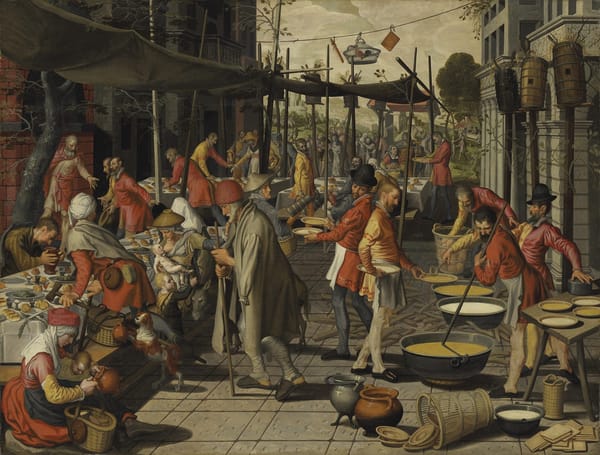
This Gospel has given to the present Sunday the name of the Sunday of the invited to the marriage. And yet, from the very opening of the dominical series, which began with the Descent of the Holy Ghost, the Church gave us the Gospel teaching which she offers to us, now a second time, for our consideration. On the second Sunday after Pentecost, she related to us, from St. Luke,19 the parable of the great supper, to which many were invited, and which St. Matthew, entering into fuller details, calls a marriage-feast.
Set thus before us, both at the beginning and at the close of the liturgical season over which the holy Spirit reigns supreme, this parable is, as it were, the interpreter of the whole portion of the year which it thus hems in : it is an additional revelation of the true aim of the Church. But how much has the light increased, since the first time we had these mystery-telling allegories! The certain man (homo quidam), who made a great supper, and invited many, has become the King, who makes a marriage for His Son, and, in this marriage, gives us an image of the kingdom of heaven. The world’s history, too, has been developing, as we gather from the terms respectively used by the two Evangelists. Those who were the first invited, and contented themselves with declining the kindness of the Master of the house, have grown in their impious ingratitude; laying hands on the messengers sent them by the loving kindness20 of the King, they treat them with contumely, and put them to death! We have seen the merited punishment inflicted on these deicides, by this Man, who was God Himself, the Father of Israel, now become King of the Gentiles : we have seen how He sent his armies to destroy them, and burn their city.21 And now at last, in spite of the refusal of the invited of Juda, in spite of the treacherous opposition put by them against the celebration of the nuptials of the Son of God, all things are ready for the marriage, and the banquet-hall is filled with guests.
Our heavenly King has confided, to the ministers of His love, the work of calling from every people the new guests. But now that His ambassadors, according to His command, have traversed the whole earth,22 bringing together all nations for this day of the joy of His heart,23 He Himself is coming in person, to see that nothing is wanting to the due preparation for the feast, and to give the signal for the eternal banquet of the divine nuptials. Now, for such a feast, and in such a place, if there be any deficiency, it can only be on the part of the guests. Let them, then, be careful not to draw down upon themselves, in this general and last examination, the displeasure of the great King, who has called them to an alliance with Himself. Though He has condescended to call them, notwithstanding their extreme poverty, from the public streets and highways, He has given them abundant time to lay aside their tatters; and knowing that they could not get ready of themselves, He has placed at their disposal, for the marriage-feast, the richest garments of His grace and virtues. Woe, then, to him who on the last day shall be found not having the wedding garment of charity! Such a want would admit of no excuse; and the King would justly punish it, by excluding the guilty man from the feast, as one that had insulted His Son.
Everything we have had on the preceding Sundays, has shown us how solicitous the Church ever is in preparing mankind for that wonderful marriage whose realization is the one object aimed at by the divine Word, in coming upon our earth. During her long exile, the bride of the Son of God has been a living model to her children; and, by her instructions, she has been unceasingly preparing them for the understanding of the great mystery of divine union. Three weeks ago,24 treating more directly than she had hitherto done on the great subject of her ambition as mother and bride, she reminded them of the great call. On the following Sunday, she gave them another lesson : she revealed to them the Bridegroom of the nuptials, to which they were invited, as the Man-God, the object of the twofold precept of love which embodies the whole Law. To-day, we have the teaching in all its perfection. It is condensed in the night Office, where we have St. Gregory explaining her whole teaching. The great doctor and the great Pope thus, in the name of the Church, explains our Gospel:
'The kingdom of heaven is the assembly of the just; for, the Lord says by a prophet: “Heaven is My throne";25 and Solomon says : “The soul of the just man is the throne of wisdom ”;26 and Paul calls Christ the Wisdom of God.27 If, therefore, heaven be the throne of God, we must evidently conclude that, as Wisdom is God, and the soul of the just man is the throne of Wisdom, this soul is a heaven . . . . The kingdom of heaven, then, is the assembly of the just . . . . If this kingdom is said to be like to a King, who made a marriage for his Son, your charity at once understands who is this King, who is the Father of a Son, King like Himself. It is He, of whom the psalmist says: “Give to the King Thy judgment, O God, and to the King’s Son Thy justice!”28 God the Father made the marriage of God His Son, when He wished that He, who had been God before all ages, should become Man towards the end of ages. But we must not, on that account, suppose that there are two persons in Jesus Christ, our God and our Saviour . . . . It is, perhaps, clearer and safer to say, that the King made a marriage for His Son, in that, by the mystery of the Incarnation, He united the Church to Him. The womb of the Virgin-Mother was the nuptial-chamber of that Bridegroom, of whom the psalmist says:29 He hath set His tabernacle in the sun : and He, as a Bridegroom, cometh out of His bride-chamber!'30
Notwithstanding her dignity of beloved bride of the Son of God, the Church is, none the less, subject to tribulations here below. The enemies of the Spouse, having ho longer any direct power to injure our Lord, turn all their rage against her. In these trials, endured as they are by the Church with love, Jesus sees a fresh trait of that resemblance which He wishes her to have to Himself; He, therefore, leaves her to suffer in this world, contenting Himself with ever upholding and saving her, as the Offertory says, in the midst of the evils which go on thickening around her.
Offertory
The august sacrifice, which is about to be offered, always obtains its effect, as far as the glory of the divine Majesty is concerned; but its virtue is applied to man in a greater or less degree, according to the dispositions of the creature, and depending on the divine mercy. Let us, in the Secret, beseech our heavenly Father, that we may experience abundantly the effects of the divine mysteries, which are so soon to be produced on our altar.
Secret
The other Secrets, as on page 130.
The Man-God, by His divine contact in the sacred banquet, has spiritually given vigour to our members; let us recall to mind that we must, henceforward, consecrate them to His service, and that our feet, now made sure, must run in the way of the divine commandments.
Communion
The Postcommunion, again, seems to be an allusion to the Gospel of the paralytic, which used formerly to be read on this Sunday. In it, we implore the assistance of the heavenly Physician, who sets man free from the palsy, which held him a prisoner; He also gives him the strength needed for fulfilling the law of God bravely and perseveringly.
Postcommunion
The other Postcommunions, as on page 181.
Vespers
The psalms, capitulum, hymn, and versicle, as above, pages 71-81.
Antiphon of the Magnificat
Oremus.
- St. John i. 14. ↩︎
- Heb. i. 3 ↩︎
- Col. ii. 3, 9, ↩︎
- St. John xiv. 6. ↩︎
- Eph. iv. 18. ↩︎
- Ibid. i. 10. ↩︎
- Col. i. 15-20. ↩︎
- Cf. St. John iv. 14; vii, 37, 39. ↩︎
- Ibid. xvii. 17. ↩︎
- Cf. St. John xv. 26. ↩︎
- Ibid. xvii. 21-23. ↩︎
- Ibid. 19. ↩︎
- Rom. xiii. 14. ↩︎
- Eph. iv. 3. ↩︎
- Ps. iv. 5. ↩︎
- S. Chrys., in ep. ad Eph. Hom., xiv. ↩︎
- Eph. v. 1, 2. ↩︎
- S. Basil, Const, mon., xviii ↩︎
- St. Luke xiv. 16-24. ↩︎
- See Time after Pentecost, vol. i., p. 358. ↩︎
- See Ninth Sunday after Pentecost. ↩︎
- Ps. xviii. 5. ↩︎
- Cant. iii. 11. ↩︎
- The Sixteenth Sunday after Pentecost. ↩︎
- Isa. lxvi. 1. ↩︎
- Wisd. vii. 27. ↩︎
- 1 Cor. i. 24. ↩︎
- Ps. lxxi. 2. ↩︎
- Ps. xviii. 6. ↩︎
- S. Greg., Hom, xxxviii. in Ev. ↩︎
October 11: The Motherhood of the Blessed Virgin Mary
In the sixteenth century, even amidst their many divergences, the so-called Reformers agreed in utterly rejecting all the honours paid by the Catholic Church to the Blessed Virgin Mary, on the grounds that such veneration of the Mother detracted from the supreme worship due to her divine Son. Four centuries have more than sufficed to show the result of so doing: the Son has followed the Mother! The descendants of those who refused to Mary the title and rights of Theotokos—Mother of God—refuse to Jesus the title of Son of God in the traditional sense of the term. Many reject his Godhead altogether, placing him merely at the head of the line of great moral and social world-teachers; others still retain the word “divinity” with respect to him, but for them it is no longer synonymous with “deity.”
Holy Scripture tells us that those who first came to adore him who is Son of God and Son of Mary found him “with Mary his Mother.” At the scene of the first miracle at Cana, which marked the opening of his public life, “the Mother of Jesus was there.” In the tremendous hour when all was consummated, when types and shadows gave place to the mighty reality, “there stood by the cross of Jesus his Mother.” And when the little flock who were to be the nucleus of the Church of God awaited in prayer the coming of the Paraclete, who would teach them all truth, again it was in company with “Mary the Mother of Jesus.” Far from taking from the honour and love due to the Word Incarnate, devotion to Mary is a strong bulwark protecting the central doctrine. He is ever found with his Mother; where Mary is denied her rights, sooner or later Jesus is denied his; they stand or fall together.
This was realized in the year 431 when, at the General Council of Ephesus, the Church condemned the Nestorian heresy, whereby the Patriarch of Constantinople, Nestorius, had taught that, since in Christ there are two persons, a divine and a human, Mary was mother only of the Man Christ, and therefore could not be called “Mother of God.” He therefore denied “that wondrous and substantial union of the two natures which we call hypostatic.”
On the occasion of the fifteenth centenary of the Council of Ephesus, the Sovereign Pontiff, Pius XI, issued the Encyclical Lux Veritatis, recalling the history of the heresy and commenting thus upon the dogma of the hypostatic union: “When once the doctrine of the hypostatic union is abandoned, whereon the dogmas of the Incarnation and of man’s Redemption rest and stand firm, the whole foundation of the Catholic religion falls and comes to ruin . . . . When once this dogma of the truth is securely established, it is easy to gather from it that, by the mystery of the Incarnation, the whole aggregate of men and of mundane things has been endowed with a dignity than which certainly nothing greater can be imagined, and surely grander than that to which it was raised by the work of creation.”
Proceeding to speak of the special dignity of the Blessed Virgin Mary, the Pope emphasizes that, " because she brought forth the Redeemer of mankind, she is also in a manner the most tender Mother of us all, whom Christ our Lord deigned to have as his brothers; wherefore we may confidently ehtrust to her all things that are ours, our joys, our troubles, our hopes; especially if more difficult times fall upon the Church—if faith fail because charity has grown cold, if private and public morals take a turn for the worse.”
In this last connection we are reminded of another result of the loss of devotion to the Mother of God. Frequently and truly we hear and speak of the “paganism” of the present age. The decay of faith has been followed inevitably by a decline in morality, and our elaborate and complex civilization is threatened with the dissolving agent which contributed in no small measure to the overthrow of the magnificent civilization of old Rome: namely, the loss of the domestic virtues, the disappearance of healthy, normal family life, consequent upon the abandonment of the Christian ideals of marriage and parenthood.
It is a truism that one of the greatest social effects of Christianity was to raise the status of womanhood. Her legal position in the Ancient World was little better than that of a slave, and although classical literature furnishes us with examples of women who, in pagan homes, yet enjoyed high honour and affection, such are few indeed, and but serve to prove the rule. Divorce, infanticide, general degradation of womanhood, and not infrequently of childhood, were accepted features of pagan social order. The ideal and model of the “new woman” of the Christian dispensation was the Mother of God. It was Mary, “Mother of fair love,” “Madonna,” “our Lady,” who ennobled the degenerate old civilization, just as she tamed the fierce barbarian peoples; she it was who inspired the ideals of the later chivalry. In Mary, all her sex was uplifted; in her motherhood all motherhood became blessed. Now again the world needs the hallowing influence of the Mother of God and of men, if “the life of the family, the beginning and the foundation of all human society” is to be preserved in all its nobility and its purity.
Desirous “to mark the commemoration, and help to nourish the piety of clergy and people towards the great Mother of God,” His Holiness concludes the Encyclical by establishing the new feast of the Divine Motherhood, to be celebrated on October 11 by the universal Church.
Mass
Introit
Collect
Epistle
Eccli. xxiv.
Ego quasi vitis fructificavi suavitatem odoris: et flores mei fructus honoris et honestatis. Ego mater pulchræ dilectionis et timoris et agnitionis et sanctæ spei. In me gratia omnis viæ et veritatis: in me omnis spes vitæ et virtutis. Transite ad me, omnes qui concupiscitis me, et a generationibus meis implemini. Spiritus enim meus super mel dulcis, et hereditas mea super mel et favum. Memoria mea in generationes sæculorum. Qui edunt me adhuc esurient: et qui bibunt me, adhuc sitient. Qui audit me, non confundetur: et qui operantur in me non peccabunt. Qui elucidant me, vitam æternam habebunt.
Ecclus. xxiv.
Gradual
Gospel
Cap. ii.In illo tempore: Cum redirent puer remansit Jesus in Jerusalem, et non cognoverunt parentes ejus. Existimantes autem ilium esse in comitatu, venerunt ter diei, et requi rebant eum inter cognatos et notos. Et non invenientes, regressi sunt in Jerusalem, requirentes eum. Et factum est, post triduum invenerunt ilium in tempio sedentem in medio doctorum, audientem illos et interrogantem eos. Stupebant autem omnes qui eum audiebant, super prudentia et responsis ejus. Et videntes admirati sunt. Et dixit mater ejus ad ilium: Fili, quid fecisti nobis sic? Ecce, pater tuus et ego dolentes quærebamus te. Et ait ad illos: Quid est, quod me quærebatis? Nesciebatis quia in his quæ Patris mei sunt, oportet me esse? Et ipsi non intellexerunt verbum, quod locutus est ad eos. Et descendit cum eis, et venit Nazareth: et erat subditus illis.
Ch. ii.At that time: When they returned, the child Jesus remained in Jerusalem. And his parents knew it not. And thinking that he was in the company, they came a day’s journey and sought him among their kinsfolk and acquaintance. And not finding him, they returned into Jerusalem seeking him. And it came to pass that, after three days, they found him in the temple, sitting in the midst of the doctors, hearing them and asking them questions. And all that heard him were astonished at his wisdom and his answers. And seeing him they wondered. And his mother said to him: Son, why hast thou done so to us? Behold thy father and I have sought thee sorrowing. And he said to them: How is it that you sought me? Did you not know that I must be about my Father’s business? And they understood not the word that he spoke unto them. And he went down with them to Nazareth, and was subject to them.
Offertory
Secret
Preface of the Blessed Virgin Mary: Et te in festivitate.
Communion
Postcommunion
| Previous October 10: St. Francis Borgia, Confessor | Next October 11: The Motherhood of the Blessed Virgin Mary |