Daily reading
After Pentecost
Double of the I Class · Movable from Easter · Temporal
November 1, 2020
From Dom Guéranger’s The Liturgical Year.

|
The Twenty-Second Sunday after Pentecost
Mass
According to Honorius of Autun, the Mass of to-day has reference to the days of Antichrist.1 The Church, foreseeing the reign of the man of sin,2 and as though she were actually undergoing the persecution which is to surpass all others, takes her Introit of this twenty-second Sunday from the Psalm De profundis.3
If, unitedly with this prophetic sense, we would apply these words practically to our own personal miseries, we must remember the Gospel we had last week, which was formerly appointed for the present Sunday. Each one of us will recognize himself in the person of the insolvent debtor, who has nothing to trust to but his master’s goodness; and, in our deep humiliation, we shall exclaim : If thou, O Lord, mark iniquities, who shall endure it?4
Introit
Ps. De profundis clamavi ad te, Domine : Domine, exaudi vocem meam. Gloria Patri. Si iniquitates.
Ps. Out of the depths have I cried unto thee, O Lord : Lord! hear my voice. Glory, etc. If thou.
We have just been rousing our confidence by singing that with God there is merciful forgiveness. It is He Himself who gives that loving unction to the prayers of the Church, which proves that He wishes to grant them. But we shall not be thus graciously heard, as she is, unless, like her, we ask with faith, that is to say, conformably with the teachings of the Gospel. To ask with faith is to forgive our fellow-creatures their trespasses against us; on that condition we may confidently beseech our common Lord and Master to forgive us.5
Collect
The other Collects, as on page 120.
Epistle
Cap. i.Fratres, Confidimus in Domino Jesu, quia qui cœpit in vobis opus bonum, perficiet usque in diem Christi Jesu. Sicut est mihi justum hoc sentire pro omnibus vobis, eo quod habeam vos in corde, et in vinculis meis, et in defensione, et confirmatione Evangelii, socios gaudii mei omnes vos esse. Testis enim mihi est Deus, quomodo cupiam omnes vos in visceribus Jesu Christi. Et hoc oro, ut charitas vestra magis ac magis abundet in scientia, et in omni sensu: ut probetis potiora, ut sitis sinceri, et sine offensa in diem Christi, repleti fructu justitiæ per Jesum Christum, in gloriam et laudem Dei.
Ch. i.Brethren : We are confident of this very thing, that he who hath begun a good work in you, will perfect it unto the day. of Christ Jesus. As it is meet for me to think this for you all: for that I have you in my heart; and that in my bands, and in the defence and confirmation of the Gospel, you are all partakers of my joy. For God is my witness, how I long after you all in the bowels of Jesus Christ. And this I pray, that your charity may more and more abound in knowledge and in all understanding; that you may approve the better things, that you may be sincere and without offence unto the day of Christ. Filled with the fruit of justice, through Jesus Christ, unto the glory and praise of God.
St. Paul, in the Church’s name, again invites our attention to the near approach of the last day. But what, on the previous Sunday, he called the evil day, he now, in the short passage taken from his Epistle to the Philippians which has just been read to us, calls twice over the day of Christ Jesus. The Epistle to the Philippians is full of loving confidence; its tone is decidedly one of joy, and yet it plainly shows us that persecution was raging against the Church, and that the old enemy was making capital of the storm to stir up evil passions, even amidst the very flock of Christ. The apostle is in chains; the envy and treachery of false brethren Intensify his sufferings;6 still, joy predominates in his heart over everything else, because he has attained that perfection of love, wherein divine charity is enkindled by suffering more even than by the sweetest spiritual caresses. To him, to live is Christ and to die is gain;7 he cannot make up his mind which of the two to choose: death, which would give him the bliss of being with his Jesus,8 or life, which would add to his merits and his labours for the salvation of men.9 What are all personal considerations to him? His one joy, for both the present and the future, is that Christ may be known and glorified, no matter how! As to his hopes and expectations, he cannot be disappointed, for Christ is sure to be glorified in his body by its life and by its death!10
Hence, in Paul’s soul, that sublime indifference which is the climax of the Christian life; it is, of course, a totally different thing from that fatal apathy, to which the false mystics of the seventeenth century pretended to reduce the love of man’s heart. What tender affection has this convert of Damascus for his brethren, once he has reached this point of perfection! God, says he, is my witness how I long after you all in the bowels of Jesus Christ! The one ambition which rules and absorbs him11 is that God, who has begun in them the work which is good by excellence, the work of Christian perfection such as we know had been wrought in the apostle himself, may continue and perfect it in them all, by the day, when Christ is to appear in His glory.12 This is what he prays for, that charity, the wedding-garment of those whom he has betrothed to the one Spouse,13 may beautify them with all its splendour for the grand day of the eternal nuptials.14
Now, how is charity to be perfected in them? It must abound, more and more, in knowledge and in all understanding of salvation, that is, in faith. It is faith that constitutes the basis of all supernatural virtue. A restricted, a diminished,15 faith could never support a large and high-minded charity. Those men, therefore, are deceiving themselves whose love for revealed truth does not keep pace with their charity! Such Christianity as that believes as little as it may; it has a nervous dread of new definitions; and out of respect for error, it cleverly and continually narrows the supernatural horizon. Charity, they say, is the queen of virtues; it makes them take everything easily, even lies against truth; to give the same rights to error as to truth is, in their estimation, the highest point of Christian civilization grounded on love! They quite forget that the first object of charity, God who is substantial Truth, has no greater enemy than a lie; they cannot understand how it is that a Christian does not do a work of love by putting on the same footing the Object beloved and His mortal enemy!
The apostles had very different ideas; in order to make charity grow in the world, they gave it a rich sowing of truth. Every new ray of light they put into their disciples’ hearts was an intensifying of their love; and these disciples, having by Baptism become themselves light,16 were most determined to have nothing to do with darkness. In those days, to deny the truth was the greatest of crimes; to expose themselves, by a want of vigilance, to infringe on the rights of truth, even in the slightest degree, was the height of imprudence.17 When Christianity first shone upon mankind, it found error supreme mistress of the world. Having, then, to deal with a universe that was rooted in death,18 Christianity adopted no other plan for giving it salvation than that of making the light as bright as could be; its only policy was to proclaim the power which truth alone has of saving man, and to assert its exclusive right to reign over this world. The triumph of the Gospel was the result. It came after three centuries of struggle— a struggle intense and violent on the side of darkness, which declared itself to be supreme, and was resolved to keep so; but a struggle most patient and glorious on the side of the Christians, the torrents of whose blood did but add fresh joy to the brave army, for it became the strongest possible foundation of the united kingdom of love and truth.
But now, with the connivance of those whose Baptism made them, too, children of light, error has regained its pretended rights. As a natural consequence, the charity of an immense number has grown cold in proportion;19 darkness is again thickening over the world, as though it were in the chill of its last agony. The children of light,20 who would live up to their dignity, must behave exactly as did the early Christians. They must not fear, nor be troubled: but, like their forefathers and the apostles, they must be proud to suffer for Jesus' sake,21 and prize the word of life22 as the dearest thing they possess; for they are convinced that, so long as truth is kept up in the world, so long is there hope for it.23 As their only care is, to make their manner of life worthy of the Gospel of Christ,24 they go on, with all the simplicity of children of God, faithfully fulfilling the duties of their state of life, in the midst of a wicked and perverse generation, as stars of the firmament shine in the night.25 ‘The stars shine in the night,' says St. John Chrysostom, ‘they glitter in the dark; so far from growing dim amidst the gloom that surrounds them, they seem all the more brilliant. So will it be with thee, if thou art virtuous amidst the wicked; thy light will shine so much the more clearly.’26 ‘As the stars,' says St. Augustine, ‘keep on their course in the track marked out for them by God, and grow not tired of sending forth their light in the midst of darkness, neither heed they the calamities which may be happening on earth; so should do those holy ones whose conversation is truly in heaven;27 they should pay no more attention to what is said or done against them, than the stars do.’28
The Gradual hymns the praise of the sweet and strong unity, which the Church maintains even to the end; she does this by charity, in which the Epistle urged us to be making fresh progress, and which the ancient Gospel of this same Sunday put before us as the one means of securing a favourable sentence at the day of judgment.
Gradual
Gospel
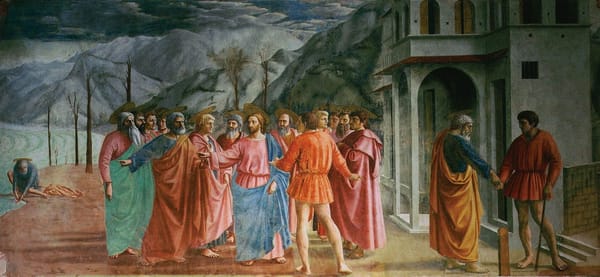
Cap. xxii.In illo tempore: Abeuntes Pharisæi, consilium inierunt, ut caperent Jesum in sermone. Et mittunt ei discipulos suos cum Herodianis, dicentes : Magister, scimus quia verax es, et viam Dei in ventate doces, et non est tibi cura de aliquo : non enim respicis personam hominum : dic ergo nobis, quid tibi videtur : licet censum dare Cæsari, an non? Cognita autem Jesus nequitia eorum, ait : Quid me tentatis, hypocritæ? ostendite mihi numisma census. At illi obtulerunt ei denarium. Et ait illis Jesus : Cujus est imago hæc, et superscriptio? Dicunt ei: Cæsaris. Tunc ait illis : Reddite ergo quæ sunt Cæsaris, Cæsari: et quæ sunt Dei, Deo.
Ch. xxii.At that time : The Pharisees going, consulted among themselves how to ensnare Jesus in his speech. And they send to him their disciples, with the Herodians, saying : Master, we know that thou art a true speaker, and teachest the way of God in truth, neither carest thou for any man : for thou dost not regard the person of men. Tell us therefore what dost thou think; is it lawful to give tribute to Caesar or not? But Jesus knowing their wickedness, said : Why do you tempt me, ye hypocrites? Show me the coin of the tribute. And they offered him a penny. And Jesus saith to them: Whose image and inscription is this? They say to him : Cæsar’s. Then he saith to them: Render therefore to Cæsar the things that are Caesar’s: and to God the things that are God’s.
The diminution of truth29 is evidently to be a leading peril of the latter times; for, during these weeks which represent the last days of the world, the Church is continually urging us to a sound and solid understanding of truth, as though she considered that to be the great preservative for her children. Last Sunday she gave them, as defensive armour, the shield of faith, and, as an offensive weapon, the word of God.30 On the previous Sunday, it was circumspection of mind and intelligence that she recommended to them,31 with a view to their preserving, during the approaching evil days, the holiness which is founded on truth;32 for, as she told them the previous week, their riches in all knowledge are of paramount necessity.33 To-day, in the Epistle, she implored of them to be ever progressing in knowledge and all understanding, as being the essential means for abounding in charity, and for having the work of their sanctification perfected for the day of Christ Jesus. The Gospel comes with an appropriate finish to these instructions given us by the apostle: it relates an event in our Lord’s life, which stamps those counsels with the weightiest possible authority, viz., the example of Him, who is our divine Model. He gives His disciples the example they should follow, when, like Himself, they have snares laid, by the world, for their destruction.
It was the last day of Jesus’ public teaching; it was almost the eve of His departure from this earth.34 His enemies had failed in every attempt hitherto made to ensnare Him; this last plot was to be unusually deep-laid. The pharisees, who refused to recognize Cæsar’s authority and denied his claim to tribute, joined issue with their adversaries, the partisans of Herod and Rome, to propose this insidious question to Jesus : Is it lawful to give tribute to Cæsar, or not? If our Lord’s answer was negative, He incurred the displeasure of the government; if He took the affirmative side, He would lose the estimation of the people. With His divine prudence, He disconcerted their plans. The two parties, so strangely made friends by partnership in one common intrigue, heard the magnificent answer, which was divine enough to make even pharisees and Herodians one in the truth. But truth was not what they were in search of; so they returned to their old party quarrels. The league formed against our Jesus was broken; the effort made by error recoiled on itself, as must ever be the case; and the answer it had elicited, passed from the lips of our Incarnate Lord to those of His bride, the Church, who would be ever repeating it to the world, for it contains the first principle of all governments on earth.
Render to Caesar the things that are Caesar's and to God the things that are God's: it was the dictum most dear to the apostles. If they boldly asserted that we must obey God rather than men,35 they explained the whole truth, and added: 'Let every soul be subject to the higher powers: for there is no power but from God: and those that are, are ordained of God. Therefore, he that resisteth the power, resisteth the ordinance of God; and they that resist, purchase to themselves damnation. Wherefore, be subject of necessity, not only for wrath, but also for conscience' sake. For therefore also ye pay tribute; for they are the ministers of God serving unto this purpose.’36
The will of God:37 there is the origin, there is the real greatness of all authority amongst men! Of themselves, men have no right to command their fellow-men. Their number, however imposing it may be, makes no difference to this powerlessness of men over my conscience; for, whether they be one, or five hundred, I, by nature, am equal to each one among them; and, by adding the number of their so-called rights over me, they are only adding to the number of nothingnesses. But God, wishing that men should live one with the other, has thereby wished that there should exist amongst them a power which should rule over the rest; that is; should direct the thousands or millions of different wills to the unity of one social end. God leaves much to circumstances, though it is His providence that regulates those circumstances; He leaves to men themselves, at the beginning of any mere human society, a great latitude as to the choice of the form, under which is to be exercised both the civil power itself and the mode of its transmission. But, once regularly invested with the power, its depositaries are responsible to God alone, as far, that is, as the legitimate exercise of their authority goes, because it is from God alone that that power comes to them; it does not come to them from their people, who, not having that power themselves, cannot give it to another. So long as those rulers comply with the compact, or do not turn to the ruin of their people the power they received for its well-being, so long their right to the obedience of their subjects is the right of God Himself, whether they exercise their authority in exacting the subsidies needed for government; or in passing laws, which, for the general good of the people, restrain the liberty otherwise theirs by natural right; or again, by bidding their soldiers defend their country at the risk of life. In all such cases, it is God Himself that commands, and insists on being obeyed: in this world, He puts the sword into the hands of representatives, that they may punish the disobedient;38 and, in the next, He Himself will eternally punish them, unless they have made amends.
How great, then, is the dignity of human law! It makes the legislator a representative of God, and, at the same time, spares the subject the humiliation of feeling himself debased before a fellow-man! But, in order that the law oblige, that is, be truly a law, it is evident that it must be, first and foremost, conformable to the commands and the prohibitions of God, whose will alone can give it a sacred character by making it enter into the domain of man’s conscience. It is for this reason that there cannot be a law against God, or His Christ, or His Church. When God is not with Him who governs, the power he exercises is nothing better than brute force. The sovereign, or the parliament, that pretends to govern a country in opposition to the laws of God, has no right to aught but revolt and contempt from every upright man; to give the sacred name of law to tyrannical enactments of that kind is a profanation unworthy, not only of a Christian, but of every man who is not a slave.
The Offertory-anthem, together with the verses which used to be joined to it, refers, like the Introit, to the period of the last persecution. The words are taken from the prayer addressed to God by Esther, when about to enter into the presence of Assuerus that she might plead with him against Aman, who is a figure of Antichrist. Esther is a type of the Church; and we could not better show the spirit in which we ought to sing our Offertory, than by quoting the inspired words which preface this sublime prayer. ‘Queen Esther, fearing the danger that was at hand, had recourse to the Lord. And when she had laid away her royal apparel, she put on garments suitable for weeping and mourning; instead of divers precious ointments, she covered her head with ashes and filth, and she humbled her body with fasts: and all the places in which before she was accustomed to rejoice, she filled with her torn hair. And she prayed to the Lord the God of Israel, saying: O my Lord, who alone art our King, help me a desolate woman, and who have no other helper but Thee!’39
Offertory
℣. Everte cor ejus in odium repugnantium nobis, et in eos qui consentiunt eis; nos autem libera in manu tua, Deus noster in æternum.
℣. Qui regis Israel, intende; qui deducis velut ovem Joseph.
Recordare mei, Domine.
℣. Turn his heart into hatred of them that oppose us, and of them that consent unto them; but deliver us by thy hand, O our God for ever!
℣. O thou that rulest Israel, give ear; thou that leadest Joseph like a sheep.
Remember me, O Lord.
The surest guarantee a Christian can have against adversity is freedom from sin. It is sin that stirs up the anger of God, and calls upon Him for vengeance. Let us unite in the following prayer of the Church :
Secret
The other Secrets, as on page 130.
The Communion anthem shows us with what perseverance and earnestness the Church prays to her divine Lord. We must imitate her.
Communion
While offering the sacred mysteries in memory of our Jesus as He commanded us to do, we must not forget that these same are also our refuge in all our miseries. It would be presumption, or folly, to neglect to pray that they may thus protect us. The Church, here again, is our model, in utilizing these most powerful of all means for help.
Postcommunion
The other Postcommunions, as on page 131.
Vespers
The psalms, capitulum, hymn, and versicle, as above, pages 71-81.
Antiphon of the Magnificat
- Hon. Aug., Gemm. an., iv. ↩︎
- 2 Thess. ii. 3. ↩︎
- Ps. cxxix. ↩︎
- Rup., De. Div. Off., xii 22. ↩︎
- Bern, Aug., De Offic. Miss., v. ↩︎
- Phil. i. 15, 17. ↩︎
- Ibid. 21. ↩︎
- Ibid. 23. ↩︎
- Ibid. 22. ↩︎
- Ibid. 18, 20. ↩︎
- Phil. i. 24-27. ↩︎
- Col. iii. 4. ↩︎
- 2 Cor. xi. 2. ↩︎
- Durand., Ration., vi. 139. ↩︎
- Ps. xi. 2. (Diminutœ veritates.) ↩︎
- Eph. v. 8. ↩︎
- Ibid. 15, 17. ↩︎
- St. Matt. iv. 16. ↩︎
- St. Matt. xxiv. 12. ↩︎
- Eph. v. 8. ↩︎
- Phil. i. 28-80. ↩︎
- Ibid. ii. 16. ↩︎
- St. John viii. 32. ↩︎
- Phil. i. 27. ↩︎
- Ibid. ii. 15. ↩︎
- St. Chrys., in Phil., Hom. viii. 4. ↩︎
- Phil. iii. 20. ↩︎
- St. Aug., Enarr. in Ps. xciii. 5, 6. ↩︎
- Ps. xi. 2. ↩︎
- Epistle of the twenty-first Sunday after Pentecost. ↩︎
- Epistle of the twentieth Sunday. ↩︎
- Epistle of the nineteenth Sunday. ↩︎
- Epistle of the eighteenth Sunday. ↩︎
- Tuesday in Holy Week. ↩︎
- Acts v. 29. ↩︎
- Rom. xiii. 1, 2, 5, 6. ↩︎
- 1 St. Pet. ii. 15. ↩︎
- Rom. xiii. 4. ↩︎
- Esth. xiv. 1-3. ↩︎
November 1: Feast of All Saints
|
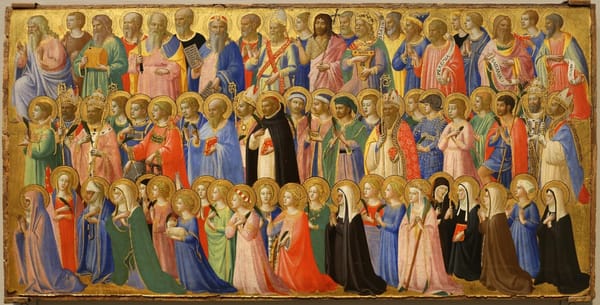
I saw a great multitude which no man could number of all nations and tribes and peoples and tongues, standing before the throne, and in sight of the Lamb, clothed with white robes, and palms in their hands: and they cried with a loud voice, saying: Salvation to our God!1
TIME is no more; it is the human race eternally saved that is thus presented in vision to the prophet of Patmos. Our life of struggle and suffering on earth is then, to have an end. Our long-lost race is to fill up the angelic ranks thinned by Satan’s revolt; and, uniting in the gratitude of the redeemed of the Lamb, the faithful spirits will sing with us: “Thanksgiving, honour, and power, and strength to our God forever and ever!2
And this shall be the end, as the apostle says;3 the end of death and suffering; the end of history and of its revolutions, which will then be explained. The old enemy, hurled down with his followers into the abyss, will live on only to witness his own eternal defeat. The Son of man, the Saviour of the world, will have delivered the kingdom to God His Father; and God, the last end of creation and of redemption, will be all in all.4
Long before the seer of the Apocalypse, Isaias sang: I saw the Lord sitting upon a throne, high and elevated, and his train filled the temple. And the Seraphim cried one to another, and said: Holy, holy, holy, the Lord God of hosts, all the earth is full of his glory.5 The train and fringes of God’s vesture are the elect, who are the adornment of the Word, the splendour of the Father. For since the Word has espoused our human nature, that nature is his glory, as he is the glory of God. The Bride herself is clothed with the justifications of the Saints; and when this glittering robe is perfected, the signal will be given for the end of time. This feast announces the ever-growing nearness of the eternal nuptials; for on it we annually celebrate the progress of the Bride’s preparation.
Blessed are they that are called to the marriage-supper of the Lamb!6 Blessed are we all, who have received in Baptism the nuptial robe of holy charity, which entitles us to a seat at the heavenly banquet! Let us prepare ourselves for the unspeakable destiny reserved for us by love. To this end are directed all the labours of this life: toils, struggles, sufferings for God’s sake, all adorn with priceless jewels the garment of grace, the clothing of the elect. Blessed are they that mourn!7
They that have gone before us, wept as they turned the furrows and cast in the seed; but now their triumphant joy overflows upon us as an anticipated glory in this valley of tears. Without waiting for the dawn of eternity, the present solemnity gives us to enter by hope into the land of light, whither our fathers have followed Jesus the divine forerunner. Do not the thorns of suffering lose their sharpness, at the sight of the eternal joys into which they are to blossom? Does not the happiness of the dear departed cause a heavenly sweetness to mingle with our sorrow? Let us hearken to the chants of deliverance sung by those for whom we weep; little and great, this is the feast of them all, as it will one day be ours. At this season, when cold and darkness prevail, nature herself, stripping off her last adornments, seems to be preparing the world for the passage of the human race into the heavenly country. Let us, then, sing with the Psalmist: “I rejoiced at the things that were said to me: We shall go into the house of the Lord. Our feet as yet stand only in thy outer courts; but we see thy building ever going on, O Jerusalem, city of peace, compacted together in concord and love. To thee do the tribes go up, the tribes of the Lord, praising the name of the Lord, thy vacant seats are being filled up. May all good things be for them that love thee, O Jerusalem; may peace be in thy strength, and abundance in thy towers. For the sake of my brethren and of my neighbours, who are already thy inhabitants, I take pleasure in thee; because of the Lord our God, whose dwelling thou art, I have placed in thee all my desire.”8
First Vespers
The bells ring out as joyously as on the brightest days. They announce the great solemnity of the closing Cycle; the feast which shows us time stamped with the impress of eternity, and God taking possession of the declining year and gathering in its harvest. At the sound of their triumphant and harmonious peals, the Church, prostrate and fasting since morning, raises her brow to the light. Guided by St. John, she penetrates the secrets of heaven; and the words of the beloved disciple, uttered by her lips, assume a tone of incomparable enthusiasm. This feast is truly the triumph of her motherhood; for the great crowd of the blessed before the throne of the Lamb, are the sons and daughters she alone has given to the Lord.
Ps. Dixit Dominus, page 36.
Beside her own glorified sons the Church beholds the Angels, with their magnificent ritual and their prostrate adoration. Her heart is enraptured at the scene, and she describes it to those who are still militant on earth with her.
Ps. Confitebor tibi Domine, page 37.
But the uninterrupted homage and chants of the heavenly Princes, are not the only glory rendered to the Most High in his eternal temple. As, even in the midst of a numerous choir, a mother can distinguish the voice of her child, so the Church exults to hear the family she has brought up for her Spouse, joining in the heavenly concert and celebrating the Lamb, whose Blood has purchased them the kingdom of God.
Ps. Beatus vir, page 38.
This is the true joy, the ineffable consolation of this day; and the exiled Church cannot refrain from sending up a burning appeal to the Saints, to praise the Lord if possible with still greater zeal. “Be happy, all of you, and sing to him,” she cries out from this valley of tears, borrowing the words of Tobias in the land of his captivity.
Ps. Laudate pueri, page 39.
To praise God unceasingly is the lot of the Saints, Israel’s goodly inheritance in the true Sion. The Church, in her transport, wearies not of extolling this glorious lot, this better part, privilege of a few on earth, but enjoyed by all in heaven.
Psalm 116
Quoniam confirmata est super nos misericordia ejus: * et veritas Domini manet in aeternum.
For his mercy is confirmed upon us: and the truth of the Lord remaineth forever.
No power can lessen the glory of the holy city, or diminish the number of its happy inhabitants, which was fixed before all ages in the counsels of the Most High. Although the world is only too deserving of wrath, it cannot be consumed until it has furnished heaven with the last of the elect. This is expressed in a lively manner by the Capitulum, taken from the Apocalypse.
Capitulum.
(Apoc. vii.)
Rabanus Maurus, Abbot of Fulda and Archbishop of Mayence, is supposed to be the author of the following hymn. The perfidious nation, whose expulsion from Christian lands is prayed for, was in the ninth century the race of infidel Normans, who filled the empire with slaughter and ruin under Charlemagne’s weak successors. The striking conversion of these savage destroyers was the answer of the Saints. May they ever hear the Church’s prayers in a like manner, enlighten those who persecute her without knowing her, and make of them her firmest supporters.
Hymn
Quibus Patris clementiam
Tuae ad tribunal gratiae
Patrona Virgo postulat.
Distincta gyros agmina,
Antiqua cum praesentibus,
Futura damna pellite.
Apud severum Judicem,
Veris reorum fletibus
Exposcite indulgentiam.
Vos candidati praemio
Confessionis, exsules
Vocate nos in patriam.
Et quos eremus incolas
Transmisit astris, coelitum
Locate nos in sedibus.
Credentium de finibus,
Ut unus omnes unicum
Ovile nos pastor regat.
Natoque Patris unico,
Sancto simul Paraclito,
In sempiterna saecula.
for whom thy Virgin Mother
stands as advocate before the throne of grace,
imploring the Father’s mercy.
of blessed choirs,
drive far from us all evils,
past, present, and to come.
plead before the terrible Judge,
and, for the unfeigned tears of us poor sinners,
obtain our pardon.
ye confessors with snow-white wreaths,
call us from exile
into our fatherland.
and ye who from the desert
have sped beyond the stars,
give us a place among your heavenly thrones.
far from Christian lands,
that we may all be gathered
by one Pastor into the one fold.
and to his only Son,
together with the holy Paraclete,
through everlasting ages.
All the choirs of Angels, all the ranks of the Saints receive, in the Magnificat Antiphon, the homage of the Church’s prayer; and all will join in praising the Queen of heaven and earth, by singing her own glorious Canticle.
Antiphon of the Magnificat
The Canticle Magnificat page 44.
Prayer
When Rome had completed the conquest of the world, she dedicated to all the gods in token of her gratitude the Pantheon, the most durable monument of her power. But when she herself had been conquered by Christ, and invested by him with the empire over souls, she withdrew her homage from vain idols and offered it to the Martyrs; for they, praying for her as she slew them, had rendered her truly eternal. To the martyrs then, and to Mary their Queen, she consecrated forever, on the morrow of her merciful chastisement, the now purified Pantheon.
“Come forth from your dwellings, ye Saints of God, hasten to the place prepared for you.”9 For three centuries the catacombs were the resting‑place of our Lord’s athletes, when they were borne from the arena. These valiant warriors deserved the honours of a triumph far better than did the great victors of old. In 312, however, Rome disarmed but not yet changed in heart, was not at all disposed to applaud the men who had conquered the gods of Olympus and of the Capitol. While the Cross surmounted her ramparts, the white-robed army still lay entrenched in the subterranean crypts that surrounded the city like so many outworks. Three centuries more were granted to Rome, that she might make satisfaction to God’s justice, and take full cognizance of the salvation reserved for her by his mercy. In 609 the patient work of grace was completed; the Sovereign Pontiff Boniface IV uttered the word for the sacred crypts to yield up their treasures. It was a solemn moment, a forerunner of that wherein the Angel’s trumpet-call shall sound over the sepulchers of the world.10 The successor of St. Peter, in all his apostolic majesty, and surrounded by an immense crowd, presented himself at the entrance of the catacombs. He was attended by eighteen chariots magnificently adorned for the conveyance of the martyrs. The ancient triumphal way opened before the Saints; the sons of the Quirites sang in their honour: “You shall come with joy and proceed with gladness; for behold, the mountains and the hills exult, awaiting you with joy. Arise, ye Saints of God, come forth from your hiding-places; enter into Rome, which is now the holy city; bless the Roman people following you to the temple of the false gods, which is now dedicated as your own church, there to adore together with you the majesty of the Lord.”11
Thus, after six centuries of persecution and destruction, the martyrs had the last word; and it was a word of blessing, a signal of grace for the great city hitherto drunk with the blood of Christians. More than rehabilitated by the reception she was giving to the witnesses of Christ, she was now not merely Rome, but the new Sion, the privileged city of the Lord. She now burned before the Saints the incense they had refused to offer to her idols; their blood had flowed before the very altar, on which she now invited them to rest, since the usurpers had been hurled back into the abyss. It was a happy inspiration that induced her, when she dedicated to the holy martyrs the temple built by Marcus Agrippa and restored by Severus Augustus, to leave upon its pediment the names of its primitive constructers and the title they had given it; for then only did the famous monument truly merit its name, when Christian Rome could apply to the new inhabitants of the Pantheon those words of the Psalm: I have said, you are gods.12 The thirteenth of May was the day of their triumphant installation.
Every dedication on earth reminds the Church, as she herself tells us, of the assembly of the Saints, the living stones of the eternal dwelling which God is building for himself in heaven.13 It is not astonishing, then, that the dedication of Agrippa’s Pantheon, under the above-mentioned circumstances, should have originated the feast of today.14 Its anniversary, recalling the memory of the martyrs collectively, satisfied the Church’s desire of honouring year by year all her blessed sons who had died for the Lord; for, at an early date it became impossible to celebrate each of them on the day of his glorious death. In the age of peace there was added to the cultus of the martyrs that of the other just, who daily sanctified themselves in all the paths of heroism opened out to Christian courage. The thought of uniting these with the former in one common solemnity, which would supply for the unavoidable omission of many of them, followed naturally upon the initiative given by Boniface IV.
In 732, in the first half of that eighth century which was such a grand age for the Church, Gregory III dedicated, at St. Peter’s on the Vatican, an oratory in honour of the Saviour, of his blessed Mother, of the holy Apostles, of all the holy Martyrs, Confessors, and perfect Just, who repose throughout the world.15 A dedication under so extensive a title did not, it is true, imply the establishment of our feast of All Saints by the illustrious Pontiff; yet from this period it began to be celebrated by divers churches, and that too on the first of November; as is attested, with regard to England, by Venerable Bede’s Martyrology and the Pontifical of Egbert of York. It was far, however, from being universal, when in the year 835 Louis Le Débonnaire, at the request of Gregory IV and with the consent of all the bishops of his realm, made its celebration obligatory by law. This decree was welcomed by the whole Church and adopted as her own, says Ado, with reverence and love.16
The councils of Spain and Gaul, as early as the sixth century,17 mention a custom then existing, of sanctifying the commencement of November by three days of penance and litanies, like the Rogation days which precede the feast of our Lord’s Ascension. The fast on the Vigil of All Saints is the only remaining vestige of this custom of our forefathers, who, after the institution of the feast, advanced the triduum of penance, so as to make it a preparation for the solemnity itself. “Let our devotion be ‘complete,’ is the recommendation of a contemporaneous author; ‘let us prepare ourselves for this ‘most holy solemnity by three days of fasting, prayer and almsdeeds.’”18
When extended to the entire world, the feast became complete; it was made equal to the greatest solemnities, and widened its horizon till it reached the infinite, embracing uncreated as well as created sanctity. Its object was now, not only Mary and the martyrs; not only all the just children of Adam, but moreover the nine choirs of Angels, and above all the Holy Trinity Itself, God who is all in all, the King of kings, that is, of the Saints, the God of gods in Sion. Hear how the Church awakes her children on this day: Come let us adore the Lord, the King of kings, for he is the crown of all the Saints.19 Such was the invitation addressed by our Lord himself to St. Mechtilde, the chantress of Helfta, the privileged one of his divine Heart: “Praise me, for that I am ‘the crown of all the Saints.’” The virgin then beheld all the beauty of the elect and their glory drawing increase from the Blood of Christ, and resplendent with the virtues practised by him; and responding to our Lord’s appeal, she praised with all her might the blissful and ever adorable Trinity, for deigning to be to the Saints their diadem and their admirable dignity.20
Dante too describes Beatrice in the highest heaven, forming her crown of the reflection of the eternal rays. “Glory be to the Father, and to the Son, and to the Holy Ghost,” sang the inhabitants of Paradise with one voice. “I seemed,” says the sublime poet, “to behold a smile of the universe. The kingdom of bliss, with all its people both ancient and new, turned look and love all towards one point. O triple light, which shining in a single star dost so delight them, look down upon our tempests!”21
In many churches, the ancient Office of the Feast, up to the sixteenth century, had this peculiarity, that at the Nocturns the first Antiphon, the first Blessing, the first Lesson, and the first Responsory treated of the Blessed Trinity; the second of these respective pieces spoke of our Lady, the third of the Angels, the fourth of the Patriarchs and Prophets, the fifth of the Apostles, the sixth of the Martyrs; the seventh of the Confessors, the eighth of the Virgins, the ninth of all the Saints. On this account the first Lesson, contrary to the custom of the rest of the year, was given to the highest dignitary of the choir, and the first Responsory to the first cantors. The rest followed in order down to the children; one of whom sang the Lesson of the Virgins, and five others clothed in white and holding lighted tapers in their hands in memory of the five wise virgins, sang the eighth Responsory before the Lady-Altar. The ninth Lesson and Responsory were again chanted by Priests. All, or nearly all, these customs have been successively modified; but the arrangement of the Responsories remains the same.
Our readers will be glad to find here the primitive Antiphons and Responsories referred to in the visions of Saints, who show us each order of the blessed in heaven taking part, during this sacred night, in the prayers and thanksgivings of earth. The following texts are found alike in the Breviaries of Aberdeen and Salisbury.
Antiphons.
Responsories.
3. ℟. Te sanctum Dominum in excelsis laudant omnes Angeli, dicentes:* Te decet † Laus et honor, Domine.℣. Cherubim quoque ac Seraphim Sanctus proclamant, et omnis coelicus ordo dicens.* Te decet. Gloria Patri. † Laus et honor.
4. ℟. Inter natos mulierum non surrexit major Johanne Baptista:* Qui viam Domino praeparavit in eremo.℣. Fuit homo missus a Deo cui nomen Johannes erat.* Qui viam.
5. ℟. Cives Apostolorum et domestici Dei advenerunt hodie: * Portantes facem et illuminantes patriam, dare pacem gentibus et liberare populum Domini.℣. Audite preces supplicum vitae aeternae poscentes praemia, qui fertis in dextris manipulos justitiae, quique gaudentes advenistis hodie.* Portantes.
6. ℟. O constantia Martyrum laudabilis: o charitas inexstinguibilis:* patientia invincibilis quae, licet inter pressuras persequentium visa sit despicabilis:* Invenietur in laudem et gloriam et honorem. * In tempore retributionis.℣. Nobis ergo petimus piis subveniant meritis, honorificati a Patre qui est in coelis.* Invenietur. Gloria. † In tempore.
7. ℟. Sint lumbi vestri praecincti et lucernae ardentes in manibus vestris:* Et vos similes hominibus exspectantibus dominum suum quando revertatur a nuptiis.℣. Vigilate ergo, quia nescitis qua hora Dominus vester venturus sit.* Et vos.
8. ℟. Audivi vocem de coelo venientem: Venite, omnes Virgines sapientissimae:* Oleum recondite in vasis vestris, dum Sponsus advenerit.℣. Media nocte clamor factus est: Ecce Sponsus venit.* Oleum.
9. ℟. Concede nobis, Domine quaesumus, veniam delictorum: et intercedentibus Sanctis quorum hodie solemnia celebramus:* Talem nobis tribue devotionem.* Ut ad eorum pervenire mereamur societatem.℣. Adjuvent nos eorum merita, quos, propria impediunt scelera; excuset intercessio accusat quos actio: et qui eis tribuisti coelestis palmam triumphi, nobis veniam non deneges peccati.* Talem. Gloria. † Ut ad.
3. ℟. Thee, holy Lord, all the Angels praise on high, saying:* To thee beseemeth † Praise and honour, O Lord.℣. The Cherubim also and the Seraphim cry out, Holy; and every heavenly rank, saying:* To thee beseemeth. Glory be to the Father. † Praise and honour.
4. ℟. Among those born of women there hath not arisen a greater than John the Baptist: * Who prepared the way for the Lord in the desert.℣. There was a man sent from God, whose name was John.* Who prepared.
5. ℟. The fellow-citizens of the Apostles and the servants of God have come before us today: * Bearing a torch and enlightening our fatherland, to give peace to the nations, and to deliver the people of the Lord.℣. Hear the prayers of suppliants imploring the rewards of eternal life, O ye who bear in your hands the sheaves of justice, and who come today rejoicing.* Bearing.
6. ℟. O praiseworthy constancy of the Martyrs; O inextinguishable charity; O invincible patience! Although under the tortures of the persecutors it appeared despicable, * It shall be found worthy of praise and glory and honour, † In the time of retribution.℣. Therefore we pray that they may assist us with their blessed merits, now that they are honoured by the Father who is in heaven.* It shall be found. Glory be to the Father. † In the time.
7. ℟. Let your loins be girt and lamps burning in your hands. * And you yourselves like to men who wait for their lord, when he shall return from the wedding.℣. Watch ye therefore, because you know not what hour your Lord will come.* And you yourselves.
8. ℟. I heard a voice coming from heaven: Come all ye most wise Virgins: * Keep oil ready in your vessels, for when the Spouse shall come.℣. At midnight there was a cry made: Behold the Bride-groom cometh.* Keep oil.
The Greeks honour with us, on one common solemnity, “all the Saints of all the countries on earth, of Asia, Lybia, and Europe, of North and South.”22 But, whereas the West celebrates at the close of the year a feast which represents the gathering of the harvest into our heavenly Father’s granary, the East keeps it on the first Sunday after Pentecost, in the spring time of the Church, when under the action of the Holy Ghost, sanctity was everywhere beginning to blossom.23 We find it thus as early as the fourth century; for it was on this first Sunday after Pentecost, which with us Latins is now the feast of the most holy Trinity, that St. John Chrysostom pronounced his discourse in honour of “all the Martyrs, who have suffered throughout ‘the world.’”24
In the West also as we have seen, the origin of All Saints’ feast was this general commemoration of the Martyrs. This latter was placed by some Eastern churches on the Friday within the Octave of Easter.25 It was a happy thought thus to associate the confession of Christ’s witnesses with the victory over death won by him, whose divine confession before Pontius Pilate had been an example and a support to them in presence of their executioners. Indeed Rome herself had had the same inspiration, when she made her solemn commemoration of the Martyrs in the beginning of May; and she still reserves to the Martyrs and Apostles the honour of having a special Office for the whole of Paschal Time.
We borrow the following passages from the Greek Office for the Sunday of All Saints.
In Magno Vespertino.
Mass
Ancient documents referring to this day inform us, that on the Calends of November the same eagerness was shown as at Christmas to assist at the holy Sacrifice.26 However general the Feast was, or rather because of its universality, was it not the special joy of everyone, and the honour of Christian families? Taking a holy pride in the persons whose virtues they handed down to posterity, they considered the heavenly glory of their ancestors, who had perhaps been unknown in the world, to be a higher nobility than any earthly dignity.
Faith was lively in those days; and Christians seized the opportunity of this feast to make amends for the neglect, voluntary or involuntary, suffered during the year by the blessed inscribed on the general Calendar. In the famous Bull Transiturus de hoc mundo, by which he established the feast of Corpus Christi, Urban IV mentions this as one of the motives that had led to the prior institution of All Saints;27 and expresses a hope that the new solemnity may in like manner compensate for the distractions and coldness of the rest of the year, towards this divine Sacrament, wherein he resides who is the crown and the glory of all Saints.28
The Introit Antiphon resembles that of our Lady’s Assumption day. This feast is indeed a sequel to Mary’s triumph. As our Lord’s Ascension called for his Mother’s Assumption, both required for their completion the universal glorification of the human race which provides heaven with its King and Queen. Joy, then, on earth, which continues thus magnificently to give its fruit! Joy among the Angels, who see their vacant thrones filled up! Joy, says the Verse, to all the blessed, who are receiving the congratulations of heaven and earth!
Introit
But we sinners, who are still in exile, have always and everywhere need of mercy. Today we may well hope for it, since so many are interceding for us. If the prayer of one Saint is powerful, what must be the united suffrages of all heaven!
Collect
Epistle
Cap. Vii.In diebus illis: Ecce ego Joannes vidi alterum Angelum ascendentem ab ortu solis, habentem signum Dei vivi: et clamavit voce magna quatuor Angelis, quibus datum est nocere terrae et mari, dicens: Nolite nocere terrae et mari, neque arboribus, quoadusque signemus servos Dei nostri in frontibus eorum. Et audivi numerum signatorum, centum quadraginta quatuor milia signati, ex omni tribu filiorum Israel. Ex tribu Juda duodecim millia signati. Ex tribu Ruben duodecim millia signati. Ex tribu Gad duodecim millia signati. Ex tribu Aser duodecim millia signati. Ex tribu Nephthali duodecim millia signati. Ex tribu Manasse duodecim millia signati. Ex tribu Simeon duodecim millia signati. Ex tribu Levi duodecim millia signati. Ex tribu Issachar duodecim millia signati. Ex tribu Zabulon duodecim millia signati. Ex tribu Joseph duodecim millia signati. Ex tribu Benjamin duodecim millia signati. Post haec vidi turbam magnam, quam dinumerare nemo poterat ex omnibus gentibus, et tribubus, et populis, et linguis: stantes ante thronum, et in conspectu Agni, amicti stolis albis, et palmae in manibus eorum; et clamabant voce magna, dicentes: Salus Deo nostro, qui sedet super thronum, et Agno. Et omnes Angeli stabant in circuitu throni, et seniorum, et quatuor animalium: et ceciderunt in conspectu throni in facies suas, et adoraverunt Deum, dicentes, Amen. Benedictio, et claritas, et sapientia, et gratiarum actio, honor, et virtus, et fortitudo Deo nostro, in saecula saeculorum. Amen.
Chap. vii.
In those days, behold I, John, saw another angel ascending from the rising of the sun, having the sign of the living God. And he cried with a loud voice to the four angels, to whom it was given to hurt the earth and the sea, saying, Hurt not the earth, nor the sea, nor the trees, till we sign the servants of our God in their foreheads. And I heard the number of them that were signed: an hundred forty‑four thousand were signed, of every tribe of the children of Israel. Of the tribe of Juda were twelve thousand signed: of the tribe of Ruben twelve thousand signed: of the tribe of Gad twelve thousand signed: of the tribe of Aser twelve thousand signed: of the tribe of Nephthali twelve thousand signed: of the tribe of Manasses twelve thousand signed: of the tribe of Simeon twelve thousand signed: of the tribe of Levi twelve thousand signed: of the tribe of Issachar twelve thousand signed: of the tribe of Zabulon twelve thousand signed: of the tribe of Joseph twelve thousand signed: of the tribe of Benjamin twelve thousand signed. After this I saw a great multitude, which no man could number, of all nations, and tribes, and peoples, and tongues, standing before the throne and in sight of the Lamb, clothed with white robes, and palms in their hands; and they cried with a loud voice saying: Salvation to our God who sitteth upon the throne, and to the Lamb. And all the angels stood round about the throne, and the ancients, and the four living creatures; and they fell down before the throne upon their faces, and adored God, saying: Amen. Benediction, and glory, and wisdom, and thanksgiving, honour, and power, and strength to our God forever and ever. Amen.
At the time of his birth, the Man-God, through the instrumentality of Caesar Augustus, took a census of the world; it was fitting that on the eve of the Redemption, the statistics of the human race should be officially registered. And now it is time to make a fresh enrollment, and to enter in the Book of Life the results of the work of Redemption.
“Wherefore this number of the world at the time of our Lord’s birth,” says St. Gregory in one of the Christmas homilies, “save for this manifest reason, that he was appearing in the Flesh, who is to enregister the elect in eternity?”29 But, many having withdrawn themselves by their own fault from the benefit of the first enrollment, which included all men in the ranks of those to be redeemed, there was need of a second and definitive registration, which should cancel the names of the guilty. Let them be blotted out of the book of the living, and with the just let them not be written;30 such are the words of the Psalmist, quoted by St. Gregory in the above-mentioned homily.
Today, however, the Church is too full of joy to think of any but the elect; they alone take part in the glorious close of human history described in the Epistle. Indeed, they alone are reckoned before God; the reprobate are but the waste of a world where sanctity alone responds to the Creator’s advances, to the ventures of his infinite love. Let our souls be supple to receive the divine stamp, which is to render us comformable to the image of the Only-begotten Son, and mark us out as God’s coin. Whoever is unwilling to receive the divine impress will inevitably be marked with the character of the beast;31 and when the Angels come to make the final settlement, every coin unfit to bear the divine stamp will fall into the furnace, where the dross will burn eternally.
Let us then, as the Gradual recommends, live in fear; not that of the slave, who dreads punishment; but that filial fear, which is anxious never to displease him from whom are all good things, and whose kindness deserves all our love in return. Without losing aught of their beatitude, or diminishing their love, the angelic Powers and all the Saints in heaven prostrate with a holy trembling beneath the gaze of God’s awful majesty.32
Gradual
Gospel
Cap. v.In illo tempore: Videns Jesus turbas, ascendit in montem, et cum sedisset, accesserunt ad eum discipuli ejus, et aperiens os suum, docebat eos, dicens: Beati pauperes spiritu: quoniam ipsorum est regnum coelorum. Beati mites: quoniam ipsi possidebunt terram. Beati, qui lugent: quoniam ipsi consolabuntur. Beati, qui esuriunt et sitiunt justitiam: quoniam ipsi saturabuntur. Beati misericordes: quoniam ipsi misericordiam consequentur. Beati mundo corde: quoniam ipsi Deum videbunt. Beati pacifici: quoniam filii Dei vocabuntur. Beati qui persecutionem patiuntur propter justitiam: quoniam ipsorum est regnum coelorum. Beati estis cum maledixerint vobis, et persecuti vos fuerint, et dixerint omne malum adversum vos mentientes, propter me: gaudete, et exsultate, quoniam merces vestra copiosa est in coelis.
Chap. v.
At that time, Jesus, seeing the multitudes, went up into a mountain; and when he was set down his disciples came unto him. And opening his mouth, he taught them saying: Blessed are the poor in spirit; for theirs is the kingdom of heaven. Blessed are the meek; for they shall possess the land. Blessed are they that mourn; for they shall be comforted. Blessed are they that hunger and thirst after justice; for they shall have their fill. Blessed are the merciful; for they shall obtain mercy. Blessed are the clean of heart; for they shall see God. Blessed are the peacemakers; for they shall be called the children of God. Blessed are they that suffer persecution for justice sake; for theirs is the kingdom of heaven. Blessed are ye when they shall revile you, and persecute you, and speak all that is evil against you, untruly, for my sake: be glad and rejoice, for your reward is very great in heaven.
Earth is so near to heaven today, that the one thought which fills all hearts is happiness. The Friend, the Bridegroom, the divine Brother of Adam’s children, comes and sits down among them, and talks of blessedness: “Come to me all you that labour and suffer,” sang the Alleluia-Verse, that sweet echo from our fatherland reminding us withal of our exile. And immediately in the Gospel appears the goodness and kindness of God our Saviour. Let us listen to him, teaching us the ways of blessed hope, the holy delights which are at once an assurance and a foretaste of the perfect bliss of heaven.
On Sinai Jehovah held the Jew at a distance, giving him precepts under pain of death. On the summit of this other mountain where the Son of God is seated how differently the Law of love is promulgated! In the New Testament, the eight beatitudes have taken the place occupied in the Old by the Decalogue graven on stone. Not that the beatitudes repeal the Commandments; but their superabundant justice goes far beyond all prescriptions. It is from his Heart that Jesus brought them forth in order to imprint them, more lastingly than on stone, in the hearts of his people. They are the portrait of the Son of Man, the summary of our Redeemer’s life. Look then, and do according to the pattern that was shown thee in the mount.33
Poverty was the first mark of our God in Bethlehem; and who ever appeared so meek as Mary’s Child? Who wept for more noble causes than he in his crib, where he was already expiating our sins and appeasing his Father? They that hunger after justice, the merciful, the clean of heart, the peacemakers where, save in him, will they find the incomparable ideal, never attained yet ever imitable? And by his death he became the leader of all those who are persecuted for justice’ sake. In this the highest beatitude on earth, the Incarnate Word takes delight, returning upon it, detailing it, and closing with it in today’s Gospel as with a song of ecstasy. The Church has never had any other ideal; she has ever walked in the footsteps of her Spouse, and her history, throughout the ages, has been but the prolonged echo of the Beatitudes. Let us also understand; that we may be blessed both in this world and in the next, let us follow our Lord and the Church.
The evangelical beatitudes raise man above torments, above death itself, which disturbs not the peace of the just, but consummates it. Such is the burthen of the Offertory chant, taken from the Book of Wisdom.
Offertory
As the Secret explains, the Sacrifice in which we are allowed to take part, glorifies God, honours the Saints, and renders the divine goodness propitious to us.
Secret
The Communion Antiphon, like an echo of the Gospel, repeats the last three beatitudes, referring them, and rightly, to the divine Sacrament whereby they are nourished.
Communion
In the Postcommunion, the Church asks as the fruit of this feast, that her children may always honour the Saints, and ever benefit by their favour with God.
Postcommunion
Second Vespers
The Second Vespers are the same as the First, except the last Psalm, the Versicle, and the Magnificat Antiphon. The Psalm, which is as follows, puts upon the lips of the Saints a beautiful summary of their life of faith and suffering here on earth, and of their eternal gratitude and praise in heaven.
Psalm 115
Ego dixi in excessu meo: * Omnis homo mendax.
Quid retribuam Domino: * pro omnibus quae retribuit mihi?
Calicem salutaris accipiam: * et nomen Domini invocabo.
Vota mea Domino reddam coram omni populo ejus: * pretiosa in conspectu Domini mors Sanctorum ejus.
O Domine, quia ego servus tuus: * ego servus tuus, et filius ancillae tuae.
Dirupisti vincula mea: * tibi sacrificabo hostiam laudis, et nomen Domini invocabo.
Vota mea Domino reddam in conspectu omnis populi ejus: * in atriis domus Domini, in medio tui, Jerusalem.
I said in my excess: Every man is a liar.
What shall I render to the Lord, for all the things that he hath rendered to me?
I will take the chalice of salvation; and I will call upon the name of the Lord.
I will pay my vows to the Lord, before all his people: precious in the sight of the Lord is the death of his saints.
O Lord, for I am thy servant: I am thy servant and the son of thy handmaid.
Thou hast broken my bonds: I will sacrifice to thee the sacrifice of praise, and I will call upon the name of the Lord.
I will pay my vows to the Lord in the sight of all his people; in the courts of the house of the Lord, in the midst of thee, O Jerusalem!
Antiphon of the Magnificat
This Antiphon which expresses at once an unspeakable delight and a patient longing, closes the solemnity of the Saints. But the Church’s day is not yet ended. Scarcely has she given the last salute to her glorious sons disappearing in their white robes in the train of the Lamb, when an innumerable crowd of suffering souls surrounds her at the gate of heaven; and to these she at once lends her voice and her heart. The glittering vestments, which reminded her of the snowy garments of the blessed, are changed for the colour of mourning; the ornaments and flowers disappear from the Altar; the organ is hushed; the bells ring a plaintive knell. Without any transition, the Vespers of All Saints’ are followed by the Vespers of the Dead.34
Vespers Of The Dead
No human science or eloquence could ever reach the depth of teaching, the power of soul-stirring supplication contained in the office of the Dead. This intimate knowledge of the secrets of the other world, and of the way to win the Heart of her Spouse, belongs to the Bride alone; and she alone, the true Mother of men, is able with exquisite tact to console the orphans and the bereaved, by shortening the painful purification of those who have passed away.
Dilexi: this first song of the holy souls is all love; as the Credidi, the last Psalm sung by the heavenly citizens on this feast, recalled their faith, and the trials they have endured on earth. We have just remarked that there is no transition between the two solemnities. What need of any? The suffering souls and the blessed, both are the captives of love; love gives them their dignity, and is their imperishable treasure. In the case of the blessed, faith having given place to the vision of God, their love is highest bliss; but to the suffering souls, imprisoned in darkness by sins not yet expiated, love is the source of inexpressible pain. However, they are now free from the anxieties of this world, the perils of hell; they are confirmed in grace, and can never sin again; they are full of gratitude towards God who has saved them in his mercy, and in his justice is purifying them to make them worthy of himself. They are in a state of absolute and perfect resignation, and of calm expectancy, called by holy Church a “sleep of peace.”35
Psalm 114
Quia inclinavit aurem suam mihi: * et in diebus meis invocabo.
Circumdederunt me dolores mortis: * et pericula inferni invenerunt me.
Tribulationem et dolorem inveni: * et nomen Domini invocavi.
O Domine, libera animam meam: * misericors Dominus, et justus, et Deus noster miseretur.
Custodiens parvulos Dominus: * humiliatus sum; et liberavit me.
Convertere anima mea in requiem tuam: * quia Dominus benefecit tibi.
Quia eripuit animam meam de morte: * oculos meos a lacrimis, pedes meos a lapsu.
Placebo Domino: * in regione vivorum.
Because he has inclined his ear to me, and in my days I will call to him.
The sorrows of death have surrounded me; and the dangers of hell are come upon me.
I have found tribulation and sorrow; and I have invoked the name of the Lord.
O Lord, deliver my soul: the Lord is merciful and just: and our God shows mercy.
The Lord keeps the little ones; I was humbled, and he delivered me.
Return, my soul, into thy rest; because the Lord has done good to thee.
Because he has delivered my soul from death, my eyes from tears, and my feet from slipping.
I will please the Lord in the land of the living.
Instead of the usual doxology the Church makes, at the end of every Psalm, a fervent prayer for the departed.
Requiem aeternam * dona eis Domine.
Et lux perpetua * luceat eis.
Grant them eternal rest, O Lord:
And let perpetual light shine on them.
The soul in Purgatory, separated from the body which weighed her down and distracted her by a thousand vain preoccupations, is now entirely absorbed by the one desire of becoming at length perfectly pleasing to God. Towards this end her whole energy is directed; and so too is the force of the torments for whose violence she is so grateful. Purgatory is a crucible where the dross of sin is burnt away, until every debt is cancelled. When its flames have effaced every stain and every wrinkle that marred the soul’s beauty, then she flees away to her Spouse, truly a blessed one and sure of offering no obstacle to the complacent love of her Lord.
Yet to what a sad length her exile is prolonged! True she is united by charity to the inhabitants of heaven: but the fire which torments her is of the same nature as that of hell; her abode is nigh to that of the damned: she must endure the proximity of the infernal Cedar, and of those adversaries of all peace, the detestable demons, who attacked her unceasingly during her mortal life with their assaults and their snares, and who still with deceitful tongue accuse her before the throne of God. Presently we shall hear the Church imploring: “ From the gate of hell deliver her!”
Psalm 119
Ad Dominum cum tribularer clamavi: * et exaudivit me.
Domine libera animam meam a labiis iniquis: * et a lingua dolosa.
Quid detur tibi aut quid apponatur tibi: * ad linguam dolosam?
Sagittae potentis acutae: * cum carbonibus desolatoriis.
Heu mihi, quia incolatus meus prolongatus est: habitavi cum habitantibus cedar: * multum incola fuit anima mea.
Cum his, qui oderunt pacem, eram pacificus: * cum loquebar illis, impugnabant me gratis.
Requiem aeternam * dona eis Domine.
Et lux perpetua * luceat eis.
When I was in tribulation, I cried to the Lord; and he heard me.
O Lord deliver my soul from unjust lips, and from a deceitful tongue.
What is to be given to thee, or what is to be added to thee: to a deceitful tongue?
The sharp arrows of the mighty: with coals of desolation.
Woe is me that my abode is prolonged. I have dwelt with the inhabitants of Cedar; my soul has been long a sojourner.
I was peaceable with those that hated peace; when I spoke to them, they insulted me for no reason.
Grant them eternal rest, O Lord;
And let perpetual light shine on them.
Yet the soul faints not; lifting up her eyes to the mountains, she feels that she can rely upon her Lord, and that she is abandoned neither by heaven which is expecting her arrival, nor by her mother the Church on earth. Although Purgatory, where justice and peace meet and embrace, is so near to the region of endless weeping, it is still accessible to the Angels. These august messengers comfort the soul with divine communications; while the blessed in heaven and the just on earth assist her with their prayers and suffrages. She is well assured that sin, the only real evil, can never touch her.
Psalm 120
Levavi oculos meos in montes: * unde veniet auxilium mihi.
Auxilium meum a Domino: * qui fecit coelum et terram.
Non det in commotionem pedem tuum: * neque dormitet qui custodit te.
Ecce non dormitabit neque dormiet: * qui custodit Israel.
Dominus custodit te, Dominus protectio tua: * super manum dexteram tuam.
Per diem sol non uret te: * neque luna per noctem.
Dominus custodit te ab omni malo: * custodiat animam tuam Dominus.
Dominus custodiat introitum tuum, et exitum tuum: * ex hoc nunc, et usque in saeculum.
Et lux perpetua * luceat eis.
I lifted up my eyes to the mountains: from whence my help will come.
My help is from the Lord: who made heaven and earth.
May he not suffer thy foot to stagger; and may he not slumber that keeps thee.
Lo, he will not slumber nor sleep: that keeps Israel.
Our Lord keeps thee, our Lord is thy protection: on thy right hand.
The sun shall not burn thee by day: nor the moon by night.
The Lord preserveth thee from all evil; may the Lord keep thy soul.
May the Lord keep thy coming in, and thy going out: from henceforth, now and forever.
And let perpetual light shine on them.
Christian usage has appropriated the 129th Psalm as the peculiar prayer for the dead; it is a cry of anguish, mingled with hope. The destitute condition of the holy souls is well calculated to touch our hearts. Though not yet in heaven, they no longer belong to earth, and have consequently lost those privileges whereby God compensates us for the dangers which surround us in our passage through this world of trial. Their perfect acts of love, of hope, of faith, and of resignation have no merit. Such unspeakable sufferings, accepted with their dispositions, would earn for us a reward equal to that of a thousand martyrs; yet to these souls they profit nothing, for all eternity, beyond the mere payment of the penalty exacted by the just judge. Besides their inability to merit, they can no longer satisfy God’s justice by offering him an equivalent such as he can accept. Their powerlessness to help themselves is more absolute than that of the paralytic of the Pool of Bethsaida:36 the saving waters are left behind on earth, together with the holy Sacrifice, the Sacraments, and the use of the all-powerful keys entrusted to the Church.
The Church, however, albeit she has no longer any jurisdiction over these poor souls, still feels towards them all a mother’s tenderness; nor has she lost her credit with the Spouse. She makes their prayer her own. Opening the treasure she has inherited from the plenteous redemption of the Lord, she makes an offering from her dowry to him who gave it her, begging in return the deliverance of the captives, or at least an alleviation of their sufferings. Thus, all rights being duly respected, abundant mercy penetrates into the kingdom of inexorable justice.
Psalm 129
Fiant aures tuae intendentes: * in vocem deprecationis meae.
Si iniquitates observaveris Domine: * Domine quis sustinebit?
Quia apud te propitiatio est: * et propter legem tuam sustinui te Domine.
Sustinuit anima mea in verbo ejus: * speravit anima mea in Domino.
A custodia matutina usque ad noctem: * speret Israel in Domino.
Quia apud Dominum misericordia: * et copiosa apud eum redemptio.
Et ipse redimet Israel: * ex omnibus iniquitatibus ejus.
From the depths I have cried unto thee, O Lord: Lord hear my voice.
Let thy ears be attentive: to the voice of my petition.
If thou wilt observe iniquities, O Lord: Lord, who shall sustain it?
Because with thee is propitiation: and for thy law I have expected thee, O Lord.
My soul has relied on his word: my soul has hoped in the Lord.
From the morning watch even until night: let Israel hope in the Lord.
Because with the Lord there is mercy: and with him plentiful redemption.
And he will redeem Israel from all his iniquities.
And let perpetual light shine on them.
I will praise thee for thou hast heard me. The Church’s prayer is never in vain. The last Psalm utters her gratitude, and that of the souls freed, by the Office we are now saying, from the abyss, or drawn nearer to heaven. The Church has prayed, and in answer to her prayer many who were captives this morning make their entrance into everlasting light on the evening of this beautiful feast; and they enhance its joy and glory at its close. Let our hearts and our thoughts follow these new Saints; they smile upon us, they thank us their brethren and children, as they ascend all radiant from the land of shadows singing; In the sight of Angels I will sing to thee, O Lord ; I will adore in thy holy temple. –No; the Lord does not despise the works of his hands.
Psalm 137
In conspectu angelorum psallam tibi: * adorabo ad templum sanctum tuum, et confitebor nomini tuo.
Super misericordia tua et veritate tua: * quoniam magnificasti super omne, nomen sanctum tuum.
In quacumque die invocavero te, exaudi me: * multiplicabis in anima mea virtutem.
Confiteantur tibi Domine omnes reges terrae: * quia audierunt omnia verba oris tui:
Et cantent in viis Domini: * quoniam magna est gloria Domini.
Quoniam excelsus Dominus, et humilia respicit: * et alta a longe cognoscit.
Si ambulavero in medio tribulationis, vivificabis me: * et super iram inimicorum meorum extendisti manum tuam, et salvum me fecit dextera tua.
Dominus retribuet pro me: Domine, misericordia tua in saeculum: * opera manuum tuarum ne despicias.
I will praise thee, O Lord, with all my heart: because thou hast heard the words of my mouth.
In the sight of angels I will sing to thee: I will adore in thy holy temple, and praise thy name.
For thy mercy and thy truth; because thou hast magnified thy holy name above everything.
In what day soever I shall call to thee, hear me: thou wilt increase strength in my soul.
Let all kings of the earth confess thee, O Lord; for they have heard all the words of thy mouth.
And let them sing in the ways of our Lord: because the glory of the Lord is great:
Because the Lord is high, and he beholds the low things; and the high things he knows afar off.
If I shall walk in the midst of trouble, thou wilt enliven me; and upon the wrath of my enemies thou hast stretched thy hand, and thy right hand has saved me.
The Lord will repay for me: thy mercy, O Lord, is forever: despise not the works of thy hand.
And let perpetual light shine on them.
And now from heaven itself, as if sent to us by the dear newly-delivered souls, comes this intimation of their happiness:37
The whole of this wonderful liturgical drama, which has been represented before us, points to the fulfilment of our Lord’s promise,38 which the Church repeats in the following Antiphon.
Antiphon of the Magnificat
But as in this world every grace from Jesus comes to us through Mary, so in the next world it is through her that deliverance and all good things are obtained. The Mother of God is queen over all whom her Son has redeemed. Thus the revelations of the saints tell us that she is truly the queen of Purgatory; whether she graciously sends the Angels of her guard to represent her there; or deigns herself, the beautiful dawn of eternal day, to enter its gloomy precincts, and shed upon its flames the abundant dew of morning. Shall the snow of Libanus fail from the rock of the field? Or can the cold waters that gush out and run down, be taken away?39 We must understand, then, why we sing the Magnificat in the Office of the Dead: it is the loyal homage to Mary of the souls that are entering heaven, and the sweet hope of those still detained in the region of expiation.
Our Lady’s Canticle.
(St. Luke, i.)
Magnificat: * anima mea Dominum;
Et exsultavit spiritus meus: * in Deo Salutari meo.
Quia respexit humilitatem ancillae suae: * ecce enim ex hoc beatam me dicent omnes generationes.
Quia fecit mihi magna qui potens est: * et sanctum Nomen ejus.
Et misericordia ejus a progenie in progenies: * timentibus eum.
Fecit potentiam in brachio suo: * dispersit superbos mente cordis sui.
Deposuit potentes de sede: * et exaltavit humiles.
Esurientes implevit bonis: * et divites dimisit inanes.
Suscepit Israel puerum suum: * recordatus misericordiae suae.
Sicut locutus est ad patres nostros: * Abraham et semini ejus in saecula.
Et lux perpetua * luceat eis.
My soul magnifies the Lord.
And my spirit hath rejoiced in God my Saviour.
Because he has regarded the humility of his handmaid: for behold from henceforth all generations shall call me blessed.
Because he that is mighty had done great things for me: and holy is his Name.
And his mercy is from generation to generation: on them that fear him.
He has showed power in his arm: he has dispersed the proud in the conceit of their heart.
He has deposed the mighty from their seat: and has exalted the humble.
He has filled the hungry with good things: and has sent the rich away empty.
He has received Israel his servant: being mindful of his mercy.
As he spoke to our fathers; to Abraham, and his seed forever.
And let perpetual light shine on them.
Here all kneel, and the Priest begins the Lord’s Prayer:
The rest is said in silence as far as this conclusion, which is followed by the Versicles and Prayer that close the Vespers of the Dead.
℟. Sed libera nos a malo.
℟. Erue Domine animas eorum.
℟. Et clamor meus ad te veniat.
℟. Deliver their souls, O Lord.
Prayer
Let us offer our Lady this touching supplication, which for a long time many churches addressed to her for the dead. It was composed in the fourteenth century, by John IV. de Langoueznou, Abbot of Landevenec, inspired by his tender love for Mary.
Prose.
Qui purgantur ardore nimio,
Et torquentur gravi supplicio,
Subveniat tua compassio:
O Maria!
Omnes juvas et nullum respuis:
Manum tuam extende mortuis,
Qui sub poenis languent continuis:
O Maria!
Cupientes de poenis erui,
Et adesse tuo conspectui,
Aeternisque gaudiis perfrui:
O Maria!
Pietatis ostende viscera:
Illos Jesus per sua vulnera
Ut sanare dignetur impetra:
O Maria!
Ad te clamat turba sodalium.
Pro fratribus ut places Filium,
Et coeleste det eis praemium:
O Maria!
Quas fundimus ad pedes Judicis,
Mox exstinguant vim flammae vindicis,
Ut jungantur choris angelicis:
O Maria!
In tremendo Dei judicio,
Judicanti supplica Filio,
Ut cum Sanctis sit nobis portio:
O Maria!
whom the burning flame is cleansing
and sharp pains are tormenting,
may thy compassion bring assistance,
O Mary!
thou aidest all, despisest none:
to the dead who languish in unceasing tortures
stretch forth thy hand,
O Mary!
yearning to be delivered from their sufferings
and to be admitted to the sight
of thee in the enjoyment of eternal bliss,
O Mary!
to show the love of thy heart;
obtain of Jesus that he would deign
to heal them thro’ his own wounds,
O Mary!
lo! United multitudes cry to thee for their brethren,
that thou wouldst appease thy Son,
and obtain for them the heavenly reward,
O Mary!
thou seest us shed before the feet of the Judge,
to speedily extinguish the flames of the avenging fire,
that the dear souls may join the angelic choirs,
O Mary!
shall take place at God’s terrible judgment,
oh! Then implore thy Son the Judge
that we may share the inheritance of the Saints,
O Mary!
Truly this day is grand and beautiful. Earth, midway between heaven and purgatory, has united them together. The wonderful mystery of the communion of saints is revealed in all its fulness. The immense family of the sons of God is shown to be one in love, while distinct in its three states of beatitude, trial, and purifying expiation: the trial and expiation being but temporary, the beatitude eternal. It is the fitting completion of the teaching given us through the entire year; and every day within the octave we shall see the light increase.
Meanwhile, every soul is recollected, pondering over the dearest and noblest memories. On leaving the home of God, let our thoughts linger lovingly upon those who have the best claim to them. It is the feast of our beloved dead. Let us hear their suppliant voices in the plaintive tones that, from belfry to belfry throughout the Christian world, are ushering in this dark November night. This evening or to-morrow they will expect us to visit them at the tombs where their mortal remains rest in peace. Let us pray for them; and let us also pray to them: we need never be afraid to speak to them of the interests that were dear to them before God. For God loves them; and, as his justice keeps them in an utter inability to help themselves, he makes amends to his goodness by hearing them all the more willingly on behalf of others.
- Apoc vi. 9, 10. ↩︎
- Ibid. 12. ↩︎
- I Cor. xv. 24. ↩︎
- I Cor. xv. 24-28. ↩︎
- Is. vi. 1-3. ↩︎
- Apoc. xix. 9. ↩︎
- St. Matth. v. 5. ↩︎
- Ps. cxxi. ↩︎
- Pontificale rom. Ant. In Eccl. dedicatione. ↩︎
- Sequence Dies irae. ↩︎
- Cf. Pontifical. Rom. Ant. In Eccl. dedicat. ↩︎
- Ps. lxxxi. 6. ↩︎
- Collects in die Dedicationis Altaris; Postcom. Anniv. Ded. Eccl ↩︎
- Martyrolog. ad hanc diem. ↩︎
- Lib pontific. in Gregorio III. ↩︎
- Ado. Martyrol. ↩︎
- Concil. Gerund. an. 517, can. 3; Lugdun. II. an. 567, can. 1. ↩︎
- Inter Opera Alcuini, Epist. xci. Ad calcem. ↩︎
- Invitatory of the Feast. ↩︎
- Liber specialis gratiae, P. I. cap. Xxxi. ↩︎
- Dante, Paradiso, xxvii, xxxi. ↩︎
- Pentecostarion, in Dominica Sanctorum omnium. ↩︎
- Leon. Philosoph. Oratio xv. In universae terrae Sanctos universos. ↩︎
- Chrys. Opera ii, 711. ↩︎
- Calendaria Syrorum et Chaldaeorum. ↩︎
- Lectiones antiquae Breviarii Romani ad hanc diem. ↩︎
- Hil/Trop. Ordo rom. ↩︎
- Cap. Si Dominum, De Reliquiis et Veneratione Sanctorum. Clementin. iii. 16. ↩︎
- Lectio vii. In Nocte Natal. Domini; ex Homil. viii. In Ev. ↩︎
- Ps. lxviii. 29 ↩︎
- Apoc. xiii. 16. ↩︎
- Cf. Praefat. Missae. ↩︎
- Exod. xxv. 40 ↩︎
- If the morrow of All Saints’ be a Sunday, the Commemoration of the Dead is transferred to the Monday. ↩︎
- Canon Missae. ↩︎
- St John v. ↩︎
- Apoc. xiv. 13. ↩︎
- St. John vi. 37. ↩︎
- Jerem. xviii.14. ↩︎
| Previous October 31: Vigil of All Saints | Next November 1: Feast of All Saints |