Daily reading
After Pentecost
Double · Movable from Easter · Temporal
November 8, 2020
From Dom Guéranger’s The Liturgical Year.

|
The Twenty-Third Sunday after Pentecost
When the number of the Sundays after Pentecost is only twenty-three, the Mass for to-day is taken from the twenty-fourth and last Sunday; and the Mass appointed for the twenty-third is said on the previous Saturday, or on the nearest day of the preceding week which is not impeded by a double or semi-double feast.
But, under all circumstances, the antiphonary ends to-day. The Introits, Graduals, Communions, and Postcommunions, which are given below, are to be repeated on each of the Sundays till Advent, which vary in number each year. Our readers will remember that, in the time of St. Gregory, Advent was longer than we now have it;1 and that, in those days, its weeks commenced in that part of the cycle which is now occupied by the last Sundays after Pentecost. This is one of the reasons for the lack of liturgical riches in the composition of the dominical Masses which follow the twenty-third.
Even on this one, the Church, without losing sight of the last day, used to lend a thought to the new season which was fast approaching, the season, that is, of preparation for the great feast of Christmas. There was read, as Epistle, the following passage from Jeremias, which was afterwards, in several Churches, inserted in the Mass of the first Sunday of Advent: 'Behold! the days come, saith the Lord, and I will raise up to David a just branch: and a King shall reign, and shall be wise: and shall execute judgment and justice in the earth. In those days, shall Juda be saved, and Israel shall dwell confidently: and this is the name that they shall call Him: The Lord our Just One. Therefore, behold the days come, saith the Lord, and they shall say no more: The Lord liveth, who brought up the children of Israel out of the land of Egypt! But: The Lord liveth, who hath brought out, and brought hither, the seed of the house of Israel, from the land of the north, and out of all the lands, to which I had cast them forth! And they shall dwell in their own land.’2
As is evident, this passage is equally applicable to the conversion of the Jews and the restoration of Israel, which are to take place at the end of the world. This was the view taken by the chief liturgists of the middle ages, in order to explain thoroughly the Mass of the twenty-third Sunday after Pentecost. Bearing in mind that, originally, the Gospel of this Sunday was that of the multiplication of the five loaves, let us listen to the profound and learned Abbot Rupert, who, better than anyone, will teach us the mysteries of this day, which brings to a close the grand and varied Gregorian melodies.
'Holy Church,’ he says,’is so intent on paying her debt of supplication, and prayer, and thanksgiving, for all men, as the apostle demands,3 that we find her giving thanks also for the salvation of the children of Israel, who, she knows, are one day to be united with her. And, as their remnants are to be saved at the end of the world,4 so, on this last Sunday of the year, she delights in them, as though they were already her members. In the Introit, calling to mind the prophecies concerning them, she thus sings every year: My thoughts are thoughts of peace, and not of affliction. Verily, His thoughts are those of peace, for He promises to admit to the banquet of His grace the Jews, who are His brethren according to the flesh; thus realizing what had been prefigured in the history of the patriarch Joseph. The brethren of Joseph, having sold him, came to him when they were tormented by hunger; for then he ruled over the whole land of Egypt. He recognized them; he received them; and made, together with them, a great feast. So, too, our Lord, who is now reigning over the whole earth, and is giving the bread of life, in abundance, to the Egyptians (that is, to the Gentiles), will see coming to Him the remnants of the children of Israel. He, whom they had denied and put to death, will admit them to His favour, will give them a place at His table, and the true Joseph will feast delightedly with His brethren.
‘The benefit of this divine Table is signified, in the Office of this Sunday, by the Gospel, which tells us of our Lord’s feeding the multitude with five loaves. For it will be then that Jesus will open to the Jews the five Books of Moses, which are now being carried whole, and not yet broken; yea, carried by a child, that is to say, this people itself, who, up to that time, will have been cramped up in the narrowness of a childish spirit.
Then will be fulfilled the prophecy of Jeremias, which is so aptly placed before this Gospel: “They shall say no more: The Lord liveth, who brought up the children of Israel out of the land of Egypt! But, the Lord liveth, who hath brought out the seed of Israel from the land of the north, and from all the lands into which they had been cast."
Thus delivered from the spiritual bondage which still holds them, they will sing with all their heart the words of thanksgiving as we have them in the Gradual: “Thou hast saved us, O Lord, from them that afflict us!"
‘The words we use in the Offertory: “From the depths I have cried to thee, O Lord," clearly allude to the same events; for, on that day, His brethren will say to the great and true Joseph: “We beseech thee to forget the wickedness of thy brethren!”5 The Communion: “Amen, I say to you, all things whatsoever ye ask, when ye pray," etc., is the answer made by that same Joseph, as it was by the first:6 “Fear not! Ye thought evil against me : but God turned it into good, that He might exalt me, as at present ye see, and might save many people. Fear not, therefore, I will feed you, and your children.”’7
Mass
The Introit, which we have just had explained to us by Rupert, is taken from the Prophet Jeremias,8 as was the ancient Epistle.
Introit
Prayer for pardon is continually on the lips of the Christian people, because the weakness of human nature is ever making itself felt, here below, even by the just man.9 God knows our frailty, and He is always ready to pardon us; but it is on the condition that we humbly acknowledge our faults, and have confidence in His mercy. These are the sentiments which suggest to the Church the words of the Collect.
Collect
The other Collects, as on page 120.
Epistle
Cap. iii. et iv.Fratres, Imitatores mei estote, et observate eos, qui ita ambulant, sicut habetis formam nostram. Multi enim ambulant, quos sæpe dicebam vobis (nunc autem et flens dico) inimicos crucis Christi : quorum finis interitus : quorum deus venter est : et gloria in confusione ipsorum, qui terrena sapiunt. Nostra autem conversatio in cœlis est: unde etiam Salvatorem exspectamus Dominum nostrum Jesum Christum, qui reformabit corpus humilitatis nostræ, configuratum corpori claritatis suæ, secundum operationem, qua etiam possit subjicere sibi omnia. Itaque, fratres mei charissimi et desideratissimi, gaudium meum et corona mea : sic state in Domino, charissimi. Evodiam rogo, et Syntichen deprecor idipsum sapere in Domino. Etiam rogo et te, germane compar, adjuva illas, quæ mecum laboraverunt in Evangelio, cum Clemente, et ceteris adjutoribus meis, quorum nomina sunt in libro vitæ.
Chapters iii. and iv.
Brethren: Be followers of me, and observe them who walk so as you have our model. For many walk, of whom I have told you often (and now tell you weeping) that they are enemies of the cross of Christ; whose end is destruction, whose god is their belly, and whose glory is in their shame: who mind earthly things. But our conversation is in heaven; from whence also we look for the Saviour, our Lord Jesus Christ, who will reform the body of our lowness, made like to the body of his glory, according to the operation whereby also he is able to subdue all things unto himself. Therefore, my dearly beloved brethren, and most desired, my joy, and my crown: so stand fast in the Lord, my dearly beloved. I beg of Evodia, and I beseech Syntyche, to be of one mind in the Lord. And I entreat thee also, my sincere companion, help those women that have laboured with me in the Gospel, with Clement and the rest of my fellow labourers, whose names are in the book of life.
The Clement here mentioned by the apostle was St. Peter’s second successor. Very frequently, the twenty-third Sunday after Pentecost comes close upon the feast of this great Pope and Martyr of the first century. Disciple of Paul, and, later on, in close intimacy with Peter, and named by the Vicar of Christ as the fittest to succeed him in the apostolic chair, Clement, as we shall see on November 23, was one of the saints most venerated by the faithful in those early times. The mention made of him in the Office of the time, just before his appearance on the cycle of holy Church, excited the Christian people to joy, and roused their fervour; it reminded them, that one of their best and dearest protectors would soon be visiting them.
At the time when St. Paul was writing to the Philippians, Clement, who was long to survive the apostles, was prominently one of those men spoken of in our Epistle, those illustrious models, who were called to perpetuate in the flock confided to their care10 the pattern of holy living; and that, not so much by their zealous teaching, as by the force of example. The Church, the one true bride of the divine Word, was known by the incommunicable privilege of possessing within her the truth; not only its dead letter, but its ever-living self. The Holy Ghost has not kept the Books of sacred Scripture from passing into the hands of the sects separated from the centre of unity; but He has reserved to the Church the treasure of tradition, which transmits, surely and fully, from one generation to another, the word which is life and light.11 This tradition is kept up by the truth and the holiness of the Man-God, ever existing in His members, ever tangible and visible in the Church.12 Holiness, which is inherent in the Church, is tradition in its purest and strongest form; because it is the truth, not only preached, but reduced to action and work,13 as it was in Christ Jesus, and as it is in God.14 It is the deposit,15 which the disciples of the apostles had the mission to hand faithfully down to their successors, just as the apostles themselves had received it from the Word, who had come upon the earth.
Hence, St. Paul did not content himself with entrusting dogmatic teaching to his disciple Timothy;16 he said to him : 'Be thou an example to the faithful, in word, and in living.,17 He said much the same to Titus: ‘Show thyself an example of good works, in doctrine and in integrity of life.’18 He repeated to all: 'Be ye followers of me, as I also am of Christ.'19 He sent Timothy to the Corinthians, that he might remind them, or, where it was necessary, might teach them, not only the dogmas of his Gospel, but likewise his ways in Christ Jesus, that is, his manner of life. For this manner of life of the apostle was, in a certain measure, his teaching everywhere in all the Churches;20 and he lauded the faithful of Corinth for being mindful to imitate him in all things, which was a keeping to the tradition of Christ.21 As for the Thessalonians, they had so thoroughly entered into this teaching, taken from their apostle’s life, that, as St. Paul says of them, they had become a pattern to all believers; this silent teaching of Christian revelation, which they showed forth in their conduct, made it superfluous for the messengers of the Gospel to say much.22
The Church is a magnificent temple, which is built up, to the glory of God, of the living stones, which let themselves be set into its walls.23 The constructing of those sacred walls on the plan laid down by Christ is a work in which all are permitted to share. What one does by word,24 another does by good example;25 but both of them build, both of them edify the holy city; and, as it was in the apostolic age, so always; example is more powerful than word, unless that word be supported by the authority of holiness in him who speaks it, unless, that is, he lead a life according to the perfection taught by the Gospel.
But, as the giving of edification to those around him is an obligation incumbent on the Christian—an obligation imposed both by the charity he owes to his neighbour, and by the zeal he should have for the house of God—so likewise, under pain of presumption, he should seek his own edification in the conduct of others. The reading of good books, the study of the lives of the saints, the observing, as our Epistle says, those holy people with whom he lives, all this will be an incalculable aid to him, in the work of his own personal sanctification and in the fulfilment of God’s purposes in this regard. This devout intercourse with the elect of earth and of heaven will keep us away from men who are enemies of the cross of Christ and mind earthly things, and put their happiness in carnal pleasures. It will make our conversation be in heaven. Preparing for the day which cannot now be far off, the day of the coming of our Lord, we shall stand fast in Him, in spite of the falling off of so many amongst us, who, by the current of the world’s fashion, are hurried into perdition. The troubles and sufferings of the last times will but intensify our hope in God; for they will make us long all the more ardently for the happy day when our Redeemer will appear and complete the work of the salvation of His servants by imparting to their very flesh the brightness of His own divine Body. Let us, as our apostle says, be of one mind in the Lord; and then, as he bids his dear Philippians, let us rejoice in the Lord always, for the Lord is nigh.26
Gradual
Gospel
Cap. ix.In illo tempore : Loquente Jesu ad turbas, ecce princeps unus accessit, et adorabat eum, dicens: Domine, filia mea modo defuncta est: sed veni, impone manum tuam super eam, et vivet. Et surgens Jesus sequebatur eum, et discipuli ejus. Et ecce mulier, quæ sanguinis fluxum patiebatur duodecim annis, accessit retro, et tetigit fimbriam vestimenti ejus. Dicebat enim intra se : Si tetigero tantum vestimentum ejus, salva ero. At Jesus conversus, et videns eam, dixit : Confide, filia, fides tua te salvam fecit. Et salva facta est mulier ex illa hora. Et cum venisset Jesus in domum principis, et vidisset tibicines, et turbam tumultuantem, dicebat : Recedite, non est enim mortua puella, sed dormii. Et deridebant eum. Et cum ejecta esset turba, intravit, et tenuit manum ejus. Et surrexit puella. Et exiit fama hæc in universam terram illam.
Ch. ix.At that time : As Jesus was speaking to the multitude: Behold a certain ruler came up and adored him, saying : Lord, my daughter is even now dead; but come lay thy hand upon her, and she shall live. And Jesus rising up followed him, with his disciples. And behold a woman who was troubled with an issue of blood twelve years, came behind him, and touched the hem of his garment. For she said within herself: If I shall touch only his garment I shall be healed. But Jesus turning and seeing her, said : Be of good heart, daughter, thy faith hath made thee whole. And the woman was made whole from that hour. And when Jesus was come into the house of the ruler, and saw the minstrels and the multitude making a rout, he said : Give place: for the girl is not dead, but sleepeth. And they laughed him to scorn. And when the multitude was put forth, he went in and took her by the hand. And the maid arose. And the fame hereof went abroad into all that country.
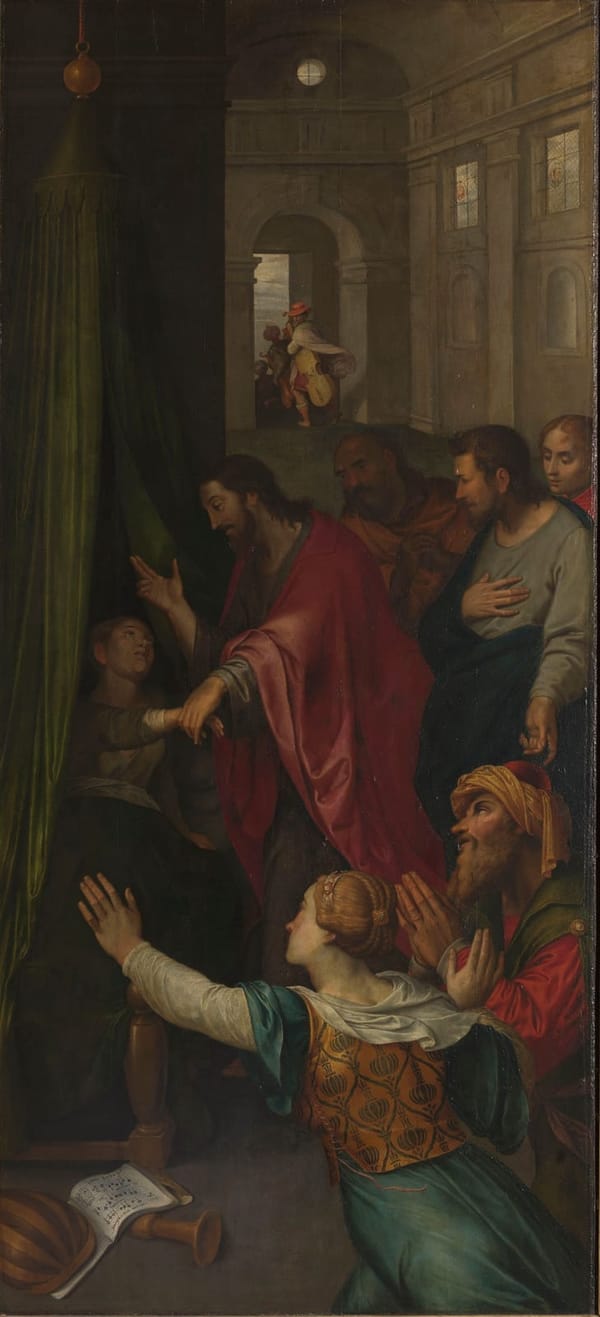
Although the choice of this Gospel for the twenty-third Sunday is not of great antiquity, yet is it in most perfect keeping with the post-pentecostal liturgy, and confirms what we have stated relative to the character of this portion of the Church’s year. St. Jerome tells us, in the homily selected for the day, that the hemorrhoissa, healed by our Lord, is a type of the Gentile world; whilst the Jewish people is represented by the daughter of the ruler of the Synagogue.27 This latter is not to be restored to life until the former has been cured; and this is precisely the mystery we are so continually commemorating during these closing weeks of the liturgical year, viz., the fullness of the Gentiles recognizing and welcoming the divine Physician, and the blindness of Israel at last giving way to the light.28
The liturgy at this close of the year continually alludes to the end of the world. The earth seems to be sinking away, down into some deep abyss; but it is only that it may shake off the wicked from its surface, and then it will come up again blooming in light and love. After the divine realities of this year of grace, we ought to be capable of feeling a thrill of admiration at the mysterious, yet, at the same time, the strong and sweet ways of eternal Wisdom.29 At the beginning, when man was first created, sin soon followed, breaking up the harmony of God’s beautiful world, and throwing man off the divine path where his Creator had placed him. Wickedness went on increasing, until God’s mercy fell upon one family. The light which beamed on that privileged favourite only showed more plainly the thick darkness in which the rest of mankind were enveloped. The Gentiles, abandoned to their misery, all the more terrible because they had caused it and loved it, saw God’s favours all bestowed on Israel, whilst they themselves were disregarded, and wished to be so. Even when the time came for original sin to be remedied, it seemed to be the very time for the final reprobation of the Gentiles; for the salvation that came down from heaven in the person of the Man-God was seen to be exclusively directed towards the Jews and the lost sheep of the house of Israel.30
But the people that had been treated with so much predilection, and whose fathers and first rulers had so ardently prayed for the coming of the Messias, was no longer in the position to which it had been raised by the holy patriarchs and prophets. Its beautiful religion, founded on desire and hope, was then nothing but a sterile expectancy, which kept it motionless and unable to advance a single step towards its Redeemer. As to its Law, Israel then minded nothing but the letter, and, at last, turned it into a mummy of sectarian formalism. Now, whilst in spite of all this sinful apathy it was mad with jealousy, pretending that no one else had any right to heaven’s favours, the Gentile, whose ever-increasing misery urged him to go in search of some deliverer, found one, and recognized him in Jesus the Saviour of the world. He was confident that this Jesus could cure him; so he took the bold initiative, went up to Him, and had the merit of being the first to be healed. True, our Lord had treated him with an apparent disdain; but that had only had the effect of intensifying his humility, and humility has a power of making way anywhere, even into heaven itself.31
Israel, therefore, was now made to wait. One of the Psalms he sang ran thus: ‘Ethiopia shall be the first to stretch out her hands to God.’32 It is now the turn for Israel to recover, by the pangs of a long abandonment, the humility which had won the divine promises for his fathers, the humility which alone could merit his seeing those promises fulfilled.
By this time, however, the word of salvation has made itself heard throughout all the nations, healing and saving all who desired the blessing. Jesus, who has been delayed on the road, comes at last to the house towards which He first purposed to direct His sacred steps; He reaches, at last, the house of Juda, where the daughter of Sion is in a deep sleep. His almighty compassion drives away from the poor abandoned one the crowd of false teachers and lying prophets, who had sent her into that mortal sleep, by all the noise of their vain babbling: He casts forth for ever from her house those insulters of Himself, who are quite resolved to keep the dead one dead. Taking the poor daughter by the hand, He restores her to life, and to all the charm of her first youth; proving thus, that her apparent death had been but a sleep, and that the long delay of dreary ages could never belie the word of God, which He had given to Abraham, His servant.33
Now therefore, let this world hold itself in readiness for its final transformation; for the tidings of the restoration of the daughter of Sion puts the last seal to the accomplishment of the prophecies. It remains now but for the graves to give back their dead.34 The valley of Josaphat is preparing for the great meeting of the nations;35 Mount Olivet is once more to have Jesus standing upon it,36 but this time as Lord and Judge!37
Offertory
The service we pay to God is, of itself, far beneath what His sovereign Majesty deserves; but the Sacrifice, which every day constitutes part of our service, ennobles it even to an infinite worth, and supplies all our own deficiencies of merit. This is what we are told in this Sunday’s Secret.
Secret
The other Secrets, as on page 130.
Communion
Having, by these sacred mysteries, entered into a participation of divine life, let us beseech our Lord, that we may no longer be subject to the dangers of this world. Let us say with the Church:
Postcommunion
The other Postcommunions, as on page 131.
Vespers
The psalms, capitulum, hymn, and versicle, as above, pages 71-81.
Antiphon of the Magnificat
- See our ‘Advent,’ chap. i., page 23 et seq. ↩︎
- Jer. xxiii. 5-8. ↩︎
- 1 Tim. ii. 1. ↩︎
- Rom. ix. 27. ↩︎
- Gen. l. 17. ↩︎
- Ibid. 19-21. ↩︎
- Rup., De Div. Off., xii. 28. ↩︎
- Jer. xxix. ↩︎
- Prov. xxiv. 16. ↩︎
- 1 St. Pet. v. 3. ↩︎
- St. John i. 4. ↩︎
- 1 St. John i. 1. ↩︎
- 1 Thess. ii. 13. ↩︎
- St. John v. 17. ↩︎
- 1 Tim. vi. 20. ↩︎
- 2 Tim. ii. 2. ↩︎
- 1 Tim. iv. 12. ↩︎
- Tit. ii. 7. ↩︎
- 1 Cor. iv. 16. ↩︎
- Ibid, 17. ↩︎
- Ibid. xi. 1-2. ↩︎
- 1 Thess. i. 5-8. ↩︎
- Eph. ii. 20-22. ↩︎
- 1 Cor. xiv. 3. ↩︎
- Rom. xiv. 19. ↩︎
- Phil. iv. 4, 5. ↩︎
- S. Hieron., in Matt., cap. ix. ↩︎
- Rom. xi. 25. ↩︎
- Wisd. viii. 1. ↩︎
- St. Matt. xv. 24. ↩︎
- Ecclus. xxxv. 21. ↩︎
- Ps. lxvii. 32. ↩︎
- St. Luke i. 54, 55. ↩︎
- Dan. xii. 1, 2. ↩︎
- Joel iii. 2. ↩︎
- Acts i. 11. ↩︎
- Zach. xiv. 4. ↩︎
November 8: Octave Day of All Saints
How could we more appropriately conclude the teachings of this Octave, than by quoting the words used by the Church herself in today's Liturgy?
Strangers as we are and pilgrims on the earth, let us fix our hearts and our thoughts on the day which will give to each of us a home, and restore us to Paradise. Who, that is on a voyage, would not hasten to return to his country! Who, that is on the way home, would not eagerly desire a favourable wind, that he might the sooner embrace his dear ones! Parents, brothers, children, friends in multitudes impatiently await us in our heavenly fatherland; blessed crowd already secure of their own eternal happiness, they are solicitous about our salvation. What joy for them and for us, when at length we see them and they may embrace us! How great the delight of that heavenly kingdom: no more fear of death; but eternal and supreme happiness! Let all our earnest desires tend to this: that we may be united with the Saints, that together with them we may possess Christ.1
These enthusiastic words, borrowed from St. Cyprian's beautiful book “On Mortality,” are used by the Church in her second Nocturn; and in the third she gives us the strong language of St. Augustine, consoling the faithful, who are obliged still to remain in exile, by reminding them of the great beatitude of this earth : the beatitude of those who are persecuted and cursed by the world. To suffer gladly for Christ, is the Christian's glory, the invisible beauty which wins for his soul the good pleasure of God, and procures him a great reward in heaven.2
He that hurteth, let him hurt still, says our Lord ; and he that is filthy, let him be filthy still; and he that is just, let him be justified still; and he that is holy, let him be sanctified still. Behold I come quickly; and my reward is with me, to render to every man according to his works. I am Alpha and Omega, the first and the last, the beginning and the end.3 Patience, then, Christians I Patience, all who are now despised, for time is short; the fashion of this world passeth away!4 It is in the light of our Baptism that we must look upon those foolish men, who think themselves strong, because they are violent; who call themselves wise, because pleasure is their only law. When the Man-God, with the spirit of his mouth, shall take vengeance on Satan their leader, their lot will be the indignant sentence heard by the Prophet of Patmos: Without are dogs, murderers, every one that loveth and maketh a lie.5 Meanwhile the whole creation, which they made the unwilling slave of their corruption, will answer to their disgraceful fall by a triumphant song of deliverance. Itself will be transformed into new heavens and a new earth. It will partake of the glory of the children of God, delivered like itself, and will be worthy to contain the new Jerusalem, the holy city, where in our flesh we shall see God; and where, seated at the right hand of the Father in the Person of Jesus Christ, our glorified human nature will enjoy forever the honours of a bride.
Let us honour all the Saints by a Sequence long sung on this Octave day by the church of Seville.
Sequence
Intus corde, voce foris,
Concinat haec concio;
Dulcis erit melodia
Si concordent ista tria:
Cor, os, operatio.
Suis Deus; sed cum tantis
Tandem bonis satiat,
Cur dum spirant in hac vita
Vix respirant, eos ita
Flagellat et cruciat?
Quos diversis poenae modis
Dignum ducis affici,
Et attritos in tormentis
Saepe sinis et consentis
Dirae neci subjici?
Quo affectu quis laborat
In ejus obsequio;
Amat cunctos, probat tamen
Per sudorem et certamen
Quanta sit devotio.
Hostem nequam et immundum,
Carnis quoque vitia;
Hac imprimis confessores
Martyresque formant mores
Virili constantia.
Quod confligit capitale
Martyri supplicium;
Sed interdum confessori
Litor deest in lituri
Carnis optans gaudium.
Certant illi, certant isti,
Tam mares quam feminae:
Qui plus sudat in agone
Plus mercedis et coronae
Refert pro certamine.
Velit Deus horum flecti
Meritis et precibus,
Ut quum dies erit dira
Non nos sua subdat ira
Tartari tortoribus.
Cum coelorum civibus.
let this assembly sing,
both with the inward music of the heart,
and with the outward sound of the voice;
sweet will be the melody if these three
be of one accord: heart, lips, and action.
but since at the last he satisfies them
with such good things, wherefore,
while they live this life,
are they scarce able to breathe,
he so scourges and torments them?
dost lovingly hate them,
since thou judgest well that
they should suffer in so many ways,
and permittest them often to be crushed
under tortures and subjected to a cruel death?
but seeks to know with how much
love each one labours in his service;
he loves them all, yet he proves,
by the toil and the strife,
how great is their devotedness.
the wicked unclean foe,
the vices of the flesh;
chiefly by this manly constancy
that confessors and martyrs
form themselves to virtue.
is that which gives him
the stroke of death;
but for the confessor the executioner is wanting;
he must choose the struggle
against the pleasures of the flesh.
that strive the former and the latter,
whether men or women;
and he that labours most in the strife,
carries off a higher prize,
a brighter crown for his combat.
may God allow himself to be moved
by their merits and prayers,
that when the terrible day shall come,
he may not in his wrath
hand us over to the infernal torturers.
to praise him in the company of the heavenly citizens.
Let us next pray for our dear departed ones. The Missals of several churches furnish us with this earnest supplication.
Sequence
Audi, Christe, nostras voces
In coelesti curia:
Pro defunctis fidelibus
Orat nunc mater omnibus,
Te supplex Ecclesia.
Ut audiant tuae aures
Vocis haec suffragia:
Vox haec orat, Rex gloriae
Fidelibus ut hodie
Concedas remedia.
Sustinere nec possimus,
Si observes vitia:
Fiat tamen salutaris
Quae offertur nunc a nobis
Pro defunctis hostia.
Offerimus et nos ipsi;
Sit eis propitia:
Propitius esto eis;
Solve vincla, jesu, reis
In tua potentis.
Te sustinent quos fecisti:
Averte supplicia:
Te sustinent, eruantur;
In te sperant, educantur
Ad coeli palatia.
Ad te tendunt et suspirant
De faecis miseria:
In te die, in te nocte,
In te mane et vespere
Sit eis fiducia.
Pro qua tibi supplicamus,
Pietatis copia:
Ut redimas eas, Christe,
Supplex rogat coetus iste,
Ab omni nequitia.
Tua roget te genitrix:
Fiat horum impetratrix
Quae rogamus, Maria.
Omnes sancti praecipue
Te rogantes sint hodie
Pro eorum venia.
Peccatorum es misertus,
Audi preces queis devotus
Ad te clamat noster coetus
Cum misericordia.
Portae mortis destruantur,
Diaboli confundantur,
Et animae consequantur
Sempiterna gaudia.
hear, O Christ, our voices
from thy heavenly court:
mother Church now
suppliantly implores thee
for all the faithful departed.
to hear her prayerful voice:
this voice that calls on thee,
O King of glory,
to grant this day
some relief to the faithful.
and unable to endure
if thou consider our vices:
still, let the victim
now offered by us
avail for the dead.
as thou didst offer to the Father:
may it be a succour to them;
yea, be thou propitious to them,
and in thy might, O Jesus,
loose the bonds of the guilty.
the creatures thou hast made wait for thee;
turn away the punishment:
they wait for thee, may they be delivered;
they trust in thee,
lead them forth to the heavenly dwellings.
towards thee they yearn and sigh
from their awful depth of misery;
in thee by day, in thee by night,
in thee at morn and evening
be their sure confidence.
be that abundant mercy for which we pray;
that thou wouldst redeem them,
O Christ, from all evil,
this suppliant crowd
beseeches thee.
thy Mother, intercede;
may Mary obtain
for us what we ask.
let all thy Saints
ask pardon for them,
especially on this day.
didst take pity on sinners,
mercifully hear the prayers
wherewith our assembly
cries to thee.
the gates of death destroyed,
the devils put to confusion,
and souls obtain possession
of never-ending joys.
Sunday within the Octave of All Saints: The Dedication of the Churches
Domum Dei decet sanctitudo: Sponsum ejus Christum adoremus in ea. Such is the Invitatory Antiphon, which sums up the liturgical thought of the day: “Holiness becometh the House of God: let us adore therein Christ her Spouse.” What is this mystery of a house that is at the same time a bride? - Our churches are holy because they belong to God, and on account of the celebration of the holy Sacrifice therein, and the prayer and praise offered to the divine Guest who dwells there. More truly than the figurative tabernacle or the ancient temple, they are separated, solemnly and forever by their dedication, from all the dwellings of men, and exalted far above all earthly palaces. Still, notwithstanding the magnificent rites performed within them on the day they were consecrated to God, notwithstanding the holy oil with which their walls remain forever impregnated, they themselves are devoid of feeling and life. What else, then, can be meant, but that the solemn function of the dedication, and the annual Feast that commemorates it, do not point merely to the material building, but rise to living and more sublime realities? The principal glory of the noble edifice will be to symbolize those great realities. Under the shelter of its roof, the human race will be initiated into ineffable secrets, the mystery whereof will be consummated in another world, in the noonday light of heaven. Let us listen to some doctrine on this subject.
God has but one sanctuary truly worthy of him, viz: his own divine life; the tabernacle, with which he is said to surround himself when he bends the heavens; though impenetrable darkness to the eyes of mortals, it is the inaccessible light wherein dwells in glory the ever-tranquil Trinity.1 And yet, O God most high, this same divine life, which cannot be contained by the heavens, much less by the earth, thou deignest to communicate to our souls, and thereby to make man a partaker in the divine nature. Henceforth there is no reason why the holy Trinity should not reside in him, just as in the highest heavens. Thus, from the beginning, thou couldst lay it down as the law of the newly-created world, and couldst declare to the abyss, to the earth, to the heavens, that it would be thy delight to dwell with the children of men.
When, therefore, the fulness of time came, God sent his Son, making him the son of Adam, in order that in man might dwell all the fulness of the Godhead corporally.2 From that day forward earth has had the advantage over heaven. Every Christian has participation in Christ; and having become the temple of the Holy Ghost, bears God in his body.3 This temple of God, says the Apostle, is holy, which you are;4 the temple is the individual Christian; it is also the Christian assembly.
Whereas Christ calls the whole human race to participate in his own fulness, the human race in its turn completes Christ. It is bone of his bone, flesh of his flesh, one body with him, and, together with him, the one victim which is to burn eternally with the fire of love upon the altar of heaven. At the same time, Christ is the corner-stone, on which other living stones, all the predestined, are built up by the apostolic architects into the holy temple of the Lord. Thus the Church is the Bride, and by and with Christ she is the House of God. She is such already in this world, where in labour and suffering the elect stones are chiselled, and are laid successively in the places assigned them by the divine plan. She is such in the happiness of heaven, where the eternal temple is being constructed of every soul that ascends from earth; until, when completed by the acquisition of Our immortal bodies, it will be consecrated by the great High-Priest on the day of the incomparable dedication, the close of time. Then will the world, redeemed and sanctified, be solemnly restored to the Father who gave it his only-begotten Son, and God. will be all in all. Then it will appear that the Church was truly the archetype shown beforehand on the Mount,5 whereof every other sanctuary, built by the hands of men, could be but the figure and the shadow. Then will be realized the vision of St. John: I saw the holy city, the new Jerusalem, coming down out of heaven from God, prepared as a bride adorned for her husband. And I heard a great voice from the throne, saying: Behold the tabernacle of God.
It was fitting, then, that this Feast should illuminate the closing Cycle with the first rays of eternity. It is by one of the seven Angels having phials full of the seven last plagues, that the Bride in her rich apparel was shown to the Evangelist; let the hope of contemplating her in her glory be a comfort to us too in these evil days. The expectation of her approaching appearance will animate the courage of the just during the final combats.
But let us, the children of the Church, already praise our Mother. Let this day so dear to her heart be to us one of the greatest solemnities; for it commemorates both her birth from the side of the heavenly Adam, and the sacred consecration which entitles her to the good pleasure of the Father, to the love of the Son, and to the bountiful gifts of the Holy Ghost.
First Vespers
When, at the beginning of the nineteenth century, the churches of France were restored to their holy use, it seemed good to the Holy See to establish a general Dedication Feast, instead of the local solemnity hitherto observed by each church on the actual anniversary of its consecration. The Feast was still to have the honours of a Double of second class, which proved that it had lost nothing of its importance in the eyes of Rome. Its being permanently fixed on a Sunday, secured to the people the benefit of annually receiving the sublime teaching in which our fathers took such delight. And the choice of this particular Sunday, immediately after the Octave of All Saints', made this solemnity as it were the completion of the other, and the crowning of the entire year.
The following Office and Mass are those of the Common of the Dedication per annum. We shall have them again, in this same month, on the Dedications of the Lateran Basilica of our Saviour, and of the Basilicas of St. Peter on the Vatican and St. Paul on the Ostian Way.
The Church, about to sing in the 109th Psalm the eternal Priesthood of Christ, is seized with an overpowering sentiment of the holiness of this house of the Lord, where she has assembled her children, and in which the great Sacrifice is offered to God. The first Antiphon is taken from the 92nd Psalm, which it accompanies at Lauds.
Ps. Dixit Dominus, page 36.
Yes, this house is holy: the house of prayer is the name given to it by all nations. This name had been foretold by Isaias, as our Lord himself reminded the buyers and sellers in the temple.
Ps. Confitebor tibi Domine, page 37.
House of God! How the Church loves to repeat it! And now it reminds her of the Gospel text, where our Lord compares the man who hears his word and does it, to one who builds his house upon a rock. We begin to perceive the connection in the Church's mind between the faithful soul and the sacred building whose stability she is praising.
Ps. Beatus vir, page 38.
The chants rise in enthusiasm ; the fourth Antiphon repeats, as if in ecstasy, the expressions of the third. Without any doubt the Church is no longer thinking of these walls which are one day to crumble; the solid rock is Christ, the house is the assembly of the elect.
Ps. Laudate pueri, page 39.
Caught up beyond this world, the Church in her admiration addresses the glorious dwelling, which the Lord her Spouse is building in heaven entirely of precious stones, the living gems which are to form the towers of the new Sion.
Psalm 147
Quoniam confortavit seras portarum tuarum: * benedixit filiis tuis in te.
Qui posuit fines tuos pacem: * et adipe fumenti satiat te.
Qui emittit eloquium suum terrae * velociter currit sermo ejus.
Qui dat nivem sicut lanam: * nebulam sicut cinerem spargit.
Mittit crystallum suam sicut buccellas: * ante faciem frigoris ejus, quis sustinebit?
Emittet Verbum suum, et liquefacet ea: * fiabit Spiritus ejus, et fluent aquae.
Qui annuntiat Verbum suum Jacob: * justitias, et judicia sua Israel.
Non fecit taliter omni nationi: * et judicia sua non manifestavit eis.
Because he hath strengthened the bolts of thy gates, he bath blessed thy children within thee.
Who hath placed peace in thy borders: and filleth thee with the fat of corn.
Who sendeth forth his speech to the earth: his word runneth swiftly.
Who giveth snow like wool: scattereth mists like ashes.
He sendeth his crystal like morsels: who shall stand before the face of his cold?
He shall send out his word, and shall melt them: his wind shall blow, and the waters shall run.
Who declareth his word to Jacob: his justices and his judgments to Israel.
He hath not done in like manner to every nation: and his judgments he hath not made manifest to them.
But this new Sion is the Church herself; for who but she is the Bride? And iu the Capitulum St. John shows us this holy city, coming down from heaven, adorned as a bride for her bridegroom.
Capitulum (Apoc. xxi.)
The seventh century, it will be remembered, witnessed the solemn Dedication of the Pantheon, which gave rise to the Feast of All Saints. It is to the same century we are indebted for the beautiful composition, from which the Hymns of Vespers and Lauds are taken. We will give the whole of it farther on, in its primitive text.
Hymn
Beata pacis visio,
Quae celsa de viventibus
Saxis ad astra tolleris,
Sponsaeque ritu cingeris
Mille Angelorum millibus.
Dotata Patris gloria,
Respersa sponsi gratia,
Regina formosissima,
Christo jugata Principi,
Coeli corusca civitas.
Patentque cunctis ostia:
Virtute namque praevia
Mortalis illuc ducitur;
Amore Christi percitus
Tormenta quisquis sustinet.
Et tunsione plurima,
Fabri polita malleo
Hanc saxa moem construunt,
Aptisque juncta nexibus
Locantur in fastigio.
Sit usquequaque Altissimo,
Natoque Patris unico,
Et inclyto Paraclito,
Cui laus, potestas, gloria
Eterna sit persaecula.
blessed vision of peace!
Built of living stones,
thou risest to the very stars;
and like a bride art circled round
with thousand, thousand Angels.
Dowered with the Father's glory,
and the grace of thy Spouse shed over thee,
most lovely Queen united
to Christ the King;
resplendent city of heaven!
are open to all;
thither is led whosoever follows virtue,
and who, urged
by the love of Christ,
endures torments.
and many a blow,
the stones, polished by the workman's hammer,
raise up this stately pile;
and being well fitted together,
are placed in the highest summit.
paid to the most high Father,
and to that Father's only Son,
and to the glorious Paraclete;
to whom be praise, power, and glory,
through everlasting ages.
When Solomon dedicated the Temple, he reminded Jehovah of his former promises, concerning the place he would choose for his Name to dwell in. Our churches are far superior to the ancient temple, for they have in them more than the Name of the Lord; moreover, every Christian is now the dwelling-place of God. How much more excellently such is Mary, the predestined tabernacle, sanctified and dedicated, from the first moment of her existence, to the God who was to take Flesh in her, and thus begin to dwell among us! Let us return thanks, both for her and for ourselves, by singing her heavenly canticle.
Antiphon of the Magnificat
The Canticle Magnificat, page 44.
Prayer
The name of Church given to the Christian temple signifies the assembly of the baptized. The sanctification of the elect in its successive phases, is the soul and inspiration of that most solemn of liturgical functions, the dedication of a church.
First of all, the temple with its bare walls and closed doors represents the human race created by God, and yet robbed of his presence ever since the original sin. But the heirs of the promise have not yielded to despair: they have fasted, they have prayed through the night; morning finds them sending up to God the supplication of the penitential Psalms, the inspired expression of David's chastisement and repentance.
At early dawn there appears under the tent, where the exiles are praying,6 the Word our Saviour. He is represented by the Pontiff vesting in the sacred robes, as he clothed himself with our flesh.7 The God-Man joins his brethren in their prayer; then, leading them to the still closed temple, he there prostrates with them and redoubles his supplications.
Then around the noble edifice, unconscious of its destinies, begins the patient strategy, wherewith the grace of God, and the ministers of that grace, undertake the siege of abandoned souls. Thrice the Pontiff goes around the whole building, and thrice he attempts to force open those obstinately closed doors; but his storming consists of prayers to heaven, his force is but the merciful and respectful persuasion of human liberty. “Open, O ye gates, and the King of glory shall enter in.” At length the unbeliever yields; an entrance is gained into the temple: “Peace eternal to this house, in the name of the Eternal!”
All is not yet finished however; far from it; this is but the commencement; the still profane edifice must be made into a dwelling worthy of God. The Pontiff, now within, continues to pray. His thoughts are intent upon the human race, symbolized by this future church. He knows that in its fallen state ignorance is its first evil. Accordingly he rises; and, on two lines of ashes running transversely from end to end of the temple and crossing in the centre of the nave, he traces with his episcopal crozier the Greek and Latin alphabets, the elements of the two principal languages8 in which Scripture and Tradition are preserved. They are traced with the pastoral staff, on ashes, and on the cross; because sacred science comes to us from doctrinal authority, because it is understood only by the humble, and because it is all summed up in Jesus crucified.
Like the catechumen, the human race now enlightened requires, together with the temple, to be purified. The Pontiff makes use of the loftiest Christian symbolism, in order to perfect the element of this purification which he has so much at heart: he mingles water and wine, ashes and salt, figures of the humanity and the divinity, of the death and the resurrection of our Saviour. As Christ preceded us in the waters of Baptism at the Jordan, the aspersions are begun at the Altar and continued through the whole building.9 Originally, at this point in the function, not only the interior and the pavement of the temple, but also the exterior of the walls, and in some places even the roof,10 were inundated with the sanctifying shower which drives away demons, gives this dwelling to God, and prepares it for the reception of fresh favours.
In the order of the work of salvation, water is followed by oil, which confers on the Christian, in the second Sacrament, the perfection of his supernatural being; and which also makes kings, priests, and pontiffs. For all these reasons, the holy oil now flows copiously over the Altar, which represents Christ our Head, Pontiff and King, that it may afterwards, like the water, find its way to the walls of the entire church. Truly is this temple henceforth worthy of the name of church; for thus baptized and consecrated, with the God-Man, by water and the Holy Ghost, the stones of which it is built represent perfectly the faithful,11 who are bound together and to the divine Corner-Stone by the imperishable cement of love.
Praise the Lord, O Jerusalem, praise thy God, O Sion!12 The sacred chants which, since the beginning of the solemn function, have not ceased to enhance its sublime developments, now redouble in enthusiasm; and rising to the full height of the mystery, they hail the church, now so intimately associated to the Altar, as the Bride of the Lamb.13 From this Altar ascend clouds of incense, which, mounting to the roof and stealing down the nave, impregnate the whole temple with the perfumes of the Spouse. And now the Subdeacons come forward, presenting for the Pontiff's blessing the gifts made to the Bride on this great day, and the vesture she has prepared for herself and for the Lord.
In the early middle ages, it was only at this point14 that took place the triumphant translation of the relics destined to be placed in the Altar, after having remained all this time in the tent outside, as it were in exile. This ceremony is still, in the East, the conclusion of the Dedication rites.15 “I go to prepare a place for you,” said our Lord, “and when I have prepared it, I will come again, and will take you to myself, that where I am you also may be.” In the Greek church, the Pontiff lays the holy relies on the sacred disc, (corresponding to our paten), and carries them raised above his head, “honouring equally with the venerable mysteries these precious remains, because the Apostle said of the faithful: You are the body of Christ and his members.”16 In the West, up to the thirteenth century and even later, the sacred Body of our Lord himself in the holy Eucharist was sealed up in the Altar with the relics of the Saints. It was the “Church united to the Redeemer, the Bride to the Bridegroom,” says St. Peter Damian;17 it was the final consummation, the passage from time to eternity.
Mass
Filled with the thought of the day when she became the object of the divine predilection, the Church renews her youth, and puts on her richest ornaments; she robes herself in white as a bride. As at the moment when she was ennobled for ever by the outpouring of the holy chrism, the twelve torches, symbols of apostolic light, shine from her consecrated walls above the twelve crosses which testify her right to the favours of heaven.
Our churches are to the Angels the border-land between heaven and earth; hence the Introit repeats the words uttered by Jacob on awaking from his vision of the mysterious ladder, with its heavenly messengers ascending and descending. The Verse, taken from the 83rd Psalm, celebrates at once the earthly and the heavenly temple.
“Is this the kingdom thou didst promise me, Father?” asked Clovis dazzled, as he entered for the first time the church of St. Mary at Rheims. “No,” replied Remigius, “it is the entrance of the way that will lead thee thither.”
Introit
The Holy See, while extending this Feast to churches not consecrated, has not thought fit to make any alteration in the Collect. Whether we consider these churches as participating in the privilege of their respective cathedrals ; or prefer to look at the dedication in its universal sense as explained above, whereby each sacred building is but the symbol of one august temple the same in all places: thanks are due to him, who enables us this year again to taste the joys of so great a solemnity. Life prolonged and health preserved, are benefits of God which we ought to recognize; and to thank him for them in his house, is to dispose him to hear us when we come to ask him for all other blessings, corporal or spiritual, in this place where he deigns to listen to all the petitions of his people.
Collect
Epistle
Cap. xxvi.In diebus illis: Vidi sanctam civitatem Jerusalem novam descendentem de coelo a Deo, paratam sicut sponsam ornatam viro suo. Et audivi vocem magnam de throno dicentem: Ecce tabernaculum Dei cum hominbus, et habitabit cum eis. Et ipsi populus ejus erunt, et ipse Deus cum eis erit eorum Deus: et absterget Deus omnem lacrymam ab oculis eorum: et mors ultra non erit, neque luctus, neque clamor, neque dolor erit ultra, quia prima abierunt. Et dixit qui sedebat in throno: Ecce nova facio omnia.
Ch. xxvi.In those days, I saw the holy city, the new Jerusalem, coming down out of heaven from God, prepared as a bride adorned for her husband. And I heard a great voice from the throne, saying: Behold the tabernacle of God with men; and he will dwell with them: and they shall be his people, and God himself with them shall be their God: and God shall wipe away all tears from their eyes; and death shall be no more, nor mourning nor crying, nor sorrow shall be any more, for the former things are passed away. And he that sat on the throne said: Behold, I make all things new.
We must not forget that all the grandeurs of the Church in heaven belong, though invisibly, to the Church on earth, who is even now all beautiful and holy, truly a Bride, and as such attracting God, who through her dwells among us. The Prophets of Israel used the same expressions as does here the beloved disciple, when they announced that the unfaithful Sion was to be superseded, even on earth, by a new Jerusalem: — Behold I create new heavens and a new earth, and the former things shall not be in remembrance . . . And I will rejoice in Jerusalem and joy in my people, and the voice of weeping shall no more be heard in her, nor the voice of crying.18 And I will be their God, and they shall be my people.19 Jerusalem, city of God, give glory to the Lord for thy good things, and bless the God eternal, that he may rebuild his tabernacle in thee . . . Thou shalt shine with a glorious light: and all the ends of the earth shall worship thee. Nations from afar shall come to thee, and shall bring gifts, and shall adore the Lord in thee . . . The gates of Jerusalem shall be built of sapphire and of emerald, and all the walls thereof roundabout of precious stones. All its streets shall be paved with white and clean stones: and Alleluia shall be sung in its streets.20
Today, then, let us congratulate the Church militant no less than the triumphant; let us renew our veneration for her, our devotedness, and our love. Rejoice with Jerusalem and be glad with her, all you that love her: rejoice for joy with her, all you that mourn for her. That you may suck, and be filled with the breasts of her consolation: that you may milk out, and flow with delights, from the abundance of her glory.21 Thus sang the prince of prophets, who had seen, in the vision of the far future, the house of the Lord prepared on the top of mountains, and above the hills among the Gentiles. In proud Ninive, which held Israel captive, the old Tobias echoed his words, declaring himself blessed in the hope that one of his seed might live to contemplate the glory of the new Sion; and he added: They shall be cursed that shall despise thee: and they shall be condemned that shall blaspheme thee : and blessed shall they be that shall build thee up . . . Blessed are all they that love thee, and that rejoice in thy peace. And let us also conclude with him: Blessed be the Lord who hath exalted it, and may he reign over it forever and ever.22
The ineffable sentiments which fill the soul of holy Church, find vent, in the Gradual, in one of the most admirable of all the Gregorian melodies. The Alleluia Verse is taken from the 137th Psalm.
Gradual
Gospel
Cap. xix.In illo tempore: Ingressus Jesus perambulabat Jericho. Et ecce vir nomine Zachaeus: et hic princeps erat publicanorum, et ipse dives: et quaerebat videre Jesum, quis esset: et non poterat prae turba, quia statura pusillus erat. Et praecurrens ascendit in arborem sycomorum ut videret eum: quia inde erat transiturus. Et cum venisset ad locum, suspiciens Jesus vidit illum, et dixit ad eum: Zachaee, festinans descende: quia hodie in domo tua oportet me manere. Et festinans descendit, et excepit illum gaudens. Et cum viderent omnes, murmurabant, dicentes, quod ad hominem peccatorem divertisset. Stans autem Zachaeus, dixit ad Dominum: Ecce dimidium bonorum meorum, Domine, do pauperibus: et si quid aliquem defraudavi, reddo quadruplum. Ait Jesus ad eum: Quia hodie salus domui huic facta est: so quod et ipsa filius sit Abrahae. Venit enim Filius hominis quaerere, et salvum facere, quod perierat.
Ch. xiv.At that time, Jesus entering in walked through Jericho. And behold there was a man named Zachaeus, who was the chief of the publicans, and he was rich; and he sought to see Jesus, who he was, and he could not for the crowd, because he was of low stature. And running before, he climbed up into a sycamore-tree that he might see him, for he was to pass that way. And when Jesus was come to the place, looking up he saw him, and said to him: Zachzeus, make haste and come down, for this day I must abide in thy house. And he made haste and came down, and received him with joy. And when all saw it, they murmured, saying that he was gone to be a guest with a man that was a sinner. But Zachasus standing said to the Lord: Behold, Lord, the half of my goods I give to the poor, and if I have wronged any man of anything, I restore him fourfold. Jesus said to him: This day is salvation come to this house; because he also is a son of Abraham. For the Son of man is come to seek and to save that which was lost.
In the Mass which follows the Dedication of their churches, the Greeks sing the .passage of the Gospel, where Jesus says to Simon Bar-Jona: Thou art Peter: and upon this rock I will build my Church, and the gates of hell shall not prevail against it. It is a fitting conclusion to the symbolical lessons of so great a day; and one certainly not less relished by us because of the schism which originated it. Let us hail this apostolic rock, the fixing of which in our West proves that the Latin races are predestined to remain forever the quarry that will furnish the noblest materials for the eternal temple. Nevertheless it is from other texts of the sacred Volume that our fathers chose the Gospel reading for today.
The comparison drawn by our Lord between the faithful soul and the man who built his house upon a rook, determined the choice of some churches; and as we have seen, it has inspired more than one Antiphon and Verse in the Office. Rome, however, preferred the passage in St. Luke, where Jesus invites himself to the house of ZachEeus. The house which our Lord deigned to make his own, and that not merely for a day, was the publican himself, so despised by the Synagogue; it was all we the Gentiles, of whom, as St. Ambrose says in the Night Office, he was the figure.23
Zachaeus, lowly of origin and poor in merits like the nations, as the holy Doctor explains, merited to see our Lord, whom his own people would not receive. He, then, who had neither the Prophets nor the Law to raise him above earth and enable him to see the Saviour, ran before; he ran to the sycamore, that is to the Cross,24 by which Jesus, leaving the Jews, had to pass in order to go to the Gentiles. From the height attained by his humility, he beheld the Wisdom of God.25 He heard the Lord saying to this proud and ungrateful multitude: Behold your house shall be left to you desolate; while to him, despite the pharisaical murmurs of fallen Israel, rose the sweet voice that invited him to supplant the first-born in the honour of receiving his God into his house. And surely, if the house of the man, who hears the words of Jesus and does them, is proof against winds and waves, being built upon a rock: what dwelling could be more secure, than the heart of this representative of the disinherited nations, so magnificently repairing the past, and anticipating so generously the very counsels of our Lord!
The Offertory is taken from a passage in the first Book of Paralipomenon, where David thanks God for having allowed him to gather the treasures necessary for the building of the temple. The Church makes his words her own, while she offers on the altar not only her gifts, but also herself and her children, to be united in one same Sacrifice with the Lord her Spouse, and to form with him the true temple of God. All things are thine, said the Prophet-King; and we have given thee what we received of thy hand . . . I know, my God, that thou provest hearts and lovest simplicity.26
Offertory
When the Dedication feast is not that of the church in which the Mass is being said, the words in parenthesis in the Secret are omitted.
Secret
Prayer said in a consecrated church has a very special efficacy, as the Communion Antiphon assures us on the strength of God's own words, declaring his house to be a house of prayer. And therein, adds the Church on her own authority, is verified this other divine word: Every one that asketh, receiveth; and he that seeketh, findeth ; and to him that knocketh, it shall be opened.27
Communion
The Postcommunion gathers into one last aspiration the sentiments which fill the holy Church on this great feast, while it beautifully expresses the manifold mystery of the day.
Postcommunion
Second Vespers
The Second Vespers are the same as the First, excepting only the Versicle and the Magnificat Antiphon.
Antiphon of the Magnificat
This Feast, as might be expected, has furnished abundant themes for Christian poetry. The Hymns of the Office in their original form, which we now give, were composed, as we have already said, in the seventh century.
Hymn
Dixta pacis visio,
Quae contruitur in coelis
Vivis ex lapidibus,
Et Angelis coronata,
Ut sponsata comite.
Nuptiali thalamo
Praeparata, ut sponsata
Copuletur Domino:
Plateae et muri ejus
Ex auro purissimo.
Adytis patentibus;
Et virtute meritorum
Illuc introducitur
Omnis, qui ob Christi nomen
Hic in mundo premitur.
Expoliti lapides,
Suis coaptantur locis
Per manus artificis,
Disponuntur permansuri
Sacris aedificiis.
Lapis Christus missus est,
Qui parietum compage
In untroque nectitur,
Quem Sion sancta suscepti,
In quo credens permanet.
Et dilecta civitas,
Plena modulis, in laude,
Et canore jubilo,
Trinum Deum unicumque
Cum fervore praedicat.
Exoratus adveni;
Et clementi bonitate
Recum vota suscipe;
Largam benedictionem
Hic infunde jugiter.
Petita acquirere,
Et adepta possidere:
Cum Sanctis perenniter
Paradisum introire,
Translati in requiem.
Usquequaque altissimo,
Una Patri, Filioque,
Inclyto Paraclito,
Cui laus est et potestas
Per aeterna saecula.
called the vision of peace!
She is built up
in heaven of living stones,
and surrounded by Angels,
as a bride by her cortege.
coming down from heaven,
adorned for her nuptials,
that as a bride she may be united to her Lord.
Her streets and walls
are all of purest gold.
are glittering with pearls;
and whosoever suffers in this world
for the Name of Christ,
finds entrance there
in virtue of his merits.
by the blows of affliction,
are fitted to their places
by the builder's hand:
they are fixed to remain
for ever in the hallowed pile.
was sent to be the foundation,
bound in both joints of the walls;
whom Sion received and became holy,
in whom believing
she endures for ever.
consecrated to God,
is full of melodies;
in praise and joyful song
she fervently extols
her God One and Trine.
be present when thou art called upon;
and in thy merciful goodness
receive our suppliant vows;
here pour out ever
thy copious benedictions.
to obtain what they request,
and to keep what they have obtained:
so that, when taken into their rest,
they may enter Paradise
for ever with the Saints.
to God most high:
equally to the Father, and to the Son,
and to the glorious Paraclete,
to whom belong praise and power
through everlasting ages.
The following Sequence magnificently celebrates the sublime mystery of the Dedication, as understood by our forefathers. It has been sung in our churches ever since the thirteenth century, and has been considered worthy to be attributed to Adam of St. Victor. We have thought it necessary to give the text most generally used at present.
Sequence
Coetus omnis fidelis curise,
Melos pangant jugis laetitiae:
Alleluia.
Matrem nostram desponsat hodie,
Quam de lacu traxit miseriae.
Ecclesiam.
Dum penderet in crucia arbore,
De proprio produxit latere
Deus homo.
Figuratur in prima femin,
Quae de costis adiae est edita,
Mater Heva.
Haec est mater electi generis,
Vitae parens, asylum miseris,
Et tutela.
Hoc ovile quo tecti condimur
Haec columna qua firmi nitimur
Veritatis.
Quo unitur Christus Ecclesiae,
In quo nostrae salutis nuptiae
Celebrantur!
Lapsis autem donatur venia:
Et sanctorum augentur gaudia
Angelorum.
Intuitu solius gratiae,
Sic praevidit in rerum serie
Haec futura.
Recreatos veris deliciis,
Interesse faciat gaudiis
Electorum.
and all the assembly of the faithful people,
sing a sweet song
of never-ending joy: Alleluia.
this day doth wed our mother,
holy Church, whom he hath drawn
from the abyss of misery.
the God made Man brought her forth
from his own side,
giving her the blood and water for her dower.
was prefigured in the first of womankind,
our mother Eve,
produced from Adam's side.
but this one is the mother of the chosen race,
parent of life, a refuge to the wretched,
and their shelter.
this the sheep-fold
that shelters and protects us,
this the pillar of truth whereon we lean securely.
Whereon Christ is united to the Church,
where on the nuptials
of our salvation are celebrated!
and pardon is bestowed upon the fallen;
yea, and the joys of the holy
Angels are increased.
regardless of aught save his free grace alone,
foresaw and arranged in due course
these happy events.
and recreating us with true delights,
admit us to share
in the eternal joys of his elect.
Let us now hear what blessings the Bride implores, on the day of their consecration, for these churches, in each of which she sees an image of herself. If we remember that the Church’s prayer is always heard, this Preface from the Pontifical will show us what great benefits await our humble supplications.
Preface
We will conclude with these beautiful formulae from the Ambrosian Liturgy, where the Dedication is celebrated on the third Sunday of October, and gives its name, post Dedicationem, to the last Sundays of the sacred Cycle.
Preface
Prayer
I have loved O Lord the beauty of thy house, and the place where thy glory dwelleth.28 May this word remain with us as a lingering fragrance of the great solemnity. Thy house, O God, is our Church, unspeakably beautiful with the splendour of the divine mysteries. Compared with her, what was the tabernacle that sheltered the Ark of the Covenant of Sinai? And yet the thought of it filled the heart of David in the desert, and made him faint like the stag panting after the fountains of water. Let us learn from our fathers, who lived in the ages of expectation, how to love the courts of the Lord.
Christian! The exile which afflicted David, can never be your fate; for in Baptism you became the sanctuary of God. Let this Dedication day remind you of the consecration which took you from yourself to make you the temple of the Holy Ghost; to give you to Christ, together with whom your life is henceforth hidden in the sweet and fruitful secrecy of the Father's Face. Learn to render to the Blessed Trinity in your soul a homage worthy of his presence.
Lastly, baptized and consecrated soul, remember that you are not alone at the banquet of God's love; that divine charity, which unites you to Christ the Spouse, must link you to his members, and fit you, a living stone, to the other stones; preparing you here below for your future place in the structure of the heavenly sanctuary. Learn to adapt yourself to the living Church; to vibrate in unison with the great Bride; practising for eternity, where your one happy occupation will be to glorify with her, God the Father, the Son, and the Holy Ghost, forever and ever.
- Cf. Ps. xvii. ↩︎
- Col. ii. 9. ↩︎
- Cor. vi. 20. ↩︎
- Ibid. iii. 17. ↩︎
- Exod. xxvi. 30. ↩︎
- Sub tentorio ante fores Ecclesiae consecrandae parate. Pontificale rom. ↩︎
- Simson Thessalonic. De temple et ejus consecratione. cii. ↩︎
- Remig. Antissiodorensis, tractatus de Dedicat. Ecclesiae; Ivo Carnotensis, Sermo iv, de Sacramentia Dedicat., De Rossi, Bulletin. 1881. ↩︎
- Simeon Thessalon, ubi supra, cvii. ↩︎
- Et per colmina templi. Ordo IV. In Dedicat. Apud Martène, ex Pontific. S. Dunstani Cantuar. ↩︎
- Pontificale rom. Ant. Lapides pretiosi, ad unctionem parietum. ↩︎
- Ps. cxlvii. Ibid. ad id. ↩︎
- ℟. Haec est Jerusalem, ibid. ↩︎
- Remig. Antissiod. Ubi supra; Ordines veterum apud Martène. ↩︎
- Eucholog. Ordo et Officium Dedicationis Templi. ↩︎
- Simeon Thessalon. Ubi supra. cxvi. ↩︎
- Petr. Damien. Sermo lxxii. in Dedicat. iv. ↩︎
- Is. lxv. 17-19. ↩︎
- Jerem. xxxi. 33. ↩︎
- Tob. xiii. ↩︎
- Is. lxvi. ↩︎
- Tob. xiii. ↩︎
- Homil. diei festi, ex Ambr. in Luc. viii. ↩︎
- Homil. 5th diei infra Oct., ex Bed. in Luc. v. ↩︎
- Homil. 4th diei infra Oct., ex Greg. Moral. xxvii. 27. ↩︎
- I Paralip. xxix. ↩︎
- St Luke xi. 10. ↩︎
- Ps. xxv. 8. ↩︎
November 8 (the Same Day): The Four Crowned Martyrs
Let us go in spirit to Rome, and direct our steps towards the ancient church on the Coelian Hill, which bears the name of the Four crowned Martyrs. There are few Saints whose Acts have been more disparaged “by a superficial criticism ignorant of archeological science,” such as that of the 16th, 17th, and 18th centuries. But now "the history and traditions relating to the august monument on the Coelian have been restored to honour by learned men and antiquaries, whom no one could accuse of superstition, or of a blind credulity with regard to mediaeval legends.* Such is the unanswerable decision of the Commandant de Rossi. Let us, then, with the holy Liturgy, offer our homage and prayers to the titular Saints of this venerable church, who once held offices of trust in the empire; and let us not forget those other Martyrs, the five sculptors, who like the former preferred death to infidelity, and now share the glory of their tomb.
Prayer
* De Rossi. Bullet: 1879. ↩︎
| Previous November 7: Seventh Day within the Octave of All Saints | Next November 8: Octave Day of All Saints |