Daily reading
Advent
Movable from Advent · Temporal
December 6, 2020
From Dom Guéranger’s The Liturgical Year.
The Sunday leads; St. Nicholas, Bishop of Myra and Confessor is commemorated.Rubrics

|
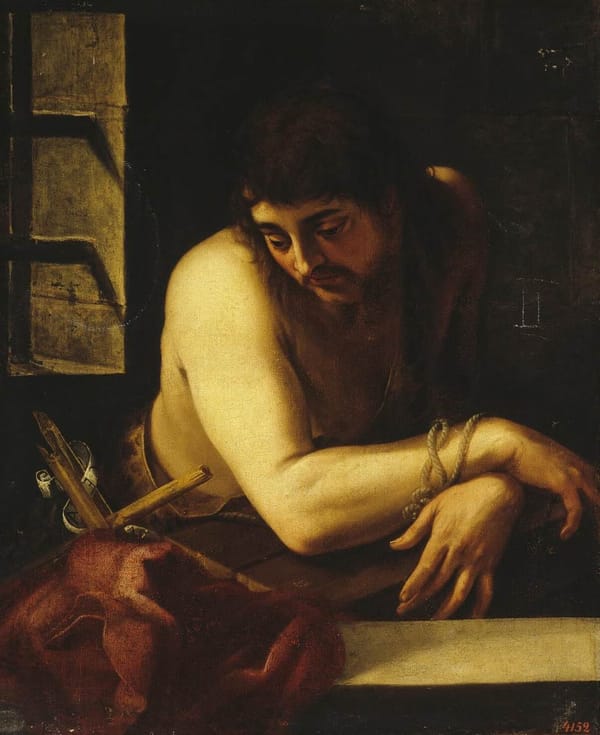
The Second Sunday of Advent
The Office of this Sunday is filled, from beginning to end, with the sentiments of hope and joy, with which the soul should be animated at the glad tidings of the speedy coming of Him who is her Saviour and Spouse. The interior coming, that which is effected in the soul, is the almost exclusive object of the Church’s prayers for this day: let us therefore open our hearts, let us prepare our lamps, and await in gladness that cry, which will be heard in the midnight: 'Glory be to God! Peace unto men!'
The Roman Church makes the Station to-day in the basilica of Holy-Cross-in-Jerusalem. It was in this venerable church that Constantine deposited a large piece of the true cross, together with the title which was fastened to it by Pilate’s order, and which proclaimed the kingly character of the Saviour of the world. These precious relics are still kept there; and, thus enriched with such a treasure, the basilica of Holy-Cross-in-Jerusalem is looked upon, in the Roman liturgy, as Jerusalem itself, as is evident from the allusions made in the several Masses of the Stations held in that basilica. In the language of the sacred Scriptures and of the Church, Jerusalem is the image of the faithful soul; and the Office and Mass of this Sunday have been drawn up on this idea, as the one of the day. We regret not to be able here to develop the sublime beauty of this figure; and must proceed at once to the passage, which the Church has selected from the prophet Isaias. There she tells her children how well founded are her hopes in the merciful and peaceful reign of the Messias. But first let us adore this divine Messias:
Cap. xiEt egredietur virga de radice Jesse, et flos de radice ejus ascendet. Et requiescet super eum Spiritus Domini, Spiritus sapientiæ et intellectus, Spiritus consilii et fortitudinis, Spiritus scientiæ et pietatis: et replebit eum Spiritus timoris Domini. Non secundum visionem oculorum judicabit, neque secundum auditum aurium arguet: sed judicabit in justitia pauperes, et arguet in æquitate pro mansuetis terræ. Et percutiet terram virga oris sui, et spiritu labiorum suorum interficiet impium. Et erit justitia cingulum lumborum ejus, et fides cinctorium renum ejus. Habitabit lupus cum agno, et pardus cum hœdo accubabit: vitulus et leo et ovis simul morabuntur, et puer parvulus minabit eos. Vitulus et ursus pascentur: simul requiescent catuli eorum: et leo quasi bos comedet paleas. Et delectabitur infans ab ubere super foramine aspidis: et in caverna reguli, qui ablactatus fuerit, manum suam mittet. Non nocebunt, et non occident in universo monte sancto meo: quia repleta est terra scientia Domini, sicut aquæ maris operientes. In die illa radix Jesse, qui stat in signum populorum, ipsum Gentes deprecabuntur, et erit sopulchrum ejus gloriosum.
Ch. xi.And there shall come forth a branch out of the rod of Jesse, and a flower shall rise up out of his root. And the Spirit of the Lord shall rest upon him, the Spirit of wisdom and of understanding, the Spirit of counsel and of fortitude, the Spirit of knowledge and of godliness: and he shall be filled with the Spirit of the fear of the Lord. He shall not judge according to the sight of the eyes, nor reprove according to the hearing of the ears: but he shall judge the poor with justice, and shall reprove with equity for the meek of the earth. And he shall strike the earth with the rod of his mouth, and with the breath of his lips he shall slay the wicked. And justice shall be the girdle of his loins, and faith the girdle of his reins. The wolf shall dwell with the lamb, and the leopard shall lie down with the kid: the calf and the lion and the sheep shall abide together, and a little child shall lead them. The calf and the bear shall feed: their young ones shall rest together: and the lion shall eat straw like an ox. And the suckling child shall play on the hole of the asp: and the weaned child shall thrust his hand into the den of the basilisk. They shall not hurt, nor shall they kill in all my holy mountain: for the earth is filled with the knowledge of the Lord, as the covering waters of the sea. In that day the root of Jesse, who standeth for an ensign of people, him the Gentiles shall beseech, and his sepulchre shall be glorious.
How much is contained in these magnificent words of the prophet! The branch; the flower that is to come from it; the Spirit which rests on this flower; the seven gifts of this Spirit; peace and confidence established on the earth; and, throughout the world, one brotherhood in the kingdom of the Messias! St. Jerome, whose words are read by the Church in the lessons of the second nocturn of this Sunday, says that the branch which cometh forth from the root of Jesse, is the blessed Virgin Mary, who had contact with no shrub or plant; and that the flower is the Lord Jesus, who says in the Canticle of canticles: 'I am the flower of the field, and the lily of the valley.’ In every age of the Christian Church, this wonderful branch and its divine flower have been objects of enthusiastic veneration. In the middle ages the tree of Jesse, with its prophetic branches, was carved on the cathedral porches, was painted on the windows, was embroidered on the hangings of the sanctuary, and the melodious voice of the priests sang its praises in the beautiful responsory composed by Fulbert of Chartres, and put to music by the devout king Robert.
The devout St. Bernard, commenting upon this responsory in his second Advent homily, says; 'The Virgin’s Son is the flower, a flower white and ruddy, chosen out of thousands; a flower on whom the angels love to look; a flower whose fragrance restores the dead; a flower, as himself assures us, of the field, not of a garden: for the flowers of the field bloom without man’s care, no man has sown their seed, no man has cultivated them. Just so the Virgin’s womb, a meadow verdant in an endless spring, has brought forth a flower, whose beauty will never droop, whose freshness will never fade. O Virgin, branch sublime, to what a height art thou grown! Even up to Him that sitteth on the throne, even to the Lord of majesty. It was sure to be so, for thou castest deep down the roots of humility. O plant of heaven indeed! precious above all, holier than all. O tree of life indeed! alone worthy to bear the fruit of salvation.’
And of the holy Spirit and His gifts, what shall we say? They rest and are poured out on the Messias only to the end that they may flow from Him upon us; He needs them not; but we alone need wisdom and understanding, counsel and fortitude, knowledge and godliness, and fear of the Lord. Let us ask with instance for this divine Spirit, by whose operation Jesus was conceived and born in Mary’s womb, and let us beg of Him to form Jesus within our hearts. But let us not forget to rejoice at those other glorious things which are told us by the prophet, of the happiness, and peace, and delights, which are to be on the holy mountain. The world has been looking so many ages for peace; it is now coming. Sin had caused enmity and division everywhere; grace will bring unity. A little Child will be the pledge of an alliance between all nations. The prophets have foretold it, the sibyl has announced it, and in Rome itself, buried as it is in paganism, the prince of Latin poets has sung the celebrated poem, which, after all, is but the voice of the old tradition: 'The last age foretold by the Cumean Sibyl, is at hand; a new race is being sent down to earth from high heaven. The flock shall no more fear the fierce lions. The serpent shall be no more: the treacherous plant, which yielded poison, shall grow no more.’*
Come then, O Messias, and restore to the world its primitive peace; but remember, we beseech Thee, that it is in the heart of man that harmony has been broken more than elsewhere in Thy creation: cure this heart, enter into possession of this Jerusalem, which Thou lovest, though so unworthy: she has been too long captive in Babylon; lead her out of this strange land. Build up her temple again, and make the glory of this second temple to be greater than that of the first, by having Thee to dwell in it, not in figure, but in the reality of Thy adorable Person. The angel said to Mary: 'The Lord God shall give unto thy Son the throne of David His father; and He shall reign in the house of Jacob for ever; and of His kingdom there shall be no end.’ What can we do, O Jesus, but say with Thy beloved disciple, at the close of his prophecy: 'Amen. Come, Lord Jesus!’
The Mass
The holy sacrifice commences with a song of triumph, addressed to Jerusalem. This song expresses the joy which will fill the heart of man, when he shall hear the voice of his God. It extols the goodness of that divine Shepherd, who looks on each of our souls as a sheep most dear to Him, so dear, indeed, that He will feed it with His own flesh.
The Introit
While the priest is approaching the altar, there to offer up the holy sacrifice, the Church opens her chants by this beautiful one, which so well expresses her confidence as the beloved bride of Jesus. Let us repeat it together with her, and let the heart be in harmony with our voice, for the Saviour comes to each of us in proportion to the earnestness of our longing for Him.
Collect
In the Collect, the priest lays stress on the great preparation we must make for the coming of our Saviour; we must have purity of heart.
The other Collects of the blessed Virgin, against the persecutors of the Church, and for the Pope, are the same as on the first Sunday in Advent, page 128.
Epistle
Cap. xv.Fratres, quæcumque scripta sunt, ad nostram doctrinam scripta sunt: ut per patientiam et consolationem Scripturarum, spem habeamus. Deus autem patientiæ et solatii det vobis idipsum sapere in alterutrum secundum Jesum Christum: ut unanimes uno ore honorificetis Deum, et Patrem Domini nostri Jesu Christi. Propter quod suscipite invicem, sicut et Christus suscepit vos in honorem Dei. Dico enim Christum Jesum ministrum fuisse circumcisionis propter veritatem Dei, ad confirmandas promissiones patrum. Gentes autem super misericordiam honorare Deum, sicut scriptum est: Propterea confitebor tibi in Gentibus Domine, et nomini tuo cantabo. Et iterum dicit: Lætamini Gentes cum plebe ejus. Et iterum: Laudate omnes Gentes Dominum: et magnificate eum omnes populi. Et rursum Isaias ait: Erit radix Jesse; et qui exsurget regere Gentes, in eum Gentes sperabunt. Deus autem spei repleat vos omni gaudio, et pace in credendo: ut abundetis in spe, et virtute Spiritus sancti.
Ch. xv.Brethren, what things soever were written, were written for our learning: that through patience and the comfort of the Scriptures, we might have hope. Now the God of patience and of comfort grant you to be of one mind one towards another, according to Jesus Christ: that with one mind and with one mouth you may glorify God and the Father of our Lord Jesus Christ. Wherefore receive one another as Christ also hath received you unto the honour of God. For I say that Christ Jesus was minister of the circumcision for the truth of God, to confirm the promises made unto the fathers. But that the Gentiles are to glorify God for his mercy, as it is written: Therefore will I confess to thee, O Lord, among the Gentiles, and will sing to thy name. And again he saith: Rejoice ye Gentiles with his people. And again: Praise the Lord all ye Gentiles, and magnify him all ye people. And again Isaias saith: There shall be a root of Jesse, and he that shall rise up to rule the Gentiles, in him the Gentiles shall hope. Now the God of hope fill you with all joy and peace in believing: that you may abound in hope, and in the power of the Holy Ghost.
Here, Christians, is your instruction; be patient, be firm in hope, and you shall delight in the God of peace who is coming to you. But take heed, you must have cordial charity one for the other; it is the mark of the children of God. The prophet tells us that the Messias will make even wolf and lamb dwell together; and now we have the apostle showing us how this same Christ brings Jews and Gentiles into the one same family. Glory to this sovereign King, the powerful offspring of the root of Jesse, who now bids us hope in Him! Listen to the Church, she again tells us that He is about to show Himself in Jerusalem.
Gradual
Gospel
Cap. xi.In illo tempore: Cum audisset Joannes in vinculis opera Christi, mittens duos de discipulis suis, ait illi: Tu es, qui venturus es, an alium exspectamus? Et respondens Jesus ait illis: Euntes renuntiate Joanni quæ audistis, et vidistis. Cæci vident, claudi ambulant, leprosi mundantur, surdi audiunt, mortui resurgunt, pauperes evangelizantur: et beatus est, qui non fuerit scandalizatus in me. Illis autem abeuntibus, cœpit Jesus dicere ad turbas de Joanne: Quid existis in desertum videre? Arundinem vento agitatam? Sed quid existis videre? Hominem mollibus vestitum? Ecce qui mollibus vestiuntur, in domibus regum sunt. Sed quid existis videre? prophetam? Etiam dico vobis, et plus quam prophetam. Hic est enim de quo scriptum est: Ecce ego mitto angelum meum ante faciem tuam, qui præparabit viam tuam ante te.
Ch. xi.At that time: When John had heard in prison the works of Christ, sending two of his disciples, he said to him: Art thou he that art to come, or look we for another? And Jesus making answer, said to them: Go and relate to John what you have heard and seen. The blind see, the lame walk, the lepers are cleansed, the deaf hear, the dead rise again, the poor have the Gospel preached to them s and blessed is he that shall not be scandalized in me. And when they went their way, Jesus began to Bay to the multitude, concerning John: What went you out into the desert to see? A reed shaken with the wind? But what went you out to see? A man clothed in soft garments? Behold they that are clothed in soft garments are in the houses of kings. But what went you out to see? A prophet? Yea, I tell you, and more than a prophet. For this is he of whom it is written: Behold, I send my angel before thy face, who shall prepare thy way before thee.
Thou art He that was to come, O Jesus! We look for no other. We were blind, Thou hast enlightened us; we were lame, Thou hast made us walk; the leprosy of sin disfigured us, Thou hast cleansed us; we were deaf to Thy words, Thou hast given us hearing; we were dead in sin, Thou hast given us life again; we were poor and had none to care for us, Thou hast come to us with every aid and consolation. These have been, and will again be, the blessings of Thy visit to our souls, O Jesus! A visit, silent but wonderful in its work; which flesh and blood cannot understand, but which faithful hearts feel is granted them. Come, my Saviour, come to me, Thy condescension, and familiarity with such poverty as mine, shall not scandalize me; Thy workings in the souls of men are proof enough that Thou art God. He alone, that created souls, can heal them.
After the symbol of faith has been chanted, when you see the priest is about to make the offering of the bread and wine, unite with the Church in asking to be filled with life by the divine Guest, who is so soon to be with her.
Offertory
During the offering of the bread and wine, the Church, with her look steadfastly fixed on Him who is to come, keeps to her sweet canticle:
Secret
The other Secrets of the blessed Virgin, against the persecutors of the Church, and for the Pope, are the same as on the first Sunday in Advent, page 132.
Communion
After the Communion of the priest and people, the choir sings these beautiful words of David in praise of the sweetness of the divine Fruit, whom our earth is going to bring forth, and who has just given Himself, by anticipation, to His faithful servants. This earth, which is ours, and which, as the prophet Isaias says, opens and buds forth the Saviour, is the blessed Virgin Mary made fruitful by the dew of heaven.
Postcommunion
In the following prayer the Church explains in what consists that high standing to which she has just invited Jerusalem: love of the things of heaven whence comes her Saviour, and contempt of earthly things which, when loved, separate man from God.
The other Postcommunions of the blessed Virgin, against the persecutors of the Church, and for the Pope, are the same as on the first Sunday in Advent, page 134.
Vespers
5. Ant. Ecce Dominus noster cum virtute veniet, et illuminabit oculos servorum suorum, alleluia.
5. Ant. Behold our Lord will come with power, and will enlighten the eyes of his servants, alleluia.
Chapter
Rom. xv. 4.
The hymn, Creator alme siderum, the verse Rorate and the canticle Magnificat, are given on pages 107 and 109.
Antiphon of the Magnificat
Collect
* Ultima Cumæi venit jam carminis ætas ....
Jam nova progenies cœlo demittitur alto ....
.... Nec magnos metuent armenta leones ....
Occidet et serpens, et fallax herba veneni
Occidet.... (Virgil. Elog. iv.) ↩︎
December 6: St. Nicholas, Bishop of Myra and Confessor
Divine Wisdom has willed that on the way which leads to the Messias, our great High Priest, there should be many pontiffs to pay Him the honour due to Him. Two Popes, St. Melchiades and St. Damasus; two holy doctors, St. Peter Chrysologus and St. Ambrose; two bishops, St. Nicholas and St. Eusebius; these are the glorious pontiffs who have been entrusted with the charge of preparing, by their prayers, the way of the Christian people towards Him, who is the sovereign Priest according to the order of Melchisedech. As each of their feasts comes we will show their right to have been thus admitted into the court of Jesus. To-day the Church celebrates with joy the feast of the great thaumaturgus Nicholas, who is to the Greek Church what St. Martin is to us. The Church of Rome has honoured the name of Nicholas for nearly a thousand years. Let us admire the wonderful power which God gave him over creation; but let us offer him our most fervent congratulations for that he was permitted to be one of the three hundred and eighteen bishops, who proclaimed, at Nicæa, that the Word is consubstantial with the Father. The humiliations of the Son of God did not scandalize him. Neither the lowliness of the flesh, which the sovereign Lord of all things assumed to Himself in the womb of the Virgin, nor the poverty of the crib, hindered him from confessing the Son of Mary to be Son of God, equal to God; and for this reason, God has glorified this His servant, and given him the power to obtain, each year, for the children of the Church, the grace of receiving this same Jesus, the Word, with simple faith and fervent love. Let us now listen to the eulogy of St. Nicholas, which the Roman Church has inserted in her liturgy.
Almost all the breviaries of the Latin Church, up to the seventeenth century, contain most fervent praises of the virtues and miracles of St. Nicholas, and give the beautiful Office of the holy bishop, which was composed about the twelfth century. We have spoken elsewhere of this Office as regards the music; at present we will only mention its being drawn up exclusively on the Acts of St. Nicholas, and its being more explicit on some circumstances of the saint’s life than is the legend of the Roman breviary. The following portions of this Office dwell with complacency on a fact which is not mentioned in our liturgy: we mean the miraculous oil, which, for almost eight hundred years, has flowed without ceasing from the tomb of the holy bishop, and by means of which God has frequently wrought miracles. The responsory and antiphon which we give are upon the miracle of the oil itself. They were formerly so familiar to the faithful, that in the thirteenth century their music was sung to the responsory Unus Panis, and to the antiphon O quam suavis est, of the Office of Corpus Christi.
Responsory
Antiphon
Hymn I
Præsulis praeconium,
Ut nos summus Adonai,
Rex et Pater omnium,
Ad salutis portum trahi
Faciat per Filium.
Matris, ab infantia,
Quarta semel bibit illam,
Atque sexta feria;
Ne per lactis puer stillam
Solveret jejunia.
Nicolaus praesulis,
Pietatis ita rorem
Cunctis pluit populis,
Ut vix parem aut majorem
Habeat in sæculis.
Virgines prohibuit;
Far in fame, vas in mari,
Servat et distribuit;
Qui timebant naufragari,
Nautis opem tribuit.
Furtem qui commiserat;
Et Judæus baptizatur,
Furtumque recuperat;
Illi vita restauratur;
Hic ad fidem properat.
Decus, honor, gloria,
Plebem omnem, clerum totum,
Mentes, manus, labia,
Ad reddendum Deo votum,
Tua juvet gratia.
Virtus et victoria,
Quae det nobis ut beati
Nicolai gaudia
Assequamur laureati,
Post vitam in patria.
the praise of the pontiff Nicholas;
that so the sovereign Adonai,
the King and Father of all creatures,
may grant us to be brought by his Son,
to the port of salvation.
he took it but once
on each fourth and sixth feria,
nor would the child
break his fast
by one drop of milk.
Nicholas so abundantly
gave to all men the dew of piety,
that scarce could any age
find a better
or so good a pastor.
he distributes corn to the people in a famine;
he brings up from the depths of the sea a vase
that had fallen in;
he brings help to mariners
who were well nigh to shipwreck.
who had committed a theft;
the Jew is baptized and recovers
what had been stolen from him;
the one is restored to life;
the other is brought to the faith.
and honour, and glory of the priesthood!
help by thy gracious intercession
the whole people, the whole clergy;
that their minds, and hands, and lips,
may pay their tribute to our God.
to the most high Trinity!
May it give us to come, after this life,
with our laurel wreaths upon us,
to the joys which Nicholas the blessed
possesses in our country of heaven.
Hymn II
Nicolaum prædicet,
Læte promens vocis sonum
Clerus, et magnificet:
Se cor promptum, se cor pronum
Sono vocis ampliet.
Lingua, tribus, natio:
Orbis terræ, maris sinus,
Sexus et conditio;
Hospes, cives, peregrinus,
Pari psallat studio.
Cunctis beneficia
Præsul, cujus nomen abit
Numquam e memoria;
Quisque mœstus germinabit,
Florens sicut lilia.
Carnis spernens opera,
Nihil agens aut locutus,
Nisi salutifera;
Vinclis carnis absolutus,
Tandem scandit æthera.
Hoc præsenti sæculo,
Oleum declarat satis,
Quod manat de tumulo;
Et dat munus sanitatis
Imploranti populo.
Virtus et victoria,
Quæ det nobis ut beati
Nicolai gaudia
Assequamur laureati,
Post vitam in patria.
joyfully raise their voice in song,
and magnify Nicholas
the father and patron of the clergy;
and let their chants give fresh devotion
to their already fervent and docile heart.
and every tongue and tribe and nation;
let the sea, and land;
let all, whatever their sex or condition,
guest or citizen or stranger,
sing the praises of Nicholas with one like enthusiasm.
in the memory of men,
ever gave, gives, and will give favours to all;
he will make him,
who was pining away in grief,
bloom in joy as a lily.
he spurned the deeds of the flesh;
he did nothing and spoke nothing
but what was unto salvation:
and now, having been loosed from the bonds of the flesh,
he has mounted to the starry realms.
even in this very age,
is plainly enough manifested by the oil
which flows from his tomb,
giving to all people, that ask it,
the boon of health.
to the most high Trinity.
May it give us to come, after this life,
with our laurel wreaths upon us,
to the joys which Nicholas the blessed
possesses in our country of heaven.
It was impossible for Adam of Saint-Victor to remain silent in the praise of St. Nicholas. The Churches, in the middle ages, received from him the following beautiful sequence.
Sequence
Vocali concordia,
Ad beati Nicolai
Festiva solemnia.
Qui in cunis adhuc jacens,
Servando jejunia;
A papillis cœpit summa
Promereri gaudia.
Litterarum studia,
Alienus et immunis
Ab omni lascivia.
Felix Confessor,
Cujus fuit dignitatis
Vox de cœlo nuntia.
Præsulatus sublimatur
Ad summa fastigia.
Erat in ejus animo
Pietas eximia,
Et oppressis impendebat
Multa beneficia.
Tollitur infamia,
Atque patris earumdem
Levatur inopia.
Et contra fluctuum
Sævitiam luctantes,
Navi pene dissoluta;
In tanto positi
Periculo: clamantes
Voce dicunt omnes una:
O beate Nicolae,
Nos ad maris portum trahe
De mortis angustia.
Tu qui tot auxiliaris
Pietatis gratia.
Dum clamarent, nec incassum,
Ecce quidam, dicens: Adsum
Ad vestra præsidia.
Statim aura datur grata:
Et tempestas fit sedata,
Quieverunt Maria.
Ex ipsius tumba manat
Unctionis copia:
Quae infirmos omnes sanat
Per ejus suffragia.
Vitiorum in profundo
Jam passi naufragia,
Gloriose Nicolae,
Ad salutis portum trahe,
Ubi pax et gloria.
Impetres a Domino,
Prece pia:
Quæ sanavit læsionem
Multorum peccaminum
In Maria.
Gaudeant per sæcula;
Et coronet eos Christus
Post vitæ curricula.
let us exult
on this festive solemnity
of blessed Nicholas.
When a babe in his cradle,
he began to fast,
And thus deserved, before weaned from the breast,
the joys of heaven.
upon a course of studies,
Yet follows not,
yet knows not, impurity.
Blessed confessor indeed,
whose worth was known
by a message from heaven,
he was promoted and exalted
to the supreme dignity of pontiff.
There was in his soul
the most tender compassion,
which prompted him to bestow continual benefits
on those who suffered oppression.
from virgins by the gold he gave;
and by the same he relieved
their father’s poverty.
when a furious storm
attacked them,
and their bark was well-nigh wrecked:
and in this extreme danger,
they cry out
with one voice, saying:
‘O holy Nicholas!
help us out of these straits of death,
and lead us into harbour!
thou whose kind heart is ever ready
to help them that are in affliction.’
They prayed; nor was it in vain:
for lo! a voice was heard saying: ‘I am here
to help you.’
Straightway arose a favourable wind:
the storm was lulled:
the sea was calm.
From his tomb there flows
an abundant oil:
It heals all kinds of sickness,
through the intercession of the saint.
have already suffered
shipwreck in the sea of sin:
Ah! glorious Nicholas,
lead us into the harbour of salvation,
where there is peace and glory.
which thy merciful prayers
must get us from the Lord:
It is that unction
which healed the wound
of Magdalene’s many sins.
come to the eternal joys;
And may Jesus crown them
after this life is run.
But none of the sequences of St. Nicholas was so popular as the one we now give. It is to be found in a great many processionals up to the seventeenth century, and on its model were composed innumerable others, which, though drawn up in praise of various patrons, not only kept the measure and the melody, but the very expressions, ingeniously turned here and there, of the sequence of St. Nicholas.
Sequence
Olei perfusio.
Adfuit praesidio.
Defunctum in bivio.
Judæus indicio.
Redditur cum filio.
Farris augmentatio.
Ergo laudes Nicolao
Concinat hæc concio.
Propulsato vitio,
Sospes regreditur.
by the miraculous oil.
are delivered by Nicholas’ prayers.
a corpse which lay on the road.
on witnessing the miraculous recovery of his money.
and a child that was lost to his father, are both recovered.
by multiplying corn in a famine!
Let, then, this congregation
sing the hymns of Nicholas’ praise;
with earnest hearts,
will go back cured of their spiritual ailments.
But no Church has evinced such enthusiasm for St. Nicholas as the Greek Church in its Menæa. The illustrious thaumaturgus was evidently one of the firmest hopes of the Byzantine empire, and Constantinople transmitted the same confidence to Russia, which even to this day professes great devotion to St. Nicholas. We extract, as usual, a few stanzas from the sacred chants which the Church of St. Sophia anciently sang in the Greek language, and which the gilded domes of Moscow re-echo still, every year, in Slavonic.
Hymn to St. Nicholas
(Taken from the Menæa of the Greeks)
Holy pontiff Nicholas, how great is thy glory in God’s Church! Thou didst confess the name of Jesus before the proconsuls of the world’s empire and suffer persecution for His name’s sake; afterwards thou wast witness to the wonderful workings of God, when He restored peace to His Church; and a short time after this again, thou didst open thy lips, in the assembly of the three hundred and eighteen fathers, to confess with supreme authority the Divinity of our Saviour Jesus Christ, for whose sake so many millions of martyrs had already shed their blood. Receive the devout felicitations of the Christian people throughout the universe, who thrill with joy when they think of thy glorious merits. Help us by thy prayers during these days when we are preparing for the coming of Him, whom thou didst proclaim to be consubstantial with the Father, Vouchsafe to assist our faith and to obtain fresh fervour to our love. Thou now beholdest face to face that Word by whom all things were made and redeemed; beseech Him to permit our unworthiness to approach Him. Be thou our intercessor with Him. Thou hast taught us to know Him as the sovereign and eternal God; teach us also to love Him as the supreme benefactor of the children of Adam. It was from Him, O charitable pontiff, that thou didst learn that tender compassion for the sufferings of thy fellow-men, which made all thy miracles to be so many acts of kindness: cease not, now that thou art in the company of the angels, to have pity on us and to succour our miseries.
Stir up and increase the faith of mankind in the Saviour whom the Lord hath sent them. May this be one of the fruits of thy prayer, that the divine Word may be no longer unknown and forgotten in this world, which He has redeemed with His Blood. Ask for the pastors of the Church that spirit of charity, which shone so brilliantly in thee; that spirit which makes them like their divine Master, and wins them the hearts of their people.
Remember, too, O holy pontiff, that Church of the east which still loves thee so fervently. When thou wast on this earth, God gave thee power to raise the dead to life; pray now, that the true life, which consists in faith and unity, may return once more and animate that body which schism has robbed of its soul. By thy supplications, obtain of God that the sacrifice of the Lamb, who is so soon to visit us, may be again and soon celebrated under the cupolas of St. Sophia. May the sanctuaries of Kiew and Moscow become resanctified by the return of the people to unity. May the pride of the crescent be humbled into submission to the cross, and the schismatic be brought to acknowledge the power of the keys of St. Peter; that thus there may be henceforth neither Scythian, nor barbarian, but one fold under one Shepherd.
Let us resume our considerations upon the state of the world at the time immediately preceding the coming of the Messias. Everything proves that the prophecies which foretold the great event have now been fulfilled. Not only has the sceptre been taken from Juda; the weeks of Daniel also are almost expired. The other scriptural predictions relative to the great revolutions, which were to take place in the world, have been successively fulfilled. The empires of the Assyrians, the Medes, the Persians, and the Greeks, have fallen one after the other; that of the Romans is now at the zenith of its greatness; in its turn, it must yield to the eternal empire of the Messias. This succession of empires, which was to result in a perfect kingdom, was foretold; and all is now ready for its final accomplishment. God has also said, by one of His prophets: ‘Yet one little while, and I will move heaven and earth . . . and I will move all nations, and the Desired of all nations shall come.’* Descend, therefore, O Thou eternal Word! All is consummated. The misery of the world is extreme; the crimes of men cry to heaven for vengeance; the whole human race is threatened with self-destruction, and without knowing what it does, it calls for Thee as its only resource. Then come! All the predictions which were to designate the Redeemer have been spoken and promulgated. There is no longer a prophet in Israel, and the oracles of the Gentile world have ceased to speak. Come, Lord Jesus, and fulfil all things, for the fulness of time has come.
Prayer for the Time of Advent
(The Mozarabic breviary, first Sunday of Advent, Capitulum)
* Aggeus ii 7. 8. ↩︎
| Previous December 5: St. Sabas, Abbot | Next December 6: St. Nicholas, Bishop of Myra and Confessor |