Daily reading
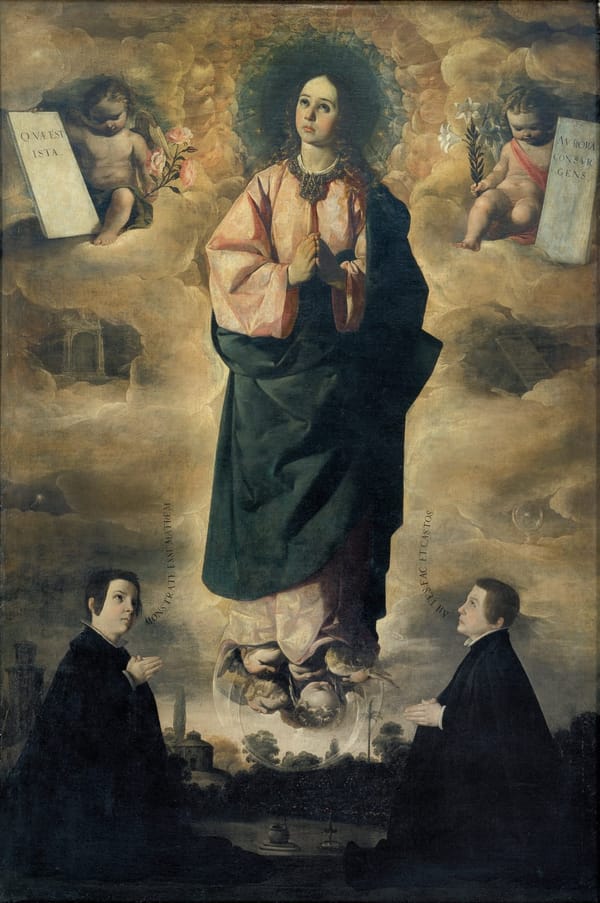
December 9: The Second Day within the Octave of the Immaculate Conception
Let us consider how the immaculate Mary came into this world nine months after her conception, and how each day of her life gave man fresh reason to hope for the great promises made him by God. Let us admire the fulness of grace which God has given to her, and contemplate the respect and the love wherewith the holy angels look upon her as the future Mother of Him who is to be their Head and King, as well as ours. Let us follow this august Queen to the temple of Jerusalem, where she is presented by her parents, St. Joachim and St. Anne. When but three years of age, she was initiated into all the secrets of divine love. 'I always rose at midnight (thus she spoke of herself, in a revelation to St. Elizabeth of Hungary), and went before the altar of the temple, where I besought of God that I might observe all the commandments of His Law, and be enriched with those graces which would render me pleasing to His Majesty. I most earnestly prayed Him, that I might live to see that most holy virgin who was to bring forth into this world His own divine Son. I asked Him to grant me to enjoy the use of my eyes that I might see her, of my tongue that I might praise her, of my hands that I might serve her, of my feet that I might go her errands, and of my knees that I might adore the Son of God resting in her arms.’
Thou, O Mary, thou thyself wast this Virgin, who was worthy of the praises of men and angels! But God had not yet revealed it to thee, and thy heavenly humility forbade thy thinking that the immense dignity, which thou didst so deeply venerate, could ever be thine. Nay, thou wast the first and the only one of the daughters of Israel that had renounced all hope of ever being the Mother of the Messias. To be Mother of the Messias was, indeed, an ineffable honour; but it seemed as though it could only be received on the condition of having another spouse besides God, and this thou wouldst not suffer; thou wouldst be united to God alone, and thy vow of virginity which made thee so, was dearer to thee than the possibility of any privilege, which would rob thee of even a tittle of that. Thy marriage with St. Joseph, therefore, was a fresh lustre added to thy incomparable purity, whilst, in the designs of God, it provided thee with the protection which thy coming honours would soon require. We follow thee, O bride of Joseph, into thy house at Nazareth, where is to be spent thy humble life. There we behold thee diligent in all thy duties, the valiant woman of the Scriptures,1 the object of the admiration of God and of His angels. Suffer us, O Mary! to unite our Advent devotions with the prayers which thou didst offer up for the coming of the Messias; with the veneration wherewith thou didst think upon her that was to be His Mother; and with the inflamed desires wherewith thou didst long for the divine Saviour. We salute thee as the Virgin2 foretold by Isaias; it is thyself, O blessed Mother, that deservest the praise and love of the holy people and city, the redeemed of the Lord.3
Sequence (Taken from the Cluny Missal of 1523)
Genitricem gratiæ,
Salutis dulcedinem,
Fontem Sapientiæ.
Regina prudentiæ,
Virgo plena gratia,
Aurora laetitiae.
Castitatis lilium;
Jaspide splendidior,
Mœroris solatium.
Fidei principium.
Mater admirabilis,
Vas virtutis pretium.
Mater honestissima,
Odor nardi pretiosi,
Rosa suavissima.
Stella fulgentissima,
Generosa Mater, gaude,
Virginum sanctissima.
Regina consilii,
Peperisti florem florum,
Christum fontem gaudii.
Donatrix auxilii,
Memor esto miserorum,
In die judicii.
Charitatis regula,
Victoris stipendium,
Aromatum cellula.
Virgo sine macula,
Honor et imperium,
Per aeterna saecula.
the Mother of grace,
the sweetness of salvation,
the fount of Wisdom.
the Queen of prudence,
the Virgin full of grace,
the aurora of joy.
the lily of chastity;
she is brighter than the jasper,
our solace in sorrow.
source whence came the author of our faith,
Mother most admirable,
precious vessel of virtue.
Mother of the beautiful King;
thou art the perfume of precious ointment;
thou art the sweetest rose.
O brightest of stars,
O noblest of mothers,
O Virgin most holy!
and Queen of counsel,
didst bring forth the flower of flowers,
Jesus the source of our joy.
help of the needy,
be mindful of us sinners
on the day of judgement.
the model of charity,
the encouragement to victory,
the treasury of every fragrance.
immaculate Virgin,
be queenly honour
for ever.
Prayer from the Gregorian Sacramentary
(In the daily Prayers for Advent)
Wednesday of the Second Week of Advent
Cap. xvi.Emitte Agnum Domine, dominatorem terræ, de petra deserti ad montem filiæ Sion. Et erit: sicut avis fugiens, et pulli de nido avolantes, sic erunt filiae Moab in transcensu Arnon. Ini consilium, coge concilium, pone quasi noctem umbram tuam in meridie: absconde fugientes, et vagos ne prodas. Habitabunt apud te profugi mei: Moab, esto latibulum eorum a facie vastatoris. Finitus est enim pulvis, consummatus est miser, defecit qui conculcabat terram. Et praeparabitur in misericordia solium, et sedebit super illud in veritate, in tabernaculo David, judicans et quaerens judicium, et velociter reddens quod justum est.
Ch. xvi.Send forth, O Lord, the Lamb, the ruler of the earth, from Petra of the desert to the mount of the daughter of Sion. And it shall come to pass, that as a bird fleeing away, and as young ones flying out of the nest, so shall the daughters of Moab be in the passage of Arnon. Take counsel, gather a council, make thy shadow as the night in the midday: hide them that flee, and betray not them that wander about. My fugitives shall dwell with thee: O Moab, be thou a covert to them from the face of the destroyer. For the dust is at an end, the wretch is consumed, he hath failed that trod the earth under foot. And a throne shall be prepared in mercy, and one shall sit upon it in truth in the tabernacle of David, judging and seeking judgement, and quickly rendering that which is just.
Send forth to us, O Lord, the Lamb: 'It is the Lamb,’ says Peter of Celles,' it is the Lamb we need, and not the Lion; the Lamb that knows no anger, and whose meekness is never ruffled; the Lamb that will give us His snow-white wool to warm our coldness, and cover our nakedness; the Lamb that will give us His flesh to eat, lest we faint with hunger on the way. Send Him full of wisdom, for in His divine prudence He will vanquish the spirit of pride; send full of strength, for it is written that the Lord is strong and mighty in battle; send Him full of meekness, for He is to come down as dew that falls on the fleece; send Him as a victim, for He is to be sold and immolated for our ransom; send Him the pardoner of sinners, for He is to come to call them, and not the just; send Him to receive power and divinity, for He is worthy to loose the seven seals of the sealed book, the unspeakable mystery of the Incarnation.’* Thou art King, then, O divine Lamb! Thou art even now, in thy Mother’s womb, the sovereign Ruler. This virginal womb is a throne of mercy whereon Thou art seated in humility, ready to avenge our rights and confound our cruel enemy. O most dear King! our eyes cannot yet behold Thee, but our hearts tell us Thou art near us. We know that it is for our sake that Thou hast put on this strange royalty. Suffer us to approach Thee, and offer Thee our homage and loyalty, even now that a cloud hides Thee from our sight. . A few days more, and Thou wilt be seated on another throne, Thy Mother’s arms, and then all the earth will see the salvation that is sent unto it.
Hymn taken from the Anthology of the Greeks
(December 20)
Prayer from the Mozarabic Missal
(Second Sunday of Advent)
* Third Sermon for Advent. ↩︎
| Previous Tuesday of the Second Week of Advent | Next Wednesday of the Second Week of Advent |