Daily reading
Christmas
Double of the II Class · December 27 · Sanctoral
December 27, 2020
From Dom Guéranger’s The Liturgical Year.

|
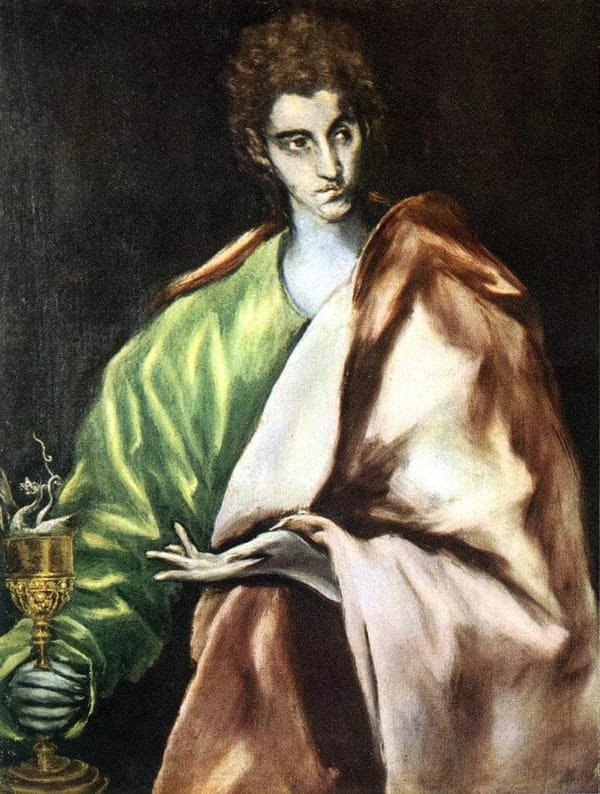
December 27: St. John, Apostle and Evangelist
NEAREST to Jesus' Crib, after Stephen, stands John, the Apostle and Evangelist. It was only right that the first place should be assigned to him, who so loved his God that he shed his blood in his service; for, as this God himself declares, greater love than this hath no man, that he lay down his life for his friends,1 and Martyrdom has ever been counted by the Church as the greatest act of love, and as having, consequently, the power of remitting sins, like a second Baptism. But next to the sacrifice of Blood, the noblest, the bravest sacrifice, and that which most wins the heart of him who is the Spouse of souls, is the sacrifice of Virginity. Now just as St Stephen is looked upon as the type of Martyrs, St John is honoured as the Prince of Virgins. Martyrdom won for Stephen the Crown and palm; Virginity merited for John most singular prerogatives, which, while they show how dear to God is holy Chastity, put this Disciple among those who by their dignity and influence are above the rest of men.
St John was of the family of David, as was our Blessed Lady. He was consequently a relation of Jesus. This same honour belonged to St James the Greater, his brother; as also to St James the Less and St Jude, both sons of Alpheus. When our Saint was in the prime of his youth, he left not only his boat and nets, not only his Father Zebedee, but even his betrothed, when everything was prepared for the marriage. He followed Jesus, and never once looked back. Hence the special love which our Lord bore him. Others were Disciples or Apostles, John was the Friend of Jesus. The cause of this our Lord's partiality was, as the Church tells us in the Liturgy, that John had offered his Virginity to the Man-God. Let us, on this his Feast, enumerate the graces and privileges that came to St John from his being the Disciple whom Jesus loved.
This very expression of the Gospel, which the Evangelist repeats several times—The Disciple whom Jesus loved2—says more than any commentary could do. St Peter, it is true, was chosen by our Divine Lord to be the Head of the Apostolic College, and the Rock whereon the Church was to be built: he, then, was honoured most; but St John was loved most. Peter was bid to love more than the rest loved, and he was able to say, in answer to Jesus' thrice repeated question, that he did love him in this highest way: and yet, notwithstanding, John was more loved by Jesus than was Peter himself, because his Virginity deserved this special mark of honour.
Chastity of soul and body brings him who possesses it into a sacred nearness and intimacy with God. Hence it was that at the Last Supper—that Supper which was to be renewed on our Altars to the end of the world, in order to cure our spiritual infirmities and give life to our souls—John was placed near to Jesus, nay, was permitted, as the tenderly loved Disciple, to lean his head upon the Breast of the Man-God. Then it was that he was filled, from their very Fountain, with Light and Love: it was both a recompense and a favour, and became the source of two signal graces, which make St John an object of special reverence to the whole Church.
Divine wisdom wishing to make known to the world the Mystery of the Word, and commit to Scripture those profound secrets which, so far, no pen of mortal had been permitted to write, the task was put upon John. Peter had been crucified, Paul had been beheaded, and the rest of the Apostles had laid down their lives in testimony of the Truths they had been sent to preach to the world; John was the only one left in the Church. Heresy had already begun its blasphemies against the Apostolic Teachings; it refused to admit the Incarnate Word as the Son of God, Consubstantial to the Father. John was asked by the Churches to speak, and he did so in language heavenly above measure. His Divine Master had reserved to this his Virgin-Disciple the honour of writing those sublime Mysteries which the other Apostles had been commissioned only to teach—the Word was God, and this Word was made Flesh for the salvation of mankind. Thus did our Evangelist soar, like the Eagle, up to the Divine Sun, and gaze upon him with undazzled eye, because his heart and senses were pure, and therefore fitted for such vision of the uncreated Light. If Moses, after having conversed with God in the cloud, came from the divine interview with rays of miraculous light encircling his head: how radiant must have been the face of St John, which had rested on the very Heart of Jesus, in whom are hid all the treasures of wisdom and knowledge!3 how sublime his writings! how divine his teaching! Hence the symbol of the Eagle, shown to the Prophet Ezechiel,4 and to St John himself in his Revelations,5 has been assigned to him by the Church: and to this title of The Eagle has been added, by universal tradition, the other beautiful name of Theologian.
This was the first recompense given by Jesus to his Beloved John—a profound penetration into divine Mysteries. The second was the imparting to him of a most ardent charity, which was equally a grace consequent upon his angelic purity, for purity unburdens the soul from grovelling egotistic affections, and raises it to a chaste and generous love. John had treasured up in his heart the Discourses of his Master: he made them known to the Church, and especially that divine one of the Last Supper, wherein Jesus had poured forth his whole Soul to his own, whom he had always tenderly loved, but most so at the end.6 He wrote his Epistles, and Charity is his subject: God is Charity—he that loveth not, knoweth not God—perfect Charity casteth out fear—and so on throughout, always on Love. During the rest of his life, even when so enfeebled by old age as not to be able to walk, he was for ever insisting upon all men loving each other, after the example of God, who had loved them and so loved them! Thus, he that had announced more clearly than the rest of the Apostles the divinity of the Incarnate Word, was par excellence the Apostle of that divine Charity which Jesus came to enkindle upon the earth.
But our Lord had a further gift to bestow, and it was sweetly appropriate to the Virgin-Disciple. When dying on his cross, Jesus left Mary upon this earth. Joseph had been dead now some years. Who then shall watch over his Mother? who is there worthy of the charge? Will Jesus send his Angels to protect and console her? for, surely, what man could ever merit to be to her as a second Joseph? Looking down, he sees the Virgin-Disciple standing at the foot of the Cross: we know the rest, John is to be Mary’s Son: Mary is to be John’s Mother. Oh! wonderful Chastity, that wins from Jesus such an inheritance as this! Peter, says St Peter Damian, shall have left to him the Church, the Mother of men; but John shall receive Mary, the Mother of God, whom he will love as his own dearest Treasure, and to whom he will stand in Jesus’ stead; whilst Mary will tenderly love John, her Jesus’ Friend, as her Son.
Can we be surprised after this, that St John is looked upon by the Church as one of her greatest glories? He is a Relative of Jesus in the flesh; he is an Apostle, a Virgin, the Friend of the Divine Spouse, the Eagle, the Theologian, the Son of Mary; he is an Evangelist, by the history he has given of the Life of his Divine Master and Friend; he is a Sacred Writer, by the three Epistles he wrote under the inspiration of the Holy Ghost; he is a Prophet, by his mysterious Apocalypse, wherein are treasured the secrets of time and eternity. But is he a Martyr? Yes, for if he did not complete his sacrifice, he drank the Chalice of Jesus,7 when, after being cruelly scourged, he was thrown into a caldron of boiling oil before the Latin Gate at Rome. He was therefore a Martyr in desire and intention, though not in fact. If our Lord, wishing to prolong a life so dear to the Church, as well as to show how he loves and honours Virginity, miraculously stayed the effects of the frightful punishment, St John had, on his part, unreservedly accepted Martyrdom.
Such is the companion of Stephen at the Crib, wherein lies our Infant Jesus. If the Protomartyr dazzles us with the robes he wears of the bright scarlet of his own blood; is not the virginal whiteness of John’s vestment fairer than the untrod snow? The spotless beauty of the Lilies of Mary’s adopted Son, and the bright vermilion of Stephen’s Roses—what is there more lovely than their union? Glory, then, be to our New-Born King, whose court is tapestried with such heaven-made colours as these! Yes, Bethlehem’s Stable is a very heaven on earth, and we have seen its transformation. First we saw Mary and Joseph alone there: they were adoring Jesus in his Crib; then, immediately, there descended a heavenly host of Angels singing the wonderful Hymn; the Shepherds soon followed, the humble, simple-hearted Shepherds; after these entered Stephen the Crowned, and John the Beloved Disciple; and even before there enters the pageant of the devout Magi, we shall have others coming in, and there will be each day grander glory in the Cave, and gladder joy in our hearts. Oh! this birth of our Jesus! Humble as it seems, yet how divine! What King or Emperor ever received in his gilded cradle, honours like these shown to the Babe of Bethlehem? Let us unite our homage with that given him by these the favoured inmates of his court. Yesterday the sight of the Palm in Stephen’s hand animated us, and we offered to our Jesus the promise of a stronger Faith: to-day the Wreath that decks the brow of the Beloved Disciple breathes upon the Church the heavenly fragrance of Virginity: an intenser love of Purity must be our resolution, and our tribute to the Lamb.
Mass
The Church commences her chants of the holy Sacrifice with words taken from the Book of Ecclesiasticus, which she applies to St John. Our Lord has proclaimed his mysteries to the Church by the teaching of his Beloved Disciple. He favoured him with his divine intimacy, which filled him with the spirit of wisdom. He clad him with a robe of glory, in reward for his virginal purity.
Introit
In the Collect the Church asks for the Light, that is for the Word of God, of whom St John was the propagator by his sublime writings. She aspires to the eternal possession of this Emmanuel who is come to enlighten the world, and who has revealed to his Beloved Disciple the secrets of heaven.
Collect
Commemoration of Christmas Day
Epistle
Eccli. cap. XV.
The Wisdom here spoken of is Jesus the Eternal Word, who came to St John and called him to the Apostolate. The Bread of life wherewith she fed him is the divine Bread of the Last Supper, the Body and Blood of Jesus; the wholesome Water is that promised by our Saviour to the Samaritan Woman, of which St John drank so abundantly from its very source when he rested his head on the Heart of Jesus. The immovable Strength is the Saint’s close and resolute custody of the treasure of his Virginity, and the courageous profession of the religion of Christ before the Proconsuls of Domitian. The Treasure which Wisdom heaped upon him is the magnificence of the prerogatives granted to him. Lastly, the everlasting Name is that glorious title given him of John the Beloved Disciple.
Gradual
Gospel
Cap. XXI. In illo tempore, dixit Jesus Petro: Sequere me. Conversus Petrus vidit illum discipulum quem diligebat Jesus sequentem, qui et recubuit in cœna super pectus ejus, et dixit: Domine, quis est qui tradet te? Hunc ergo cum vidisset Petrus, dixit Jesu: Domine, hic autem quid? Dicit ei Jesus: Sic eum volo manere donec veniam, quid ad te? Tu me sequere. Exiit ergo senno iste inter fratres, quia discipulus ille non moritur. Et non dixit ei Jesus: Non moritur; sed: Sic eum volo manere donec veniam, quid ad te? Hic est discipulus ille, qui testimonium perhibet de his, et scripsit hæc; et scimus quia verum est testimonium ejus.
Ch. XXI. At that time: Jesus said to Peter: Follow me. Peter turning about, saw that Disciple whom Jesus loved following, who also leaned on his breast at supper, and said: Lord, who is he that shall betray thee? Him therefore, when Peter had seen, he saith to Jesus: Lord, and what shall this man do? Jesus saith to him: So I will have him to remain till I come, what is it to thee? Follow thou me. This saying, therefore, went abroad among the brethren, that that Disciple should not die. And Jesus did not say to him: He should not die; but: So I will have him to remain till I come, what is it to thee? This is that Disciple who giveth testimony of these things, and hath written these things; and we know that his testimony is true.
This passage of the holy Gospel has been much commented upon. Some of the Fathers and Commentators interpret it as signifying that St John was to be exempt from death, and that he is still living in the flesh, awaiting the coming of the Judge of the living and the dead. It is certain that this opinion regarding our Apostle has been entertained; and one of the arguments in its favour was this very passage. But the general opinion of the Holy Fathers is that nothing further is implied by it than the difference between the two vocations of St Peter and St John. The former shall follow his divine Master, by dying, like him, on a cross; the latter shall remain—he shall live to a venerable old age—and at length Jesus shall come and take him out of this world by sending him a sweet and peaceful death.
During the Offertory, the Church makes a remembrance of the flourishing Palms which grew up around the Beloved Disciple; she tells us of the spiritual children he had trained, and of the Churches he had founded; all which, like young cedars round the venerable parent-tree on Libanus, multiplied under the fostering care of their Father.
Offertory
Secret
Commemoration of Christmas Day
The Preface as on page 64: but on the Octave-Day it is as below.8
The mysterious words of the Gospel are repeated in the Communion, that is, at the moment when Priest and people have partaken of the Victim of salvation; they convey this teaching—that he who eats of this Bread, though he must die the death of the body, will yet live for the coming of the supreme Judge and Rewarder.
Communion
Postcommunion
Commemoration of Christmas Day
Vespers
The Antiphons and Psalms are sung as yesterday, the Feast of St Stephen: they are given on page 210. After the last Psalm, the Office of St John is resumed, commencing as follows:
Capitulum (Ecclus. xv)
Hymn[9]
Cœlum resultet laudibus;
Apostolorum gloriam
Tellus et astra concinunt.
Et vera mundi lumina:
Votis precamur cordium,
Audite voces supplicum.
Serasque verbo solvitis,
Nos a reatu noxios
Solvi jubete, quæsumus.
Languor salusque sentiunt;
Sanate mentes languidas,
Augete nos virtutibus.
In fine Christus sæculi,
Nos sempiterni gaudii
Concedat esse compotes.
Qui natus es de Virgine:
Cum Patre et almo Spiritu
In sempiterna sæcula.
let the heavens re-echo with praise:
the glory of the Apostles
is sung by both earth and heaven.
and the true Lights of the earth!
we pray to you with all earnestness of heart:
hear the prayers of your clients.
by your word, to shut and open
the gates of heaven: we beseech you,
loosen us from the bonds of sin.
do your bidding;
oh! heal our languid souls,
bring us growth in virtue;
shall come again at the end of the world,
he may grant us to be
partakers of neverending bliss.
that wast born of the Virgin!
and to the Father, and to the Spirit of love,
for everlasting ages.
Antiphon of the Magnificat
Ecclesiam tuam, Domine, benignus illustra, ut beati Joannis Apostoli tui et Evangelistæ illuminata doctrinis, ad dona perveniat sempiterna. Per Dominum.
Mercifully, O Lord, enlighten thy Church; that being taught by blessed John, thine Apostle and Evangelist, she may come to thy eternal rewards. Through, etc.
Commemoration of the Holy Innocents
℣. Herodes iratus occidit multos pueros.
℣. Herod, being angry, killed many children.
Commemoration of Christmas Day
℣. The Lord hath made known, alleluia.
Now let us listen to the several Churches, proclaiming in their liturgical praises the glory of St John. We begin with the Church of Rome, from which we take this beautiful Preface of the Leonine Sacramentary.
Preface
The Church of Milan, in her Ambrosian Missal, thus sings forth the praises of the Beloved Disciple:
The Mozarabic Missal has the following prayer to our holy Apostle and Evangelist:
Prayer
The following Hymn, which we have taken from the Milan Liturgy, is attributed to St Ambrose; it certainly bears a resemblance to his style—sublime thoughts, majestically told.
Hymn
Et filius Tonitrui,
Arcana Joannes Dei
Fatu revelavit sacro.
Patris senectam pascere;
Turbante dum natat salo
Immobilis fide stetit.
Piscatus est Verbum Dei;
Jactavit undis retia,
Vitam levavit hominum.
Mundi supernatans salum,
Subnixa Christi pectore,
Sancto locuta Spiritu:
Et Verbum erat apud Deum,
Et Deus erat Verbum. Hoc erat
In principio apud Deum.
Sed ipse laude resonet;
Et laureatus Spiritu,
Scriptis coronetur suis.
Cruorque delictum lavans;
Hoc morte præstat Martyrum
Quod fecit esse Martyres.
Calente olivo dicitur
Tersisse mundi pulverem,
Stetisse victor æmuli.
Qui natus es de Virgine;
Cum Patre et Sancto Spiritu
In sempiterna sæcula.
named by him the Son of Thunder,
revealed in sacred words
the hidden things of God.
and supported his aged parent by his toil:
whilst sailing on the troubled waves, he received the faith,
and firmly did he hold to it.
and takes the Word of God;
he lets down his nets into the waters,
he draws in him who is the Light of the world.
which swam through the briny flood of this world;
it rested on the Breast of Christ,
and thus spoke in the Holy Spirit:
and the Word was with God,
and the Word was God.
The same was in the beginning with God.
Then let us sing the praises of this Disciple,
and since he bears the laurels of the Spirit,
let his writings be his crown.
and this shedding of their own blood purifies them from every sin;
but John did what was better than Martyrdom:
he taught to the world that which made the Martyrs.
and plunged into boiling oil;
it did but cleanse him from this world's dust,
and give him victory over the enemy.
that wast born of the Virgin!
and to the Father, and to the Holy Ghost,
for everlasting ages.
We will now give a few stanzas from the Hymns which the Greek Church, in her accustomed pomp of language, sings in honour of St John. She keeps his Feast on September 26.
XXVI Septembris, in magno Vespertino, et passim
Lyra a Deo mota cœlestium odarum, mysticus ille scriptor, os divina loquens, Canticum canticorum dulciter decantat, et precatur salvari nos.
This heaven-hymned Harp attuned by God, this mystic writer, this mouth that speaks divine things, is now sweetly singing the Canticle of Canticles, and prays for our salvation.
As usual, we will close these liturgical praises of our dear Saint by a Prose of the Western Churches in the Middle Ages, which we have taken from the collection of the Monastery of St Gall. It was composed by Blessed Notker, and was for centuries in the Roman-French Missals.
Sequence
Multum dilecte virgo.
Parentem liquisti.
Pectus respuisti,
Ut ejus pectoris Sacra meruisses Fluenta potare.
Gloriam conspexisti Filii Dei,
Contuenda esse perenni.
Matri suæ dedit custodem;
Virginem servares, Atque curam suppeditares.
Testimonio pro Christo Es gavisus.
Venenum forte vincis.
Præ cæteris Verbum suum Pater revelat.
Apud Deum Semper commenda, Joannes, Christi care.
Beloved Virgin Disciple of Jesus!
leave thy father Zebedee and his boat.
the caresses of thy young betrothed,
That thou mightest merit to drink at the sacred fount of his heart.
didst behold the transfiguration of the Son of God,
is not granted save to the Saints in life eternal.
entrusted his Mother to thy keeping;
mightest protect and care for the Virgin in his stead.
thou didst rejoice, for it was thy bearing testimony to Christ.
breakest the poison's power.
the Almighty Father reveals his own embosomed Word.
O John, Disciple dear to Christ!
Beloved Disciple of the Babe of Bethlehem! how great is thy happiness! how wonderful is the reward given to thy love and thy purity! In thee was fulfilled that word of thy Master: Blessed are the clean of heart; for they shall see God. Not only didst thou see this God-Man: thou wast his Friend, and on his Bosom didst rest thy head. John the Baptist trembles at having to bend the head of Jesus under the water of Jordan; Magdalen, though assured by his own lips that her pardon was perfect as her love, yet dares not raise her head, but keeps clinging to his feet; Thomas scarce presumes to obey him when he bids him put his finger into his wounded Side; and thou, in the presence of all the Apostles, sittest close to him, leaning thy head upon his Breast! Nor is it only Jesus in his Humanity that thou seest and possessest; but, because thy heart is pure, thou soarest like an eagle up to the Sun of Justice, and fixest thine eye upon him in the light inaccessible wherein he dwelleth eternally with the Father and the Holy Ghost.
Thus was rewarded the fidelity wherewith thou didst keep intact for Jesus the precious treasure of thy Purity. And now, O worthy favourite of the great King! forget not us poor sinners. We believe and confess the Divinity of the Incarnate Word whom thou hast evangelized unto us; but we desire to draw nigh to him during this holy season, now that he shows himself so desirous of our company, so humble, so full of love, so dear a Child, and so poor! Alas! our sins keep us back; our heart is not pure like thine; we have need of a Patron to introduce us to our Master's crib.10 Thou, O Beloved Disciple of Emmanuel! thou must procure us this happiness. Thou hast shown us the Divinity of the Word in the bosom of the Eternal Father; lead us now to this same Word made flesh. Under thy patronage Jesus will permit us to enter into the Stable, to stand near his Crib, to see with our eyes and touch with our hands11 this sweet Fruit of eternal Life. May it be granted us to contemplate the sweet Face of him that is our Saviour and thy Friend; to feel the throbs of that Heart which loves both thee and us, which thou didst see wounded by the Spear, on Calvary. It is good for us to fix ourselves here near the Crib of our Jesus, and share in the graces he there lavishes, and learn, as thou didst, the grand lesson of this Child’s simplicity: thy prayers must procure all this for us.
Then too, as Son and Guardian of Mary, thou hast to present us to thine own and our Mother. Ask her to give us somewhat of the tender love wherewith she watches over the Crib of her Divine Son; to see in us the Brothers of that Child she bore; and to admit us to a share of the maternal affection she had for thee, the favoured confidant of the secrets of her Jesus.
We also pray to thee, O holy Apostle! for the Church of God. She was planted and watered by thy labours, embalmed with the celestial fragrance of thy virtues, and illumined by thy sublime teachings; pray now that these graces may bring forth their fruit, and that to the end of her pilgrimage faith may be firm, the love of Jesus fervent, and Christian morals pure and holy. Thou tellest us in thy Gospel of a saying of thy Divine Master: I will not now call you my Servants, hut my Friends:12 pray, dear Saint, that there may come to this, from our hearts and lips, a response of love and courage, telling our Emmanuel that, like thyself, we will follow him whithersoever he leads us.
Let us, on this second day after our Divine Infant’s Birth, meditate upon the Sleep he deigns to take. Let us consider how this God of all goodness, who has come down from heaven to invite his creature man to come to him and seek rest for his soul, seeks rest himself in our earthly home, and sanctifies by his own divine sleep that rest which to us is a necessity. We have just been dwelling with delighted devotion on the thought of his offering his Breast as a resting-place for the Beloved Disciple, and for all souls that imitate John in his love and devotedness: now let us look at this our God, sweetly sleeping in his humble Crib, or on his Mother's lap.
St Alphonsus Liguori, in one of his delicious Canticles, thus describes the sleep of Jesus, and the enraptured love of the Mother:
Mary sings—the ravished heavens
Hush the music of their spheres;
Soft her voice, her beauty fairer
Than the glancing stars appears:
While to Jesus slumbering nigh,
Thus she sings her lullaby.
Sleep, my Babe! my God! my Treasure!
Gently sleep: but ah! the sight
With its beauty so transports me,
I am dying of delight:
Thou canst not thy Mother see,
Yet thou breathest flames to me.
If within your lids unfolded,
Slumbering eyes! you seem so fair;
When upon my gaze you open,
How shall I your beauty bear?
Ah! I tremble when you wake,
Lest my heart with love should break.
Cheeks than sweetest roses sweeter,
Mouth where lurks a smile divine—
Though the kiss my Babe should waken,
I must press those lips to mine.
Pardon, Dearest, if I say,
Mother's love will take no nay.
As she ceased, the gentle Virgin
Clasped the Infant to her breast,
And upon his radiant forehead
Many a loving kiss impressed:
Jesus woke, and on her face
Fixed a look of heavenly grace.
Ah! that look, those eyes, that beauty,
How they pierce the Mother's heart;
Shafts of love from every feature
Through her gentle bosom dart.
Heart of stone! can I behold
Mary's love, and still be cold?
Where, my soul! thy sense, thy reason?
When will these delays be o'er?
All things else, how fair soever,
Are but smoke—resist no more!
Yes! 'tis done! I yield my arms
Captive to those double charms.
If, alas, O heavenly beauty!
Now so late those charms I learn,
Now at least, and ever, ever,
With thy love my heart will burn
For the Mother and the Child,
Rose and Lily undefiled.
Plant and fruit, and fruit and blossom,
I am theirs, and they are mine:
For no other prize I labour,
For no other bliss I pine;
Love can every pain requite,
Love alone is full delight.13
Let us, then, adore the Divine Babe in this state of Sleep to which he voluntarily subjects himself, and contrast it with the cruel fatigues which are one day to be his. When he is grown up, and come to the age of manhood, he will go through every toil and suffering in search of us his Lost Sheep. But these first slumbers shall not be troubled by anything of ours which could pain this loving wakeful Heart; and the Blessed Mother shall not be disturbed in the blissful contemplation of her Sleeping Child, over whom she is at a future time to shed such bitter tears. The day is not far distant when he will say: The foxes have holes, and the birds of the air nests; but the Son of Man hath not where to lay his head.14
‘Christ has had three resting-places,’ says Peter of Celles. ‘The first was in the Bosom of his Eternal Father. He says, I am in the Father, and the Father is in me.15 What repose could be compared to this, of the Father's complacency in the Son, and the Son's complacency in the Father? It is a mutual and ineffable love, and they are happy in the union. But whilst maintaining this place of his eternal rest, the Son of God has sought a second in the womb of the Virgin Mary. He overshadowed her with the Holy Ghost, and slept a long sleep in her chaste womb, whilst his Body was there being formed. The holy Virgin troubled not the sleep of her Child: she kept all the powers of her soul in a silence like that of heaven; and rapt in self-contemplation, she heard mysteries which it is not permitted to man to utter. The third restingplace of Christ is in man. Jesus dwells in a heart that is purified by faith, enlarged by charity, raised above earth by contemplation, and is renewed by the Holy Ghost. Such a heart as this offers to Jesus not an earthly but a heavenly dwelling; and the Child who is born unto us will not refuse to enter it, and take his rest within it.’16
To this Eternal Word made flesh for our salvation let us offer up this Hymn of our great ecclesiastical Poet, Prudentius:
Hymn
Ante mundi exordium;
A et O cognominatus:
Ipse fons et clausula
Omnium quæ sunt, fuerunt,
Quæque post futura sunt.
Dixit ipse, et facta sunt;
Terra, cœlum, fossa ponti,
Trina rerum machina,
Quæque in his vigent sub alto
Solis et lunæ globo.
Membra morti obnoxia
Induit, ne gens periret
Primoplasti ex germine,
Merserat quem lex profundo
Noxialis Tartaro.
Virgo cum puerpera
Edidit nostram salutem,
Fœta Sancto Spiritu,
Et puer Redemptor orbis
Os sacratum protulit.
Psallite, omnes Angeli,
Quidquid est virtutis usquam,
Psallat in laudem Dei:
Nulla linguarum silescat,
Vox et omnis consonet.
Concinebant sæculis,
Quem Prophetarum fideles
Paginæ spoponderant,
Emicat promissus olim;
Cuncta collaudent eum.
Parvulorum te chorus,
Turba matrum, virginumque,
Simplices puellulæ,
Voce concordes pudicis
Perstrepant concentibus.
Littorum crepidines,
Imber, æstus, nix, pruinæ,
Silva et aura, nox, dies,
Omnibus te concelebrent
Sæculorum sæculis.
before the world began,
his name is Alpha and Omega.
He is the beginning and end
of all things
present, past, and future.
he spoke and they were made;
earth, heaven, and sea,
the triple kingdom,
and all things that are in them,
under the sun and moon.
and with members subject to death;
lest the human race, the offspring of Adam,
should perish together with their first Parent,
whom a terrible sentence had condemned
to the depth of hell.
when a Virgin-Mother,
having conceived of the Holy Ghost,
brought forth the Child that was our salvation;
and the Babe, the Redeemer of the world,
showed unto us his divine Face!
and sing all ye Angels!
Let every living creature
sing to the praise of God!
Let every tongue proclaim it,
and every voice join in the hymn of praise.
of whom sang the Seers in the ancient times,
and whom the Prophets foretold
in their truthful oracles!
Praise be to him
from every creature.
and children,
mothers and virgins
and innocent maidens, sing to thee,
O Jesus! and with concordant voice
chastely hymn thy praise!
and the sea-shore wave,
rain and heat, snow and frost,
forest and zephyr, day and night,
for ever and for ever
give thee praise.
Let us now honour and invoke the ever Blessed and most Merciful Mother of our God, and use the words of this beautiful Hymn of the ancient Roman-French Missals:
Hymn
Læto puerperio,
Cujus casta viscera
Fœcundantur Filio.
Cum pudoris lilio;
Membra foves tenera,
Virgo, lacte proprio.
Per quem fecit sæcula,
Hic degit humanitus,
Sub Matre paupercula.
Angelos lætitia:
Hic sitit et esurit
Degens ab infantia.
Hic a Matre regitur:
Ibi dat imperia,
Hie ancillæ subditur.
Residet in solio;
Hie ligatus fasciis
Vagit in præsepio.
Revocans memoriae,
Quanta sint hæc opera
Divinae clementiæ.
Si multum deliqueris,
Ubi tot insignia
Charitatis videris.
Fuge, causa veniæ:
Nam tenet in gremio
Fontem indulgentiæ.
Cum spei fiducia,
Dicens, flexis genibus:
Ave plena gratia.
Sedabas uberibus:
Nunc iratum mitigas
Pro nostris excessibus.
Piæ Matris precibus;
Emendatos effice
Dignos cœli civibus.
in thy joy-giving delivery,
for thy chaste womb was made
fruitful of the very Son of God.
—Jesus feeding from the Lily of Purity!
Yea, most pure Virgin,
thou feedest at thy breasts his infant life.
by whom he made this world,
is dwelling here
the Babe of a poor Mother.
the holy Angels with joy:
here he is in hunger
and thirst from his cradle.
here he is in subjection to a Mother.
There he commands:
here he obeys his Handmaid.
on the throne of highest majesty:
here he is lying
swathed and weeping in a manger.
and to thy memory recall
these stupendous works
of God's mercy.
yet canst thou not despair,
for the proofs thou seest here
of Jesus' love speak but of pardon.
fly to the Mother for protection,
for she holds on her lap
the Infinite Fountain of Mercy.
and with hopeful love
salute her thus:
Hail!full of grace!
thy Jesus and stay his infant tears;
so now, dear Mother,
appease him angered by our sins.
and with an eye of pity look upon us sinners!
Correct and change us,
and make us worthy to be citizens of heaven.
Con voce divina
La Virgine bella,
Più vaga che stella,
Diceva cosi:
Mio figlio, mio Dio,
Mio caro tesoro,
Tu dormi, ed io moro
Per tanta beltà.
Dormendo, mio bene,
Tua Madre non miri,
Ma l' aura che spiri,
E foco per me.
Cogli occhi serrati
Voi pur mi ferite;
Or quando li aprite,
Per me che sara?
Le guance di rose
Mi rubano il core:
O Dio! che si more
Quest’ alma per te.
Mi sforza a baciarti
Un labbro si raro:
Perdonami, caro,
Non posso più, no.
Si tacque, ed al petto
Stringendo il Bambino,
Al volto divino
Un baci donò.
E tu non languisci,
O dur’ alma mia,
Vedendo Maria
Languir per Gesù.
Si desta il diletto;
E tutto amoroso,
Con occhio vezzoso
La Madre guardò.
Se tardi v' amai,
Bellezze divine,
Ormai senza fine
Per voi arderò.
Ah Dio! ch’ alla Madre
Quegli occhi, quel guardo
Fu strale, fu dardo,
Che l’alma feri.
Il Figlio e la Madre,
La Madre col Figlio,
La rosa col giglio
Quest’ alma vorrà.
- St John xv 13. ↩︎
- St John xiii 23; xix 26; xxi 7; xxi 20. ↩︎
- Col. ii 3. ↩︎
- Ezech. i 10; x 14. ↩︎
- Apoc. iv 7. ↩︎
- St John xiii 1. ↩︎
- St Matt, xx 22. ↩︎
- Preface. For the Octave-Day. ↩︎
- According to the Monastic Rite, it is as follows: ℟. Breve. Constitues eos principes, * Super oranem terram. Constitues. ℣. Meraores erunt Pnominis tui, Domine. * Super. Gloria atri. Constitues. Exsultet coelum laudibus, Resultet terra gaudiis; Apostolorum gloriam Sacra canunt solemnia. Vos sæcli justi judices Et vera mundi lumina, Votis precamur cordium, Audite preces supplicum. Qui cœlum verbo clauditis, Serasque ejus solvitis, Nos a peccatis omnibus Solvite jussu, quæsumus. Quorum præcepto subditur Salus et languor omnium, Sanate ægros moribus, Nos redden tes virtutibus. Ut cum judex advenerit Christus in fine sæculi, Nos sempiterni gaudii Faciat esse compotes. Gloria tibi, Domine, Qui natus es de Virgine, Cum Patre, et Sancto Spiritu, In. sempiterna sæcula. Amen. ↩︎
- Isa. i 3. ↩︎
- St John i 1. ↩︎
- St John xv 15. ↩︎
- Translation by the Very Rev. ℟. A. Coffin. We subjoin the original:
Fermarono i cieli
La loro armonia,
Cantando Maria
La nanna a Gesù. ↩︎ - St Matt, viii 20. ↩︎
- St John xiv 11. ↩︎
- Fourth Sermon On our Lord’s Nativity. ↩︎
Sunday within the Octave of Christmas or the Sixth Day within the Octave of Christmas
(If December 30 falls on a Saturday, it is called the Sixth Day within the Octave, and the third Mass of Christmas Day, page 202, is repeated, except for the Epistle and Gospel, which are taken from the second Mass, pages 191, 192, the extra prayers are given on page 415, and in this case the Office of the Sunday in the Octave is said on December 31, with a commemoration of St Silvester. But if December 30 falls on any other day of the week, the Office is of the Sunday within the Octave of Christmas.)
THIS is the only day within the Christmas Octave which is not a Saint’s Feast. During the Octaves of the Epiphany, Easter and Pentecost, the Church is so absorbed in the respective mysteries that she puts off everything that could share her attention; whereas during this of Christmas, there is only one day which does not celebrate the memory of some glorious Saint, and our Infant Jesus is surrounded by a choir of heroes who loved and served him. Thus the Church, or, more correctly, God—for God is the first author of the cycle of the year—shows us how the Incarnate Word, who came to save mankind, desires to give mankind confidence by this his adorable familiarity.
We have already shown that the Birth of our Lord took place on a Sunday, the Day on which, in the beginning of the world, God created Light. We shall find, later on, that his Resurrection also was on a Sunday. This the first day of creation, and the first of the week, was consecrated by the old Pagans to the Sun: with us Christians, it is most sacred and holy, on account of the two risings of our divine Sun of Justice—his Birth and his Resurrection. Whilst the solemnity of Easter is always kept on a Sunday, that of Christmas falls by turns on each of the days of the week—we have already had this difference explained to us by the Holy Fathers: but the mystery of Jesus’ Birth is more aptly and strongly expressed, when its anniversary falls on a Sunday. Other years, when the coincidence does not happen, the Faithful will at least be led by their Christian instincts, to give especial honour to the day within the Octave which falls on the Sunday. The Church has honoured it with a proper Mass and Office, and we of course insert them.
Mass
It was at midnight that the Lord delivered his people from bondage, by the Passage of his destroying Angel over the land of the Egyptians: so also was it in the still hour of midnight that Jesus, the Angel of Great Counsel, came down from his royal throne, bringing mercy to our earth. It is just, that whilst commemorating this second Passage, the Church should sing the praises of her Emmanuel, who comes, clad in his strength and beauty, to take possession of his Kingdom.
Introit
In the Collect the Church prays to be directed by that divine rule which was taught us by our Saviour, the Sun of Justice, who shone upon us in order to enlighten and guide our steps in the path of good works.
Collect
The Commemoration of the Octave of Christmas is given on page 228.
Epistle
Cap. IV.Fratres, quanto tempore hæres parvulus est, nihil differt a servo, cum sit dominus omnium: sed sub tutoribus et actoribus est usque ad præfinitum tempus a patre: ita et nos, cum essemus parvuli, sub elementis mundi eramus servientes. At ubi venit plenitudo temporis, misit Deus Filium suum factum ex muliere, factum sub lege, ut eos, qui sub lege erant, redimeret, ut adoptionem filiorum reciperemus. Quoniam autem estis filii, misit Deus Spiritum Filii sui in corda vestra, clamantem: Abba, Pater. Itaque jam non est servus, sed filius. Quod si filius: et hæres per Deum,
Ch. IV.Brethren: As long as the heir is a child, he differeth nothing from a servant, though he be lord of all: but is under tutors and governors, until the time appointed by the father: so we also, when we were children, were serving under the elements of the world. But when the fulness of the time was come, God sent his Son, made of a woman, made under the law, that he might redeem them who were under the law, that we might receive the adoption of sons. And because you are sons, God hath sent the Spirit of his Son into your hearts, crying: Abba, Father. Therefore now he is not a servant, but a son. And if a son, an heir also, through God.
The Child that is born of Mary and is couched in the Crib at Bethlehem, raises his feeble voice to the Eternal Father, and calls him, My Father! He turns towards us and calls us My Brethren! We, consequently, when we speak to his Father, may call him Our Father! This is the mystery of adoption, revealed to us by the great event we are solemnizing. All things are changed, both in heaven and on earth: God has not only one Son, he has many sons; henceforth we stand before this our God, not merely creatures drawn out of nothing by his power, but children that he fondly loves. Heaven is now not only the throne of his sovereign Majesty; it is become our inheritance, in which we are joint-heirs with our Brother Jesus, the Son of Mary, Son of Eve, Son of Adam, according to his Human Nature, and (in the unity of Person) Son of God according to his Divine Nature. Let us turn our wondering and loving thoughts first to this sweet Babe, that has brought us all these blessings, and then to the blessings themselves, to the dear inheritance made ours by him. Let our mind be seized with astonishment at creatures having such a destiny! and then let our heart pour out its thanks for the incomprehensible gift!
Gradual
Gospel
Cap. II.In illo tempore: Erat Joseph, et Maria mater Jesu, mirantes super his quæ dicebantur de illo. Et benedixit illis Simeon, et dixit ad Mariam matrem ejus: Ecce positus est hic in ruinam et in resurrectionem multorum in Israel: et in signum cui contradicetur: et tuam ipsius animam pertransibit gladius, ut revelentur ex multis cordibus cogitationes. Et erat Anna Prophetissa, filia Phanuel, de tribu Aser. Hæc processerat in diebus multis, et vixerat eum viro suo annis septem a virginitate sua. Et hæc vidua usque ad annos octoginta quatuor: quæ non discedebat de templo, jejuniis et obsecrationibus serviens nocte ac die. Et hæc, ipsa hora superveniens, confitebatur Domino, et loquebatur de illo omnibus, qui exspectabant redemptionem Israel. Et ut perfecerunt omnia secundum legem Domini, reversi sunt in Galilæam, in civitatem suam Nazareth. Puer autem crescebat, et confortabatur, pienus sapientia: et gratia Dei erat in illo.
Ch. II.At that time: Joseph, and Mary the Mother of Jesus, were wondering at those things which were spoken concerning him. And Simeon blessed them, and said to Mary his Mother: Behold, this Child is set for the fall and for the resurrection of many in Israel: and for a sign which shall be contradicted: and thine own soul a sword shall pierce, that out of many hearts thoughts may be revealed. And there was one Anna, a prophetess, the daughter of Phanuel, of the tribe of Aser: she was far advanced in years, and had lived with her husband seven years from her virginity. And she was a widow until fourscore and four years: who departed not from the temple, by fastings and prayers serving day and night. Now she at the same hour, coming in, confessed to the Lord, and spoke of him to all that looked for the redemption of Israel. And after they had performed all things according to the law of the Lord, they returned into Galilee, to their city Nazareth. And the Child grew and waxed strong, full of wisdom: and the grace of God was in him.
The passage of the Gospel selected for this Mass, though bearing on the Divine Infancy, yet gives us, we may almost say prematurely, the terrible prophecy of Simeon regarding the dear Babe of Bethlehem. The heart of Mary, that was overflowing with joy at the miraculous Birth of her Child, is here made to feel the sword spoken of by the venerable Priest of the temple. Her Son, then, is to be but a sign that shall he contradicted! The mystery of man's adoption by God is to cost this Child of hers his life! We that are the Re deemed in his Blood, we may not yet dwell on the fatigues and the Passion and the Death of our Emmanuel; the time will come for that; at present we are forbidden to think of him other than as the sweet Child that is born to us, the source of all our happiness by his having come among us. Let us catch up the words of Anna, who calls him the Redemption of Israel. Let our eye delight in the sight of the earth regenerated by the birth of its Saviour. Let us admire and study well this Jesus newly born among us, and adore in humble love the wisdom and grace that are in him.
During the Offertory, the Church celebrates the wonderful renovation wrought in the world, a renovation which saved it from destruction. She sings the praises of the great God who came down into the poor Stable of Bethlehem, yet left not his eternal throne.
Offertory
Secret
The Commemoration of the Octave is given above, p. 232.
The words chanted by the Church at the Communion are those spoken by the Angel to St Joseph. She has given this Divine Infant to her faithful children in Holy Communion, in order that they may carry him in their hearts, and bids them guard him against the snares laid for him by his and their enemies. Let the
Christian, therefore, take heed lest Jesus should be taken from him. Let him, by strict watchfulness and by good works, crush the tyrant sin that seeks the life of the Divine Guest of his soul. It is for this reason that, in the Postcommunion, the Church prays that our vices may be destroyed, and our desires for a virtuous life be blessed.
Communion
Postcommunion
The Commemoration of the Octave is given above, p. 233.
Vespers
If December 30 be kept as the Sunday in the Octave of Christmas, Vespers are as follows:
The Antiphons and Psalms are those of Christmas Day, p. 210.
Capitulum (Gal. iv)
Hymn, Jesu Redemptor omnium, p. 217.
Antiphon to the Magnificat
Commemoration of St Sylvester, Pope
Then Commemoration of Christmas Day, p.321.
But if the Sunday in the Octave be kept on December 31, Vespers are as above, except that the Antiphon to the Magnificat is Dum medium silentium, as on p.321; and commemorations are made of St Sylvester, as above, and of the Octave of Christmas, as on p. 321.
On this the sixth day since the Birth of our Emmanuel, let us consider how the Divine Infant lies in the Crib of a Stable, and is warmed by the breath of the Ox and the Ass, as Isaias had foretold: The ox knoweth his owner, and the ass his master's crib; but Israel hath not known me.1 Thus does the great God enter that world which his own hands have created! The dwellings of men are refused him, for man has a hard heart for his God, and an indifference which is a real contempt. The only shelter he can find to be born in is a Stable; and that necessitates his coming into the world in the company of poor dumb brutes.
At all events, these animals are his own work. When he created the irrational world of living things, he subjected it, as the inferior part of creation, to man; and man was to ennoble it, by referring it to the Creator. When Adam sinned, this subjection, this harmony, was broken. The apostle teaches us that the brute creation is not insensible to the degradation thus forced upon it by sinful man.2 It obeys him with reluctance; it not infrequently rebels against and deservedly punishes him; and on the day of judgement it will take the side of its Creator, and avenge itself of that wickedness of which man has made it the unwilling instrument.3
In the mystery of his Birth, the Son of God visits this part of his creation; men refused to receive him, and he accepts the hospitality of the dwelling of brutes. It is from their dwelling that he begins the divine career of the three and thirty years. The first human beings he invites into the company of his blessed Mother and his dear St Joseph, the first he admits into the Stable to see and adore himself, are shepherds, who were busy watching their flocks, and whose simple hearts have not been corrupted by the atmosphere of cities.
The Ox—which, as we learn from Ezechiel4 and St John,5 is one of the symbolic creatures standing round God’s throne—is the figure of the sacrifices of the Old Law. The blood of oxen has flowed in torrents upon the altar of the Temple: it was the imperfect and material offering prescribed to be made to God, until he should send the true Victim. The Infant Jesus, who lies in the Crib, is that Victim, and St Paul tells us what he says to his Eternal Father: Sacrifices and Oblations and Holocausts for sin thou wouldst not have, neither are they pleasing to thee; behold, I come!6
The Prophet Zachary,7 foretelling the peaceful triumph of the Meek King, says that he will make his entry into Sion riding upon an Ass. We shall assist, further on in the year, at the accomplishment of this prophecy. Now that we are at Bethlehem, in our Christmas mystery, let us observe how the heavenly Father places his Divine Son between the instrument of his peaceful triumph and the symbol of his Sacrifice on Calvary.
Ah! dear Jesus! Creator of heaven and earth! how strange is this thy entrance into thine own world! The whole universe should have given thee a welcome of love and adoration: and yet what motionless indifference! Not one house to take thee in! Men buried in sleep! And when Mary had placed thee in the Crib, thy first sight was that of two poor animals, the slaves of him who proudly rejected thee! Yet this sight did not displease thee, for thou dost not despise the work of thy hands. What afflicts thy loving Heart is the presence of sin in our souls, the sight of that enemy of thine which has so often caused thee to suffer. Oh! hateful sin! we renounce it, and wish, dear Jesus, to acknowledge thee for our Lord and Master, at did the Ox and the Ass. We will unite in that hymn of praise which creation is ever sending up to thee, by henceforth adding to it the homage of our adoration and gratitude; nay, we will lend speech to nature, and give it soul, and sanctify it, by referring all creatures to thy service.
The following Prose is the composition of Adam of St Victor, and is one of the most mystical of the Sequences in the Missals of the Middle Ages. It will serve us as a further tribute of praise to the Divine Infant.
Sequence
Se conformans homini,
Tandem lætus,
Novum promat canticum;
Et captivus,
Prodeat in publicum.
Vitae fructum
Virgo gaudens edidit.
Propter illum
Castitatis perdidit.
Atque soli sit objecta,
Scintillat igniculum:
Nec in partu solvitur
Pudoris signaculum.
Stupet usus et natura,
Deficitque ratio.
Tam pia, tam humilis
Christi generatio.
Virga profert, et pudica
Virgo Dei Filium.
Vellus rorem,
Creatura creatorem,
Creaturæ pretium.
Nucis, roris;
Pietati Salvatoris
Congruunt mysteria.
Protegendo;
Flos, dulcore;
Nux, pascendo:
Ros, cœlesti gratia.
Est Judæis scandalum,
Cum virga produxerit
Sicca sic amygdalum?
Nam prolata nux in lucem
Lucis est mysterium.
Tria confert, unctionem,
Lumen et edulium.
Circa carnem pæna crucis,
Testa, corpus osseum.
Et Christi suavitas
Signatur per nucleum.
Christus ægris, et fomentum
Piis animalibus.
Fœnum carnis in frumentum
Convertit fidelibus.
Jesu, pascis in præsenti,
Tuo vultu satia.
Nos hinc transfer ad paternæ
Claritatis gaudia.
taking to himself the likeness and nature of man,
is at length made glad,
and may sing a new canticle;
and captive
may now come before the world.
Mary, the glad Virgin,
brought forth the Fruit of Life.
thereby lose
the treasure of virginity.
up to the sun;
the spark glitters through,
so in the Birth of Jesus,
it injured naught of the Mother's purity.
at that divine Birth,
and reason was confounded.
is an ineffable mystery
—so full of love, and so humble!
yields leaf and flower and almond:
so does the chaste Virgin her Child, the Son of God.
bears the dew from heaven;
the creature bears the creature's ransom
—the Creator.
the almond and the dew,
are mystic emblems
of our Saviour’s love.
that shades us;
the sweet flower that regales us;
the almond-nut that feeds us;
the dew that waters us with heavenly grace.
should be a stumbling-block to the Jews?
Have they forgotten the dry branch of Aaron,
how it bore the almonds?
for, viewed in its true light,
it is the mystic emblem of him that is the Light.
and all three it gives to man:
unction, light and food.
he endured in the Flesh:
the shell is his Body—his Flesh and Bones.
which are sheathed within the Flesh,
are figured by the kernel.
and unction to the sick,
and soothing to holy souls.
He changes his Flesh, that lies as hay in the manger,
into the Wheat of the elect.
to be satiated
with the sight of thy holy Face in heaven.
take us hence to the joys
of thy Father's glory.
We borrow from the Syrian Church the following stanzas of one of its hymns, written by her sublime poet, St Ephrem the Deacon of Edessa.
Hymn
| Previous December 26: St. Stephen, the First Martyr | Next Sunday within the Octave of Christmas or the Sixth Day within the Octave of Christmas |