Daily reading
Epiphanytide
Double · Temporal
January 17, 2021
From Dom Guéranger’s The Liturgical Year.

|
The Second Sunday after Epiphany
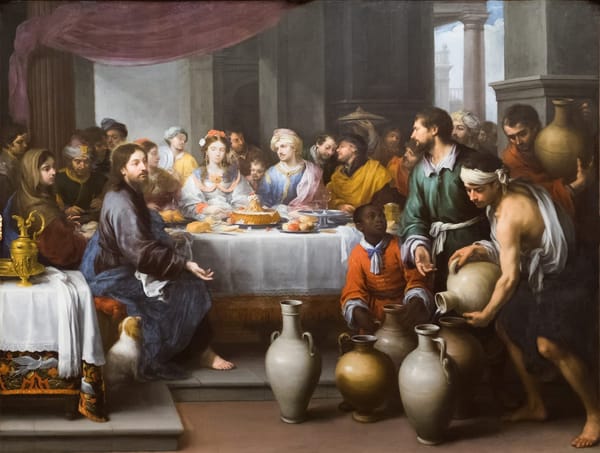
THE third Mystery of the Epiphany shows us the completion of the merciful designs of God upon the world, at the same time that it manifests to us, for the third time, the glory of our Lord and Saviour, Jesus Christ. The star has led the soul to faith; the sanctified Waters of the Jordan have conferred purity upon her; the Marriage-Feast unites her to her God. We have been considering, during this Octave, the Bridegroom revealing himself to the Spouse; we have heard him calling her to come to him from the heights of Libanus; and now, after having enlightened and purified her, he invites her to the heavenly feast, where she is to receive the Wine of his divine love.
A Feast is prepared;1 it is a Marriage-Feast; and the Mother of Jesus is present at it, for it is just that, having co-operated in the mystery of the Incarnation of the Word, she should take part in all that her Son does, and in all the favours he bestows on his elect. But, in the midst of the Feast, the Wine fails. Wine is the symbol of Charity or Love, and Charity had failed on the earth; for the Gentiles had never tasted its sweetness; and as to the Synagogue, what had it produced but wild grapes?2 The True Vine is our Jesus, and he calls himself by that name.3 He alone could give that Wine which gladdeneth the heart of man;4 he alone could give us that Chalice which inebriateth,5 and of which the Royal Psalmist prophesied.
Mary said to Jesus: They have no Wine. It is the office of the Mother of God to tell him of the wants of men, for she is also their Mother. But Jesus answers her in words which are apparently harsh: Woman! what is it to me and to thee? My hour is not yet come. The meaning of these words is, that, in this great Mystery, he was about to act, not as the Son of Mary, but as the Son of God. Later on, the hour will come when, dying upon the Cross, he will do a work, in the presence of his Mother, and he will do it as Man, that is, according to that human nature which he has received from her. Mary at once understands the words of her Son, and she says to the waiters of the Feast, what she is now ever saying to her children: Do whatsoever he shall say to you.
Now, there were six large waterpots of stone there, and they were empty. The world was then in its Sixth Age, as St Augustine and other Holy Doctors tell us. During these six ages, the earth had been awaiting its Saviour, who was to instruct and redeem it. Jesus commands these waterpots to be filled with water; and yet water does not suit the Feast of the Spouse. The figures and the prophecies of the ancient world were this water, and until the opening of the Seventh Age, when Christ, who is the Vine, was to be given to the world, no man had contracted an alliance with the Divine Word.
But, when the Emmanuel came, he had but to say, Now draw out, and the waterpots were seen to be filled with the wine of the New Covenant, the Wine which had been kept to the end. When he assumed our human nature—a nature weak and unstable as water—he effected a change in it; he raised it up even to himself, by making us partakers of the divine nature;6 he gave us the power to love him, to be united to him, to form that one Body, of which he is the Head, that Church of which he is the Spouse, and which he loved from all eternity, and with such tender love, that he came down from heaven to celebrate his nuptials with her.
St Matthew, the Evangelist of the Humanity of our Lord, has received from the Holy Ghost the commission to announce to us the Mystery of Faith by the star; St Luke, the Evangelist of Jesus' Priesthood, has been selected, by the same Holy Spirit, to instruct us in the Mystery of the Baptism in the Jordan; but the Mystery of the Marriage-Feast was to be revealed to us by the Evangelist John, the Beloved Disciple. He suggests to the Church the object of this third Mystery, by this expression: This beginning of miracles did Jesus in Cana of Galilee, and he manifested his glory.7 At Bethlehem, the Gold of the Magi expressed the Divinity of the Babe; at the Jordan, the descent of the Holy Ghost and the voice of the Eternal Father proclaimed Jesus (known to the people as a carpenter of Nazareth) to be the Son of God; at Cana, it is Jesus himself that acts, and he acts as God, for, says St Augustine, he who changed the water into wine in the waterpots could be no other than the same who, every year, works the same miracle in the vine. Hence it was that, from that day, as St John tells us, his disciples believed in him,8 and the Apostolic College began to be formed.
Mass
The Introit proclaims the joy of this day, which shows us human nature espoused to the Son of the eternal Father. Surely the earth will henceforth surrender itself wholly to the love and praise of this sacred Name which, in the Marriage Feast, has become that of the Sons of Adam.
Introit
This name of Sons of God which has become ours by right through the bond of the sacred nuptials is none other, as Jesus himself tells us in his Beatitudes, than Peace—the Peace of God, ours truly through the action of his grace ever working it out within us. In the Collect Peace again figures as the final end of God's government both in heaven and on earth, likewise as the supreme desire of the Church.
Collect
Commemoration is made, by their proper Collects, of the Saint whose feast may occur with this Sunday; the third prayer will be that of the Blessed Virgin.
Commemoration of the Blessed Virgin Mary
Epistle
Cap. XII.Fratres: Habentes donationes secundum gratiam, quæ data est nobis, differentes: sive prophetiam secundum rationem fidei, sive ministeriura in ministrando, sive qui docet in doctrina, qui exhortatur in exhortando, qui tribuit in simplicitate, qui præest in sollicitudine, qui miseretur in hilaritate. Dilectio sine simulatione. Odientes malum, adhærentes bono: Caritate fraternitatis invicem diligentes: Honore invicem prævenientes: Sollicitudine non pigri: Spiritu ferventes: Domino servientes: Spe gaudentes: In tribulatione patientes: Orationi instantes: necessitatibus sanctorum communicantes: Hospitalitatem sectantes. Benedicite persequentibus vos: benedicite et nolite maledicere. Gaudere cum gaudentibus, flere cum flentibus: idipsum invicem sentientes: non alta sapientes, sed humilibus consentientes.
Ch. XII.Brethren: Having different gifts, according to the grace that is given us, either prophecy, to be used according to the rule of faith: or ministry, in ministering; or he that teacheth, in doctrine; he that exhorteth in exhorting; he that giveth with simplicity; he that ruleth with carefulness; he that sheweth mercy with cheerfulness. Let love be without dissimulation. Hating that which is evil, cleaving to that which is good. Loving one another with the charity of brotherhood: with honour preventing one another. In carefulness not slothful, in spirit fervent: serving the Lord: rejoicing in hope: patient in tribulation: instant in prayer: communicating to the necessities of the saints: pursuing hospitality. Bless them that persecute you: bless and curse not. Rejoice with them that rejoice, weep with them that weep. Being of one mind one towards another, not minding high things, but consenting to the humble.
This peace which characterizes, in the abode of saints, the Sons of God, effects in like measure on earth the oneness of the Bride, that is of the Church: peace it is that makes her to be but one body wherein the many members find their multiplicity upheld and guided by the head, the one lord; their functions, so diverse in themselves, regulated and brought under the rule and love of the Bridegroom, Christ Jesus. The Epistle which has just been read sets before us the different operations of this peace which has as its ruling motive Charity, the Queen of virtues, and which is so essential to Christianity; the Apostle specifies in detail its forms and conditions and adapts its practice to every social condition and circumstance of life. Of such value does the Church judge these considerations, that, on the following Sunday, she resumes the text of the Apostle where today she has interrupted it.
Far from a divine life in the peace of God which was its precious gift, the human race incurred death with its penalty of separation. Let us then in the Gradual sing of this wonder that has been wrought in our midst, and with the angelic choirs exalt the Lord in praise and admiration.
Gradual
Gospel
Cap. II.In illo tempore: Nuptiæ factæ sunt in Cana Galilææ, et erat Mater Jesu ibi. Vocatus est autem et Jesus et discipuli ejus ad nuptias. Et deficiente vino, dicit Mater Jesu ad eum: Vinum non habent. Et dicit ei Jesus: Quid mihi et tibi est, mulier? nondum venit hora mea. Dicit Mater ejus ministris: Quodcumque dixerit vobis, facite. Erant autem ibi lapideæ hydriæ sex, positæ secundum purificationem Judæorum, capientes singulæ metretas binas vel ternas. Dicit eis Jesus: Implete hydrias aqua. Et impleverunt eas usque ad summum. Et dicit eis Jesus: Haurite nunc, et ferte architriclino. Et tulerunt. Ut autem gustavit architriclinus aquam vinum factam, et non sciebat unde esset, ministri autem sciebant qui hauserant aquam; vocat sponsum architriclinus, et dicit ei: Omnis homo primum bonum vinum ponit, et cum inebriati fuerint, tunc id quod deterius est; tu autem servasti bonum vinum usque adhuc. Hoc fecit initium signorum Jesus in Cana Galilææ, et manifestavit gloriam suam, et crediderunt in eum discipuli ejus.
Ch. II.At that time, there was a marriage in Cana of Galilee; and the Mother of Jesus was there. And Jesus also was invited, and his disciples to the marriage. And the wine failing, the Mother of Jesus saith to him, They have no wine. And Jesus saith to her, Woman, what is it to me and to thee? my hour is not yet come. His Mother saith to the waiters, Whatsoever he shall say to you, do ye. Now there were set there six waterpots of stone; according to the manner of the purifying of the Jews, containing two or three measures apiece. Jesus saith to them, Fill the waterpots with water. And they filled them up to the brim. And Jesus saith to them, Draw out now, and carry to the chief steward of the feast: and they carried it. And when the chief steward had tasted the water made wine, and knew not whence it was, but the waiters knew who had drawn the water; the chief steward calleth the bridegroom, and saith to him, Every man at first setteth forth good wine, and when men have well drunk, then that which is worse: but thou hast kept the good wine until now. This beginning of miracles did Jesus in Cana of Galilee, and manifested his glory, and his disciples believed in him.
O the wonderful dignity of man! God has vouchsafed, says the Apostle, to show the riches of his glory on the vessels of mercy, which had no claim to, nay, were unworthy of such an honour. Jesus bids the waiters fill them with water and the water of Baptism purifies us; but, not satisfied with this, he fills these vessels, even to the brim, with that heavenly and new Wine, which was not to be drunk save in the kingdom of his Father.9 Thus, divine Charity, which dwells in the Sacrament of Love, is communicated to us; and that we might not be unworthy of the espousals with himself, to which he called us, he raises us up even to himself. Let us, therefore, prepare our souls for this wonderful union, and, according to the advice of the Apostle, let us labour to present them to our Jesus with such purity as to resemble that chaste Virgin, who was presented to the spotless Lamb.10
During the Offertory, the Church resumes her songs of joy and gives free course to her holy transports. All faithful souls are invited by her to the celebration of this adorable Mystery, the intimate union of man with God.
Offertory
Secret
After the Secret of the Saint who is being commemorated today, that of the Blessed Virgin is said.
Commemoration of the Blessed Virgin Mary
The Communion Antiphon recalls once more the miracle of the changing of the water into wine. This was only a dim figure of that wondrous transformation which is accomplished on our altars, only a symbol of that divine Sacrament, the food of our souls whereby, in an unspeakable way, is realized our union with God.
Communion
Postcommunion
Commemoration of the Blessed Virgin Mary
Vespers
The Psalms, Capitulum, Hymn and Verse are given on pages 88-97.
Antiphon of the Magnificat
January 17: St. Antony, Abbot
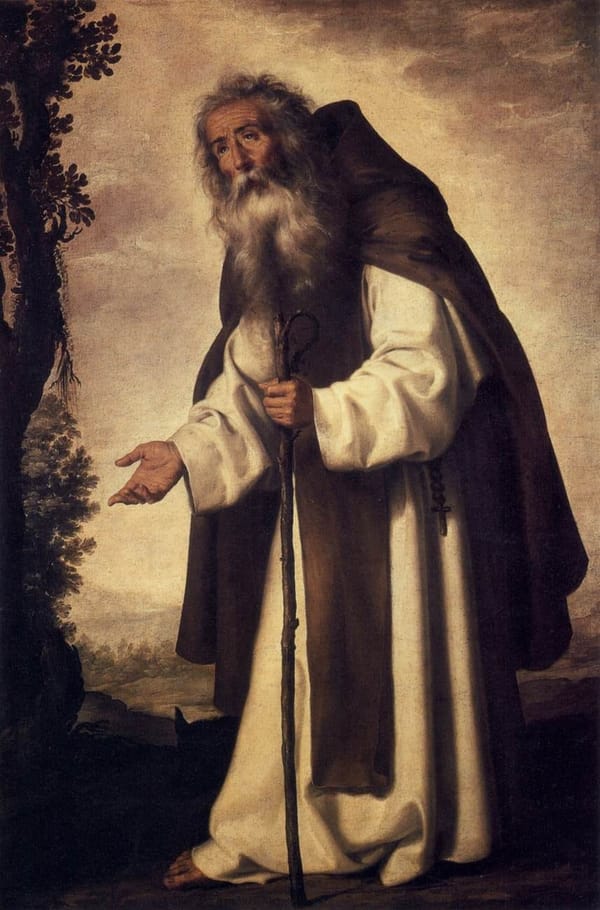 |
THE East and West unite, to-day, in honouring St Antony, the Father of Cenobites. The Monastic Life existed before his time, as we know from indisputable testimony; but he was the first Abbot, because he was the first to bring Monks under the permanent government of one Superior or Father.
Antony began with seeking solely his own sanctification; he was known only as the wonderful Solitary against whom the wicked spirits waged an almost continuous battle: but in course of time, men were attracted to him by his miracles and by the desire of their own perfection; this gave him disciples; he permitted them to cluster round his cell; and monasteries thus began to be built in the desert. The age of the Martyrs was near its close; the persecution under Diocletian, which was to be the last, was over as Antony entered on the second half of his course: and God chose this time for organizing a new force in the Church. The Monastic Life was brought to bear upon the Christian world; the Ascetics, as they were called, not even such of them as were consecrated, were not a sufficient element of power. Monasteries were built in every direction, in solitudes and in the very cities; and the Faithful had but to look at these communities living in the fervent and literal fulfilment of the Counnsels of Christ, and they felt themselves encouraged to obey the Precepts. The apostolic traditions of continual prayer and penance were perpetuated by the monastic system; it secured the study of the Sacred Scriptures and Theology; and the Church herself would soon receive from these arsenals of intellect and piety her bravest defenders, her holiest Prelates, and her most zealous Apostles. Yes, the Monastic Life was to be and give all this to the Christian world, for the example of St Antony had given her a bias to usefulness. If there ever were a monk to whom the charms of solitude and the sweetness of contemplation were dear, it was our Saint; and yet they could not keep him in his desert when he could save souls by a few days spent in a noisy city. Thus, we find him in the streets of Alexandria when the pagan persecution was at its height; he came to encourage the Christians in their martyrdom. Later on, when that still fiercer foe of Arianism was seducing the Faith of the people, we again meet the great Abbot in the same capital, this time preaching to its inhabitants that the Word is consubstantial with the Father, proclaiming the Nicene faith, and keeping up the Catholics in orthodoxy and resolution. There is another incident in the life of St Antony which tells in the same direction, inasmuch as it shows how an intense interest in the Church must ever be where the Monastic Spirit is. We are alluding to our Saint's affection for the great St Athanasius, who on his part reverenced the Patriarch of the Desert, visited him, promoted the Monastic Life to the utmost of his power, used to say that he considered the great hope of the Church to be in the good discipline of monasticism, and wrote the Life of his dear St Antony.
But to whom is the glory of the institution of monasticism due, with which the destinies of the Church were, from that time forward, to be so closely connected, that the period of her glory and power was to be when the monastic element flourished, and the days of her affliction were to be those of its decay? Who was it that put into the heart of Antony and his disciples the love of that poor and unknown, yet ever productive life? It is Jesus, the humble Babe of Bethlehem. To him, then, wrapt in his swaddling-clothes, and yet the omnipotent God, be all the glory!
It is time to hear the account of some of the virtues and actions of the great St Antony, given by the Church in her Office of his Feast.
The Churches of the West, during the Middle Ages, have left us several Sequences in honour of St Antony. They are to be found in the ancient Missals. As they are not by any means remarkable as liturgical pieces, we shall content ourselves with inserting only one, omitting the three which begin Alme Confessor; In hac die lætabunda; Antonins hnmilis.
Sequence
Et devotis celebremus
Laudibus Antonium.
Et in suis honoretur
Sanctis, auctor omnium.
Opes ejus et honorem:
Parens Evangelio.
Ut non currat in incertum
In hoc vitæ stadio.
Clarus fulsit eremita.
Sed mox hostis subdoli
Gravi pugna: verum non vincitur
Insultu diaboli.
Et a sævis laceratur
Immane dæmonibus.
Et clara personuit
Dei vox de nubibus.
Decertasti: regione
Omni nominaberis:
Pro pellendis item morbis
Ignis, invocaberis.
Conspicamur, et repletum
Mundum tuo nomine.
Tibi pia defert vota
Pro tuo munimine.
Mulieris: pretiosæ
Nunc in massæ specie,
Sed, qui tanta, vafer, audes,
Succumbis in acie.
Sunt inanes: illi soli
Cedit orcus ingemens,
Et robustam ejus manum
Horret hostis infremens.
Fultus, inimico tali
Hic athleta restitit.
Illi fuit: his protectus
Armis, victor exstitit.
Palmæ frondes et amictus,
Ac cum bestiis conflictus,
Intra solitudinem.
Operandi crebritate,
Atque somni parcitate
Restinxit libidinem.
Et philosophis profanis,
Paulum visit, nec inanis
Fit via, nec irrita.
Inde sanctam ejus mentem
Cœlos vidit ascendentem,
Carne terræ reddita.
Nunc in regno claritatis
Gloriaris; hie gravatis
Mole camis, pietatis
Tuæ pande viscera.
Mors gehennæ, manum tende.
Nos a morbido defende
Igne, nobis et impende
Gloriam post funera.
the praises of Antony,
and celebrate his name in sacred hymns.
and God, the author of all,
be honoured in his Saints!
the beauty, and riches,
and honours of the world.
that he might not run with uncertainty
in the race of this life.
He was a celebrated hermit.
But soon does the crafty enemy
The combat is fierce and oft renewed;
but he is not vanquished by the devil's attacks.
and his flesh is cruelly torn
by the angry enemy.
and the sweet voice of God was heard
speaking from above:
thy name shall be published
in every country.
Thou shalt be invoked
against the disease of Fire.'
and the world resounds
with thy name.
and fervently pray to thee
for help and protection.
and sometimes under the form
of a piece of gold,
but after all thy daring, O crafty tempter!
thou art defeated in the fight.
and all hell falls back bemoaning
that one man single-handed has repelled them.
before this venerable soldier,
whose hand so roughly deals its blows.
and yet he wears no breast-plate
such as soldiers use.
these were his arms,
and by these he conquered.
the palm-leaf gave him raiment;
and his companions were the wild beasts
of the wilderness.
by assiduous prayer,
frequent manual labour,
and short sleep.
and the profane Philosophers;
he visited Paul the Hermit,
nor was the journey fruitless or vain;
and then saw his holy soul
mounting up to heaven,
and buried his body.
with the Blessed, in the kingdom of light;
show thy affectionate pity on us,
who are here weighed down
by the burden of the flesh.
lest the terrible death of hell seize upon us.
Defend us from the burning distemper,
and assist us to gain heaven
when our life is spent.
The Greek Church is enthusiastic in her praises of St Antony. We extract the following stanzas from her Menæa.
Die XVII Januarii
We unite, great Saint! with the universal Church in offering thee the homage of our affectionate veneration, and in praising our Emmanuel for the gifts he bestowed upon thee. How sublime a life was thine, and how rich in fruit were thy works! Verily thou art the Father of a great people, and one of the most powerful auxiliaries of the Church of God. We beseech thee, therefore, pray for the Monastic Order, that it may reappear in all its ancient fervour; and pray for each member of the great Family. Fevers of the body have been often allayed by thy intercession, and we beg for a continuance of this thy compassionate aid; but the fevers of our soul are more dangerous, and we beg thy pity and prayers that we may be delivered from them. Watch over us in the temptations which the enemy is unceasingly putting in our way; pray for us, that we may be viligant in the combat, prudent in avoiding dangerous occasions, courageous in the trial, and humble in our victory. The angel of darkness appeared to thee in a visible shape; but he hides himself and his plots from us; here again we beg thy prayers that we be not deceived by his craft. May the fear of God's judgements, and the thought of eternity, penetrate into the depth of our souls. May prayer be our refuge in every necessity, and penance our safeguard against sin. But above all, pray that we may have that which thou didst counsel—the Love of Jesus; of that Jesus who, for love of us, deigned to be born into this world, that so he might merit for us the graces wherewith we might triumph—of that Jesus who humbled himself even so far as to suffer temptation, that so he might show us how we were to resist and fight.
| Previous January 16: St. Marcellus, Pope and Martyr | Next January 17: St. Antony, Abbot |