Daily reading
Simple · February 3 · Sanctoral
February 3, 2021
From Dom Guéranger’s The Liturgical Year.
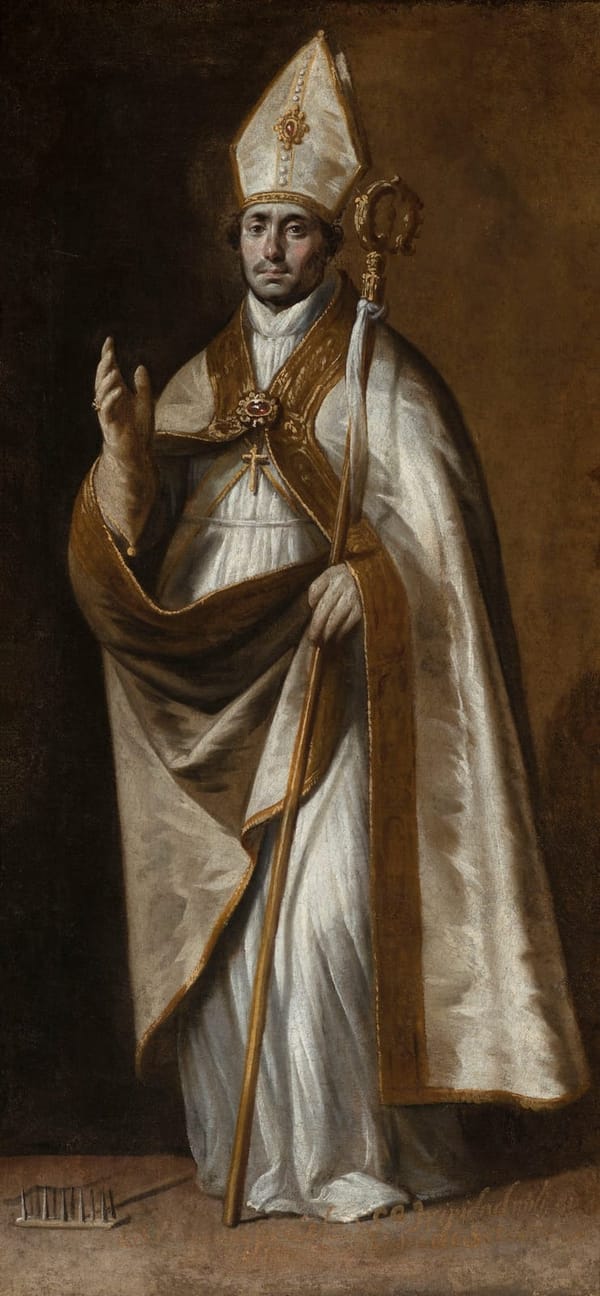
February 3: St. Blaise, Bishop and Martyr
Now that the Church has closed the joyous period of her forty days of Christmas, and is putting us through a course of meditations on subjects which are to excite a spirit of penance within us, each of the saints’ feasts must produce an impression, which shall be in accordance with that spirit. From this day till Easter, we will study the saints, as they come to us, in this special light: how much they laboured and suffered during their pilgrimage of life, and what was the plan they took for conquering the world and the flesh. ‘They went,’ says the psalmist, ‘and wept, casting their seeds: but coming they shall come with joyfulness, carrying their sheaves.’* It shall be the same with us; and at the end of our lenten labours, our risen Jesus will hail us as His living, regenerated children.
The calendar of this portion of the year abounds with martyrs; and, at the very outset, we meet with one of the most celebrated of these glorious champions of Christ. The scene of his pastoral virtues and of his martyrdom was Sebaste, a city of Armenia, the same that will give us forty martyred soldiers on a single day. The devotion to St. Blase is, even to this day, most fervently kept up in the east, especially in Armenia. The western Churches Boon began to love and honour his memory, and so universally, that we might call him one of the most popular of our saints. His feast, however, with us is only a simple, and the Church of Rome has given only one lesson on his life.
Accept, O glorious martyr, the praise which we, too, offer thee in union with that given thee by the whole Church. In return for this homage of our veneration, look down upon the Christian people, who are now preparing to enter on the season of penance, and to be converted to the Lord their God by holy compunction and tears. We ask it of thee by thine own combat: assist us in the one for which we are preparing. When duty required thee to undergo tortures and death, it found thee ready and brave; our duty is expiation by penance, and thy prayers must get us courage. Our enemies are not more cruel than thine, but they are more treacherous, and if we spare them we are lost. Obtain for us that heavenly assistance, which enabled thee to conquer. We are children of the martyrs; God forbid we should be degenerate! Pray, too, O holy pontiff, for the country thou didst water with thy blood. Armenia lost the faith for which thou didst lay down thy life. Intercede for her, that she may be restored to the Church, and let her conversion bring consolation to the few that have remained orthodox and faithful.
* Ps. cxxv. 6, 7. ↩︎
Wednesday of Septuagesima Week
Wednesday of Septuagesima Week
The guilty pair appear before the great God, whom they have offended; and instead of acknowledging their guilt, they seek to palliate and excuse it. But divine justice pronounces their condemnation, and the sentence will be felt by their posterity, even to the last generation. The two beings, that had committed the heinous crime, had been enriched with every gift of nature and grace. It was not with them, as it is with us. Concupiscence which gives us an inclination for what is wrong; ignorance and forgetfulness which cloud the intellect of fallen man, these miseries had nothing whatever to do with the fall of our first parents. They sinned through sheer ingratitude. They began by weighing the proposal of revolt, when they ought to have spurned it with indignation and conquered by flight. Then, by degrees, the proposed crime seemed no great harm, because, though God would lose their obedience, they would gain by the disobedience! And at length, the love of God was made to give place to the love of self, and they declared their independence! Yet God had mercy on them, because of their posterity.
The angels were all created at one and the same instant, and each of them was subjected to the trial, which was to decide his eternal future. Each angel depended on his own act, on his own choice between fidelity to his Creator and rebellion against Him; so that they who rebelled drew on themselves the eternity of God’s chastisement. The human race, on the contrary, existed not save as represented in its two first parents, and was plunged by and with them into the abyss of God’s reprobation: therefore, God, who spared not the angels, mercifully spared the human race.
But let us listen to the three sentences pronounced by God after the fall of man. The first is against the serpent, and is the severest. The curse, which is already upon him, is deepened, and the pardon, which is about to be promised to the human race, is to be given in the form of an anathema against that wicked spirit, that has dared to war with God in the work of His hands.
'I will put enmities between thee and the woman; she shall crush thy head.’1 Thus does God avenge Himself on His enemy. The victory won over the woman is made to turn against the proud conqueror, and become his humiliation and his defeat. In his fiendish craft, he had directed his first attack, not against the man, but against the woman. She, by nature, was weaker and more credulous; and if he conquered her, he hoped—too well, alas!—that Adam would be led to turn against his Creator, in order not to displease the creature. All happened as he willed it: but now, see how God uses the woman to foil and punish him. He enkindles in her heart an implacable hatred against His and our enemy. This cruel serpent may raise his proud head, and, here and there, find men that will adore him: the day will come, when a woman’s foot shall crush this head, which refused to bend before God. This daughter of Eve, whom all generations are to call blessed,2 shall be prefigured by other women: by Debbora, Judith, Esther, and others, all celebrated for their victories over the serpent. She shall be followed, until the end of time, by an uninterrupted succession of Christian virgins and matrons, who, with all their weakness, shall be powerful in co-operating with God’s designs, and, as the apostle says, ‘the unbelieving husband shall be sanctified by the believing wife.’3
Thus will God punish the serpent’s pride. Before pronouncing upon our first parents the sentence they have deserved, He promises to bless their posterity, and pours into their own hearts a ray of hope.
In Dominica Tyrophagi.
| Previous Tuesday of Septuagesima Week | Next Wednesday of Septuagesima Week |