lyp.network

Daily reading

Septuagesima

Double · February 4 · Sanctoral

February 4, 2021

From Dom Guéranger’s The Liturgical Year.

A Double leads the weekday.Rubric
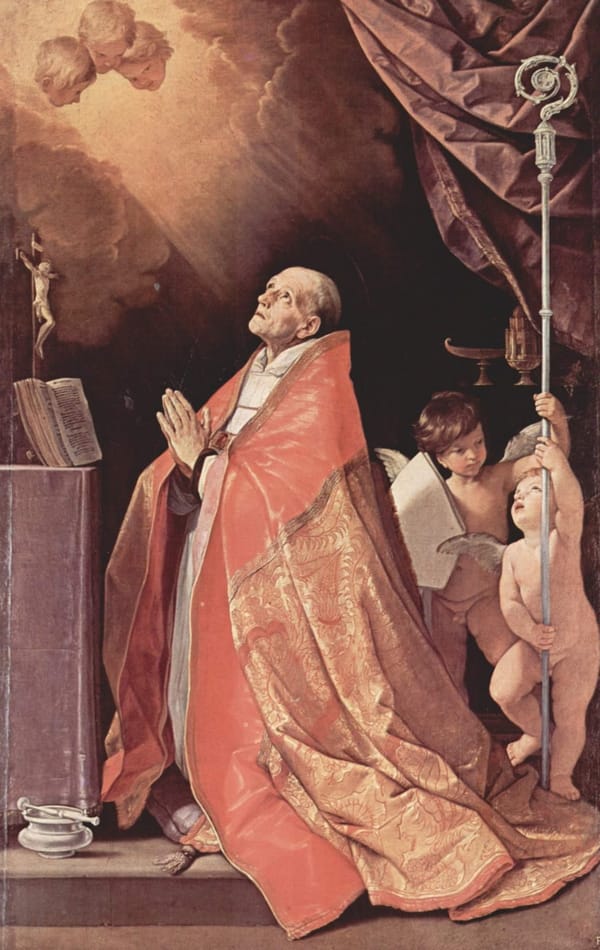
Bishop saint in coral cope praying; putti with crozier and book
St Andrew Corsini in Prayer, Guido Reni (1575–1642), 1630–1635. Credits

February 4: St. Andrew Corsini, Bishop and Confessor

The saintly bishop, whose feast we keep to-day pressingly invites us, by his austere life and his burning zeal for the salvation of souls, to procure, at all costs, our own reconciliation with the divine justice. We are indebted for this feast to a member of the illustrious family of the Corsini, Pope Clement XII., who, however, was but the instrument used by divine Providence. The holy bishop of the little town of Fiesole ever sought to be unknown during his life, and God, who willed that he should be glorified by the whole Church, inspired the sovereign Pontiff to inscribe his name among the saints of the universal calendar. Andrew the saint was once a sinner; his example will encourage us in the work of our conversion.

Let us read the account of his virtues as given us by the Church.

Andream Florentiæ ex nobili Corsinorum familia natura parentes precibus a Deo impetrarunt, et beatæ Virgini spoponderunt. Qualis autem futurus esset, divino præsagio, antequam nasceretur, ostensum est: nam mater gravida sibi visa est per quietem lupum edidisse, qui, ad Carmelitarum ædem pergens, in ipso templi vestibuio statim in agnum conversus est. Adolescens pie et ingenue educatus, cura sensim ad vitia declinaret, sæpe a matre increpatus fuit. Ubi autem cognovit, se parentum voto Deiparæ Virgini dicatum fuisse, Dei amore succensus, deque visu matris admonitus, Carmelitarum institutum amplexus est, in quo variis tentationibus a dæmone vexatus, numquam tamen potuit a religionis proposito dimoveri. Mox Lutetiam missus, emenso studiorum curriculo, et laurea donatus in patriam revocatur, suique Ordinis regimini in Etruria præficitur.
Interea Fesulana Ecclesia suo viduata pastore eum sibi episcopum elegit: quo munere se indignum oestimans, diu latuit iguotus, donec pueri voce mirabiliter loquentis proditus, et extra urbem inventus, ne divinæ contradiceret voluntati episcopatum suscepit. Ea dignitate auctus, humilitate, quam semper coluerat, impensius incubuit et pastorali solicitudini, misericordiam in pauperes, liberalitatem, orationis assiduitatem, vigilias, aliasque virtutes adjunxit, et spiritu etiam prophetico clarus fuit, adeo ut ejus sanctitas ab omnibus celebraretur.
His permotus Urbanus quintus ad sedandas Bononiæ turbas Andream legatum misit: quo in munere multa perpessus, civium odia, quæ ad internecionem exarserant, summa prudentia restinxit; tum restituta tranquillitate ad propria reversus est. Nec multo post assiduis laboribus, et voluntaria carnis maceratione confectus, obitus die a beata Virgine sibi prædicto, ad cœlestia regna migravit, anno Domini millesimo trecentesimo septuagesimo tertio, ætatis suæ septuagesimoprimo. Quem Urbanus octavus multis magnisque miraculis clarum, sanctorum numero adscripsit. Ejus corpus Fiorentiæ in ecclesia sui Ordinis quiescit, et maxima civium veneratione colitur: quibus non semel in præsenti discrimine præsidio fuit.
Andrew was born at Florence, of the noble Corsini family. He was the fruit of his parents’ prayers, and was consecrated by them to the blessed Virgin. His future was thus shown by God to the mother. She dreamt that she had given birth to a wolf, which went to the church of the Carmelites, and, as it crossed the threshold, was suddenly changed into a lamb. Though his early education was calculated to form him to piety, and to everything that suited his high birth, he, by degrees, fell into a vicious manner of life, notwithstanding the frequent reproaches made him by his mother. But as soon as he was told that he had been consecrated by his parents to the Virgin Mother of God, and heard of his mother’s vision, he entered the Order of Carmelites. The devil ceased not to molest him, even then, with manifold temptations; but nothing could make him change his resolution of entering the religious life. Shortly after his profession, he was sent to Paris for a course of study; having completed it, and taken his degrees, he returned to Italy, and was made superior of his Order in the province of Tuscany.
It happened about that time, that the Church of Fiesole lost its bishop, and Andrew was chosen as his successor. But looking on himself as unworthy of such a dignity, he hid himself so that no one knew where he was. But a child, who had not yet received the use of speech, miraculously revealed the place, outside the town, where he was: upon which the saint, fearing that further refusal would be a resistance to the divine will, was consecrated bishop. Thus exalted to so great a dignity, he applied himself more than ever to the practice of humility, which had always been his favourite virtue. To the zeal of a good pastor, he united tender compassion for the poor, abundant almsgiving, a life of prayer, long watchings, and other virtues; all which, together with the gift of prophecy he had received, gained for him a great reputation for sanctity.
Pope Urban V., hearing of his great merits, sent him as his legate to Bologna, that he might quell a sedition that had arisen in that city. The fulfilment of this charge cost him much suffering; but such was his prudence, that he succeeded in restoring peace among the citizens, and so preventing further bloodshed; he then returned to Fiesole. Not long after this, being worn out by ceaseless labours and bodily mortifications, and having been told by the blessed Virgin of the precise day of his death, he passed from this life to the kingdom of heaven, in the year of our Lord thirteen hundred and seventy three, and in the seventy-first year of his age. Great was the reputation of his name on account of the many and wonderful miracles wrought through his intercession, and at length he was canonized by Urban VIII. His body reposes in the church of his Order at Florence, where it is held in great veneration, the citizens having often experienced his protection in times of public calamity.

Hear, O holy pontiff, our prayer: we are sinners, and would learn from thee how we are to return to the God we have offended. His mercy was poured out upon thee; obtain the same for us. Have pity on Christians throughout the world, for the grace of repentance is now being offered to all; pray for us, that we may be filled with the spirit of compunction. We have sinned; we sue for pardon; intercession like thine can win it for us. From wolves, change us into lambs. Strengthen us against our enemies; obtain for us an increase of the virtue of humility, which thou hadst in such perfection; and intercede for us with our Lord, that He crown our efforts with perseverance, as He did thine; that thus we may be enabled to unite with thee in singing, for ever, the praises of our Redeemer.


Thursday of Septuagesima Week

Forgiveness is promised; but atonement must be made. Divine justice must be satisfied, and future generations be taught that sin can never pass unpunished. Eve is the guiltier of the two, and her sentence follows that of the serpent. Destined by God to aid man in peopling the earth with happy and faithful children, formed by this God out of man’s own substance 'flesh of his flesh, and bone of his bones,’ woman was to be on an equality with man. But sin has subverted this order, and God’s sentence is this: conjugal union, notwithstanding the humiliation of concupiscence now brought upon it, is to be, as before, holy and sacred; but it is to be inferior in dignity, before both God and man, to the state of virginity, which disdains the ambitions of the flesh.

Secondly, woman shall be mother still, as she would have been in the state of innocence; but her honour shall be a burden. Moreover, she shall give birth to her children amidst cruel pains, and sometimes even death must be the consequence of her infant’s coming into the world. The sin of Eve shall thus be memorialized at every birth, and nature shall violently resist the first claims of him, whom sin has made her unwelcome lord.

Lastly, she who was at first created to enjoy equality of honour with man, is now to forfeit her independence. Man is to be her superior, and she must obey him. For long ages, this obedience will be no better than slavery; and this degradation shall continue till that Virgin comes, whom the world shall have expected for four thousand years, and whose humility shall crush the serpent’s head. She shall restore her sex to its rightful position, and give to Christian woman that influence of gentle persuasiveness, which is compatible with the duty imposed upon her by divine justice, and which can never be remitted: the duty of submission.

In Dominica Tyrophagi

Dominator sæculorum omnium Domine, qui me voluntate tua procreasti, dolosi draconis invidia quondam afflictum, teque, Salvator, ad iracundiam concitantem, ne despicias, Deus, sed revoca me.
Hei mihi! pro stola splendida, turpitudinis indumentis obvolutus, lugeo, Salvator, exitium meum, et fide ad te clamo; ne despidas me bone Deus, sed revoca.
Serpentium ferarumque dominus effectus, quo pacto serpenti animabus exitiali familiariter congressus es, inimico velati bono consiliario usus? O errorem tuum, miserrima anima mea!
(Canimus te, Maria, Dei gratia plena, lucidum divinæ incarnationis tabernaculum; quare me cupiditatibus fœde obtenebratum illumina, fons misericordiæ, spes eorum quos omnis spes dereliquit.)
O Lord! King of all ages! who didst create me by thy love; I have been injured by the envy of the crafty serpent, and have provoked thee, my Saviour, to anger: but despise me not, O God! Call me back to thee.
Alas! my bright robe has been changed into this garb of shame. I bewail my ruin, O Saviour, and to thee do I cry with confidence: My good God! Despise me not, but call me back to thee.
How, my soul, couldst thou, that wast made the lord of serpents and beasts, treat the soul-slaying serpent with familiarity, and use thine enemy as a trusty counsellor? Bewail, my wretched soul, thy fatal error!
(To thee do we sing, O Mary, full of divine grace! Hail bright tabernacle of the Incarnation! O fount of mercy, hope of them that are in despair, enlighten me that am dishonoured by the dark clouds of my passions.)
Previous
Wednesday of Septuagesima Week
Next
Thursday of Septuagesima Week